1. Introduction
The bird eggshells from the Tertiary of southern France have been known since the 1950s, with the first discovery in 1957 by Philippe Biro, and the first published study in 1959 by Dughi & Sirugue (Reference Dughi and Sirugue1959). During the 1960s–1970s, several studies on the stratigraphic distribution of eggshells, their ornamentation and their microstructure were conducted (Dughi & Sirugue, Reference Dughi and Sirugue1959, Reference Dughi and Sirugue1962, Reference Dughi and Sirugue1968; Fabre-Taxy & Touraine, Reference Fabre-Taxy and Touraine1960; Touraine, Reference Touraine1960, Reference Touraine1961, Reference Touraine1962, Reference Touraine1963, Reference Touraine1967, Reference Touraine1978; Martini, Reference Martini1961; Dughi, Plaziat & Sirugue, Reference Dughi, Plaziat and Sirugue1969). Since the 1970s, interest in these avian eggs has waned, with only a few contributions to the topic, including remarks on the microstructure (Penner, Reference Penner1983) and a semi-popular review paper (Kerourio & Aujard, Reference Kerourio and Aujard1987).
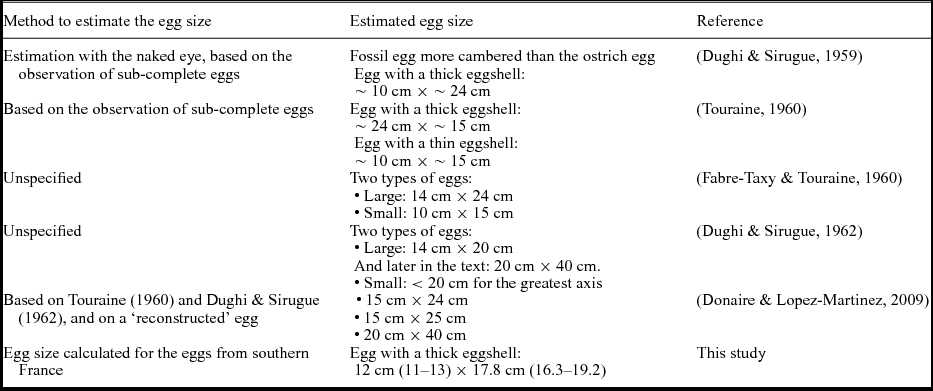
The estimation of the egg size is a significant point of interest because it may have some important consequences for the attribution of these eggshells to a specific group of Palaeogene birds. Since these eggshells have never been found in association with skeletal remains, there is still considerable uncertainty as to the type of bird that may have laid them. The first estimation of the egg size was provided by Dughi & Sirugue (Reference Dughi and Sirugue1959) in the first published study of eggshells from southern France (Table 1). These authors, however, only compared the fossil eggshell curvature with that of ostrich eggs, and concluded that the fossil eggshells are more curved than the ostrich eggshells, without applying any quantitative method. They proposed an egg size of about 24.0 cm by 10.0 cm based on an observation of an egg section with a thick eggshell. One year later, Touraine (Reference Touraine1960; Table 1) mentioned some sub-complete eggs that had been observed, and used them to estimate the size of the egg. An egg with a thick eggshell was sectioned along the major diameter, allowing an estimation of the maximal length of 24.0 cm. A second egg sectioned along the minor axis presented a circular diameter of 15.0 cm. On the other hand, the eggs of the thin-shelled type measured 15.0 cm in length and 10.0 cm in diameter. All the following authors used these estimates without further measurements or calculations (Fabre-Taxy & Touraine, Reference Fabre-Taxy and Touraine1960; Dughi & Sirugue, Reference Dughi and Sirugue1962; Kerourio & Aujard, Reference Kerourio and Aujard1987; Donaire & Lopez-Martinez, Reference Donaire and Lopez-Martinez2009; Table 1). Several problems arose, however, the first major one being a direct outcome of the publications of Dughi & Sirugue (Reference Dughi and Sirugue1959) and Touraine (Reference Touraine1960). They did not indicate the localities where they found the sub-complete eggs, and following these two succinct descriptions, no one has ever found other sub-complete eggs, but only isolated eggshell fragments. No photograph or drawing was made available to document these sub-complete eggs, and none of them has been deposited in a museum because they could not be extracted. Secondly, Dughi & Sirugue (Reference Dughi and Sirugue1962) gave some measurements of these eggs, in which they somewhat modified their original data (Dughi & Sirugue, Reference Dughi and Sirugue1959), proposing a maximal length of 20.0 cm for the large eggs, instead of 24.0 cm as proposed originally, without any explanation for the discrepancy. Furthermore, in the same paper, a length of 40.0 cm was also mentioned, which we think was probably a misprint, and therefore erroneous. The latest publication (Donaire & Lopez-Martinez, Reference Donaire and Lopez-Martinez2009) (Table 1) used all the previous measurements to estimate the mass of these eggs, and added new measurements coming from a purported sub-complete egg exhibited at a fossil show. However, the more or less ‘complete’ eggs exhibited at such shows are artificial reconstructions made by gluing isolated eggshell fragments onto a plastic form (N. Houles, pers. comm.) and should by no means be used to estimate the size of real eggs. Based on these previous studies, the fossil eggs from the Palaeogene of southern France were certainly large, but no real consensus was reached about their real size. Therefore, we propose a new quantitative estimate of the size of these eggs, which provides evidence about the identification of the bird that may have laid these eggs.
Summary of the different estimates of egg size based on the fossil eggshells from southern France, proposed in previous publications

Institutional abbreviations: MNHN – Muséum National d’Histoire Naturelle, Paris; MC – Musée des Confluences, Lyon; APSO – Association Paléontologique du Sud-Ouest; MDE – Musée des Dinosaures d’Espéraza.
2. Material and methods
2.a. Methods
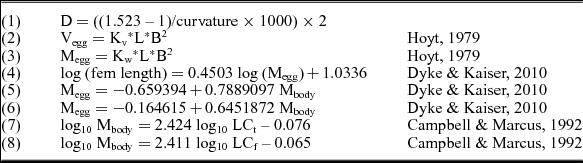
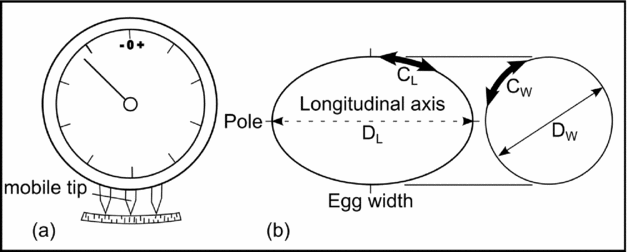
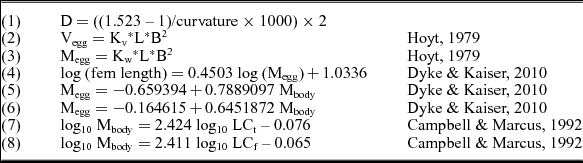
The method proposed by Williams (Reference Williams1981) was used to estimate the average egg size. This author measured the shell curvature, with a spherometer (Fig. 1a), in all spatial directions. This method allowed the acquisition of the maximal curvature (CW) and the minimal curvature (CL), corresponding, respectively, to the transversal curvature and the longitudinal curvature (Fig. 1b). The curvature measurements were obtained in diopters and converted into diameter (D) in millimetres by using Eq. (1) (Table 2):
 \begin{equation}
{\rm D} = {\rm ((1}{\rm .523 - 1)/curvature\; \times\, 1000)\, \times\, 2}\end{equation}
Equations used in this work
Explanations of the egg measurements from Williams (Reference Williams1981). (a) Measurement of the curvature of the eggshells with a spherometer; (b) egg geometry: CW is the transversal curvature, CL is the longitudinal curvature.

The greatest curvature (CW) gives the smallest diameter (DW) (Fig. 1b), which corresponds to the transversal diameter and to the egg width, if we postulate that the transversal section of the egg is circular. The smallest curvature (CL) permits the obtention of the greatest diameter (DL), which, however, does not correspond to the egg length because the egg is probably not spherical. The egg width is the point that corresponds to the highest DW and DL values. This value represents the flattest part of the eggshell in all spatial directions, which must be at the middle of the egg. Considering that the egg was circular in section, the obtained DW value corresponds to the egg width. To estimate the egg length we cannot use the same method because it is only applicable for a circular section: as the eggs were in all likelihood not spherical, we cannot consider that the longitudinal section was circular. We used the ratio 1.48 proposed by Williams (Reference Williams1981) to calculate the length (L) based on the mean width value, itself obtained on the basis of numerous egg ratios.
Using these values with Eq. (2) (Table 2), the volume of a bird egg (Vegg) can be obtained according to the work of Hoyt (Reference Hoyt1979), where Kv is a factor defined by Hoyt and equal to 0.51, L is the length and B the width, both measured in centimetres.
 \begin{equation}
{\rm V}_{{\rm egg}} = {\rm K}_{\rm v} {\rm ^{*}L^{*}B}^{\rm 2}\end{equation}
The egg mass (Megg) can be obtained using Eq. (3) (Table 2; Hoyt, Reference Hoyt1979), with Kw a factor defined by Hoyt and equal to 0.55, and L the length and B the width, both in centimetres.
 \begin{equation}
{\rm M}_{{\rm egg}} = {\rm K}_{\rm w} {\rm ^{*}L^{*}B}^{\rm 2}\end{equation}
2.b. Material
The material consists of fossil avian eggshell fragments from southern France collected during two field trips in 2011 and 2012, during which 1343 eggshell fragments were unearthed from 13 localities of late Paleocene and early Eocene age. Eggshells of two distinct average thicknesses have been observed, most of them (95%) being thick (around 2 mm in thickness), while the thin ones (around 1 mm in thickness) are very rare (5%). Only the first group (thick eggshells), named Ornitholithus arcuatus by Dughi & Sirugue (Reference Dughi and Sirugue1962), has been used in this study, because the fragments belonging to the thin group are too small to be measured with the spherometer. Among the 1343 fragments collected, only 106 are large enough in all the spatial directions to apply Williams's method. These 106 eggshell fragments come from eight different sites in southern France: Saint Antonin-sur-Bayon, Sillans-la-Cascade, Cengle indet., Suberoque, Pontevès, Rians-Les Bardouines, Vinon-sur-Verdon and Lagrasse (online Supplementary Material Table S1 available at http://journals.cambridge.org/geo). The Ornitholithus arcuatus eggshells are always stratigraphically younger than the thin eggshells (Ornitholithus biroi) and occur in the upper part of the Calcaire de Saint-Marc Formation and in overlying red marls, which are Sparnacian in age (Cojan, Moreau & Stott, Reference Cojan, Moreau and Stott2000), whereas the thin eggshells come from underlying Paleocene deposits. Dughi & Sirugue (Reference Dughi and Sirugue1962) distinguished several oospecies among the thick eggshells, on the basis of small differences in thickness, ornamentation and microstructure, but our observations are in agreement with Penner's (Reference Penner1983) and Mikhailov's (Reference Mikhailov1997) conclusions, viz. that the subdivision into several oospecies is questionable. We therefore recognize a single thick-shelled oospecies, namely Ornitholithus arcuatus.
Size and mass estimates obtained for the fossil eggshells have been compared with some values for large living ground birds, such as the Ostrich (Struthio camelus), the Greater Rhea (Rhea americana), the Emu (Dromaius novaehollandiae) and the Cassowary (Casuarius casuarius). For each group the length and the diameter have been measured for several eggs using a caliper (online Supplementary Material Table S2 at http://journals.cambridge.org/geo). These estimates have also been compared to large fossil birds for which complete eggs are known, such as the Dromornithidae (Williams, Reference Williams1981), the Aepyornithidae (Mlikovsky, Reference Mlikovsky2003) and the Dinornithiformes (Gill, Reference Gill2000, Reference Gill2006, Reference Gill2007).
3. Results: discussion
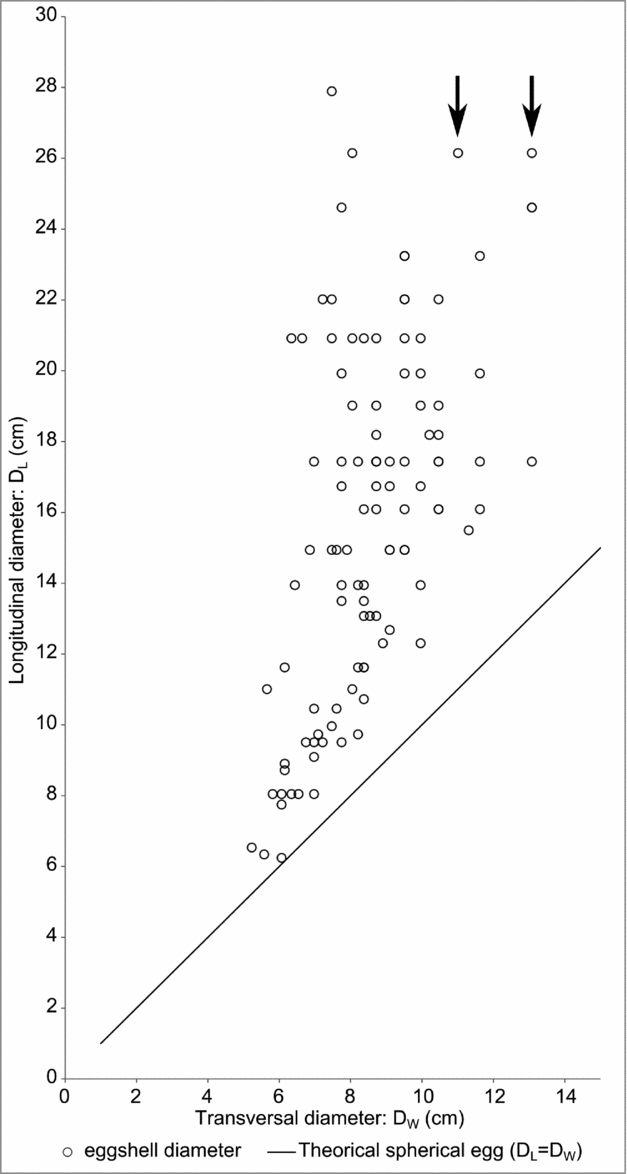
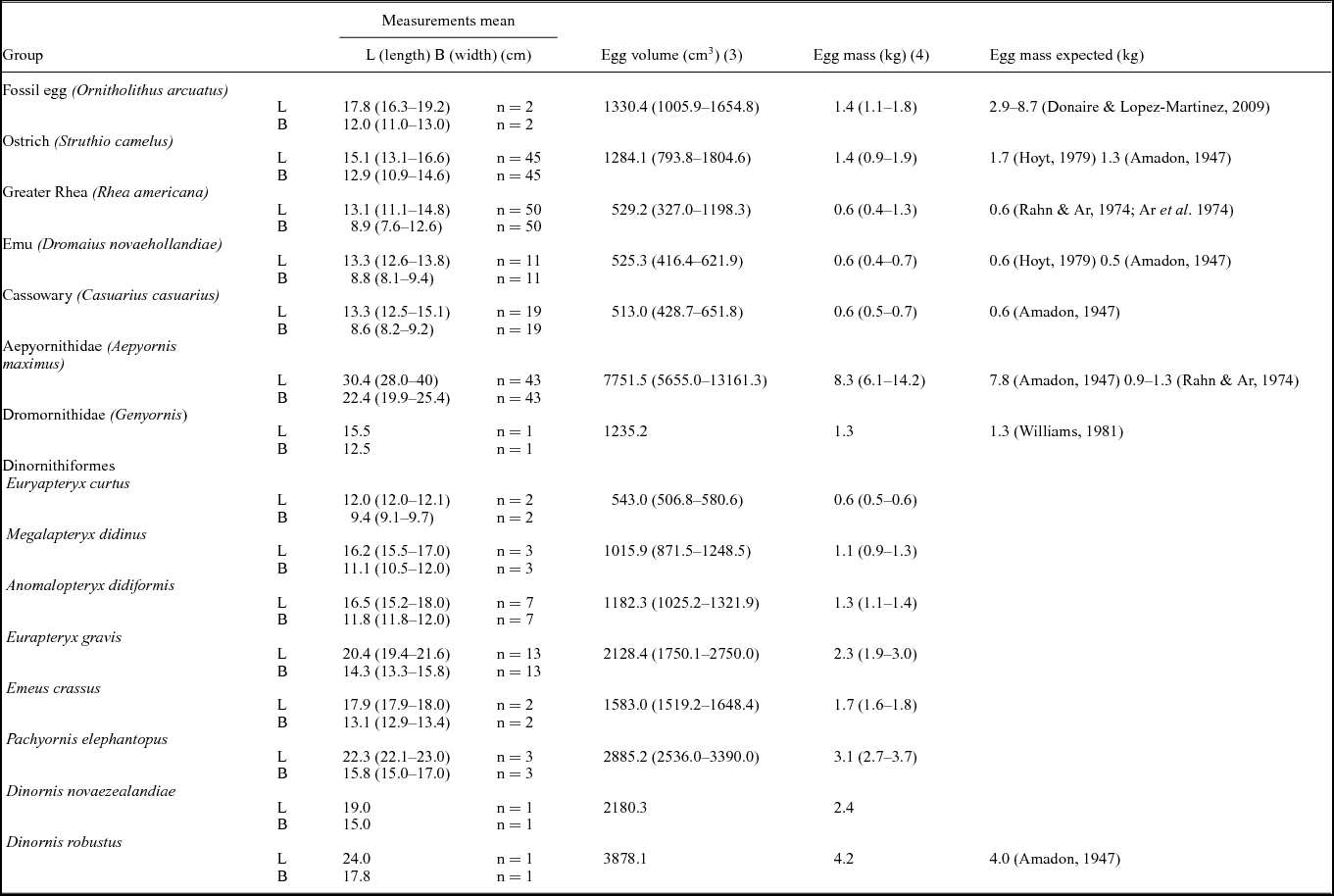
Based on these 106 eggshell fragments, we selected for size and mass calculations the two fragments (eg124 and eg515) that had the highest DW value and the highest DL value, and estimated an egg width of between 11.0 cm and 13.0 cm (Fig. 2). Using the ratio of 1.48 proposed by Williams (Reference Williams1981), the calculated egg length ranged between 16.3 cm and 19.2 cm (Table 1). These values correspond to a very large egg, which is in agreement with the thickness of the eggshells, around 2 mm.
Estimation of the egg width using Williams's graph (Reference Williams1981) representing the transversal diameter (DW) as a function of the longitudinal diameter (DL) in centimetres. The two upper-right-most values used for the estimation of the width are indicated by arrows.

3.a. Comparisons with the previous estimates for these eggs
The egg size we estimated is smaller than the sizes previously proposed with a mean width around 12.0 cm versus 14.0 cm (Fabre-Taxy & Touraine, Reference Fabre-Taxy and Touraine1960; Dughi & Sirugue, Reference Dughi and Sirugue1962) to 15.0 cm (Touraine, Reference Touraine1960; Donaire & Lopez-Martinez, Reference Donaire and Lopez-Martinez2009), and a mean length of around 17.8 cm versus 20.0 cm (Dughi & Sirugue, Reference Dughi and Sirugue1962; Donaire & Lopez-Martinez, Reference Donaire and Lopez-Martinez2009) to 25.0 cm (Dughi & Sirugue, Reference Dughi and Sirugue1959; Touraine, Reference Touraine1960; Fabre-Taxy & Touraine, Reference Fabre-Taxy and Touraine1960; Donaire & Lopez-Martinez, Reference Donaire and Lopez-Martinez2009). The new estimate of 12.0 cm for the diameter is, however, relatively close to the first value proposed by Dughi & Sirugue (Reference Dughi and Sirugue1959), which was close to 10.0 cm (Table 1). This new estimate poses the question of the validity or the repeatability of the field observations made by Touraine (Reference Touraine1960) and Dughi & Sirugue (Reference Dughi and Sirugue1959), even more so that during our two field trips, we never found any sub-complete eggs. Even finding two associated fragments is exceptional, and never permitted the direct estimation of the size of the complete egg.
3.b. Comparisons with modern and fossil large bird eggs
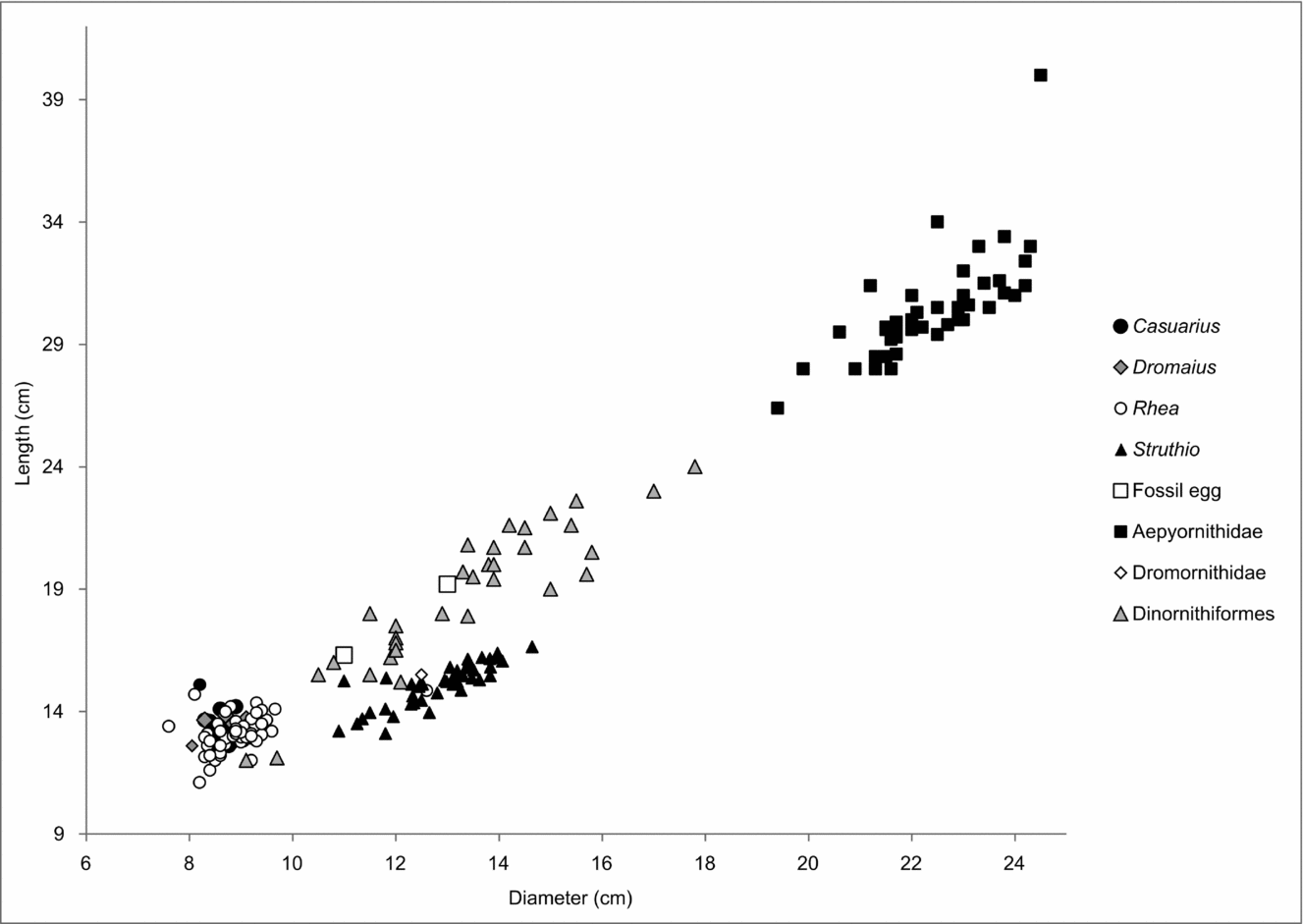
The comparison between these estimates and the eggs of living large birds shows that these fossil eggs were larger than those of the Emu, Cassowary and Greater Rhea, which are about 11.1 cm to 15.1 cm in length by 7.6 to 12.6 cm in diameter (Table 3; Fig. 3). The fossil eggs correspond to the highest part of the ostrich egg range of dimensions (maximum about 15.0 cm by 17.0 cm) or are even larger. The comparison with large fossil bird eggs, including mainly the Aepyornithidae (Aepyornis maximus), the Dromornithidae (Genyornis sp.) and the Dinornithiformes, shows that the fossil eggs studied here are larger than the Genyornis eggs, measuring 12.5 cm by 15.5 cm, and than the eggs of the smallest Dinornithiformes (Euryapteryx curtus, Megalapteryx didinus and Anomalopteryx didiformis), measuring 12.0 cm by 9.4 cm, 16.2 cm by 11.1 cm and 16.5 cm by 11.8 cm, respectively. They are, however, much smaller than the Aepyornis eggs, which measure on average 30.4 cm by 22.4 cm and than the eggs of the largest Dinornithiformes (Table 3; Fig. 3; online Supplementary Material S2 available at http://journals.cambridge.org/geo). Therefore, these fossil eggs are among the largest known fossil ones, with only the Aepyornis eggs and some of the largest dinornithiform ones being larger.
Values estimated using the different equations presented in Table 2, for living and fossil birds, and for the eggshell Ornitholithus arcuatus
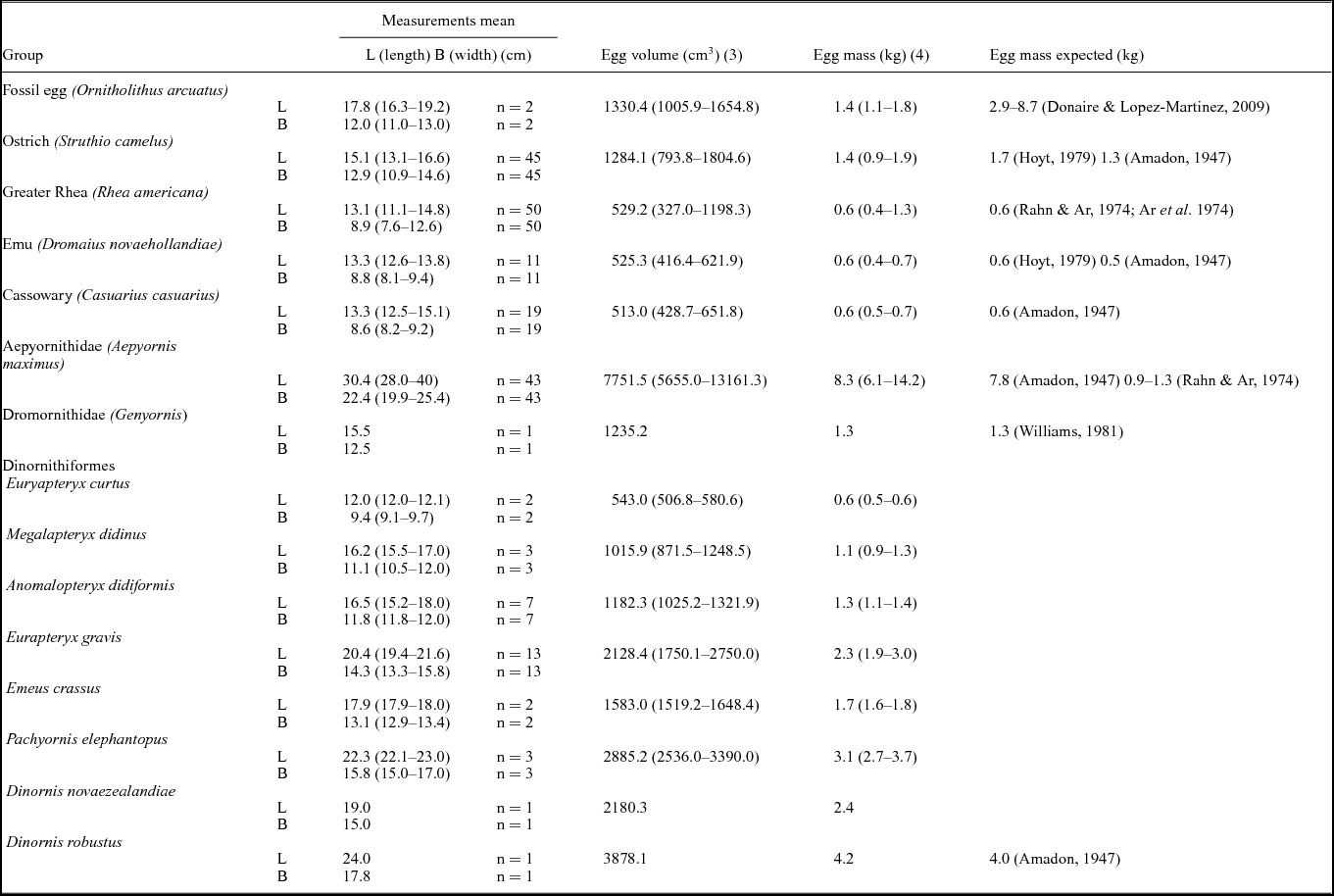
Numbers in brackets are min.–max.; n – number of measurements.
Egg size comparison between the studied fossil eggs (white square), and modern and fossil known bird eggs, using the diameter (in centimetres) as a function of the length (in centimetres).

The use of Eq. (2) (Table 2) leads to a calculated egg volume of 1330.4 cm3 for Ornitholithus arcuatus. It is close to the ostrich egg mean volume (1284.1±235.1 cm3) and significantly larger than the volume of the eggs of the other living and fossil large ground birds (Table 3), except for the largest Dinornithiformes and Aepyornis eggs with mean values of 1721.6±778.5 cm3 and 7751.5±1323.4 cm3, respectively, which are the largest known bird eggs.
3.c. Estimated mass of the egg
On the basis of both length and diameter values, we obtained a mean mass of around 1.4 kg (Table 3) for the Ornitholithus arcuatus egg according to Eq. (3) (Table 2). This value is much lower than that proposed by Donaire & Lopez-Martinez (Reference Donaire and Lopez-Martinez2009), with a weight between 2.9 kg and 8.7 kg. These differences, however, can be explained by the values for length and width used by these authors, which are largely overestimated or false.
Hoyt's method was applied to some modern birds (Struthio, Rhea, Dromaius, Casuarius), and well-studied fossil birds (Aepyornithidae, Dromornithidae, Dinornithiformes) in order to test its validity when applied to fossil eggs studied here. The comparison with these other large birds shows that the values obtained using Hoyt's equation are totally in accordance with the measured and published values, which demonstrates the robustness of this method (Table 3). The egg mass estimated for the Ornitholithus arcuatus eggshells matches the egg weight of the ostrich in the range of uncertainties (1.4±0.3 kg) (Amadon, Reference Amadon1947; Ar et al. Reference Ar, Paganelli, Reeves, Greene and Rahn1974) and is larger than that of all the other large bird eggs studied here, except Aepyornithidae (Amadon, Reference Amadon1947; Rahn & Ar, Reference Rahn and Ar1974), as well as the larger Dinornithiformes (Gill, Reference Gill2007). The egg corresponding to the eggshell named Ornitholithus arcuatus was therefore a large egg close to the ostrich egg in terms of size and mass.
Calculations based on geometrical properties of eggs show that the oospecies Ornitholithus arcuatus of Dughi & Sirugue (Reference Dughi and Sirugue1962) was a very large egg, measuring on average 12.0 cm in diameter and 17.8 cm in length. An egg with such proportions must have been laid by a very large bird. In Europe, only a few large birds are known from the Palaeogene. The ratite Remiornis had a size similar to that of a Greater Rhea and is known from two late Paleocene localities in France, Mont-de-Berru and Cernay (Martin, Reference Martin and Campbell1992). Palaeotis, also a ratite, is another relatively large bird, but smaller than Remiornis, with a size close to that of a Bustard (a little less than 1 m in height), known from the Middle Eocene of the Geiseltal and Messel in Germany (Lambrecht, Reference Lambrecht1928; Houde & Haubold, Reference Houde and Haubold1987). The only very large bird known from the Palaeogene of France is Gastornis, a probable anseriform, described from several French localities such as Meudon (Hébert, Reference Hébert1855a ,Reference Hébert b ), Cernay-les-Reims (Lemoine, Reference Lemoine1878, Reference Lemoine1881, Reference Lemoine1884) and Mont-de-Berru (Andors, Reference Andors1992; Martin, Reference Martin and Campbell1992; Buffetaut, Reference Buffetaut1997; Angst & Buffetaut, Reference Angst and Buffetaut2013). In southern France, Gastornis is known from the Early Eocene of Saint-Papoul (Buffetaut, Reference Buffetaut2008; Laurent et al. Reference Laurent, Adnet, Bourdon, Corbalan, Danilo, Duffaud, Fleury, Garcia, Godinot, Le Roux, Maisonnave, Métais, Mourer-Chauviré, Presseq, Sigé and Solé2010). The eggshells found in the Early Tertiary basins of southern France may therefore be referred to Gastornis on the basis of the very large size of the reconstructed egg and of the considerable mass of the birds which laid these eggs.
Results from Dyke & Kaiser's (Reference Dyke and Kaiser2010) study were used to test this association between these two separate kinds of fossils, the avian eggshells and the bones of Gastornis. These authors proposed a relationship between the egg mass and the femur length (as a proxy of mass) of the birds having laid the eggs, based on various modern birds. On the basis of our study the mass of our fossil eggs is estimated at 1.4 kg on average. Using the regression equation (Eq. (4); Table 2) proposed by Dyke & Kaiser (Reference Dyke and Kaiser2010), the relationship between the femur length and the mass of the egg is expressed as follows:
 \begin{equation}
{\rm log\; (fem\; length)} = {\rm 0}{\rm .4503\; log \;(M}_{{\rm egg}} {\rm ) + 1}{\rm .0336}\end{equation}
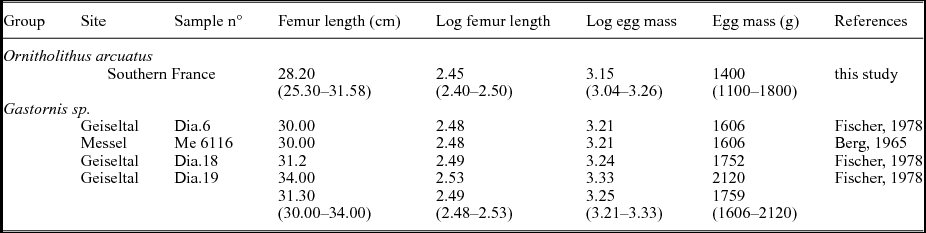
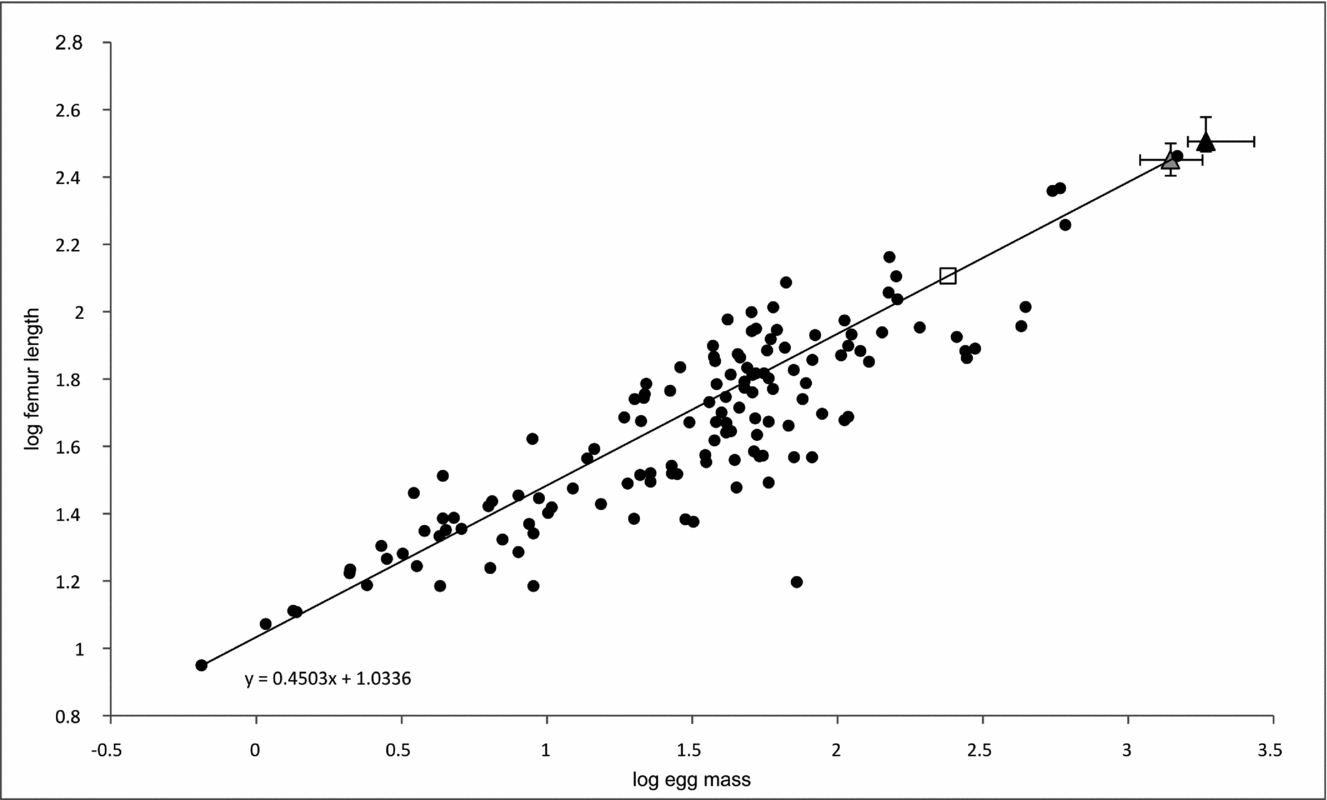
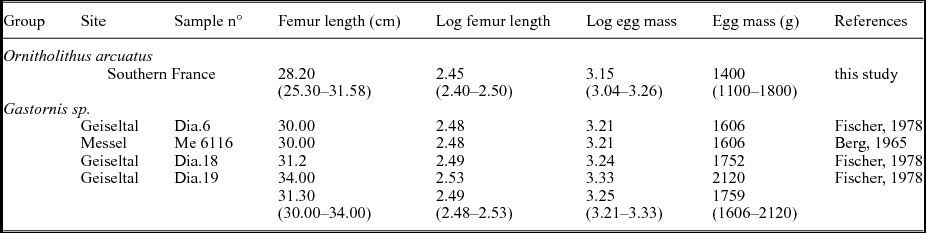
Thus we obtain a log of the femur length of 2.45 (Table 4), which is comparable to that obtained for European Gastornis specimens, the femora of which have a mean length of 28.2 cm, which corresponds to a log of the egg mass of 3.15 (Fig. 4). If we use the same method with the femora of Palaeotis we obtain an estimated point clearly distinct from the two former ones. Using this method, we can strongly support the association of the eggshells from southern France with Gastornis. This association between the two different kinds of fossils had already been suggested by Dughi & Sirugue (Reference Dughi and Sirugue1959, Reference Dughi and Sirugue1962, Reference Dughi and Sirugue1968) and by Touraine (Reference Touraine1960), who tentatively referred the fossil eggs to gastornithids on the basis of contemporaneity of both fossil occurrences, a suggestion supported by Mayr (Reference Mayr2009). The quantitative study of the eggshell size and mass proposed in this study provides more solid evidence to support this hypothesis.
Calculations to estimate the log egg mass from the femur length, and the log femur length from the egg mass, based on the equation proposed by Dyke & Kaiser (Reference Dyke and Kaiser2010)
Estimation of the log(femur length) from the log(egg mass), using the measurements and the regression equation proposed by Dyke & Kaiser (Reference Dyke and Kaiser2010) (log femur length = 0.4503 log egg mass+1.0336) (grey triangle); compared with the log(egg mass) estimated from the log(femur length) measured for the European Gastornis (black triangle). Both values are very close, showing that the fossil eggshells studied here can be referred to Gastornis. For comparison, the white square corresponds to Palaeotis, based on the measurements of the femur.

3.d. Estimated body mass of the bird that laid these eggs
Assuming that these eggs have been laid by Gastornis, the body mass of the female bird which laid these eggs can be estimated using two other equations (Eqs (5) and (6); Table 2) determined by Dyke & Kaiser (Reference Dyke and Kaiser2010). These two equations correlate the log of the egg mass to the log of the body mass, depending on the developmental mode of the young: ‘altricial’ (helpless, Eq. (5)) or ‘precocial’ (independent, Eq. (6)).
 \begin{equation}
{\rm M}_{{\rm egg}} = - {\rm 0}{\rm .659394} + {\rm 0}{\rm .7889097\; M}_{{\rm body}}\end{equation}
 \begin{equation}
{\rm M}_{{\rm egg}} = - {\rm 0.164615} + {\rm 0.6451872}\; {\rm M}_{\rm body}
\end{equation}
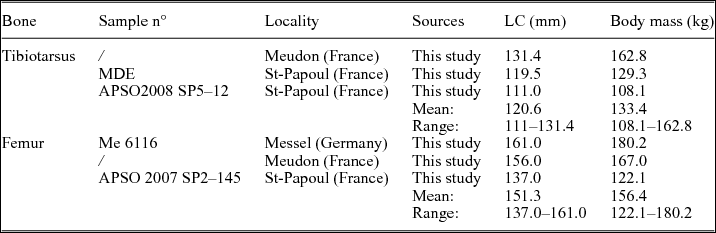
As we do not know what type of development the Gastornis hatchlings had, we tested both equations using the egg mass calculated before. Therefore, in the case of an altricial bird, we obtain a female body mass of between 66.6 kg and 79.3 kg. For a precocial bird, the estimated body mass is between 135.4 kg and 156.4 kg. These values are smaller than the previous body mass estimates for Gastornis proposed by Andors (Reference Andors1992) and Murray & Vickers-Rich (Reference Murray and Vickers-Rich2004), which were around 175.0 kg and 199.0 kg, respectively. But both estimates were based on measurements of Gastornis specimens from North America, which were larger than the European form. This size difference can easily explain the differences in estimated body mass, because our study is based on European specimens. Body mass estimates for European Gastornis using Campbell & Marcus's method (Reference Campbell and Marcus1992) based on minimal circumference (LC) of the tibiotarsus (Eq. (7)) and femur (Eq. (8)) (Tables 2, 5), are between 133.4 kg and 156.4 kg, respectively, a result which is in good agreement with our estimates based on egg mass.
 \begin{equation}
{\rm log}_{{\rm 10}} \,{\rm M}_{{\rm body}} = {\rm 2}{\rm .424\; log}_{{\rm 10}} \;{\rm LC}_{\rm t} - 0.076
\end{equation}
 \begin{equation}
{\rm log}_{{\rm 10}} \,{\rm M}_{{\rm body}} = {\rm 2}{\rm .411\; log}_{{\rm 10}} \;{\rm LC}_{\rm f} - 0.065\end{equation}
Estimation of the body mass of Gastornis based on the method of Campbell & Marcus (Reference Campbell and Marcus1992)

LC – minimal circumference
The values obtained using the altricial equation appear rather small for Gastornis, but could be explained if this bird presented a large sexual dimorphism. The precocial estimates of between 135.4 kg and 156.4 kg are more in agreement with the estimated weight of Gastornis, which is not unexpected since all the large living ground birds, including the present-day ostrich, are precocial (Dyke & Kaiser, Reference Dyke and Kaiser2010).
4. Conclusion
This new study of the bird eggshells from the Early Tertiary of southern France permits us to associate the fossils eggs with Gastornis, as well as to propose a body mass estimate for the female of Gastornis, which is totally in accordance with the estimates independently obtained for this Early Tertiary giant ground bird. This association raises some questions about the ecology of Gastornis: are the very large quantities of eggshell fragments found at some sites only due to a specific taphonomic environment or do they reflect nesting sites? If the eggshell localities correspond to nesting sites, the fact that only fragments are found (unlike the situation of dinosaur nesting sites in the Cretaceous of the same areas of southern France, where complete eggs and clutches are common) probably reflects the fact that the eggs were laid unprotected on the ground and not buried. Because the eggs are broken, it is difficult to assess how many there were in a clutch and how many eggs were laid each year by a single bird. Similarly, it is difficult to evaluate how many laying periods are represented at each site, or how many birds used the nesting sites. The large accumulations of eggshell fragments found at some sites may suggest gregarious nesting of Gastornis flocks. Another fact worth noting is that these eggshell sites only occur in southern France and northern Spain while Gastornis skeletal remains are mainly known (with the exception of the Saint-Papoul locality) from localities further north, in northeastern France, Belgium, England and Germany. This fact was already commented on by Touraine (Reference Touraine1960), who noted that no bones had been found in association with the eggshell fragments (this also applies to Cretaceous dinosaur nesting sites in southern France, where skeletal remains do not occur). Conversely, in their review of fossil eggs from the Geiseltal, where Gastornis bones are known, Kohring & Hirsch (Reference Kohring and Hirsch1996) did not describe any eggshell type that could be referred to gastornithids. However, it seems difficult to envision migrations of the flightless Gastornis to distant regions for egg-laying to explain this geographical pattern. What the reasons were why some specific locations were chosen by gastornithids to lay their eggs is an additional question. Further studies on the numerous and productive Early Tertiary eggshell localities of southern France, using approaches such as sedimentology and geochemical analysis, may provide answers to at least some of these questions.
Acknowledgements
This work was supported by a grant from the INTERRVIE programme of the Institut National des Sciences de l’Univers (CNRS) and by the grant from the program L'Oréal-Pour les femmes et la Science.
Declaration of Interest
None
Supplementary materials
To view the Supplementary Material for this article, please visit http://dx.doi.org/10.1017/S0016756814000077