The Alaska Purchase of 1867 belongs to the common store of historical curiosities, yet the history of Russian possessions in America has been successfully buried. Modern patterns of political and geographical cultures do not fit well with this episode of Russian expansion, and the fact that there was once a ‘Russian America’ seems odd to many observers.Footnote 1 European and American notions of global geography are based on a very strong continental system, which tends to imagine continents as enclosed and self-contained and to equate them with specific cultures.Footnote 2 Modern Western conceptions also often consider the North American continent as congruent with the United States of America. In addition, Western mental maps, as well as two-dimensional ‘real’ maps, often do not acknowledge the relative proximity between the Russian east and the American west coasts. Finally, America is usually located in ‘the West’ and defined as ‘the world beyond the Atlantic ocean’,Footnote 3 while Russia – culturally, politically, and, on our maps, geographically – clearly counts as ‘Eastern’. There are thus various reasons why the Russian ‘discovery’ of the American continent from the Pacific might seem strange and out of place, a conception mostly – but not only – prevalent in popular culture. Many scholarly books on imperialism and maritime discoveries ignore Russia altogether, or cover it in a humble final chapter. In turn, specialists on the Russian empire tend to treat the Russian expansion in the Pacific as a strange episode that is hard to include in the general narrative of a landed Russian empire.Footnote 4
The fact that the Russian route across the Pacific does not fit Western geographic conceptions invites a closer look at Russian perceptions of America. Eighteenth-century documents show how Russian travellers arriving on American shores from the West imagined this part of the world and how they reflected on their own situation. A close reading of such documents calls into question several modern assumptions about geography and imperial expansion. Most significantly, it demonstrates that there was not just one direction from which to approach America, nor was there only one way to perceive of ‘America’.
The history of Russian ‘discoveries’ in this part of the world is not limited to the oft-cited ‘facts’ that the Cossack Semen DezhnevFootnote 5 first sailed the Bering Strait in 1648, that the geodesist and navigator Mikhail Gvozdev first reached Alaska in 1732, and that the explorer Aleksei Chirikov made the first landfall in 1741. Rather, we are looking at a course of mental discovery, similar in some ways to what scholars such as Edmundo O’Gorman and Eviatar Zerubavel have described as an often lengthy and complex process of imagination and invention, exploration and interpretation.Footnote 6 What did Russians of the eighteenth century think they had ‘discovered’, how did they imagine this ‘America’, and what did they expect to find there? This article draws on various documents such as travelogues, official instructions, letters, and reports, as well as maps from the eighteenth century, and reads them for perceptions of geography and concepts of landscapes. These perceptions often contradict modern images, but they follow their own logic and serve political, economic, and administrative strategies. When the strategies changed – when imperial competition, processes of globalization, and a novel standardization of the geographical imagination set in – these perceptions were modified. In the early nineteenth century, distinct Russian geographic concepts vanished as Russian notions grew more attuned to those of western Europeans and Americans.
A discovery neglected
The eighteenth century was a time when neither islands, nor coasts, nor even the very dimensions of the North Pacific were known to cartographers, when sailors were unable to determine the exact longitude, and when measures of length, temperature, and weight were anything but standardized on a global scale. Diverse, non-standardized, and speculative images of geography appear to be a logical result of such widely varying worldviews. One of those images of geography will be presented in this article.
Research on the topic is strikingly asymmetric. There is, on the one hand, no denying that early Russian perceptions of ‘America’ have been described quite extensively, and we have considerable knowledge about how Russians appropriated the New World: through images of freedom and savagery, as well as by importing cotton, tobacco, and lemons.Footnote 7 By the sixteenth century, Russians had learned about heathen savages populating ‘America’. Russian knowledge about and interest in the New World was considerably weaker than western European efforts to make sense of this continent, yet the images were largely similar.Footnote 8 From the late eighteenth century on, the term ‘America’ was used increasingly as being synonymous with ‘the United States’Footnote 9 and became connected to key concepts of the time such as progress, civilization, freedom, democracy, slavery, and economic opportunity. The author Aleksandr Radishchev praised American liberty in his ‘Ode to Freedom’;Footnote 10 Feodor Karzhavin, who travelled across North America in the 1770s and again in the 1780s, admired the American economy;Footnote 11 the Decembrist Nikolai Murav’ev adopted parts of the American constitution for his own drafts;Footnote 12 and the nineteenth-century historian and writer Aleksandr Lakier vividly described life and culture in the United States for Russian readers.Footnote 13 In their own ways, Russians took part in the European mental discovery or invention of America, and historians have duly taken notice of this process.
On the other hand, the ‘other discovery’ of America, from the Pacific side, has so far not been considered as a process of mental mapping.Footnote 14 In an interesting reflex, many historians of the rivalry between Russia and the United States tend to include the Russian expansion in the American north-west as an integral part of their stories. The German historian Erwin Hölzle, for example, considered the very existence of the Bering Strait and Russian expeditions into the Pacific basin as natural geopolitical starting points for the fateful struggle of the superpowers to be.Footnote 15 Nikolai Bolkhovitinov refrained from taking such a strong Cold War perspective, yet he likewise commented that ‘from the very beginning the colonization of northeast Asia, the Aleutian Islands, and Alaska was directly connected with the problem of Russian relations with the new republic created on the Atlantic coast of North America’.Footnote 16 These approaches not only mirror Cold War anxieties, but also indicate a posteriori perceptions of ‘America’ being equal to the United States. The assumption appears to be that Russians grappled with the United States as soon as they had reached the American continent. How could it have been different?
My reading of the documents will suggest that the reality was different and that the notion of Russian expansion in the North Pacific as an early element of the Russian–American rivalry is misleading. My approach to Russian conceptions of the North Pacific region does not make them an integral chapter in the history of Russian–American relations. Rather, it places them within the context of research on mental maps, and is informed by the approaches of global history. The era under consideration has been described as a phase of ‘new internationalization’Footnote 17 and entanglement in the Pacific basin, a time when the entities ‘Russia’ and ‘America’ were far from sufficient to describe the region. Numerous protagonists were active, and concepts of territory and space, as well as nation and empire, were very much in flux.Footnote 18 The following description of Russian geographic perceptions will add a few pieces to this Pacific puzzle.
Late eighteenth-century Russian perceptions of the United States on the one hand and of the north-west coast of the American continent on the other were highly incongruent. The distance between Kamchatka, the Aleutian Islands, Alaska, and the north-west coast of the American continent was covered by people with different interests from those of the people who undertook the transatlantic voyage from St Petersburg to Philadelphia or Boston. This led to different perceptions and imaginations. Beginning in the late eighteenth century, Russian travellers and writers in the United States wanted to learn about cities, economics, social structures, and political ideas. They were tourists or businessmen, sometimes both. In contrast to this, the sibiriaki (inhabitants of Siberia) who fought their way through the endless wilderness of the Eurasian continent were part of a much longer tradition that had begun long before the founding of the United States: ever since the time of Ivan the Terrible, these promyshlenniki (fur hunters) and Cossacks,Footnote 19 later accompanied by officers, scientists, entrepreneurs, and missionaries, hunted fur-bearing animals, brought new subjects under the emperor's or empress's ‘mighty hand’, collected iasak (tribute) and learned more about a region that was still largely uncharted territory. When they arrived in America, they did not visit city halls and salons but communicated with and fought against indigenous people, simply tried to survive in a hostile environment, and planned to return with (in order of importance) furs, maps, and scientific specimens. To them, the British were only one power out of many in North America, and the Spanish colonists were closer and thus more interesting.
In fact, documents from the eighteenth and early nineteenth centuries show at least two different ‘Americas’. This becomes clear, for instance, in the existence of two different kinds of ‘Americans’. The word ‘amerikantsy’ was used to refer to very different people, depending on the speakers and their interests. Entrepreneurs and travellers who sailed the North Pacific used the word to describe the indigenous population on the north-western coast of the American continent.Footnote 20 Philosophical writings from the heart of the Russian empire, looking upon the events on the east coast of North America, also spoke about ‘amerikantsy’, yet for them this term referred to the citizens of the British colonies or, later on, of the United States. Official documents tended to switch usage according to the topic: in such sources, both US citizens and Tlingits could be described as ‘amerikantsy’.Footnote 21 For several decades there was no need to resolve this coexistence of words, since the meaning of neither the descriptions nor the people described clashed. Trade and hunting in the north-west simply had no connection with the political, cultural, and diplomatic developments in the east. In terms of describing the population, ‘America’ and the ‘United States of America’ were clearly not synonymous from the Russian perspective, yet no correspondence was desired or needed. At that time, the Russian perspective did not differ much in this from that of other nations.
The Russian discovery of America via the Pacific did not simply extend the mental discovery of America that had been going on since the late fifteenth century from the Atlantic side. Rather, the Russian process of geographical imagination started from other discourses and began to develop slowly in the mid seventeenth century, finding its own expressions and images. While the Russian ‘discovery’ of the east coast of America generally followed the course of western European imaginations, Russians in the North Pacific region had to pioneer. The region was largely uncharted territory and speculative cartography prevailed. Most contemporary world maps filled the uncomfortable void in the upper left corner with fictitious islands such as Company Land or used elaborate space-filling cartouches. It had taken long enough for explorers and mapmakers to define ‘America’ as a separate continent from the Atlantic side, and the question of whether America and Asia were really unconnected or rather joined still remained open for the north-western coast.
The protagonists of this story came from a broad spectrum of society and from different cultural and ethnic backgrounds: Russian government officials, high-ranking bureaucrats, merchants and entrepreneurs, hunters and Cossacks, sailors and navy officials, geodesists and scholars. They came from Russia, Germany, the Baltic region, Scandinavia, Britain, and Siberia. All were interested and involved in the Russian expansion in the North Pacific region, and all described and constructed America in different and often surprising ways.
Carving out a niche in the eighteenth century
Any history of the Russian expansion to America usually begins with Peter the Great. In 1719, he sent the two geodesists Ivan Evreinov and Fyodor Luzhin to sea explicitly in order to find out whether ‘America and Asia are joined’. In his unusually laconic decree, Peter did not give any reasons for the enterprise,Footnote 22 and so his interest in and perceptions of America aroused controversy. The tsar's general interest in geography and cartography was certainly important,Footnote 23 as was the economic relevance of a possible north-eastern passage. Yet what exactly were his ambitions regarding America? What were the aims of the Evreinov–Luzhin campaign and later of the two major expeditions led by Vitus Bering to Kamchatka and into the North Pacific in 1725–30 and 1733–43? Raymond Fisher has argued that Peter focused his intention on ‘finding America’.Footnote 24 According to Fisher (and, tacitly, many scholars agreeFootnote 25), Peter's main interest was neither cartographic accuracy nor the question of a north-east passage. Rather, it was America as a new space for expansion and exploitation that lured Russian expeditions into the Pacific Ocean: as Fisher put it, the purpose was ‘to lay the foundation for an empire’.Footnote 26 Entering the continent from the Pacific, Russians must have planned to reach America, to explore America, to conquer America. Is this not, the assumption seems to be, what new worlds are there for? While Fisher is certainly correct in stating that there was an interest in finding and reaching America, his statement needs to be refined: I will argue that the American coast, rather than the American continent, was the goal of Russian expeditions throughout the eighteenth century and that, in fact, America was not seen as a ‘new world’ from this side. Given the laconic phrasing of Peter's instructions, it is not possible to determine his personal intentions and objectives precisely. However, later documents provide plenty of information to aid our understanding of eighteenth-century Russian notions of ‘America’. To be more specific, Russian texts and maps of the Pacific expeditions present a picture of an enclosed North Pacific basin. In this picture, the American coast formed the margin of this basin, rather than the beginning of a new continent. In the eighteenth century, Russians coming from the Pacific did not establish an image of an American continent. Instead they cut out a small piece along the coast that was imagined as ‘Russian America’, an integral part of the Russian niche in the North Pacific.
Throughout the eighteenth century, documents of Russian expansion in the North-west Pacific scarcely ever mentioned the British colonies or, later, the United States, or even any of the ideas connected to them, such as freedom, democracy, or progress. The more general idea of a ‘new world’ also appears very rarely in the documents. It is true that some famous eighteenth-century authors such as Mikhail Lomonosov and Gavriil Derzhavin played with the image of a ‘Russian Columbus’ who discovered ‘new worlds’. However, their songs of praise were written from St Petersburg; the protagonists of discovery themselves did not use this expression. With the single exception of the charismatic and vain Russian-American Company (RAK) official Aleksandr Baranov, who in 1799 staged a ceremony of taking possession and wrote a song about Russian success in America,Footnote 27 neither promyshlenniki, nor officers, nor scientists marvelled about ‘new worlds’. In a manner consistent with this down-to-earth rhetoric, Catherine II favoured a very pragmatic, less than spectacular approach to the possibility of Russian expansion to America. Motives such as prestige or myths of a new world did not figure in her thought. In 1788, the empress expressed her doubts about the advantages of an American enterpriseFootnote 28 and wrote of expenses, labour shortage, and governability. The Siberian journey had been difficult enough, and circumstances in America promised to be even more complicated.
Seen in the context of recent historiography on the character of Russian imperial expansion, Catherine's pragmatic attitude appears quite typical. The Russian empire had grown enormously since Ivan IV had conquered Kazan and thus opened the way to Siberia. If a single word were to characterize this expansion it would probably be ‘pragmatism’. The need to secure frontiers and the greed for profit led the early modern Russian state, often preceded by Cossacks and merchants, further to the East. Expansion proceeded step by step.Footnote 29 At every step, the explorers met new indigenous peoples and encountered new environmental challenges. Russians grappled with these novelties in a manner very different from Spanish, Portuguese, and British conquerors, however. Travelogues contain little traces of ‘marvel’,Footnote 30 and the slow, pragmatic, gradual expansion yielded a specific way to deal with subjected people and territories. The general aim was to incorporate people as smoothly as possible, not to construct otherness and create contrasts. When conquered in the seventeenth and early eighteenth centuries, Siberia was thus not considered a ‘new world’.Footnote 31 Neither was America.
Modern perceptions of geography, culture, and the landlocked Russian empire suggest that Russians must have reached a natural limit and indeed a mental boundary when they arrived at the Pacific.Footnote 32 The historic documents, however, paint a different picture. There are almost no indications in eighteenth-century travelogues or instructions to expeditions to the North Pacific and the American coast that this route was considered a leap, a break, or anything else but a logical continuation of the established means of expansion. Any search for ‘new world attitudes’ in travelogues of scientists and merchants before the early nineteenth century remains strikingly fruitless, and pragmatism prevails. Most travellers did not plan to become a Russian Columbus. The reality was much simpler: when Russian Cossacks and merchants had reached the Pacific Ocean in the seventeenth century, the immensely profitable sables were becoming rare, and so the next step was necessarily into the ocean. In addition, in the permanent search for new tribute-paying subjects, the sovereign's servitors were looking for inhabited islands. This does not mean that they did not encounter novel practical problems and that changes in strategies and techniques were not necessary, in particular considering the scientific and entrepreneurial expeditions from Peter the Great's time on. Ships had to be built, enormous amounts of money needed to be raised, maps had to be drawn, and new methods of hunting had to be invented when sea otters turned out to be the most valuable of natural resources in the region.Footnote 33 The Pacific journey was probably only feasible because this point of expansion was reached at the very time when the newly enlightened rulers developed new scientific and imperial ambitions and were thus ready to collaborate. The new ideals of the elite in St Petersburg met with the monetary motives of the merchants in eastern Siberia, and from then on, trade, science, and politics combined in a relationship that was sometimes fruitful, sometimes tense, and never fully clarified.
Yet, even if the practical conditions changed profoundly, the attitude towards the people encountered and the territories mapped remained remarkably stable. Just as the vastness of Siberia had been conquered step by step and without a targeted master plan, no general integrated project of the expansion to America can be found in early eighteenth-century documents either.
The sources thus suggest that, in the eighteenth century, Russians generally perceived the passage to America as a simple continuation of the expansion through Siberia and not the discovery of a special ‘new world’ that would be particularly prestigious to explore. The documents do not show any interest in the American continent apart from its coasts. They rather reveal a very specific geographic perception of this region that it seems worthwhile to consider closely: the northern Pacific Ocean as a Russian niche.
In 1741, the vessel St Peter left Kamchatka to sail eastwards. On board was the German scholar Georg Wilhelm Steller. We owe to him not only the description of ‘Steller's sea cow’ but also one of the most interesting travelogues of the time.Footnote 34 Steller, who had joined Russian services only shortly before the Second Kamchatka Expedition, strongly expressed his disappointment when the expedition hardly touched the American coast. He notes many times that, in his opinion, sailors and officers were simply unable to appreciate the true objective of the voyage: setting foot on American soil. The German vigorously emphasized his own, ‘scientifically’ based interest in reaching the American continent, as well as the ignorance of the rest of the crew. In addition, he constructed a strong dichotomy between Kamchatka and the American coast. Kamchatkan mountains were crumbly, while American ones appeared massive; Kamchatkan forests were poor, American ones amazingly beautiful; Kamchatka probably had no precious metals, whereas America would certainly be extremely rich. Steller described himself as an exception to the Russian explorers, and in this he was correct. His great interest in reaching America and his demonstrative juxtapositions of Asia and America serve to underline the indifference towards new worlds in other Russian documents.
Coastal ambitions and a coastal imagination
Steller's report also contrasts with Russian reports in another way: he sees the North Pacific as an obstacle on the way to the New World, whereas they see the North Pacific basin itself as the objective. The Bering expedition of 1732, for example, was explicitly sent out to learn as much as possible about the North Pacific islands; on their way back to Kamchatka, they were to sail a different route in order to discover even more islands.Footnote 35 When Aleksei Chirikov described the course and results of the Second Kamchatka Expedition, islands were once again of great interest – much greater, in fact, than was the American continent.Footnote 36 In 1785, Catherine II gave an instruction to Joseph Billings and sent him to the ‘Cape of Chukotsk and to the many islands in the Eastern Ocean, stretching out to the American coasts’.Footnote 37 Numerous other documents similarly show the ways in which Russia focused on the North Pacific rather than on the New World lying across the body of water.Footnote 38 In part, this can be explained simply by the route across the ocean. Vessels left Kamchatka in order to sail from one island to the next. The chain of the Aleutian Islands was very convenient here, as it made sailing easier and provided a certain protection from the dangers of high seas.
These islands were not seen as stepping stones to the mainland: the documents do not show any ambition towards greater and possibly aggressive expansion into the American continent. In 1733, the Admiralty Board focused explicitly on the coast as the point of interest. In the same year, Aleksei Chirikov declared that the American continent was big enough for both Spanish and Russian explorers; Russians could remain in the northern parts and did not even have to come close to Mexico. Travellers and merchants were warned time and again to hunt and settle only in regions that no other European, ‘civilized’, power had claimed so far. Debates about territorial rights were to be avoided, not to mention possible conflicts.Footnote 39 If the Russian empire was ready to fight other powers in its western and southern regions, it certainly aimed at staying clear of disputes in faraway America.
All ambitions focused exclusively on the coastline, and so did the Russian geographic imagination. New settlements and additional grounds for hunting and trading were to be located mostly to the north, sometimes also further south, but always along the coast. Coastlines, bays, islands, and shores formed the landscape that Russian explorers were interested in. Places for possible settlements were chosen according to their accessibility by ship and the chance to hunt sea otters.Footnote 40 As the entrepreneur Grigorii Shelikhov declared in 1786: ‘Of people living inland, I know nothing’;Footnote 41 nor did he seem to be interested in accumulating more knowledge. It was only from the 1820s on, when the boundaries of Russians possessions came to be regulated explicitly and in international contracts, that a few individuals developed new ambitions. At the same time, however, when the St Petersburg officials Nikolai Mordvinov and particularly Dmitrii Zavalishin advocated a stronger Russian involvement on the American continent, other parties had already developed serious doubts about the purpose of Russian ambitions overseas more generally.Footnote 42
The reasons for and implications of the Russian focus on islands and coasts can easily be explained by pragmatic economic reasons. Sea otters had lured Russian hunters into the region, and sea otters were to be collected around islands and along the coast. Moreover, Russian explorers both did not want to and were explicitly forbidden to provoke conflicts with other imperial powers, be they Spain or, later, France, Britain, and the Unites States. Yet beyond these economic necessities and political considerations, the Russian concentration on the coast was also shaped by the distinctive Russian geographic imagination of the region and the Russian relationship to the ocean.
In a recent article, Guido Hausmann has presented evidence of Russian maritime interest in the Black Sea, the Baltic Sea, and the Pacific, as well as the existence of a Russian concept of intermarium, an empire surrounded by seas. These findings strongly contradict the general view of Russia as a strictly continental empire.Footnote 43 A close look at the North Pacific expansion supports Hausmann's conclusions. As noted above, the fact that the expansion now had to be carried on by ships instead of carriages did not enforce any fundamental changes in the concept of empire. Nor do the documents betray a cultural construction of the ocean as ‘other’, particularly dangerous, or inaccessible.Footnote 44 The distinction between maritime and landlocked empires was made by later historians, not by Russians at the time.Footnote 45 Wherever possible, conquest in the Pacific was carried out in the same way as in Siberia: people were ‘convinced’ to become subjects of the Russian tsar, hostages were taken, iasak in the form of furs was collected, Orthodox Christianity was offered but rarely imposed, and sometimes the conquerors engaged in armed conflict.
Even the basic characteristics of mapmaking in Siberia – the attempt to make the vast land appear accessible and to provide cartographic enclosureFootnote 46 – were continued by the cartographers of the Pacific Ocean. No conceptions of new worlds were employed, no powerful myth of the great ocean constructed. Throughout the eighteenth century, the region was conceptualized not as the Pacific Ocean but rather as a Russian mare nostrum and thus a part, not simply a frame, of the empire.Footnote 47 In the pragmatic imperial approach of Russian travellers, there was no place for a fundamental, ideological difference between landed and maritime expansion. In an interesting twist, the Russian empire of ‘landlubbers’ appears as a sometimes almost enthusiastic maritime power in the documents. Pragmatic reasons supplied the basis for their interest in the coastal region and, to a large extent, their thwarted interest in advancing inland. Based on this, Russian explorers (though not, of course, later settlers) remained largely on their vessels and developed a geographic imagination that was strongly centred on the ocean.
The cartography of islands and oceans
Apart from written sources such as travelogues and reports, maps also provide interesting information on Russian conceptions of the North Pacific and America. Eighteenth-century cartographers of the North Pacific had plenty of work ahead of them. Seen from the Pacific, ‘America’ was anything but clearly defined. For instance, the outline of Alaska – an island? a peninsula? part of the mainland?Footnote 48 – was not clear for quite some time, and although the Second Kamchatka Expedition had ‘proved’ that Alaska was an island, this did not necessarily translate into international maps or Russian perceptions. Joseph-Nicolas Delisle's maps of the 1750s did not contain Alaska, and in 1767 the Admiralty Board still assumed Alaska to be an island.Footnote 49 More interesting than such ‘mistakes’, however, were attempts to systematize and structure the region. One map from 1774 by the scholar Jakob von Staehlin pictured Kamchatka, the Aleutian Islands, and the ‘Anadyrskii ostrov’ as the ‘Northern archipelago’.Footnote 50 As the labelling on the map's Russian version suggests, the small portion of the American mainland (‘Severnaia Amerika’) was counted as part of the archipelago.Footnote 51 This was not a worldview of distinct continents, as in today's atlases, but rather an image of closely connected land portions. The cartographic focus on the North Pacific basin – largely uncharted well into the eighteenth century – can be explained by the old interest in a north-west and a north-east passage, as well as by the legendary Strait of Anian.Footnote 52 From the 1730s on, the Russian discoveries, eagerly absorbed by the European republique de lettres, gave another reason for a growing fascination with the North Pacific.Footnote 53
While Staehlin's concept of a northern archipelago that included only a narrow stripe of the American coast did not catch on, a different cartographic design of the North Pacific basin became very popular in the eighteenth century: on pointedly symmetrical maps the Asian and American continents were allotted portions of equal size, the Pacific Ocean dominating the perspective. While today's atlases are usually systematized according to continents, and thus neatly classify Russia and America in different chapters, the two parts of the world came strikingly close on these symmetrical maps.Footnote 54
The symmetrical design emphasized the proximity and connections between the coasts rather than distance. The very narrow Bering Strait on the one hand and the Kuril islands and the Aleutians on the other, leading from Kamchatka right to Alaska and the American coast, provided crucial geographic elements and were perceived to form a connecting path for Russian ambitions in this imperial niche.Footnote 55 Emphasizing this perception, Russians counted the Aleutian chain as beginning with KamchatkaFootnote 56 rather than, as today, with the ‘Near Islands’ Attu and Agattu. Details on maps intensified the impression of proximity: fine lines connecting the islands and continents not only bore witness to important expeditions but also provided another visual link between Asia and America.Footnote 57
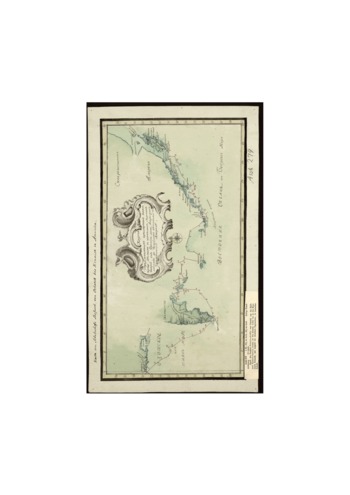
Joseph-Nicolas Delisle, a Frenchman in Russian service, used the same symmetrical concept with the Pacific Ocean in the centre, but classified and emphasized the continents by using different colours. Many Russian maps abstained from such techniques, however,Footnote 58 or used them in different ways: a map from 1787, for example, used colours to distinguish the Russian sphere of influence from the Spanish one, rather than to separate continents.Footnote 59 A highpoint of this strategy of depicting connections rather than distances, similarities rather than differences, can be seen in the map of Grigorii Shelikhov's travels: islands are hardly distinguished from mainland, and there are no continents to be seen at all (see Figure 1).Footnote 60
‘Karta predstavliaiushchaia prosledovanie voiazha Kuptsa Shelekhova’ (map showing the voyage of the merchant Shelikhov), 1700. Reproduced courtesy of the Goettingen State and University Library.

Historians of cartography have emphasized time and again that maps are not simply ‘right’ or ‘wrong’ but rather represent ideas, values, identities, and strategies. On eighteenth-century Russian maps of the North Pacific, as on probably every map, the important things were moved to the centre of attention: the islands of the North Pacific, the possible routes to cover the distances, the expeditions that had been successfully completed. The concept of America as a distinct continent, a ‘new world’, was largely irrelevant to the mapmakers. When entrepreneurs such as Shelikhov designed maps, they did so in order to facilitate orientation and to convince sponsors (in particular the government) to support the venture. ‘America’, the myth of a new world, was obviously not the carrot that would have successfully lured the elite of St Petersburg to America. Rather, the concept of manageability and of the North Pacific as a Russian niche, fairly accessible and as yet largely undisturbed by competing powers, promised to be the right strategy.
While many reports from the Pacific tended to emphasize the remoteness of the region in order to explain and excuse difficulties, the authors of projects and plans often suggested a strong Russian advantage in the region and employed an image of proximity. Despite the excessive financial costs of ventures in this region, many written documents stressed the enclosed character of the North Pacific basin and the proximity of the islands and coasts.Footnote 61 Shelikhov liked to emphasize his immense financial and physical exertions in sailing the region, yet he also let the traffic between Kamchatka and the American coast appear very lively – the modern reader almost gets the image of a Pacific highway between Okhotsk, Kodiak, and the American coast.Footnote 62 ‘America’ was imagined as a part of the North Pacific basin, which in turn was considered a legitimate part of the Russian empire. The strategic character of mental maps becomes very obvious here: the project of exploring the Pacific basin with its rich natural resources and the promising markets in China and possibly Japan formed a unique chance for the Russian empire to establish a position in the global race. This was to be a region for Russians, who – considering themselves a ‘northern’ nation – appeared both geographically and culturally more apt to conquer it than Spain, Britain, or France.Footnote 63 Imagining ‘America’ as a continent and a new world, and thus a challenge different from previous expansion, would only have been obstructive to imperial and economic claims.
Shifting terminology for oceans and coasts
This picture of the North Pacific as both a crucial and an integral part of the empire is also evident from geographic designations in texts and on maps. To Russians of the eighteenth and well into the nineteenth century, the North Pacific was the ‘Eastern Sea’ (Vostochnoe more/Vostochnoi okean). This term indicates a subjective angle or, rather, a relative conception of geography. This is anything but a Russian anomaly; even today, our real as well as our mental maps are filled with such relative terms made absolute: Mediterranean Sea, Eastern Europe, Middle East. In the case of ‘Eastern Sea’, however, it is interesting that this relative conception existed side by side with the absolute one of ‘the Pacific Ocean’. If relative perspectives are still significant today, their importance in the eighteenth century does not come as a surprise – particularly considering that it was only at the end of the eighteenth century that the exact position of ships could be established in terms of longitude, that the metre was defined, and that cartography became intentionally standardized. In Russian documents, the North Pacific was described in several different but not competing perspectives and logics. In probably all of the written texts that I have seen, the North Pacific was called the ‘Eastern Sea’. As opposed to this, on many – though not all – maps, the term Tikhoe more or Pacific Ocean was used, sometimes in combination with Vostochnoe more, with the Pacific often starting south of the Aleutian chain. In contrast with letters, instructions, and many travelogues, maps were translated and circulated widely and thus tended to employ standards that could be understood internationally.
The denomination ‘Eastern Sea’ not only indicates the subjective outlook of eighteenth-century geography but also emphasizes the concept and claim of a Russian niche in the north. The division of oceans into ‘eastern’ and ‘western’, introduced by Martin Waldseemüller's maps and common since the sixteenth century, had been motivated by the discovery of America as a continent and included an explicitly global perspective. It had been replaced on most maps in the eighteenth century by a different global system, that of southern (Pacific) and northern (Atlantic) seas.Footnote 64 The Russian concept of Vostochnoe more was not simply an anachronism, however. The name was not used to describe the whole Pacific – a mare orientale as opposed to the Atlantic mare occidentale – but instead to distinguish the northern part of the ocean from the greater Pacific. The term did not refer to the entire Pacific Ocean and did not include global claims but rather focused on the much smaller part north of the Aleutian chain – the Russian niche. Only in the early nineteenth century did Russian seafarers, politicians, and entrepreneurs widen their perspective and become interested in trade with the islands of Hawaii, and with California and Australia.
North-eastern or north-western?
Another quite perplexing terminology emerges in many written texts and a few maps: the north-western coast of the American continent was often called ‘north-eastern’. As far as I know, this has not been noted by historiansFootnote 65 and, in some translations, the ‘mistake’ has been tacitly ‘corrected’ – Basil Dmytryshyn, for instance, repeatedly translates severovostochnaia Amerika as ‘north-western America’. Unfortunately, such erroneous translation conceals the geographical and political logic behind the ‘mistake’. As the Russian words – zapadnyi (‘western’) and vostochnyi (‘eastern’) – are clearly distinguishable, we can rule out the possibility of a simple misreading due to bad handwriting, as would have been possible in Western languages (ouest/est, West/Ost, ‘west’/‘east’). Rather, the logic behind this ‘mistake’ appears to be the same that generated the name Vostochnoe more and the general attitude towards the American continent that I have described. Most documents calling the north-western coast of America ‘north-eastern’ came from Shelikhov. In his travelogue from 1786, he described his interest in islands lying off ‘north-eastern America’.Footnote 66 In several letters, instructions, and petitions, he also spoke about the ‘north-eastern coast’ and ‘north-eastern America’.Footnote 67 On the map depicting his voyages, the coast was marked as Severovostochnaia Amerika; the same word appeared in the cartouche.Footnote 68 Even one of the predecessor companies of the famous RAK was officially named Severovostochnaia Amerikanskaia Kompaniia.Footnote 69 Again, we are looking at a subjective perspective on geography. For those who came from Russia, the regions of Siberia, Kamchatka, the Pacific Ocean, and, indeed, America, clearly lay to the east or north-east. This was mirrored in the language of the documents speaking about north-eastern Siberia. Joseph Billings, for instance, was sent on a North-eastern Expedition, and the sea travelled was the Eastern or North-eastern Ocean.Footnote 70
This perspective and geographical logic did not stop at the American coast. Marking the American coast as ‘north-western’ would have required a radical change of perspective halfway, suddenly placing the centre somewhere other than Russia. Such a terminology would, in fact, have meant the interruption of the process of actual and mental expansion from Russia to the east. And it would have required a new evaluation of the American continent. The term ‘north-east America’ confirms that the North Pacific was much more significant for the mental maps of Russian explorers than a system of distinct and self-contained continents, and it emphasizes the concept of a niche: a fairly enclosed region claimed by the Russian empire. Shelikhov, Golikov, and other merchants and sailors were interested in neither a globally informed view nor in America as a continent. To them, America formed the north-eastern rim of the Pacific Ocean, and this perception determined the geographic description.
This perspective was by no means universal in Russia. St Petersburg's position yielded a different logic. In 1719, Peter the Great ordered his geodesists to travel in all four directions: ne tol’ko Ziud i Nord, no i Ost’i Vest (‘not only south and north, but also east and west). The question of an isthmus between Asia and America had not yet been answered, and geographical knowledge of the region was much more limited than in Shelikhov's time. Nevertheless, Peter's language emphasized his theoretically inspired approach, aiming at a standardized, universally valid cartography. He conceptualized Asia and America as two clearly defined continents, and all four points of the compass – marked with the technical terms of navigation that had been adopted from Dutch terminology – betray Peter's perspective: not specifically Russian but, as it were, oriented objectively from above. The distinction between the two approaches – one by protagonists on-site and one from faraway St Petersburg – persisted throughout the eighteenth century. In 1786, Aleksandr Vorontsov and Aleksandr Bezborodko, two high-ranking officials in the Russian capital, wrote a memorandum on Russian claims and European competition in the North Pacific.Footnote 71 They used the term Vostochnoe more, but marked the American coast as ‘north-western’. Even if Vorontsov and Bezborodko clearly pursued the same interests as Shelikhov and wanted to secure Russian claims to the North Pacific region, their perspective was different and resembled the absolute approach of Peter I. This is hardly surprising, considering not only Bezborodko's and Vorontsov's position in the Russian capital but also their involvement in global diplomatic activities, including with the United States. To them, America was a continent, not just a coast at the eastern end of the Pacific Ocean.
The documents therefore show two different terminological systems. Yet this dualism was not absolute, and it is not possible to talk about competing or mutually exclusive conceptions. Officials in Russia did not simply know better than the protagonists on-site. The governor-general of Siberia, Ivan Pil’, often – though by no means constantly – wrote about ‘north-eastern America’ when referring to Russian America in his letters and reports. The same can be said of the governor-general of Irkutsk and Kolyvan, Ivan Iakobii.Footnote 72 Even the imperial decrees of 1799, governing the merger between several companies in the North Pacific and providing privileges to the new ‘Russian-American Company’, described the region in question as ‘north-eastern America’.Footnote 73 We can probably assume that both these documents relied heavily on reports and petitions made by Grigorii Shelikhov and his followers and thus adopted his terminology. Yet even if we are able to trace and explain the course of the ‘mistake’, it remains remarkable that this ‘mistake’ was not ‘corrected’. The governmental decrees of 1799 had been carefully debated, checked, and proofread several times,Footnote 74 but nobody seems to have stumbled over the description ‘north-eastern America’. The most reasonable explanation seems to be the simplest: ‘north-eastern’ was not considered to be a false description. Ever since the time Peter the Great, geography had been counted among the most significant sciences in the Russian empire, but the process of standardization had not been completed by the end of the eighteenth century. The region of Alaska could be seen as the north-western coast of the American continent, but it was just as possible to describe it as the north-eastern coast of a differently perceived America. Even when the objective and the subjective perspectives met, as they did in the person of Ivan Pil’ or the authors of the decrees of 1799, they did not clash.
The Americas come together in the early nineteenth century
The America discovered by Russian explorers of the North Pacific was a very different one from the America of those travellers who had crossed the Atlantic. Yet towards the end of the eighteenth century, the Pacific perspective began to crumble as the two notions of America were about to meet. This ‘meeting of frontiers’ was symmetrical. Russians of the North Pacific needed some time to get a perspective on the American east coast, and the population of the east coast colonies and the early United States needed time to learn about the Pacific, which ‘was so remote as to be little thought of’Footnote 75 until the mid 1780s.
Russians had barely settled in their Pacific niche when both their imperial ambitions and their geographic imagination were disturbed. Fear of competition and espionage had characterized Russian expeditions since the 1730s, but nearing the close of the century the rivalry with other colonial powers became ever more acute. The first such palpable event – after a long history of suspicious eyeballing – took place in 1779 when Catherine the Great was informed about unidentified vessels in the northern Pacific Ocean and the statesman Count Nikolai Panin suspected them of coming from Canada.Footnote 76 Nikolai Bolkhovitinov has interpreted Catherine's reaction as an early sign of the very special relationship between the United States and Russia.Footnote 77 Yet Catherine's interest was probably rooted in geographical curiosity and in astonishment that somebody had actually discovered the long-searched-for North-west Passage. She ordered that Benjamin Franklin be asked for more information; the American savant readily explained that no such passage had been found and that the ships were probably part of James Cook's expedition.Footnote 78 For a little longer, the Russian niche would remain largely untouched.
From the mid 1780s, however, significant changes began to take place. Spanish, French, and particularly British vessels sailed the region in search of the profitable sea otters. Merchants from the Unites States also discovered China as an extremely profitable market and were about to secure for themselves a considerable piece of the pie.Footnote 79 The desirable sea-otter furs were to be bought – or bartered for commodities or guns – from indigenous hunters along the Aleutian chain and the American coast. Russians, who considered the fur trade their own privilege, felt tricked because the Americans had found a better way of shipping goods to China – they used the port of Canton rather than the city of Kiakhta – and because Russian merchants feared guns in the hands of ‘their’ natives.Footnote 80
Competition from vessels from the United States started in 1783, when the ban that the British government had imposed on trade between the colonies and Asia was lifted. With the new American ambitions in their trade with Asia and with the Columbia's circumnavigation of the globe in 1788–89, the Russian niche in the North Pacific appeared less safe than expected. Merchant ships were not the only ones regarded with suspicion, however: in 1786–87, John Ledyard, a seafarer and adventurer born in the United States, planned to travel through Siberia, cross the North Pacific, and advance further to the American east coast. Russian protagonists both in the region and in St Petersburg became alarmed.Footnote 81 Ledyard was accused of being an American spy and had to return from Siberia to St Petersburg.
It is interesting that Catherine the Great did not think about trying to involve Ledyard in Russian expeditions, particularly given his efforts to find an ally and supporter and his plans for trade with Europe and China. After all, throughout the eighteenth century, Russian vessels had been manned by foreigners, in particular from Germany, but also from Denmark and England. Thus Ledyard's being a foreigner does not appear to be a sufficient explanation for the Russian mistrust. In fact, the esteemed naturalist Peter Simon Pallas championed Ledyard's trip with the argument that an exploration from west to east would be much simpler and more effective than the other way around.Footnote 82 It seems, however, that this point was lost on Catherine, who had no interest in exploring the American continent from any direction. The global ambitions of John Ledyard, and the foreseeable complications with Spain were he successful, simply did not fit the Russian concept of an enclosed Pacific niche created to lessen serious inter-imperial competition. In addition, the idea of travelling North America from west to east and thus embarking on a journey to discover the whole continent would have destabilized Russian geographical patterns of the eighteenth century.
However, even after Ledyard was sent back to Europe, it was not possible to prevent the two ends of the American continent from converging. The niche that the Russians had attempted to establish for themselves was too fascinating for merchants, cartographers, and explorers from different nations. Russians reacted in very different ways, with pragmatism and flexibility remaining the most important characteristics of their policy. From the beginning, competition and cooperation had gone hand in hand, and Russian merchants appreciated the chance to barter with British and American ships.
One early plan was to expand Russian settlements as far north as possible, getting ‘closer to the North Pole’.Footnote 83 Later, when merchants and sailors from the American east coast increasingly approached the North Pacific region, Russians turned south and asked the Spanish in California for assistance.Footnote 84 Nikolai Rezanov, one of the most important proponents of this policy in the early nineteenth century, had a hard time convincing the government in St Petersburg that this was the right way forward; all rulers of the eighteenth century had considered further expansion on the American continent and viewed the potential danger of clashing with other colonial powers as a major risk. Thus Rezanov made it a part of his strategy to include the Spanish colony as part of the Russian niche – despite the competition and fears of the Spanish moving further north.Footnote 85 Spanish politics, however, appeared more closely connected to Russian principles than those of the unfathomable Americans. Like St Petersburg, Madrid had reserved a specific region (in this case the western coast of North America) as its own sphere of interest.Footnote 86 From a geopolitical view, Spanish California and Russian America appeared to be meant to cooperate.Footnote 87 The Russian minister of commerce, Nikolai Rumiantsev, designed a picture of complementary powers, exchanging fabrics and iron from Russia for Californian grain and cattle.Footnote 88 It is remarkable how prominently the concept of a niche still figured in Rumiantsev's argument: he had a region in mind that formed a triangle between Siberia, Russian America, and California.
Ultimately, however, Russian politics allowed a new concept of the American continent to emerge, somewhat eclipsing the strategy of a North Pacific niche. The first Russian circumnavigation, in 1803–06, proved to be an important step in the transformation of the Russian imperial imagination and strategies.Footnote 89 This journey marked the first Russian traversal of the equator, thus causing the traditional Russian politics of geographic confinement and its strong identity as a ‘northern’ nation to lose some of their validity. And, whereas in the 1760s Lomonosov had warned about the insurmountable obstacles and dangers of the southern hemisphere,Footnote 90 in 1804 the ‘tireless efforts of our Captain’ saved the crew from the consequences of climate change and magnetism.Footnote 91
These ambitious and costly Russian expeditions around the world were concurrent with the growing power of the young United States. In the eighteenth century Russians had tried to keep ‘Bostonians’ out of their niche, but this attitude began to change in the early nineteenth century. On the one hand, ‘Bostonians’ still posed a grave threat to the economic interests of the RAK, as they competed for both goods and trade partners;Footnote 92 the expedition of Lewis and Clark was not destined to make the representatives of the RAK sleep any better.Footnote 93 On the other hand, the United States promised to become a valuable ally. In 1803, Nikolai Rumiantsev sent a note to Emperor Aleksandr I about the economic and administrative problems in Russian America, explaining his new, globally inspired, concept of trade with China, Japan, the United States, Britain, and Europe. In an interesting move, he constructed a Russian tradition of keen interest in ‘America’. This ‘America’ was not clearly specified in the text, yet the context of trade with the United States suggests that Rumiantsev had the whole North American continent in mind. He argued for better ports, faster sea routes, and new markets for furs. The time to establish a better system had come, he argued, ‘with the vessel now going off to America’.Footnote 94 In 1806, the same Rumiantsev focused even more on the potentials of the American continent, arguing for direct trade between Russia and the United States, without the use of British middlemen.Footnote 95 Diplomatic relations between Russia and the United States were established in 1807 and the ambassador Andrei Dashkov arrived in Philadelphia; he explicitly and officially accepted the RAK's request to become their ‘honourable correspondent’.Footnote 96 Thus the affairs of Russian America were no longer handled only in St Petersburg and Novoarkhangel’sk, but also in the diplomatic capital of the United States. In terms of Russian politics and imagination, the two coasts of the American continent had grown together.
The two Americas had met, and sometimes the images and terminologies had to change. At first, the new ‘Americans’ coming from the East Coast were called bostontsy and respublikantsy, later bostonskie amerikantsy,Footnote 97 whereas the natives largely remained amerikantsy, sometimes specified as dikie (‘savage’) or prirodnye (‘natural’) amerikantsy.Footnote 98 In a statement from St Petersburg from 1808, however, the choice of names reveals an interesting contrast: traders coming from the United States are called simply grazhdane (‘citizens’), while the indigenous population is characterized only as dikie.Footnote 99 Andrei Dashkov, deployed at Philadelphia, informed Aleksandr Baranov in Novoarkhangel’sk that he was to support and defend the interests of the RAK and particularly to find out ‘whether Americans intended to pursue further trade with the savages’.Footnote 100 The term ‘America’ and ‘American’ had become ambivalent and needed to be defined anew, as the continent was increasingly considered an entity. In terms of geographical denominations, the relative perspective of geography was left behind, and Russian America became ‘correctly’ located on the north-western coast. Even the term Vostochnoe more lost it ubiquity and was replaced by the globally understood Tikhoe more or, sometimes, Beringskoe more, which was a new way of expressing Russian claims to the region.
Conclusions
The documents analysed in this article display the complex and fluid mental maps of eighteenth-century Russian protagonists and the changes in these maps that developed largely as the result of growing international competition. They refute the notion that the Russian way to America through the Pacific was from its very beginning aimed at the creation of a Russian empire in the New World and that this journey was an early chapter of Russo-American competition. Instead, Russian ambitions in the eighteenth century focused on the North Pacific. When seen from the Pacific side, ‘America’ appeared first and foremost as part of the Pacific Rim. Coasts, not continents, characterized the mental maps of Russian travellers in the Pacific.
These mental maps did not exist for long, because imperial competition and the process of globalization in the age of sail disturbed the Russian niche in the North Pacific. The question remains, however (and cannot be answered here), whether the concept of a niche was simply disturbed or whether it was actually destroyed. While it is true that a few Russian adventurers devised ambitious plans of Russian influence, even envisioning an empire on the North American continent, actual developments took a different path: in 1867, Alaska, a part of the Russian niche, was sold to the United States of America.
Many factors played into this highly controversial act – economic, financial, and political – but changes in the geographic imagination may also have been relevant.Footnote 101 The concept of the North Pacific, including the north-western American coast, as an integral part of the Russian empire did not fit the images that an increasingly standardized Western geography produced in the course of the nineteenth century. In particular, the strong emphasis on continents as the main structure of global geography made any Russian ambitions on the American mainland appear futile and odd. This feeling of oddity still characterizes our understanding of ‘Russian America’. A consideration of eighteenth-century sources demonstrates, however, that both the region and the term ‘Russian America’ did not appear at all odd to contemporaries. Instead Russian America formed a consistent part of the empire and of Russian mental maps. Yet the standards of geography developed in a different way, and Russian strategies of expanding along the American coast did not prove successful in the long term.