Introduction
Hookworms (Strongylida: Ancylostomatoidea) are parasitic nematodes that live in the small intestine of many mammals, such as dogs, cats, cattle and sheep, causing anaemia, rapid weight loss and mandibular oedema. More importantly, some hookworms can also infect humans, causing ancylostomiasis which is a serious public health problem in some countries (Brooker et al., Reference Brooker, Bethony and Hotez2004; Hotez, Reference Hotez2008; Alemu et al., Reference Alemu, Atnafu, Addis, Shiferaw, Teklu, Mathewos, Birhan, Gebretsadik and Gelaw2011). Hookworms of ruminants have a worldwide distribution (Borgsteede et al., Reference Borgsteede, Tibben, Cornelissen, Agneessens and Gaasenbeek2000; Wang et al., Reference Wang, Qiu, Zhu, Han, Ni, Zhao, Zhou, Zhang and Lun2006, Reference Wang, Gao, Zhu and Zhao2012; Makovcová et al., Reference Makovcová, Langrová, Vadlejch, Jankovská, Lytvynets and Borkovcová2008; Tariq et al., Reference Tariq, Chishti and Ahmad2010). In China, the sheep and cattle hookworms Bunostomum trigonocephalum and B. phlebotomum are distributed nationwide (Wang et al., Reference Wang, Gao, Zhu and Zhao2012), and adult hookworms attach to the mucosa of the small intestine and suck blood, causing considerable economic losses to the livestock industries throughout the country.
Previous studies clearly indicated that genetic variability is common in parasite populations, including cestodes, trematodes and nematodes (Li et al., Reference Li, Lin, Song, Sani, Wu and Zhu2008; Dai et al., Reference Dai, Liu, Song, Lin, Yuan, Li, Huang, Liu and Zhu2012; Liu et al., Reference Liu, Li, Li, Song, Lin, Cai, Zou, Yan, Yuan, Zhou and Zhu2012a). Given its nationwide distribution, understanding genetic variability among the sheep hookworm B. trigonocephalum isolates from different geographical regions has implications for studying its systematic and population structure, as well as for the effective control of ancylostomiasis. A number of studies have shown that mitochondrial DNA (mtDNA) sequences provide useful genetic markers for investigating population genetic structures, systematics and phylogenetics, due to their higher mutation rates than nuclear genes (Zhao et al., Reference Zhao, Mo, Zou, Weng, Lin, Xia and Zhu2009; Cerutti et al., Reference Cerutti, Citterio, Bazzocchi, Epis, D'Amelio, Ferrari and Lanfranchi2010; Liu et al., Reference Liu, Gasser, Su, Nejsum, Peng, Lin, Li, Xu and Zhu2012b). Although intra- and inter-specific variations have recently been studied using nuclear rDNA sequences among B. trigonocephalum from different geographical regions (Wang et al., Reference Wang, Gao, Zhu and Zhao2012), there is a paucity of information on genetic variability in mtDNA sequences among populations of B. trigonocephalum of socio-economic significance.
The purposes of this study were to examine sequence variability in cytochrome c oxidase subunit 1 (cox1), cytochrome b (cytb), NADH dehydrogenase subunits 1 and 5 (nad1 and nad5) genes among B. trigonocephalum isolates from sheep in four provinces in China. Based on the combined sequences of these four mtDNA regions, phylogenetic relationships of B. trigonocephalum isolates in China were also constructed.
Materials and methods
Parasites
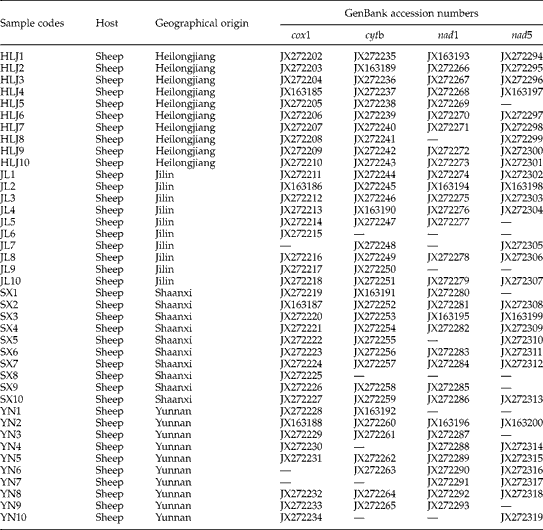
All adult hookworms of B. trigonocephalum were collected from the small intestine of sheep from Heilongjiang Province (HLJ1–HLJ10), Jilin Province (JL1–JL10), Shaanxi Province (SX1–SX10) and Yunnan Province (YN1–YN10) in China (table 1). Individual hookworms were washed extensively in physiological saline, identified to species according to their morphological features, using existing keys and descriptions (Taylor et al., Reference Taylor, Coop and Wall2007), and then fixed in 70% ethanol until the extraction of genomic DNA.
Geographical origins in provinces in China of Bunostomum trigonocephalum samples used in the present study, as well as the GenBank accession numbers for sequences of partial mitochondrial cytochrome c oxidase subunit 1 gene (cox1), NADH dehydrogenase subunit 1 gene (nad1), NADH dehydrogenase subunit 5 gene (nad5) and cytochrome b gene (cytb).

— Indicates that the samples have identical sequences with some of those having GenBank accession numbers.
Extraction of genomic DNA
Total genomic DNA was extracted from individual hookworms by treatment with sodium dodecyl sulphate/proteinase K (0.5 m NaCl, 0.1 m Tris-HCl, pH 8.0, 50 mm EDTA, 10% sodium dodecyl sulphate (SDS), 20 mg/ml protease K) at 37°C overnight, and then de-activated at 95°C. Then, the genomic DNA was extracted by phenol/chloroform, precipitated by ethanol and then dissolved in 30 μl double-distilled water, as described previously (Wang et al., Reference Wang, Gao, Zhu and Zhao2012). DNA samples were stored at − 20°C until further use.
Enzymatic amplification and sequencing
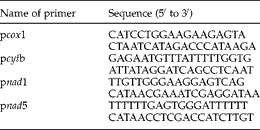
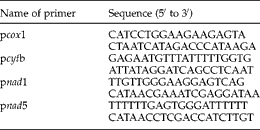
A portion of the cox1, cytb, nad1 and nad5 were amplified individually by polymerase chain reaction (PCR) using the primers listed in table 2. One microlitre of DNA template was used in a PCR reaction of 25 μl containing 10 mm Tris-HCl (pH 8.4), 50 mm KCl, 2 mm MgCl2, 200 mm each deoxynucleoside triphosphate (dNTP), 50 pmol of each primer and 2 U Taq polymerase (Takara, Dalian, China) in a thermocycler (Bioer Technology, Japan) under the following conditions: after an initial denaturation at 94°C for 5 min, then 94°C for 30 s (denaturation); 48°C (for pcox1 and pcytb) or 50°C (for pnad1 and pnad5) for 30 s (annealing); 72°C for 1 min (for nad1 and nad5) or 45 s (for cox1 and cytb) (extension) for 35 cycles, followed by a final extension at 72°C for 5 min. These cycling conditions were optimized for the efficient and specific amplification of individual mtDNA fragments through varying annealing temperatures. Samples without genomic DNA (no-DNA controls) and host (sheep) genomic DNA (host-DNA controls) were included in each amplification run, and in no case were amplicons detected in the no-DNA and host-DNA controls (not shown). Each amplicon (5 μl) was examined by agarose gel (1%) electrophoresis to validate amplification efficiency. PCR products were sent to Sangon Company (Shanghai, China) for sequencing from both directions using the primers used in primary amplification.
Primers used to amplify a part of the cytochrome c oxidase subunit (cox1), cytochrome b (cytb) and NADH dehydrogenase subunits 1 and 5 (nad1 and nad5) from Bunostomum trigonocephalum. The upper and lower sequences are forward and reverse primers for each primer pair, respectively.
Sequence analyses and phylogenetic reconstruction
Sequences of the four mtDNA regions were separately aligned utilizing the computer program Clustal X 1.83 (Thompson et al., Reference Thompson, Gibson, Plewniak, Jeanmougin and Higgins1997). Then, the level of sequence differences (D) among different B. trigonocephalum samples were calculated by pairwise sequence comparisons (Chilton et al., Reference Chilton, Gasser and Beveridge1995). The haplotypes of each gene were determined using the DnaSP 5.0 program (Librado & Rozas, Reference Librado and Rozas2009). Inter-specific sequence differences in the four mtDNA regions among members of the family Ancylostomatidae were determined by comparison with corresponding sequences of Ancylostoma caninum (NC_012309), Ancylostoma duodenale (NC_003415) and Necator americanus (NC_003416). The phylogenetic relationship among all B. trigonocephalum samples was reconstructed based on the combined partial sequences of cox1, cytb, nad1 and nad5 using B. phlebotomum (NC_012308) as the outgroup. Three inference methods, namely Bayesian inference (Bayes), maximum likelihood (ML) and maximum parsimony (MP) were used for phylogenetic reconstructions. MP analyses were carried out using PAUP 4.0 Beta 10 program (Swofford, Reference Swofford2002), Bayes analyses were performed using MrBayes 3.1 (Ronquist & Huelsenbeck, Reference Ronquist and Huelsenbeck2003), and ML analyses using PUZZLE 4.1 (Strimmer & Haeseler, Reference Strimmer and Haeseler1996). The consensus tree was obtained after bootstrap analysis with 1000 replications, with values above 50% being reported. Phylograms were drawn using the Tree View program version 1.65 (Page, Reference Page1996).
Results and discussion
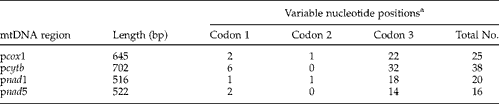
The partial sequences of cox1, cytb, nad1 and nad5 were amplified individually from 40 B. trigonocephalum samples (table 1) and subjected to agarose gel eletrophoresis. The PCR products were approximately 690 bp, 750 bp, 560 bp and 570 bp (not shown) in length, respectively. For each mtDNA region, no size variation was detected on agarose gel among any of the amplicons examined. Then all the positive amplicons were subjected to sequencing. The sequences of pcox1, pcytb, pnad1 and pnad5 were 645, 702, 516 and 522 bp in length, respectively. The A+T contents of the sequences were 69.6–70.4% (pcox1), 71.9–72.7% (pcytb), 70.4–71.1% (pnad1) and 72.0–72.6% (pnad5), consistent with previous reports of the A+T contents for parasitic nematodes (Hu et al., Reference Hu, D'Amelio, Zhu, Paggi and Gasser2001; Li et al., Reference Li, Lin, Song, Sani, Wu and Zhu2008). Thirty-seven haplotypes were observed among pcox1 sequences, 35 haplotypes were observed among pcytb sequences, 32 haplotypes were observed among pnad1 sequences and 30 haplotypes were observed among pnad5 sequences. The intra-specific sequence variations within B. trigonocephalum were 0–1.9% for pcox1, 0–2.0% for pcytb, 0–1.6% for pnad1 and 0–1.7% for pnad5. However, the inter-specific sequence differences among members of the family Ancylostomatidae were significantly higher, being 12.1–14.2% for pcox1, 13.7–16.0 for cytb, 17.6–19.4 for nad1 and 16.0–21.6 for nad5, which was consistent with that of a recent study using internal transcribed spacer (ITS) sequences (Wang et al., Reference Wang, Gao, Zhu and Zhao2012). For pcox1, pcytb, pnad1 and pnad5, the nucleotide variation was related mainly to changes at the third codon position, while fewer changes were detected at the first and second codon positions (table 3), consistent with results of other helminths (Li et al., Reference Li, Lin, Song, Sani, Wu and Zhu2008; Dai et al., Reference Dai, Liu, Song, Lin, Yuan, Li, Huang, Liu and Zhu2012; Liu et al., Reference Liu, Li, Li, Song, Lin, Cai, Zou, Yan, Yuan, Zhou and Zhu2012a).
Number and position of nucleotide variations in a part of the cytochrome c oxidase subunit (cox1), cytochrome b (cytb) and NADH dehydrogenase subunits 1 and 5 (nad1 and nad5) among Bunostomum trigonocephalum from different geographical locations in China.
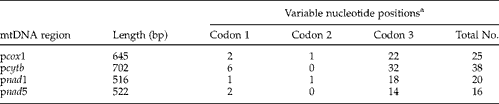
a The first codon position of each sequence was determined in relation to the complete mitochondrial DNA sequence of B. phlebotomum (NC_012308).
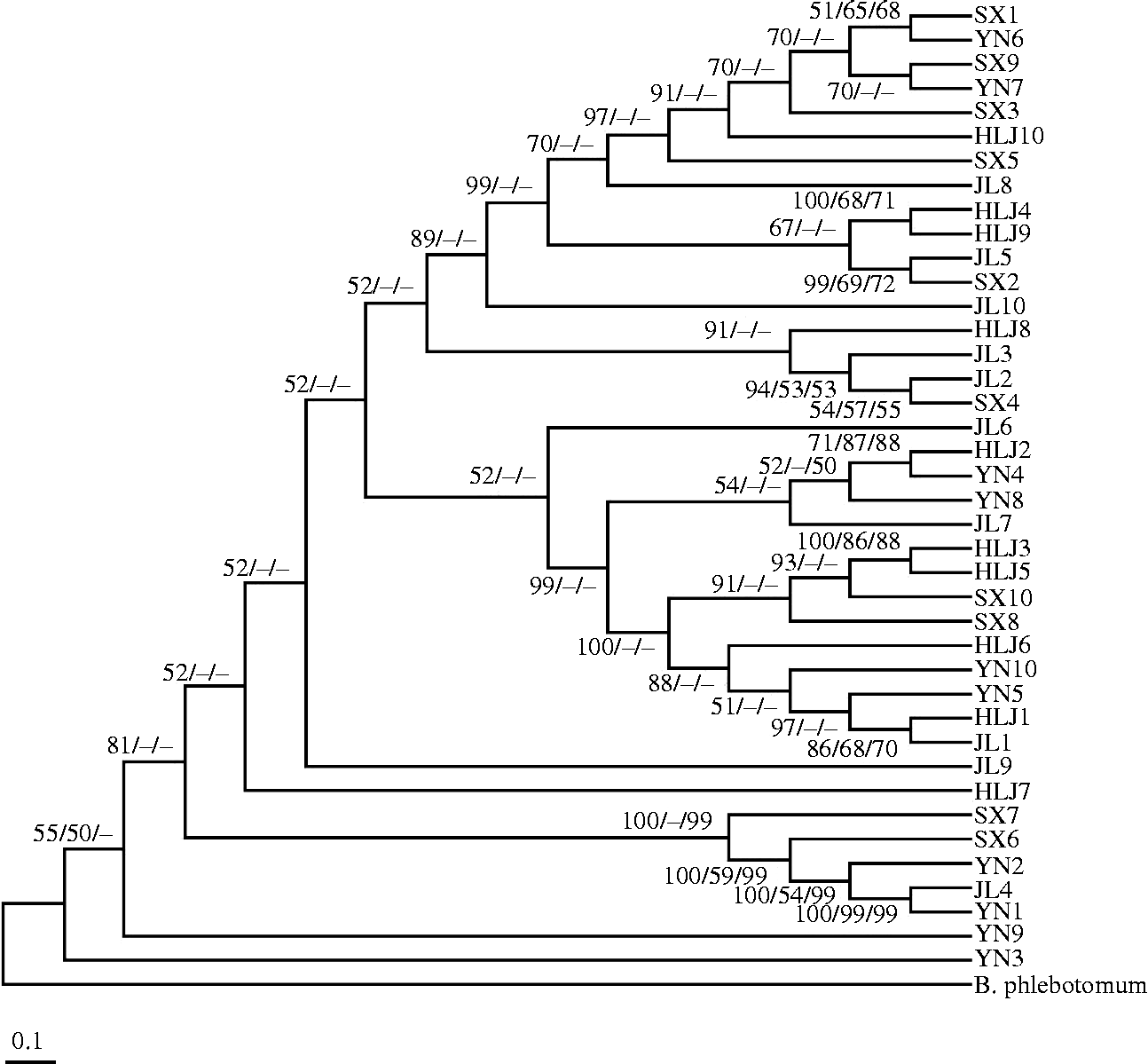
The sequences of pcox1, pcytb, pnad1 and pnad5 of B. trigonocephalum collected from different geographical origins in China were combined and aligned (2385 bp), and used for phylogenetic analysis. The TrN+I+G model with its parameter for the concatenated dataset was determined for the ML analysis using Modeltest (Posada & Crandall, Reference Posada and Crandall1998) based on the Akaike information criterion (AIC). Topologies of all trees inferred by different methods (MP, Bayes, ML) with different building strategies and/or different distance models were identical or similar, with only a small difference of bootstrap values (fig. 1). The phylogenetic tree showed that samples of B. trigonocephalum form monophyletic groups, but samples from the same geographical origin did not always cluster together, suggesting that there was no obvious geographical distinction within B. trigonocephalum based on sequences of the four mtDNA genes. Therefore, other, more variable, molecular makers and more samples from broader geographical localities should be employed in further studies to better elucidate the population genetic structures of B. trigonocephalum.
The bootstrap consensus phylogram of the stationary trees reconstructed by Bayesian inference (Bayes), maximum likelihood (ML) and maximum parsimony (MP) of phylogenetic relationships among Bunostomum trigonocephalum samples from sheep in different geographical locations in China, based on the combined data set (pcox1+pnad1+pnad5+pcytb), using B. phlebotomum (NC_012308) as the outgroup. The numbers along branches indicate bootstrap values resulting from different analyses in the order: Bayes/ML/MP. Values lower than 50 are given as dashes.
In conclusion, the present study determined the partial sequences of cox1, cytb, nad1 and nad5 from 40 B. trigonocephalum samples from four different provinces in China. Comparative analyses revealed low-level intra-specific variation in cox1, cytb, nad1 and nad5 sequences among B. trigonocephalum samples in China.
Acknowledgements
This work was supported, in part, by the Open Funds of the State Key Laboratory of Veterinary Etiological Biology, Lanzhou Veterinary Research Institute, Chinese Academy of Agricultural Sciences (Grant Nos. SKLVEB2009KFKT004, SKLVEB2011KFKT011, SKLVEB2010KFKT009, SKLVEB2011KFKT010 and SKLVEB2011KFKT004), the Program for Innovative Research Teams in Universities in Heilongjiang Province (Grant No. 2010td05), the Program for Outstanding Scientists in Agricultural Research and the Yunnan Provincial Program for Introducing High-level Scientists (Grant No. 2009CI125).