Infections caused by carbapenem-resistant Klebsiella pneumoniae (CRKP) pose a major clinical and public health challenge due to their high mortality rates and limited treatment options. Reference Martin, Fahrbach, Zhao and Lodise1 The burden of CRKP is especially high among chronically, critically ill (CCI) patients due to their extensive healthcare and antibiotic exposures. Colonization rates among patients in long-term acute-care hospitals (LTACHs), which serve as a site of post-acute care for CCI patients, have been reported to be 8- to 9-fold higher than those of patients in short-stay acute-care hospitals. Reference Marquez, Terashita, Dassey and Mascola2 Although therapies for CRKP infections now include several β-lactam/β-lactamase inhibitor combinations including ceftazidime-avibactam, meropenem-vaborbactam, and imipenem-relebactam, as well as the aminoglycoside plazomicin, resistance to these agents is poorly characterized among CRKP in the post–acute-care setting. We describe the antimicrobial resistance profiles of CRKP isolates from patients in a multistate sample of LTACHs.
Methods
Study setting
This study was conducted from August 1, 2014, through July 25, 2015, at 21 LTACHs within a national LTACH network. LTACHs were distributed across 4 US states: 12 LTACHs in southern California including 11 in Los Angeles and 1 in San Diego; 6 LTACHs in Houston, Texas; 2 LTACHs in Tampa, Florida; and 1 LTACH in Louisville, Kentucky.
CRKP collection
CRKP isolates from blood, respiratory, urine, or wound cultures were collected from patients in participating LTACHs. CRKP was identified, according to 2015 US Centers for Disease Control and Prevention (CDC) criteria, as K. pneumoniae with a meropenem or imipenem minimum inhibitory concentration (MIC) of ≥4 µg/mL or an ertapenem MIC of ≥2 µg/mL, according to testing performed by the clinical microbiology laboratories that service the participating LTACHs. 3 Confirmatory testing of isolates has been previously described. Reference Han, Lapp and Bushman4 Among patients with >1 CRKP isolate during the study period, only the first isolate was included.
Antibiotic susceptibility testing
Antimicrobial susceptibility testing for meropenem-vaborbactam, imipenem-relebactam, ceftazidime-avibactam, amikacin, plazomicin, tigecycline, and colistin were performed using a custom Sensititre colorimetric broth microdilution panel (ThermoFisher, Waltham, MA). Reference Matuschek, Ahman, Webster and Kahlmeter5,Reference Jones, Holliday and Krause6 2021 Clinical and Laboratory Standard Institute (CLSI) interpretative criteria were used for all agents except for tigecycline and plazomicin, for which US Food and Drug Administration (FDA) break points were used. 7,8 Antibiotic nonsusceptibility was defined as an MIC in the intermediate or resistant category.
Phylogenetic analysis
Whole-genome sequencing (WGS), variant calling, and phylogenetic tree reconstruction were performed as described by Han et al. Reference Han, Lapp and Bushman4 and Lapp et al. Reference Lapp, Han, Wiens, Goldstein, Lautenbach and Snitkin9 Phylogenies were visualized in R version 4.2.0 using ggtree version 3.4.0, ggnewscale version 0.4.7, phytools version 1.0-3, and cowplot version 1.1.1 packages. Reference Yu, Smith, Zhu and Guan10–Reference Wilke, Wickham and Wilke12 Due to the enrichment of sequence type (ST) 258 in the data set, the phylogenies of ST258 and non-ST258 isolates were visualized separately. 7 isolates were excluded from phylogenetic analysis due to low sequencing or assembly quality. Kleborate version 2.0.4 (https://github.com/katholt/Kleborate/releases) was used to identify and classify β-lactamase genes. Reference Lam, Wick, Watts, Cerdeira, Wyres and Holt13
Statistical analyses
Data were analyzed using Stata IC version 16.1 software (StataCorp, College Station, TX). Bivariate comparisons were performed using the Fisher exact test or the Pearson χ Reference Marquez, Terashita, Dassey and Mascola2 test. Two-tailed P values are reported.
Results
In total, 375 CRKP isolates were collected: 198 (52.8%) respiratory isolates, 133 (35.5%) urine isolates, 34 (9.1%) blood isolates, and 10 (2.7%) wound isolates. Among them, 336 (89.6%) were from patients in southern California; 29 (7.7%) were from patients in Texas, 9 (2.4%) were from patients in Florida, and 1 (0.3%) was from a patient in Kentucky. Colistin resistance was observed in 128 (34.1%) isolates. Amikacin nonsusceptibility was observed in 124 isolates (33.1%; 113 [30.1%] intermediate and 11 [2.9%] resistant). Tigecycline nonsusceptibility was observed in 10 isolates (2.7%; 9 [2.4%] intermediate and 1 [0.3%] resistant).
Regarding newer agents, 37 isolates (9.9%) were nonsusceptible to meropenem-vaborbactam (20 [5.3%] intermediate and 17 [4.5%] resistant); 34 isolates (9.1%) were nonsusceptible to imipenem-relebactam (20 [5.3%] intermediate and 14 [3.7%] resistant); 4 isolates (1.1%) were resistant to ceftazidime-avibactam; and 3 isolates (0.8%) were nonsusceptible to plazomicin (2 [0.5%] intermediate and 1 [0.3%] resistant) (Fig. 1 and Supplementary Fig. 1 online). Among colistin-resistant isolates, 9 (7.0%) were nonsusceptible to meropenem-vaborbactam, 14 (10.9%) were nonsusceptible to imipenem-relebactam, 3 (2.3%) were nonsusceptible to ceftazidime-avibactam, and 2 (1.6%) were nonsusceptible to plazomicin. 18 meropenem-vaborbactam nonsusceptible isolates (48.6%) also demonstrated nonsusceptibility to imipenem-relebactam, and 4 (10.8%) also demonstrated nonsusceptibility to ceftazidime-avibactam. Among imipenem-relebactam nonsusceptible isolates, 18 (52.9%) were nonsusceptible to meropenem-vaborbactam and 4 (11.8%) were nonsusceptible to ceftazidime-avibactam (Supplementary Fig. 2 online).
(A) Overall antimicrobial susceptibility interpretations and (B) prevalence of nonsusceptibility by anatomic source among carbapenem-resistant Klebsiella pneumoniae isolates, August 2014 through July 2015. In panel B, isolates with colistin minimum inhibitory concentration ≥4 µg/mL are denoted as “nonsusceptible.” Note. AMK, amikacin; CST, colistin; CZA, ceftazidime-avibactam; I-R, imipenem-relebactam; MVB, meropenem-vaborbactam; PLZ, plazomicin; TGC, tigecycline; resp, respiratory.

The prevalences of meropenem-vaborbactam nonsusceptibility by anatomic source were as follows: 20 (15.0%) of 133 urinary isolates, 14 (7.1%) of 198 respiratory isolates, 3 (8.8%) of 34 blood isolates, and 0 (0%) of 10 wound isolates (P = .095). The prevalences of imipenem-relebactam nonsusceptibility by anatomic source were as follows: 15 (11.3%) of 133 urinary isolates, 17 (8.6%) of 198 respiratory isolates, 1 (2.9%) of 34 blood isolates, and 1 (10.0%) of 10 wound isolates (P = .44). Nonsusceptibility did not differ significantly by geographic region for either meropenem-vaborbactam (P = .91) or imipenem-relebactam (P = .50). Among isolates collected from southern California, the prevalence of meropenem-vaborbactam nonsusceptibility differed by facility (P = .009), ranging from 0% to 26.7% (Supplementary Table 1 online). In contrast, imipenem-relebactam nonsusceptibility did not significantly differ by facility (P = .17).
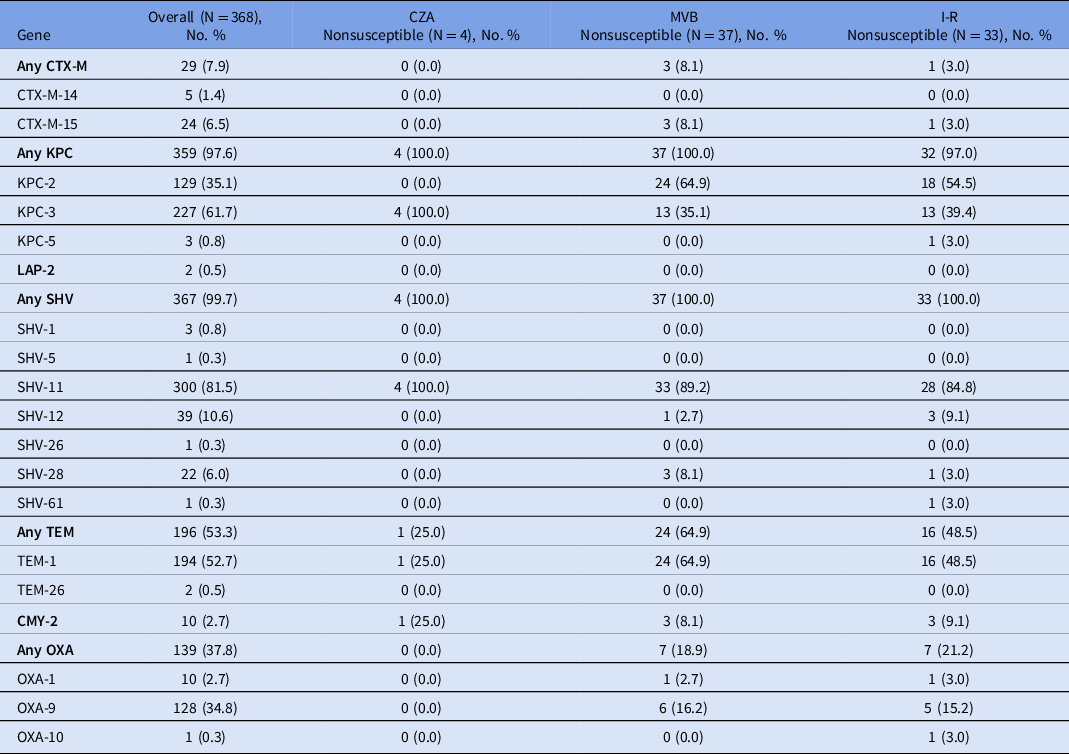
Of 368 whole-genome sequenced CRKP isolates, 335 (91.0%) were ST258 (Supplementary Fig. 3 online). All ceftazidime-avibactam nonsusceptible isolates were ST258. ST258 isolates comprised 34 (91.9%) meropenem-vaborbactam nonsusceptible isolates, with the remaining 3 belonging to ST307. Among imipenem-relebactam nonsusceptible isolates, 31 (93.9%) were ST258, 1 was ST193, and 1 was ST307. Plazomicin nonsusceptible isolates included 2 ST258 and 1 ST193. The resistance genes detected among isolates are summarized in Table 1.
Beta-Lactamase Genes detected Among Carbapenem-Resistant Klebsiella pneumoniae Clinical Isolates in Long-Term Acute-Care Hospitals (LTACHs), August 2014 through July 2015

Note. CZA, ceftazidime-avibactam; MVB, meropenem-vaborbactam; I-R, imipenem-relebactam; CTX-M, plasmid-mediated cefotaximase; KPC, Klebsiella pneumoniae carbapenemase; SHV, sulfhydryl variable; TEM, temoniera; OXA, oxacillinase.
Discussion
Although a high prevalence of colistin and amikacin nonsusceptibility was observed in this collection of CRKP isolates from patients in LTACHs, most were susceptible to newer antimicrobials including ceftazidime-avibactam, imipenem-relebactam, meropenem-vaborbactam, and plazomicin. Additionally, >90% of isolates that were nonsusceptible to either of the carbapenem/β-lactamase inhibitors retained susceptibility to ceftazidime-avibactam. In contrast, a previous study reported that only 6 (60%) of 10 meropenem-vaborbactam nonsusceptible KPC-positive Enterobacterales isolates from a global repository were ceftazidime-avibactam susceptible. Reference Hackel, Lomovskaya, Dudley, Karlowsky and Sahm14 However, we did note a high prevalence of cross resistance between meropenem-vaborbactam and imipenem-relebactam, for which mechanisms should be investigated in future studies. Notably, our CRKP isolates were collected prior to the widespread use of ceftazidime-avibactam, meropenem-vaborbactam, imipenem-relebactam, or plazomicin. Of these, ceftazidime-avibactam was the only agent to be granted FDA approval during the study period. Because resistance patterns may have evolved since the introduction of these agents into clinical practice, this study should be repeated in a contemporary sample.
This study had some limitations. Most isolates in this study were from patients in southern California, limiting generalizability to other geographic regions. Additionally, the findings of this study may not apply to other patient populations.
In conclusion, susceptibility to the novel β-lactam/β-lactamase inhibitor combinations and plazomicin were common in this collection of CRKP isolates from patients in LTACHs. These findings may help inform antibiotic formulary and empiric treatment decisions for CCI patients with suspected CRKP infection in the post–acute-care setting.
Supplementary material
To view supplementary material for this article, please visit https://doi.org/10.1017/ice.2022.185
Acknowledgments
The authors thank all participating ScionHealth/Kindred Healthcare facilities for their collaboration in this study. Any opinions, findings, and conclusions or recommendations expressed in this material are ours and do not necessarily reflect the views of the National Science Foundation.
Financial support
This work was supported by the National Institute for Allergy and Infectious Diseases (grant no. K01-AI103028 to J.H.H and grant no. T32-AI055435 to H.L.Z.) and the National Human Genome Research Institute (grant no. T32-HG000040 to K.J.G.) at the National Institutes of Health. This work was also supported by a CDC Cooperative Agreement (no. FOA#CK16-004-Epicenters for the Prevention of Healthcare Associated Infections to E.L.). Z.L. received support from the National Science Foundation Graduate Research Fellowship Program (grant no. DGE 1256260).
Conflicts of interest
J.H.H. is an employee of, and holds shares in, the GlaxoSmithKline group of companies.