Implications
We studied in vivo regulation of cytochrome P450 (CYP450) 1A, 2A and 2E1 activities in uncastrated male pigs with high concentrations of testicular steroids, and surgically and immunologically castrated pigs with low steroid concentrations. We confirmed an association between steroids and CYP450 expression. We suggest that this regulation occurs at the transcriptional level, as indicated by suppressed CYP450 mRNA in uncastrated pigs. This suppression was not always reflected in decreased activities, suggesting that at least some CYP450s (e.g. CYP2E1) are regulated by a post-transcriptional mechanism. These results contribute to the knowledge on porcine CYP450 and its in vivo regulation by testicular steroids.
Introduction
The role of gender in the regulation of cytochrome P450 (CYP450) 1A, 2A and 2E1 enzyme activities is well established (Zamaratskaia and Squires, Reference Zamaratskaia and Squires2009). It is likely that gender-related differences are due to the presence of testicular steroids affecting CYP450 enzymes (Whittington et al., Reference Whittington, Nute, Hughes, McGivan, Lean, Wood and Doran2004; Kojima et al., Reference Kojima, Sekimoto and Degawa2008; Zamaratskaia et al., Reference Zamaratskaia, Zlabek, Chen and Madej2009). Androstenone and oestrogens, which are produced in high amounts in the testicles of male pigs, were suggested to be particularly important in this modulation (Zamaratskaia et al., Reference Zamaratskaia, Gilmore, Lundström and Squires2007 and Reference Zamaratskaia, Rasmussen, Herbin, Ekstrand and Zlabek2011). Studies investigating the interaction between testicular steroids and selected CYP450 have shown an effect both in vitro (Doran et al., Reference Doran, Whittington, Wood and McGivan2002a; Zamaratskaia et al., Reference Zamaratskaia, Gilmore, Lundström and Squires2007; Chen et al., Reference Chen, Cue, Lundström, Wood and Doran2008; Rasmussen et al., Reference Rasmussen, Zamaratskaia and Ekstrand2011b) and in vivo (Whittington et al., Reference Whittington, Nute, Hughes, McGivan, Lean, Wood and Doran2004; Kojima et al., Reference Kojima, Sekimoto and Degawa2008; Zamaratskaia et al., Reference Zamaratskaia, Oskam, Ropstad, Tajet, Dahl and Andresen2008 and Reference Zamaratskaia, Zlabek, Chen and Madej2009). However, whether the in vivo effect of testicular steroids on hepatic enzymes is mediated by the hormones themselves, or indirectly through other agents, such as growth hormone or IGFs, is not known.
Surgical castration and vaccination with Improvac block the biosynthesis of testicular steroids, and are thus valuable tools for investigating in vivo effects of testicular steroids on CYP450. Both surgical castration and active immunisation against gonadotropin-releasing hormone (GnRH) by vaccinating with Improvac increase the activity of hepatic CYP450, including the isoforms CYP1A, CYP2A and CYP2E1 (Gillberg et al., Reference Gillberg, Skaanild and Friis2006, Zamaratskaia et al., Reference Zamaratskaia, Chen and Lundström2006 and Reference Zamaratskaia, Zlabek, Chen and Madej2009). In addition, surgical castration increases CYP1A and CYP2A mRNA and protein expression and enzyme activities (Gillberg et al., Reference Gillberg, Skaanild and Friis2006; Kojima et al., Reference Kojima, Sekimoto and Degawa2008) and also the expression of hepatic CYP2E1 protein (Whittington et al., Reference Whittington, Nute, Hughes, McGivan, Lean, Wood and Doran2004). These isoforms are of special interest for meat scientists because they are involved in the metabolism of skatole (a metabolite of tryptophan in the intestine), which together with androstenone (a testicular steroid), contributes to boar taint in pork from entire male pigs. Thus, the isoforms CYP1A2, CYP2A and CYP2E1 were selected for study.
The hypothesis that the increased CYP450 activity in pigs vaccinated with Improvac arises from the induction or reduced suppression of gene expression has not previously been examined. Thus, the aim of this study was to investigate the effects of surgical castration and vaccination with Improvac on CYP1A, CYP2A and CYP2E1 activities in pig liver microsomes and elucidate the mechanisms responsible for any differences by comparing gene and protein expression for these enzymes in the liver from the same pigs. In addition, we investigated the effect of timing of Improvac administration on CYP1A, CYP2A and CYP2E1 mRNA and protein expression and enzyme activity by comparing two groups of pigs vaccinated with Improvac: pigs vaccinated when aged 11 and 15 weeks (early vaccinated) and pigs vaccinated when aged 17 and 21 weeks (standard vaccinated).
Material and methods
Animals, treatments and sampling
This study was part of a larger project investigating the effects of early vaccination of male pigs using a vaccine against GnRH (Improvac, Pfizer Ltd, Sandwich, Kent, UK). Other parts have focused on testicular histology and sperm morphology (Einarsson et al., Reference Einarsson, Brunius, Wallgren, Lundström, Andersson, Zamaratskaia and Rodriguez-Martinez2011), performance and behaviour (Andersson et al., Reference Andersson, Brunius, Zamaratskaia and Lundström2011), as well as boar taint, hormones and reproductive organs (unpublished). The study was performed in accordance with Swedish regulations for the use of pigs.
The 32 male cross-bred pigs (Swedish Yorkshire dams × Swedish Landrace sires) enrolled in this study were born and raised at the Swedish University of Agricultural Sciences Funbo-Lövsta experimental station. Eight pigs per treatment group were randomly selected from a population of pigs included in a larger project (Andersson et al., Reference Andersson, Brunius, Zamaratskaia and Lundström2011). Four treatment groups were enrolled. In the first group, piglets were surgically castrated without anaesthesia before the age of 1 week. Pigs in the second, early vaccination, group were vaccinated with Improvac when aged 11 weeks (76.4 ± 4.6 days; live weight (LW) 36.8 ± 5.3 kg) and 15 weeks (104.4 ± 4.6 days; LW 57.2 ± 6.1 kg). Pigs in the third, standard vaccination, group were vaccinated when aged 17 weeks (117.6 ± 6.4 days; LW 66.7 ± 6.1 kg) and 21 weeks (145.6 ± 6.4 days; LW 91.8 ± 8.5 kg). Pigs in the fourth, entire male, group were kept intact throughout the study. No placebo substance was administered. Testosterone and oestradiol concentrations in plasma from these selected animals 1 day before slaughter were measured by radioimmunoassay and enzyme immunoassay, respectively (Table 1).
Effect of treatment on hormone concentrations in plasma

Data are presented as medians with interquartile ranges within brackets. n = 8 per treatment group.
*Below detection limit.
Pigs of the same treatment were raised in pens of eight until slaughter (173.8 ± 5.5 days; LW 118.8 ± 7.7 kg). All pigs were fed the same commercial diet (12.4 MJ metabolisable energy per kg, digestible CP 13.5%) twice a day according to the standard feeding regimen for growing and finishing pigs in Sweden (Andersson et al., Reference Andersson, Schaub, Andersson, Lundström, Thomke and Hansson1997). Liver samples were taken at slaughter, immediately frozen in liquid nitrogen and stored at −80°C for further analysis.
Microsomal preparation
Microsomes were prepared by a calcium aggregation method using Tris-EDTA homogenisation buffer (Rasmussen et al., Reference Rasmussen, Ekstrand and Zamaratskaia2011a). Protein concentrations in the microsomes were assayed with a commercially available kit (Bio-Rad Laboratories Inc., Hercules, CA, USA) according to the manufacturer's instructions. Microsomes were diluted to a protein concentration of 4 mg/ml and stored at −80°C until use within 1 month of preparations.
Chemical analyses
Real-time RT-PCR
Isolation of mRNA, reverse transcription and PCR were performed as described by Rasmussen et al. (Reference Rasmussen, Zamaratskaia and Ekstrand2011d). Briefly, from approximately 10 mg frozen liver tissue, mRNA was isolated using an RNA isolation kit (RNeasy Mini Kit, VWR, Herlev, Denmark) and converted to cDNA by the use of SuperScript II RNase H Reverse Transcriptase and Oligo(dT)12-18 primer (Invitrogen, Carlsbad, CA, USA), according to the manufacturer's instructions. The mRNA content of the samples was assessed using PCR with specific primers and a TaqMan probe. Sequences of the primers and probes used were described by Rasmussen et al. (Reference Rasmussen, Zamaratskaia and Ekstrand2011d). Relative mRNA expression was calculated from the obtained Ct values and normalised against mRNA expression of glyceraldehyde-3-phosphate dehydrogenase. The average expression in the group of entire male pigs was arbitrarily set to 1.
Western blot
Western blotting was performed according to Rasmussen et al. (Reference Rasmussen, Zamaratskaia and Ekstrand2011c). Briefly, an equal amount of microsomal protein was loaded in each lane and separated on a 12% Tris-Bis (Bio-Rad) gel and electroblotted on to a polyvinylidene fluoride membrane. After blocking with 2% Tween 20, the membrane was incubated over night with primary antibodies. Following several washing steps, the membrane was incubated with Alexaflour 488-attached secondary antibodies at room temperature for 90 min. The membrane was then washed several times before visualising the blots on a fluorescence scanner. The antibodies used were all raised against a human epitope, but have been shown to be specific against porcine CYPs (Rasmussen et al., Reference Rasmussen, Zamaratskaia and Ekstrand2011d). Relative protein expression was quantified using ImageJ 1.43u (National Institutes of Health, Bethesda, MD, USA) and expressed relative to the average of the group of entire male pigs.
Microsomal enzyme activity
The CYP-catalysed activities of the following enzymes were measured; 7-ethoxyresorufin O-deethylase (EROD; CYP1A1/1A2), 7-methoxyresorufin O-demethylase (MROD, CYP1A2), coumarin 7-hydroxylase (COH; CYP2A) and p-nitrophenol hydroxylase (PNPH; CYP2A/2E1). EROD and MROD activities were measured as described by Zamaratskaia and Zlabek (Reference Zamaratskaia and Zlabek2009), and COH activities as described by Zamaratskaia et al. (Reference Zamaratskaia, Zlabek, Chen and Madej2009).
The activity of PNPH was measured using a simplified HPLC-based method. Incubation conditions were described by Zamaratskaia et al. (Reference Zamaratskaia, Zlabek, Chen and Madej2009). The HPLC system consisted of a pump (L-6200A), autosampler (AS 2000), UV detector (L-4250) and D-7000 HSM software (Merck Hitachi, Tokyo, Japan). Chromatographic separation of p-nitrophenol and p-nitrocatechol was performed on a Hypersil ODS column (5 μm, 50 × 4.6 mm) equipped with a guard column. The mobile phase was delivered under isocratic conditions and consisted of A: 0.1% trifluoroacetic acid in water and B: 100% acetonitrile, in a composition of 75% A at a flow rate of 1.0 ml/min. Detection of p-nitrocatechol was achieved through UV absorption at 345 nm.
Statistical analyses
Data were analysed using SAS 9.2 (SAS Institute, Cary, NC, USA). The effect of treatment on mRNA and protein expression and enzymatic activity was evaluated using the mixed procedure on rank-transformed data, with treatment as a fixed factor. Pair-wise comparisons between treatments were obtained through the pdiff option. The Spearman correlations between measured variables were calculated for all pigs.
Results
As expected, concentrations of testosterone and oestradiol in plasma markedly differed between entire and castrated pigs (Table 1). Testosterone concentrations were detectable only in entire male pigs. Oestradiol concentrations were also higher in entire pigs compared with surgically castrated and immunocastrated pigs (Table 1).
Expression of mRNA
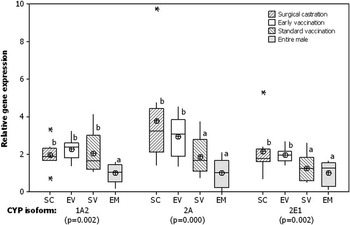
Treatment was significantly associated with mRNA expression of CYP1A2, 2A and 2E1 (Figure 1). Compared with entire male pigs, mRNA expression was higher for the three isoforms in surgically castrated (CYP1A2 +81%, P = 0.003; CYP2A +219%, P = 0.000; and CYP2E1 +40%, P = 0.003) and early-vaccinated pigs (CYP1A2 +129%, P = 0.000; CYP2A +205%, P = 0.000; and CYP2E1 +57%, P = 0.001). Expression in standard vaccinated pigs was higher only for CYP1A2 (+60%, P = 0.009).
Hepatic mRNA expression of cytochrome P450 (CYP450) 1A2, 2A and 2E1 in surgically castrated (SC), early-vaccinated (EV), standard vaccinated (SV) and entire male (EM) pigs. Data are presented as boxplots, with median and interquartile ranges (horizontal lines), mean value (⊕) and total range (extreme ends of vertical lines). Potential outliers (*) were not included in total range. Medians with different superscripts within each isoform differ (P < 0.05, pair-wise comparisons). The P-values in brackets indicate the overall effect.

Protein expression
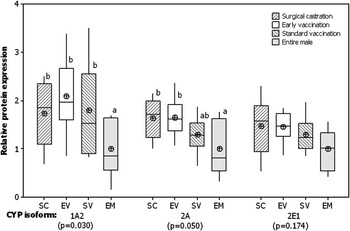
Protein expression differed between treatments for the different isoforms (Figure 2). Compared with entire male pigs, CYP1A2 and 2A protein expressions were higher in surgically castrated (CYP1A2 +118%, P = 0.032; CYP2A +109%, P = 0.021) and early-vaccinated pigs (CYP1A2 +131%, P = 0.005; CYP2A +97%, P = 0.020), whereas standard vaccinated pigs had higher expression only of CYP1A2 (+79%, P = 0.042; Figure 2). Large differences within treatments were observed in protein expression of all isoforms.
Protein expression of cytochrome P450 (CYP450) 1A2, 2A and 2E1 in microsomes from surgically castrated (SC), early-vaccinated (EV), standard vaccinated (SV) and entire male (EM) pigs. Data are presented as boxplots, with median and interquartile ranges (horizontal lines), mean value (⊕) and total range (extreme ends of vertical lines). Medians with different superscripts within each isoform differ (P < 0.05, pair-wise comparisons). The P-values in brackets indicate the overall effect.

Enzyme activity
Only CYP2A-dependent COH activity differed significantly between treatments (Table 2). Compared with entire male pigs, COH activity was 82% higher in surgically castrated pigs (P = 0.026), 81% higher in early-vaccinated pigs (P = 0.006) and 45% higher in standard vaccinated pigs (P = 0.043). Although the overall effect on the other isoforms was not significant, pair-wise comparisons showed higher EROD (+39%, P = 0.037) and MROD (+72%, P = 0.016) activities in early-vaccinated pigs, compared with those in entire male pigs.
Effect of treatment on CYP450 enzyme activities in porcine microsomes

CYP = cytochrome P450; EROD = 7-ethoxyresorufin O-deethylase, CYP1A; MROD = 7-methoxyresorufin O-demethylase, CYP1A2; COH = coumarin hydroxylase, CYP2A; PNPH = p-nitrophenol hydroxylase, CYP2E1.
Medians with different superscripts within each isoform differ (P < 0.05).
Data are presented as medians with interquartile ranges within brackets (pmol/min/mg). n = 8 per treatment group.
Relationship between mRNA, protein expression and enzymatic activities
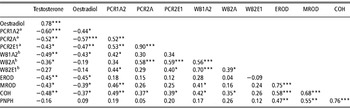
Expressions of mRNA and protein and enzyme activity were correlated for CYP1A and 2A (Table 3). For CYP2E1, a correlation was observed only between mRNA and protein expressions. Correlations were also observed between the isoforms at the levels of mRNA and protein expression and enzyme activity, respectively. Testosterone and oestradiol levels in plasma were negatively correlated with mRNA expression for all isoforms. Their correlations with protein expression and enzyme activities varied depending on isoform.
Spearman correlations between hormones in plasma, mRNA and protein expressions and activity of CYP1A2, 2A and 2E1

CYP = cytochrome P450; WB = Western blot; EROD = 7-ethoxyresorufin O-deethylase; MROD = 7-methoxyresorufin O-demethylase; COH = coumarin hydroxylase, CYP2A; PNPH = p-nitrophenol hydroxylase CYP2A/2E1.
The correlation analysis is preformed on the data set obtained by pooling data from all treatment groups (n = 32).
Significance level: *P < 0.05; **P < 0.01; ***P < 0.001.
aExpression of mRNA measured by PCR.
bProtein expression measured by WB.
Discussion
This study further investigated the influence of testicular steroids on CYP450 regulation in male pigs. Hepatic gene and protein expression, and enzyme activity of CYP1A, 2A and 2E1 were compared between pigs with high (entire male pigs) or low levels of testicular steroids (castrated pigs). Pigs were castrated either surgically or immunologically with Improvac. Castrated pigs are known to have higher activities of a number of CYP450 isoforms (Zamaratskaia et al., Reference Zamaratskaia, Zlabek, Chen and Madej2009). It is likely that the higher CYP450 activity (for at least some isoforms) is due to the absence or low levels of testicular steroids, which otherwise inhibit CYP450 expression at the level of transcription (Tambyrajah et al., Reference Tambyrajah, Doran, Wood and McGivan2004; Gillberg et al., Reference Gillberg, Skaanild and Friis2006; Kojima et al., Reference Kojima, Sekimoto and Degawa2008). Moreover, testicular steroids, particularly androstenone and oestradiol, are directly involved in the regulation of CYP2E1 activities (Zamaratskaia et al., Reference Zamaratskaia, Gilmore, Lundström and Squires2007 and Reference Zamaratskaia, Rasmussen, Herbin, Ekstrand and Zlabek2011; Rasmussen et al., Reference Rasmussen, Zamaratskaia and Ekstrand2011b). It should be emphasised that other steroids of testicular origin, as well as growth hormone and IGFs, may also be relevant in such regulation. To the best of our knowledge, no previous studies have examined the regulation of hepatic CYP1A, 2A and 2E1 activities in pigs vaccinated with Improvac. The only previous study investigating CYP450 after Improvac administration (Zamaratskaia et al., Reference Zamaratskaia, Zlabek, Chen and Madej2009) focused on the enzymatic activities of several isoforms and did not attempt to relate the activities to either gene or protein expression. That study suggested that the activities of EROD, COH and PNPH were higher in surgically castrated and vaccinated pigs compared with entire male pigs at normal slaughter age and weight.
Activities of CYP1A, 2A and 2E1 in this study were estimated as EROD/MROD, COH and PNPH activities, respectively. The selection of the substrates was based on our previous results. It is known that substrate specificities of CYP1A1 and CYP1A2 can overlap. In pigs, the substrate probes 7-ethoxyresorufin and 7-methoxyresorufin are not highly specific in their recognition of CYP1A1 and CYP1A2 (Zamaratskaia and Zlabek, Reference Zamaratskaia and Zlabek2009). To increase the accuracy in estimation of CYP1A activity in this study, we used both substrates. The specificity of PNPH in the estimation of porcine CYP2E1 activity is also questionable. It was suggested that this reaction can be mediated by both CYP2A and CYP2E1 (Skaanild and Friis, Reference Skaanild and Friis2007). However, our recent study indicated that one single enzyme was responsible for p-nitrophenol hydroxylation, suggesting that an involvement of CYP2A is minor, if any (Zamaratskaia et al., Reference Zamaratskaia, Rasmussen, Herbin, Ekstrand and Zlabek2011). COH is believed to be a specific reaction to estimate CYP2A activity (Gillberg et al., Reference Gillberg, Skaanild and Friis2006).
Our study showed that EROD, MROD and COH activities in hepatic microsomes varied in pigs with different levels of testicular steroids. These results concur with the results of Zamaratskaia et al. (Reference Zamaratskaia, Zlabek, Chen and Madej2009), who observed similar trends for EROD and COH. In that study, however, a difference in PNPH activity was also observed, with higher activity in surgically castrated and standard vaccinated pigs compared with entire male pigs. This discrepancy is surprising because Zamaratskaia et al. (Reference Zamaratskaia, Zlabek, Chen and Madej2009) and this study used pigs of the same breed, and samples were taken at approximately the same age and LW.
The differences in activities were much lower compared with the differences in mRNA and protein expression of corresponding isoforms. The higher expression of CYP450 mRNA found in surgically castrated and early-vaccinated pigs imply that castration, whether by surgical or immunological means, upregulates gene expression. Possible explanations for the differences in gene expression of investigated CYP450 could be due to interactions between testicular steroids and proteins involved in transcriptional regulation of CYP450 genes.
The pattern observed for protein expression of CYP1A2 and CYP2A was similar to that for gene expression. This relation in combination with strong correlations between gene and protein expression indicates that protein expression is regulated by the expression of corresponding genes. Interestingly, increased mRNA expression of CYP2E1 did not result in increased protein expression and activity. This implies that porcine hepatic CYP2E1 is regulated by post-transcriptional stabilisation of the enzyme. Indeed, this mechanism of regulation is very common for CYP2E1 (Kocarek et al., Reference Kocarek, Zangar and Novak2000). Furthermore, in interpreting our results, methodological issues should also be taken into account, for example, the specificity of antibodies and substrate against CYP2E1 (Skaanild and Friis, Reference Skaanild and Friis2007).
Overall, mRNA and protein expression of the hepatic CYP1A2, 2A and 2E1 and their catalytic activities in early-vaccinated pigs were comparable with surgically castrated pigs. In standard vaccinated pigs, these parameters were more similar with those of entire male pigs. This could be due to the fact that early-vaccinated pigs had their testicular function suppressed 6 weeks earlier than standard vaccinated pigs, and that the testicular tissue never subsequently developed. Thus, a long-term suppression of testicular steroid production resulted in similar CYP450 characteristics in early-vaccinated and surgically castrated pigs. Interestingly, in this study, mRNA expression and protein expression and activities of hepatic CYP1A, 2A and 2E1 were similar in standard vaccinated and entire male pigs. Synthesis of testicular steroids in standard vaccinated pigs was blocked 4 weeks before liver samples were taken. It is likely that this was not sufficient time to completely remove the inhibitory effect of testicular steroids.
Large variations between individuals in hepatic mRNA or protein expression and activities of the investigated enzymes were observed in this study. It is known that CYP450 activities in pigs are affected by factors such as age and gender (Zamaratskaia et al., Reference Zamaratskaia, Chen and Lundström2006), gene polymorphism (Lin et al., Reference Lin, Lou and Squires2004; Skinner et al., Reference Skinner, Doran, McGivan, Haley and Archibald2005; Lin et al., Reference Lin, Lou and Squires2006) and feed components (Rasmussen et al., Reference Rasmussen, Zamaratskaia and Ekstrand2011c). In addition, the metabolic capacities of CYP450s is breed dependent (Doran et al., Reference Doran, Whittington, Wood and McGivan2002b).
It should be noted that our study had some limitations. First, the number of animals within each group was low, which limited our ability to accurately evaluate the effect of testicular steroids on CYP450. Second, our study used surgically castrated pigs and pigs vaccinated with Improvac as a model to study the effect of testicular steroids. However, it should be noted that other endocrine changes take place in surgically and immunologically castrated pigs, such as alterations in the levels of growth hormone and IGFs (Owens et al., Reference Owens, Gatford, Walton, Morley and Campbel1999; Metz and Claus, Reference Metz and Claus2003).
In summary, this study provides insights into the mechanism of in vivo regulation of hepatic CYP1A, CYP2A and CYP2E1 activities in pigs with different concentrations of circulating testicular steroids. An increase in mRNA expression measured by real-time RT-PCR suggests induction of CYP1A, CYP2A and CYP2E1 at the transcriptional level. However, this induction was not always followed by increased catalytic activities of these isoforms.
Conclusions
Expressions of mRNA of porcine CYP450 isoforms 1A, 2A and 2E1 and protein expression of CYP1A and 2A in the livers of castrated pigs were upregulated compared with entire male pigs. The degree of this upregulation was similar in surgically and early-vaccinated pigs. Although CYP1A-dependent EROD and MROD and 2A-dependent COH activities differed between early-vaccinated and entire male pigs, an overall effect of castration on CYP450 activity was significant only for COH. This suggests that mRNA and protein expression of porcine CYP450 isoforms 1A2, 2A and 2E1 are not precisely reflected in the activities of corresponding isoforms. Regulation of porcine CYP1A, CYP2A and CYP2E1 is probably more complex and needs further investigations.
Acknowledgements
This work was financially supported by the Swedish Board of Agriculture. Pfizer provided additional economical support and Improvac vaccine. We thank the staff at Funbo-Lövsta, especially Ulla Schmidt, for taking excellent care of the animals and collecting data. Eleonor Palmér, Johanna Zingmark, Gunilla Jacobsson and Rolf Grahm are gratefully acknowledged for their help during sampling. Isabelle Herbin is thanked for her help during microsome preparation. We also thank Kerstin Lundström for valuable discussions while preparing the manuscript.