Introduction
Longitudinal studies of older adults with comorbid conditions are characterized by two main features. First, missing data are common, especially when older adults are followed for a long period (Lavikainen et al., Reference Lavikainen, Leskinen, Hartikainen, Mottonen, Sulkava and Korhonen2015). Second, older adults often have multiple medical comorbidities resulting in multiple medications use (Lau et al., Reference Lau, Mercaldo, Harris, Trittschuh, Shega and Weintraub2010; Lim et al., Reference Lim2017). Older adults experience varying beneficial and harmful effects of multiple medications. Additionally, with advanced age, the use of multiple medications may contribute to adverse events, such as functional decline (Lau et al., Reference Lau, Mercaldo, Harris, Trittschuh, Shega and Weintraub2010), falls, fractures, hospitalization, cognitive impairment, and poorer clinical outcomes (Hilmer and Gnjidic, Reference Hilmer and Gnjidic2009).
Capturing medication use accurately in studies of older adults can be challenging. This is because missing data patterns in outcomes of medication use can either be (i) monotonic (due to attrition/dropout including death), that is, when a participant does not participate in any subsequent follow-up assessments after dropping out of study or (ii) intermittent, that is, when a participant returns to a subsequent follow-up having not participated in one or more previous follow-up assessments (Gavin and Myers, Reference Gavin and Myers2003; Shardell et al., Reference Shardell, Hicks and Ferrucci2013). Here, we define missing data patterns for dropout (i.e. for monotonic missingness). Missing data by dropout can follow three well-known mechanisms (Rubin, Reference Rubin1976; Little, Reference Little1995). First, missing data can occur completely at random (MCAR) if the probability of dropout does not depend upon the observed outcomes, such that there is no difference in the characteristics of those with incomplete data and those with complete data (Chan, Reference Chan2016). Second, dropout can occur at random (MAR) if the probability of dropping out depends on the observed outcomes and covariates at some time before dropping out, but not on the unobserved outcomes during or after dropout (Little, Reference Little1995; Chang et al., Reference Chang, Yang, Tang and Ganguli2009). Finally, missing data by dropout can be non-ignorable/informative, that is, missing not at random (MNAR) if the probability of a participant dropping out depends on their unobserved data (outcome and covariates) at the time of dropout.
Missing data is common and problematic in studies of older adults with cognitive impairment and dementia. Participants with dementia may drop out due to several reasons, such as death, inability to continue participating given their worsening conditions, or due to their relocation outside the study areas (Gao, Reference Gao2004). Generally, participants with multiple conditions are more likely to die than disease-free participants, and if covariates to account for this are not collected, the missing data may be non-ignorable. This suggests that missing data by death may be associated with the disease status and may lead to biased estimates. Moreover, because older adults with multimorbid conditions often take multiple medications concomitantly, the effect of disease on the use of medications for participants who dropped out of study may differ systematically from participants who completed the study (Chang et al., Reference Chang, Yang, Tang and Ganguli2009). When faced with such missing data complexities, some investigators analyze only complete-case data, under the assumption of MCAR. However, this approach can lead to biased conclusions and loss of power to detect significant associations, and is often unrealistic (Lavikainen et al., Reference Lavikainen, Leskinen, Hartikainen, Mottonen, Sulkava and Korhonen2015).
Dementia is becoming increasingly common in older adults and it typically occurs in the setting of multi-morbidity. There is emerging evidence that medication use may differ by common types of dementia. However, there is no consensus on whether individuals with Alzheimer's disease (AD) are healthier than individuals with other types of dementia (Eaker et al., Reference Eaker, Mickel, Chyou, Mueller-Rizner and Slusser2002; Imfeld et al., Reference Imfeld, Pernus, Jick and Meier2013). Therefore, the likelihood of dropping out may vary due to different medication profiles for underlying conditions and dementia types. As persons approach the end of life, they tend to have higher burden of diseases and medication to treat these conditions. Currently, there is limited research on the impact of dropout on the associations between dementia diagnosis and medication use. Dropout may lead to underestimation/overestimation of the associations; therefore, it is important that investigators account for dropout to ensure unbiased estimation of effects.
The aim of this research is to study the longitudinal association between medication use and incident diagnosis of three common types of dementia: AD, vascular dementia (VD), and Lewy-body dementia (LBD) simultaneously accounting for dropout due to death and other reasons for persons aged 65 years and older using data from the National Alzheimer's Coordinating Center (NACC).
Methods
Study design
The data used in this study were obtained from NACC. Detailed description of the NACC cohort is available elsewhere (Beekly et al., Reference Beekly2007; Weintraub et al., Reference Weintraub2009). In brief, NACC was established in 1999 to facilitate research related to AD. This cohort includes participants with AD and related disorders, participants who are cognitively normal and those with mild cognitive impairment. Participants were enrolled through Alzheimer's Disease Centers (ADCs) based in universities and other institutions in the USA. The NACC was established by funding from the National Institute on Aging. Participants underwent a comprehensive cognitive, behavioral, and functional assessment at their initial study visit and at annual follow-up visits until they were deceased or declined to further participate in the study.
Study sample
This sample included participants who had an incident dementia diagnosis at one of their follow-up assessments. Participants with an incident diagnosis of dementia were followed from the visit in which they were diagnosed with dementia (baseline) for up to three years. Participants were excluded if they were (1) < 65 years old at the time of incident dementia diagnosis; (2) had a diagnosis of dementia at their initial visit (prevalent dementia); (3) had only one NACC assessment; (4) were not diagnosed with dementia during the follow-up period, or had a primary dementia diagnosis of other pathology. Participants were deemed to have dementia if they met the standard criteria for dementia of the Alzheimer's type or for other non-Alzheimer's dementing disorders based on comprehensive neuropsychiatric battery or cognitive assessment with a trained ADC clinician (Mirra et al., Reference Mirra1991; Beach et al., Reference Beach, Monsell, Phillips and Kukull2012). This analysis used data from 34 ADCs. In this study, we included incident dementia cases only for the three mutually exclusive groups based on the clinician's determination of their primary etiology of dementia at the time of their incident dementia diagnosis:
1. AD (McKhann et al., Reference McKhann, Drachman, Folstein, Katzman, Price and Stadlan1984): A participant was considered to have AD if they met the criteria for dementia and had probable AD as the primary clinical diagnosis based on the National Institute of Neurological and Communicative Disorders and Stroke and the Alzheimer's Disease and Related Disorders Association criteria.
2. VD: We included participants identified with stroke, probable VD, possible VD, or any significant vascular brain injury as the primary cause of dementia.
3. LBD: Participants with LBD listed as the primary etiologic diagnosis on the Uniform Data Set clinician diagnosis form were included.
The analytic sample includes 2,306 participants who enrolled in NACC between 2005 and 2014 and had an incident diagnosis of AD (n = 2,032), VD (n = 135), and LBD (n = 139) after enrolment. We used three years of follow-up assessments after incident dementia diagnosis for these participants as presented in Supplementary Figure S1 (available as supplementary material attached to the electronic version of this paper at www.journals.cambridge.org/jid_IPG).
Medication exposure
Medication use assessment included a count of all medications a participant reported taking at each annual visit, including prescription and over-the-counter medications, supplements, and vitamins (Morris et al., Reference Morris2006). We further dichotomized the reported total number of medications at each assessment using two commonly used cut-offs: concomitant use of five or more medications (hereafter, polypharmacy (Gnjidic et al., Reference Gnjidic2012; Fried et al., Reference Fried, O'Leary, Towle, Goldstein, Trentalange and Martin2014; Sganga et al., Reference Sganga2015; Lim et al., Reference Lim2017)), and concomitant use of ten or more medications (hereafter, hyperpolypharmacy) and assessed the effect of three dementia types on polypharmacy, hyperpolypharmacy, and on the total number of medications.
Covariates
Covariates that may be related to medication use, dementia type, or dropout included age, gender, race (white versus non-white), cardiovascular disease (myocardial infarction, atrial fibrillation, angioplasty, coronary artery bypass graft surgery, pace maker, congestive heart failure, or other cardiovascular disease), diabetes (type 1 or type 2), depression, and psychiatric disorders.
Statistical methods
Descriptive statistics
We explored study participation and causes of dropout over the three-year follow-up. We examined systematic differences in the baseline (visit of incident dementia diagnosis) characteristics between participants who completed the three-year follow-up (hereafter, completers) and those who did not complete the study (hereafter, non-completers) using proportions for categorical variables and means for continuous variables, and tested the differences using Pearson χ 2 test and F-test, respectively. The MCAR assumption may be violated if there are significant differences in participants’ characteristics between non-completers and completers. We further explored the following four dropout patterns: (i) those with baseline data only, (ii) those with baseline and one-year follow-up data, (iii) those with baseline, one-year, and two-year follow-up data, and (iv) those with complete data for the three-year follow-up period. The means and 95% confidence intervals (CI) for these four groups were plotted by follow-up year to explore systematic differences between them. We further explored medication use over the three-year follow-up period for the whole cohort using means (and standard deviations) for the total number of prescription medications, and proportions for polypharmacy and hyperpolypharmacy. Finally, we explored the MAR assumption by assessing whether the probability of dropout at a given time point is predicted by the number of medications reported at the previous time point and other observed baseline characteristics using logistic regression.
Statistical modeling
First, we used separate models that estimate the effects of dementia types on medication use and ignore the dropout component. Then, we used joint models with shared random effects to model the association between medication use and dementia types (Gao, Reference Gao2004; Vonesh et al., Reference Vonesh, Greene and Schluchter2006). The joint model accounts for informative dropout. These models are described below.
Separate mixed effects models
We fit two naive mixed effects (fixed covariate effects and random intercept) models that ignore the specification of the dropout model in estimating the effect of dementia types on medication use (polypharmacy, hyperpolypharmacy, and total number of medications). First, we fit a mixed effects model to data for those who completed the three-year follow-up study (hereafter, separate model-complete case). Note that the separate model-complete case assumes MCAR, implying that participants who did not complete the three-year follow-up study do not differ from participants who completed the study in terms of their characteristics. Second, we fit a mixed effects model to the data from the whole cohort (hereafter, separate model-whole cohort). Note that the separate model-whole cohort assumes MAR. These separate models assume ignorable dropout, and that the association between dementia types and medication use does not depend on the probability of dropout. For total number of medications, we fit a Poisson mixed effects model adjusted for covariates previously listed, and for polypharmacy and hyperpolypharmacy, we fit logistic mixed effects models adjusted for covariates previously listed.
Longitudinal joint shared parameter model for medication use and dropout
Unlike separate mixed effects model, a longitudinal joint shared random effect model provides an intuitive approach in modeling the association between dementia types and medication use, simultaneously accounting for dropout due to death and other factors. The joint shared random effects modeling approach has the following advantages. First, it can handle informative dropout when the probability of dropout depends on the unobserved outcome at the time of dropout. Second, joint modeling can handle intermittent missing data patterns, and finally, the joint modeling approach can be applied if participants do not follow the same follow-up schedule; for instance, when participants have different interview intervals. It is common for the number of medications and a participant's probability to dropout to be related through observed participant's characteristics, such as disease status, gender, age, and through their unobserved characteristics. In the joint model, medication use (polypharmacy, hyperpolypharmacy, and total number of medications) and dropout are modeled jointly conditional on a participant's observed characteristics (listed above) and unobserved shared random effects. The shared random effects quantify the unobserved quantities that underlie a participant's probability to use multiple medications or to dropout. We illustrate the joint shared parameter model for polypharmacy and informative dropout. We denote polypharmacy reported at jth annual visit for the ith participant by Polyij, and a set of a participant's characteristics, namely, VD, LBD, depression (dep), diabetes (diab), gender (female = 1, male = 0), age (65–84 years vs. 85 years or older), race (white vs. non-white), cardiovascular disease (cardio_dis, present vs. absent), and psychiatric disorders (psychia, present vs. absent) by Xij, and the dropout indicator is denoted by Dropij. The joint shared parameter model for polypharmacy and dropout is defined by
 $$\begin{eqnarray*}
{\rm{Prob}}\big( {\rm{Pol}}{{\rm{y}}_{ij}} &=& 1{\rm{|}}X_{ij}^{\prime},{\mu _i} \big) = \varphi ({\alpha _0} + {\alpha _1}{\rm{V}}{{\rm{D}}_{ij}} \nonumber\\
&&+\, {\alpha _2}{\rm{LB}}{{\rm{D}}_{ij}} + {\alpha _3}{\rm{de}}{{\rm{p}}_{ij}} + {\alpha _4}{\rm{dia}}{{\rm{b}}_{ij}}\nonumber\\
&&+\, {\alpha _5}{\rm{femal}}{{\rm{e}}_i} + {\alpha _6}{\rm{ag}}{{\rm{e}}_{ij}} \nonumber\\
&&+\, {\alpha _7}{\rm{white}}\_{\rm{rac}}{{\rm{e}}_i} + {\alpha _8}{\rm{cardio}}\_{\rm{di}}{{\rm{s}}_{ij}} \nonumber\\
&&+\, {\alpha _9}{\rm{psychi}}{{\rm{a}}_{ij}} + {\mu _i}),
\end{eqnarray*}$$
 $$\begin{eqnarray*}
{\rm{Prob}}\big( {\rm{Dro}}{{\rm{p}}_{ij}} &=& 1{\rm{|}}X_{ij}^{\prime},{\mu _i} \big) = \varphi ({\beta _0} + {\beta _1}{\rm{V}}{{\rm{D}}_{ij}} \nonumber\\
&&+\, {\beta _2}{\rm{LB}}{{\rm{D}}_{ij}} + {\beta _3}{\rm{de}}{{\rm{p}}_{ij}} + {\beta _4}{\rm{dia}}{{\rm{b}}_{ij}} \nonumber\\
&& +\, {\beta _5}{\rm{femal}}{{\rm{e}}_i} + {\beta _6}{\rm{ag}}{{\rm{e}}_{ij}}\ \nonumber\\
&& +\, {\beta _7}\;{\rm{white}}\_{\rm{rac}}{{\rm{e}}_i} + {\beta _8}{\rm{cardio}}\_{\rm{di}}{{\rm{s}}_{ij}} \nonumber\\
&& +\, {\beta _9}{\rm{psychi}}{{\rm{a}}_{ij}} + \lambda {\mu _i}),
\end{eqnarray*}$$
where μi ~ N(0, σ2u) is the shared random effect that represents the unobserved factors underlying a participant's susceptibility to polypharmacy and to dropping out of the study, λ is a scalar multiplier that quantifies the random effects on the probability of a participant to drop out (Gao, Reference Gao2004), αi's and βi's quantify the effects; for instance, α1 for VD quantifies the odds of those diagnosed with incident VD to report polypharmacy relative to the odds of those diagnosed with AD, and φ is an inverse logit function.
These models were fit in SAS version 9.4 and using NLMIXED procedure.
Results
Descriptive measures
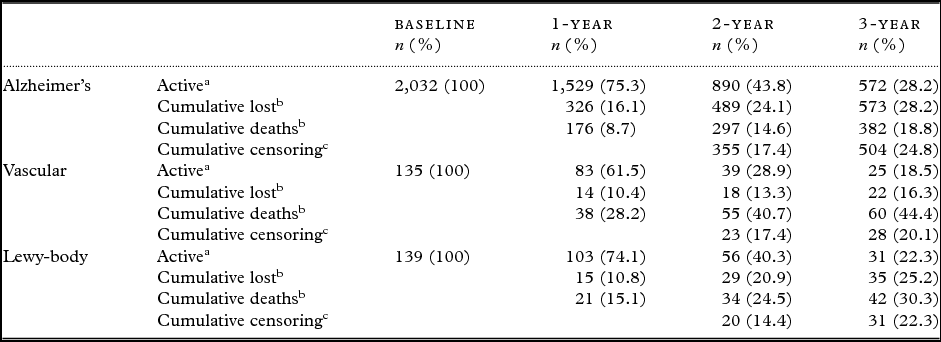
In Table 1, descriptive measures for active, lost, and dead participants over the three-year follow-up are presented. Missing data are evident with only 28.2% of study participants with AD, 18.5% with VD, and 22.3% with LBD still active in the study three years after incident diagnosis of dementia.
Study participation and causes of dropout over three years following incident dementia diagnosis in NACC

a % reflects proportion of the visit one-year active sample for each type of dementia.
b % reflects cumulative proportion, defined as yearly cumulative frequency divided by baseline frequency for active sample for each type of dementia expressed as a percentage.
c Censoring refers to the number of participants who were diagnosed with dementia in 2014 and were only able to contribute one year of data during this study period.
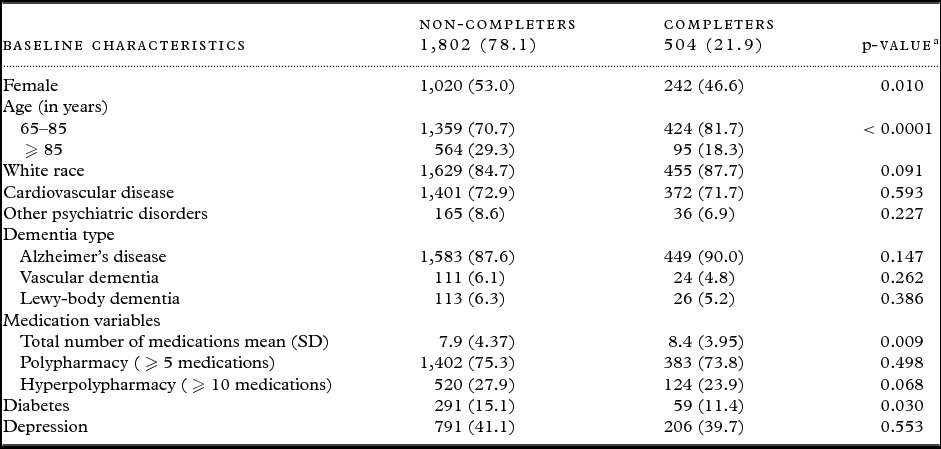
In Table 2, baseline characteristics are compared between non-completers and completers and the differences between them are tested using Pearson χ 2 test for the categorical variables and F-test for the continuous variables. Of the 2,306 participants, 21.9% (n = 504) completed the three-year follow-up study. Further, there is no significant difference between completers and non-completers by dementia diagnosis (all p > 0.05). Completers and non-completers differ significantly by gender (p = 0.010), age (p < 0.0001), total number of medications (p = 0.009), and diabetes (p = 0.030), suggesting a potential violation of MCAR assumption.
Counts (percentages) and means (standard deviations) for categorical and continuous baseline characteristics, respectively, for participants who completed the three-year follow-up study (completers) versus those who did not complete the follow-up (non-completers) in NACC

ap-value computed from Pearson χ 2 test for gender, age, race, cardiovascular disease, psychiatric disorders, dementia type, polypharmacy, hyperpolypharmacy, diabetes, and depression, and F-test for total number of medications.
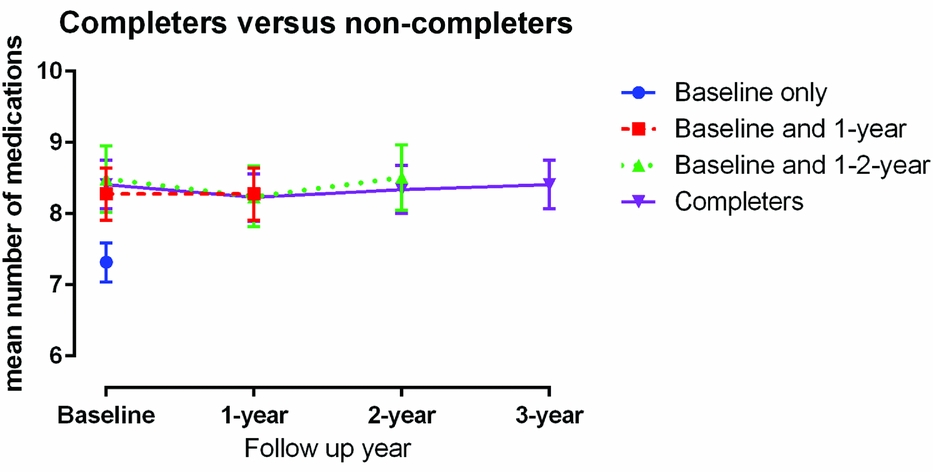
In Figure 1, the unadjusted means (95% CI) for total number of medications are plotted for each dropout pattern over the three-year follow-up period. Participants with baseline values only have the lowest mean number of medications (mean = 7.3) as compared with the means from the other groups (range: 8.3–8.5). Among participants with one, two, and three years of follow-up data, there is no significant difference in their total number of medications, as shown by the overlapping 95% CIs.
Mean (95% CI) for total number of medication for who completed three years of follow-up assessments (completers) versus those who did not complete the three years of follow-up (non-completers).

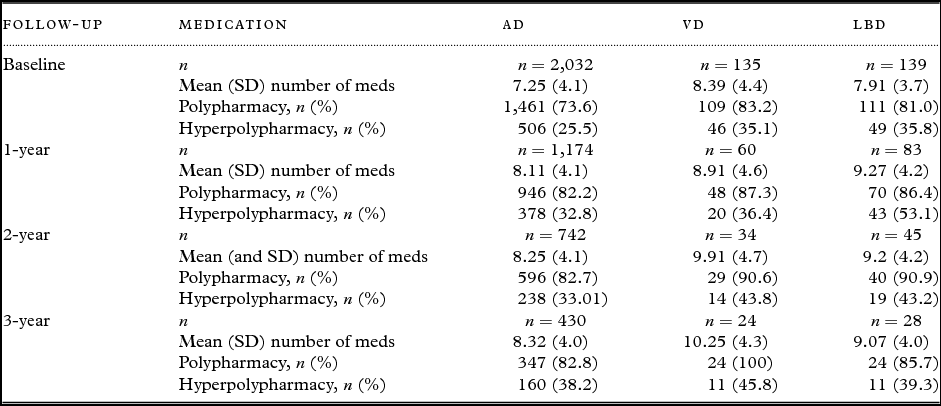
Descriptive measures for medication outcomes by dementia type are presented in Table 3. Most participants had incident AD. The unadjusted mean number of medications and percentages for polypharmacy and hyperpolypharmacy, respectively, increase over the three-year follow-up for participants with incident diagnosis of AD and VD. The unadjusted mean number of medications and percentage with polypharmacy for participants diagnosed with VD and LBD are higher than for participants diagnosed with AD.
Descriptive measures for medication use (number of medications, polypharmacy, and hyper-polypharmacy) for dementia diagnosis (Alzheimer's disease (AD), vascular dementia (VD), and Lewy-body dementia (LBD)) by year of follow-up

Statistical modeling
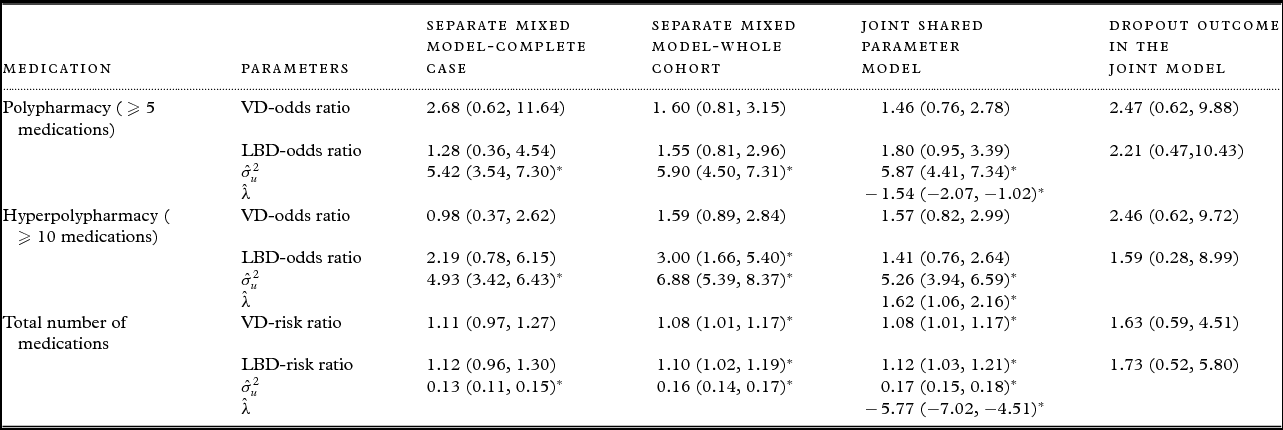
Parameter estimates from the two separate models and joint models that quantify the odds and risk ratios of medication use for persons with VD or LBD relative to AD are presented in Table 4.
Odds and risk ratio, variance of shared random effect  $( {\hat{\sigma }_u^2} ),$ and multiplier
 $( {\hat{\lambda }} )$ estimates (and 95% confidence interval) for vascular dementia (VD) and Lewy-body dementia (LBD) relative to Alzheimer's disease for separate models that ignore informative dropout and joint model that accounts for informative dropout; the estimates for other model parameters are also presented

*Statistically significant at α = 0.05.
Separate model-complete case compared to separate model-whole cohort
The models that fit to the dataset provide similar associations to the unadjusted values in Table 3 – those diagnosed with either VD or LBD were more likely to take more medications than those diagnosed with AD. The parameter estimates from the separate model fit to complete three-year follow-up data only (separate model-complete case) are systematically different, with non-significant associations for VD or LBD relative to AD for all medication use outcomes, and larger standard errors than those from the separate models fit to the whole-cohort data set. Additionally, the associations of either VD or LBD with total number of medication became significant when estimated using separate model-whole cohort.
Separate model-whole cohort versus joint shared parameter model
Using estimates from the joint model, the odds of a person with incident VD having polypharmacy are about 1.5 times higher than the odds of a person with incident AD reporting polypharmacy. Using the whole-cohort data, we observe appreciable differences in the effect estimates from separate models and joint models, mainly for polypharmacy and hyperpolypharmacy. For instance, the odds of a person with LBD reporting hyperpolypharmacy are 3 times significantly higher than the odds of a person with AD when dropout is ignored; the odds ratio reduces to 1.41 and even becomes non-significant when estimated from the joint model that accounts for the dropout. In contrast, the risk ratio estimates for the association between dementia types and total number of medications from the separate model and joint model do not differ substantially. Finally, participants who are male, white race, had a diagnosis of depression in the past two years, had diabetes, or cardiovascular diseases were more likely to report taking multiple medications than their counterparts (Table S1).
Susceptibility to dropout
The variability in the shared random effects (σ2u) that represents unobserved factors is significant in all models for all medication outcomes and increases when total number of medication is dichotomized using either a cut-off of 5 or 10. For instance, the variance of the unobserved factors that jointly underlie a participant's susceptibility to polypharmacy and to dropout is 5.87. Further, the multiplier  $( {\hat{\lambda }} )$ that quantifies the effect of unobserved factors on a participant's susceptibility to dropout is significantly different from zero (p < 0.05) for all outcomes. For example, the log odds ratio that quantifies the effect of unobserved factors to dropout is −1.54 when dropout is jointly modeled with polypharmacy. These estimates had wide CIs leading to non-significant but higher odds of dropout among those diagnosed with VD and LBD relative to those diagnosed with AD (Table 4, last column). Similarly, participants aged 85 years and older were more likely to drop out (Table S1).
Discussion
We studied the association between three common dementia diagnoses and medication use, and demonstrated a joint modeling approach to account for missing data patterns. Using the whole-cohort data, we found that older adults who were diagnosed with either incident VD or LBD were more likely to use multiple medications than those diagnosed with incident AD. Furthermore, participant's susceptibility to dropout due to unobserved factors was significant for all medication outcomes.
Missing data by attrition are often inevitable in longitudinal studies of older adults (Lavikainen et al., Reference Lavikainen, Leskinen, Hartikainen, Mottonen, Sulkava and Korhonen2015). Usually, participants drop out of study not in a completely random manner but for some reason. However, attrition can be associated with many factors that might themselves be under investigation in the study (Gao, Reference Gao2004). In this study, participants who were either 85 years and older and had diabetes or cardiovascular disease had higher odds of dropout (Table S1). Specifically, the odds of a participant aged 85 years and older to drop out were about 10 times relative to the odds of those aged 65–84 years. This finding is in line with previous studies; for instance, in a longitudinal study of older persons aged 49 years and older by Van Beijsterveldt et al. (Reference Van Beijsterveldt, van Boxtel, Bosma, Houx, Buntinx and Jolles2002), a higher rate of attrition by death was found to be associated with male gender, older age, and poor cognitive performance. In this analysis, the systematic differences in some baseline characteristics between completers and non-completers could suggest a violation of MCAR assumption. In such cases, participants who drop out often differ systematically from those who complete the study, and this difference may lead to biased conclusions, as suggested in this study and in previous studies (Touloumi et al., Reference Touloumi, Babiker, Pocock and Darbyshire2001; Lavikainen et al., Reference Lavikainen, Leskinen, Hartikainen, Mottonen, Sulkava and Korhonen2015). In the NACC dataset, there was a non-significant positive association between the number of concomitant medication reported at the previous visit and the probability of dropout at the subsequent visit; this association might suggest the dropout mechanism to be MAR. Additionally, the association of comorbid conditions with the probability of dropout evidenced in this study could indicate a non-ignorable dropout. The analysis showed significant parameter estimate that quantifies the association between unobserved random effects and dropout. A negative value for this parameter could be interpreted as a “protective” effect of these latent factors to dropout, whereas a positive value could be construed as a risk factor to dropout. This parameter was negative for polypharmacy and total number of medications, but became significantly positive for hyperpolypharmacy. We posit that this reversal of sign could be due to a cut-off shift from 5 to 10, leading to increased frequency in the reference group (i.e. participants taking less than ten medications) in the outcome variable.
There is a substantial difference in the point estimates for the effect of dementia diagnosis on polypharmacy and hyperpolypharmacy usage outcomes from complete case analysis as compared with the estimates obtained by accounting for missing data. The substantial difference in the point estimates may be construed as a pointer to the amount of bias in the effect estimate attributable to missing data. The amount of bias can only be determined through a simulation study, where the true effect is known (Burton et al., Reference Burton, Altman, Royston and Holder2006; Chan, Reference Chan2016). However, a simulation study is beyond the scope of this paper.
Even though there is no established method to distinguish between MAR and MNAR, the judgment can be based on experience or by conducting a sensitivity analysis (Moreno-Betancur and Chavance, Reference Moreno-Betancur and Chavance2016). Dropout is typically related to a person's health conditions, thus, ignoring dropout may lead to too optimistic conclusions. Therefore, it is important to identify the cause of missing data and use appropriate modeling techniques when faced with missing data problem. For investigators analyzing longitudinal studies with non-trivial amounts of missing data, it is recommended that the factors attributing to attrition be investigated, and to analyze data under both ignorable and non-ignorable missing data assumptions, when the missing data mechanism is unknown (Lavikainen et al., Reference Lavikainen, Leskinen, Hartikainen, Mottonen, Sulkava and Korhonen2015).
The shared random effect model used here has the following strengths. First, it can handle informative attrition. Second, it can handle unobserved factors that may lead to a person's likelihood to use concomitant medications or to drop out. Third, it is flexible because it is not limited to dropout missing data patterns only. Finally, the shared parameter model can be implemented in standard statistical software, such as in SAS using NLMIXED procedure as is the case in this study, and can also fit in R using JM and joineRML packages. Despite these strengths, this study has a few limitations. First, the NACC data repository is not a representative national sample; therefore, the findings may not be generalizable to other populations. Second, assessments occur at one-year intervals and do not capture changes between visits, but common chronic conditions were included as they indicate conditions for medication use. Third, although we used a large observational study with rigorous diagnostic tests for dementia type and a systematic method for collecting all medications, causality cannot be inferred; however, the dropout mechanism was estimated using the prior year's medication data providing temporality. Fourth, although NACC systematically collected data on all types of medication at each visit, data on the dose and frequency of these medications were not collected. Fifth, NACC included both prescription and over-the-counter medications, vitamins, and supplements; therefore, the effects of these medications cannot be separated. Finally, the number of participants with dementia diagnoses other than AD was low, but not unexpected, which might lead to larger standard errors of parameter estimates that quantify the effects. However, VD and LDB are less common in the population and have different pathology; thus, patients may be treated for both underlying causes and concomitant diseases, warranting investigation into medication usage.
In conclusion, investigators should ensure maximum retention of study participants to minimize missing data; if this is inevitable, as is the case in most longitudinal studies of older adults with dementia, the reasons for missing data should be ascertained and appropriate statistical methods should be used to handle informative missingness to reduce bias in the risk estimates of interest. Recording dose and frequencies would allow estimation of standardized dose effects, while recording severity of disease would allow modeling of medications by disease indication and severity.
Conflict of interest
None.
Description of authors’ roles
Dr G. O. Agogo identified the statistical methodologies, carried out the statistical analysis, interpreted the results, and wrote the manuscript. Dr C. M. Ramsey assisted with data cleaning, statistical analysis, interpretation of the results, and writing the manuscript. Dr D. Gnjidic assisted with interpretation of the results and writing the manuscript. Dr D. C. Moga facilitated data access and accuracy, wrote SAS code to extract the analytic sample, and assisted with writing the manuscript. Prof. H. Allore secured funding, developed the concept, advised on statistical methodology and analysis, interpretation of the results, and writing the manuscript.
Acknowledgments
This work was supported by grants: R01 AG047891 (Allore and Agogo), the Yale Older Americans Independent Center P30 AG021342 (Allore and Agogo), Yale Alzheimer's Disease Research Center, Data Management and Statistics Core P50 AG047270 (Allore and Ramsey) and R01 AG054130 (Moga) all from the National Institutes of Health/National Institute on Aging. D. Gnjidic is supported by the Bridging Support Fellowship and International Profile Development Fund of the University of Sydney. The NACC database is funded by NIA/NIH grant U01 AG016976. NACC data are contributed by the NIA-funded ADCs: P30 AG019610 (PI Eric Reiman, MD), P30 AG013846 (PI Neil Kowall, MD), P50 AG008702 (PI Scott Small, MD), P50 AG025688 (PI Allan Levey, MD, PhD), P50 AG047266 (PI Todd Golde, MD, PhD), P30 AG010133 (PI Andrew Saykin, PsyD), P50 AG005146 (PI Marilyn Albert, PhD), P50 AG005134 (PI Bradley Hyman, MD, PhD), P50 AG016574 (PI Ronald Petersen, MD, PhD), P50 AG005138 (PI Mary Sano, PhD), P30 AG008051 (PI Thomas Wisniewski, MD), P30 AG013854 (PI M. Marsel Mesulam, MD), P30 AG008017 (PI Jeffrey Kaye, MD), P30 AG010161 (PI David Bennett, MD), P50 AG047366 (PI Victor Henderson, MD, MS), P30 AG010129 (PI Charles DeCarli, MD), P50 AG016573 (PI Frank LaFerla, PhD), P50 AG005131 (PI James Brewer, MD, PhD), P50 AG023501 (PI Bruce Miller, MD), P30 AG035982 (PI Russell Swerdlow, MD), P30 AG028383 (PI Linda Van Eldik, PhD), P30 AG053760 (PI Henry Paulson, MD, PhD), P30 AG010124 (PI John Trojanowski, MD, PhD), P50 AG005133 (PI Oscar Lopez, MD), P50 AG005142 (PI Helena Chui, MD), P30 AG012300 (PI Roger Rosenberg, MD), P30 AG049638 (PI Suzanne Craft, PhD), P50 AG005136 (PI Thomas Grabowski, MD), P50 AG033514 (PI Sanjay Asthana, MD, FRCP), P50 AG005681 (PI John Morris, MD), and P50 AG047270 (PI Stephen Strittmatter, MD, PhD).
Supplementary material
To view supplementary material for this article, please visit https://doi.org/10.1017/S1041610218000017