Introduction
Deregulation is one of the most profound policy shifts in industrialised countries in recent decades (Hammond and Knott Reference Hammond and Knott1988; Potrafke Reference Potrafke2010).Footnote 1 While governments have not refrained from regulating the economy (Vogel Reference Vogel1999), they have shifted from direct intervention and state ownership to much subtler forms of control. Deregulation has, therefore, reduced the government’s ability to manipulate prices and practices across a broad swath of industries.
The economic costs and benefits of deregulation remain contested, but few would disagree with the claim that deregulation has had profound effects on the economy. The liberalisation of electricity markets has given third parties, such as renewable energy producers, access to the grid, and has thus increased competition. In the telecommunications sector, competition has forced service producers to compete for customers. However, failed efforts to deregulate have also caused major problems, as California’s 2001 electricity crisis shows.
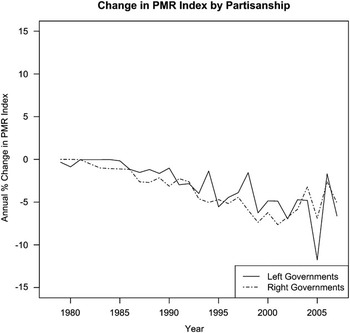
But, what are the origins of deregulation? Given the large economic effects of deregulation, new answers to this question can provide useful insights into regulatory politics in industrialised countries. One common argument is that deregulation stems from the electoral success of the right wing in the United States (US) and Europe (Garrett Reference Garrett1998; Potrafke Reference Potrafke2010). However, at least in the case of product market regulation (PMR), the data indicate that the effect of right-wing partisanship on regulatory policy in many sectors is limited. Figure 1 shows the annual percentage change in average PMR for seven sectors on a 0–6 scale in 29 industrialised countries, 1978–2007, under left- and right-wing governments. This measure captures such regulations as barriers to entry and public ownership.Footnote 2 Though PMR has been trending downwards with time, no clear difference exists between the behaviour of left- and right-wing governments. At the very least, the received wisdom would have had right-wing governments deregulate earlier and more aggressively than left-wing governments. In the graph, the two trajectories are almost identical.
Historical trend in product market regulation (PMR) change by partisanship. The figure shows the percentage change in PMR under left- and right-wing governments in a given year.

If right-wing governments are generally hostile to state intervention while left-wing governments believe that regulation is important for addressing market failures, why are the differences in deregulation of product markets between the left and the right hardly noticeable? Why are right-wing governments not pushing for the deregulation of product markets much more aggressively than left-wing governments?
To solve this puzzle, we present a theory of the effect of partisanship on regulatory policies. In developing this theoretical argument, we emphasise the importance of political fragmentation in the legislature. While left-wing governments have fewer incentives to deregulate than right-wing governments, the diverging partisan preferences may not produce observable effects unless right-wing governments are in a position to realise their regulatory ambitions. Legislative fragmentation forces right-wing governments to make compromises because multiple small parties with different preferences compete for influence. In a fragmented legislature, it is difficult for a right-wing government to create a sufficiently large coalition in favour of any particular reform, because the transaction costs of creating unity among many parties with different preferences is high. In contrast, a non-fragmented legislature makes coalition formation easier.
We test this theory against PMR data in the OECD, 1978–2007. We find that, in six of the seven covered sectors, right-wing governments deregulated more aggressively only in the absence of legislative fractionalisation. This result indicates that right-wing governments did drive deregulation in industrialised democracies, but only when they had relatively free hands because of a unified legislature. The effects are substantively large, statistically robust and capable of explaining several salient country histories.
This article offers two contributions to political economy. First, it solves an important puzzle: if partisan preferences exert influence on a government’s willingness to deregulate, why do we not see a strong and consistent effect of right-wing partisanship? We have shown that the answer may lie in the political constraints that governments face. Left-wing differences are pronounced under unified legislatures and strong governments, but they tend to deflate as the government’s freedom to manoeuvre declines. While we find evidence for the common claim that policy diffusion among neighbouring countries is important (Belloc and Nicita Reference Belloc and Nicita2011), controlling for such diffusion does not change our substantive findings regarding the interactive effect of partisanship and government fractionalisation.
Second, it also provides an interactive theory of how political institutions mediate the effects of partisanship. Institutions that induce fragmentation, such as proportional voting rules, will dampen the effects of partisan preferences, whereas institutions that create strong governments actually will drive a wedge between different political parties. The former may result in more consistent and reliable policy formation, but the latter could enhance democratic accountability by creating differences between political parties. The normative implications of this difference for democratic politics are substantial.
Partisanship, legislative fragmentation and policy formation
Scholars of regulatory and other economic policy have identified a variety of covariates of deregulation. We review here the theoretical models and empirical analyses that are directly related to our argument. First, we review the role of partisanship in deregulation. Second, we examine the role of legislative fragmentation. The review demonstrates that, while previous research has identified both factors as important, scholars have yet to examine their interactions.
Previous research suggests partisanship has an important influence on deregulation. Right-wing parties emphasise the virtues of deregulation given their opposition to state interference with business, while left-wing parties believe that regulation is often necessary to correct market failures and prevent companies from acquiring monopoly positions (Boix Reference Boix2000; Benoit and Laver Reference Benoit and Laver2006). Though some exceptions exist – for example, many right-wing governments have rural constituencies who oppose the dismantling of agricultural subsidies – on average, right-wing parties are more inclined towards liberalisation and deregulation.
The empirical record offers some support for this view. For example, Potrafke (Reference Potrafke2010) finds that in the case of OECD PMR – the data set we also use – left-wing governments deregulate less than right-wing governments. However, he does not discuss the importance of partisanship relative to other factors. Chang and Berdiev (Reference Chang and Berdiev2011) examine the role of partisanship in OECD energy regulation, but they do not comment on the importance of partisanship relative to other factors. In any case, the raw data indicate that partisanship may not have a large average effect. Thus, the puzzle remains: why are the differences between left-wing and right-wing governments not more pronounced? Neither study examines the conditional effect of partisanship in different circumstances. Finally, Belloc and Nicita (Reference Belloc and Nicita2011), again using the same data, show that right-wing governments privatise more and liberalise less than left-wing governments, suggesting that parties of different partisan orientations have varying preferences over paths to deregulation. In other work, they note that, in network industries, partisanship plays a minor role, while diffusion is an important explanatory factor.
Murillo and Martínez-Gallardo (Reference Murillo and Martínez-Gallardo2007) find that, in Latin America, the privatisation and deregulation of the electricity and telecommunications sectors have also advanced at a faster pace under right-wing governments. This effect is substantively large, but it remains unclear to what extent this finding is specific to the deregulation of these two sectors in a particular region at a given time. To what extent are right-wing governments more interested in regulation in other sectors and political contexts?Footnote 3
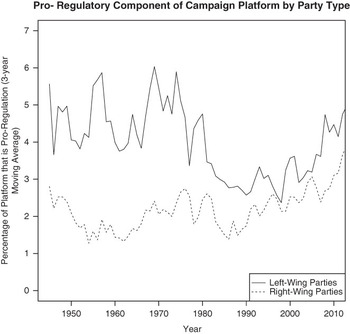
To further substantiate the claim that there is a consistent partisan split on regulatory policy, Figure 2 shows the three-year moving average of the percentage of campaign platforms that are dedicated to the need for regulation by left- and right-wing parties between 1945 and 2010. As the plot shows, left-wing parties dedicate more of their electoral campaigns to discussing the need for regulation than do right-wing parties in every year. Furthermore, though the difference between the parties is somewhat smaller from roughly 1980 to 2000 during which time many left-wing parties began to adopt more market-conforming platforms, left parties in this period still dedicated more of their platform to the need for regulation than did right-wing governments. Thus, left-wing parties are consistently more pro-regulatory than right-wing parties, on average.
Percentage of campaign platforms that discuss the need for regulation by party type. The figure shows the three-year moving average of the percentage of party platforms that are dedicated to the need for regulation made by left- and right-wing political parties. The data come from the CMP (Volkens et al. Reference Volkens, Lehmann, Merz, Regel, Werner, Lacewell and Schultze2013) and are averaged by year over every party in the data set.

The data in the figure come from the Comparative Manifestos Project (CMP) (Volkens et al. Reference Volkens, Lehmann, Merz, Regel, Werner, Lacewell and Schultze2013), which includes 923 parties in 638 elections held in 55 countries between 1920 and 2013. To construct the three-year moving average of the percentage of campaign platforms that are dedicated to the need for increased regulation, two variables from the CMP were first summed by party, per403 and per412. per403, Market Regulation, indicates the percentage of party platforms dedicated to the need for regulations that make private enterprises work better, take action against monopolies and trusts, and defend consumers and small businesses. per412, Controlled Economy, indicates the percentage of party platforms dedicated to the need for government control of the economy, including the need for control over prices, wages and rents. Next, these values were then averaged by left- and right-wing parties by each year in the CMP data set. Left-wing parties here are those deemed by the CMP to be Communist or Social Democratic parties. Right-wing parties are those deemed by the CMP to be Liberal, Christian Democratic or Conservative parties. Finally, in order to smooth the data, three-year moving averages are taken.Footnote 4
The relationship between legislative fragmentation and deregulation is somewhat more subtle. Legislative fragmentation may force governments to adopt less ideological positions, and thus deregulate or regulate according to complex compromise packages that reflect a wide variety of social interests (Becker Reference Becker1983). Strong governments in unified legislatures, by contrast, should be able to implement their preferred legislative policies with less of a need for compromise and deviations from their constituencies’ ideal points.
According to Roubini and Sachs (Reference Roubini and Sachs1989), this can be seen in governments’ ability to avoid heavy fiscal burdens: strong governments and unified legislatures are able to adopt “painful” policies that are necessary to achieve fiscal sustainability. In a similar vein, Alesina and Drazen (Reference Alesina and Drazen1991) argue that competition between political interest groups leads to delay in stabilisation during economic crises. This literature does not, however, examine the interactive effect of legislative fragmentation and partisanship on policy reform.
Other studies examine the role of “veto players” and related institutional constraints on policy formation (Hallerberg and Basinger Reference Hallerberg and Basinger1998; Henisz Reference Henisz2000; Tsebelis Reference Tsebelis2002; Hammond and Butler Reference Hammond and Butler2003). While this literature has not analysed deregulation, it suggests that increased numbers of veto players usually reduce the probability of policy change in any direction.Footnote 5 Similar to veto player theories, we expect heterogeneous preferences to constrain policy formulation; our addition is the effort to evaluate the role of legislative fragmentation beyond the veto point.
While previous research has not examined interactions between government preferences and legislative fragmentation, several related empirical analyses exist. Frye (Reference Frye2002) finds that political competition between polarised parties produces inconsistent policy formation, and hence lower economic growth, in the post-Communist world. His focus is on polarisation itself, however, and he does not examine how polarisation interacts with the government’s average partisanship.Footnote 6 Murillo and Martínez-Gallardo (Reference Murillo and Martínez-Gallardo2007) also find that political competition, measured as the effective number of parties and ideological polarisation, reduces deregulation in Latin American electricity and telecommunications sectors, because incumbents worry about the electoral responses of marginal voters who may be discontented with market reform. But, they do not develop or test a model of how political competition interacts with the executive’s partisanship.
In sum, these studies omit the interaction between partisan preferences and legislative fragmentation. While legislative fragmentation may have an independent effect that does not depend on the government’s partisanship, it seems more plausible that legislative fragmentation will have divergent effects on left- and right-wing governments. Left-wing governments have different preferences than the political right, and each type responds to legislative fragmentation in different ways. In what follows, we develop a theory that can account for such contingent effects and provide empirical evidence for this theory.
The literature identifies several other influences on deregulation that warrant a brief digression, if only to justify the choice of control variables and robustness checks below. According to Henisz et al. (Reference Henisz, Zelner and Guillen2005) and Pitlik (Reference Pitlik2007), policies for deregulation diffuse from one country to another, especially if the countries have similar trade profiles or compete for similar markets. Hirsh (Reference Hirsh1999) writes that, in the US, electricity deregulation was induced by slow progress in the efficiency of electricity production and the gradual decrease in the political and economic power of the electricity utilities. Gehlbach and Malesky (Reference Gehlbach and Malesky2010) show that veto players can increase economic reform in transitional countries, because effective and comprehensive policy changes are needed to create a large enough winning coalition. Meseguer (Reference Meseguer2004) examines learning effects in privatisation in the OECD and Latin American countries, arguing that there is evidence for learning. Eising (Reference Eising2002) argues that the European Union (EU) has facilitated policy learning in electricity reform among its member states, thus facilitating policy diffusion within an international organisation.
Argument and hypotheses
The argument can be summarised as follows. First, left-wing governments have less interest in deregulation than right-wing governments. Next, we argue that the difference between deregulatory outcomes under left- and right-wing governments depends on legislative fragmentation. Left-wing governments are less sensitive to legislative fragmentation than right-wing governments because they do not have strong incentives to deregulate in the first place. Unless the pressure to deregulate is heavy, even strong left-wing governments choose not to exploit the window of opportunity that a unified legislature offers to deregulate. In other words, even a strong left-wing government should exhibit less propensity to deregulate than its political competitors.
In contrast, right-wing governments are sensitive to legislative fragmentation, because the political cost of deregulation is high if they face a fragmented legislature with many parties holding divergent ideologies and preferences. To deregulate, they would have to create a legislative coalition that includes a variety of left-wing parties. In a non-fragmented legislature dominated by a right-wing government with many seats, legislative bargaining is less costly and fewer side payments are needed. Thus, more deregulation can be expected.
We focus on legislative fragmentation instead of the fragmentation of the governing coalition. Governing coalitions are formed by leading parties acting in a strategic fashion. Legislative fragmentation determines the basic level of cohesion in the legislature, and a leading political party considers this level of cohesion in inviting other parties, if any, to join the coalition. As the fragmentation of the governing coalition is an endogenous product of legislative fragmentation, we consider the underlying legislative fragmentation the key variable of interest. Empirically, we also verify that the results are consistent if we consider government fragmentation instead.
In the analysis, we largely omit the possibility of increased regulation. In principle, left-wing parties could increase the level of direct regulation, and the data indicate that such reversals have occurred. Empirically, such increases are rare because most industrialised countries have moved towards decreased regulation over time.Footnote 7 For any given previous level of regulation, the key cleavage is whether the current levels should be retained or more deregulation sought. Reflecting this notion, we write our argument and hypotheses in view of deregulation. As this approach is applied widely in the empirical study of regulatory policies (Henisz et al. Reference Henisz, Zelner and Guillen2005; Murillo and Martínez-Gallardo Reference Murillo and Martínez-Gallardo2007; Potrafke Reference Potrafke2010), our findings are comparable with previous work.
Partisan preferences are important for deregulation because they set the baseline. The finding in the literature of a partisan difference on regulatory policy might result from left-wing government’s belief that state intervention in the economy can be useful, and this belief covers regulatory policy. For example, product regulation can improve consumer safety, mitigate monopoly power and help control the negative externalities from production processes that generate air pollution or hazardous waste. Right-wing governments, in contrast, believe that state intervention is mostly harmful. The government does not have the information to set optimal regulations, so it is better to allow the markets to self-organise. Deregulation could, therefore, help increase economic growth and lower consumer prices through relentless competition in the marketplace. Limited intervention, perhaps in the form of Pigouvian taxes, would be enough to address possible negative externalities. The cost of direct regulation would be too high, and thus not warranted from a political or economic perspective.
While specific constituency demands, international economic competition and the idiosyncratic features of an extant regulatory policy may complicate the formation of partisan preferences, on average, a left-right cleavage regarding the merits of state intervention exists. Among right-wing governments, a further distinction could be made between pro-market and pro-business preferences. A pro-business government could, in the extreme, implement policies that limit entry to a certain sector. We lack the data to analyse this possibility. As our various measures for right-wing partisanship are largely based on a pro-market position, however, we can be confident that the pro-market position is common among the right-wing parties in the data.
Legislative fragmentation determines the opportunity structure that the government faces. Under limited fragmentation, it is relatively easy for an interested government to form a coalition in support of deregulation. The number of relevant parties in the legislature is small, so the cost of reaching a compromise among the key parties is low. In such circumstances, the implementation of deregulation is not difficult. The government has a strong position that allows it to pass legislation on deregulation, so if the government is interested in deregulation in the first place, it can implement it.
Conversely, legislative fragmentation should ceteris paribus raise impediments to deregulation. A government interested in deregulation would have to incur a high transaction cost from forming a supporting coalition, because the preferences of multiple small parties would have to be accommodated. With a high number of bargaining parties and a large number of possible coalitions, negotiating a credible legislative package that garners the support of a sufficient legislative majority is costly. The executive must carefully balance a wide variety of different interests, so the risk of bargaining failure in the legislature is high.
The importance of legislative fragmentation also depends on the distribution of preferences (Henisz Reference Henisz2000; Tsebelis Reference Tsebelis2002). If legislative fragmentation is accompanied by distributional conflicts, the government’s ability to form coalitions is further diminished. For a government interested in promoting deregulation, a legislative environment with multiple small parties holding divergent preferences presents particularly large challenges. If the small parties held similar preferences, their fragmentation would be less of an issue. If the parties were larger, legislative logrolling and bargaining on side payments would be easier (Spiller and Tommasi Reference Spiller and Tommasi2003).
Though related, legislative fragmentation is not analytically equivalent to the number of veto players with different preferences. In any legislature, the leading party can engage in logrolling or use side payments to increase support for a policy. As legislative fragmentation increases, the cost of such coalition formation increases. Even if no individual political party or voting block is a veto player, coalition formation can be difficult under high levels of fragmentation. Consequently, partisan preferences may shape policy formulation even if no individual party holds a veto over a policy. Similarly, for any given number of veto players with certain preferences, an increase in fragmentation raises the cost of creating a coalition in support of the policy. Different policy packages draw the support of different parties in the legislature, and coalition formation is more difficult under fragmentation owing to the large number of relevant interests.
Left-wing governments have fewer incentives to deregulate. Even left-wing governments may deregulate if they face international or domestic interest group pressure, or if state intervention has proven to be an ineffective strategy during economic woes. In general, though, the literature reviewed above shows that left-wing governments have less interest in deregulation than right-wing governments. Further, the effects of legislative fragmentation are mediated for left-wing governments. Suppose first that legislative fragmentation remains at low levels. In this case, left-wing governments would not deregulate because they are in a relatively safe position. Suppose now that legislative fragmentation increases. Even then, left-wing governments do not deregulate because their supporters do not reward such policies.
Right-wing governments, in contrast, can be expected to have strong incentives to deregulate in most circumstances. Thus, under limited legislative fragmentation they do so. But, under increased legislative fragmentation, their ability to do so decreases. They need to offer side payments to left-wing parties, and thus the transaction cost of successful deregulation increases. Ceteris paribus, this will produce less deregulation.
H1 Left-wing governments deregulate less than right-wing governments.
H2 Deregulation by left-wing governments does not depend on legislative fragmentation.
H3 Deregulation by right-wing governments decreases with legislative fragmentation.
In evaluating these hypotheses, it is important to account for other hypotheses. First, conventional theories of veto players (Henisz Reference Henisz2000; Tsebelis Reference Tsebelis2002) suggest that deregulation is difficult if policymakers with diverging preferences, perhaps for partisan reasons, hold the ability to block deregulation. Our argument is consistent with the standard veto players approach, but we emphasise the overall degree of legislative fragmentation instead of just looking at the preference of the key veto player, that is, the member of the coalition party with the strongest pro-regulation stance. We also emphasise that legislative fragmentation is not simply about ideological homogeneity.
All else constant, it is more difficult for a government leader to negotiate a deregulation package if there are many small parties. Even among parties that have broadly similar views on deregulation, the complex details of deregulation require attention, and this process is both costly and difficult if the number of relevant parties is large.
Second, a much simpler theory of deregulation would state that the key difference is between majority and minority governments. If legislative bargains and logrolling are not important, a majority right-wing government should be able to deregulate without any problems. While our theory suggests that the extent of legislative fragmentation is critical even for the deregulatory success of majority governments, because legislative fragmentation can impede the formation of coalitions necessary to realise deregulation, the simple theory of majority voting instead ignores the importance of coherent preferences within a majority government.
Finally, presidential systems may present some difficulties for our theory. Given the executive’s privileged position, one may conjecture that legislative fragmentation is somewhat less important in presidential systems. Instead, such phenomena as a “divided government” could play an important role. However, remember that our focus is on explaining variation over time within a country. Given that changes between presidentialism and parliamentarism are very rare in established OECD democracies, the issue of presidentialism is not a major problem for our empirical analysis.
Product market deregulation in industrialised countries
To test our theoretical argument, we need empirical data on deregulation in industrialised democracies. The deregulatory outcomes should be politically salient, provoke ideological disagreement between political parties, and vary both across countries and over time.
Our PMR data are from the OECD, and we have data for seven sectors across 29 industrialised countries over the years 1978–2007.Footnote 8 The data focus on regulation of competition, with deregulation interpreted as fewer restrictions imposed by the state. For example, in the electricity sector, allowing free third-party access (TPA) to the grid would count as deregulation. The product markets covered include seven important sectors under the categories of energy, transport and communications. They are airlines, electricity, gas, postal services, railways, road transit and telecommunications.
The data perform well against all three yardsticks for hypothesis testing. First, they are politically salient because changes in regulatory policies carry substantial redistributive consequences. For example, the effects of electricity deregulation are directly felt by consumers as they pay their electricity bills, usually on a monthly basis. Moreover, political parties have good reasons to disagree on the merits of deregulation and engage in public debate on it. State intervention is a key cause of the left-right divide, and the PMR issues we examine capture some of the most central forms of state intervention, including public ownership and barriers to entry. Consequently, our PMR approach is suitable for a political analysis.
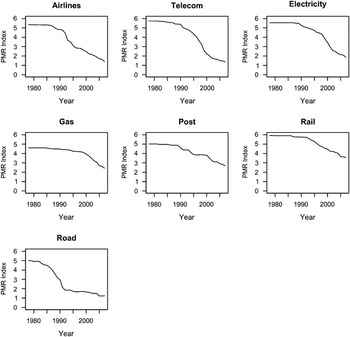
Second, as Figure 3 shows, substantial variation exists over time. While deregulation has advanced in all seven sectors, the shape of the curve is very different across industries. In road transit, deregulation had already made rapid advances before 1990. In other sectors, such as telecommunications and electricity, the most rapid advances occurred between 1990 and 2000. In yet others, such as postal regulation, deregulation has been gradual and slow. In the supplementary appendix, we also provide changes in average PMR regulation across all 29 countries.
Historical trend in product market regulation (PMR) by industry. For a given industry and year, the figure shows the average PMR score in the 29 industrialised countries included in the data set.

Each sector obtains a score between 0 and 6, with 6 indicating maximal regulation and 0 complete deregulation. The score is not perfectly continuous on this interval, but values between two integers are common. In addition, when we pool the sectors the scale becomes de facto continuous.
The score consists of different subscores that may vary by sector. In the electricity sector, for example, they are public ownership, barriers to entry and vertical integration. The questions presented regarding barriers to entry are the following:
-
1. How are the terms and conditions of TPA to the electricity transmission grid determined?
-
2. Is there a liberalised wholesale market for electricity (a wholesale pool)?
-
3. What is the minimum consumption threshold that consumers must exceed in order to be able to choose their electricity supplier (gigawatts)?
Similarly, the question for public ownership is as follows:
-
1. What is the ownership structure of the largest companies in the generation, transmission, distribution and supply segments of the electricity industry?
The questions regarding vertical integration are the following:
-
1. What is the degree of vertical separation between the transmission and generation segments of the electricity industry?
-
2. What is the overall degree of vertical integration in the electricity industry?
These questions are weighted and aggregated to obtain the 0–6 score for this sector in a given country-year. Full details of the data can be found at the OECD’s PMR webpage (http://www.oecd.org/eco/pmr).
These data have also been used in previous research by political scientists and economists. Potrafke (Reference Potrafke2010) models the pure effects of partisanship and political competition, but he does not develop a theory of possible interactions. Høj et al. (Reference Høj, Galasso, Nicoletti and Dang2006) present a broad overview of the factors that influence deregulation, but they also do not explore interactive effects. Chang and Berdiev (Reference Chang and Berdiev2011) examine the role of partisanship and other factors in the energy sector, but they do not model interactive effects. We contribute to this literature by presenting an interactive theory and testing it against the data.
Research design
To test our hypotheses, we use the OECD PMR data described above. Our data set is unbalanced, and we have, depending on the sector, between 732 and 862 country-years. In the pooled data set, we have 5,708 country-sector-years. We have included every country for which we have data over time, and we have included all sectors available. The geographic and temporal coverage is appropriate, as virtually all industrialised countries and several important sectors are covered. The panels are also long, of approximately 30 years in length, so we are able to account for dynamics in our analyses. To scrutinise the robustness of our findings, we also analyse subsamples of countries and individual sectors. Finally, the supplementary appendix reports tests of alternative hypotheses, such as the role of minority government and institutional constraints on executive authority.
Dependent variable
The dependent variable is the sectoral score for PMR from the OECD. We use the aggregate score for each sector, and we then form an average score by using the annual mean for each observation within a country-year. We give each sector an identical weight because there are no a priori reasons to assign different weights to different sectors. We also report results for each individual sector. Only a small percentage of country-sector-years have a 0 PMR value,Footnote 9 however, and these values are concentrated in the latter years of the data set and are spread across a number of countries,Footnote 10 assuaging fears that the sector-level data may be censored.
Independent variables
To test our theory of the interactive effects of partisanship and political competition, we need data for both variables. For partisanship, our first measure is from the Database of Political Institutions (DPI). This variable records whether a country’s executive is from a left-wing, centrist or right-wing party. Given that very few centrist cases exist, we convert this measure into a binary variable indicating whether the executive is from a right-wing party (Right).
While alternative measures of partisan preferences exist, this measure is ideal for our purposes because it focuses on variation within countries. Thus, it does not conflate cross-country differences in political preferences and style. Alternative measures, such as the one from the CMP project, would suffer from this problem.Footnote 11
The use of this variable, along with the inclusion of the lagged dependent variable or country fixed effects, implies that we can only focus on within-country variation over time. This is appropriate for our analytical purposes. Right-wing parties in Sweden are quite different from right-wing parties in Italy, for example, so comparing them in a genuine cross-national context would be problematic. In addition, many other institutional factors vary across countries, and these could confound the effects of partisanship. To avoid comparing apples and oranges, therefore, we focus on more plausible and accurate within-country comparisons. The DPI measure allows exactly this, though the issue of possible coding errors remains.
As we noted in the introduction, the general relationship between partisan preferences and deregulation is underwhelming. In the supplementary appendix, we show the distribution of the country-specific correlation between the annual change in deregulation and the partisanship of the government (left or right) in all of the seven sectors. The correlation is more negative, indicating a greater propensity to deregulate, in five of the seven sectors, but even then the differences between the medians are small and the variation in outcomes large. This graph, again, supports the need for conducting an interactive analysis.
Partisanship is, of course, to a large extent, a function of the prevailing circumstances. In principle, for example, voters could support right-wing parties if they prefer less state intervention. This would lead to bias because the real driver of deregulation could be voter preferences, as opposed to right-wing parties’ strategic behaviour. For our purposes, though, such selection issues are less problematic than is usually the case. First, the data clearly indicate that the average difference between left-wing and right-wing deregulatory efforts is small. This would not be the case if right-wing governments often came to power because they prefer product market deregulation. Second, our focus is on interactive effects. Even if right-wing governments come into power under somewhat different circumstances than left-wing governments, we can nonetheless examine the conditioning effect of legislative fragmentation.
One particularly interesting alternative is the partisan ideology measure that Potrafke (Reference Potrafke2009) introduced and used in his study of PMR (Potrafke Reference Potrafke2010). As an extra robustness check, we thus used his ideology scale. The main advantage of this measure is that it accounts for the ideology of all parties in the governing coalition, as opposed to the leading party. Thus, this test allows us to verify that our results do not depend on our sharp focus on the executive’s partisanship. On the 1–5 scale, increasing values indicate a more left-wing orientation. We first convert this variable into a binary indicator by coding all governments at the lowest levels, 1 and 2, as right-wing governments, in order to make it consistent with our existing dichotomous measure. Next, we reverse the ordering of the measure, such that increasing values indicate a more right-wing orientation. To foreshadow, we show below that this alternative measure, regardless of how it is transformed, produces virtually identical results.
Next, we use the DPI measure of legislative fractionalisation for political competition (Frac). This measure gives the probability that two randomly chosen deputies from the legislature represent different political parties. As this probability increases, the legislature becomes increasingly fractionalised because the number of different partisan preferences increases. The variable indicates the extent to which each party must compete for influence with multiple other parties. The variable obtains very high values when political parties are small, and low values if a small number of large parties are dominating the legislature.
For robustness, we consider an alternative measure of fractionalisation that focuses only on the governing coalition. The variable government fractionalisation (Gov. Frac) indicates the probability that two randomly chosen deputies from the government are from different political parties. It is thus similar to the legislative fractionalisation measure, and allows us to scrutinise the robustness of our theoretical argument.
The primary concern about this variable is that it is influenced by a country’s political institutions, notably the proportionality of the political system. In majoritarian systems, small parties cannot easily make it to the parliament. Thus, proportional systems generally feature much higher levels of fractionalisation than majoritarian systems. If the proportionality of the political system shapes deregulation through channels other than legislative fragmentation, omitted variables bias ensues unless we control for the proportionality of the system. In the empirical specification, we include a lagged dependent variable on the right-hand side to account for the time-invariant features of different political systems.Footnote 12 Thus, we isolate the effect of changes in fractionalisation while accounting for the baseline induced by a proportional electoral system and other time-invariant factors. We also include country fixed effects in some specifications.
Another important issue is that legislative fractionalisation is a potentially problematic measure in presidential systems, because “divided government” may ultimately be much more important. As a robustness test, we estimated our models excluding countries with a presidential system. The results continue to hold.
In an ideal world, we would supplement legislative fractionalisation data with a detailed measure of political parties’ PMR preferences. As discussed above, PMR preferences could mediate the effect of legislative fractionalisation. Unfortunately, such measures do not exist for the three decades and 29 countries that our data set covers.
In each model, we include an interaction term between the partisan variable and one of the two fractionalisation measures. We expect this interaction term to have a positive sign, as it would indicate that right-wing parties react to increased legislative fractionalisation by reducing their efforts to deregulate.
Control variables
We control for several additional variables. First, regulatory policies in a given year are obviously very dependent on previous years’ policies, so we include a lagged value of the dependent variable as a regressor (PMR Lag). This specification not only allows us to account for the general stickiness of regulatory policy, but it also allows us to consider dynamics.
Second, we include either year fixed effects or decade dummies in all of our specifications. Regulatory policies exhibit a clear downward trend, so it is important to avoid conflating our findings with the general downward trajectory of regulatory levels in industrialised democracies. Year fixed effects amount to removing the annual mean regulation in the sample, so that the focus is sharply on variation across outcomes.
Third, in some specifications – particularly when we pool our data set to account for all seven sectors – we also include country fixed effects. Our theory predicts both variation across and within countries, so we need to verify that the results hold regardless of these decisions.Footnote 13
Fourth, we include sectoral fixed effects in the pooled analysis. Deregulatory patterns vary widely across sectors, so we need to ensure that we do not confuse the interactive effects of legislative fractionalisation and partisanship with general sectoral differences.
Fifth, we include the Polcon 3 measure of political constraints (Henisz Reference Henisz2000) to account for the institutional ability of veto players to block legislation (Polcon 3). This measure counts the number of branches of government outside of executive control, whether these branches are controlled by a party other than that of the executive and the degree of preference homogeneity amongst these veto players in order to determine the extent to which the executive’s will is limited. Our theory focuses on the effects of legislative fragmentation, but executive constraints could also influence deregulatory outcomes (Tsebelis Reference Tsebelis2002; Gehlbach and Malesky Reference Gehlbach and Malesky2010). Further, including this variable allows us to account for the possibility that policy stability, or deregulatory inactivity for the case at hand, is more of a function of differential partisanship across the branches of government in some institutional settings than in others (e.g. the partisanship of the President compared with the partisan composition of Congress may be more relevant than the degree of fractionalisation within Congress in the US).Footnote 14
In the robustness analysis, we also include additional variables that account for institutional and economic factors. As an additional measure of political constraints, we also employ ln(Checks), the natural logarithm of the DPI’s Checks measure. This measure counts the number of veto points present in a given country-year. Owing to its right-skewed nature, we opt to transform it into a natural logarithm. We examine whether or not the relationship between government fractionalisation, partisanship and deregulation is an artefact of differing electoral laws and political institutions that may inhibit the ability of the executive to exercise her political will. To do this, dummy variables measuring proportional representation (PR), plurality (Plurality) and parliamentary (Parliamentary) systems are included in some specifications.Footnote 15 The data for these measures come from the DPI. To examine whether or not economic shocks are the primary cause of deregulation, the annual GDP growth rate (GDP Growth) and level of unemployment (Unemployment), both from the World Development Indicators, are also included as controls in some specifications. These account for the possibility that governments may face pressure to deregulate in response to economic difficulties, regardless of their partisan orientation. Finally, another set of control variables analysed in the supplementary appendix accounts for spatial factors (Eising Reference Eising2002; Belloc and Nicita Reference Belloc and Nicita2011). Finally, we include an EU membership dummy and the average PMR value of a country’s neighbours to account for spillovers. Summary statistics and a correlation matrix can be found in the supplementary appendix.
Model specification
To account for the sticky nature of regulatory policy, we estimate a model with the lagged dependent variable on the right-hand side. Specifically, our regression equation can be written as follows:
 $$\eqalignno{ {\rm PMR}_{{i,t}} =\ \beta _{0} {\plus}\beta _{1} \;{\rm PMR}_{{i,t{\minus}1}} {\plus}\beta _{2} \;{\rm Right}_{{i,t}} {\plus}\beta _{3} \;{\rm Frac}_{{i,t}} \cr {\plus}\beta _{4} \;{\rm Right}_{{i,t}} {\times}{\rm Frac}_{{i,t}} {\plus}{\bf X}'_{{i,t}} \tau {\plus}\phi _{t} {\plus}{\varepsilon}_{{i,t}} $$
where
 $${\bf X'}_{{i,t}}^{} $$
is an array of control variables,
 $$\phi_{t} $$
the year fixed effects and
 $${\varepsilon}_{{i,t}} $$
the error term. Some specifications also contain country fixed effects.
In so far as bouts of deregulation are subject to processes of diffusion, both across industries within a country and across countries, failure to account for this spatial dependence can lead to inconsistent standard error estimates. Thus, we account for heteroskedasticity, cross-sectional dependence and serial correlation by estimating Driscoll and Kraay (Reference Driscoll and Kraay1998) standard errors. As a robustness check, we further estimate conventional Beck and Katz (Reference Beck and Katz1995) panel-corrected standard errors with a correction for AR(1) serial correlation.
For time series data, it is important to address the issue of stationarity.Footnote 16 As we estimate our dynamic models below, we find that the coefficient for the lagged dependent variable is statistically distinguishable from unity. This means that, controlling for the relevant covariates, a unit root does not exist. At any rate, we also estimated our models using a first-differenced dependent variable, as shown in the supplementary appendix. The coefficients were virtually identical, suggesting that stationarity is not an issue.
Results
We begin with a discussion of our main model and then consider the sectoral disaggregation. Next, we test alternative hypotheses. Finally, we examine patterns in different countries and provide several qualitative examples from statistically selected countries.
Main model
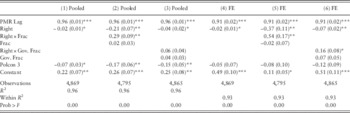
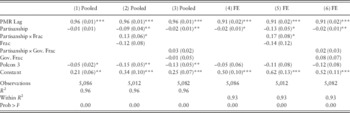
The models in Table 1 examine the relationship between partisanship, government fractionalisation and deregulation employing all of the sectoral data. In each model, a negative coefficient indicates that the variable in focus induces deregulation. We thus expect the Right variable to have a negative sign, whereas the interaction with Frac or Gov. Frac should have a positive sign, so that the deregulatory effect of right-wing partisanship decreases with fractionalisation.
Main models

Notes: In each model, the hypotheses predict that the coefficient for Right is negative while the interaction with Frac or Gov. Frac is positive. All models include industry fixed effects, and the last three models also include country fixed effects. Standard errors in parentheses.
FE, fixed effects; PMR, product market regulation.
*p<0.005, **p<0.01, ***p<0.001.
Recall that the interpretation of the substantive results requires some care owing to the inclusion of the lagged dependent variable. When the lagged value of the dependent variable is included, dynamic estimation is possible and the coefficient for a variable is interpreted as a growth rate relative to previous year (de Boef and Keele Reference de Boef and Keele2008). The long-run effect of an independent variable with a coefficient β is given by
 $${\beta \over {1{\minus}\lambda }}$$
, where
 $$\lambda \in (0,1)$$
is the coefficient of the lagged dependent variable. As Brambor et al. (Reference Brambor, Clark and Golder2006) write, the interpretation of interactive effects is also not straightforward. In particular, evaluating the statistical significance of an interacting variable is best done graphically.
Models 1 and 4 show that on average right-wing governance has a negative and statistically significant impact on PMR. Models 2 and 3 test the interactive hypotheses in the between-country setting and show the impact of the interaction terms between Right and Frac and Right and Gov. Frac. More importantly, models 5 and 6 repeat this exercise while controlling for country fixed effects, allowing us to make substantive claims within countries over time.
As expected, right-wing governments have a large decreasing effect on regulation, but the magnitude of this effect decreases with legislative or government fragmentation. For example, consider model 4. When Frac equals 0, a country with right-wing government has a score of PMR that is 0.37, lower than that country without right-wing government. In a dynamic setting, this is the difference in the annual rate of deregulation between left- and right-wing governments. Given the large coefficient for the lagged dependent variable, 0.91, the long-run effects of an unconstrained right-wing as opposed to an unconstrained left-wing government in a country over time on PMR are calculated over the sampled time period as −4.11, or more than two-thirds of the maximum change over time.
Consider now a higher level of legislative fractionalisation. Moving Frac to its mean value of 0.64, a country with right-wing government has a PMR score that is only 0.01 lower than a country without right-wing government. The result is also statistically insignificant. As expected, high fractionalisation levels prevent right-wing governments from promoting deregulation.
Our alternative measure is government fractionalisation. Consider model 6. Moving Gov. Frac from 0 to its mean of 0.27 decreases the impact of right-wing governance from −0.07 to −0.01. However, both values are statistically significant at the p<0.95 level. Again, these coefficients give the effect of right-wing governance on the growth rate. Given the large coefficient for the lagged dependent variable, 0.91, right-wing governments produce large shifts in PMR over time; holding Gov. Frac at 0, a right- as opposed to a left-wing government would reduce PMR by 0.77 over the sampled period. Even in this model, the substantive effect is thus notable.
As to control variables, the Polcon 3 measure of political constraints acts to depress the PMR index in all models. This result is consistent with the expectation that the presence of additional veto players serves to maintain the status quo of regulation (Tsebelis Reference Tsebelis2002). While the variable is statistically significant in the pooled models, it is never significant when using fixed effects. This is unsurprising given that political constraints vary more across countries than over time within a given country.
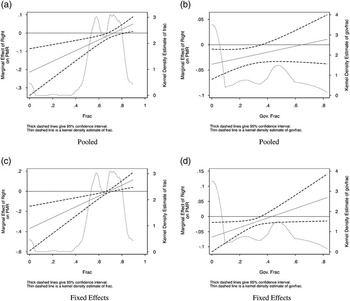
Graphical representations of the interaction terms are shown in panels (a) through (d) of Figure 4.Footnote 17 In our marginal effect figures, the y-axis shows the effect of right-wing governance on regulation at different levels of fractionalisation on the x-axis. The effect should be negative for low levels of fractionalisation, and this effect should be statistically distinguishable from zero. The effect should approach zero as fractionalisation increases. For example, panel (a) shows that the effect of right-wing governance remains negative and statistically significant until fractionalisation achieves a level of about 0.7. For the lowest possible level, 0, the effect is strongly negative or clearly below −0.2.
Marginal effects of right-wing partisanship. The hypotheses predict the marginal effect to be negative and statistically distinguishable from zero at low levels of the conditioning variable (Frac or Gov. Frac). In addition to the marginal effect and the 95% confidence intervals, the figure shows the distribution of the conditioning variable (Frac or Gov. Frac). (a and b) Pooled; (c and d) fixed effects.

These figures show that, with and without fixed effects, and regardless of how we measure legislative fragmentation, the marginal effect of right-wing governance on regulation is negative only if legislative fragmentation achieves low levels. As expected, in fragmented legislatures, there is generally no difference between left- and right-wing government. Panels (a) and (c) of the figure show, however, that for extremely high values of Frac, right-wing governments appear less likely to deregulate than left-wing governments. This may be because of the fact that the partisan orientation of the executive is virtually irrelevant when the governing coalition is extremely fractionalised.
How robust are these findings? The supplementary appendix provides additional tests. These models contain a variety of different control variables, exclude socialist economies and poor countries, use alternate standard errors and exclude years before 1989. In each case, the signs are as expected, though the statistical significance of the coefficients varies somewhat. In addition, the results hold when we use both forms of the Potrafke (Reference Potrafke2010) partisan measure or if we exclude five countries with presidential systems. This is important because the role of legislative fractionalisation may differ in systems that give the executive considerable authority. Exclusion of presidential systems shows that our results hold even under systems that do not allow for “divided government”. Finally, the results hold if we control for political polarisation and if we exclude all country-years with 0 values on Frac.
Evaluating alternative explanations
For a full test of our theory, it is essential to consider alternative explanations. Most importantly, veto player theories predict that, in a governing coalition, the preference of the most pro-regulation party – the veto player – is decisive as an impediment to deregulation. If the governing coalition has a pro-regulation party, this party may block deregulatory legislation. In this case, the lack of ideological homogeneity in the governing coalition may result in legislative paralysis even if the leading party prefers deregulation.
Our data allow us to test this proposition to see if legislative fragmentation adds any explanatory power to the model. Table 2 replicates the main results using an alternative method of coding government partisanship in the form of a variable called Partisanship. Higher values on this variable indicate a more conservative orientation. The new coding method is as follows: the partisanship of governments in Presidential systems remains the same, as it is the partisan orientation of the President’s party as identified by the DPI, scored as 1 for left, 2 for centre and 3 for right. In Parliamentary systems, however, Partisanship is a function of whether or not the governing coalition is a majority or a minority. If the governing coalition holds a majority of seats in the Parliament, the Partisanship variable takes on the partisan coding assigned by the DPI to the most pro-regulation party in the governing coalition. As we assume that the more left leaning a party is, the more it is pro-regulatory, the variable essentially takes on the minimum partisanship value assigned by the DPI to the parties that comprise the governing coalition. If the governing coalition has a minority of seats, however, Partisanship takes on the partisan coding by the DPI of the largest opposition party in Parliament.
Alternative coding method of government partisanship

Notes: In each model, the hypotheses predict that the coefficient for Partisanship is negative while the interaction with Frac or Gov. Frac is positive. Standard errors in parentheses.
FE, fixed effects; PMR, product market regulation.
*p<0.005, **p<0.01, ***p<0.001.
As the table shows, the results are virtually identical to the main results reported in the paper. The interaction of Partisanship and Frac has a positive and statistically significant coefficient in models 2 and 4, implying that more right-leaning governments, coded using this alternative method, are better able to deregulate given lower levels of fractionalisation. The coefficient on the interaction of Partisanship and Gov. Frac is also positive, though it is statistically insignificant. The interaction terms are further plotted in Figure A3 in the supplementary appendix. Again, the marginal effect of right-wing governance on regulation is negative only if legislative fragmentation is also low. In summary, the results indicate the relevance of both veto players and legislative fragmentation.
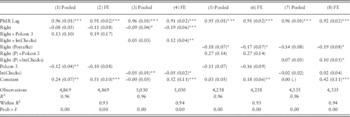
Next, could it be that institutional veto points are the real obstacle to deregulation by right-wing governments? To consider this possibility, Table 3 reports replications of our prior findings, but first using Polcon 3 in place of our fractionalisation measures in interaction with both Right and Right (Potrafke) (models 1, 2, 5 and 6) and next using ln(Checks) in their place (models 3, 4, 7 and 8). When we use the Henisz (Reference Henisz2000) variable, which is a comprehensive measure of both institutional and partisan veto points, we find that the interaction with either Right or Right (Potrafke) has no statistically significant impact on PMR. This suggests that the focus on fractionalisation is more appropriate than a focus on veto players. When using ln(Checks), the interaction term with both measures of partisanship is insignificant in the pooled models, but significant and positive in the fixed effects ones. This suggests that the results using this alternative measure are mixed at best, and certainly less stable than those found using the fractionalisation measures.
Replication of main models using veto players measures

Notes: All models include industry fixed effects, and models 2, 4, 6 and 8 also include country fixed effects. Standard errors in parentheses
FE, fixed effects; PMR, product market regulation.
*p<0.005, **p<0.01, ***p<0.001.
Further, in the supplementary appendix, we replicate our analyses using the executive constraints measure from the DPI. Regardless of specification, we found no interactive effect whatsoever. This suggests that legislative fractionalisation, instead of institutionalised veto points, impede deregulation. Therefore, our theory allows a more detailed explanation for impediments to deregulation by right-wing governments than conventional veto player accounts (Tsebelis Reference Tsebelis2002).
Second, perhaps minority right-wing governments face difficulties in implementing deregulation. We found strong support for this alternative hypothesis: right-wing governments only induce deregulation if they have a majority in the legislature. However, this does not mean that legislative fractionalisation is not important. In the supplementary appendix, we replicate our analyses excluding all minority governments. Here, legislative fractionalisation continues to reduce deregulation by right-wing governments. Therefore, a naive account based on majority voting cannot explain the disappointing performance of a right-wing government. Instead, a more sophisticated analysis of legislative fractionalisation is required.
Third, it is possible that international factors, including efforts by the EU to push deregulation and the diffusion of ideas regarding deregulation across border, are what have driven PMR. To explore the relevance of these factors, in the supplementary appendix we report results that include a EU membership dummy variable, as well as a spatial variable of average PMR values in all neighbouring countries lagged by one year.Footnote 18 The inclusion of these variables has no impact on our main results, though we also find evidence for diffusion, as the PMR values of neighbouring countries are positively correlated.
Disaggregation by sector
So far, we have seen that the results hold at the aggregate level. But, what about for different sectors? Our theory does not produce specific predictions on variation across sectors, but it is nonetheless useful to evaluate the power of our theory in different sectors. If most sectors indicate the same pattern identified in the aggregated analysis, it is less likely that our findings are driven by sectoral idiosyncracies.
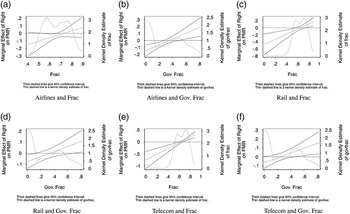
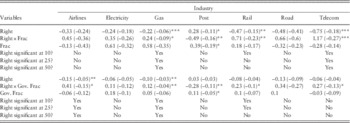
Table 4 shows the results by sector. The table shows truncated results for 14 separate models run only using data for the relevant industries. All models include country and year dummies and either Right, Frac and Right×Frac, or the equivalent set of variables with Gov. Frac. The table also indicates whether Right has a statistically significant impact on PMR at the 10th, 25th and 50th percentile, respectively, of the relevant fractionalisation variable. The results show that, in six of the seven sectors, the coefficients are correctly signed, regardless of whether we use legislative or government fractionalisation as the conditioning variable, though the interaction terms are not always statistically significant. As Figure 5 shows, however, in the case of airlines, rail and telecommunications, the interaction terms do attain statistical significance for some lower values of the relevant fractionalisation terms.Footnote 19
Marginal effects of right-wing partisanship by industry. The hypotheses predict the marginal effect to be negative and statistically distinguishable from zero at low levels of the conditioning variable (Frac or Gov. Frac). In addition to the marginal effect and the 95% confidence intervals, the figure shows the distribution of the conditioning variable (Frac or Gov. Frac). (a) Airlines and Frac; (b) Airlines and Gov. Frac; (c) Rail and Frac; (d) Rail and Gov. Frac; (e) Telecom and Frac; (f) Telecom and Gov. Frac.

Estimates by industry

*p<0.005, **p<0.01, ***p<0.001.
The only exception to this general rule is for the postal sector, in which right-wing governments have liberalised, especially under excessive legislative fragmentation. We then compare present levels of regulation in the postal sector across countries. We see that, while the countries with electoral systems that typically produce the low levels of fractionalisation critical to deregulation tend to maintain higher levels of regulation (e.g. Australia, Canada and the United Kingdom maintained scores of 3.2, 4.2 and 3.2, respectively, in 2007), a number of European countries with higher levels of fractionalisation have much lower values (e.g. both Finland and Sweden held PMR index values of 2.0 for the postal sector in 2007), as does New Zealand (2.5 in 2007), having undertaken liberalisation under a coalition government in 1998. Campbell (Reference Campbell2002) argues that this latter set of countries depicts postal deregulation as critical to reinforcing overall national competitiveness, implying a broader national consensus on the need to move forward on liberalisation. Perhaps this different perspective on the postal sector is what has inhibited the countries that otherwise fit our theory of deregulation from moving forward here.
Graphical analysis of deregulation
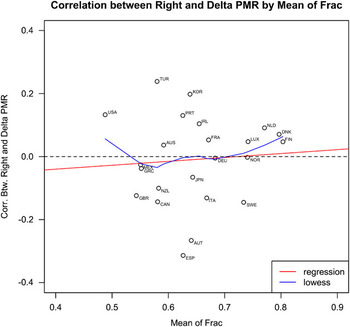
Now that we have finished presenting the results from the regression analysis, we begin looking into patterns in different countries in a simple graphical analysis. This approach has two major advantages. First, it allows us to test our hypotheses in a less parametric fashion by examining simple correlations between partisanship and deregulation in countries with different average degrees of legislative fragmentation. Second, it enables us to identify cases that can be used for a qualitative validation of the statistical model.
To conduct this analysis, we first computed the correlation between right-wing governance and the annual change in PMR in each country. In Figure 6, this is shown on the y-axis. We then computed the mean level of fractionalisation in each country, as shown on the x-axis. Next, we fitted a lowess estimator to the resulting scatterplot. The figure provides clear support for our hypothesis: in countries with generally high levels of legislative fragmentation, right-wing parties are much less different from left-wing parties with regard to regulation than in countries with low levels of legislative fragmentation. According to the lowess estimator, the only salient exception to this clear pattern is the US, a country in which the degree of legislative fractionalisation is generally less important than the difference between the partisan composition of the Congress and the executive’s partisanship.
Correlation between partisanship and annual change in product market regulation (PMR) by mean legislative fractionalisation. The hypotheses predict that the correlation becomes less negative as mean legislative fractionalisation increases. To evaluate this prediction, the figure shows a fitted linear regression line and a lowess estimator.

Based on this figure, we next use the case of Great Britain as an illustration. The English case is a stark example of the ease with which governments facing very low levels of legislative fractionalisation are able to realise their policy aims. Before the solid electoral victory of Margaret Thatcher and the right-wing Conservatives in 1979, the United Kingdom had an aggregate PMR score of 4.7; by the end of four consecutive majority Conservative governments in 1997, the PMR score had been reduced to 1.6. With an average Frac score 0.54 and an average Gov. Frac score of 0 between 1979 and 1997, the Conservative party possessed both the partisan inclination and legislative centralisation required to realise large-scale regulatory reform.
The United Kingdom faced severe economic difficulties throughout the 1970s, and alternating Conservative (right-wing) and Labour (left-wing) governments did little to address underlying structural issues in the economy. Though the Heath Conservative government, elected in 1970, had platformed on reining in government largesse, labour unrest and economic turmoil in 1971 and 1972 lead to a dramatic “U-turn”, as the government nationalised the failing Rolls-Royce and implemented a number of subsidies and wage and price controls (Bolick Reference Bolick1995).
Deregulation began in earnest with the election of Margaret Thatcher’s Conservatives in 1979. The party gained 339 out of 635 seats in the House of Commons despite winning only 43% of the popular vote. Facing skyrocketing inflation, high unemployment and labour unrest, Thatcher’s first term was primarily geared towards fiscal policies aimed at addressing these issues. This included large budgets cuts and efforts at reining in the money supply, though deregulation began in this period with the privatisation of British Aerospace in 1981 and British Telecom in 1982 (Evans Reference Evans1999). The fiscal policies put in place initially served to further increase unemployment and to cause economic contraction. Despite holding such a large majority in Parliament, Thatcher faced a difficult challenge convincing members of her own party that her radical and initially unpopular and unsuccessful policies were the appropriate measure to deal with the UK’s economic malaise. By firing dissenting Minister before they could conspire to replace her, Thatcher managed to reinforce her grasp on power (Bolick Reference Bolick1995). Given such low levels of fractionalisation, the challenges to realising a platform of deregulation came from within the Conservative party, rather than from other parties in Parliament or in the governing coalition.
By the time of her reelection in 1983 with a majority of 144 seats, Thatcher had managed to secure control over her party and, absent any policy break imposed by other parties in Parliament, was able to fully implement her desired economic policies. Denationalisation and deregulation, initially attempted in the telecommunications sector, spread to gas, electricity, water, steel and coal (Bolick Reference Bolick1995). By 1992, two-thirds of formerly state-owned industries were transferred to private ownership (Evans Reference Evans1999). Further deregulation occurred in the transportation sector with the 1985 Transport Act that privatised and deregulated inter-city bus service. The Civil Aviation Authority gradually lost its role as a licensing authority and its approval was no longer required to approve domestic aviation fares. In the financial sector, greater competition was also introduced between financial institutions (Fleming and Button Reference Fleming and Button1989) with the reform of the London Stock Exchange and the liberalisation of financial markets in 1986 (Matthews and Minford Reference Matthews and Minford1987). In summary, uninhibited by the need to compromise with coalition partners, the Conservative party was able to realise its goals of deregulation across 18 consecutive years of majority rule.
Conclusion
How do partisan preferences influence the politics of deregulation? While the received wisdom emphasises the importance of the left-right cleavage, the empirical data indicate that, in general, there is little difference. We have shown that the underwhelming difference reflects the absence of windows of opportunity for large deregulatory reforms: right-wing governments have a large positive effect on deregulation if the levels of legislative (and government) fractionalisation are low, whereas partisan differences lose importance under extreme fragmentation in the legislature and government. This interactive theory can explain broad patterns in the deregulation of product markets in industrialised countries, 1978–2007, and it also accords with some notable cases, such as Margaret Thatcher’s deregulatory programme in the United Kingdom.
The analysis raises new questions worth addressing in future research. Perhaps most importantly, our theory cannot account for deregulatory dynamics in the postal sector. The results indicate that right-wing governments are more likely to deregulate only under high levels of legislative fractionalisation. Investigating the case of the postal sector in greater detail could shed new light on the role of partisan politics in deregulation, as they may depend on sectoral features. Another interesting distinction is that between pro-market and pro-business positions. If a right-wing government’s support coalition comprises big business, the party leader may face pressure to implement policies that create profits for the incumbents in different sectors. In this case, even a right-wing party that is averse to state intervention may deregulate selectively, depending on the constellation of sectoral interests.
In addition to shedding light on the puzzling absence of a strong relationship between partisan preferences and deregulation, our findings offer a broader contribution with regard to the interactions between partisan preferences and political institutions. They show how political institutions can shape the opportunity structure of a government, and thus condition the effect of partisan preferences on policies. Normatively, political institutions that create fragmentation in the legislature limit the importance of partisan preferences. This may create more consistent and predictable policy formation, yet it also implies that parties cannot really engage in electoral competition based on diverging platforms. While the broader normative implications of our findings thus remain unclear, the large magnitude of the positive effect underscores the importance of further analysis of the interactive effects of partisan preferences and the constraints that political institutions impose.
Acknowledgements
The authors thank Brett Meyer, Pablo Pinto and Thomas Sattler for helpful comments on a previous draft.
Supplementary material
To view supplementary material for this article, please visit http://dx.doi.org/10.1017/S0143814X14000300