Introduction
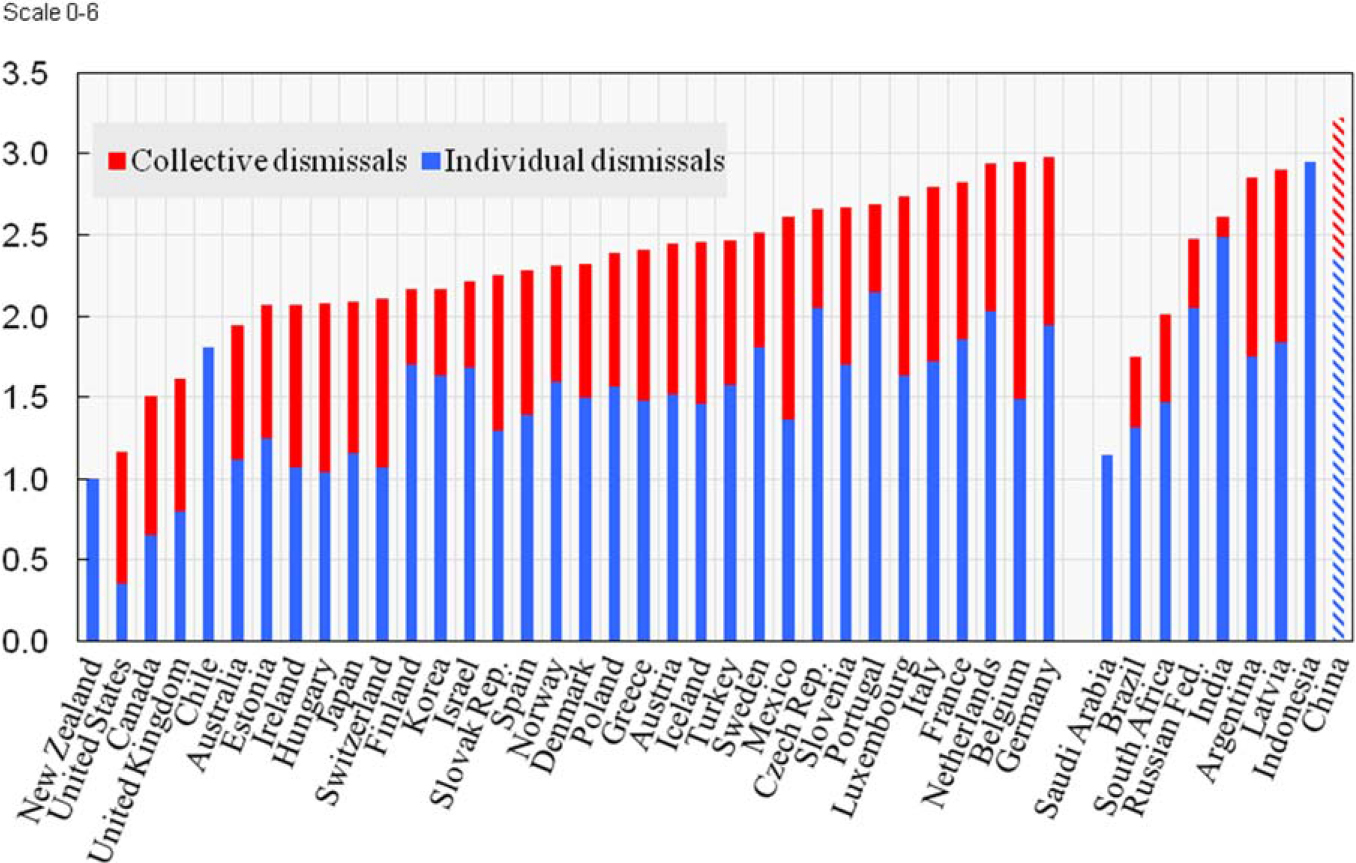
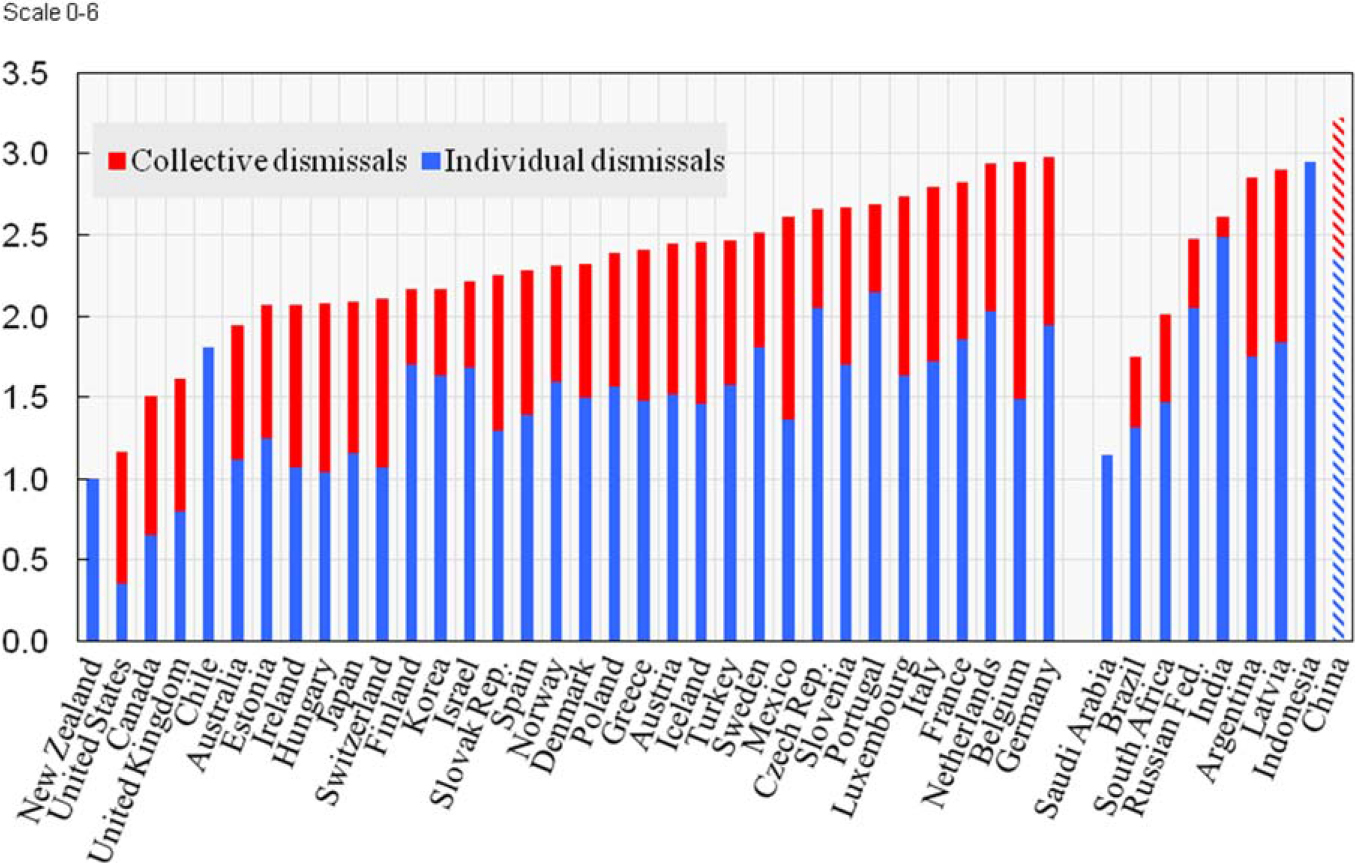
In 2007, after several years of debate, China's National People's Congress passed the Labor Contract Law (LCL).Footnote 1 This law and a collection of related legislation moved Chinese labor and employment law toward increased protection of the employee and greater constraints on employer flexibility and autonomy, reversing a trend toward greater flexibility and declining protection (Kuruvilla, Lee, and Gallagher Reference Kuruvilla, Ching and Gallagher2011). The LCL's emphasis on written employment contracts and more severe penalties for failure to sign contracts also expanded the proportion of the workforce subject to the law's requirements. In comparative terms, China now ranks at the very top of developing countries in employment security according to the Employment Protection Index of the OECD (Venn 2009; OECD 2013). China's labor laws “on the books” offer workers some of the highest protections in the world (see Figure 1).
OECD Employment Index, 2013; All OECD Countries and Selected Developing Countries.
In addition to high standards, the Chinese state has fostered legal education campaigns that propagate knowledge of codified law and instruct citizens on how to make use of the law to protect their rights. While China, as an authoritarian one-party state, scores very low in most indices measuring “rule of law,” such as judicial independence and freedom of expression, it does disproportionately well in measures of propagating legal knowledge to its population. According to the World Justice Project's rule-of-law index, on the third factor, “open government and regulatory enforcement,” China scores higher than the regional average and above the average in its income group in only one subfactor—“the laws are publicized and accessible.” Overall, China's rule of law scores thirteen out of fifteen countries in the East Asia region, only ahead of Myanmar and Cambodia. However, for propagation of legal knowledge, China ranks sixteenth globally, just ahead of Germany and behind Australia (World Justice Project 2014). Not only are China's labor standards high, but the state also uses its impressive media and propaganda system to propagate legal awareness and rights consciousness.
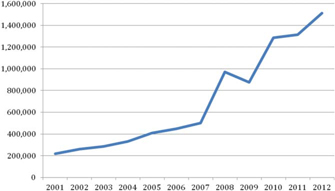
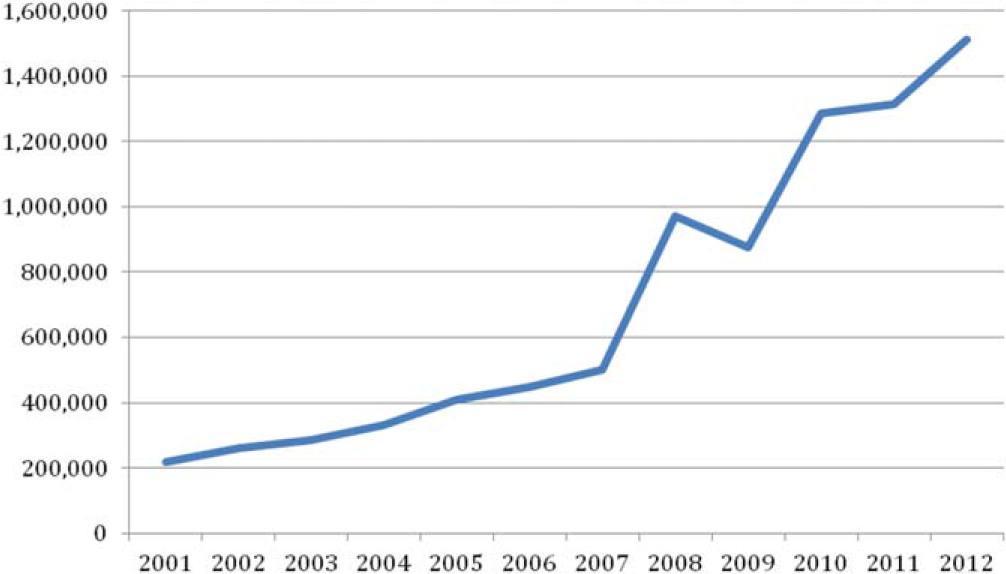
These two trends—higher labor standards and state-sponsored legal awareness campaigns—combined with continued weak local government implementation and enforcement of labor law are behind the dramatic increase in legal mobilization among Chinese workers. In 2008, the year that the LCL took effect, labor disputes doubled nationally and have continued to rise since then (see Figure 2). An authoritarian but activist state has promoted the concept of rights and extorted the population to use the legal system as a weapon to protect these newly enshrined rights. Although the political constraints are considerable, many citizens have “taken the state at its word,” invoking rights and legal protections against employers, polluters, other citizens, and sometimes even the government itself (O'Brien and Li Reference O'Brien and Li2006,17; Michelson Reference Michelson2007,Reference Michelson2008; Givens Reference Givens2013; Stern Reference Stern2013).
Labor Disputes, 2001–2112 (Labor Statistical Yearbook various years).
Building on Zemans's (Reference Zemans1983) early call for legal mobilization to be theorized as a form of political participation, we show here how legal mobilization is one critical way that citizens engage with the state, invoking state power and authority for their own interests, and challenging the state to provide a public arena for the resolution of private disputes. Many studies of legal mobilization around workplace rights have explored the impact of litigation, individual and institutional determinants of success, the link between legal strategies and social movements, and the promise and limits of social change via the law (Burstein Reference Burstein1991; Edelman, Erlanger, and Lande Reference Edelman, Erlanger and Lande1993; McCann Reference McCann1994; Epp Reference Epp1998; McCammon Reference McCammon2001; Albiston Reference Albiston2005; Nelson, Berrey, and Nielsen Reference Nelson, Berrey and Nielsen2008; Rosenberg Reference Rosenberg2008; Gleeson Reference Gleeson2009). Studies of workers' legal mobilization have been overwhelmingly based on experiences in the United States and other Western, or at least, democratic societies. This is not surprising as it is in those places where “rights revolutions” have been most successful, building on activist judiciaries, vibrant civil societies, and competitive electoral systems (Epp Reference Epp1998).
Using both survey data and case narratives of legal-aid litigants, we explore patterns of legal mobilization at the workplace in China and the role of education, both formal and informal, in bringing people to the law as a mode of conflict resolution and rights protection. There are three major findings worth highlighting. First, as expected, formal education is an important predictor of both propensity to use the law and belief in the law's effectiveness. As with other types of political participation, patterns of legal mobilization reflect the importance of educational resources and skills. The benefits of rule of law accrue to those with the resources to make use of them. However, our second finding is that informally acquired specialized knowledge about labor rights can substitute for formal education, encouraging even less educated workers to use the legal system. Aggrieved workers often begin their road to the courts with an intense period of self-education, using the media, books, the Internet, and social networks to find out their rights “on the books.” Such informally gained knowledge can also instill more positive evaluations of the law and higher levels of efficacy. Third, while more educated and knowledgeable citizens are more likely to use these new institutions to foster their own political participation and advance their interests in the market economy, prior dispute experience reduces a person's propensity to seek out legal institutions for resolution and even contributes to a general lack of faith in the official channels. As experienced citizens, these disputants may have higher demands and expectations regarding the performance of such institutions, which can lead to dashed hopes and disappointment in the dispute aftermath.
Using the difference in access to representation between the legal aid plaintiffs in the case narrative data and the respondents of two recent surveys, we conclude that the broad lack of access to adequate representation is one important factor that produces strong disenchantment with the legal system. In China, the lack of strong civil society organizations to build sustained connections between workers and the restrictions on freedom of association block the adequate representation of most workers, creating dissatisfaction and alienation among experienced users of the institutions (Gallagher Reference Gallagher2006). Legal mobilization in the absence of institutional complementarity, such as institutions that provide representation, exacerbates citizen perception of an unresponsive and biased state. State-led attempts to encourage individualized legal mobilization and channel social conflict into formal institutional channels may be undermining the state's legitimacy and citizen confidence in its legal institutions. The state's instrumental use of “rule of law” produces contradictory outcomes—encouraging citizens to use the legal system, but also breeding their disdain for it. This conclusion challenges the commonly accepted notion that the Chinese government's construction of a functioning legal system in the aftermath of the Cultural Revolution has enhanced the regime's legitimacy and resilience (Nathan Reference Nathan2003; Zweig Reference Zweig2003).
While disenchantment with legal institutions is not unique to China (Benesh Reference Benesh2006; Hendley Reference Hendley2013), it is possible that these problems are more endemic to authoritarian regimes in which the gap between formal institutions and how they actually operate is large. In China, this gap is even more consequential as the state's protective labor legislation and its large-scale dissemination campaigns of legal knowledge have heightened the expectations of the population. Michelson and Read find a similar problem of high expectations and dashed hopes in their study of public attitudes toward the legal system (Michelson and Read Reference Michelson and Read2010). The CCP's embrace of democratic institutions, such as “rule of law,” to sustain authoritarian rule may be backfiring. While the state encourages citizens to use these institutions to advance their interests and protect their rights, such use exposes its flaws and the local state's own ambivalent and inadequate provision of these institutions.
Data and Methods
The argument and evidence presented here are the result of two modes of research inquiry: in-depth analysis of over sixty labor dispute cases litigated by a legal-aid center at a Shanghai University from 2004 to 2012 and survey data from multicity surveys in 2005 and 2010. The case narratives include in-depth interviews with the plaintiff, case materials, including pieces of evidence, letters, petitioning records, and, finally, related administrative and judicial documents, including judicial and arbitration decisions, mediated agreements, and other forms of settlement. The 2005 Labor Law Mobilization Survey (LLMS) is a randomly sampled household survey in four Chinese cities—Chongqing (in the southwest), Foshan (in the southeast), Wuxi (in the east), and Shenyang (in the northeast). The survey examined respondents' knowledge of labor law, attitudes toward various dispute resolution processes, and actual behavior in handling workplace grievances. The 2010 China Urban Labor Force Survey (CULS) is a randomly sampled household survey of labor and employment issues in five Chinese cities, also regionally dispersed, including Shenyang, Xian, Wuhan, Shanghai, and Fuzhou. The survey included a section that measured labor law knowledge, dispute experience, and attitudes about the dispute processing experience. As multicity surveys, they capture labor and employment patterns in large urban areas, but are not nationally representative. They do not include information on rural employment or agricultural workers. However, both surveys include migrant workers in the populations studied. More information about both surveys is available in the Appendix.
Both the 2005 and 2010 surveys indicate the importance of education and knowledge in encouraging legal mobilization for workplace rights. They also indicate that actual dispute experience is associated with less confidence in legal institutions and less desire to use them again for rights protection. In the case narratives, we see the various ways in which formal education and more informally acquired knowledge affect a plaintiff's process of legal mobilization and also his or her evaluation of external institutions and potential future action. We use the case narratives to highlight important correlative relationships that emerge in the survey analysis. However, the two populations (legal-aid plaintiffs and survey respondents) are very different, and we use these differences to emphasize key findings. First, the relatively more positive experiences and assessments of the plaintiffs underscore the importance of adequate legal representation. Each of these plaintiffs received free, high-quality, specialized legal assistance.Footnote 2 The presence of high-quality legal aid for these respondents is most likely responsible for their relatively better legal experience and their postdispute accounts of more confidence and faith in themselves, if not the system. As Relis (Reference Relis2002) notes in analysis on civil litigants' experiences, legal representation can make the difference between a good experience and a horrific one, unrelated to the objective outcomes of the case. Most Chinese workers are unable to avail themselves of quality legal aid. Government-run legal aid is usually means tested, which restricts aid to the very poorest. University affiliated legal-aid centers are few and far between. Independent NGOs that provide legal aid for workers do exist, but are highly concentrated in the Pearl River Delta in southern China and subjected to sporadic repression, harassment, and arrest (Cheng, Ngok, and Zhuang Reference Cheng, Ngok and Zhuang2010; Spires Reference Spires2011; Xu Reference Xu2013). Among disputants surveyed in the 2005 LLMS, less than 8 percent had access to any type of representation (such as a for-fee lawyer or trade union assistance) and only a miniscule number had contact with legal-aid organizations during their dispute.
Second, as legal aid recipients, these disputants are generally of low education and social status. Some are rural migrants with “hukou” still linking them to their rural birthplaces (Chan and Buckingham Reference Chan and Buckingham2008; Chan Reference Chan2010).Footnote 3 Others are middle-aged state-sector workers with low levels of education who faced layoffs and unemployment after the state sector was restructured in the late 1990s. Their disputing behavior, which generally began with an intense period of self-education in labor and employment law via the media, the workplace, and social networks, helps us make sense of the importance of specific labor law knowledge in encouraging rights' protection and legal mobilization. Their hard-fought efforts to overcome deficits in formal education underscore the critical importance of the media and propaganda system in China's rule-of-law development.
The Labor Dispute Resolution Process
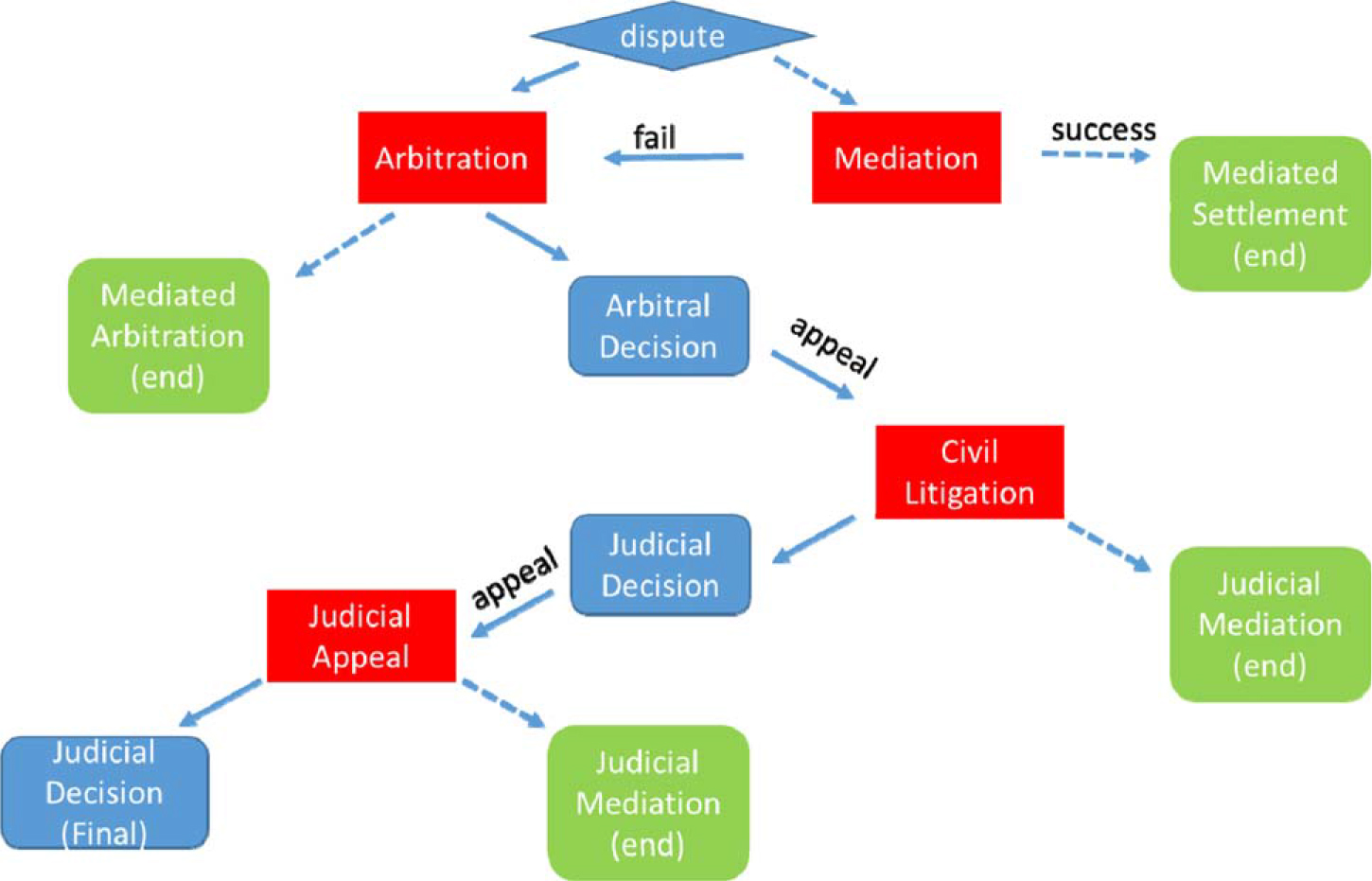
China's system of labor dispute resolution has multiple stages and can be a lengthy, drawn-out process (see Figure 3). After a workplace dispute has occurred, the two sides have an initial choice between voluntary mediation or compulsory labor arbitration. Mediation can occur in many different venues, including the enterprise itself, the local government's neighborhood office or community center, via trade union mediation services, or through the labor bureau directly. Mediation options vary greatly by locality. Since 2008 with the implementation of the Labor Dispute Mediation and Arbitration Law, mediation is the government's preferred form of settlement and the option to mediate is present at every level of resolution.Footnote 4 If the initial mediation is unsuccessful or refused by either side, the aggrieved party then lodges a formal claim at the local Labor Arbitration Committee. Arbitration is a required step and results in either a formal arbitral judgment or a mediated settlement. Arbitration is staffed and managed by local labor bureau officials, though with the increase in disputes, many localities have hired part-time arbitrators from universities, law firms, and other professional entities. In complicated cases, the representatives from the local branch of the ACFTU and the official business associations may also take part.
Labor Dispute Resolution Process.
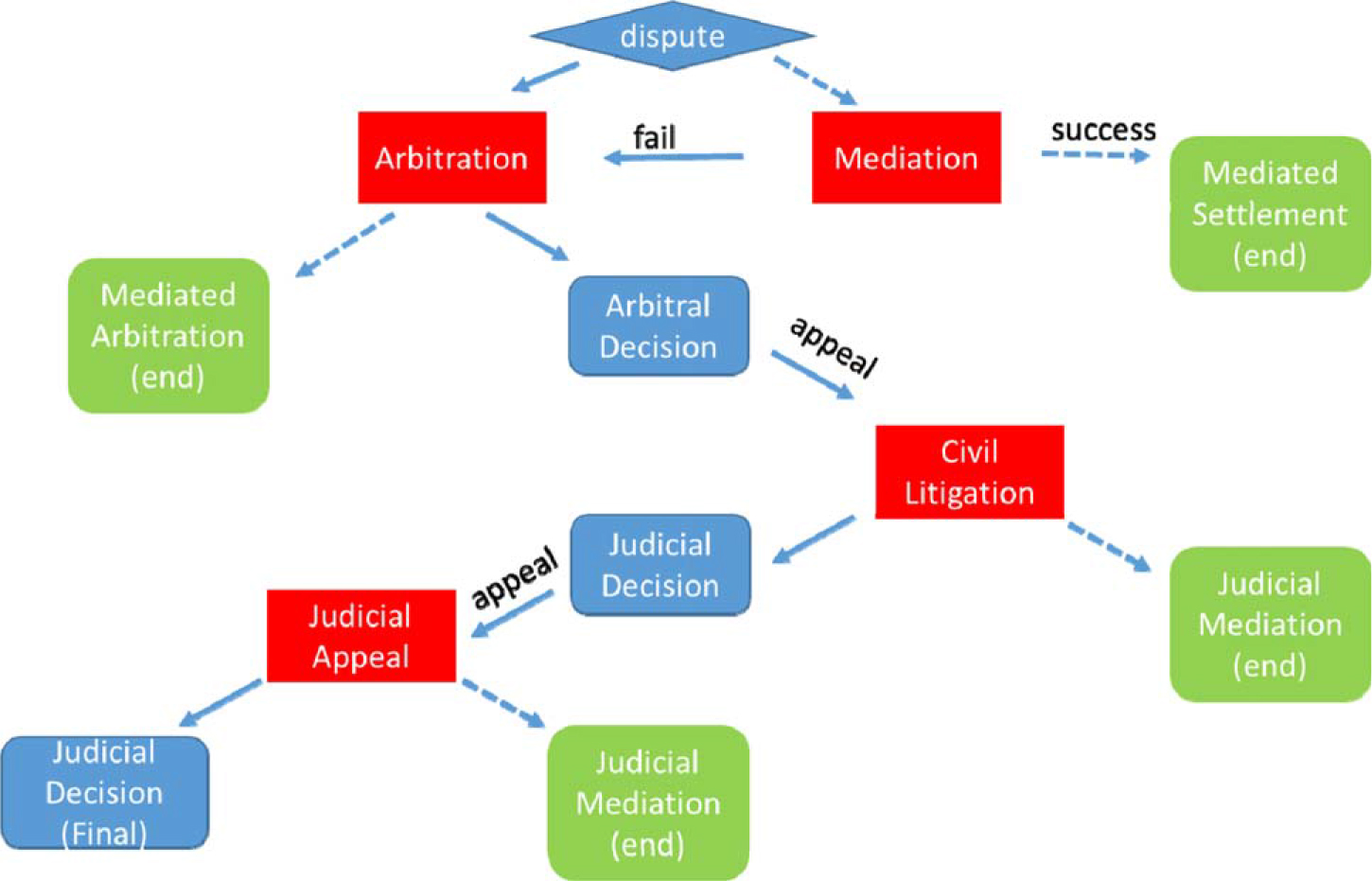
Litigation is the final stage of resolution. If either side of the arbitration suit is dissatisfied with the arbitration ruling, they can appeal for a de novo hearing in civil court. The judicial process can conclude with a formal judicial decision or a mediated settlement. Judges' career and promotion incentives encourage mediated settlements. If either side is dissatisfied with the first judicial decision, they are also entitled to an appeal to the local intermediate court. This right to appeal is often used by employers to delay judgment and to drag on the resolution process for an extended period of time. Disputes can easily take over one year to resolve from beginning to end, sometimes longer. Despite the problems in getting to court, many respondents see the courts as the most effective resolution strategy, as we explore below.
Prior to the 2008 Labor Dispute Mediation and Arbitration Law, the costs of labor dispute resolution were substantial for ordinary workers. The cost of filing an arbitration case was 300 RMB in Shanghai and many other places. Some localities set the filing fee as a percentage of the total claim, which could be very high for cases involving occupational injury and other large settlements. The new law shifted all costs of resolution to the government; arbitration became free and court-filing fees were also reduced. The law also shifted the burden of proof from the employee to the employer; if the employer kept the evidence needed, it is now obligated to provide it. Finally, the 2008 Law extended the statute of limitations from sixty days to one year.
Legal Mobilization and Education
Legal mobilization is the “invoking of legal norms” to solve problems; it is “a form of political activity by which the citizenry uses public authority on its own behalf” (Zemans Reference Zemans1983, 690). Legal mobilization differs from more routine political behavior, such as voting, but this does not reduce its political consequences. Unlike voting, which may have only indirect effects on an individual, legal mobilization usually entails a personal cause first. Public outcomes are often the indirect consequences of decisions on single cases—outcomes through changes in legislation, case law, or public opinion. Legal mobilization is also a process—the transformation of a social problem into a legal one. While it might end in court, it could also include extralegal action such as protest, petitioning, or seeking out media exposure. Many disputants also use multiple avenues (sometimes simultaneously and sometimes consecutively) to maximize their chances of a positive outcome. Its effects might be seen in the courtroom and on the streets.
Despite its roots in private concerns, even individual legal mobilization can be linked to important public policy goals, such as enhanced implementation and enforcement of law. Much of law enforcement and rights empowerment only occurs when people invoke laws and rights around their own personal interests. Rights are “contingent,” given by the state in legislation, but often not realized until citizens mobilize to press for enforcement. The state's encouragement of legal mobilization by private citizens in China is partly motivated by the inability of the local state to enforce laws effectively (Gallagher forthcoming). Bottom-up legal mobilization serves as a “fire-alarm” regulatory system that compensates for a fragmented local state that is tasked both with economic growth and control of the negative externalities of growth, such as pollution and labor violations (McCubbins and Schwartz Reference McCubbins and Schwartz1984). As Clarke demonstrates for China, the legal mobilization of citizens as “private attorney generals” is part of a policy environment that relies on nonstate action to achieve the state's goals by supplying a “structure of incentives designed to mobilize citizens …” (Clarke Reference Clarke2009, 242). This public role of legal mobilization further bolsters the argument to take individual legal action as inherently political. While the state might be self-serving in its promotion of legal mobilization, there also may be important consequences of state-led citizen activism beyond what the state intended.
In an authoritarian political context in which most political institutions are formalistic and highly constrained, the political importance of legal mobilization is heightened. In China, electoral and legislative institutions do not offer many opportunities for individual citizens to participate in meaningful ways. As Shi notes in his study of Beijing, many people participate in politics via informal or administrative channels where policy preferences, complaints, and suggestions might receive more attention (Shi Reference Shi1997). When formal political participation is restricted, the few channels that exist become more significant as space for state-society interaction, for individuals to have a sense of voice and to engage in expressive political participation.
As a mode of political participation, however, the importance of education to the legal process cannot be overemphasized, especially in a system like China's that restricts civil society and organizations, such as trade unions, that might substitute when individual capacity or knowledge is lacking. In studies of political participation in developed democracies, the “resource model”—one's ability to marshal “time, money, and skills” toward political participation—finds that education is the “single best predictor of political activity” (Brady, Verba, and Schlozman Reference Brady, Verba and Lehman Schlozman1995; Burns, Schlozman, and Verba Reference Burns, Schlozman and Verba2009). Scholars of US political participation have examined the myriad ways in which nonpolitical organizations, such as churches and social organizations, can provide a training ground for political activists and make up for individual deficiencies in income or in formal education. Perhaps because of the dearth of social organizations and associational life in China, scholars of political participation in China have found that the general resource model fits China well (Shi Reference Shi1997; Tang Reference Tang2005, 135). The decreasing importance of work-unit type and occupational group reflects the growing individualization of Chinese society, the increasing importance placed on individual skill, education, and achievement, and the declining influence of socialist institutions on people's daily lives (Tang Reference Tang2009). Jennings reiterates this importance of individual resources, not only in light of the decline of administrative power of the state, but also in the context of weak civil society and associational life (Jennings Reference Jennings1997, 362).
Beyond the resource model's focus on who participates is Galanter's question about who benefits. Structural inequalities built into the legal process disadvantage individuals without the requisite skills, tools, or resources to use the law effectively (Galanter Reference Galanter1974). This is especially the case in disputes that pit individual litigants against repeat players such as large corporations with ample legal and financial resources. The legal process can be frustrating and disempowering, especially when the plaintiff lacks adequate legal representation, which is critical to managing expectations and shaping claims. Not only does having a lawyer improve perceptions of fairness among litigants, many disputants profess satisfaction with their own lawyer even when unhappy with the entire system (Relis Reference Relis2002, 160). Other work has noted the importance of civil society organizations in assisting marginalized workers in making formal claims and moving through difficult administrative processes to resolve disputes (Gleeson Reference Gleeson2009). However, for the vast number of unrepresented litigants, the legal mobilization process is unsatisfactory, confusing, and frustrating (Relis Reference Relis2002, 178). Lower levels of educational attainment are commonly collinear with other factors that suppress mobilization, including race, gender, and class (Bumiller Reference Bumiller1988; Ewick Reference Ewick1998). Benesh, in her study of individual contact with the courts, finds that in the US context, education and knowledge tend to produce more confidence in judicial institutions (Benesh Reference Benesh2006). Relis's overview of the literature on individual perceptions of the legal system also finds that individual-level attributes can have critical effects on how one experiences and evaluates the legal system (Relis Reference Relis2002).
In the context of legal mobilization around workplace issues, the Chinese case highlights these problems in stark relief. Inequality in resources affects legal outcomes (Lee Reference Lee2007), with individual differences in resources exacerbated by the paucity of civil society organizations, which restricts opportunities for representation; creating legal experiences that are often alienating, bureaucratic, and frustrating for many aggrieved workers. Other work has reiterated the importance of political and personal connections as important resources in legal mobilization (Michelson Reference Michelson2007; Ang and Jia Reference Ang and Jia2014), factors that also tend to accrue to those in positions of power. In analyzing patterns of legal mobilization in China, Gallagher introduced the concept of “informed disenchantment” to theorize about the contradictory effects of legal mobilization on legal-aid recipients in Shanghai and to emphasize the educative components of the process itself (Gallagher Reference Gallagher2006). The process of becoming educated about how the law works can have strongly negative effects on evaluations of legal and administrative institutions such as arbitration committees and courts. However, this same process via legal aid can have positive effects on an individual's own sense of internal efficacy. Many disputants leave the process with strong opinions that the law does not work well, but that they have learned to work the law more effectively. This interpretation also explains the contradictory bundle of beliefs that many legal-aid recipients exhibited during in-depth interviews, including very negative evaluations of the law and political system coupled with affirmative evaluations of their own future chances using the law to protect their rights. As we discuss in this article, gaining a high level of legal knowledge improves the legal experience and contributes to more positive evaluations of legal institutions. Actual experience with the law, however, dampens enthusiasm for the law as effective for rights' protection.
In the empirical sections that follow, we present our findings on the educative process of legal mobilization. We first explore how formal education and informally acquired legal knowledge assist plaintiffs in the initial stages of the dispute process when awareness and knowledge of rights and the violation of rights are critical. We then examine the roles of education and knowledge in the disputing process, demonstrating the relationship between higher levels of education and knowledge with greater propensity to embrace formal institutions, especially litigation. Finally, we explore the process of disenchantment with the legal system as actual experience is gained.
Knowing and Naming Rights
One precondition of legal mobilization is knowledge and awareness of codified rights (Albiston Reference Albiston2005). If one is unaware of rights on the books, then the process of legal mobilization, “naming, blaming, claiming,” cannot even begin because discovery of a grievance requires knowledge that another person's behavior contravenes a rule (Felstiner, Abel, and Sarat Reference Felstiner, Abel and Sarat1980). It is widely accepted in China today that people's awareness and consciousness about their legal rights has increased (Pei Reference Pei1997; O'Brien and Li Reference O'Brien and Li2006; Yang and Calhoun Reference Yang and Calhoun2007). Much of the legal dissemination and knowledge dispersion about rights in China has been done either by the state or with the state's encouragement through the official media (Stockmann and Gallagher Reference Stockmann and Gallagher2011). Based on the evidence presented here, these knowledge campaigns have been successful. First, people now know a good amount about their basic workplace rights, though many do not know specific details. Second, the gap between urban residents and migrant workers in knowledge seems to be narrowing, especially among younger workers and more educated workers. Third, formal education is associated with higher levels of knowledge, but there is no relationship between dispute experience and higher levels of knowledge.
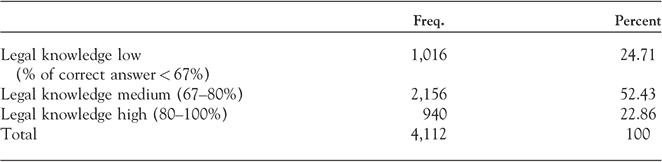
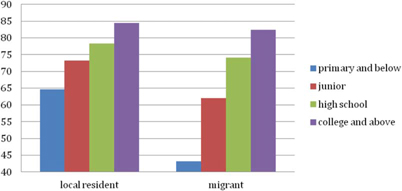
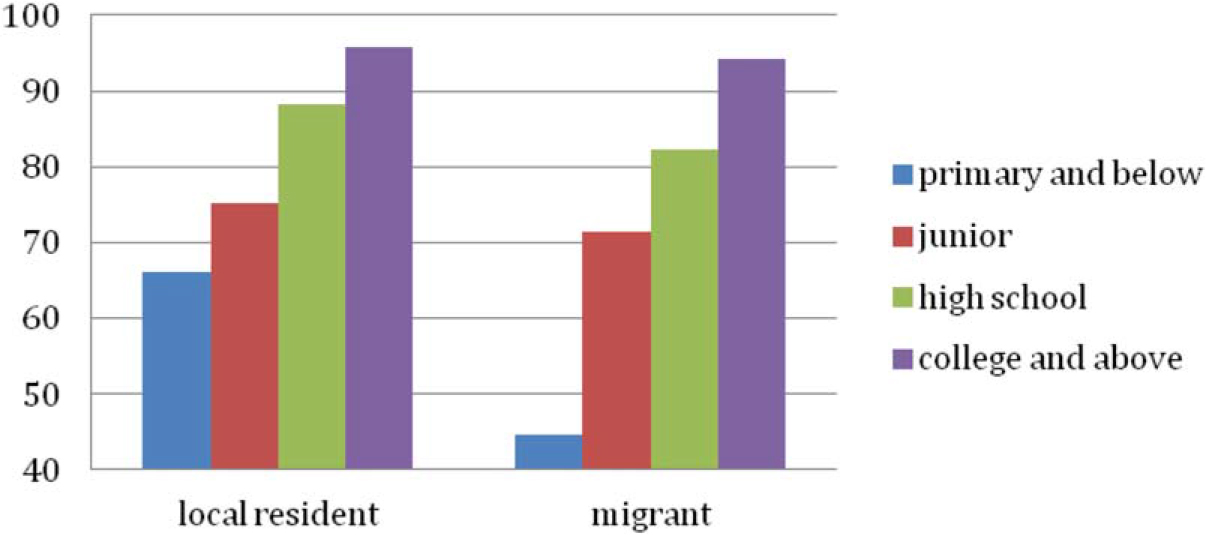
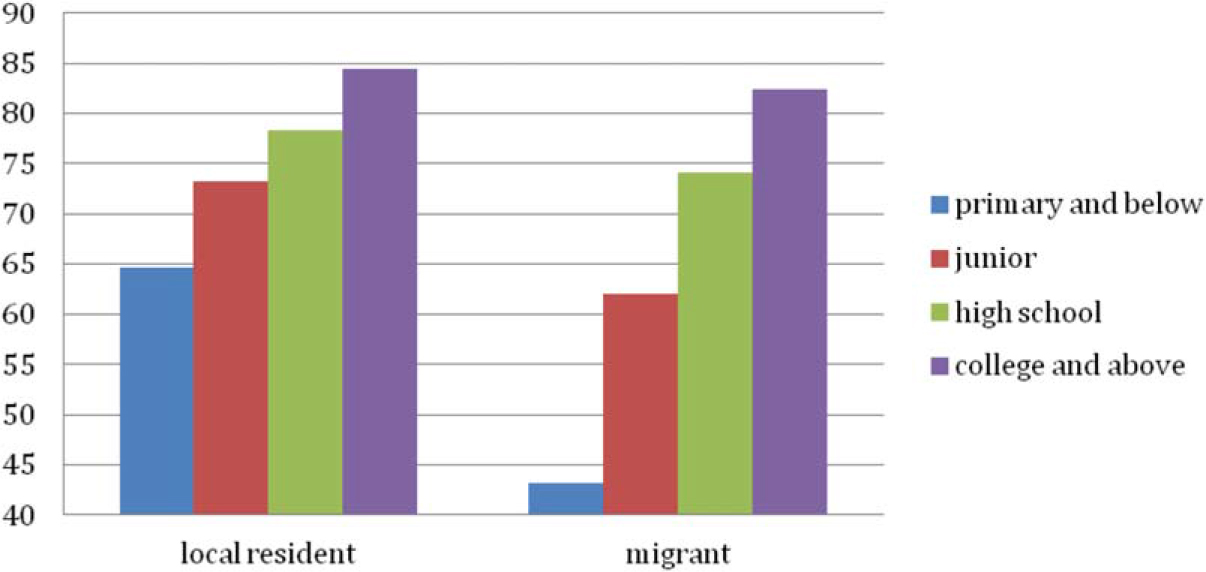
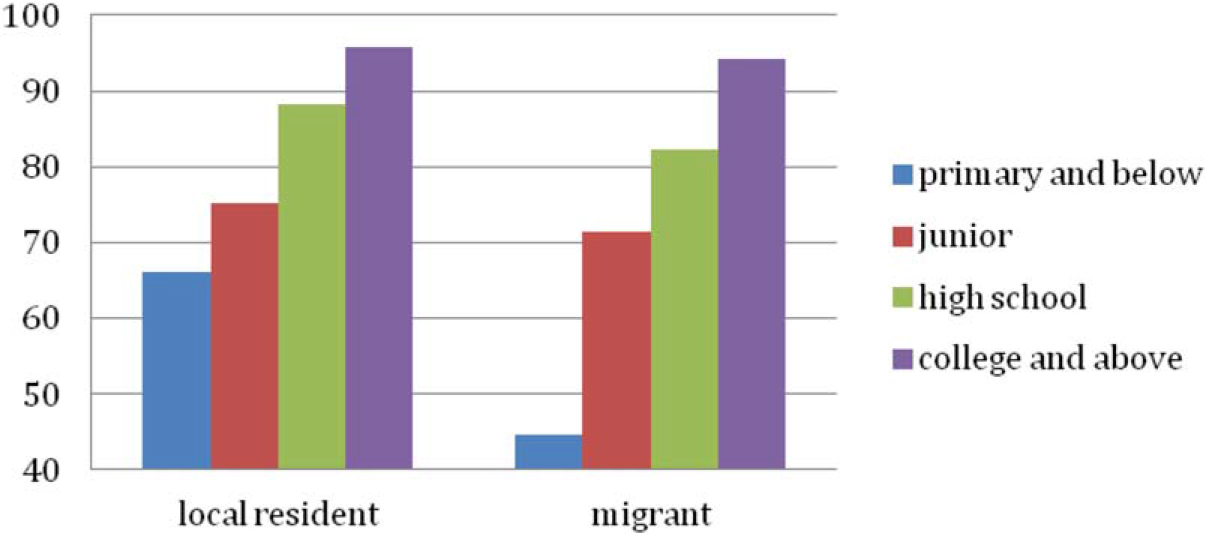
In the 2005 LLMS, respondents answered a battery of thirty-four questions related to labor and employment law. The questions ranged from relatively general to very specific. Given the level of specificity, range of topics, and number of questions, it is surprising that a large number of respondents did relatively well on this test of their specific labor law knowledge. As displayed in Table 1, over 75 percent of the more than 4,000 respondents attained medium to high levels of labor law knowledge.Footnote 5 (See Table 1.) In the 2010 CULS, using a truncated battery of similar questions, both urban residents and migrants displayed high levels of knowledge on major issues (Gallagher et al. Reference Gallagher, Giles, Park and Wang2014). Ninety-five percent of local residents and 89.5 percent of migrants knew that they were entitled to a labor contract. Eighty percent of local residents and 77 percent of migrants knew that the penalty for failing to conclude a contract is double wages for every month worked without a formal contract. Migrant workers with a high school education and above trail their urban counterparts only slightly in awareness of the labor law and in detailed knowledge of the law's content (see Figures 4 and Figures 5). The smaller gaps in the CULS 2010 survey may indicate that migrants are catching up quickly in what they know about workplace rights. In both the 2005 and 2010 surveys, education is associated with higher levels of legal knowledge.Footnote 6
Legal Knowledge (LLMS 2005)

| Freq. | Percent | |
|---|---|---|
| Legal knowledge low (% of correct answer < 67%) | 1,016 | 24.71 |
| Legal knowledge medium (67–80%) | 2,156 | 52.43 |
| Legal knowledge high (80–100%) | 940 | 22.86 |
| Total | 4,112 | 100 |
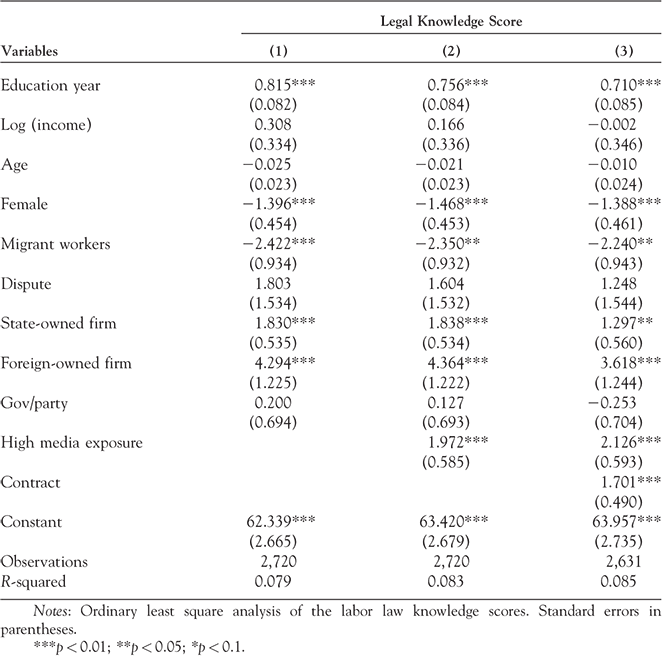
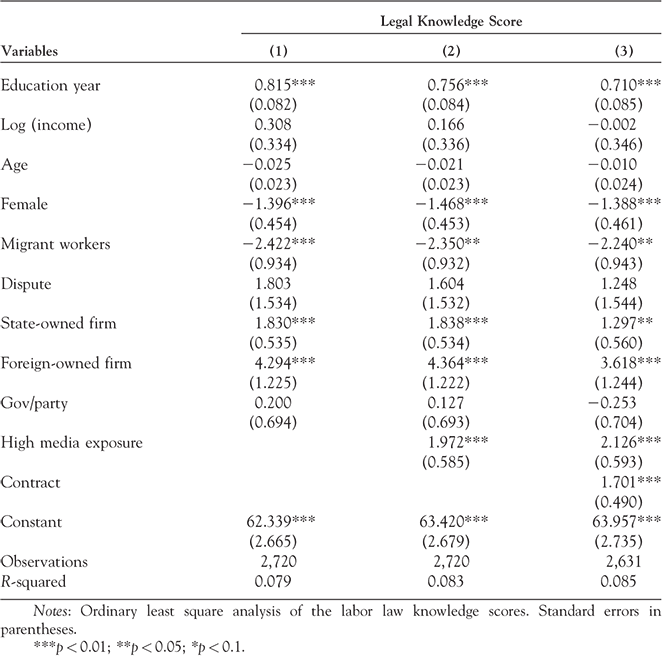
There is a strong relationship between formal education and levels of legal knowledge. In the 2005 LLMS, education year is significantly and positively associated with the legal knowledge score through all the tests (Table 2). The 2010 CULS also found that education was significantly and positively associated with awareness of the law (Gallagher et al. Reference Gallagher, Giles, Park and Wang2014). Cai and Wang, using the same CULS data, found that formal education is a consistent predictor of an individual's propensity to initiate a labor dispute (Cai and Wang Reference Cai and Wang2012, 7). As witnessed by our case narratives below, however, formal education is not the major or exclusive source of legal knowledge. Workers from different educational backgrounds acquire legal knowledge using various resources. The media is one of the most important sources from which workers acquire relevant legal knowledge (Gallagher Reference Gallagher2006). Both formally educated and educated workers rely greatly on the media resources to obtain legal knowledge. This process of self-education and confidence building (as well as consciousness raising) through media, newspapers, and Internet sources become important parts of the legal mobilization of both types of workers.
Med-High Knowledge by Education Level (LLMS 2005).
Awareness of Labor Law by Education Level (LLMS 2005).
Mr. Hao's (SH200440) case shows the role of newspapers in disseminating legal knowledge to Chinese workers. Mr. Hao, born in 1951 with a middle school education, started work in 1968 at a shipping company associated with the municipal Translation Bureau. In 1994, he was laid off and given 280 RMB (34 USD) per month for living expenses. Finally, in 2001, he was fired without any notification. He learned that he had been terminated only after he inquired about his unpaid social insurance. He also realized that he was never given severance pay. Even though he was poorly educated, he learned how to protect his rights and interests by reading the newspapers, especially Labor Daily, run by the Shanghai Municipal Trade Union, New People Evening News, and the Liberation Daily.
Some workers use more diverse resources than newspapers to attain legal knowledge. Like Mr. Hao, Old Zhao (SH200449) is a classic example of the “lost generation” of the Cultural Revolution. Born in 1957, he was sent down during the Cultural Revolution to a farm in Subei, a poor rural part of Jiangsu Province. When he returned Shanghai, it was too late. He lost out on educational opportunities and faced a period of unemployment. Finally, in 1984, he inherited his mother's state-owned enterprise (SOE) position. Zhao's company formed a joint venture with a Korean firm in the early 1990s and he signed an open-ended contract with his employer in 1997. Two years later, due to restructuring and the departure of the foreign partner, Zhao was laid off. While he was allocated a small living stipend, the firm's new management continuously offered him employment at a newly formed firm with a short-term contract and low pay. Zhao as a middle-aged, poorly educated, former rusticated worker was fearful that this move would sever his former relationship with his original employer and leave him to the vagaries of the market. He refused and began to petition, seeking out the government and the media at various levels to resolve his case.
Determinants of Legal Knowledge (LLMS 2005)
| Legal Knowledge Score | |||
|---|---|---|---|
| Variables | (1) | (2) | (3) |
| Education year | 0.815 *** | 0.756 *** | 0.710 *** |
| (0.082) | (0.084) | (0.085) | |
| Log (income) | 0.308 | 0.166 | −0.002 |
| (0.334) | (0.336) | (0.346) | |
| Age | −0.025 | −0.021 | −0.010 |
| (0.023) | (0.023) | (0.024) | |
| Female | −1.396 *** | −1.468 *** | −1.388 *** |
| (0.454) | (0.453) | (0.461) | |
| Migrant workers | −2.422 *** | −2.350 ** | −2.240 ** |
| (0.934) | (0.932) | (0.943) | |
| Dispute | 1.803 | 1.604 | 1.248 |
| (1.534) | (1.532) | (1.544) | |
| State-owned firm | 1.830 *** | 1.838 *** | 1.297 ** |
| (0.535) | (0.534) | (0.560) | |
| Foreign-owned firm | 4.294 *** | 4.364 *** | 3.618 *** |
| (1.225) | (1.222) | (1.244) | |
| Gov/party | 0.200 | 0.127 | −0.253 |
| (0.694) | (0.693) | (0.704) | |
| High media exposure | 1.972 *** | 2.126 *** | |
| (0.585) | (0.593) | ||
| Contract | 1.701 *** | ||
| (0.490) | |||
| Constant | 62.339 *** | 63.420 *** | 63.957 *** |
| (2.665) | (2.679) | (2.735) | |
| Observations | 2,720 | 2,720 | 2,631 |
| R-squared | 0.079 | 0.083 | 0.085 |
Notes: Ordinary least square analysis of the labor law knowledge scores. Standard errors in parentheses.
*** p<0.01;
** p<0.05;
* p<0.1.
While Zhao looked at local newspapers as Mr. Hao did, he also used other diverse channels to gather the legal information. He actively pursued learning about the law and availed himself of all the possible tools to do so—the media, books, sitting in on the courts, reading documents, calling the government hotline, consulting with knowledgeable friends, and gaining specialized knowledge from legal aid. Even before he encountered legal aid two years into his dispute, he had used considerable time and resources to educate himself about the various laws and policies that might improve his case. He reports spending over 3,000 RMB ($365 USD) on books about the labor law and contract law. As Zhao's dispute progressed through arbitration and litigation, he became more interested in new legal protections for workers. He began to sit in on court cases to observe how other cases are decided.
Educated workers also actively utilize media resources to educate themselves. Little Sister Yao (SH200413) is a young university graduate from rural Jiangxi Province who migrated to Shanghai and found an administrative position in a Sino-Japanese joint venture. She was demoted to a factory position from her office position after she took a one-week absence from the workplace following an accident in her home village in which seven family members were injured. Although she notes that she received oral permission to do so, when she returned to work a week later, her manager accused her of an unexcused absence and sent her down to the workshop. When she resigned in protest, the company demanded that she repay costs of 20,000 RMB ($2,439 USD). She refused and sued the company for the right to resign freely and for severance compensation. During the process, she did a lot of research to find out what her rights were—she went to the library, found newspapers and magazines, and read about legal aid in the New People Evening News, a popular evening paper in Shanghai.
Formal education is far from an exclusive source from which workers learn legal knowledge. Learning emerges in disparate ways among disputants with different backgrounds and situations. Moreover, even educated workers rely greatly on media resources to obtain legal knowledge. Nevertheless, the role of formal education is a constant throughout and was a theme raised again and again by legal-aid plaintiffs. More highly educated plaintiffs attributed their effectiveness to their higher levels of education while less educated plaintiffs blamed their low “cultural level” for their inability to master the law. Our statistical evidence also supports this. Table 2 shows that the effect of formal education remains the same even when the media exposure level, the dominant source from which both types of workers acquire legal knowledge, is controlled. If formal education is not an exclusive source of legal knowledge, what explains the positive relationship between formal education and workers' legal knowledge levels? What advantages do formally educated workers have over poorly educated workers in terms of acquiring legal knowledge?
Our case narratives show that formally educated workers are more competent in processing the large amount of legal information available to the public. This partly explains why educated workers have higher legal knowledge levels even though the resources available are the same. While both Sister Yao and Old Zhao relied on newspapers to find out their rights, their ability to read articles and find information varied. Uneducated Zhao had “never even read newspapers or books prior to his dispute.” Contrary to Zhao, Yao developed her ability to read and find relevant information, to synthesize material as part of her formal education. These educated plaintiffs acquire legal knowledge more efficiently and use it more effectively. For example, Yao presents her arguments in carefully composed, typed letters that cite the relevant laws and are sent to the company by registered mail. Old Zhao scrawls his demands in longhand on the company's letterhead and submits reams of paper and petitions to anyone who will listen.
Formally educated workers are also more likely to become the representatives of their coworkers during dispute processes, which creates greater need for them to become knowledgeable about the law. As representatives of their colleagues, formally educated workers learn labor laws more proactively. They also play a pivotal role in spreading legal knowledge and encouraging their neighbors and colleagues to defend their rights by using the laws. Mr. Hong (SH200438) was a middle manager in a large Sino-Australian joint venture (JV). When the joint venture term expired, a large number of employees worried about their employment security and their chances for severance pay in the event of termination. Hong was voted in as their representative because he was better educated, more confident and skillful than many other workers. While he had a vague notion of his rights at the workplace, he began to actively research labor laws and regulations on the Internet in preparation for the case. He became known as the resident expert in labor law and was asked by coworkers and friends for assistance. He found a chart in a popular local newspaper on how to calculate compensation for early termination and used it to prepare for negotiation. He visited the office of the general manager and tried to negotiate a solution. The company, fearful of the precedent it would set across all its subsidiaries across the country, declined to reach a compromise. Hong filed a collective claim in arbitration for himself and more than 100 other workers. Mr. Hong did not receive legal aid during the early and middle stages of the dispute. He did everything on his own and tried to keep the large group of employees together, despite their different employment terms and contract specifics. His arbitration complaint was successful, resulting in a combined award of 1.6 million RMB ($195,121 USD) for all the workers whose contracts had not expired when the JV was liquidated. While he then chose to rely on legal-aid experts to deal with the more complicated litigation process following the company's appeal, Mr. Hong's ability to carry out the whole dispute processes on behalf of his colleagues was the key to their successful resolution.
Yang (SH200435) is a high school graduate worker who worked for a Sino-Swiss joint venture that was solely run by the Chinese side. At this company, workers worked in poor conditions for low wages. In 2001, the company fired her and eight other workers and replaced them with migrant workers. Although she did not understand labor law very much at the time, her coworkers selected her as their representative as she had a relatively higher education level. By then, she started to study the law by reading newspapers. As she went through the dispute process, she became confident and did all the consulting work for her colleagues. Her role as a missionary of labor law was not limited to her workplace. Later on, when her son's teacher was laid off after sick leave, she told her about compensation and gave her the contact information of the legal-aid center. Her son's teacher went to consult and won at arbitration. Formally educated workers contribute to the spread of legal knowledge not only in their workplace but also to other communities in which they are embedded.
These cases demonstrate how workers with higher levels of education deploy their skills in acquiring and using the information disseminated by the activist state. Formal education imbues workers with internal confidence to file disputes on their own and learn procedures as they go. Educated workers, thus, have better understanding of legal processes, an important part of legal knowledge. While these are the more mundane, but necessary, tasks of legal mobilization, the ability to articulate demands and claims in a clear and legally compelling way is essential to success.
Another important determinant of legal knowledge level, in addition to education level, is firm ownership. As can be seen in Table 2, those working for foreign and state-owned companies are more likely to have higher rates of knowledge compared to those employed in the domestic private sector. As shown in Column 1 in Table 2, workers in state-owned companies have 1.8 points higher legal knowledge scores (on the basis of 100 points) than workers in domestic private companies. Workers in foreign companies have 4.3 points higher legal knowledge scores than their counterparts in domestic private companies. These results may indicate that respondents employed in more legalistic settings absorb legal knowledge at the workplace as part of the socialization process. Many foreign enterprises emphasize law as a way to limit employment security, avoid litigation, and please domestic audiences back home. State enterprise reform completed at the turn of the last century brought legalization and contract employment into the public sector, replacing socialist norms of lifetime employment and paternalism. As Edelman argues, firm managers in these sectors emphasize legality in a way that legitimates the interests of economically powerful groups (Edelman Reference Edelman2004, 190). Such managerialization of law challenges traditional customs and introduce new techniques that organizational stakeholders prioritize as rational, efficient, and progressive (Abrahamson Reference Abrahamson1996; Abrahamson and Fairchild Reference Abrahamson and Fairchild1999). It is not surprising that workers in these firms also begin to define their interests according to legal norms and the notion of contracts. As can be seen in Table 2, in the 2005 LLMS, having a formal labor contract is associated with high levels of legal knowledge. Formal employment via exposure to contracts seems to provide more opportunities to learn about workplace rights. The 2010 CULS also showed a similar result. In addition to this, the 2010 CULS shows an impressive decrease in informal employment of migrant workers. The proportion of migrant workers with a written labor contract increased from 12 percent to 34 percent between 2005 and 2010. The increase in formal employment is expected to enhance workers' awareness of their workplace rights. One of the interviewee's comments shows how learning about laws happens once a worker started to sign contracts.
When I graduated, you entered into a company that you were never going to leave. Then you might not care about the law, but now you're switching from company to company every year, signing contracts all the time. Of course you're going to start to pay attention to the law. Now all the newspapers have information about the law, about how to negotiate, how to sign labor contracts … . (SH200426)
Claiming Rights
After gaining knowledge about legal rights, legal mobilization begins with the process of pursing resolution of a grievance. As much of the China literature has shown, pathways of dispute resolution are multipronged and not mutually exclusive (Michelson Reference Michelson2007; Peerenboom and He Reference Peerenboom and He2009). Aggrieved workers can seek resolution through a variety of mechanisms, simultaneously or in sequence. Litigation as the most formal mechanism may often be delayed as the person seeks out less costly, more expedient, and private ways to resolve the dispute. We continue to find a strong relationship between formal education and propensity to pursue a grievance, particularly to pursue resolution through litigation. However, we also find that more informally gained specialized legal knowledge can compensate for lower levels of education.
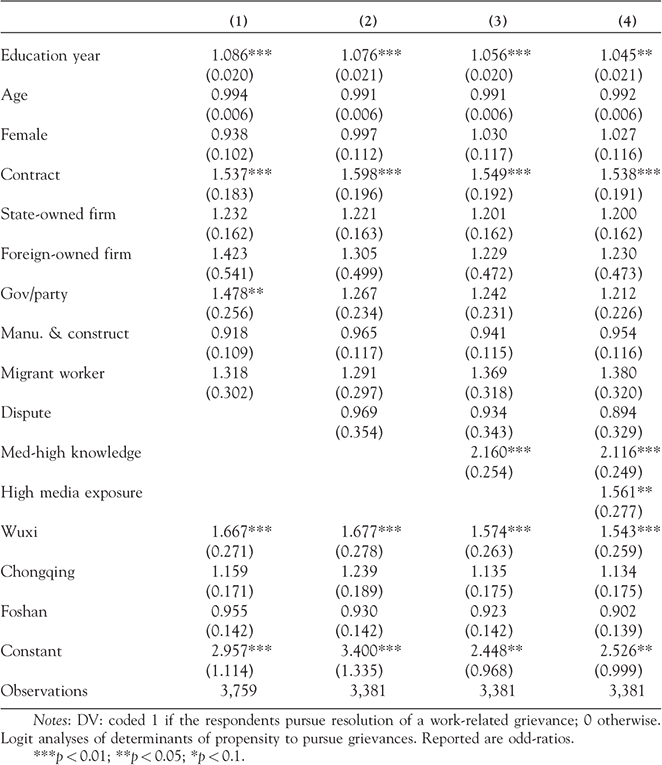
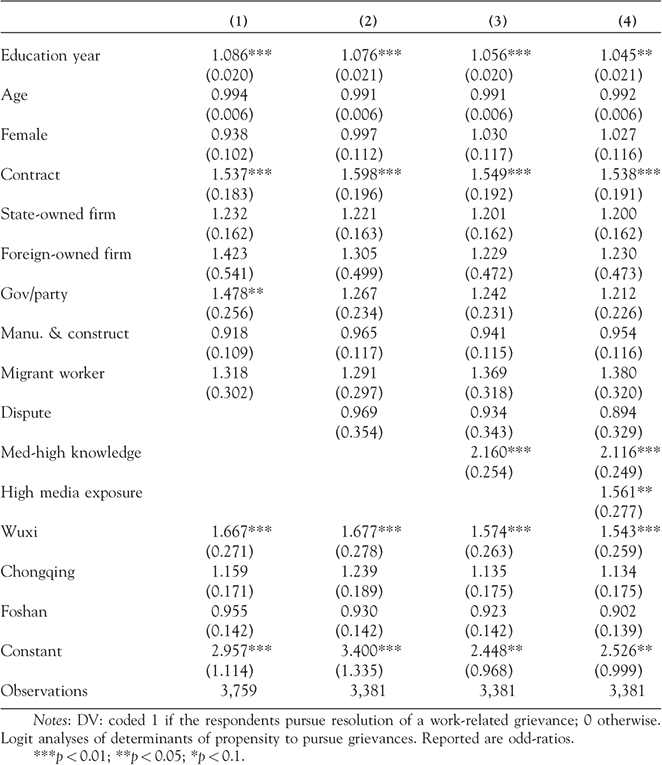
The two surveys used different strategies to examine patterns of dispute resolution. In the 2005 LLMS, 8.6 percent (391) of the respondents reported having a labor problem in the last ten years. Of those 391 respondents with a problem, eighty-two (or about 21 percent) pursued resolution. Using a hypothetical vignette of a common labor dispute, we examine patterns of resolution across the entire sample, using dispute experience as one independent variable. The 2010 CULS examined the dispute patterns only of those with actual dispute experience. Despite the differences in the survey design, we continue to find an association between education and propensity to pursue. As can be seen in Column 1 in Table 3, in the 2005 LLMS, a unit increase of education year increases the probability of pursuing resolution of the grievance by 8.6 percent. The significance of education year is not interrupted even when the media exposure level and the legal knowledge level are controlled, as can be seen in Columns 3 and 4. Analysis of respondents in the 2010 CULS who had actually experienced a dispute also found that the only significant determinant of experiencing a labor dispute is education, especially for migrant workers. Migrant workers with a junior high school education have a 27 percent higher likelihood of initiating a dispute; those with a high school education are 59 percent more likely. Migrants with a college education are more than 78 percent more likely to initiate disputes than those with a primary school education or less (Gallagher et al. Reference Gallagher, Giles, Park and Wang2014, 21).
As discussed above, formal education has a positive effect on increasing workers' awareness of legal procedures as well as labor rights. This makes educated workers more knowledgeable about the legal system and imbues disputants with a sense of personal efficacy. This internal efficacy facilitates workers' engagement with legal institutions and helps them pursue resolutions for their grievances more proactively. For educated migrants in particular, educational resources and skills may substitute for social connections and networks in their adopted cities. We see these patterns in Sister Yao's case discussed above. As a migrant from rural Jiangxi province, she saw herself as an outsider in Shanghai. She never used administrative methods, such as petitioning, as she believed that no one would even pay attention to her. Although she identifies as an “outsider” in Shanghai, her formal education sets her apart from true “peasant workers,” rural migrants who work in Shanghai but can rarely obtain access to legal urban status (Tang and Yang Reference Tang and Yang2008). Her educational credentials imbue her with internal confidence to learn about the law to fight against her employer. Her confidence in her own efficacy leads to subsequent use of the courts as well as attempts to avoid courts through more legalistic practices at the workplace. At the outset of her dispute, she submits formal, written complaints to management; she expresses hope that the company will proactively change its decision and its attitude, but also determination “to use law as a weapon to defend my due rights” if the company does not relent. Yao's written documents list clearly by number the violations and the relevant laws and regulations. She employs “rights talk,” claiming that her Japanese employer has violated her “right to know” and her “right to work”—a basic right of the Chinese Constitution. In a second registered letter, after relations have grown worse, she invokes both rule of law and nationalism. “China is a rule of law society. The Chinese people have long ago already stood up! As a 100 percent Japanese company, you cannot just have your way, forcing your Chinese employees to resign through terror and coercion! You cannot just evade your duties, allowing your base conduct to run amok in China! As for your disregard and violation of the People's Republic of China Labor Law and Labor Contract Law, I solemnly express my strongest protest!” Yao combines discourses of law and emotional nationalism, deftly using her legal knowledge and her educational resources to substitute for her low social position in Shanghai.
Propensity to Pursue Grievance (LLMS 2005)
| (1) | (2) | (3) | (4) | |
|---|---|---|---|---|
| Education year | 1.086 *** | 1.076 *** | 1.056 *** | 1.045 ** |
| (0.020) | (0.021) | (0.020) | (0.021) | |
| Age | 0.994 | 0.991 | 0.991 | 0.992 |
| (0.006) | (0.006) | (0.006) | (0.006) | |
| Female | 0.938 | 0.997 | 1.030 | 1.027 |
| (0.102) | (0.112) | (0.117) | (0.116) | |
| Contract | 1.537 *** | 1.598 *** | 1.549 *** | 1.538 *** |
| (0.183) | (0.196) | (0.192) | (0.191) | |
| State-owned firm | 1.232 | 1.221 | 1.201 | 1.200 |
| (0.162) | (0.163) | (0.162) | (0.162) | |
| Foreign-owned firm | 1.423 | 1.305 | 1.229 | 1.230 |
| (0.541) | (0.499) | (0.472) | (0.473) | |
| Gov/party | 1.478 ** | 1.267 | 1.242 | 1.212 |
| (0.256) | (0.234) | (0.231) | (0.226) | |
| Manu. & construct | 0.918 | 0.965 | 0.941 | 0.954 |
| (0.109) | (0.117) | (0.115) | (0.116) | |
| Migrant worker | 1.318 | 1.291 | 1.369 | 1.380 |
| (0.302) | (0.297) | (0.318) | (0.320) | |
| Dispute | 0.969 | 0.934 | 0.894 | |
| (0.354) | (0.343) | (0.329) | ||
| Med-high knowledge | 2.160 *** | 2.116 *** | ||
| (0.254) | (0.249) | |||
| High media exposure | 1.561 ** | |||
| (0.277) | ||||
| Wuxi | 1.667 *** | 1.677 *** | 1.574 *** | 1.543 *** |
| (0.271) | (0.278) | (0.263) | (0.259) | |
| Chongqing | 1.159 | 1.239 | 1.135 | 1.134 |
| (0.171) | (0.189) | (0.175) | (0.175) | |
| Foshan | 0.955 | 0.930 | 0.923 | 0.902 |
| (0.142) | (0.142) | (0.142) | (0.139) | |
| Constant | 2.957 *** | 3.400 *** | 2.448 ** | 2.526 ** |
| (1.114) | (1.335) | (0.968) | (0.999) | |
| Observations | 3,759 | 3,381 | 3,381 | 3,381 |
Notes: DV: coded 1 if the respondents pursue resolution of a work-related grievance; 0 otherwise. Logit analyses of determinants of propensity to pursue grievances. Reported are odd-ratios.
*** p < 0.01;
** p < 0.05;
* p < 0.1.
Formal education may lead to higher rates of legal mobilization among migrants because it sets them apart from the vast majority of migrant workers in urban China. However, given the increased dissemination of legal information at the workplace, through self-education and the media, even poorly educated workers have access to the tools of legal mobilization. In Models 3 and 4 of Table 3 we see that media attentiveness and specific labor law knowledge are also associated with a greater propensity to seek resolution. Given the heavy state role in legal dissemination campaigns (Troyer, Clark, and Rojek Reference Troyer, Clark and Rojek1989; Exner Reference Exner1995) and the wide array of materials and outlets available for motivated citizens to self-educate about the law, opportunities to gain specific knowledge at the workplace, through self-education, and the media can compensate for lower levels of formal education.
Mr. Hao, the middle school graduate introduced above, compensated for a lack of formal education by reading newspapers and studying cases like his. After finding out he had been terminated, he went directly to arbitration to pursue resolutions for his grievances. He had internal confidence that he could effectively use legal weapons to protect his legal rights and interests. Until the second judicial appeal of his first arbitration case, he did not go to legal aid, hire a lawyer, or go to a law firm; he pursued justice alone. Legal knowledge replaces the role of formal education in imbuing disputants with internal efficacy in pursuing grievances. Although Mr. Hao only had a low level of formal education and could not employ legal discourses as effectively as Sister Yao did in her dispute processes, a high level of legal knowledge helped him take action against his employer.
Legal mobilization does not exclusively mean “going to court”; rather, it is the transformation of a social problem into a legal one. Many labor disputants might use their newly gained knowledge of labor law and the threat of a lawsuit in negotiations and actions that are not explicitly related to court and litigation. For example, Old Zhao, the uneducated worker who gained high levels of legal knowledge, reported that when he petitioned to Beijing about his case, he utilized his growing legal knowledge as he researched laws and regulations on SOE restructuring, labor law, bankruptcy proceedings, and policies for low-income residents. His petitioning letter to the Beijing government cites laws on foreign investment, employment, early retirement policies, and payment of social insurance. He brought volumes of laws and regulations, tossed them out onto the counter and declared: “These are all the nation's laws. Why aren't they being enforced!?” His initial method of resolution was still via administrative methods, the direct petitioning of the state for intervention in his case, but he also used the law and his knowledge of the law as a tool to embarrass and cajole the central government into action. This action is also part of the process of legal mobilization and a common starting point for uneducated, older workers.
Going to the Law
What are the factors that encourage or discourage Chinese citizens from choosing the courts as a method of dispute resolution? In the 2005 LLMS, when asked which method they would use first, 86.9 percent said mediation, 3.1 percent administrative methods, 5 percent arbitration, and 2.7 percent litigation. However, choice of first method does not indicate that that method is most effective. In a second question on effectiveness, 44 percent said litigation was the most effective, 18 percent said arbitration, 17.9 percent said mediation, and 8.1 percent said administrative methods; 2.7 percent responded that no method is effective. A large proportion of people see the courts as most effective in resolving a work dispute, which suggests that the courts are authoritative. On the other hand, less than 3 percent of the 2005 survey respondents would choose the court first, as it is costly, time consuming, and public. Litigation was also the least common method to be chosen among the four possibilities. In each separate question that queried whether the respondent would use the method, 82 percent said they would mediate, 72 percent arbitrate, 70 percent would use administrative methods, and 67 percent would litigate. Although people may value litigation's effectiveness, they take seriously the higher costs of this approach.
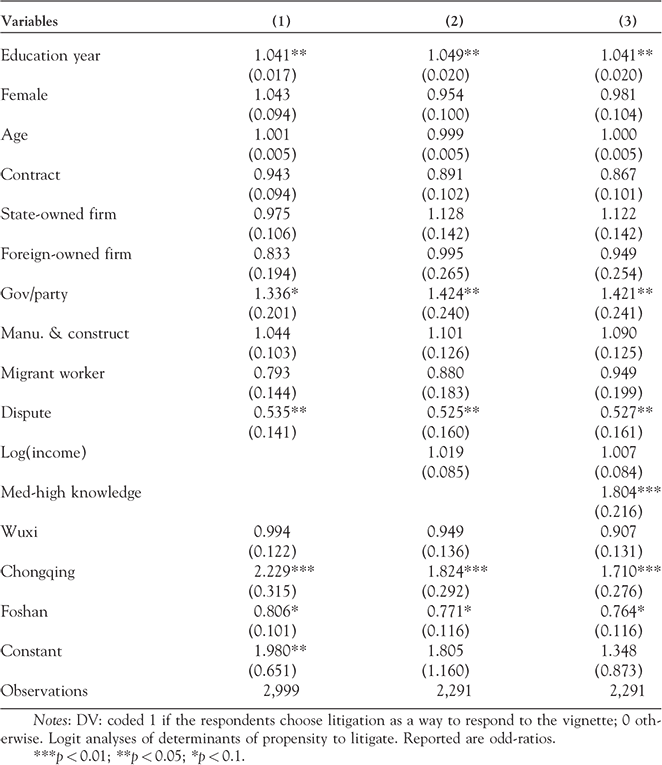
In statistical analysis of the propensity to litigate, we examine the respondent's decision to use litigation as one possible method to resolve an employment dispute. We find again that formal education and specific knowledge of labor law are both consistently associated with the propensity to choose litigation (see Table 4). In Column 1 of Table 4, we can see a unit increase of education year increases the probability of choosing litigation by 4.1 percent. The positive and significant relations between education year and the propensity to litigate remain even when the income level and the legal knowledge level are controlled, as can be seen in Columns 2 and 3. A unit increase of education increases the probability of choosing litigation by 4.9 percent and 4.1 percent, respectively. The important roles of education and knowledge accord with what we learn from the case narratives below: litigation is more acceptable when a person's internal efficacy, skills, and knowledge are more developed. We also find that respondents employed in government or party units are more likely to pursue litigation compared to other workplaces. This corroborates other findings that demonstrate the importance of political connections and status in legal mobilization (Michelson Reference Michelson2007; Su and He Reference Su and He2010; Ang and Jia Reference Ang and Jia2014).
Our case studies also support these findings and they add additional information about the links between education/knowledge and the propensity to litigate. Sister Yao, the Jiangxi college graduate mentioned above, had high levels of legal knowledge, capacities to frame her grievances effectively using legal discourses, and internal confidence to proceed with the legal procedures. While Yao lost in arbitration and only received part of her demands in her first court appeal, she did not give up and pursued litigation. In her first court appeal, she received only part of her demands. During her second appeal, however, she finally won overwhelmingly, receiving compensation for her termination and the right to leave the company freely. She brought the company back to court twice after the final appeal on her own with no legal assistance, first to forcibly implement the compensation decision and, second, to require them to issue her a notice of termination, without which one cannot be legally employed elsewhere. She attributes her success to her own hard work and the help she received from legal aid. She credits her experience for strengthening her resolve and her awareness about her rights at the workplace.
Propensity to Choose Litigation (LLMS 2005)

| Variables | (1) | (2) | (3) |
|---|---|---|---|
| Education year | 1.041 ** | 1.049 ** | 1.041 ** |
| (0.017) | (0.020) | (0.020) | |
| Female | 1.043 | 0.954 | 0.981 |
| (0.094) | (0.100) | (0.104) | |
| Age | 1.001 | 0.999 | 1.000 |
| (0.005) | (0.005) | (0.005) | |
| Contract | 0.943 | 0.891 | 0.867 |
| (0.094) | (0.102) | (0.101) | |
| State-owned firm | 0.975 | 1.128 | 1.122 |
| (0.106) | (0.142) | (0.142) | |
| Foreign-owned firm | 0.833 | 0.995 | 0.949 |
| (0.194) | (0.265) | (0.254) | |
| Gov/party | 1.336 * | 1.424 ** | 1.421 ** |
| (0.201) | (0.240) | (0.241) | |
| Manu. & construct | 1.044 | 1.101 | 1.090 |
| (0.103) | (0.126) | (0.125) | |
| Migrant worker | 0.793 | 0.880 | 0.949 |
| (0.144) | (0.183) | (0.199) | |
| Dispute | 0.535 ** | 0.525 ** | 0.527 ** |
| (0.141) | (0.160) | (0.161) | |
| Log(income) | 1.019 | 1.007 | |
| (0.085) | (0.084) | ||
| Med-high knowledge | 1.804 *** | ||
| (0.216) | |||
| Wuxi | 0.994 | 0.949 | 0.907 |
| (0.122) | (0.136) | (0.131) | |
| Chongqing | 2.229 *** | 1.824 *** | 1.710 *** |
| (0.315) | (0.292) | (0.276) | |
| Foshan | 0.806 * | 0.771 * | 0.764 * |
| (0.101) | (0.116) | (0.116) | |
| Constant | 1.980 ** | 1.805 | 1.348 |
| (0.651) | (1.160) | (0.873) | |
| Observations | 2,999 | 2,291 | 2,291 |
Notes: DV: coded 1 if the respondents choose litigation as a way to respond to the vignette; 0 otherwise. Logit analyses of determinants of propensity to litigate. Reported are odd-ratios.
*** p < 0.01;
** p < 0.05;
* p < 0.1.
As the survey findings demonstrate, even workers without sufficient formal education pursue litigation when they have high levels of legal knowledge. Moreover, our case studies show that workers with high levels of legal knowledge prefer litigation to informal and administrative methods. Mr. Hao, with only middle school education, showed a strong preference for litigation. As he knew clearly what his interests and rights are, he found no reason to mediate, remarking that “mediation is for the dissolution of contradictions, not for the representation of interests.” Although he lost his case, he promised to pursue litigation again when necessary, noting that he would certainly win the case now as he knows so much more about law.
Mrs. Shao (SH200424), a middle-aged female worker, also preferred litigation over other means she could have pursued. In 1998, the leaders of her company changed and the company began to get rid of all the old workers. The company changed her position, reducing her salary from 3,500 RMB (427 USD) to 500 RMB (61 USD) and changing her status to a nonpermanent employee. She wanted to leave but also wanted to be compensated. She had a relatively high level of education and understood labor law quite well. She had done work in the trade union and was educated about the 1995 Labor Law in trade union legal education. High levels of education and legal knowledge played an important role in imbuing her with internal confidence to pursue litigation. Like Mr. Hao, she did not have any faith in administrative methods or mediation. She thought petitioning was a waste of time and that mediation, though favored by the company, would only be to her disadvantage. She paid 50 RMB to a lawyer for consultation but went to arbitration without the lawyer. She won in arbitration but the company appealed against the judgment. Finally, during the lawsuit, after she received legal assistance, she won again.
Mr. Hong, discussed above, represented his colleagues in a large collective dispute involving severance compensation and won a large settlement of 1.6 million RMB for all the employees who had current contracts. However, about half the people who had joined the suit were denied compensation on the grounds that their contracts had expired before the dissolution of the joint venture. When Mr. Hong heard that the company appealed the arbitration ruling in civil court, he felt it was necessary to turn to legal aid. Although he had been successful on his own, it was a lot of work and time and required much coordination to keep the group together. Hong also worried that he did not understand complex legal procedures. Legal aid was a tool to improve his chances and balance against the company, which had hired an experienced lawyer. At the court proceedings, the employee group, led by Mr. Hong, decided to mediate at the judge's encouragement. In the end, the company paid 80 percent of the 1.6 million RMB original settlement to the current employees plus an additional 50 percent compensation to the employees whose contracts had already expired. The plaintiffs' legal-aid litigator praised the mediation as a just solution—granting the employees immediate compensation, cutting off another possible appeal to the Intermediate Court, and providing “moral compensation” to those plaintiffs who were not legally entitled to the settlement.
Hong's confidence is apparent in his desire to continue to rely on legal institutions. Although he clearly acknowledges problems with the legal system, he believes that more utilization will pressure the courts to improve. He notes, after the suit had ended, “I would definitely sue again. And I tell all my friends; I tell them the same thing. I give them help, support, and advice. If other people did the same to protect their rights, if more people use the legal system, it will improve, become more responsible, with higher costs for people who violate the law.”
Although we could not statistically test the effect of legal representation on the propensity to litigate, our case studies show how legal representation and legal-aid help workers navigate the litigation process. While the case narratives show that even people with low education can acquire the requisite knowledge to engage in the disputing process, this is more difficult for most disputants who do not have access to legal representation or legal aid. Among the actual disputants surveyed in the 2005 LLMS, only 7.3 percent had some form of legal representation. So the positive and confidence-inducing legal experiences of legal-aid plaintiffs are the exception not the norm. This may account for the disjuncture between survey respondents with legal experience, who are uniformly more disenchanted with the law, and the legal-aid plaintiffs, who mostly remain upbeat about future legal battles and their own legal efficacy. We turn to this issue of legal experience and disenchantment next.
Pathways to Disenchantment
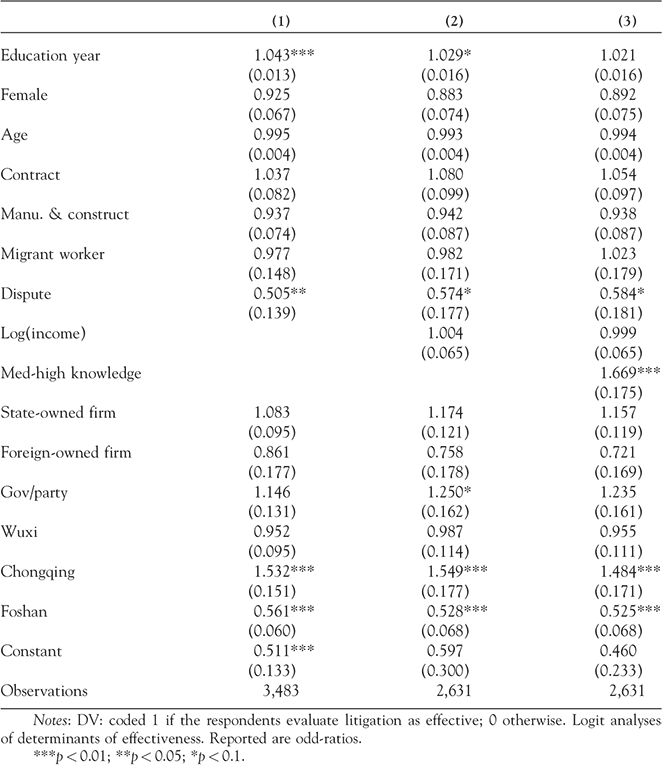
Formal education and even informal learning about the law is protective in that it increases disputants' knowledge about the law and legal procedure and their own efficacy and confidence in using legal institutions effectively. In the LLMS, educated respondents are more likely to choose litigation as a strategy to solve a workplace grievance; they are also more likely to evaluate litigation as an effective strategy. As can be seen in Columns 1 and 2 of Table 5, education year is positively and significantly associated with the evaluation of litigation as an effective strategy. A unit increase of education year increases the probability of evaluation of litigation as an effective strategy by 4.3 percent when the income level is not controlled (Column 1), and by 2.9 percent when the income level is controlled (Column 2). However, as with earlier discussions, high levels of specific knowledge of labor law are also associated with more positive evaluations of litigation's effectiveness. The education variable loses its significance in predicting the effectiveness of litigation when legal knowledge is added to the model, though the sign is still positive (Column 3). If a respondent has a medium-high level of legal knowledge, the probability that he evaluates litigation as effective increases by 67 percent. If a person uses the various available channels to self-educate about workplace rights, he or she is also likely to view litigation as an effective method of resolution.
The positive relationship between education and legal knowledge and the propensity to use and believe in the law is an important sign of the potential value of law in China as a durable social institution that can reinforce existing inequalities of resources and power structures (Silbey Reference Silbey2005), but also push forward new ideas of workplace rights and employer responsibility, ideas that the state itself promoted because they were beneficial to the regime's goal to end socialist employment. Given the survey's reliance on a hypothetical workplace problem, the responses capture popular belief and confidence in the law as an institution that promises justice. Do these beliefs and this confidence carry forward to those with actual experience? Does law live up to the hopes and expectations of the uninitiated?
Dispute experience does not dissuade respondents from rights mobilization; survey respondents with labor dispute experience are no less likely to pursue resolution of the hypothetical grievance; they are, however, significantly less likely to choose litigation as a resolution method. As seen in Tables 5 and Tables 5, dispute experience has a consistently negative association with choosing the litigation option. Dispute experience also has a significant and consistent role in diminishing expectations about the law's effectiveness. In response to the question on which method is the most effective, among labor disputants only 28.6 percent say litigation is most effective (compared to 49.3 percent of nondisputants). Disputants are also much more likely to say that none of the resolution methods is effective (15.9 percent vs. 2.8 percent).
Determinants of Effectiveness (LLMS 2005)

| (1) | (2) | (3) | |
|---|---|---|---|
| Education year | 1.043 *** | 1.029 * | 1.021 |
| (0.013) | (0.016) | (0.016) | |
| Female | 0.925 | 0.883 | 0.892 |
| (0.067) | (0.074) | (0.075) | |
| Age | 0.995 | 0.993 | 0.994 |
| (0.004) | (0.004) | (0.004) | |
| Contract | 1.037 | 1.080 | 1.054 |
| (0.082) | (0.099) | (0.097) | |
| Manu. & construct | 0.937 | 0.942 | 0.938 |
| (0.074) | (0.087) | (0.087) | |
| Migrant worker | 0.977 | 0.982 | 1.023 |
| (0.148) | (0.171) | (0.179) | |
| Dispute | 0.505 ** | 0.574 * | 0.584 * |
| (0.139) | (0.177) | (0.181) | |
| Log(income) | 1.004 | 0.999 | |
| (0.065) | (0.065) | ||
| Med-high knowledge | 1.669 *** | ||
| (0.175) | |||
| State-owned firm | 1.083 | 1.174 | 1.157 |
| (0.095) | (0.121) | (0.119) | |
| Foreign-owned firm | 0.861 | 0.758 | 0.721 |
| (0.177) | (0.178) | (0.169) | |
| Gov/party | 1.146 | 1.250 * | 1.235 |
| (0.131) | (0.162) | (0.161) | |
| Wuxi | 0.952 | 0.987 | 0.955 |
| (0.095) | (0.114) | (0.111) | |
| Chongqing | 1.532 *** | 1.549 *** | 1.484 *** |
| (0.151) | (0.177) | (0.171) | |
| Foshan | 0.561 *** | 0.528 *** | 0.525 *** |
| (0.060) | (0.068) | (0.068) | |
| Constant | 0.511 *** | 0.597 | 0.460 |
| (0.133) | (0.300) | (0.233) | |
| Observations | 3,483 | 2,631 | 2,631 |
Notes: DV: coded 1 if the respondents evaluate litigation as effective; 0 otherwise. Logit analyses of determinants of effectiveness. Reported are odd-ratios.
*** p<0.01;
** p<0.05;
* p<0.1.
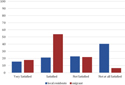
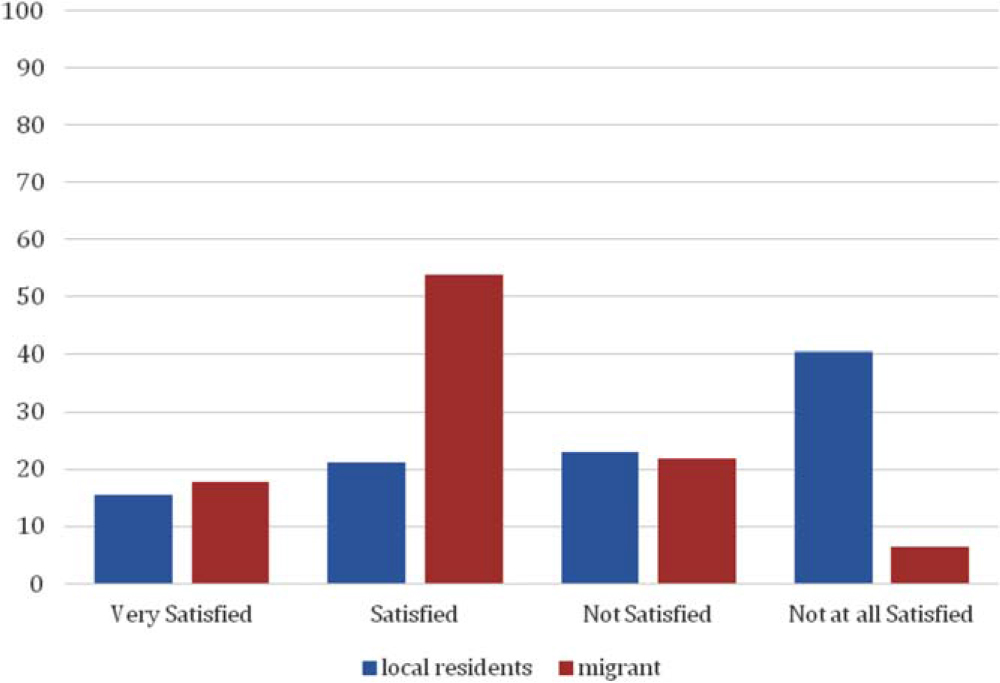
The findings in the 2005 LLMS find additional corroboration in the evaluation of dispute processing in the 2010 CULS. In the 2010 CULS, disputants also showed relatively high rates of dissatisfaction with the dispute process (see Figure 6). Sixty-three percent of local residents and 29 percent of migrants reported that they were “not at all satisfied” or “not satisfied” with the results of the dispute process. The higher rates of dissatisfaction among local residents may be the result of two factors. First, as local residents with legal “hukou” in their place of work, local residents may have higher expectations for their judicial institutions. Second, migrant cases may be simpler to solve as they often involve wage and overtime disputes that can be settled through monetary compensation. Local residents, especially older residents, often have disputes over employment security and enterprise restructuring, which are much harder to solve, as the case narratives of Old Zhao and Mr. Hao demonstrate.
Labor Dispute Satisfaction Rates (CULS 2010).
Our more finely grained qualitative analysis of the experiences of the legal-aid plaintiffs helps interpret the relationship between dispute experience and education in the 2005 LLMS respondents. Higher levels of education and legal knowledge improve the dispute experience, with legal knowledge, in particular, contributing to beliefs about the effectiveness of litigation even for those with negative dispute experiences. The educative process of legal mobilization contributed to a greater sense of internal efficacy and confidence, even when these litigants were more cynical and skeptical of the institutions themselves (Gallagher Reference Gallagher2006). However, even in this group, unusual in their access to legal representation, some litigants were utterly disaffected, condemning the legal system wholesale for its inability to provide just results. The dominant factor among this group of disaffected disputants is the suspicion that the law cannot function properly because of bias and corruption, belief that powerful state firms and influential foreign investors can pull connections and use the allure of gifts and bribery to swing the results in their favor. In the cases highlighted below, plaintiffs recount the pathway of disenchantment, which begins with confidence and knowledge that they know the law and are in the right to feelings of despair and anger that the facts of the case matter less than the identities of those involved.
Mr. Qian (SH200436) was confident in his abilities and in the law to settle his dispute in his favor. He was a former state-owned enterprise worker in his mid-fifties with a technical degree in mechanical engineering who had “jumped into the sea” of the market economy at the end of the 1990s. In 2001 he was unemployed and visited a local job fair for new opportunities. He was hired on the spot by a Hong Kong joint venture in real estate development and golf course construction. The Taiwanese boss was out of the country and his manager resisted his requests for a formal labor contract, telling him that it would be settled when the boss returned. After five months of no pay, Qian quarreled with his manager over the issue. The next day, the office locks were changed and Qian was again unemployed and missing several months of pay. He filed an arbitration suit against the company. Qian considered the case “simple” and “clear”: he had worked for the company and had not been properly compensated. Qian considered himself well-educated and familiar with the law. He had even received special legal training at his previous employer. He did not seek out a lawyer or legal aid but pursued the case himself.
Qian lost the case in arbitration on the grounds that he did not have a formal labor contract. Without a formal labor contract, the committee ruled that it was unable to determine the existence of a labor relationship and therefore it did not support his claims for compensation. Qian filed separately for social insurance fees; this was also rejected. Upon losing the case, Qian realized that the case was not simple because the law's emphasis on a written labor contract provides a loophole for companies that want to evade their legal responsibilities to employees. He continued to mobilize the law for his protection, but he looked to legal experts, reading up on newspaper articles on the issue and seeking out legal aid at several places.
Qian's lawyers instructed him to collect evidence that attests to his employment at the company. In all, he compiled over twenty pieces of evidence that confirm an employment relationship, including a registered letter from the district electric bureau to the company that includes Qian's name as the company's contact person and internal company documents that list Qian as an employee. The Shanghai Municipal Trade Union also supported the case and made this known to the court. But all of this was to no avail. Qian and his seasoned legal team lost all their appeals. In his lawyers' six-page written appeal to the Intermediate Court, they charged the courts with fraud, bribery, and perversion of justice.
In discussion with Qian after the case, his dejection is clear. “I used to think law was just. Now this case has made me lose confidence in the law. The people who used these tricks to avoid the law are the ones who determine how the law works. Many people sue because they have confidence in the law; [but] many people don't believe in the law so [they] use non-legal measures.” Qian's new lack of confidence in the legal system stems directly from his impression that the law is easily manipulated by those with power and connections. “At the center law is just, but as it goes down to the lower levels it gets twisted.” In explaining his disenchantment, Qian disentangles “law,” which is made at the center, and its enforcement, which is done locally. “Both court appeals—there was no difference with arbitration. The same logic applied from the arbitration suit. [They] knew that there was this loophole. Those who won understand law, [and] used this loophole. Not a problem with the law, but a problem with the system.” Qian's deep distrust in the ability of the courts to act fairly is heavily influenced by the opinions of his litigators, who believed that their preponderance of evidence demonstrating a labor relationship would close the loophole in the law. In a written evaluation of the case after the fact, the legal-aid lawyers questioned why the courts did not apply Supreme Court explanations that applied to the case, further insinuating that government intervention into the case had occurred to protect a foreign investor.
Qian interprets his disenchantment as a problem with the “system” not the law itself.Footnote 7 “I've lost confidence in law, but this is not my personal tragedy, it's the law's tragedy. Law is our last choice, if that choice is also not worth it, then we really don't have anywhere to go.” For the disenchanted, Qian's articulation of desperation is common. Mr. Zhou (SH200448) lost his job after a Korean company acquired his SOE. In the second judicial appeal, he felt forced to mediate and take a meager severance compensation, losing the employment security that he had enjoyed for decades. He says he “feels like killing the Korean boss” and blames his outcome on a system that protects employers at the expense of workers. “Implementation of labor law is difficult. All too weak. Look at how weak labor inspection is. They pay you 3 RMB an hour—this is not even meeting the basic living subsidy [for laid-off workers]. But if you report the violations it is no use. In our district this factory is a big customer. They do something wrong and it is just forgotten about. They pollute the environment. They abuse workers. Who cares? [The government] just protects the capitalists. We wanted to go to the factory directly and get the money right from the Korean boss himself. We wanted him to lose face. But then the lawyer called and said we couldn't do it.”
Mr. Pei (SH20043), an older worker who was transferred from his SOE to a Hong Kong JV, was fired after he sued his company for occupational injury following a fight with a person trying to enter the factory compound. (Pei was then working as a guard at the company.) He recounts in an interview a long process of multiple lawsuits, confusing procedures, and ultimate failure. When asked if he would resort to the law again, he vehemently exclaims: “No way. I couldn't stand it. It's been enough. On my new job, I'm also on a one-year contract, it's not stable; actually, I can be let go at any time. I no longer believe in labor law. The rule of law has nothing advantageous for the common person. I know the law; [but] the case [decision] is wrong. The work-unit knows people in the court and at the labor bureau. [I have] no proof but suspect it. There is a conspiracy. They have money, while I have none.”
These experienced disputants value the information and education that they have gained through the process of legal mobilization. They reserve their ire for a “system” that perverts justice. Gaining information about how law should work leads them to severe disappointment when the legal process is confounded by corruption and bias. As Hendley notes for the Russian case, however, we cannot assume that disenchantment and cynicism about judicial institutions equates with a declining propensity to use courts (Hendley Reference Hendley2012). Chinese workers continue to make use of the formal institutions, such as arbitration committees and courts, despite the problems described above and even as the government itself has pushed more mediatory approaches in the name of social harmony.
Conclusion
China's Legal Dissemination Campaign began in the mid-1980s. Since that time the government has invested a significant amount of time and resources in teaching the population about law at schools, at the workplace, and in the media (Exner Reference Exner1995). In the case narratives above, disputants make use of these resources to become informed consumers of legal institutions. In some cases, they make up for a lack in formal education to become seasoned experts, helping friends and colleagues with similar problems. Gaining knowledge and experience is part of the legal mobilization process. Although political participation in authoritarian regimes is, by definition, more narrowly circumscribed and restricted, in this case the state has instrumentally expanded the space for individualized mobilization, delegating the task of law enforcement to workers themselves. However, the effects of this engagement are contradictory. The citizenry is more active, engaged, and discriminating, but many who take the state's exhortations to use the law seriously end up disaffected with legal institutions, especially when they lack effective representation. More positive experiences and evaluations of the legal system tend to accrue to those at the higher end of the labor market.
The individualized legal mobilization around workplace rights analyzed here does not yet constitute the kind of “rights-claiming” social movements that have arisen in democratic societies, especially if we define social movements as sustained collective action with leadership and organization. Although there are many examples of activist lawyers, NGOs, and academics involved in the advancement of workers' rights in China, the political environment does not permit these disparate actors and organizations to organize and act collectively in a sustained and strategic manner (Cheng, Ngok, and Zhuang Reference Cheng, Ngok and Zhuang2010). At the local level, NGOs and activist lawyers are co-opted and/or repressed. When they push the boundaries of current practices, they do so on the margins and in quiet ways; they often seek out official patrons and protectors as well as support from public opinion and the media. At the central level, the strictures on independent trade unions allow the official trade union to monopolize representation, even when the union does not fulfill that role adequately. In McCann's study of the pay equity movement in the United States, legal mobilization over discrimination is the beginning of a social movement for public policy change (McCann Reference McCann1994). Change happens via social organizations, activist lawyers, and movement leaders who take advantage of shifts in the political opportunity structure. In the Chinese case, legal mobilization is still predominantly an individual's attempt at rights protection. The individualistic nature of legal mobilization in this context also heightens the importance of education in achieving satisfactory outcomes.
For an authoritarian government that has built up legal institutions as tools for better governance rather than as a pathway to political change, however, these findings are worrisome. Law's potential for political and social change may be via its inability to satisfy those who believe in it the most. The law attracts those citizens with the skills and the resources to master it, but then fails to convince them of law's efficacy. However, these findings also suggest areas for improvement, such as greater provision of legal aid and low-cost representation of aggrieved workers. More effective representation may make the difference between total disaffection and realistic acceptance that legal resolution is not perfect, but is still better than the alternatives.
Appendix Summary Statistics

| Variable | Obs | Mean | Std.Dev. | Min | Max |
| Dependent Variables | |||||
| Knowledge score | 4112 | 71.75 | 12.45 | 0 | 94 |
| Propensity to pursue grievances | 3986 | 0.89 | 0.31 | 0 | 1 |
| Propensity to litigate | 3542 | 0.78 | 0.41 | 0 | 1 |
| Effectiveness | 4112 | 0.38 | 0.49 | 0 | 1 |
| Independent/Control Variables | |||||
| log(income) | 3105 | 6.89 | 0.79 | 4 | 11 |
| Age | 4112 | 42.11 | 11.45 | 18 | 66 |
| Female | 4112 | 0.52 | 0.50 | 0 | 1 |
| Education year | 4092 | 10.86 | 3.41 | 0 | 25 |
| Migrant workers | 4072 | 0.07 | 0.25 | 0 | 1 |
| Dispute experience | 3699 | 0.02 | 0.15 | 0 | 1 |
| SOE | 4063 | 0.38 | 0.48 | 0 | 1 |
| FOE | 4063 | 0.03 | 0.18 | 0 | 1 |
| Gov/party | 4063 | 0.19 | 0.39 | 0 | 1 |
| High media exposure | 4112 | 0.22 | 0.41 | 0 | 1 |
| Contract | 3957 | 0.51 | 0.50 | 0 | 1 |
| Industry/manufacturing | 4112 | 0.33 | 0.47 | 0 | 1 |
| Medium-high legal knowledge | 4112 | 0.75 | 0.43 | 0 | 1 |
| Wuxi | 4112 | 0.25 | 0.43 | 0 | 1 |
| Chongqing | 4112 | 0.25 | 0.43 | 0 | 1 |
| Foshan | 4112 | 0.25 | 0.43 | 0 | 1 |