UV-C emitters are an adjunct surface disinfection method in hospitals. Reference Rutala and Weber1 The amount of light a surface receives (ie, UV-C dosage) is associated with the level of decontamination. Reference Kowalski2,Reference Masse, Hartley, Edmond and Diekema3 After a microbiologic validation, the performance of UV-C emitters may be compared using dosimetry, that is, measuring the UV-C dosage on surfaces with sensors. Reference Raeiszadeh and Adeli4
UV-C emitters are typically placed stationarily at 1 or more points of a room; thus, UV-C emitters are reduced in efficacy on distant, angled, or shadowed surfaces. Reference Boyce, Farrel, Towle, Fekieta and Aniskiewicz5,Reference Fredes, Raff, Gramsch and Tarkowski6 Emerging research shows that autonomous UV-C emitters are capable of moving to multiple points within a room, potentially mitigating these limitations; however, the relative performance advantage of autonomous strategies is unclear. Reference McGinn, Scott and Donnelly7,Reference Cadnum, Jencson and Gestrich8 To fill the knowledge gap, we compared UV-C dosages of autonomous and nonautonomous emitter placement strategies in hospital settings.
Methods
Challenge settings
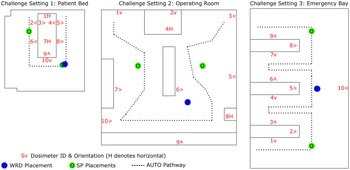
This study was completed at Providence Holy Cross Medical Center (PHCMC) in Mission Hills, California, in June 2022. Figure 1 shows dosimeter locations within the challenge settings: C1, patient bed; C2, operating room; and C3, emergency room bay. In this experiment, 10 dosimeters were placed in semigrid configurations to quantify the UV-C dosages achieved on hospital surfaces.
Approximate location and orientation of dosimeters. Note. H, horizontal orientation; WRD, whole-room disinfection; SP, spot; and AUTO, autonomous placements positions shown.

UV-C emitters
To control for variability among commercially available UV-C emitters, we used a modified remote-control UV-C emitter (ME) capable of simulating competing strategies. A Spectra 1000-RCT (TMG Health Technologies, Las Vegas, NV) UV-C emitter was mounted on a Mobile UV-C Light Platform TP-162 (SuperDroid Robots, Fuquay-Varina, NC) remote-control base. For comparison to the ME autonomous strategy, a secondary analysis of a commercially available autonomous UV-C emitter (CAE) was performed using the OhmniClean 1080W robot (OhmniLabs, San Jose, CA). The ME tower and the CAE were registered with the US Environmental Protection Agency (EPA) and were tested previously in third-party microbiology studies. Reference Raeiszadeh and Adeli4,9
Measurement
The dosimeter and UV-C emitter placements were measured using a laser distance tool and recorded with graph paper. The distance and angle of the dosimeters relative to the UV-C placements were calculated from these records. Exposure was classified as direct, indirect, or shadowed. Direct exposure was defined as a dosimeter with a line-of-sight to the UV-C emitter with an angle under 90°; indirect exposure was used for dosimeters placed on a horizontal plane; shadowed exposure was defined as an object between the UV-C emitter and dosimeter, or an angle ≥90°.
UV-C dosage (254 nm) was measured with UVKEY dosimeters (EIT, Leesburg, VA). The highly portable dosimeters are National Institute of Standards and Technology (NIST) traceable and have a 15 µW/cm2 field strength minimum sensitivity. After each disinfection cycle, the UV-C (mJ/cm2) dosage displayed on the dosimeters was recorded.
UV-C disinfection process
For each UV-C emitter, challenge setting, and placement strategy, 3 disinfections were performed and the mean dosage per dosimeter location was reported. With the modified UV-C emitter, 2 nonautonomous and 1 autonomous placement strategies were applied in 10-minute disinfection cycles: whole-room disinfection, spot disinfection, and autonomous disinfection. For whole-room disinfection, the emitter remained stationary, approximately center of the challenge setting for the duration of disinfection. For spot disinfection, the emitter was placed in 2 positions with 5-minute exposures each. UV-C emitters using autonomous disinfection moved at a constant rate of speed and made a ∼1-meter, single pass-by of all surfaces within a challenge setting. The CAE applied the manufacturer’s longest preset disinfection duration (“3× intensity”), which corresponds to the moving speed. The CAE disinfection duration is automatically calculated from the intensity and travel length. According to the manufacturer’s recommendations, the CAE performed a 3-minute warm-up before moving throughout the target space and was included in the reported disinfection time.
Statistical analysis
We used ANOVA with Bonferroni correction to compare the dosimeters’ minimum distance to the UV-C emitter placements. Median UV-C dosages were compared using the Mann-Whitney test. Statistical analyses were performed using R version 4.2.0 software (R Foundation for Statistical Computing, Vienna, Austria).
Results
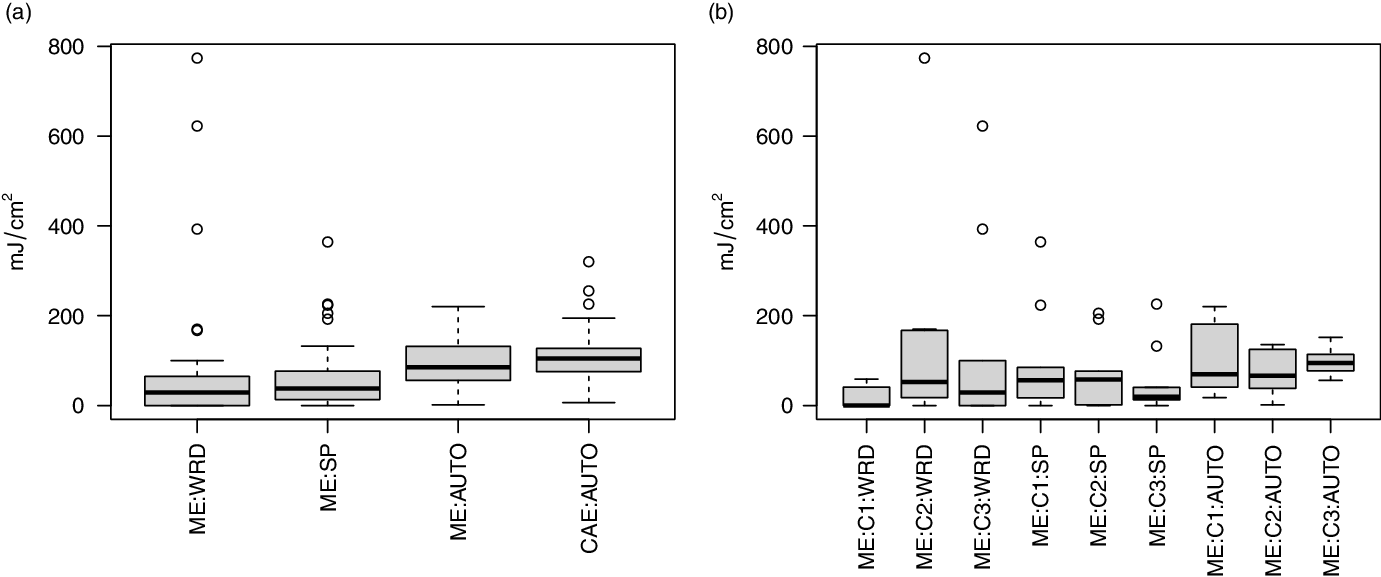
In total, 360 dosimeter readings were obtained. The mean triplicate result for each challenge setting, placement strategy, and emitter was calculated, providing 120 reportable dosimeter readings. The autonomous UV-C strategy produced significantly higher UV-C dosages compared to the nonautonomous strategies due to the reduced distances, angles, and shadows to the dosimeters. Figure 2 plots the UV-C dosages achieved.
(A) Boxplot of overall UV-C dosages grouped by disinfection strategy and UV-C emitter type, and (B) per challenge setting. Note. ME, modified emitter; CAE, commercially available emitter; WRD, whole-room disinfection; SP, spot disinfection; AUTO, autonomous disinfection.

Dosimeter exposure
Of the 30 dosimeters, 8 (27%) were shadowed to the UV-C emitter with whole-room disinfection. Both spot disinfection and autonomous disinfection were directly or indirectly exposed to all 30 dosimeters (100%). The mean distance of the dosimeters to the UV-C emitter during the autonomous disinfection strategy (1.0 m) was significantly shorter than whole-room disinfection (2.41 m; P < .001) and spot disinfection (1.87 meters; P < .001). There was no significant difference in dosimeter distance between the whole-room disinfection and spot disinfection strategies (P = .28).
UV-C dosages
Median UV-C dosage was significantly greater with autonomous disinfection (85.1 mJ/cm2) compared to spot disinfection (37.83 mJ/cm2; P = .019) or whole-room disinfection (29.02 mJ/cm2; P = .002). There was no significant difference between whole-room disinfection and spot disinfection (P = .29).
The whole-room disinfection and spot disinfection strategies had at least one 0 mJ/cm2 in all settings. With whole-room disinfection in the patient room setting (C1), 6 (60%) of 10 dosimeters had 0 mJ/cm2 dosage, primarily from shadowing caused by the bed rails. Both the modified and commercial emitters using the autonomous disinfection strategy achieved some measurable dosage on 30 (100%) of 30 dosimeters.
Secondary analysis
The CAE disinfection times per C1, C2, and C3 were 7, 11, and 11 minutes, respectively. There was no difference in median dosage measured between ME autonomous disinfection and the CAE (104.68 mJ/cm2; P = .21).
Discussion
Nonautonomous UV-C placement strategies improve environmental hygiene. Reference Rutala and Weber1 Further increases in UV-C dosage on hospital surfaces beyond these baselines may yield additional improvements in environmental hygiene.
Similar to other dosimetry studies, nonautonomous UV-C placements produced the highest recorded dosages on near, directly exposed dosimeters while simultaneously underdosing farther, angled, and shadowed dosimeters. Reference Masse, Hartley, Edmond and Diekema3,Reference Raeiszadeh and Adeli4 The relative performance advantage of autonomous disinfection was reduced in hospital settings with few shadows, such as the operating room (C2). Unlike whole-room disinfection and spot disinfection, the autonomous disinfection strategy equally distributed the UV-C light on surfaces and achieved more consistent dosages. This finding is important for hospital disinfection programs because minimum target dosages across surfaces are achieved quicker, potentially allowing faster room turnover.
Our study had several limitations. First, 10 dosimeters is a small, low-resolution sample of the UV-C dosage received on hospital surfaces. Second, it was not possible to apply the autonomous disinfection strategy at exactly 1 m to all surfaces, and there may have been slight deviations in distance or angles relative to the dosimeters during emitter travel and repositions. However, floor markings were used to maintain consistent placement of the UV-C emitters and the UV-C dosimeters remained in position through each challenge-setting disinfection sequence. Furthermore, we performed each disinfection 3 times and reported the mean UV-C dosage per dosimeter. Third, the dosimeter intensity threshold is 15 µW/cm2; thus, over the 10-minute exposure, >0 mJ/cm2 and <9 mJ/cm2 UV-C dosage may have been undetected. Although dosage susceptibility varies among microorganisms, this dosage is potentially enough for a 1–2 log reduction of Staphylococcus aereus. Reference Kowalski2,Reference Chang, Ossoff, Lobe, Dorfman, Dumais, Qualls and Johnson10 This factor may explain why some dosimeters displayed 0 mJ/cm2 despite direct, albeit angled or distant, exposure to the UV-C source. Last, other autonomous UV-C emitters may use other placement methods which likely produce different results.
The autonomous placement strategy increased overall UV-C dosages on hospital surfaces compared to nonautonomous strategies due to improved exposure on otherwise distant, angled, and shadowed surfaces. Increased UV-C dosages from autonomous emitters may further improve hospital environmental hygiene.
Supplementary material
To view supplementary material for this article, please visit https://doi.org/10.1017/ice.2022.282
Acknowledgments
Financial support
EIT (Leesburg,VA) donated 10 dosimeters for the study. OhmniLabs (San Jose, CA) donated a UV-C robot for the study. Clean Sweep Group (Los Angeles, CA), a company that offers contracted UV-C disinfection services, provided additional support for the study.
Conflicts of interest
C.H. is a shareholder of Clean Sweep Group (Los Angeles, CA). C.H. and G.H. were employed by Clean Sweep Group. W.T. received research funding from Clean Sweep Group. K.A. reports no conflicts of interest.