Madame Marie Curie said, “There is nothing in the world to be feared, only to be understood,”Reference Wilson and Crouch1 yet those who have not yet understood may very well fear. Trying to understand how people perceive risk has challenged and intrigued researchers for more than 30 years. During this time, researchers have studied risk and risk perception from many perspectives. Although many theoretical frameworks and models have been proposed, 1 common theme found throughout the risk perception literature is the acknowledgment that risk perception plays a prominent role in the decisions that people make. These differences in risk perception lie at the heart of disagreements about the best course of action to take for any given situation.Reference Slovic2 Reference Flynn, Slovic and Mertz3 Reference Finucane, Slovic and Mertz4 Reference Tippett, Archer and Kelly7
The psychometric approach to risk perception is a theoretical framework that allows researchers to develop a taxonomy of hazards, which then can be used to understand and predict responses to risks. Such a taxonomic scheme may explain, for example, paramedics' willingness to work during some disasters, their lack of willingness to work during others, and the discrepancies between, producing a quantitative representation of both risk attitudes and risk perceptions.Reference Slovic2 Reference Epstein5 Reference Tippett, Archer and Kelly7 Reference Slovic and Weber8
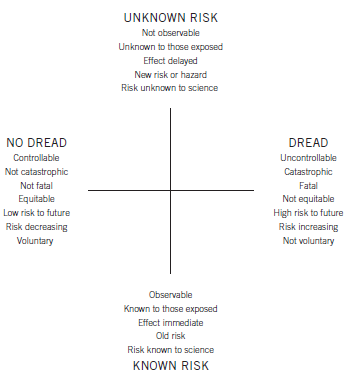
Using the psychometric approach, researchers make quantitative judgments about people's perception of risks, ranking them according to various attributes. These attributes often include concepts such as voluntariness, dread, knowledge, and controllability. Numerous studies indicate that perceived risk is not only quantifiable but also predictable, and argue that every hazard has a unique pattern of qualities that appears to be related to its perceived risk.Reference Tippett, Archer and Kelly7 Reference Slovic and Weber8 Reference Fischhoff, Lichtenstein and Slovic9 Furthermore, many of the characteristics or qualities tend to be highly correlated with each other across a wide range of hazards. For example, hazards perceived as voluntary tend also to be perceived as controllable, and so-called unknown hazards tend to be highly correlated with hazards that have catastrophic potential.Reference Slovic2 Reference Tippett, Archer and Kelly7 Reference Slovic and Weber8 Reference Fischhoff, Lichtenstein and Slovic9 Investigation of these interrelations by factor analysis has indicated that the broader domain of qualities or characteristics can be condensed to a small number of higher-order factors, namely, dread and unknown risk, upon which most current investigative studies focus. This factor analysis is illustrated in Figure 1.
Factor analysis for psychometric tool

The authors chose to build on this investigative track, with a slight adaptation of this terminology, using the terms fear (instead of dread) and familiarity (instead of unknown). This change in terminology was made based on the feedback from a sample (n = 28) of paramedics who assessed the face validity of the survey tool and were asked to report on their preferences for terms.
If Madame Curie was indeed correct, then the present study is a move toward identifying the disasters to which paramedics are less motivated to respond (which disasters they “fear” and which disasters they perceive as “unfamiliar”) to develop education and training initiatives that promote this required understanding. Better understanding will lead to a decreased feeling of fear, along with an increased feeling of familiarity and ability, and consequently result in a prehospital workforce that is more willing to respond to a broad range of disasters.
METHODS
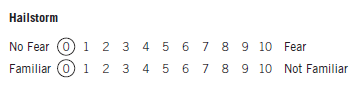
Guided by the psychometric approach to risk perception and specifically the work of Slovic and colleagues,Reference Slovic2 Reference Flynn, Slovic and Mertz3 Reference Finucane, Slovic and Mertz4 Reference Slovic6 Reference Slovic and Weber8 Reference Fischhoff, Lichtenstein and Slovic9 Reference Slovic, Fischhoff and Lichtenstein10 a survey tool was designed to investigate which disasters paramedics were most concerned about responding to on the basis of fear and familiarity. The survey captured basic demographic data (including sex, age, and years of employment with ambulance service) and listed 40 disaster scenarios that paramedics were asked to rank on 2 scales, fear and familiarity. The scale ranged from 0 to 10. A score of 0 indicated that the paramedic did not feel fearful about responding to the event and the event or disaster was familiar. A score of 10 indicated that the paramedic was fearful about responding to the event, and that the event was unfamiliar. An example is provided in Figure 2.
Example of survey question and response. This score indicates that the paramedic has no fear in responding to this event and has a high degree of familiarity with the event.

For the purpose of this study, fear was defined as a high level of perceived lack of control with the potential for catastrophic and fatal consequences, and the inequitable distribution of risks and benefits. Familiarity was defined as whether the paramedic had previous personal experience with the same type of disaster or event or whether he or she was familiar with the type of disaster or event due to training/education or media coverage. Modern theories of risk perception inform us that besides conducting risk analyses, we have another mode of thinking that is essential for making rational decisions in the face of danger, the experiential mode, which is intuitive, automatic, and fast.Reference Epstein5 This kind of risk perception relies on how people recall images and associations of past events, linking experiences to emotions.Reference Slovic6
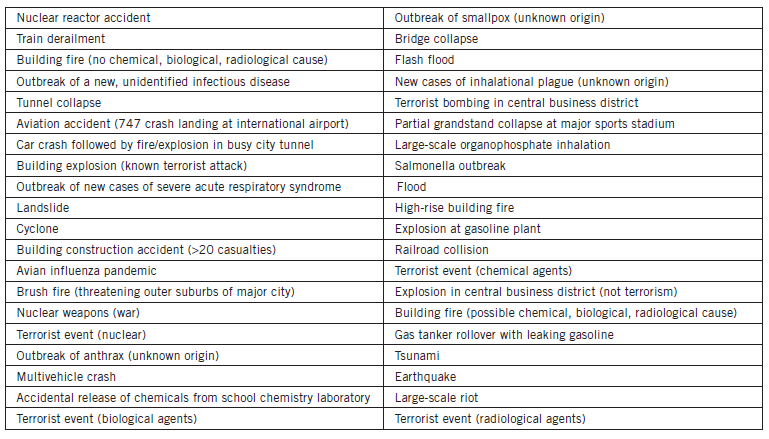
Although a study participant may not have had direct experience with responding to a case of severe acute respiratory syndrome, he or she may perceive that the event is familiar due to training/education or media coverage encountered during the original outbreak. The definition of familiarity was left deliberately broad to take into account the impact of external factors, other than direct experience, on a paramedic's willingness to respond to certain types of events. The 40 disaster scenarios listed in the survey were chosen using methods. First, the Emergency Management in Australia (www.ema.gov.au) disasters database was examined to identify which types of disasters had occurred in Australia during the past 10 years. Second, the Centre for Research on the Epidemiology of Disasters (http://www.cred.be) Web site was searched for international disasters that occurred in the past 10 years. Finally, the search engine Google (www.google.com) was used to identify major disasters and events that had occurred internationally in the last decade or disasters or events that had the potential to occur in the future, which may not have met the criteria for inclusion in the Emergency Management in Australia or the Centre for Research on the Epidemiology of Disasters databases. The types of disasters identified on these Web sites guided the development of the list of disaster scenarios used in the survey (Figure 3).
40 disaster scenarios

Research and Ethics Approvals
Research approval was granted by the Australian College of Ambulance Professionals (ACAP) to distribute the survey through 2 independent formats: conference delegates at the ACAP national conference (September 2007) and an invitation to paramedics to participate in the study published in ACAP's professional magazine, Response (October 2007). Ethics approval was granted by the Monash University Standing Committee on Ethical Research on Humans to conduct anonymous, de-identified surveys.
RESULTS
A total of 200 surveys were distributed at the conference. Of these, 143 paramedics completed and returned the survey (response rate of 72%). In addition, 32 requests from paramedics to participate in the research were received through the ACAP magazine, Response (response rate of 100%). In total, 175 paramedics responded to the survey. Of the 175 respondents, 70% (n = 123) were male and 30% (n = 52) were female. The average age of respondents was 32 (range 21–59) years, and the average length of service was 9 (range 1–16) years. These demographics are similar to the overall demographics of the entire Australian paramedic workforce, of which 62.1% are male and 37.9% are female, and to a previous Australian study wherein the mean age for paramedics was 43 years.Reference Tippett, Archer and Kelly7
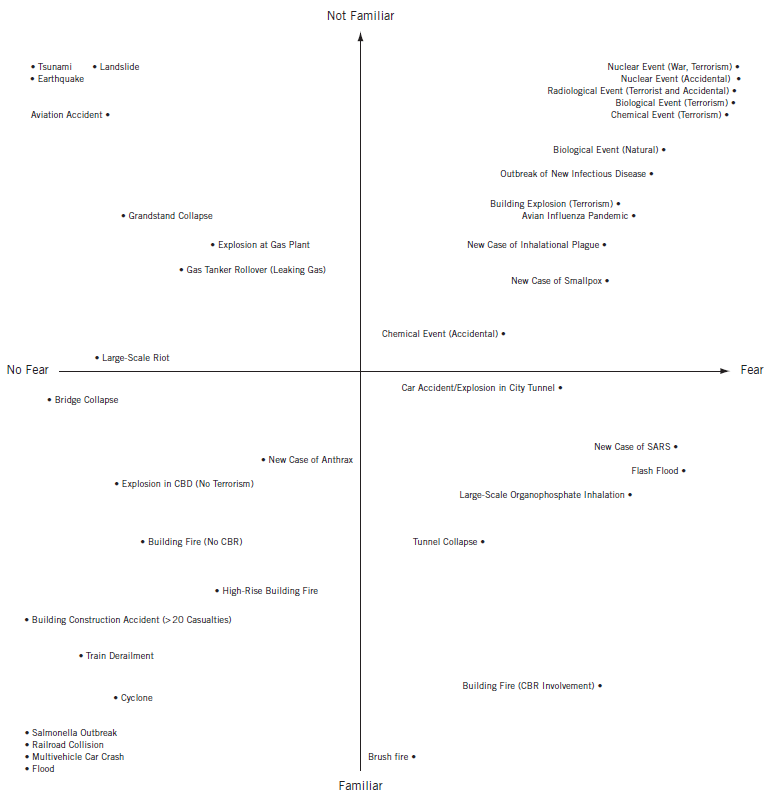
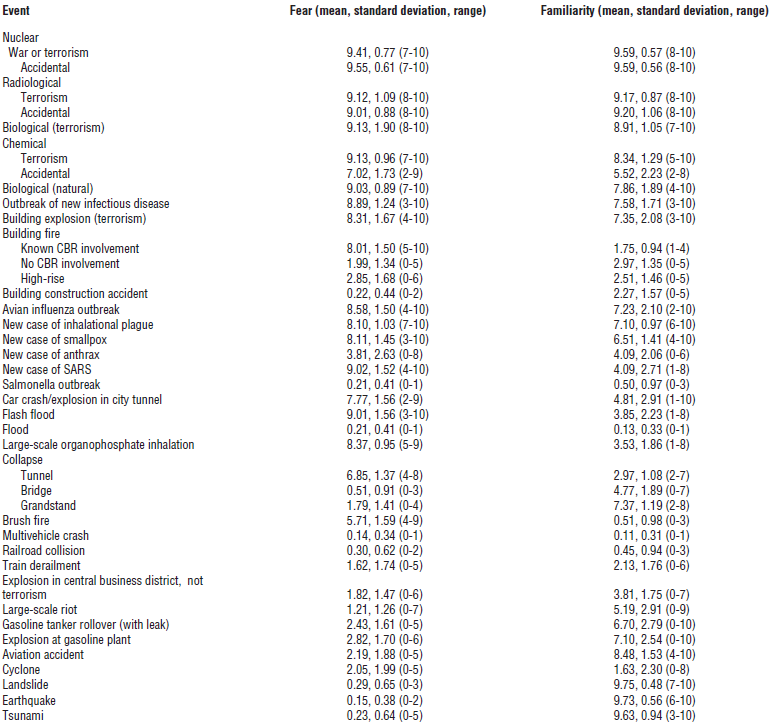
Results for each of the 40 individual disaster scenarios in Figure 3 are reported as the mean, standard deviation, and range for each factor of fear and familiarity (Table). In addition, the results are displayed graphically, using the methodology reported in previous studies of risk perceptionReference Slovic and Weber8 Reference Benthin, Slovic and Severson11 (Figure 4). The disasters located in the upper right quadrant of Figure 4 are those that were ranked highest by paramedics for fear and unfamiliarity.
Disasters about which surveyed paramedics are most concerned

Mean, Standard Deviation, and Range for Disaster Scenarios

Nuclear events that were the result of war, terrorism, or accidental release were ranked the highest for fear and unfamiliarity of all of the disaster scenarios. Radiological events (terrorism or accidental release), biological events (terrorism or natural outbreak), and chemical events (terrorism) were ranked high for fear and unfamiliarity and are located in the upper right quadrant of the risk perception graph (Figure 4).
Outbreaks of new infectious diseases were ranked higher for both fear and unfamiliarity than outbreaks of existing but highly infectious diseases (eg, smallpox, inhalational plague). Of all of the infectious disease scenarios, avian influenza ranked highest for fear and unfamiliarity. New cases of anthrax had a mean ranking of 3.81 on the scale for fear and 4.09 on the scale of familiarity. This indicates that of all of the infectious agents included in the list of disaster scenarios, anthrax is the infectious agent to which paramedics are the least concerned about responding. The only event that was not chemical, biological, radiological, or nuclear (CBRN) to be ranked in the upper right quadrant of Figure 4 was a building explosion (known terrorist event).
Other disasters that ranked high on the scale for unfamiliarity included tsunamis, landslides, earthquakes, and aviation accidents. These disasters were ranked low on the scale of fear, indicating that although paramedics believe these events are unfamiliar, they would not be fearful in responding to work. Other events that ranked high for unfamiliarity but low for fear were grandstand collapses, accidents involving gasoline plants and gasoline transport vehicles, and large-scale riots. Conversely, disasters that ranked high for fear but not for unfamiliarity included new cases of severe acute respiratory syndrome, flash flooding, and large-scale organophosphate inhalation.
These results highlight that paramedics are most concerned about responding to events that are new or unknown, invisible, involve some aspect of terrorism or bioterrorism, or have a potentially highly infectious aspect to them. These results echo previously published studies that emphasized that paramedics were more concerned about responding to work during outbreaks of new infectious diseases and to CBRN events than they were during more “conventional” disasters, such as a train derailment or a building explosion.Reference Tippett, Archer and Kelly7 Reference Smith, Morgans, Qureshi, Archer and Burkle12 Reference Reilly, Markenson and DiMaggio13 Reference Qureshi, Gershon and Sherman14 Reference DiMaggio, Markeson and Loo15 Reference Syrett, Benitez and Livingston16
DISCUSSION
The number and complexity of activities known to carry risk to human life and lifestyle are increasing in contemporary society. Technology continues to expand, social organization is becoming more complex, and the list of emerging disaster threats includes new infectious diseases and terrorism. In response, measures to assess and manage these risks are growing in number, primarily through an understanding of how those affected will judge and interpret the available evidence on possible losses and vulnerability associated with the risk. This affects in complex ways the degree to which action is taken and the ways in which people respond to risk.Reference White17
The risks (disasters) identified in this study as being most fear inducing and more unknown to paramedics have similar attributes. Those representing the highest levels of fear and unfamiliarity are potentially large in scale, long in duration, and complex in terms of the range of hazards presented. These characteristics may require paramedics to take on new roles for which they do not feel properly prepared or equipped. Although these risks have extremely low probabilities of occurring (eg, nuclear war), they have extremely negative consequences. Future risk/benefit analyses conducted for these risks will ultimately try to answer the questions: how safe is safe enough? and how safe does a situation have to be for me to respond?
People may attempt to answer these questions using historical examples and patterns to forge a balance between risk and benefit.Reference Starr18 For many disasters identified in this study, however, there is little historical experience with which to make accurate risk assessments. When paramedics are asked to evaluate the risks involved, they seldom have statistical evidence or valid experiences on which to draw. Instead, they must rely on inferences that have their basis in accounts of disasters reported in the media or observed during training/education. Psychological research investigating heuristics is relevant to this predicament. Heuristics, or judgment rules, can be useful in helping people to break down complex mental tasks into simpler ones.Reference Tversky and Kahneman19 A heuristic that is relevant to this research is availability. The availability heuristic may be used by paramedics to decide whether an event is risky or may be examples of similar events to imagine or recall. Frequently occurring events (eg, floods, brush fires) are easier to imagine and recall than rare events (eg, nuclear, radiological) and therefore may seem more familiar. Slovic and colleagues' research suggests that society appears to react more strongly to infrequent large losses of life that to frequent small losses.Reference Slovic20 For example, the Australian state of Victoria has a high level of experience annually with small and often inconsequential brush fires. Black Saturday, Australia's deadliest brushfire disaster, claimed at least 210 lives, injured 500, and destroyed thousands of homes.21 The present study, conducted before the Black Saturday brush fires of February 7, 2009, ranked fear and unfamiliarity for brush fires as low. Would this ranking change given the salient devastation inflicted by this recent event with which emergency responders now feel familiar?
Graphic media coverage of disasters can greatly distort perceptions of risk, with the risk of death from serious natural disasters tending to be overestimated. Media coverage means that exposure extends considerably beyond people who are immediately involved.Reference Lichtenstein, Slovic, Fischhoff, Layman and Combs22 Reference Combs and Slovic23 Reference Morgan, Slovic and Nair24 The amount of television viewing done by US citizens in the 7 days after the September 11, 2001, terrorist attacks correlated with the onset of symptoms of posttraumatic stress.Reference Ahern, Galea, Resnick and Vlahov25 The impact of media coverage on subsequent risk perceptions and occupational behaviors cannot be overlooked.
The findings of this research echo those of Erikson, who drew attention in the mid-1990s to the emerging threats of nuclear, radiological, and chemical toxicity, characterizing them as a “whole new species of trouble.”Reference Erikson26 Reference Erikson27 Reference Erikson28 He described high levels of fear and low levels of familiarity regarding modern technological disasters, suggesting the potential to “contaminate rather than merely damage . . . pollute, befoul and taint rather than just create wreckage. . . .penetrate human tissue indirectly rather than wound the surface,” resulting in a new breed of “trouble” that is unbounded, invisible, deadly, and associated with deep fear and anxiety.Reference Erikson28 Erikson concluded that conventional disasters such as floods or earthquakes proceed in a relatively orderly manner from beginning to middle to end. Nuclear, radiological, and chemical disasters, or “nonconventional” disasters, provoke greater concern because they are “not bounded” (that is, these disasters are not localized in time and space like more traditional disasters), and contaminate and potentially infect in ways not seen before, in which the “all clear” is never sounded.Reference Erikson28
Extreme CBRN disasters, by definition, have the potential to cause much harm to people and property. These extreme events can trigger an amplification of risk, with adverse consequences extending far beyond direct damage consequences and resulting in massive indirect effects, such as litigation and increased regulation.Reference Kasperson, Renn and Slovic29 Examples of this amplification of risk are the impact of the Union Carbide chemical manufacturing accident at Bhopal (India), the nuclear reactor accidents at Three Mile Island (Pennsylvania) and Chernobyl (Ukraine), the Exxon Valdez oil spill (Alaska), and the terrorist attacks on the World Trade Center buildings (New York) and the subsequent anthrax attacks throughout the United States. The incidents in 1982 of Tylenol capsules being tampered with, which resulted in 7 cyanide poisoning deaths, had a major ripple effect, resulting in more than 125,000 stories in the print media alone, and inflicted losses of more than US$1 billion for Johnson & Johnson.Reference Mitchell and Carson30 Similar situations arose with the anthrax attacks that followed the September 11 terrorist attacks.
Extreme events, such as those located in the upper right quadrant of Figure 4, are likely to produce large ripples. Risk perceptions will be more difficult to manage than the risk perceptions for events located in the lower left quadrant of the graph. As a result, risk analyses of these events must be sensitive to the greater ripple effects, not only the immediate consequences of the disaster. The unprecedented cascading ripples of effects from the September 11 terrorist attacks likely will affect much of the United States and the greater international community for decades.
The impact of previous major accidents and disasters such as Chernobyl have widespread effects that subsequently alter the way a hazard is perceived and, specifically, whether associated risks are tolerable. The information (availability heuristic and amplification of risk) we have to draw on often is negative and draws on the long-term ripples linked to the disaster itself. The planning for a disaster the size of Chernobyl was primitive by today's standards. Particular weaknesses were lack of provision of information and a documented mistrust of government and local information sources. Notably, foreign sources of information were significantly more trusted by the affected communities, with mistrust of local information resulting in the manifestation of posttraumatic stress, many cases of which were misinterpreted as the symptoms of exposure to radiation.Reference Breakwell31
Common concerns about CBRN disasters are that their consequences will extend over a lifetime, are not confined to a specific location or time frame, and will affect future generations. Nuclear power was first perceived as a catastrophic technology that was uncontrollable. Following the Three Mile Island and Chernobyl accidents, the level of dread and perceived likelihood of a nuclear accident recurring increased,Reference Slovic, Fischhoff and Lichtenstein32 and victims experienced a deep sense of being devoid of personal control.Reference Lee33
The events that are associated with the highest levels of perceived risk need to be targeted by disaster planners, although questions remain as to how to increase familiarity with extreme events without actually exposing responders to such hazards. Perhaps the answer lies in focused and tailored education and training programs that incorporate experience and experiential thinking that is intuitive, automatic, and rapid and that relies on images associated with direct or indirect experience and the related memories of previous outcomes. Familiarity-triggered risk perception allows individuals to transform current situations from previous experience (eg, whether it is safe to cross the street) into affective responses such as fear or anxiety.Reference Loewenstein, Weber, Hsee and Welch34
Studies by neuroscientists have demonstrated that logical argument and analytical reasoning cannot be effective tools in risk perception and risk analysis, particularly of new “unconventional risks” such as CBRN events and terrorism, unless these tools are guided by emotion and affect, which constitute the “feeling” underlying people's risk perception.Reference Tippett, Archer and Kelly7 Reference Damasio35 Decision making in the face of risk and danger requires the rational and proper integration of both modes of thought, that is, feeling with some form of formal analysis. Epstein suggests that the challenge before us is to determine how to balance feelings and intuitions in the presence of risk and danger with the use of some type of formal risk analysis.Reference Epstein5 For example, when feelings of fear regarding terrorism motivate us to purchase handguns as safety nets, our analytical selves should also heed the evidence that a gun fired in the home is 22 times more likely to harm oneself or a friend or family member than to harm an unknown, hostile intruder.Reference Kellerman, Somes, Rivara, Lee and Banton36 By understanding this complex interplay between familiarity and risk perception, and the subsequent relation between risk perception and behavior, disaster planners will appreciate that the challenge is to think creatively when managing this interplay. Information that is relevant to extreme events must be presented to paramedics in a form that facilitates familiarity-triggered risk perception and, consequently, informed decision making.
This familiarity need not come only from direct experience but also from indirect experience from targeted training and education programs, simulations, and scenarios, and from media coverage of similar events throughout the world. The disaster risk perception tool developed for the present study can be easily integrated by planners to help mitigate confusion surrounding the human resource response to disasters. Research incorporating the psychometric approach to risk assessment has invariably produced coherent results that have motivated further use of this approach.Reference Slovic20 The present study suggests that although the psychometric approach used in this study assumes that risk is subjectively defined and thus influenced by a range of psychological, social, organizational, and cultural factors, with appropriate design of survey instruments, many of these factors and interrelations can be quantified.
Limitations
This study was influenced by a number of assumptions and limitations. The research assumes that people can provide meaningful answers and accurately assign values of fear and unfamiliarity to a range of risks (disasters). The results of a risk assessment such as this depend largely on the set of hazards or risks being studied, the types of questions being asked about them, and the type of person or population that is being questioned. Furthermore, this type of research typically investigates largely subjective, affective feelings and values rather than objective actual behaviors. Therefore, although these findings reflect the opinions of the paramedics who participated in this research project, they may not necessarily be generalized to other paramedic populations. Thus, the estimates of risk reported in this research are not definitive and are truly representative only of the Australian paramedics who participated in this survey. Nevertheless, with due appreciation for the difficulties in accurately assessing risk and risk perception, this work goes a long way to improve our capability to identify and train for events associated with highest levels of risk, thereby improving our ability to respond to similar events in the future.
CONCLUSIONS
The types of disasters that ranked highest for fear and unfamiliarity were CBRN events. Other disasters that the paramedics ranked highly were outbreaks of new infectious diseases and terrorist attacks. These findings echo those of previous studies and provide further evidence that nonconventional disasters involving some aspect of nuclear or radiological technology are particularly feared as “boundless,” “uncontrollable,” and “potentially catastrophic” events. Furthermore, the findings of the present study provide emergency planners and educators with insight into the types of disasters about which paramedics are most concerned. These disasters and the features common to these disasters must be targeted in future education and training programs.
Author Disclosures:
The author reports no conflicts of interest.