

Impulsivity is a prominent feature of bipolar dis- order (BD) (Reference Moeller, Barratt, Dougherty, Schmitz and Swann1–Reference Swann, Pazzaglia, Nicholls, Dougherty and Moeller3). Heightened impulsiveness is a characteristic feature of mania (Reference Swann, Pazzaglia, Nicholls, Dougherty and Moeller3,Reference Harmon-Jones, Barratt and Wigg4) and has also been associated with depressive episodes of BD (Reference Swann, Pazzaglia, Nicholls, Dougherty and Moeller3,Reference Corruble, Benyamina, Bayle, Falissard and Hardy5). Using a self-report measure of trait impulsivity, the Barratt Impulsiveness Scale (BIS) (Reference Barratt, Patton and Zuckerman6), adults with BD show elevated impulsivity during both acute mania and depression as well as in euthymic periods (Reference Swann, Anderson, Dougherty and Moeller2,Reference Swann, Pazzaglia, Nicholls, Dougherty and Moeller3,Reference Swann, Moeller, Steinberg, Schneider, Barratt and Dougherty7–Reference Holmes, Bearden and Barguil10). These findings support impulsivity as a trait feature of BD. Impulsivity is elevated in adults with rapid-cycling BD and suicidality, suggesting that impulsivity may be associated with poorer prognosis (Reference Swann, Dougherty, Pazzaglia, Pham, Steinberg and Moeller11,Reference Swann, Lijffijt, Lane, Steinberg and Moeller12). Additionally, total and attentional impulsivity scores are related to an earlier age of onset in adult BD (Reference Swann, Lijffijt, Lane, Steinberg and Moeller12), suggesting that impulsivity may be a characteristic of BD presenting during adolescence. However, little work has focused on impulsivity in adolescent BD and thus, it is not clear whether impulsivity is a trait feature of the adolescent epoch.
To our knowledge, demonstration of trait impulsiveness across the attentional, motor and non-planning domains assessed by the BIS has not been reported previously in adolescents with BD. Increased impulsiveness in adolescents with BD is implicated by studies showing impaired response inhibition in tasks requiring inhibition of prepotent responses and adaptation of responses to changing reinforcement contingencies (Reference Dickstein, Treland and Snow13–Reference McClure, Treland and Snow16). Moreover, impulsiveness could contribute to deficits in adaptive set shifting and cognitive flexibility in BD, as shown in euthymic adolescents with BD and in adolescent BD without comorbid attention deficit hyperactivity disorder (ADHD) (Reference Dickstein, Treland and Snow13–Reference McClure, Treland and Snow16).
We assessed self-reported trait impulsivity in adolescents with BD using the BIS (Reference Barratt, Patton and Zuckerman6). We hypothesised that adolescents with BD would show increased impulsiveness compared to healthy comparison (HC) adolescents, and that this increase would be present in euthymic, in addition to symptomatic, adolescents with BD. We also explored the relationship between impulsivity and clinical features of BD, including rapid-cycling, comorbidity with ADHD and suicidality.
Materials and methods
Subjects
Participants included adolescents aged 11–17 years, 23 with BD I [43.4% female, mean (M) age 14.7years ± SD 1.32] and 23 HC adolescents (47.8% female, M = 14.2 ± 1.91). Adolescents with BD were recruited from the Yale School of Medicine medical centre and surrounding community; HC participants were recruited from the community. The presence or absence of DSM-IV Axis I disorders were confirmed by administration of the revised Schedule for Affective Disorders and Schizophrenia for School-Age Children-Present and Lifetime Version (K-SADS-PL) (Reference Kaufman, Birmaher and Brent17) to participants and a parent or guardian. Exclusion criteria included history of neurological disorders, loss of consciousness over 5 min and significant medical illness. Additionally, HC adolescents did not meet DSM-IV criteria (18) for an Axis I disorder, nor had a first degree relative with a history of psychiatric illness, as measured by the Family History Screen for Epidemiological Studies (Reference Lish, Weissman, Adams, Hoven and Bird19).
At the time of assessment, 15 (65%) adolescents with BD were euthymic and 8 (35%) were in a current mood episode: 3 (16%) depressed, 2 (11%) manic and 3 (16%) in mixed states. Owing to the small number of participants in a mood episode, they were combined into a BD ‘acute' subgroup for analyses. Six adolescents (26%) met criteria for rapid-cycling and five adolescents (22%) reported chronic mixed symptoms. These two groups were combined for analysis into a ‘rapid-cycling' subgroup to compare adolescents who experience more time in clinically symptomatic states to the non-rapid-cycling BD subgroup who experience acute symptoms less frequently; secondary analyses also assessed the subgroup that met criteria for rapid-cycling separately from the chronic symptom subgroup. Current comorbidities in adolescents with BD included ADHD (n = 7, 30%), oppositional defiant disorder (n = 3, 13%), anxiety disorders (n = 3, 13%: separation anxiety disorder n = 1, generalised anxiety disorder and post-traumatic stress disorder n = 1 and specific phobia n = 1), substance abuse (n = 1, 4%) and enuresis (n = 1, 4%). Psychotropic medications prescribed to adolescents with BD included atypical antipsychotics (n = 15, 65%), anticonvulsants (n = 11, 48%), lithium (n = 6, 26%), antidepressants (n = 4, 17%), stimulants (n = 5, 22%) and benzodiazepines (n = 1, 4%). Three (13%) adolescents with BD were unmedicated at assessment.
Prior to study, written informed consent from the parent/guardian and written assent from participants were obtained. The study was approved by the Yale School of Medicine Institutional Review Board.
Instruments
Current mood episode and history of suicidal behaviours were assessed using the K-SADS-PL (Reference Kaufman, Birmaher and Brent17). The Child Depression Rating Scale (CDRS) (Reference Emslie, Weinberg, Rush, Adams and Rintelmann20) and Young Mania Rating Scale (YMRS) (Reference Young, Biggs, Ziegler and Meyer21) assessed current mood symptoms. To measure impulsivity, the BIS version 11a (Reference Barratt, Monahan and Steadman22) was used. The total score on the BIS self-report measure of impulsivity is the sum of three subscale scores: attentional impulsivity (inability to focus or concentrate), motor impulsivity (acting on the spur of the moment) and non-planning impulsivity (lack of sense of future). Total BIS scores, as well as the three subscale scores, were calculated from the BIS-11a and prorated to BIS-11 scores (Reference Barratt, Monahan and Steadman22,Reference Patton, Stanford and Barratt23).
Statistical analysis
Analyses were performed in SAS version 9.1 (SAS Institute, Cary, North Carolina, USA) using BIS total and subscale scores as dependent variables. Independent sample t-tests were performed to compare the HC group to the BD group. Analysis of variance (ANOVA) was used to further assess differences between the euthymic BD subgroup, acute BD subgroup and HC group, followed by Tukey's multiple comparison procedure testing all pair-wise differences. Age and sex were considered in the comparisons above using analysis of covariance, but were not significant and dropped for parsimony. Within the overall BD group, effects of clinical factors were assessed one at a time using independent sample t-tests, including the presence/absence of rapid-cycling/chronic symptoms, ADHD comorbidity, history of suicide gestures and medication (on/off for any psychotropic medication and individually for atypical antipsychotic, anticonvulsant, lithium, antidepressants and stimulant subclasses).
Results
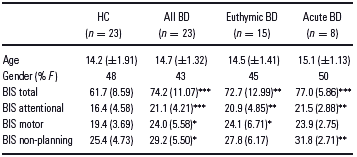
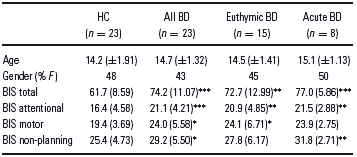
There were no significant differences between the HC and BD groups, or across HC, BD euthymic and BD acute groups, in age [t(44) = −1.08, p > 0.05] or gender [X 2(1) = 0.088, p > 0.05]. BIS total and all subscale scores were significantly higher in the BD group compared to the HC group (Table 1).
Demographic features and BIS scores
* No significant differences between euthymic BD and acute BD groups.
** Values are group means (SE) unless otherwise indicated.
*** Significantly different from HC group: *p < 0.05; **p < 0.01 and ***p < 0.001.
Comparing the euthymic BD, acute mood BD and HC groups using ANOVA, significant effects of group for total BIS scores [F(2,43) = 9.66, p < 0.001] and all subscale scores [attentional: F(2,43) = 8.37, p < 0.001; motor: F(2,43) = 5.35, p < 0.01; non-planning: F(2,43) = 4.81, p < 0.05] were observed. Tukey's post hoc tests showed the euthymic BD subgroup and acute BD subgroup each displayed significantly higher total scores than the HC group on total and attentional subscale scores (Table 1). Significantly higher scores on the motor subscale were only found for the euthymic BD subgroup, compared to the HC group. Conversely, only the acute BD subgroup differed from the HC group on the non-planning subscale. No differences were observed between the two BD subgroups. Controlling for CDRS and YMRS scores in the models above did not affect results, nor did total BIS scores correlate with current manic (r = 0.22, p > 0.05) or depressive (r = 0.28, p > 0.05) symptoms.
The subgroups of BD adolescents with rapid-cycling/chronic symptoms had higher BIS total scores [t(21) = 2.9, p < 0.05], and motor subscale scores [t(21) = −2.96, p < 0.05], than adolescents with BD without these course features. Secondary analyses assessing adolescents with rapid-cycling and adolescents with chronic symptoms separately showed the rapid-cycling subgroup differed significantly from the HC group on both the total [t(16) = −2.48, p < 0.05] and motor subscale [t(16) = −3.15, p < 0.05] scores while differences between the chronic symptom subgroup and the HC group on total [t(15) = −1.98, p = 0.06] and motor subscale [t(15) = −1.94, p = 0.07] scores were at the trend level. No significant effects were detected for the presence or absence of ADHD comorbidity, history of suicidal behaviour or medication use (overall use or for subclass of medication).
Discussion
Impulsivity, as measured by the BIS, was significantly higher in adolescents with BD compared with HC adolescents. Consistent with findings in adult samples, (Reference Swann, Anderson, Dougherty and Moeller2,Reference Swann, Pazzaglia, Nicholls, Dougherty and Moeller3,Reference Peluso, Hatch and Glahn9,Reference Swann, Lijffijt, Lane, Steinberg and Moeller12), impulsivity was elevated within the euthymic subgroup of BD adolescents. This supports self-reported impulsiveness as a trait feature of BD that is present by adolescence. Additionally, previous reports show the attentional subscale to be associated with a more severe course of the disorder and an earlier age of onset (Reference Swann, Lijffijt, Lane, Steinberg and Moeller12). Similarly, in the current sample, the attentional subscale was the only subscale to show significant elevations in both the euthymic and acute mood subsamples compared with the HC adolescents. This is potentially consistent with reports of diminished performance on tasks requiring sustained attention and inhibition of inappropriate responses and deficits in prefrontal regions subserving impulse regulation reported in euthymic BD adolescents (Reference Dickstein, Treland and Snow13,Reference Gorrindo, Blair, Budhani, Dickstein, Pine and Leibenluft15,Reference McClure, Treland and Snow16,Reference Blumberg, Hoi-Chung and Skudlarski24–Reference Leibenluft, Rich and Vinton28).
Neuroimaging studies of BD show structural and functional abnormalities in ventral prefrontal cortex (vPFC) neural systems that subserve impulse regulation (Reference Blumberg, Hoi-Chung and Skudlarski24–Reference Kalmar, Wang and Chepenik27), suggesting a neural difference that might mediate the increased impulsiveness of BD. Decreases in vPFC volume and deficits in vPFC engagement during tasks that require inhibition of prepotent responses have been reported in symptomatic and euthymic adults with BD (Reference Blumberg, Hoi-Chung and Skudlarski24,Reference Blumberg, Krystal and Bansal25). Preliminary evidence suggests these abnormalities emerge and progress during adolescence (Reference Blumberg, Krystal and Bansal25–Reference Kalmar, Wang and Chepenik27) and are associated with impaired behavioural inhibition (Reference Leibenluft, Rich and Vinton28).
Consistent with reported associations between more frequent episodes in adults with BD and elevated impulsivity (Reference Swann, Lijffijt, Lane, Steinberg and Moeller12), adolescents with BD with rapid-cycling and chronic symptoms showed elevated self-reported impulsivity, especially on the motor subscale, compared with BD adolescents with fewer episodes. We previously noted greater decreases in vPFC volume in adolescents and adults with BD with rapid-cycling, compared to those with BD without rapid-cycling (Reference Blumberg, Krystal and Bansal25), suggesting structural brain differences that may mediate the increased impulsivity in this population. Consistent with the findings, vPFC abnormalities in adolescents with BD have been linked to motor disinhibition (Reference Leibenluft, Rich and Vinton28). It is possible that greater abnormalities in the development of vPFC may lead to impulsivity and cycling phenotypic features of an adolescent subgroup with BD; however, it is also possible that episodes have neurotoxic effect in vPFC. Research to bridge the neurobiological findings, impulsivity and clinical course features of adolescents with BD is warranted.
Although increased suicidality has been associated with increased impulsivity in adults with BD (Reference Swann, Dougherty, Pazzaglia, Pham, Steinberg and Moeller11,Reference Swann, Lijffijt, Lane, Steinberg and Moeller12), we did not detect this relationship in the adolescents. The additional diagnosis of ADHD also did not influence levels of impulsivity. ADHD not in conjunction with BD has been associated with increased BIS scores (Reference Malloy-Diniz, Fuentes, Leite, Correa and Bechara29); however, our finding is consistent with reports of similar levels of difficulty in response inhibition in BD adolescents with and without comorbid ADHD (Reference Dickstein, Treland and Snow13,Reference McClure, Treland and Snow16). It should be noted though that the small subsample sizes in the subgroups with suicidality and comorbid ADHD may have reduced the ability to detect associations. Substance abuse is also associated with increased impulsivity in adult BD (Reference Moeller, Barratt, Dougherty, Schmitz and Swann1,Reference Swann, Steinberg, Lijffijt and Moeller8,Reference Swann, Dougherty, Pazzaglia, Pham, Steinberg and Moeller11). However, this sample included only one adolescent who met criteria for a substance use disorder so associations could not be assessed. More sensitive measures of substance misuse may help to elucidate associations to substance use initiation and early misuse with impulsivity in adolescents with BD. Associations between total impulsivity and psychotropic medication status for any medication use and for use of subclasses of medications were not detected, although assessments may have been limited by small sample sizes.
To our knowledge, this is the first study to show trait impulsiveness in adolescents with BD using the BIS. Given the small sample size, the results should be considered preliminary. Future research should include larger samples and more systematic assessment of clinical features and medication. Future prospective studies of adolescents at risk for BD and assessment of structural brain differences associated with BIS scores will further aid in elucidating mechanisms underlying the development of impulsivity in the disorder.
Acknowledgements
We wish to thank Kathleen Colonese, Susan Quatrano and Allison McDonough for their work with the adolescents and organisation of the data, and the adolescents and their families for their participation. Funding for this study was provided by the National Institute of Health grants RC1MH088366 (H. P. B.) and R01MH69747 (H. P. B.), UL1DE19586, the Roadmap for Medical Research/Common Fund and RL1DA024856 (H.P.B., J. H. K. and S. N.-H.), T32MH14276 (J. H. K.), the National Alliance for Research in Schizophrenia and Depression (H. P. B. and J. H. K.), the Attias Family Foundation (H. P. B.), Marcia Simon Kaplan (J. H. K.), Women's Health Research at Yale (H. P. B.) and the Klingenstein Foundation (J. H. K.). These funding sources had no further role in study design; in the collection, analysis and interpretation of data; in the writing of the report and in the decision to submit the paper for publication. All authors declare that they have no conflict of interest.