


Introduction: Performance from a sociolinguistic perspective
The YouTube video featured a small, elderly woman sitting in a kitchen, dressed in black, with a hint of some facial hair, wrinkled pale skin, and matted grey hair. Her dark, deep-set eyes shone through her large-rimmed glasses as she fielded a barrage of questions from a young, muscular white man with tanned skin, a tattoo above his right wrist, piercings in his lip, nose, and ears, wearing an oversized graphic t-shirt, baggy jeans, and a baseball cap. The question, in Portuguese, was always the same: “Avó, o que é isto?” In the montage of edited scenes, the young man repeatedly asks “What's this, grandma?” as he thrusts unrelated objects in front of her (a blue slipper, a bag of sugar, a silver teapot, a Portuguese folklore doll) in order to get a rise out of her while filming her reaction. The grandmother's responses, in a marked variety of European Portuguese that many would label as ‘Azorean’, ranged from playful to stern and elicited laughter from the grandson. While screening the video, I watched for a reaction from the balding man, forty years my senior, who sat quietly beside me at the dinner table. He rolled his tired brown eyes, raised his bushy eyebrows, and shrugged his shoulders while shaking his cracked, calloused palms at me. “You tink is funny?” he asked in a thick Portuguese accent. Most of the video's online viewers thought so, although a small minority found it abusive. I smirked, averted my gaze and mumbled, “I don't know Dad, I think it's interesting”. Raised in a proudly Portuguese home, my parents taught me that being and speaking Portuguese were worthy of respect, not mockery. In what follows, I explore how in-group stereotyping and mocking of language and identity can complicate sociolinguistic hierarchies and ethnic solidarity.
This article examines the emergence of youth-led ethnic humor among Portuguese-Canadians in Toronto as heteroglossic performance that positions and repositions dominant sociolinguistic ideologies of Portuguese and English. These dominant ideologies value monolingualism, standard language varieties, and the influence of national socioeconomic and political elites, while devaluing vernacular and mixed varieties, and the social positions of marginalized speakers. Analyzing language use through the concepts of performance and performativity allows scholars to question the creative, complex, and changing ways in which individuals and communities identify and position themselves relative to sociolinguistic hierarchies (Bauman & Briggs Reference Bauman and Briggs1990; Palmer & Jankowiak Reference Palmer and Jankowiak1996; Jaffe Reference Jaffe2009; Ahearn Reference Ahearn2012). Linguistic performances can be critically understood as forms of social action (Austin Reference Austin1962) and, through the notion of performativity (Butler Reference Butler1999), as processes of ‘doing’ rather than static forms of ‘being’. Critical views of language see it not as static or uniform either, but as continuously (re)produced and changing through individuals' actions, verbal and nonverbal (Gumperz Reference Gumperz1982; Heller Reference Heller1999). Performativity, therefore, depends on how people display, frame, and evaluate discourse. Performances and their framings can socially and politically situate actions, actors, and audiences (Goffman Reference Goffman1974; Bourdieu Reference Bourdieu1991). In analyzing language or ‘verbal art’ as performance, Bauman (Reference Bauman1975) highlights the importance of an audience in shaping and evaluating an individual's display of communicative competence.
Performance puts the act of speaking on display—objectifies it, lifts it to a degree from its interactional setting and opens it to scrutiny by an audience. Performance heightens awareness of the act of speaking and licenses the audience to evaluate the skill and effectiveness of the performer's accomplishment. (Bauman & Briggs Reference Bauman and Briggs1990:73)
Performers can mobilize symbolic resources from their sociolinguistic repertoires to produce multiple and competing utterances in a single interaction, marking multiple affiliations, and social personae. A critical analysis of these multiple voices, which Bakhtin (Reference Bakhtin and Holquist1981) defines as the verbal-ideological perspectives expressed within an utterance, can reveal ‘stance-taking’ practices (Jaffe Reference Jaffe2009): how speakers position themselves within fluid but socially constrained trajectories. That is, certain performances are evaluated more favorably than others by audiences in situated contexts where specific resources (symbolic or material) are at stake (e.g. vying for acceptance into a social group, or interviewing for a job). Speakers strategically navigate between structured social spaces where some processes tend toward uniformity and others toward differentiation of various kinds (such as spatial, economic, religious, linguistic, or social). For Bakhtin (Reference Bakhtin and Holquist1981), there is a productive tension between the centripetal forces of uniformity and standardization, and the centrifugal forces of diversity and difference (Bell Reference Bell, Bayley and Lucas2007). The key notion of heteroglossia refers to the inherent diversity present in language resulting from this centripetal/centrifugal tension. Heteroglossia is a dialogic mixture of world views, languages, and utterances, reflected in individual sociolinguistic repertoires. At a macro/societal level, an analysis of heteroglossia challenges the dominant view equating one language to one nation and one people as an homogenizing ideological construction tied to the politico-economic development of the European nation-state (Blommaert Reference Blommaert1999; Pujolar Reference Pujolar2001; Heller Reference Heller2011). At a micro/interactional level, analyzing heteroglossic performances of language and identity can illuminate the (not so) subtle politics of dominant and marginalized sociolinguistic identities in different contexts.
The sociolinguistic context discussed in this article is that of Toronto's Portuguese-Canadian community, which I have discussed elsewhere (da Silva Reference da Silva2011, Reference da Silva2012a) as a market in order to reveal the relations of power and the multiple positionings of social actors who compete for unequally distributed symbolic and material resources (Giddens Reference Giddens1984; Bourdieu Reference Bourdieu1991; Heller Reference Heller2002). This particular market is divided over constructions of ‘legitimate’ performances of Portuguese language and identity, or ‘portugueseness’ (Klimt Reference Klimt2002; da Silva Reference da Silva2011). Sociolinguistic tensions arise from an ideological competition between Portuguese immigrants from Mainland Portugal (Mainlanders) and the Autonomous Region of the Azores (Azoreans)—the respective center and periphery of linguistic, cultural, political, economic, and historical capital in Portugal.Footnote 1 Geographically distant from each other in Europe, the two groups are part of the same market in Toronto. There, a minority of Mainlanders assumed positions of power and generally imposed their language varieties and cultural performances as representative of an idealized Portugal, and marginalized the Azorean majority for their nonstandard ways of speaking and being. The monolingual and monocultural norms of the Mainland dominant discourse of portugueseness in Toronto also alienate most second-generation youth (primarily Azorean, but also Mainland descendants) who do not speak Portuguese fluently, who mix English and Portuguese, and who generally interact with people from more cultural backgrounds than do their (grand)parents.
Toronto's Portuguese market also operates within a larger Anglophone-dominant Canadian market that is divided along many lines including class, ethnicity, race, language, and migration history. The result is a sociolinguistically stratified market with multiple hierarchies. In this case, Portuguese is positioned as a subordinate language since, among other things, its speakers have mainly occupied uncelebrated working-class jobs and have not assumed mainstream positions of power where speaking ‘unaccented’ standard English and aligning with a white, Anglo-Saxon and de-ethnicized Canadian culture are markers of prestige and power.Footnote 2
This article builds on a three-year ethnography of Toronto's Portuguese community (2005–2008) examining front and back-stage performances (Goffman Reference Goffman1974) of Portuguese language and identity with a focus on second-generation youth.Footnote 3 In the following section, I present the broader historical and discursive context for public performances of portugueseness. Performances such as Portugal Day celebrations, speeches by community leaders, and religious events produce the dominant discourses of portugueseness because they publicly shape the community and ‘tend to be among the most memorable, repeatable, reflexively accessible forms of discourse’ (Bauman Reference Bauman2005:149). The third section of this article situates Portuguese-Canadian youth within these performances. Drawing from Chun's (Reference Chun2004) analysis of a Korean-American comedian (Margaret Cho) and her use of in-group stereotypical Asian speech, which complicates some analyses of racial crossing (Rampton Reference Rampton1995), the fourth section examines three comedic performances by youth who ‘put the act of speaking on display’ (Bauman & Briggs Reference Bauman and Briggs1990:73) by stylizing Portuguese and Portuguese-influenced English in ways that challenge and reproduce the sociolinguistic order around them.
Contextualizing performances of portugueseness
Essentializing discourses of Canadian multiculturalism (Porter Reference Porter1965; McAll Reference McAll1992) and Portuguese nationalism (Feldman-Bianco Reference Feldman-Bianco1992; Noivo Reference Noivo2002; Holton & Klimt Reference Holton and Klimt2009) construct Toronto's Portuguese community as a unified and homogenous market meant to fit discretely within Canada's multicultural and Portugal's diasporic mosaics. These discourses, however, gloss over internal divisions based on unequal capital (be it linguistic, regional, cultural, economic, gendered, or generational). Deconstructing these differences within Portugal is key to revealing many of the hidden relations of ethnolinguistic power within a Canadian market that first imported Portuguese workers in 1953 (Teixeira & da Rosa Reference Teixeira and da Rosa2000).
Historical relations between Mainland Portugal and the Azores have been tense since the fifteenth century because Azoreans have been physically isolated, politically marginalized, socially underprivileged, and economically exploited by distant Lisbon governments (Alves Reference Alves2000; Goulart Costa Reference Goulart Costa2008). This marginalization hinges on the Azores' remoteness, their historically rural and undereducated workforce, their sparse population (less than 250,000 inhabitants according to the 2011 Census), and on claims for a distinct Azorean identity (Oliveira & Teixeira Reference Oliveira and Teixeira2004). This marginalization also hinges on stigmatizing ideologies of language and class that equate rurality and a phonetically marked variety of Portuguese (commonly referred to as Açoriano Footnote 4 or ‘Azorean Portuguese’) with being ‘backwards’ and ‘inferior’ to the Mainland standard, thereby framing Azoreans as ‘slow’, ‘stupid’, and illegitimate speakers (Alves Reference Alves2000; Oliveira & Teixeira Reference Oliveira and Teixeira2004; da Silva Reference da Silva2011). The key phonetic features that mark Azorean Portuguese (and especially Micaelense, the linguistic variety spoken on the largest island of São Miguel) are the closed, front rounded vowel [y] (vs. the European Portuguese [u]), elongated diphthongs, and a vocalic shift towards more central and back vowels. These markers, while stigmatizing, also mark an ‘authenticity’ that unites Azoreans and informs their sense of ‘azoreanness’. In emigrant settings across time and space, these linguistic and regional differences remain salient.
Of the nearly 500,000 Portuguese-Canadians, approximately two-thirds are of Azorean descent (da Silva Reference da Silva2012a). Despite this numeric advantage and a different social environment, Azoreans are not largely found in positions of power within the Portuguese-Canadian market (i.e. Portuguese sociocultural associations, ethnic businesses, media outlets, language schools, and Portuguese diplomatic institutions). In Toronto, Azorean varieties of Portuguese, Azorean history, and Azorean descendants themselves are rarely empowered since the dominant discourses of portugueseness reify a Mainland Portuguese habitus whose influence is reproduced across generations (Oliveira & Teixeira Reference Oliveira and Teixeira2004; da Silva Reference da Silva2011).
A public casting-call for young performers
Within Toronto's Mainland-dominated Portuguese market, most of the Canadian-born second and third generations struggle to navigate Portuguese discursive spaces because they have a limited understanding of standard Portuguese and of Portugal. These discursive spaces remain monolingually Portuguese, promote antiquated and fixed images of Portuguese history and culture by romanticizing rural, working-class, Catholic, folklorized, colonial, and paternalistic traditions, and try to instill a sense of saudade ‘nostalgia’ and a desire to return to a land and time someone in their family left behind (da Silva Reference da Silva2011; see also Koven & Simões Marques, this issue, for a similar discussion of dominant discourses of portugueseness in France). Publicly engaging with these discourses is particularly difficult for youth of Azorean descent, most of whom lack the standard linguistic and cultural habitus (Bourdieu Reference Bourdieu1977) and have internalized negative ideologies of ‘bad’ (Azorean) Portuguese, but it is also challenging for youth of Mainland descent whose legitimate sociolinguistic capital may still not suffice. Although bilingual English-Portuguese code-switching (referred to as portinglês; see Lang Reference Lang1887 and Pap Reference Pap1949) is commonly heard in backstage settings, the only form of publicly sanctioned bilingualism is that of parallel monolingualisms (Heller Reference Heller1999). This can be seen as a self-preserving effort by the ethnic elite to ‘protect’ the Portuguese language and their positions of power from change, but also as a way to contest the local and global dominance of English.
As a result of these discursive tensions, many Portuguese-Canadian youth (and their families) choose not to publicly invest in performances of portugueseness that require displays of considerable linguistic or cultural capital. Their absence and silence jeopardize the future of the market, even though activities staged by the dominant Portuguese institutions continue to be legitimized as being ‘for the sake of’ the under-represented younger generations. Their absence and silence also undermine the dominant discourses of portugueseness that expect Portuguese-Canadians, young and old, to proudly identify as Portuguese, and to speak and promote Portuguese everywhere (at work, at school, at home, and at play). Koven (Reference Koven2013) calls this a discourse of obligation within a diasporic ‘moral economy’ (Lubkeman Reference Lubkeman2002). Nevertheless, most Portuguese-Canadian children in Toronto prefer speaking English, and many parents privately struggle with linguistic insecurities about the ‘quality’ of their Portuguese.
In general, my ethnography revealed a lack of public in-group contestation of the dominant discourses within Toronto's Portuguese market. Against this backdrop, my fieldwork set out, in part, to look for spaces that were either more inclusive of Portuguese-Canadian youth, or made by and for them, and that were thus more receptive to different ways of being and speaking Portuguese. At the periphery of the market, I found Portuguese-Canadian university student associations that met these criteria, although they did not always challenge the dominant discourses of portugueseness (da Silva Reference da Silva2012b). At the same time, in 2007, I saw the first public performance of Portuguese-Canadian ethnic comedy on YouTube that engaged with stereotypes of language and identity. Drawing from Jaspers' (Reference Jaspers2011) work on ambiguous sociolinguistic agency, and ethnic minority students ‘doing ridiculous’ while speaking in Dutch-based foreigner talk in Flanders, this article attends to contradictory and ridiculous Portuguese-Canadian performances of language (Portuguese and English) that may inform descriptions of ‘living in hegemony’. This hegemony can operate both in Toronto's Portuguese market (where Azorean Portuguese and Portuguese-English bilingualism are subordinate to the Mainland standard), and in the Torontonian/Canadian market (where Portuguese is subordinate to English). The comedic performers presented below highlight how subjects of this potential marginalization negotiate this hegemony.
Finding room to play
Humor has long been a productive space to explore hybrid performances and competing ideologies of language and identity through the playful public licensing of social critique and stereotypical discourses (Woolard Reference Woolard1987; Jaffe Reference Jaffe2000; Chun Reference Chun2004). As Bauman & Briggs (Reference Bauman and Briggs1990:63) argue, ‘play frames not only alter the performative force of utterances but provide settings in which speech and society can be questioned and transformed’. In this section, I present comedic performances of mocking or stylized Portuguese and English that raise questions about ideologies of language, legitimacy, authenticity, solidarity, and community membership.
The sample presented below includes performances by YouTube humorist Jeff Popsick, by a mainstream TV-based humorist (Diane Salema), and by a group of Portuguese-Canadian YouTube humorists (the Modern Fawkers). The dearth of publicly accessible Portuguese ethnic comedy in Canada up to 2012, and its general absence before 2007, raises the question of why it did not emerge sooner. With officially sanctioned Portuguese migration dating back to 1953, there was a sizeable number of youth born and raised in Canadian cities who could have produced Portuguese-Canadian comedy as part of the ‘MTV Generation’ or ‘Generation X’—born between the early 1960s and 1980s (Craig & Bennett Reference Craig and Bennett1997).Footnote 5 Contrast this, for example, with Indo-Canadian comedian Russell Peters whose brand of observational humor highlights racial, ethnic, class, and cultural stereotypes and who rose to global fame in the late 1990s. Contrast it as well with the work of Italian-Canadian comedians in the early 2000s including Debra DiGiovanni, the ‘DooWops’, and comedy tours like the ‘Italian Bad Boyz of Comedy’. The public development of Portuguese-Canadian comedy has been delayed for several reasons: the community's strict investment in celebrating and preserving a monolingual and monocultural Portuguese market, the conservative power of the local and diasporic Portuguese elite, the marginalization of its youth as well as many of its Azorean members, the community's working-class habitus, and its relative absence from Canadian mainstream attention.
The following analysis explores the ways in which heteroglossic performances both reproduce and deconstruct discriminatory discourses about the Portuguese, sometimes viewed in the mainstream as ‘uneducated’, ‘unintegrated’, ‘dirty’ manual laborers who speak ‘bad English’ (Nunes Reference Nunes1998), or in in-group debates about who and what counts as ‘good Portuguese’. Relevant here is Reyes' (Reference Reyes2004) study on how social actors (in her case Asian American teenagers) can reappropriate stereotypes of their ethnic grouping as a way to position themselves and others in socially meaningful ways and to potentially redefine stereotypes. These stereotypes can circulate in mainstream society (‘widespread typifications’) or locally on a more narrow scale (‘local typifications’), and they have different impacts on positioning the self and other by complicating hegemony and solidarity. My analysis examines the ambiguous agency of the performers, the legitimacy that they may or may not be granted, and the positioning of characters and commenters across different boundaries. These performances render public the ‘inner sphere’ of talk (Urciuoli Reference Urciuoli1996), and blur the boundaries between Portuguese and English, between standard (Mainland) and Azorean Portuguese, and between standard and ‘broken’ English.
Mocking a Portuguese grandmother? What is this?
The first Portuguese-Canadian to publicly mock portugueseness on YouTube was Jeff Popsick, the young man presented at the beginning of the article.Footnote 6 The immediate target of his humor is his grandmother, someone representing Portuguese authority and tradition, who speaks nonstandard (Azorean) Portuguese and virtually no English. By exposing her and himself to potential ridicule from Portuguese-Canadian, Portuguese, and non-Portuguese audiences, Jeff complicates notions of in-group solidarity and challenges dominant Portuguese discourses of respecting one's elders and respecting one's ‘heritage’ language.
From 2007 to 2011, this teenager of Azorean descent posted dozens of video clips of pranks on his Avó ‘grandmother’, from the abusive to the absurd and amusing. Most of the videos, organized as episodes in a ‘Portuguese grandmother’ series, involve Jeff saying a few words in Portuguese and doing ridiculous things to her (e.g. startling her both at day and night by asking for bananas, and covering her bedroom floor with papo secos ‘Portuguese bread rolls’, to elicit and record her reactions in (Azorean) Portuguese. The following excerpt is from Episode 17, O que é isto? ‘What is this?’, where, according to Jeff's online synopsis, ‘we find grandma in a Q&A session for Jeff while he asks her questions about the things around her, of course knowing what they are, Jeff just desides [sic] to keep grandma company. lol enjoy!’.Footnote 7 Interestingly, the video's metatext is almost entirely in English (except for the Portuguese title), while the linguistic interactions in the video are almost entirely in Portuguese. The lack of subtitles, which makes it difficult for a non-Portuguese speaker to follow, suggests that Jeff positions his audience as ‘in-group’ members. Audience reactions are discussed after presenting the video. They reveal multiple positionings and understandings of language and identity.
(1) Portuguese grandmother and Jeff Popsick: O que é isto? ‘What is this?’Footnote 8
[At the 1:06 mark we are in the grandmother's cramped little kitchen with Jeff thrusting random objects in front of her, starting with a bag of sugar.]
[The scene fades out and back in with the grandmother eating something when Jeff thrusts a silver teapot in front of her.] [The scene fades out and back in with the grandmother in the kitchen sitting with other people. Jeff enters holding a doll dressed in a Portuguese folklore costume and shakes it in front of his grandmother's face. The video switches to slow motion and the voices are exaggeratedly slow.]

The grandmother's increasingly frustrated reactions reveal how Jeff's annoying questions make visible the existence of certain boundaries. With the bag of sugar, the grandmother's reaction is straightforward, although she first tries to avoid getting involved in the game. Her pronunciation of the word chá ‘tea’ as [ʃja] instead of [ʃa] is a marker of Azorean Portuguese, particularly that of the island of Terceira. When faced with the teapot, her explanation of ‘what it is’ is very wry (‘for you to piss in!’) and elicits a roar of laughter as she too is in on the game. When faced with the doll, however, the grandmother's lightheartedness fades and she is infuriated. This is not just any doll. It is her doll and not a toy. Dressed in a traditional Portuguese folklore costume it embodies Portuguese culture, which presumably makes it worthy of respect. Strikingly, her respect for the traditional doll contrasts with Jeff's disrespect for his grandmother who also embodies traditional portugueseness. Indeed, Jeff's performance evokes the ‘doing ridiculous’ of Jaspers' (Reference Jaspers2006, Reference Jaspers2011) ethnic minority students in Flanders. The fact that the staged caricature of Jeff's grandmother creates a space for comments on issues that are otherwise publicly taboo can be seen as an act of resistance to the social order in the local Portuguese (and Canadian) market, where he likely would not be given the right to speak because he looks and acts like a ‘thug’.
This video also provides a curious counterpoint to the dominant sociolinguistic discourse that promotes speaking nothing but Portuguese at home. In a narrow view, a young person like Jeff could potentially merit ethnolinguistic praise for speaking Portuguese at home—despite his mocking use of it in a game that demonstrates little standard language competence. His irreverent mocking of portugueseness and of his grandmother challenges idealized ways of being and speaking Portuguese. This video and the online responses also illustrate that there are many varieties of Portuguese that are judged differently. Simply speaking Portuguese at home does not guarantee the value of one's Portuguese linguistic capital in other spaces. For example, if Jeff is only exposed to a nonlegitimized, vernacular variety of Portuguese at home (influenced by Azorean Portuguese and English), then he runs the risk of being ridiculed if/when he speaks it elsewhere in the Portuguese market (e.g. in Portuguese-language schools and in interactions with ethnic leaders, media, and businesses).
The heteroglossia of Jeff's video is intensified by the online comments (see Koven & Simões Marques, this issue, for more analysis of YouTube commentary). As of November 28, 2013, the video had drawn 144,988 views, been ‘liked’ 255 times, and ‘disliked’ fourteen times. Of the 198 written comments, twenty-eight were negative (e.g. “this is absurd”, “this guy's an animal”, “Poor grandma raising such a stupid kid!”), seven were both positive and negative (e.g. “your videos are hilarious, but give your grandmother a break!”), 129 were more or less positive, twenty-two were informative rather than appreciative, and twelve were reactions to other viewers' comments. Thus, despite the absurdity of Jeff's actions, the documented response of viewers is overwhelmingly positive. As for the languages used, 113 comments were in Portuguese, seventy-seven in English, and eight in both English and Portuguese. Language use and usernames suggest that the actively engaged audience consists mostly of Portuguese descendants (in the North-American diaspora and in Portugal) who are able to understand Jeff and his Avó. A brief description and categorization of the comments reveals that nearly half of them explicitly refer to the language use in the video, likely in reaction to the ‘initial novelty’ (Jones & Schieffelin Reference Jones and Schieffelin2009) of hearing a Portuguese-Canadian grandmother from the Azores on YouTube. About half of the positive comments (55) reproduced direct quotes from Jeff and his grandmother, including unparsed, morphologically nonsensical, but phonetically simplified revoicings that reflect their nonstandard ways of speaking (e.g. “épatumijaresaí!!” and “Óvóquéich?”). As these last reductionary examples illustrate, revoicing or representing speech is not a neutral act (Bakhtin Reference Bakhtin and Holquist1981), but rather an evaluative one involving ideologies of what one considers good or bad language, that can ridicule or support the original speaker—as we also see in the second excerpt.
There are also twenty-five negative comments about the grandmother's Azorean Portuguese pronunciation and azoreanness in general as insulting idealized portugueseness. They are almost all written in Portuguese (translated here for the reader's convenience) and perhaps written by Mainlanders whose symbolic capital feels threatened (e.g. “This is Portuguese?! What?! I can't understand a fucking thing this old woman is saying!!!” to which someone responds “It's the Azorean accent!” and “The Azores are like Brazil and Africa. After so many years of colonization they never learned our [Mainland Portuguese] language!”). Still, there were five positive comments about the ‘Azorean accent’, including one that deconstructs the sociolinguistic context of Mainland Portugal: “What a stupid discussion. Even in [Mainland] Portugal people have different accents. Lisbon has an accent, Porto another, Coimbra another, ... Azores another. What's the problem? lol?”.Footnote 9
Finally, the second largest group of comments (forty-five) contains positive declarations of belonging and familiarity with Portugal and portugueseness (“LMFAO dude I'm Portuguese and this shit is the best!!!” “OMFG i love your avo! haha. where is she from? she sounds like people from Pico”).Footnote 10 Commenters often praise the grandmother for reminding them of their own family (“She's the best! Just like my vavo!”). These declarations serve multiple functions. They can align the commenters with discourses of diasporic Portuguese nationalism and with an imagined transnational family. These declarations may also entitle the commenters to either celebrate or mock the grandmother, much like Jeff's ambivalent agency, because, as Chun (Reference Chun2004) argues with Margaret Cho's Asian comedy, claiming an ‘authentic’ ethnic identity positions him and many commenters as insiders and unlikely to indulge in discriminatory mockery.
The following heteroglossic comedic performance broadens the scope of the audience from ‘in-group’ to ‘outsiders’ in the Canadian mainstream. It highlights Portuguese performances of nonstandard English.
Mocking Portuguese in the mainstream
From 2006 to 2008, Diane Salema, a young Portuguese-Canadian woman of Azorean descent, was a host on MTV Canada. Among the most popular short video segments on the network was a comedic interview series called ‘Diane's Dad on…’. In each episode, Diane received advice on a specific topic from her elderly father who spoke in what mtvlive.ca labeled ‘broken English’ with a thick Portuguese accent. Topics included ‘Diane's Dad on…’ the government, Christmas, fashion, computers, doctors, and girlfriends, among others. The most popular of the videos uploaded to YouTube in 2009 was ‘Diane's Dad on…Octopus’, which I present below.
By bringing the ‘inner sphere’ of talk in a Portuguese household to the ‘outer and public sphere’ of the Canadian mainstream, the boundaries between Portuguese and English are explicitly structured and ordered. In this outer sphere, ‘broken English’ and the use of Portuguese are much less tolerated and are seen as disorderly or deficient (Urciuoli Reference Urciuoli1996). In fact, Mr. Salema's English is so heavily accented or ‘broken’ that it is subtitled by MTV Canada, framing him as an illegitimate speaker of (standard) English, and staging the interaction as a ‘real’ interview (Park Reference Park2009). Exposing Mr. Salema's language skills and his mannerisms to public judgment may reproduce negative stereotypes about Portuguese immigrants, but it can also provide a space for Portuguese-Canadian youth to reinforce or critique the stereotypes in a language (English) and a space (social media) they dominate well. The following video reveals a hierarchy of socially stratified languages and identities with complex and contradictory alignments between the performers and the audience. In it, Diane and her father discuss a Portuguese tradition of eating octopus at Christmas. The source of humor comes primarily from Mr. Salema's difficulty in correctly pronouncing octopus, because the ‘oct’ cluster is not very common in Portuguese.
(2) Diane's dad on… octopusFootnote 11
[The scene opens with Diane and a man we assume is her father (Mr. Salema) sitting on a living room sofa, in front of a polished wood coffee table decorated with crocheted linen, a glass bowl, and an African safari statuette, surrounded by family photos. Diane places a red hat with white trim on her father's head as drum-beats are heard.]
[There is loud music playing electronic beats and letters spelling ‘Diane's Dad on…’ appear on the screen as the camera zooms in on Mr. Salema's wrinkled face and gap-toothed grin. The music changes to that of a slow-paced acoustic guitar.][The electronic music swells as an ad for MTV Canada appears on screen.]

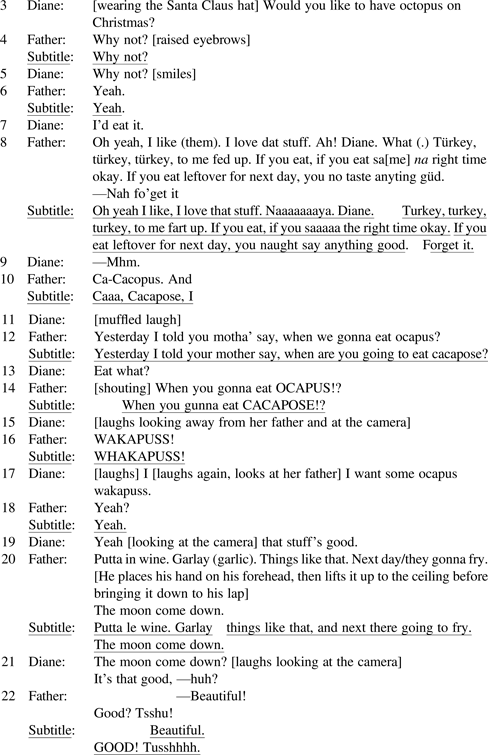
In a public rendering of the inner sphere of (staged) talk between two generations of Portuguese-Canadians, Diane, like Jeff Popsick with his grandmother, can be seen as breaking in-group solidarity by purposefully exposing her father and his accented English to social and linguistic evaluation, and by positioning herself favorably with the de-ethnicized, middle-class, Anglophone-dominant MTV audience. Her privileged position as a family and ethnic insider gives Diane enough legitimacy to publicly present in-group interactions. Furthermore, her whiteness, canadianness, and exclusive use of standard English grant her privileged access to the mainstream market. The unknown subtitle-writers use their power to add another evaluative layer to the interaction by decoding and policing Mr. Salema's speech. Although it is at times unintelligible (Wirtz Reference Wirtz2007), Mr. Salema's English is not only corrected but it is potentially ridiculed through the subtitles that occasionally deviate from the original speech and create an even more heteroglossic interaction—like the reported speech in Jeff's viewers' comments, as we have seen (see also Jaffe & Walton Reference Jaffe and Walton2000; Androutsopoulos Reference Androutsopoulos2000; and Koven & Simões Marques, this issue, for discussions on orthography and the representation of nonstandard speech). Adding this textual layer creates different levels of understanding: those, like me and Diane, who understand Portuguese-accented ‘broken’ English, can claim an insider position and identify the subtitles' deviations, unlike a non-Portuguese-speaking audience. Another textual layer heightens the ridiculousness of the utterances through uncomfortable close-ups of Mr. Salema's tanned face, bushy eyebrows, balding head, wrinkled skin, and gap-toothed grin, as he sits back in a worn blue-collared shirt and grey pants that likely index the uniforms of workers in the service industry.
Before Diane's father trips up on the pronunciation of octopus, the subtitle-writers mock his accented English pronunciation in turn 8 as he explains that he gets “fed up” with there being too much turkey to eat at Christmas. By pronouncing it [fɑːd ʌp], with a shift characteristic of Azorean Portuguese towards the back vowel, he allows the subtitle-writers to enter “fart up”, a representation that gets taken up as humorous in the online comments. By contrast, no commenter scoffs at the subtitle-writers for misrepresenting “you no taste anything good”, in turn 8, with an ungrammatical “you naught say anything good”. There should, however, be no contextual confusion since Diane's father is evoking the common reality that leftovers taste less fresh the following day.
Turns 10 to 17 represent the climax of the mocking. Mr. Salema's first attempt at pronouncing octopus yields a hesitant “cacopus”, as he inverts the first syllable, stutters, and drops the [t], creating a comical and widely recognized childish word for faeces ‘caca’. In turn 11, Diane muffles her laughter and does not correct her father. With no reason to suspect anything is wrong with the interaction, Mr. Salema continues his narrative and, in the following turn, produces “ocapus”, a word very similar to octopus. The scene would be different (and perhaps lack its appeal), however, if Diane's father were seen communicating plainly in English. This is likely why the subtitle-writers ignore the improved pronunciation and reproduce the previous mispronunciation: “cacapose”. In on the joke herself, and knowing that this is the most mockable part of the scene, Diane asks her father to clarify what exactly he wants to eat (turn 13). Mr. Salema's frustration in turn 14 may be because he expects his daughter to understand him. He raises his voice and repeats his question more slowly, as if Diane had trouble hearing what he said. Her laughter and orientation towards the camera leave Mr. Salema with an ambiguous response. He thus repeats himself a second time, even louder and more emphatically, changing “ocapus” to “wakapuss” in turn 16, to provide another plausible alternative, in case the miscommunication hinges on the word for octopus. Diane laughs again in turn 17 but goes on to jokingly align herself with her father saying that she too wants “ocapus wakapuss”. The fact that she reproduces both words suggests that Diane had no trouble hearing and decoding what her father said. Whether or not she actually enjoys eating octopus (“that stuff's good” in turn 19), it is arguably not a common part of mainstream Canadian cuisine and can, thus, represent a ‘funny’ food eaten by foreigners, like Diane's father who thinks it is literally out of this world.
Unlike Jeff Popsick's videos of his Portuguese grandmother, none of the YouTube comments online chastised Diane for exposing her Portuguese father to public ridicule. As of November 28, 2013, the Octopus video had drawn 24,281 views, been ‘liked’ fifty-four times, and ‘disliked’ only once. Of the twenty-one written comments, eighteen were more or less positive and three were unrelated to the video. As for the languages used, all twenty-one comments were in English; none were in Portuguese. Thus, the commenting audiences for these two amateur comedians were considerably different. Whereas Jeff's was primarily of Portuguese descent (and therefore legitimized to defend or ridicule their own Avó's), Diane's audience was more ethnolinguistically diverse (judging from user profiles, names, and the exclusive use of English in the posts). The most common comments (twelve of the twenty-one) revoiced Mr. Salema's character, including the confusion over “fed up” (e.g. “Turkey, turkey, turkey to me fart up. That's my favorite part, haha.  ”), the syntactically simplified, nonstandard expression “the moon come down” (e.g. “the moon come down. MY GOD I DIED”), but especially his different formulations of octopus (e.g. “Cacapose... WHAKAPUSS. LMFAO”). In this nonserious frame, practices that invoke laughter, or a somewhat positive response, can still reproduce negative ethnolinguistic stratification, as Hill (Reference Hill1998) has argued. On the one hand, Diane may be seen as a willing agent of a wealthy, Anglophone mainstream media corporation, which identifies authority, parental figures, immigrants, and nonnative English speakers, among others, as targets of linguistic and social ridicule. On the other hand, a humorous frame may allow for an ideological critique or a personal identification that might otherwise have been unavailable and that could decentralize the stigmatizing sociolinguistic positioning.
There were, for instance, four comments that affirmed ethno-cultural solidarity (e.g. “hes exactly like my grandpa”) and that celebrated Portuguese ‘authenticity’, going so far as to imagine sharing a traditional Portuguese meal with Mr. Salema: “… I want to find him and drink wine and eat sardinhas assadas [‘grilled sardines’] with him.” In addition to the alignment work in the comments, Diane's performance illustrates some complex and contradictory alignments as she animates her father's words (turns 5, 17, and 21), supports her father (turns 2, 7, 17, 19, and 21), plays the role of interpreter for a non-Portuguese audience (turns 13 and 21), and disaligns with her father by aligning with the MTV audience through her laughs, smiles and looks at the camera (turns 5, 11, 13, 15, 17, 19, and 21).
Diane's flexible alignment is due in part to her powerful capital of ‘good English’, which elevates her status in a mainstream Anglophone market (like Toronto's media) and allows her to publicly mock and sympathize with her father, whose ‘bad English’ guarantees him a less powerful position. Diane's humor derives from a caricature of Portuguese-Canadian elders who cannot speak English without a ‘foreign accent’, much like the humor of Margaret Cho's voicings of Mock Asian (Chun Reference Chun2004).
The final example of heteroglossic comedic performance does not involve an older Portuguese family member but is, rather, a youth-led parody of life for many Portuguese-Canadians in Toronto. It engages with ethnic tropes and epithets, it presents Portuguese-accented English with Portuguese loanwords, and it reveals tensions between different group positionings, including Italians and the mainstream Anglo-dominant group.
Modern ‘porkchop’ mockery
In the wake of South Korean musician Psy's wildly popular ‘Gangnam Style’ video in the summer of 2012, hundreds of parodies appeared on YouTube from around the world, including one called ‘Porkchop Construction Style’ from Toronto. This particular video, created by three young Portuguese-Canadian men of Azorean descent collectively known as the ‘Modern Fawkers’, or just ‘the Fawkers’, garnered over 215,000 views by the fall of that same year. These amateur comedians, whose name is likely a sanitized play on a similar sounding expletive (mother fuckers), have a YouTube channel with clips of pranks and random acts of absurdity (in line with MTV's television series ‘Jackass’), not all of which have to do with being Portuguese. In ‘Porkchop Construction Style’, the performers appropriate a derogatory term for the Portuguese in Canada (‘Porkchop’Footnote 12) and base their fictional sketch on a common occupation for Portuguese-Canadian men: construction. This illustrates how some ethnic epithets and stereotypes can be reappropriated as a resource for accomplishing new social actions, much in the same way as ‘nigger’ and ‘chink’ have been reappropriated, in certain conditions, as solidarity terms by African Americans (Kennedy Reference Kennedy2002) and Asian Americans (Reyes Reference Reyes2004). By invoking a frame of sketch comedy, the Fawkers are sanctioned to break with social conventions of politeness and can parody different stereotypes of Toronto's Portuguese-Canadian community (e.g. its working-class habitus, religiosity, and gender roles). Yet, as the viewers' comments reveal, these stereotypes can be taken up unsympathetically by out-group members who want to reinforce the ideologies that can marginalize the Portuguese in an English-dominated sociolinguistic hierarchy.
(3) Porkchop Construction StyleFootnote 13 (first verses, 0:00-1:30)
[An alarm clock goes off at 4am and an electronic drumbeat grows louder as a short, stout, white young man gets out of bed wearing sunglasses and starts singing/rapping.]
Like Diane's sociolinguistic position vis-à-vis her father, the Fawkers can capitalize on their position as ‘good English’ speakers to satisfy the needs of Toronto's English-speaking market, to make their videos accessible to young Portuguese-Canadian and non-Portuguese audiences and, perhaps, to resist some stigmatization ‘from above’ (i.e. the local Portuguese elite) when it comes to speaking ‘bad Portuguese’. Although the Fawkers do not all speak Portuguese fluently, the video's protagonist has enough sociolinguistic capital to produce stylized portugueseness. Of particular interest here are the features of stylized Portuguese-influenced English: the alveolar flap ‘r’, [ɾ], in words such as construction, morning and Maria, the ‘th’-alveolarization where the voiced dental fricative in the and weather, /ð/, is pronounced [d], and the closed front-rounded vowel [y] instead of [u] as in today [tydej]. This last phonological feature ‘keys’ (Goffman Reference Goffman1974) a nonstandard speaker of Azorean descent as well as a nonstandard English speaker, thereby blurring the boundaries between in-group and out-group mocking. Another stylizing strategy is to use Portuguese loanwords for rhymes like papel ‘paper/money’ and martel' ‘hammer’ or martelo with a deleted unstressed final vowel, and common Portuguese names like Maria and José Manel.
The reactions to the video on YouTube were overwhelmingly positive with dialogic responses that illustrate different alignments along class and ethnolinguistic lines (both in-group and out-group). As of November 28, 2013, the video had drawn 334,395 views, been ‘liked’ 1,420 times, and ‘disliked’ ninety-two times. Of the 323 written comments, 208 were more or less positive towards the video, twelve were negative, four were positive and negative, eight were informative rather than appreciative, and ninety-one were responses to other comments. As for the languages used, 304 comments were in English, ten in Portuguese, and eight in both English and Portuguese. More than half of the positive comments expressed general and unspecified appreciation (“LOL”, “that was hilarious!”, “awesome!!”). More specifically, forty comments identified with being Portuguese and celebrated Portuguese-Canadian (‘Porkchop’) culture (e.g. “i love being Portuguese”, “Hahaha love this I'm a porkchop… love being Portuguese333”), twenty comments applauded life as a construction worker (e.g. “Portuguese contruction [sic] workers make the world go round!”, “im a porkchop and costruction [sic] worker all true good vid”), and twenty-one comments reproduced a quote or a scene from the clip (e.g. “So true. I don't want to work but i need lotsa papel”, “Ahhhyyyy. i don't wanna work late. LOL IM Portuguese and i love this!”). These reactions reveal how potentially negative stereotypes of class can be reappropriated and used to valorize individual and group experiences of marginalization.
Despite the considerable sanctioning of the Fawkers' playful or demeaning representation of Toronto portugueseness, they are not without their detractors from in-group and out-group viewers who see them as reinforcing ethnolinguistic differences. Among the negative comments, four were in-group views critical of potential discrimination against Portuguese-Canadians (e.g. “Funny vid but really, we all know that the Portuguese are hard workers compared to others so don't give us a bad name because there will be idiots out there that will actually believe the Porkchops are like this.”). This particular commenter fears that non-Portuguese people will distort the in-group play frame (see also Koven & Simões Marques, this issue) and take this video as an accurate portrayal of Portuguese-Canadians, whom he refers to as ‘Porkchops’ in a presumably nonderogatory manner, as being dim-witted construction-working men who speak English poorly, are obsessed with money, but would rather not work. Two other comments flagged negative depictions of Portugal (e.g. “im am portuguese dont call any one portugal porkchop or we will beat shit out of you”). The basic grammatical mistakes in this comment (verb conjugation, lack of prepositions and articles) lead me to suspect that its author is not a fluent speaker of English and may be from Portugal. The commenter takes offence to the use of the epithet ‘Porkchop’, without specifying its in- or out-group use, and implies that using that term in Portugal would get the speaker in trouble. Lastly, the video garnered four negative in-group comments about the tensions between Azoreans and Mainlanders, perhaps related to the vocalic features of stylized Portuguese. One commenter wrote: “Don't group me in with these retarded islanders please. They're 2 and a half days off from being Portuguese. >_ > ”.Footnote 14 Another responded, “Let me tell u guys the truth we islanders we make Portugal the best we are fun and not a bunch of fucking retards that think there are the best in the world … so don't try to talk bad about the islanders we are Portugal liked ur not [like it or not?]”. Behind this argument about Azoreans being ‘fun’ may be the idea that the same distinctiveness and stigmatization of Azorean Portuguese makes it both mockable (or perhaps ‘retarded’ to some) and, in other cases, ‘fun’ and ‘authentic’, as opposed to the ‘stuffyness’ of standard Mainland Portuguese. Another commenter responded to this last reaction echoing notions of fun, distinctiveness, and sameness while creating a dialogically layered interaction: “c'mon man. I make fun of the island accents all the time (specifically sao miguel) but its all for fun. In the end mainlanders and islanders are both Portuguese, just with a few differences in accent/slang, and lifestyle. … We're all porkchop, stop the stupidity. Peace.”). The negative comments, then, reveal the boundaries of different group positionings: Azoreans and Mainlanders, Portuguese and Portuguese-Canadians, Porkchops and non-Porkchops.
The video's success, and its inclusion among the hundreds of parodies of the hugely popular ‘Gangnam Style’ video, positions it within a global frame of such videos that make it likely to be viewed by a wider audience beyond Portuguese descendants. This exposure to out-group viewers also creates space for negative reactions towards or from ‘rival’ groups who compete over symbolic resources within a given ecology. Portuguese-Canadians in Toronto have a (not so) friendly rivalry with Italian-Canadians and the Portuguese have often assumed a subordinate position.Footnote 15 For example, success in Canada's construction industry and in international soccer competitions are two flashpoints for this rivalry, where Italians hold the advantage. This rivalry accounted for forty-two online comments, often between viewers, who attacked or defended the sudden online popularity of portugueseness. In this context, and in response to the video's many positive comments praising Portuguese identity and even construction life, one commenter ignited a very graphic debate summarized by the following posts:
Lots of Portugese in construction today, maybe thats why there is glass falling from high rises downtown and uneven roads. I dont remember this happening when the Italians were running the show. Maybe we should have reconsidered handing the torch to the Portugese! What do you guys think? Who feels me here!!!!!!!!!!! P.S. When was Portugal's last World Cup or Euro Cup victory?
Italians are the biggest queers in this world. Italy is shit. Portugal is the best!
And you are really irritating!! look at the maturity in you bud to sit here and bash Italians, why cause one portuguese song went viral, your getting all excited to be Portuguese haha. Like a Porkchop finally did something. LOL.
screw you we portuguese are awesome
You eat shit for breakfast cuz its the scum from where your from.
(Modern Fawkers:) we do not encourage this pointless “comment war” thanks for taking time to watch and comment.
These negative reactions to the ‘Porkchop Construction Style’ video illustrate the danger that ‘widespread typifications’ of stereotypes (Reyes Reference Reyes2004) performed by in-group humorists can be taken up unsympathetically by out-group members. Like the widespread typification of the Asian storeowner stereotype, the stereotype of the Portuguese construction worker has widespread circulation in Toronto, in Canada, and elsewhere. The Fawkers narrowed the scope of the stereotype somewhat by situating their video in a Toronto suburb and by portraying local typifiers (a mall parking lot and store) that are unrecognizable to ‘nonlocals’ and that receive positive comments from ‘locals’. While the Fawkers can be seen as trying to reappropriate the stereotype as an interactional resource, the rivalry between Italians and Portuguese in the symbolic and material ecology of Toronto reveals how negative ideologies of class and language, among other social categories, can be taken up to maintain a hierarchy that privileges those with longer migration histories and more power. When the Fawkers joined the polyphonic (Bakhtin Reference Bakhtin and Holquist1981) debate of online comments, they argued that parody and humor gave them license to enact a ‘play frame’ without warranting a ‘serious frame’ from the online commenters (“if people dont know what a parody is they really shouldnt be watching them lol thanks for watching”). The Fawkers' decision not to publicly engage in the debate to ‘defend’ Portuguese identity (illustrated by their post on the Portuguese-Italian “comment war” above) suggests that they, like Jeff Popsick and Diane Salema, are more invested in ambiguous rather than resistant agency, both accepting and challenging sociolinguistic boundaries (Jaspers Reference Jaspers2011).
Conclusions
This article has shown how essentializing ideologies of language and identity in a minority ethnic market, like that of the Portuguese in Toronto, within a larger mainstream market, like that of Anglophone Canada, can inspire humorous sociolinguistic performances that acknowledge, reproduce, and challenge ethnolinguistic stratification. Humor can allow people to publicly engage with tensions of uniformity and difference by rendering explicit the inherent diversity, or heteroglossia, of social interaction. Different ways of speaking can signal different alignments between speakers and audiences in different contexts. Framing a performance as humorous grants performers the potential to break with social conventions of politeness and respect that would otherwise restrict uses of stigmatized linguistic varieties and stereotypes. This play frame allows performers to (re)situate sociolinguistic markers and to expose the nested hierarchies in which social actors operate; in this case, for example, Toronto's Portuguese market (i.e. Mainland Portuguese vs. Azorean Portuguese vs. Portuguese-English bilingualism), and the de-ethnicized Canadian mainstream (which is dominated by English and where intracommunity differences are often ignored).
Through their mockery, the performers seen above challenge the traditional conventions of exhibiting Portuguese ethnic and linguistic pride in Toronto. These traditional ways normally include publicly self-identifying as Portuguese, speaking Portuguese (well), promoting a particular version of Portuguese culture, utilizing Portuguese symbols, and participating in culturally sanctioned spaces (like cultural associations, religious institutions, Portuguese political or business organizations). The Modern Fawkers illustrate how mocking Portuguese-accented English and aspects of Portuguese-Canadian life can still be proof of Portuguese pride, as many of the YouTube commenters confirm. The Fawkers also reveal how mocking the widespread stereotype of the Portuguese construction worker presents a humorous risk in out-group settings where it can be appropriated unsympathetically. Diane Salema's performance may attest to her ethnic pride by the fact that she took someone like her father—who would otherwise have existed in the shadows of the middle-class, Anglophone-dominant Canadian mainstream—and made him publicly visible and audible. Finally, Jeff Popsick pokes fun at the monolingual rule of ‘speak Portuguese at home’ supported by the dominant discourse of portugueseness, and he frames his practices of ‘doing ridiculous’ as a way of keeping his elderly grandmother company and sharing her ‘authenticity’ with the world.
These examples of in-group stereotyping raise questions about the ideologies of legitimate mockery and its motivation. Chun (Reference Chun2004:278) argues that in-group ethnic comedians who ‘mock their own’ ethnic groups (e.g. Asians doing ‘Mock Asian’) are not being discriminatory because they are not in a position or have any intent to oppress their own. The examples presented in this article, however, reveal the young performers' ambivalent sociolinguistic dominance. Moreover, depending on the specific market and the resources at stake, in-group members can stand to profit from their sociolinguistic performance. Diane Salema, for example, got paid by MTV Canada. Jeff Popsick and the Modern Fawkers benefit from the attention (and limited financial return) they receive from YouTube.
In addition to challenging the ideologies of the Portuguese market, these young performers appear to be warding off potential stigmatization from the Mainland Portuguese-Canadian elite (e.g. language teachers, media figures, community and business leaders, and visiting Portuguese politicians who often lament Portuguese-Canadian youth's limited Portuguese sociolinguistic capital) by fronting other people's ‘incompetent’, ‘accented’, or ‘broken’ speech in Portuguese and English. In this way, the youth can deflect criticisms of their linguistic incompetence in Portuguese by identifying the limits of another person's Portuguese linguistic capital, or by shifting the terrain of the linguistic market so that their own English linguistic capital is more highly valued than that of their Portuguese elders who struggle to master the dominant language in Toronto. Indeed, mocking their own family members (with ambiguous affection) may suggest a shift in the earlier structure of the ethnic market, where respect for elders once dominated. Furthermore, this ‘extreme in-group’ critique of inner-sphere family dynamics can be an attempt to avoid challenges that the critique is coming from ‘outside’ (i.e. the Canadian mainstream) and thus constitutes discrimination.
Intracommunity critiques are taboo within Toronto's Portuguese market, but this article has deconstructed some of the sociolinguistic tensions that are often ignored by Portuguese nationalist discourses and by Toronto's dominant English-speaking mainstream. Interestingly, the emerging Portuguese-Canadian ethnic comedy market appears to be led by Azorean descendants, not Mainlander descendants whose privileged sociolinguistic habitus could grant them easier access to the dominant spaces of Toronto's Portuguese market. The ‘illegitimate’ variety of Azorean Portuguese, and the use of Azorean phonetic features in stylized Portuguese and English, so often ridiculed by those of Mainland Portuguese descent, are slowly becoming a weapon of the weak(er) (Hill Reference Hill1998) and are being made public in alternative spaces (e.g. YouTube, Facebook) and at the margins of the dominant ethnic market. Perhaps humor can (re)situate some of the voices and the experiences of a silenced Azorean majority.
The analysis of online comments suggests that young Portuguese-Canadian audiences get special enjoyment from the stereotyped languages and identities because they see their otherwise marginalized peers in positions of power in front of a broad public audience. They may also build solidarity through the public sharing of common experiences like hearing linguistic repertoires similar to their own, or perhaps their family's inherited delegitimized language, whether it is Jeff Popsick's limited Portuguese, Diane Salema speaking in English even though her father may prefer Portuguese, or the Modern Fawkers who speak limited Portuguese but who can parody portinglês on the construction site. The generally positive online reactions and the strong alignments toward ethnic solidarity can potentially recontextualize the underlying ethnic stratification and make it more bearable (Jaspers Reference Jaspers2011), just as they can reappropriate the ethnic epithet ‘Porkchop’. Yet, this reappropriation and recontextualization also depends on how it gets taken up by others, and the online comments reveal a diversity of audiences with different stakes in positioning themselves vis-à-vis the performances. Those with enough English linguistic and material capital (be they non-Portuguese or Portuguese descendants) are able to position themselves more favorably than the stereotyped characters.
Finally, these heteroglossic performances and performers can also be understood within a larger context of change impacting the homogenizing ideologies and structures of the traditional nation-state (Heller Reference Heller2011). The examples presented above uncover spaces of ambiguous in-group contestation resisting the dominant discourses of portugueseness and of middle-class Anglo-dominance. They also reveal cracks within a minority ethnic market that is slowly seeing its resources redistributed because of shifts in local and global economieswhether through processes of urban gentrification and its impact on the residential and institutional (re)structuring of Toronto's Portuguese community, or through the recent post-national mobilization of the Azorean diaspora in the Americas. Still, no matter what the context of social change, people's positions will still be partly defined by ethnolinguistic ideologies. Humor is one way to render that positioning explicit.


