Introduction
Stalking is a course of conduct in which one individual repeatedly intrudes upon another producing fear or distress. Epidemiological studies show a lifetime prevalence of stalking victimization greater than 10% (Tjaden & Thoennes, Reference Tjaden and Thoennes1998; Budd & Mattinson, Reference Budd and Mattinson2000; Morris et al. Reference Morris, Anderson and Murray2002; Purcell et al. Reference Purcell, Pathé and Mullen2002; Dressing et al. Reference Dressing, Kuehner and Gass2005). Victim surveys reveal that the psychological effects of stalking can be devastating, including post-traumatic symptoms, increased substance use, depression and suicidal ideation (Pathé & Mullen, Reference Pathé and Mullen1997; Blaauw et al. Reference Blaauw, Winkel, Arensman, Sheridan and Freeve2002; Kamphuis et al. Reference Kamphuis, Emmelkamp and Bartak2003). The frequent concurrence of stalking and psychopathology in victims and perpetrators means that any mental health professional, not just forensic specialists, may be required to assess individuals involved in a stalking situation. Moreover, the literature shows that mental health professionals themselves are at heightened risk of stalking victimization by a current or former client (Purcell et al. Reference Purcell, Powell and Mullen2005; Dressing et al. Reference Dressing, Scheuble and Gass2006; McIvor & Petch, Reference McIvor and Petch2006). For professionals faced with stalking situations, understanding and evaluating the risks involved is a daunting task.
When stalking violence occurs it usually involves punching, kicking and shoving. It rarely causes lasting physical damage, although psychological effects can be more persistent. Stalking only occasionally foreshadows serious violence, with ex-intimate partners at particular risk (Pathé & Mullen, Reference Pathé and Mullen1997; Farnham et al. Reference Farnham, James and Cantrell2000; Purcell et al. Reference Purcell, Pathé and Mullen2002; James & Farnham, Reference James and Farnham2003; Rosenfeld, Reference Rosenfeld2004). Stalking can presage sexual violence, although, with the exception of the community sample of Dressing et al. (Reference Dressing, Kuehner and Gass2005), this type of attack is rarely reported (Purcell et al. Reference Purcell, Pathé and Mullen2002; Mohandie et al. Reference Mohandie, Meloy, Green-McGowan and Williams2006).
Reviews of the stalking literature suggest that stalkers can be effectively categorized as high or low risk for violence based solely on their relationship to the victim. Ex-intimate partners pose a relatively high risk of violence, and strangers and acquaintances a relatively low risk (Rosenfeld, Reference Rosenfeld2004; McEwan et al. 2007 b; Resnick, Reference Resnick and Pinals2007). It has been suggested that increased proximity to the victim is associated with stalking violence (Palarea et al. Reference Palarea, Zona, Lane and Langhinrichsen-Rohling1999; Kropp et al. Reference Kropp, Hart and Lyon2002), and intimidation tactics including threats and property damage are identified risk factors. The role of personality disorder, substance use and other general violence risk factors including prior violence and prior criminality by the stalker are less well understood (Rosenfeld, Reference Rosenfeld2004; Rosenfeld & Lewis, Reference Rosenfeld and Lewis2005; Thomas et al. Reference Thomas, Purcell, Pathé and Mullen2008). Contrary to the general risk assessment literature, stalkers with a psychotic disorder have consistently been shown to be less violent (Rosenfeld, Reference Rosenfeld2004).
Existing analyses of stalking violence risk factors have been hampered by reliance on file review and limited sample sizes. The dominance of violence by ex-intimate stalkers means that violence committed by other stalkers is overwhelmed in statistical analyses, obscuring the presence of other characteristics that may also signify heightened risk. As a result, there is currently no way to distinguish between high- and low-risk ex-intimates, and high- and low-risk strangers or acquaintances, even though it is apparent to clinicians working with stalkers that these subdivisions exist. Due to reliance on file review, information in previous studies has often comprised assessments conducted for other purposes, not always directly concerned with stalking, and not using structured interviews or assessment schedules. The diligence with which various stalking behaviours were ascertained and discussed is unknown and definitions of violence have varied widely. Ancillary documentation appears in many cases to have been limited and examination of case files often occurred months or years after the assessment.
This study employed a pseudo-prospective design with semi-structured clinical interviews augmented by extensive psychometric assessments and collateral information to identify risk factors for stalking violence. This approach allowed separate investigation of violence amongst ex-intimate stalkers motivated by rejection and stalkers from other relationship and motivational categories. The aim of the study was to identify risk factors beyond relationship type that differentiate between stalkers presenting high and low risk of violence. A secondary aim was to compare the utility of relationship versus motivational typologies in assessing the risk of stalking violence.
Method
Procedure
Data were collected from stalkers referred to a community forensic mental health clinic between 2002 and 2007 (see Warren et al. Reference Warren, MacKenzie, Mullen and Ogloff2005). Inclusion criteria were a conviction for stalkingFootnote 1Footnote † or evidence of multiple intrusions occasioning fear. Patients were excluded if their mental state, intellectual functioning or language difficulties precluded the possibility of obtaining informed consent. The majority of assessments were conducted by the authors and the remainder carried out by other psychiatrists and clinical psychologists working in the stalker's clinic. Clinicians diagnosed mental illnesses using DSM-IV-TR criteria (APA, 2000). Personality disorder was recorded in the presence of a diagnosis or problematic traits based on clinical interview and psychometric testing [Minnesota Multiphasic Personality Inventory, 2nd edn (Hathaway et al. Reference Hathaway, McKinley and Butcher1989) or Millon Clinical Multiaxial Inventory, 3rd edn (Millon et al. Reference Millon, Millon and Davis1994)]. Substance use at the time of stalking was recorded separately and in addition to diagnosed substance-use disorders.
Data were collected from clinical interviews, psychometric testing, referral information, police reports and, where available, victim impact statements. As assessments were undertaken at the time of court appearance or the time of the stalking behaviours, some form of collateral information was able to be sourced in all cases. This information was used to classify stalkers by motivation into the ‘Rejected’, the ‘Resentful’, the ‘Intimacy Seeking’, ‘Incompetent Suitors’ or the ‘Predatory’ (Mullen et al. Reference Mullen, Pathé, Purcell and Stuart1999) and by relationship into ex-intimates, acquaintances and strangers (per Mohandie et al. Reference Mohandie, Meloy, Green-McGowan and Williams2006).
Definitions of stalking behaviour
Unwanted communications included telephone calls, written correspondence, mobile phone text messages, ordering or cancelling goods and services, and sending unsolicited materials.
‘Approach behaviours’ were intrusions that were proximate to the victim (Scalora et al. Reference Scalora, Baumgartner and Plank2003), comprising loitering near, following, accosting the victim with conciliatory or hostile intent, and entering the victim's home without consent.
Threats included explicit verbal or written statements evidencing an intent to harm; e.g. ‘I'm going to kill you’, ‘I'm going to f… you up’. Past threats (prior to the current stalking episode) were recorded as present if there were prior threat to kill or threat to injure convictions, evidence in referral information, or if the participant admitted to past threats.
Property damage was any action that damaged property belonging to the victim or associated with the victim, including theft of belongings.
Approach behaviours, threats, and property damage were recorded as being present or absent, and note was made whether they occurred prior to and separate from the first violent act in the stalking situation.
Violence was defined as physical contact with the victim with intent to coerce or harm. This included touching the victim in a hostile manner (e.g. poking the victim in the stomach with car keys or touching the victim's genitals or breasts). Where the violent behaviour was life threatening, caused significant bodily harm, involved actual or attempted contact with a weapon, or actual or attempted cases of penetrative sexual assault, violence was additionally coded as ‘serious violence’. Prior violence was present if convictions for violent offences existed (assault, causing injury, rape, manslaughter, murder, or sexual penetration offences), there were descriptions of prior violence in referral information, or if the participant admitted to prior violence. The nature and context of prior violence was ascertained at interview.
Prior stalking behaviour was present if the individual had convictions for prior stalking behaviour, or admitted prior stalking when questioned. Details of previous stalking were ascertained at interview allowing differentiation between episodes. Where the stalker offended against the same victim, any voluntary cessation of at least 6 months was taken to indicate a break between two separate stalking episodes [see McEwan et al. (Reference McEwan, Mullen and MacKenzie2008) for discussion of recurrent versus persistent stalking].
Analyses
Potential predictors with previously identified positive or disputed relationships to violence were included in the analysis, in addition to behavioural variables not previously examined (e.g. approach behaviours). Univariate analyses were by way of odds ratios and Pearson's χ2 statistics. Multivariate logistic regression was undertaken with violence as a categorical dependent variable. Individual predictors were selected for the regression equation if their univariate association with violence was significant [significant odds ratio and χ2 significant at p<0.25 (per Hosmer & Lemeshow, Reference Hosmer and Lemeshow2000, p. 95)]. To control multicollinearity, variables were screened for correlations with other predictors >0.3. Where such a correlation existed, the decision was made to include one variable of the pair based on clinical utility and perusal of the stalking literature. Receiver operating characteristic (ROC) curve analysis was used to ascertain the hit rate of the full logistic regression models and subsequent improper models [see Mossman (Reference Mossman1994) for a review]. The area under the curve (AUC) in a ROC analysis is interpreted as the probability that a randomly selected violent stalker will have a greater number of predictors included in the model than a randomly selected non-violent stalker (i.e. the hit rate as a function of the false alarm rate, or, sensitivity as a function of 1 – specificity). An improper model is one where the weights assigned to variables are obtained by a non-optimal method – in this case, they were all made equal to 1 – to overcome some of the traditional limitations of multiple regression. By setting the weights equal to 1 and retaining only the direction of the relationship to the criterion variable, the influence of sample specific variance is reduced and the model may have greater applicability outside the originating sample (Dawes & Corrigan, Reference Dawes and Corrigan1974; Dawes, Reference Dawes1979). Cross-validation of the models was not attempted due to limited sample sizes.
Results
Participants
Inclusion criteria were met by 232 individuals, 21 refused to participate (90.5% participation rate). Referral came from courts (36%), community correction services (36%), general mental health services (27%) and self-referral (1%). Of the 211, 190 were male (90%). Age ranged from 18 to 76 years (mean=35.6, s.d.=10.7). Most identified themselves as heterosexual (n=199, 94%), and the majority were unpartnered at the time of the stalking situation (n=189, 90%). Nearly a third (29%) had never maintained an intimate relationship for more than 1 year. Only 75 (36%) stalkers had completed secondary schooling. Full-time employment was reported by 90 (43%), 20 (10%) were in part-time employment, 28 (13%) on disability pensions and 73 (35%) were unemployed. English was a second language for 22 (10%) individuals.
Psychiatric status
Only 36 stalkers (17%) had no mental disorder. The commonest problems were in the personality disorder spectrum with 40 (20%) having this as their sole pathology and a further 52 (25%) coexisting with other disorders. Cluster B disorders predominated. Schizophrenia was the most common Axis I disorder (17%), followed by depression (13%). Delusional disorder (erotomanic type) was present in six cases (3%), intellectual disability in 13 cases (7%) and Asperger's syndrome in four cases. A substance-use disorder was present in 22 cases (10%), but a further 77 individuals reported substance use at the time of the stalking behaviour [47%, comprising illicit drug use (18%), alcohol use (16%) and alcohol and drug use (13%)].
Nature of stalking behaviours
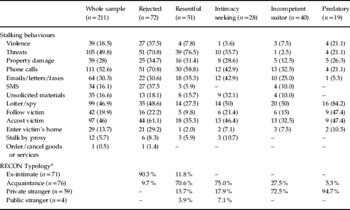
The average duration of stalking episodes was 58.3 weeks (s.d.=104.5), with a range of less than 1 week to 832 weeks (median=14, mode=4). The mean number of harassment methods was 3.4 (s.d.=1.8). Details of specific stalking behaviours and their frequency are shown in Table 1.
Frequency (%) and nature of stalking behaviours and prior relationship to victim by motivational type

SMS, Short Message Service.
a ‘RElationship and CONtext’-based stalker typology proposed by Mohandie et al. (Reference Mohandie, Meloy, Green-McGowan and Williams2006).
Prior stalking, prior violence and prior threats
A total of 65 stalkers (31%) were known to have previously stalked, 19 against the same victim. A total of 44 (21%) had previously uttered threats to harm or kill, and 86 (41%) had been violent prior to the current stalking episode.
Predictors of violence
Violence occurred in 39 cases (19%), 11 meeting the additional criteria for serious violence. Twenty were violent once, eight twice, four three times, and the three remaining were violent four, five and six times respectively. The latter three were Predatory stalkers who stalked and sexually assaulted multiple victims. In 14 cases violence was extremely minor, involving a combination of hostile touching, pushing or restraining victims. In a further 22 cases sexual touching, punching or kicking was present (in four cases constituting serious violence), and 16 cases went so far as attacks with a weapon or vehicle, sexual assault, attempted murder and armed sieges (many stalkers used multiple types of violence). In 10 cases, serious violence was committed by a Rejected ex-intimate stalker (accounting for 35% of all violence by Rejected stalkers); the other involved a Predatory stalker. In a further four cases serious violence was allayed by successful management or fortuitous circumstance. One Resentful stalker was arrested at the victim's home, armed with a knife and expressing homicidal intent. Similarly, an Intimacy-Seeking stalker was arrested inside the victim's home armed with a knife and rope. Another Resentful stalker followed up a physical attack on the victim by setting his home and car alight (in the mistaken belief that the victim was inside), and, in a final case, a Rejected stalker tried to hire someone to execute the victim. Fortunately, the person he attempted to employ was an undercover police officer.
As serious violence was relatively uncommon across the sample, violence was analysed as a single variable to avoid problems with low base rates. In 77% of cases violence was accompanied by threats. Of threats, 63% were uttered separately and prior to any violence, making them useful potential predictors for inclusion in the multivariate models. Conversely, examination of the timing of approach behaviours showed that in 60% to 90% of cases (depending on behaviour) they immediately preceded violent behaviour, e.g. the stalker followed the victim home, broke in and became violent in an unbroken sequence. This vitiated their predictive value and approach behaviours were excluded from subsequent multivariate analysesFootnote 2.
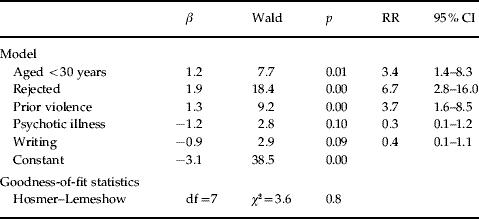
The full multiple logistic regression model predicting violence amongst stalkers is shown in Table 2. Seven predictors were entered into the model and a final combination of Rejected motive, age under 30 years, prior violence, and the absence of psychosis or writing to the victim best predicted violence. Subsequent ROC curve analysis showed that this model had a good level of predictive accuracy [AUC=0.83, 95% confidence interval (CI) 0.77–0.90] which was not markedly reduced by conversion to an improper model (AUC=0.81, 95% CI 0.74–0.88). Using ex-intimate relationship rather than Rejected motivation, an identical model with similar predictive accuracy was identified (proper model AUC=0.83, 95% CI 0.76–0.90 and improper model AUC=0.81, 95% CI 0.73–0.88).
Logistic regression model predicting violence amongst all stalkers

OR, Odds ratio; CI, confidence interval; df, degrees of freedom.
These analyses showed a Rejected stalking motivation to be one of the strongest predictors of stalking violence, but did not help to determine which Rejected stalkers were more likely to be violent. The sample was subdivided into Rejected stalkers and other motivational types to examine the primary research question (one stalker was excluded as motivational type was ambiguous).
Violence amongst Rejected stalkers
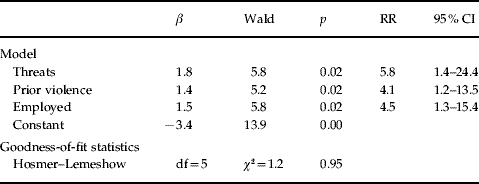
A total of 27 of the 72 Rejected stalkers were violent. Four potential predictors were entered into the multivariate equation and the final combination of previous violence, threats, and employment at the time of the stalking episode best predicted stalking violence (shown in Table 3). The full model AUC was 0.76 (95% CI 0.65–0.87), which was not reduced by conversion to an improper model (AUC=0.76, 95% CI 0.64–0.87).
Logistic regression model predicting violence amongst the Rejected stalkers

OR, Odds ratio; CI, Confidence interval; df, degrees of freedom.
As serious violence was relatively common amongst Rejected stalkers, these cases were removed and analyses repeated to identify whether serious violence was negatively affecting the predictive value of the model. The same model was identified and details are shown in Table 4. The ROC analysis of the full model resulted in an AUC of 0.77 (95% CI 0.64–0.90), and of the improper model an AUC of 0.75 (95% CI 0.60–0.88).
Logistic regression model predicting violence amongst the Rejected stalkers, excluding cases of serious violence

OR, Odds ratio; CI, Confidence interval; df, degrees of freedom.
The sample was also divided using ex-intimate relationship to compare the predictive utility of the two typologies. Of the 71 ex-intimate stalkers, 27 were violent. The multivariate model included only prior violence and threats (employment was excluded due to correlation with prior violence [r=0.4]). Receiver operating curves showed moderate levels of predictive accuracy for the proper model (AUC=0.68, 95% CI 0.55–0.81) and the improper model (AUC=0.68, 95% CI 0.55–0.80).
Violence amongst other motivational types
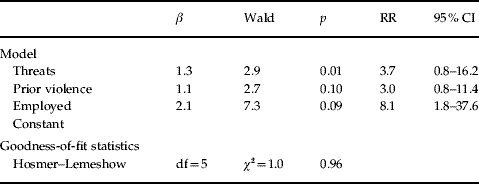
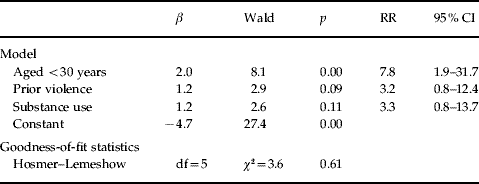
Violence occurred in 12 of 138 stalking episodes instigated by a stalker with a motivation other than rejection (including one case of serious violence). Approach behaviours were excluded from multivariate analyses due to co-occurrence with violence. Writing to the victim was significantly negatively associated with violence (χ2=5.7, p=0.02), but as no stalkers who wrote were also violent the variable was excluded from the logistic regression. The other three variables with significant relationships to violence were included in the final multivariate model shown in Table 5 (age under 30 years, previous violence, and substance use at the time of the stalking episode). Calculation of a ROC curve showed good predictive accuracy (AUC=0.82, 95% CI 0.67–0.97), which was not markedly reduced by conversion to an improper model (AUC=0.80, 95% CI 0.66–0.95).
Logistic regression model predicting violence amongst stalkers other than the Rejected

OR, Odds ratio; CI, Confidence interval; df, degrees of freedom.
Selection of the 140 stalkers with either a stranger and acquaintance relationship to the victim isolated the same 12 cases of violence and an identical multivariate model with comparable predictive accuracy (proper model AUC=0.81, 95% CI 0.67–0.96, improper model AUC=0.78, 95% CI 0.63–0.94).
Threats and stalking violence
Half of all stalkers made threats to harm or kill the victim or a third party. Of the 105 stalkers who uttered threats, 30 (29%) were also violent and threat(s) preceded violence in 63% of cases. In eight cases threats were uttered at the time of violence, and in three cases the timing of the threat could not be reliably determined.
Table 1 shows the distribution of threats by stalker motivation type. Almost half of all threats were uttered by Rejected stalkers. Examination of the frequency of threats and violence showed that while only one in 10 threats uttered by stalkers of other motivations were acted upon (six of 53), almost one in two Rejected stalkers who threatened were also violent (24 of 52). Conversely, 64% of violent stalkers with other motivations did not make threats, but the same was true for only 12% of Rejected stalkers.
Discussion
This study indicated that risk factors for stalking violence differ with stalker motivation and relationship to the victim. Largely echoing findings from earlier studies, examining stalkers as a homogeneous group revealed that young ex-intimate partners who did not suffer from psychosis, had histories of violence, and did not write to the victim were most likely to be violent during a stalking campaign. However, this study also clearly showed that high- and low-risk Rejected ex-intimate stalkers and high- and low-risk stalkers from other motivational groups could be identified by analysing these groups separately. Thus, risk assessment (and management) of stalking violence could be improved by ascertaining the stalker's motivation and then examining risk factors specific to that motivational type.
Rejected ex-intimates who present with a history of violent behaviour and who have made threats present the greatest risk of violence. This may reflect underlying difficulties managing anger or coping with change in relationships, which could contribute to affectively driven, reactive, violence. Violent Rejected ex-intimate stalkers did not have more problematic personality traits or disorders, nor Axis I disorders. Maintaining employment during the stalking episode increased the risk of violence amongst rejected stalkers. This is surprising given that employment has traditionally been associated with a lower relative risk of violence, being thought of as a proxy for greater social integration and interpersonal skills, and requires further investigation.
For stalkers of other motivational types, predictors of stalking violence were similar to violence risk factors in the general offender population, including previous violence, substance use, and youth. Sending written missives may have been associated with a lowered risk of violence because face-to-face contact was less common amongst those who communicated at a distance. These findings are preliminary, but it is possible that violence for stalkers with motivations other than rejection has less to do with explicit anger towards the victim, and more to do with contextual factors and disinhibition (associated with substance use and youth). While the results may be an artefact of the low base rate of violence amongst these stalkers, violence occurred or was narrowly averted in 10% of cases, highlighting the fact that these stalkers should not be discounted when conducting violence risk assessments.
Threats and violence
Threats were clearly related to subsequent violence amongst Rejected ex-intimates and equally clearly unrelated to subsequent violence amongst other stalker types. This is consistent with the results of Palarea et al. (Reference Palarea, Zona, Lane and Langhinrichsen-Rohling1999), and suggests that the initial confusion over the relationship between threats and violence in the stalking literature may have been a result of analysing stalkers as a homogeneous group, resulting in negligible statistical associations. While it is now generally accepted that threats should be considered risk factors for violence (Meloy, Reference Meloy2007), these results indicate that clinicians should be particularly wary when the threatener is a Rejected ex-intimate of the victim (Resnick, Reference Resnick and Pinals2007). Recent research also suggests that stalkers who utter threats should also be considered at increased risk to victims other than the threat recipient and to themselves, highlighting the need for assertive management of this particular group (Warren et al. Reference Warren, Mullen, Thomas, Ogloff and Burgess2008).
Approach behaviours
While approach behaviours are routinely examined in studies of threats and attacks on public figures (Meloy et al. Reference Meloy, James, Farnham, Mullen, Pathé, Darnley and Preston2004), approaches have rarely been studied in more typical stalking situations. Where they are examined, few have differentiated between approaches accompanying violence and those occurring independently (Palarea et al. Reference Palarea, Zona, Lane and Langhinrichsen-Rohling1999). This study shows that most approaches did not lead to violence and when a stalker both approached and was violent, the behaviours were frequently concurrent. In these cases, high levels of angry arousal typically precipitated and sustained a continuous chain of increasingly proximate stalking behaviours that culminated in violence. Therefore, approach behaviours appear to have little predictive value and their role in risk assessment is largely restricted to victim safety planning and risk management behaviours. Where other risk factors are present (i.e. Rejected ex-intimates, threats, and substance misuse), clinicians should work with victims to identify action plans if they are followed or accosted by the stalker.
Psychosis and violence
The oft-cited negative relationship between stalking violence and psychosis is refuted when motivational type is considered. The Rejected ex-intimates were rarely diagnosed with psychotic disorders. Once they were removed from the analysis, there was no difference in the frequency of violence by psychotic versus non-psychotic stalkers. This requires replication, but clinicians should not assume that the presence of psychosis is associated with lowered risk of stalking violence.
Relationship and motivation
There was overlap between categories when classifying stalkers using motivation or relationship, but the two typologies were not interchangeable. Nonetheless, there were only marginal differences in accuracy when predicting violence. Given the apparent empirical equivalence of the two typologies, the choice of classification scheme should vary according to the needs of the user. The motivational typology will assist clinicians devising management and intervention strategies (Pinals, Reference Pinals and Pinals2007; MacKenzie et al. Reference MacKenzie, Mullen, Ogloff, McEwan and James2008), while relationship type in conjunction with other easily discernable factors could be a simple way to judge risk when the nuances of a stalking situation cannot be assessed.
Limitations
Although the study's pseudo-prospective design is a significant strength, it also had some inherent limitations. Information was drawn directly from participants, but weeks or months had often passed since the stalking behaviours leading to referral. Participants' recall may have been coloured in cases where assessment would impact on sentencing or parole conditions. Subjects were likely to be more disordered than individuals who stalk without attracting police or psychiatric attention. Nonetheless, the sample reflects those most likely to be subject to a clinical risk assessment, making its composition a potential strength.
The accuracy of the multivariate models may be overly optimistic as the logistic regression equations were developed using, and then applied to, the same subjects. The model specific to stalkers with motivations other than rejection may be particularly vulnerable to over-fitting due to the low base rate of violence in that subset of the sample. Therefore, these data can support only increased concern and attention in risk management planning, not a label of high or low risk for individual stalkers. Even so, the statistical methodology attempted to overcome some of the limitations of a traditional multiple logistic regression approach. Separating subgroups of individuals with differing probabilities of stalking violence revealed different predictive models for Rejected ex-intimates and others. Conversion of proper regression models into improper models also makes them relatively simple to apply in a clinical setting. Presenting the data in this manner will hopefully make it easier to integrate the results into future risk assessments, although we advise clinicians to exercise caution and clinical sense in applying these models in practice, particularly as they have not yet been cross-validated.
Operational definitions of stalking behaviours and stalking violence were included to increase the likelihood that future studies of stalkers will use comparable definitions. The stalking literature has been plagued by inconsistent definitions of what constitutes stalking, violence and serious violence. Hopefully, future research will use similar definitions, allowing pooling of data across true prospective studies of stalking violence and other areas of stalking risk, such as persistence. Similarly, while this article presents information using the Mullen et al. (Reference Mullen, Pathé, Purcell and Stuart1999) motivational typology, stalkers were also categorized using a modified version of the relationship typology proposed by Mohandie et al. (Reference Mohandie, Meloy, Green-McGowan and Williams2006). Coding participants according to multiple typologies provides scope for appraising the utility of each when making and evaluating risk assessments and management strategies.
The identified models provide a starting point for the development of structured professional guidelines specific to violence in stalking situationsFootnote 3. Structured professional judgement-based risk assessments are flexible and sensitive to change, essential in stalking situations where risk state can fluctuate rapidly. They allow for the consideration of idiographic and situational factors particularly important in the stalking context where the nature of the relationship between victim and perpetrator, the stalker's motivation and possible psychopathology, the victim's response, and the legal and mental health context all play a role in facilitating or preventing violence (Dawes et al. Reference Dawes, Faust and Meehl1989; Mullen et al. Reference Mullen, Mackenzie, Ogloff, Pathé, McEwan and Purcell2006).
Identification of potential risk factors for stalking violence is necessary to assist clinicians faced with stalking situations, but over-reliance on largely unchangeable risk factors, like many in this study, will result in inadequate assessments of risk. We need to improve our understanding of acute causal factors such as fluctuating anger and cognitive distortions which are potentially associated with stalking violence. As James & Farnham (Reference James and Farnham2003) note, we have limited understanding of the role of situational factors in violent behaviour, factors which may be particularly important in stalking situations where context and relationship are so integral to violence. Development of effective stalking risk assessment guidelines will be reliant on research in these areas.
Acknowledgements
The authors thank Michael Davis for his assistance with statistical analyses and Dr David James for his helpful review on an earlier draft of this article. This research was supported by a Monash Graduate Scholarship.
Declaration of Interest
None.