Nuclear power has become increasingly appealing as an alternative energy source due to growing energy demands, worsening energy shortages, and rising concerns about climate change. In the Middle East, for example, twelve countries are considering building nuclear power plants as part of a movement commonly known as the ‘nuclear renaissance.’Footnote 1 At the same time, there are serious concerns that nuclear programs could make countries more vulnerable to nuclear and radiological (NR) terrorism. Revelations that Al-Qaeda planned to fly an airplane into an American nuclear power plant as part of the 9/11 attacks underscored that nuclear programs may provide terrorists with inviting targets of opportunity. Many also fear that nuclear plants will increase the availability of NR materials terrorists can use for violent attacks, especially if additional countries join the nuclear energy club in the coming years.Footnote 2
Does the diffusion of nuclear programs encourage NR terrorism? While terrorists have yet to stage a successful catastrophic nuclear attack resulting in mass destruction or casualties, a number of noncatastrophic NR terrorist incidents have occurred in recent years. We address the connection between nuclear programs and NR terrorism by analyzing these noncatastrophic events. Given the grave and sensational nature of NR terrorism, even small scale episodes often intimidate target audiences and impose economic, social, and psychological costs on target governments. For example, Chechen militants planted a mine packed with radioactive materials in Moscow's popular Izmailovsky Park as part of their campaign against Russia in 1995. This event incited public fear by highlighting the group's ability to acquire NR materials and raising doubts about the government's ability to secure its expansive nuclear infrastructure. We see similar dynamics in other cases in large part because the media sensationalizes such stories and individuals routinely misunderstand the risks associated with nuclear technologies and materials.Footnote 3 Indeed, citizens and governments often exhibit more fearful reactions toward nuclear-related incidents than one would expect based on scientific facts.Footnote 4 It is thus important to understand why noncatastrophic incidents occur even if they have not resulted in many human casualties.
An analysis of these cases may also shed light on catastrophic NR terrorism involving nuclear weapons or ‘dirty bombs.’ Policymakers in Great Britain, the United States, and elsewhere have repeatedly said that catastrophic NR terrorism represents one of the greatest threats to global security. Yet, very few studies have addressed this issue empirically because no large-scale NR terrorist attacks have occurred. Recognizing that most of the events that we study are different from those government officials have in mind when they talk about NR terrorism, we think it is fruitful to leverage available data on the types of cases that have occurred to understand one of the world's most important contemporary security challenges. This requires circumspection on our part when interpreting evidence, but as we will discuss in the conclusion, our findings have some implications for catastrophic NR terrorism.
This article advances two main arguments. First, we offer a systematic account of why a country's vulnerability to NR terrorism grows as the size of its nuclear program increases. Our rationale is rooted in the strategic incentives and constraints that terrorist groups face. The presence of expansive nuclear infrastructure facilitates terrorists’ efforts to steal or acquire nuclear and radiological materials, increases the targets open to attack, and amplifies the potential economic and social-psychological consequences of related terrorist attacks. Nuclear programs, therefore, influence both the incentives and constraints for NR terrorism. Second, we argue that countries can reduce the likelihood of NR terrorism by improving their nuclear security and reducing corruption. Since both measures reduce the probability of success of NR terrorism, they may deter terrorists from taking advantage of a state's nuclear infrastructure.
To test these arguments, we build an original dataset of NR terrorist incidents from 1992 to 2006. Statistical tests employing these new data in a sample of 152 countries show that terrorists are more likely to commit NR terrorist acts against states with larger nuclear programs. However, consistent with our theoretical expectations, the effect of nuclear programs on NR terrorism declines as countries improve the security of their nuclear facilities and reduce corruption. These findings hold when we conduct a series of robustness checks, including removing Russia (the country that experienced the most NR terrorism) from the sample, limiting our analysis to the sixty-five states that have nuclear programs, and conducting a cross-sectional analysis with temporally aggregated data.
The rest of the article proceeds in five sections. First, we briefly review the existing literature, articulate the theoretical reasons why nuclear programs may lead to more NR terrorist incidents, and discuss the mediating effects of nuclear security and corruption. Second, we specify our operational definition of NR terrorism and discuss our data collection in detail. Third, we explain our research design. The fourth section presents our statistical findings, and the final section concludes by highlighting the implications of our analysis.
Why Nuclear Programs Raise The Likelihood Of Nuclear And Radiological Terrorism
For violent extremist actors, the choice between employing conventional and nonconventional forms of terrorism involves tradeoffs. NR terrorism is typically much more challenging than conventional terrorism, requiring longer planning, larger amounts of organizational and financial resources, more highly trained personnel, and greater risks.Footnote 5 Generally, obtaining nuclear or radiological materials is much more difficult than obtaining conventional weapons or explosives; and even when countries have poor nuclear security, nuclear facilities still tend to be better protected than other ‘soft’ targets that terrorists could attack instead. In light of these challenges, it is not surprising that conventional terrorist attacks have a far better track record of success compared to chemical, biological, radiological, and nuclear (CBRN) terrorist attacks.Footnote 6 Yet, NR terrorism also has the potential to inflict much more damage and disruption than any other type of terrorism, elicit more widespread fear and insecurity far beyond its immediate targets, and generate greater publicity for its perpetrators.Footnote 7
A fairly significant body of existing research uses qualitative methods to explore whether terrorists have the ability and interest to engage in NR terrorism.Footnote 8 More recently, quantitative studies have analyzed the broader causes of CBRN terrorism, studying NR terrorism together with chemical and biological terrorism.Footnote 9 However, neither strand of research systematically evaluates the ways that nuclear programs might exacerbate the risks of terrorist violence.Footnote 10 Meanwhile, there is a large body of literature on the strategic effects of nuclear programs.Footnote 11 Yet this research focuses mostly on whether nuclear energy affects nuclear proliferation or interstate conflict, largely ignoring the consequences of nuclear power for terrorist violence. In this section we develop a theory that explains cross-national variation in NR terrorism, focusing on how nuclear programs affect terrorists’ incentives and opportunities to commit these types of attacks.
Our argument starts with the typical premise that terrorists make rational, strategic decisions regarding whether to launch an attack and what tactics to employ.Footnote 12 Given the inherent challenges in carrying out NR terrorist attacks, we would only expect terrorists to pursue this strategy when the potential payoffs exceed the risks and costs they entail. Thus, as the costs of employing NR terrorism rise, terrorists will prefer to substitute other tactics in its place. In addition, as the benefits of employing NR terrorism grow larger, terrorists will be more inclined to use it. All else being equal, terrorists should be more likely to engage in NR terrorism when its costs decline or benefits increase.
The presence and size of civilian nuclear infrastructure affects terrorist groups’ cost–benefit calculus in several respects. First, as many experts argue, gaining access to the NR materials represents the most important hurdle for terrorists seeking to engage in NR terrorism. Civilian nuclear programs increase the availability of fissile materials (e.g., plutonium or highly enriched uranium (HEU)) and radioactive materials (e.g., Cesium-137 and Strontium-90), all of which could be used in NR terror attacks.Footnote 13 Many observers argue that these materials are widely available in countries with nuclear programs and are sometimes poorly guarded.Footnote 14
Therefore, rational and cost-sensitive terrorists will be tempted to either steal NR materials or purchase them illicitly when they are cheap and/or readily available. Since terrorists have significantly greater access to nuclear and radiological materials in countries with larger civil nuclear programs, the probability that they will employ NR terrorism in these states increases. Although terrorists could acquire NR materials in one country and use them in another, it is easier to use the materials in the country in which they have been acquired. Transporting NR materials across borders involves additional costs and raises the likelihood of interception.Footnote 15 Groups are cognizant of this consideration and often look for NR materials in the country they wish to attack.
Several notable cases support this expectation. Chechen militants have reportedly attempted to obtain NR materials within Russia more often than from other countries. In January 2000 they acquired radioactive materials from a nuclear waste plant in Grozny and stole radioactive materials from a nuclear power station in the region of Rostov between July 2001 and July 2002.Footnote 16 Similarly, in July 2002 the Real IRA reportedly attempted to steal plutonium from the Sellafield nuclear power station in the United Kingdom after discovering the difficulties of acquiring fissile material from distant locations.Footnote 17
Second, the presence and size of a civilian nuclear program in a country provides additional incentives for terrorist groups to employ NR terrorism. As noted earlier, NR terrorist incidents are consequential even if they do not inflict substantial human casualties. Indeed, Brian Jenkins noted this almost forty years ago when he concluded that, ‘A well-publicized terrorist attack on a civilian nuclear facility, even if the terrorists failed in their intended mission, could be almost as alarming to the world as a terrorist success.’Footnote 18 NR terrorism can be an attractive tactic to some terrorists because it is capable of generating widespread fear, undermining public support for civilian nuclear energy, sapping public confidence in governments’ competence in ensuring security, and forcing governments to commit vast resources to guarding their nuclear infrastructures.Footnote 19 These costs will be much higher in countries with large nuclear programs than in those without them, increasing terrorist groups’ incentives to target the former states.
This logic is borne out by the terrorist campaign orchestrated by Chechen rebels during the 1990s. While the radioactive mine they planted in Moscow's Izmailovsky Park was their most high-profile incident, Chechen rebels planted another dirty bomb outside Grozny in 1998 and they repeatedly threatened to use nuclear and radiological weapons against the Russian government. This campaign aroused significant fear among the public and forced Russia's cash-strapped government to devote considerable resources to improving the security of its nuclear installations and radiological materials storage facilities.Footnote 20 Given the difficulty of successfully launching NR attacks, we should find that terrorist groups are more likely to employ this tactic when the benefits are especially high. Hence, we should find NR terrorism being used much more frequently in countries with extensive nuclear programs than in those without them.
Third, nuclear facilities present targets of opportunity for terrorist groups.Footnote 21 Attacking structures that produce or house radioactive materials, such as nuclear power plants, could cause large-scale radiological contamination or, at least, create widespread panic among the public.Footnote 22 Such attacks may appeal to groups seeking to cause mass casualties or generate publicity. An unidentified Chechen rebel field commander underscored the perception that nuclear power plants are inviting targets of opportunity when he said, ‘Take nuclear power stations – Chernobyl. Blow one up and the damage lasts for 300 years.’Footnote 23 Chechen rebels issued a number of public threats to bomb nuclear power plants in Russia throughout the 1990s. Numerous other groups have targeted nuclear plants. For example, from 1977 to 1981, Basque terrorists carried out a sustained terrorist campaign against a Spanish nuclear power plant. Over that period, they attacked the facility four times, killing four of its workers and causing damage worth over $21 million.Footnote 24 In 1982, environmental activists with ties to French and German terrorist groups fired five rocket-propelled grenades at the Superphénix fast breeder reactor, which was under construction in France.Footnote 25 More recent terrorist interest in targeting nuclear facilities is evidenced by the revelations that a suspected Al-Qaeda agent worked in five US nuclear plants from 2002 to 2008.
The preceding discussion leads to our first hypothesis on the connection between nuclear programs and NR terrorism:
hypothesis 1: The probability of being targeted by NR terrorism increases as the size of a country's nuclear program expands.
Mitigating the Nuclear and Radiological Terrorism Risk of Nuclear Programs
While nuclear programs lower the costs of and raise the incentives for engaging in NR terrorism, not all countries with nuclear programs are equally vulnerable. We argue that two factors mediate the effect of nuclear programs on NR terrorism: nuclear security and corruption. Improving nuclear security and reducing corruption lower the NR terrorism risk of nuclear programs.
Nuclear security could dampen the relationship between NR terrorism and nuclear programs for two main reasons. First, because terrorists are strategic actors, they respond to counterterrorism policies instituted by governments. Defensive measures that states adopt to protect themselves from one type of attack cause terrorists to switch to other forms of violence that are less costly, a process that is known in the terrorism literature as a ‘substitution effect.’Footnote 26 Landes, for instance, finds that the installation of metal detectors in airports reduced the number of skyjackings in the United States by raising the costs of this particular strategy.Footnote 27 This evidence is also consistent with the notion that ‘deterrence by denial’ can influence the behavior of non-state actors.Footnote 28 When it comes to NR terrorism, the most effective way to deter extremists by denial is to ‘harden’ nuclear facilities. Securing facilities where nuclear and radiological materials are housed makes it more difficult for groups to steal or otherwise acquire what they need for an attack. It is also more difficult for terrorists to sabotage better secured nuclear plants, particularly if they hope to attack a facility from the outside.
Second, even if effective nuclear security measures do not deter extremists from attempting NR terrorism, they should lower the likelihood of attack success. All else equal, it would be more difficult for terrorists to steal nuclear materials in a country with a strong commitment to nuclear security (such as Britain or Switzerland) compared to a state with relatively lax nuclear security measures (such as Pakistan or Vietnam). This leads to our second testable hypothesis:
hypothesis 2: The effect of nuclear programs on the risk of NR terrorism declines as a country's nuclear security improves.
The level of corruption in a country may also influence its susceptibility to NR terrorism. Terrorists may find it more difficult to acquire or steal nuclear materials by bribing relevant politicians and bureaucrats in ‘honest’ regimes. In contrast, as Ivanova and Sandler argue, corruption makes it easier for terrorist groups to acquire illicit materials and facilitates CBRN terrorist attacks.Footnote 29 Nuclear security experts have also expressed significant concerns regarding the vulnerabilities that corruption creates in safeguarding nuclear materials and facilities.Footnote 30 Russia, in particular, has been widely singled out as a notorious case. Its history of widespread corruption, combined with its expansive nuclear infrastructure, helped create a major security liability for the country with respect to NR terrorism.Footnote 31 Thus, in corrupt countries, terrorist groups may find it easier to obtain radiological and nuclear materials and secure insider assistance to attack their nuclear facilities.
hypothesis 3: The effect of nuclear programs on the risk of NR terrorism declines as the level of corruption in a country decreases.
Defining and Operationalizing Non-Catastrophic Nuclear And Radiological Terrorism
While the notion of terrorism is controversial, a survey of 109 definitions of terrorism suggests that they share five common elements: threats, violence/force, political objectives, fear or terror, and intended psychological effects.Footnote 32 In this study, we adopt a definition of NR terrorism that incorporates these components. NR terrorist incidents are those in which politically motivated nonstate actors target noncombatant individuals and/or properties with intimidation or violence involving nuclear or radiological materials to influence some larger audience. NR terrorist acts take two main forms: the use of nuclear or radiological materials or the targeting of nuclear facilities.Footnote 33 Consistent with a standard practice in the terrorism literature,Footnote 34 our definition includes the use of violence as well as the threat to use it.
Based on this definition, we identified all known cases in which states were targeted with NR terrorism from 1992 to 2006. These incidents were generally significant even though none of them resulted in substantial human casualties or property destruction. For example, during an industrial strike in December 1995, French workers attempted to blackmail the government by pouring salt into the cooling system of a nuclear power plant. In March 1992, a group in Moldova stole radiological materials from a facility and threatened to detonate a ‘dirty bomb’ unless the government brought an end to the War of Transnistria (fighting broke out in 1990 when Transnistria attempted to gain independence from Moldova). And in 2005, terrorists sent uranium-laced letters to several Belgian government ministries to protest against George W. Bush's visit to Brussels. Similar incidents occurred in a variety of other countries, a point that we will revisit later in this section.
We also collected data on NR terrorist plots during this time period. The successful planning and execution of an NR terrorist attack is a complex and challenging undertaking that can face disruptions at any number of stages.Footnote 35 Therefore, it is not surprising that terrorists often initiate plans to engage in NR terrorist attacks that do not materialize. Many plots involved attempts to cause mass destruction or casualties. Indeed, a large number of the cases we identified included plans to damage nuclear power plants, detonate dirty bombs, or acquire and use nuclear weapons.Footnote 36
Collecting data on plots is useful for several reasons. First, groups can gain significant notoriety in the international media and force governments to respond to a potential threat simply by planning NR terrorist attacks.Footnote 37 Al-Qaeda leveraged the media attention it received from a series of failed plots to gain recognition as one of the world's leading NR terrorism threats – despite not having ever successfully conducted an attack of this nature.Footnote 38 Via its plots and threats, Al-Qaeda was able to exploit American fears over the vulnerability of its nuclear infrastructure, driving the United States to spend billions of dollars on nuclear security upgrades. Second, data on plots allow us to have a more complete picture of terrorist interest in employing NR terrorism. Conversely, neglecting plots could bias downward our assessment of terrorists’ true level of interest in this tactic. Third, analyzing plots allows us to gain additional leverage on our research question because planned acts of NR terrorism are more common than actual attacks.Footnote 39
We recognize, however, that there are some important limitations associated with data on terrorist plots. The planning of NR terrorism may be unobserved if plots are not disrupted by governments or reported in the media.Footnote 40 Moreover, even when attacks or potential attacks are reported, planning may have begun years earlier, making it difficult to identify the timing of plots accurately. With these caveats in mind, it is still useful to study the effect of nuclear programs on plots as a robustness check. If our argument is correct, we should observe an effect of nuclear program size on NR terrorism plots as well as on threats and attacks.
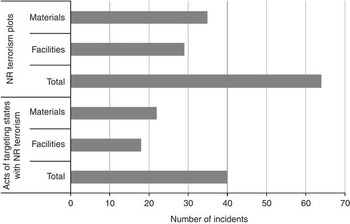
To construct our NR terrorism dataset, we consulted a variety of primary and secondary sources; these are listed in our web appendix along with descriptions of each case.Footnote 41Figure 1 summarizes the dataset. As the figure shows, we identified forty cases in which countries were targeted with NR terrorism.Footnote 42 Russia was targeted more frequently than any other state, but seventeen different countries experienced NR terrorism from 1992 to 2006. Of the incidents in our dataset, eighteen (45 percent) were attacks or public threats against nuclear facilities. The other twenty-two cases involved the use or threatened use of NR materials in attacks. We also identified sixty-four plots in which groups planned to target a country with NR terrorism.Footnote 43 Those plots targeted twenty-one different countries, indicating that NR terrorism is a potential problem for many states. The slight majority of plots involved plans to disperse nuclear or radiological materials, either through dirty bombs or improvised nuclear devices. Plots to sabotage nuclear plants were slightly less common during the period we study, but they occurred on a number of occasions.
NR terrorism incidents and plots, 1992–2006

Research Design
To test and estimate the effects of nuclear programs on non-catastrophic NR terrorism, we adopt a time-series cross-sectional data structure, including 152 countries from 1992 to 2006.Footnote 44 The unit of analysis is the country-year.
Dependent Variable
Based on our new dataset on NR terrorist incidents, the dependent variable (NR Terror) is coded 1 if a country is targeted with an NR terrorist act in a given year and 0 otherwise. As noted above, we also construct an alternative dependent variable based on plots to assess the sensitivity of our findings. NR terrorist incidents occur in 1.5 percent of the country-year observations in our sample (we will address the rare event nature of the dependent variable in our robustness tests).
Independent Variables
As a proxy for the size of a country's nuclear program, we measure the total number of operational research and power reactors in a state in a given year (Nuclear Program Size). We logarithmically transform this variable to address its skewed distribution.Footnote 45 Research reactors and nuclear power plants are included in our measure of nuclear programs because both types of facilities could raise the risk of NR terrorism.Footnote 46 Data on reactors are collected from the International Atomic Energy Agency.Footnote 47 Sixty-five of the countries in our sample operate at least one nuclear facility.
Our ability to measure a country's commitment to nuclear security is constrained by data limitations. There are no existing time-series cross-sectional datasets on the level of nuclear security in a country.Footnote 48 Therefore, we operationalize a state's commitment to nuclear security based on whether it ratified the 1980 Convention on the Physical Protection of Nuclear Material (CPPNM). The CPPNM is the only internationally legally binding measure related to the physical protection of nuclear materials. The treaty requires states to meet explicit physical protection standards for the international shipment of nuclear materials. It also obligates countries to share information on missing nuclear materials and to criminalize behaviors such as stealing nuclear materials or threatening to misuse them to harm the public. Although CPPNM ratification only captures the extent of countries’ nuclear security levels to a limited degree,Footnote 49 countries that ratify it should generally have stronger commitments to nuclear security than countries that do not. Lacking any viable alternative measures, the CPPNM ratification constitutes the best available means of testing our nuclear security hypothesis. The variable Nuclear Security Commitment is coded 1 if a state has ratified the CPPNM in a given year and 0 if not. Forty-four percent of the country-year observations in our sample are coded 1, indicating that it is slightly more common for states to refrain from ratifying the CPPNM than to commit to the treaty during the period we study.
We operationalize corruption using a measure from the Political Risk Services Group's International Country Risk Guide (ICRG) (Political Risk Services (PRS) Group 2006). The ICRG data are widely employed to measure corruption in political scienceFootnote 50 and are used in other quantitative studies of terrorism.Footnote 51 This measure is preferable to other indices because it has more complete coverage during our period of study, but our findings are robust if alternative indicators of corruption are used. Honesty ranges from 0 to 6 with low values indicating more corruption.
We generate two interaction terms – Nuclear Program Size × Nuclear Security Commitment and Nuclear Program Size × Honesty – to evaluate whether the effect of nuclear programs on NR terrorism is conditional on a state's commitment to nuclear security or the level of corruption in a country.
Control Variables
Following previous research, we control for various country characteristics that could affect a state's vulnerability to NR terrorism. Many have argued that a country's level of economic development affects terrorism, although the direction of this relationship is debated.Footnote 52 With specific respect to CBRN terrorism, Ivanova and Sandler found a positive relationship between development and violence. We control for development with a state's GDP Per Capita.Footnote 53
A country's regime type is thought to influence the amount of domestic and transnational terrorism it experiences.Footnote 54 On the one hand, democracies provide opportunities for citizens to redress their grievances and resolve disputes through compromise, reducing their incentives to engage in terrorist acts against the government. On the other hand, democracies may be more prone to experience terrorist attacks than autocracies because constraints on government power make it harder for them to identify, capture, prosecute, and punish terrorists. Terrorists may also be tempted to target democratic regimes more frequently because press freedom allows them to gain greater publicity when they attack. Prior studies that have examined the relationship between regime type and CBRN terrorism have produced mixed empirical findings. Whereas Ivanova and Sandler find that democratic states experience CBRN terrorism more frequently than authoritarian ones, Asal, Ackerman, and Rethemeyer report a statistically insignificant relationship between regime type and CBRN terrorism.Footnote 55 To control for the effect of regime type, we use the Polity IV database.Footnote 56 The variable Democracy is coded 1 if a state scores at least 7 on the Polity composite indicator of regime type and 0 otherwise.Footnote 57
The most powerful states in the international system may be more likely to experience terrorism than other relatively weaker countries.Footnote 58 Major powers tend to be more active in international politics than other countries, such that they have additional opportunities to generate grievances that could motivate groups to commit acts of NR terrorism. Al-Qaeda's NR terrorist plots against the United States, for example, were launched partially to precipitate the withdrawal of American military forces from the Muslim holy lands. Major Power is a dichotomous variable that is coded 1 if a country is a major power based on the standard Correlates of War classifications and 0 otherwise.
Military conflicts, particularly civil wars, could increase grievances and lead to terrorist attacks.Footnote 59 They could also make countries’ nuclear infrastructure more vulnerable to infiltration, sabotage, or attack. For instance, Chechen rebels used NR terrorism against Russia during two ongoing civil wars: the First Chechen War (1994–96) and the Second Chechen War (1999–2009). Contrary to this perspective, though, Asal, Ackerman, and Rethemeyer find that the longer countries are engaged in internal armed conflicts, the fewer CBRN terrorist attacks they are likely to experience.Footnote 60 To test for the effects of ongoing civil wars, we include a dummy variable (Civil Conflict) that is coded 1 if a country is involved in civil conflict in a year and 0 otherwise. We code this variable based on the UCDP/PRIO Armed Conflict Dataset.Footnote 61
Finally, following the advice of Carter and Signorino, we control for possible temporal dependence in the data by including a variable that counts the number of years since a state has experienced an act of NR terrorism (Time) together with its square (Time Squared) and its cube (Time Cubed).Footnote 62
Method
Since the dependent variable is dichotomous, we use probit to estimate the effects the independent variables have on the probability that a country will be targeted with NR terrorism in a year. Robust standard errors adjusted for clustering over countries are estimated, which are robust to both heteroskedasticity and a general type of correlation within countries.Footnote 63
Findings
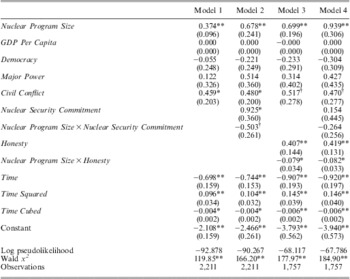
Table 1 presents the results from four statistical models. The baseline model (Model 1) shows that Nuclear Program Size is statistically associated with NR Terror in the positive direction (p < 0.01). The larger a country's nuclear program, the more likely it is to suffer NR terrorism, a finding that supports Hypothesis 1. The effect of nuclear programs on NR terrorism is substantively significant. Based on the estimates in Model 1, increasing the value of Nuclear Program Size from 0 to its sample mean (0.79) while holding all other factors constant at their sample means (for continuous variables) or modes (for dichotomous variables) raises the probability of NR terrorism by 200 percent. Larger increases in the size of a state's nuclear program produce even greater changes in the predicted probability of NR terrorism. For example, a state with the largest nuclear program in our sample (Nuclear Program Size = 5.89) is 10,625 percent more likely to experience an NR terrorist incident in a given year than a similar country with an average sized program (Nuclear Program Size = 0.79).
Probit Analysis of Noncatastrophic NR Terrorism

Notes: Robust standard errors in parentheses; **p < 0.01, *p < 0.05, †p < 0.1. All tests are two-tailed.
Can states mitigate the effect of nuclear programs on NR terrorism by strengthening their nuclear security? According to the findings from Model 2, the answer is affirmative. As expected, the main effect of Nuclear Program Size is positive and significant (p < 0.01), which indicates that larger nuclear programs increase the risk of NR terrorism when a state is not committed to the CPPNM. The interaction term between Nuclear Program Size and Nuclear Security Commitment is negative and statistically significant (p < 0.1), suggesting that being committed to nuclear security helps reduce the effect of nuclear programs on terrorism.
While the effect of the interaction term is significant and negative as expected, the nonlinear nature of the probit model means that we cannot rely solely on a test of the coefficient estimate to ascertain the mediating effect of nuclear security. Instead, we assess the size of this effect by holding all other continuous variables (GDP Per Capita and the three temporal variables) constant at their sample means and the dichotomous variables (Civil Conflict, Major Power, and Democracy) at their sample modes while letting Nuclear Program Size and Nuclear Security Commitment vary.Footnote 64 We first calculate the probability of NR terrorism for a state that is not committed to nuclear security when Nuclear Program Size is set at its sample mean (0.79), and then calculate the probability for the same state when Nuclear Program Size is set at its sample maximum (5.89). To determine the effect of nuclear programs for a state that is not committed to nuclear security, we use these two predicted probability estimates to compute their difference and the 95 percent confidence interval around that probability difference.Footnote 65 According to our computation, the 95 percent confidence interval ranges from 0.012 to 0.995. The confidence interval is exceedingly large, in part, because NR terrorism incidents occur relatively infrequently and just four countries were targeted while they were not part of the CPPNM. However, because the confidence interval excludes zero, the results suggest that for a state not committed to the treaty, a large increase in its nuclear program size raises the probability of suffering an NR incident.
Now, we make the same calculations for a state that is committed to the CPPN. For such a state, the 95 percent confidence interval around the probability difference in NR terrorism when Nuclear Program Size rises from its mean to its maximum ranges from −0.001 to 0.261. Therefore, for a state committed to nuclear security, a large increase in its nuclear program size causes a statistically insignificant change in the probability of NR incident. In other words, for such a state, a large increase in the size of its nuclear program does not make the country any more vulnerable to NR terrorism than one would observe by chance alone.
Taken together, these statistical findings support Hypothesis 2. Yet, it is worth reiterating that CPPNM ratification is a crude and imperfect measure that inadequately captures nuanced variation in nuclear security across countries. Hence, future research should develop better measures of the security of nuclear materials and facilities to test this argument further.
Can states also mitigate the effect of nuclear programs on NR terrorism by reducing corruption? The results in Model 3 support Hypothesis 3. More specifically, the main effect of Nuclear Program Size is statistically significant and positive (p < 0.01), meaning that nuclear programs lead to a higher risk of NR terrorism when corruption is most rampant (Honesty = 0). As expected, the interaction term (Nuclear Program Size × Honesty) is statistically significant and negative (p < 0.05), suggesting that corruption conditions the effect of nuclear program size. One cautionary note about these findings is that, due to missing values on the corruption variable, the sample size in this model drops by about 20 percent (from 2,211 observations in Model 1 to 1,757 in Model 3).
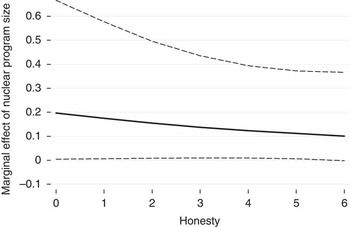
To assess the mediating effect of corruption, we again hold all other continuous variables at their sample means and the dichotomous variables at their sample modes. First, we set Nuclear Program Size at its sample mean and calculate the probability of NR terrorism at each level of Honesty. Second, we set Nuclear Program Size at its sample maximum and calculate the probability of NR terrorism as Honesty increases from 0 to 6. Third, we compute the probability difference and the 95 percent confidence interval around that difference for each level of Honesty. This final set of results allows us to test whether each level of corruption significantly mediates the positive effect of a large increase in Nuclear Program Size on NR terrorism. We plot these results in Figure 2. The figure shows that the effect of a large rise in Nuclear Program Size on the change in the probability of NR terrorism is downward sloping as Honesty goes from 0 (the most corrupt states) to 6 (the least corrupt states). The 95 percent confidence interval is rather large across the full range of Honesty, but it includes 0 (−0.002, 0.361) when this variable is set to the sample maximum. This indicates that, consistent with Hypothesis 3, the least corrupt states are not more likely to experience NR terrorism following a large expansion of their nuclear programs.Footnote 66
Marginal effect of nuclear programs on NR terrorism as corruption decreases Note: Dotted lines represent 95 percent confidence interval.

We tested Hypotheses 2 and 3 separately in Models 2 and 3. There may be objections to this on the grounds that it introduces omitted variable bias into our analysis. Hence, Model 4 reports the results when we include both interaction terms and their constituent parts in the statistical model. The findings are similar although one interaction term (Nuclear Program Size × Nuclear Security Commitment) becomes statistically insignificant. The insignificance of this variable could result from two sources: the crude nature of the nuclear security variable or the 20 percent decrease in the sample size due to missing data on corruption. In any case, Model 4 appears to suggest that fighting corruption is relatively more effective than enhancing nuclear security when it comes to reducing the risk of NR terrorism.
To interpret these results further, we computed the 95 percent confidence interval around the difference in the predicted probability of NR terrorism between the mean and maximum values of Nuclear Program Size for the most corrupt regimes (Honesty = 0 and Nuclear Program Size × Honesty = 0). In this case, even if a country is committed to the CPPNM, the confidence interval for the probability difference does not include zero (0.001, 0.718). The mediating effect of nuclear security, therefore, appears to be compromised in the most corrupt regimes. However, states that are free from corruption do not appear to be vulnerable to NR terrorism if they commit to the CPPNM. Similar to what we found based on the estimates from Model 2, the 95 percent confidence interval around the difference in the predicted probability of NR terrorism includes zero (−0.010, 0.304) when Honesty is set to its sample maximum (6) and Nuclear Security Commitment equals 1. Now, the confidence interval around the marginal effect also includes zero (−0.002, 0.972) if states are not committed to the CPPNM but are free from corruption. Thus, regardless of whether states make a nuclear security commitment or not, reducing corruption to the lowest level makes the relationship between nuclear programs and NR terrorism statistically insignificant.
We also replicated Figure 2 based on the estimates from Model 4 when we vary the level of corruption. In particular, we computed the 95 percent confidence interval around the difference in the predicted probability of NR terrorism between the mean and maximum values of Nuclear Program Size when states commit to the CPPNM. The 95 percent confidence interval excludes zero when Honesty is less than or equal to 4. Yet the confidence interval includes zero when Honesty equals 5 (−0.0003, 0.323) or 6 (−0.011, 0.304). When Nuclear Security Commitment equals 0, the 95 percent confidence interval around the difference in the predicted probability of NR terrorism that results from increases in Nuclear Program Size includes zero (−0.006, 0.426) when Honesty equals 6 – but it does not include zero when Honesty equals 5. Therefore, the mediating effect of corruption reduction is particularly strong when countries commit to international nuclear security measures. However, if states have not ratified the CPPNM, the mediating effect of corruption reduction weakens slightly.
In sum, the findings from Table 1 indicate that reducing corruption and improving nuclear security can both play an important role in reducing the risk of NR terrorism when states expand nuclear programs. However, our analysis suggests that corruption reduction has a stronger mediating effect than signing the CPPNM.
Turning to the control variables, Civil Conflict is strongly associated with NR terrorism. Countries that are in the midst of an ongoing civil conflict are 400 percent more likely to be targeted with NR terrorism than states that are not. This contrasts with Asal, Ackerman, and Rethemeyer's finding that countries experiencing civil wars are less likely to experience CBRN terrorism.Footnote 67 One explanation for this difference is that the causes of NR terrorism are different from those of CBRN terrorism more generally, a possibility that future research should examine in greater detail. The three time related variables are highly significant, demonstrating the presence of temporal dependence in the data and the need to control for it. Other control variables (Democracy, Major Power, and GDP Per Capita) do not have statistically significant effects in any of the models in Table 1.
Additional Robustness Checks and a Theoretical Extension
In this subsection, we discuss additional empirical tests that evaluate the sensitivity of our findings and address possible objections to our analysis in Table 1. To save space, all the findings discussed in this subsection are presented in our web appendix.
The first sensitivity analysis expands our empirical test to include known NR terrorism plots. Plot data have important limitations, as we previously discussed. Yet if our argument is correct, we should also find that nonstate actors are more likely to orchestrate plots against states with large nuclear programs. To evaluate whether this is the case, we reestimate Model 1 using NR Plot as the dependent variable. This variable measures whether violent extremists were actively plotting to target a country with NR terrorism in a year or not. Model A1 shows the effect of Nuclear Program Size on NR plot is statistically significant and positive. Thus, the likelihood of extremists attempting to target a state with NR terrorism increases as its nuclear program expands.
The second sensitivity analysis considers only states with nuclear programs. Some incidents (such as threats to sabotage nuclear plants) can only occur in states that have nuclear infrastructure. It is possible, therefore, that including countries without any nuclear facilities in our sample makes it easier to find a correlation between Nuclear Program Size and NR terrorism. Model A2 shows, however, that our main variable of interest remains positive and significant when we limit our sample to the sixty-five countries that have at least one nuclear facility.Footnote 68
The third analysis examines the robustness of results in Table 1 when we exclude the United States and/or Russia. As we previously noted, Russia was targeted with NR terrorism more frequently than any other state. Russia also possessed one of the world's largest nuclear programs from 1992 to 2006, which raises the possibility that our initial findings could have been driven by a single country. Yet, Model A3 shows that the relationship between Nuclear Program Size and NR terrorism persists when we remove Russia from the sample. Our core findings also hold when we exclude both Russia and the United States (Model A4).Footnote 69
The fourth test evaluates the robustness of results under alternative estimation techniques. NR terrorist incidents are rare events, and because we use a time-series cross-sectional dataset the number of observable 1's in our sample is much smaller than the number of 0's. Thus, some might argue that our initial findings were biased and that our estimated probabilities of NR terrorism may have been inaccurate. We address this criticism in two ways. First, we fit our models using rare events logit,Footnote 70 an estimator that corrects the potential problems that can arise when studying rare events. The effect of nuclear program size remains positive and significant with this new estimator as shown in Model A5. Second, we conducted a cross-sectional negative binomial analysis. We computed the mean value for each continuous independent variable by country during the whole sample period and calculated the modes for the dichotomous variables. The dependent variable now measures the total number of times a country was targeted with NR terrorism from 1992 to 2006. This increases the percentage of observations in the sample that experienced at least one NR terrorist incident from 1.5 percent to 11 percent. We fit this model using negative binomial regression, an estimator that is appropriate for count dependent variables.Footnote 71 As Model A6 shows, Nuclear Program Size remains statistically significant and positive when we use the negative binomial technique and remove the time-series component of our analysis.
The fifth analysis considers and tests one possible extension of our argument. We have shown that nuclear programs make countries more vulnerable to NR terrorism. Do nuclear weapons programs raise the probability of NR terrorism as well? Some scholars argue that they do, in part because military programs increase both the amount of NR materials a country possesses and the number of targets that are vulnerable to terrorist attacks.Footnote 72 Terrorists might also attempt to steal or otherwise acquire nuclear weapons for use in an attack. For example, Russian officials have confirmed that terrorist groups have carried out reconnaissance missions on nuclear weapons storage facilities in the country.Footnote 73
To evaluate empirically the effect of nuclear weapons programs on NR terrorism, we coded a variable (Nuclear Weapons) that measures the total number of bombs in a country's arsenal in year t and included it in our analysis.Footnote 74Nuclear Weapons does not achieve conventional levels of statistical significance (Model A7), but it has a significant positive effect when we exclude Nuclear Program Size (Model A8). This suggests that the NR terrorism risk is primarily associated with civilian nuclear programs, perhaps because nuclear weapon-related facilities tend to be better secured than civilian plants. However, future research should devote more attention to the relationship between terrorism and nuclear weapons programs.
Finally, we test whether the results on corruption in Table 1 are robust to an alternative measure. Using the Heritage Foundation's Freedom from Corruption variable, we re-estimate Models 3 and 4 in Table 1 and report the new results in Models A9 and A10. The results are consistent with those based on the ICRG measure used in Table 1.
Conclusion
Does the diffusion of nuclear programs encourage nuclear and radiological terrorism? We offered a systematic account as to why a country's vulnerability to NR terrorism may grow as the size of its nuclear program increases. The presence of expansive nuclear infrastructure facilitates terrorists’ efforts to steal or acquire nuclear and radiological materials, increases the available targets, and amplifies the potential economic and social-psychological consequences of a related terrorist attack. Yet we also argued that countries can reduce the likelihood of NR terrorism by committing to nuclear security and reducing corruption.
To test these arguments, we built a new dataset of noncatastrophic NR terrorist incidents and plots from 1992 to 2006. Using this dataset and a sample of 152 countries, we found that as a country's nuclear program develops and grows in size, it is more likely to be targeted with NR terrorism. But, consistent with our argument, the effect of nuclear programs on NR terrorism is weakened if a country is committed to reducing corruption and strengthening nuclear security. A state with a large nuclear program can, therefore, reduce its vulnerability to NR terrorism by instituting appropriate counterterrorism measures. Policies that protect states from NR terrorism will probably be most effective when they are instituted together rather than separately. However, comparing the two measures analyzed in this study, reducing corruption appears to be more effective than bolstering nuclear security. When corruption is rampant, simply committing to the CPPNM does not eliminate a state's vulnerability to terrorism. Yet reducing corruption to its lowest possible level insulates states from the dangers of NR terrorism regardless of whether they are committed to the CPPNM or not. As we previously emphasized, however, future research would benefit from a more nuanced measure of nuclear security.Footnote 75
Policymakers are most concerned about catastrophic NR terrorist attacks. While our data do not provide direct insight into when and why these incidents might occur, our analysis does shed some light on catastrophic NR terrorism. This is in part because terrorists did intend to cause catastrophic consequences in many of the observed incidents and plots in our dataset. All catastrophic plots were disrupted before they could be successfully executed and the observed attacks sometimes had more limited effects than the perpetrators intended, but this does not imply that similar trends will continue in the future. Thus, based on the prior motivations of terrorist groups, our results suggest that the future risk of catastrophic NR terrorism is likely to be higher in countries with large nuclear programs.
How can countries better protect themselves against nuclear weapons terrorism? One way that terrorists could acquire a nuclear weapon is by stealing weapons-grade materials from a nuclear facility and then constructing an improvised explosive device. We have shown that, when it comes to noncatastrophic terrorism, nonstate actors are more likely to target nuclear programs in corrupt countries that have relatively weak nuclear security. If terrorists look for ‘soft’ targets when it comes to these incidents, they are also likely to behave strategically when it comes to acquiring the materials necessary to make a crude nuclear bomb, which would be a prized possession for terrorist groups.Footnote 76 This does not imply that bomb-grade materials will always be used in the very same country in which they had been acquired, but it does suggest that strengthening nuclear security and reducing corruption could lower the risk of catastrophic NR terrorism by denying terrorists access to the requisite materials. Some policymakers have made a similar argument in recent years. President Barack Obama, for instance, recently pledged to secure all vulnerable nuclear material across the globe in order to protect the world from a catastrophic nuclear terrorist attack.Footnote 77 Our findings provide some of the first empirical evidence to suggest that this policy could be effective, but the need to fight corruption is as important – if not more imperative – based on our findings.
Many countries are considering building nuclear power plants to meet their growing energy needs. Even if policymakers are fully aware of the terrorism risks of their nuclear programs, many may still calculate that their benefits outweigh the safety and security risks they pose. Still, our findings suggest that terrorism risks should at least be part of the domestic debates on nuclear energy. However, not all countries need to be equally concerned about the additional exposure to NR terrorism due to nuclear energy programs. States where corruption is rampant or the commitment to nuclear security is weak should be especially cautious in expanding their nuclear energy programs. For countries like Britain that are conscientious about nuclear security and for whom corruption is not a major problem, expanding their nuclear energy programs may pose few additional risks of NR terrorism. In contrast, Pakistan's plan to vastly expand its reliance on nuclear energy in the coming decades is more worrisome.Footnote 78 In general, our findings suggest that nuclear energy aspirants should ramp up their nuclear security and reduce corruption prior to building nuclear power plants and other facilities, and other countries should be willing to provide assistance to facilitate these objectives. Reducing the NR terrorism risks of the growing use of nuclear energy should be a high-priority goal for the entire international community, not just those states that are most likely to be attacked.