Syncope is defined as a transient, brief, and short-limited loss of consciousness because of transient global cerebral hypoperfusion.Reference Sutton, Benditt, Brignole and Moya 1 – Reference Colman, Nahm and Ganzeboom 5 It has been estimated that around 15% of children and adolescents will experience at least one episode of syncope before adulthood. Although it can occur at any age, with a marked female preponderance,Reference Ganzeboom, Mairuhu, Reitsma, Linzer, Wieling and van Dijk 3 , Reference Sheldon, Sheldon and Connolly 6 the threshold of syncope appears to be age-dependent, with children under the age of 2 years (presenting as breath-holding spells) and youth aged 9–14 years being the peak groups.
The great majority of syncopal episodes are of reflex origin and benign in nature, but some, 2 accounting for around 25% of the cases, can be because of a potential cardiac, metabolic, psychogenic, or neurological disease. The identification of the syncope type is mainly through clinical evaluation, which is supported by a head-up tilt test.Reference Forleo, Guida and Iacoviello 7 A positive test is defined when syncope is reproduced in association with hypotension, bradycardia, or both.Reference Timoteo, Oliveira and Feliciano 8
Classically, in normal individuals, the haemodynamic changes associated with the tilt test have two phases: an initial short and acute response followed by a stabilisation phase with two periods – an adaptation period of 1–2 minutes after orthostatism and a later response to prolonged orthostasis.Reference Ducla-Soares, Santos-Bento and Laranjo 9 , Reference Hilz and Dutsch 10 These cardiovascular adaptations are primarily dependent on the autonomic nervous system, and for their evaluation, several non-invasive methods have been used. Of these methods, heart rate variability and the analysis of baroreflex sensitivity are prevalent and allow a beat-to-beat assessment of the autonomic modulatory activity during the orthostatic stress. 11 Briefly, by the usage of mathematic models, for example, Fourier transformation and/or autoregressive methods, hidden rhythmic fluctuations – variability – can be detected in heart rate signal, yielding to a spectrum with two main bands of frequencies: a high-frequency band related to parasympathetic activity and a low-frequency band related mainly to the sympathetic tone. However, only a few studies have investigated, with conflicting results, cardiovascular variability in children.Reference Alehan, Ayabakan and Ozer 12 In fact, some authors have reported that children with reflex syncope had alterations in baseline autonomic balance,Reference Stewart, Erb and Sorbera 13 whereas others did not find any modification on basal autonomic output.Reference Massin, Henrard and Gerard 14 Although both types of studies agree that the autonomic nervous system appears to play an important role in the pathogenesis of reflex syncope, many questions remain unanswered regarding the precise aetiology and pathophysiological mechanisms of the autonomic response to orthostatic stress in paediatric patients. More recently, novel approaches on signal analysis – wavelet transform, Hilbert–Huang transform – gave the ability of performing integrated and short-term analysis of heart rate and systolic blood pressure. In fact, by approaching the signal processing analysis to the dynamicity of physiological nature of the reflexes, for example, baroreceptor reflex, they have provided impressive insights into the mechanisms underlying the acute autonomic changes during the tilt test, in adult patients with syncope or dysautonomia.Reference Ducla-Soares, Santos-Bento and Laranjo 9 , Reference Xavier, Laranjo and Ducla-Soares 15 , Reference Tavares, Laranjo, Santos and Rocha 16 Accordingly, in the present study, we aim to clarify, using dynamic signal processing tools, the background of the autonomic and haemodynamic responses elicited in children with a history of unexplained syncope during a tilt test.
Materials and methods
Patients
Between January, 2005 and June, 2013, patients (mean age of 12 years) with reflex syncope were enrolled in this study. All patients met the following inclusion criteria: (1) at least two syncopal episodes within the last 6 months or one syncope and three presyncope episodes/year; (2) absence of structural or electrical heart disease; (3) absence of other evident aetiologies for syncope; and (4) absence of criteria for orthostatic hypotension. All patients had no concomitant chronic or acute disease, were non-smokers, and were not taking any medication. Physical examination, electrocardiography, and echocardiography were normal in all patients.
The study complying with the Declaration of Helsinki was approved by the Santa Marta Hospital Ethic Committee and conducted after informed consent.
Tilt test protocol
Tilt tests were conducted in a dedicated laboratory, in a quiet environment with controlled temperature and humidity, during the morning period, after a light breakfast without ingestion of caffeine, chocolate, or other xanthines. No intravenous lines were placed or provocative agents were used. Subjects were placed on a tilt table and, after a resting period of 15 minutes in the supine position, were tilted up to a level of 60 degrees, at a constant speed, during 15 seconds. Subjects were instructed to breathe normally. As soon as symptoms – syncope or presyncope – developed during the adaptation period, the table was lowered to the horizontal position and the test was terminated. If no symptoms were observed, the test was ended after 30 minutes. Following return to the supine position, a second resting period of 5 minutes was allowed to elapse to guarantee a stable condition.
A positive response to the tilt test was defined as a sudden development of syncope or presyncope associated with hypotension, bradycardia, or both,Reference Timoteo, Oliveira and Feliciano 8 whereas a negative test was determined as the absence of hypotension, bradycardia, syncope, or presyncope. Positive response types were in accordance with VASIS classification: a vasodepressor response was defined as a marked fall in systolic blood pressure of, at least, 30% or below 70 mmHg associated with the reproduction of symptoms; a cardioinhibitory response was defined as an abrupt fall in heart rate; and, a mixed response was characterised by both blood pressure and decrease in heart rate.
Data acquisition
Beat-to-beat RR intervals and arterial blood pressure were continuously recorded by a Task Force Monitor (CNSystems, Graz, Austria). The non-invasive beat-to-beat recording of stroke volume, cardiac index, and total peripheral resistance index were also computed using the data from cardiothoracic impedance signal.
Data analysis
All data analyses were performed using an in-house computational interface. Patients were divided into two groups according to their response to the tilt test: the tilt-positive patients – fainters – and the tilt-negative patients – non-fainters.
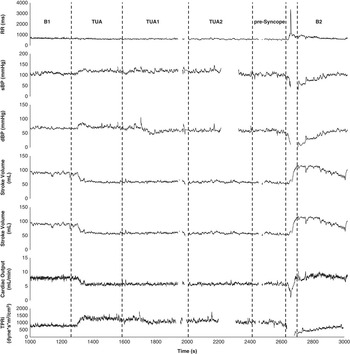
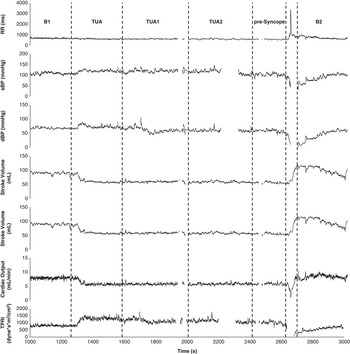
The analysis of each cardiovascular parameter was made in five consecutive periods: (1) baseline period: the 2 minutes of recording immediately before tilting; (2) 2 minutes of recording immediately after tilting up; (3) 2 minutes segment immediately after the second period; (4) at the end of tilt, corresponding to the last 2 minutes before the development of symptoms; or the last 2 minutes on tilting up for the tilt-negative patients. The last segment comprises the first 2 minutes of recovery on the supine position starting 15 seconds after tilt down (Fig 1).
RR interval (RR), systolic blood pressure (sBP), diastolic blood pressure (dBP), stroke volume, cardiac output, and total peripheral resistance (TPRI) of a representative fainting patient during head-up tilt (HUT) to 70°. The time intervals “baseline period” (B1), 2 minutes of recording immediately after tilting-up (TUA), 2 minutes segment immediately after the second period (TUA1), the last 2 minutes before the development of symptoms (TUA2), and the first 2 minutes of recovery in the supine position (B2) are indicated. A time-dependent increase in heart rate (decrease in RR) is coupled with an initial increase in TPRI, allowing for an initially stable sBP, despite the initial decrease in stroke volume and cardiac output. These events are followed by a decline in TPRI until faint.
Heart rate and systolic blood pressure variability
Heart rate and systolic blood pressure variability was assessed through the Hilbert–Huang transform, a recent tool for signal analysis of cardiovascular signals.Reference Souza Neto, Custaud and Cejka 17 Briefly, this methodology first decomposes the signal into a finite and often small number of functions, the intrinsic mode functions, followed by the application of the Hilbert spectral analysis, to obtain the instant frequency, phase, and amplitude of the given signal. Recently, Hilbert–Huang transform has been applied to biomedical signals, in particular to the cardiovascular ones. As shown by Tavares et al,Reference Tavares, Laranjo, Santos and Rocha 16 this method provides a more accurate estimation of sympathetic and parasympathetic oscillation powers combined with a dynamic autonomic analysis.
Baroreflex effectiveness index
Baroreflex sensitivity was calculated using the sequence method as stated elsewhere.Reference Di Rienzo, Parati, Castiglioni, Tordi, Mancia and Pedotti 18 , Reference Iacoviello, Guida, Forleo, Sorrentino, D’Alonzo and Favale 19 In brief, this estimation was based on the analysis of beat-to-beat series of systolic blood pressure scanned to identify ramps of three or more consecutive heart beats with a progressive increase (up-ramp) or decrease (down-ramp), of at least 1 mmHg, regardless of the possible occurrence of concomitant RR interval changes. The algorithm identifies spontaneous sequences, defined as systolic blood pressure ramps followed by concomitant and concordant RR intervals variations of 5 ms coupled with 0-, 1-, and 2-beat lags, with each sequence being included only once. For each sequence, the slope of the linear interrelationship between systolic blood pressure and the following RR intervals values was calculated and was considered reliable when the correlation coefficient was >0.80.
For each period of analysis, the baroreflex effectiveness index was defined as the ratio between the total number of baroreflex sensitivity sequences detected and the total number of systolic blood pressure ramp-like changes in blood pressure, regardless of whether the later are followed by a change in RR interval or not.Reference Di Rienzo, Parati, Castiglioni, Tordi, Mancia and Pedotti 20 The higher the effectiveness value, the more systolic blood pressure ramp changes are followed by a change in the RR interval.
Statistical analysis
Continuous variables are expressed as mean and standard deviation and plotted as the composite of the mean values of all subjects, unless specified otherwise. Categorical variables are given as frequencies and percentage of patients. Normality distribution of the continuous variables was analysed using the Kolmogorov–Smirnov test (Lilliefors’ correction), and Levene’s test was used for the assessment of homogeneity of variance. Data from the two groups of subjects – fainters and non-fainters – are represented along time. Student’s t-test was used to assess all paired data in the same group. Comparison between groups was made using a “repeated measures” analysis of variance with one “within” factor – the five consecutive periods of analysis – and one “between” factor – fainters versus non-fainters – with Bonferroni’s correction. A value of p<0.05 was considered statistically significant. Data were analysed using SPSS software version 18 (IBM Corporation, Chicago, United States of America).
Results
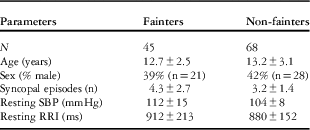
Sex and age distributions of fainters and non-fainters were not statistically different (Table 1). From the 113 patients enrolled in this study, 45 of them (39%, 21 males) experienced syncope – of mixed (n=20; 45%), vasodepressor (n=13; 30%), and cardioinhibitory (n=12; 25%) types – after a mean time of 18±10.2 minutes of tilting.
Demographic and resting haemodynamics in fainters and non-fainter subjects.

SBP=systolic blood Pressure; RRI=heart period
Comparison of haemodynamic and autonomic responses between groups
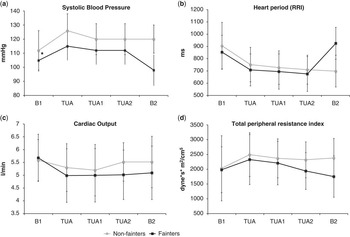
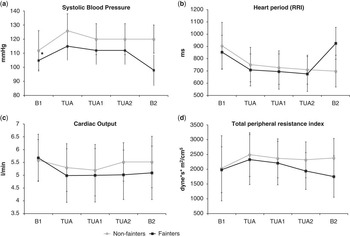
There are differences in haemodynamic and autonomic parameters among fainters and non-fainters that can explain their intrinsic behaviour upon an orthostatic stress. In fact, fainters’ blood pressure, both systolic and diastolic, is significantly lower at rest and during the initial adaptation periods (104±8 versus 112±11 mmHg, p<0.001) when compared with the non-fainters (Fig 2a). In addition, the same trend for lower values on cardiac output, total peripheral resistance, and heart period is observed (Fig 2b–d). Along the test, total peripheral resistance progressively decreased, with time being significantly lower for fainters in the last period of analysis, just before the syncopal event (Fig 2d).
Systolic blood pressure, heart period (RRI), cardiac output (CO), and total peripheral resistance (TPRI) during head-up tilt in fainters and non-fainters. Fainters: dark line; Non-fainters: grey line; *significance (p<0.05).
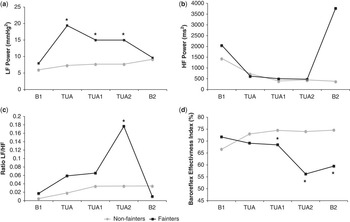
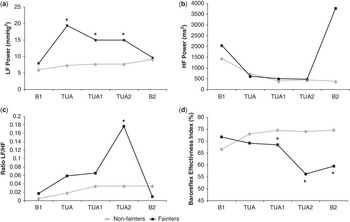
A large increase in the sympathetic activity was seen on the fainters’ group after tilting, despite their values of systolic blood pressure along the test being significantly lower than those for non-fainters. For these patients, low frequencies – spectral markers of sympathetic activity – changed dynamically during tilt (Fig 3a), showing a sudden and initial rise of sympathetic tone immediately after tilting up, followed by a second overshoot of activity continued by a steady fall-off of output 1–2 minutes before syncope. This pattern occurred in every fainter and was absent in all non-fainters. On the other hand, high-frequency values – markers of parasympathetic activity – were similar for both groups except on tilt down that were significantly higher in the fainters’ group (Fig 3b).
Fainters have an overall enhancement of sympathetic tone as shown by LF power values ( a ). Along the provocative manoeuvre, a primary increase in adrenergic drive (period TUA–TUA2) followed by marked modulation towards vagal predominance immediately before the onset of syncope (period TUA2) was observed ( b – c ). *Significance (p<0.001).
Relative comparison of responses, by period of analysis, within the same group
Among the non-fainters, analysis of cardiovascular and autonomic parameters between periods showed different profiles, despite non-significant values, on systolic blood pressure, cardiac output, and baroreflex sensitivity, without significant modifications of sympathetic and parasympathetic activity and peripheral resistance. At rest, 92% of all spontaneous baroreflex sequences occurred with no lag (lag 0). With head-up tilt, there was a non-significant reduction in the number of lag 0 sequences (80%), whereas lag 1 and lag 2 sequences increased (10–20 and 5–10%, respectively).
On the contrary, for the fainters’ group, differences were found in autonomic variables that rose significantly, as well as for systolic blood pressure and baroreflex sensitivity. At rest, 75% of all spontaneous baroreflex sequences occurred with lag 0. With head-up tilt, there was a significant reduction in the number of lag 0 sequences (25%), whereas lag 1 and lag 2 sequences increased (25–45 and 15–30%, respectively).
Discussion
In the present work, the background of the autonomic and haemodynamic responses elicited by a tilt test in children with at least one syncopal episode has been studied. In adult population, a decrease in the cardiac output is observed upon orthostatic stress conditions, in particular, during a maintained motionless upright posture. In these circumstances, baroreceptors and, hence baroreceptor reflex, exert a major role in the initiation of the compensatory circulatory responses mainly because of its role in the control of total peripheral resistance rather in its effects on heart rate.Reference van Dijk and Wieling 21 , Reference Verheyden, Liu and van Dijk 22 Most of the previous studies, which led to these conclusions, have been conducted, however, on adult patients with poor orthostatic tolerance with or without overt cardiovascular or neurological deficit. Despite the observations in adults that could be extrapolated to the paediatric population, caution should be taken as youngsters are physiologically different from adults.Reference Nowak, Ocon, Taneja, Medow and Stewart 23 Thus, the specific aim of the present study was to understand why young patients, all with a diagnosis of reflex syncope, have different physiological behaviours upon the same orthostatic stress. In particular, we were interested in clarifying whether the observed responses were because of a vagal withdrawal, sympathetic dysfunction, or some combination of both with or without impairment of baroreceptor reflex function.
Accordingly, the main finding in this study is the apparent lack of sympathetic reserve in fainters that accounts for the loss of adaptive response under specific haemodynamic stressful conditions, thus leading to a syncopal event. In fact, fainters showed lower values of blood pressure during the entire manoeuvre, a significant decrease in total peripheral resistance – particularly in the period before syncope – and no changes in cardiac output, despite the significant rise in sympathetic activity during tilt. Furthermore, fainters showed a decrease in baroreflex effectiveness index after the tilting up until they faint, which may partly account for the failure of the baroreceptor system to initiate and/or to maintain an adequate compensatory response during a haemodynamic crisis. Given that there are no significant differences between baroreceptor effectiveness index between fainters and non-fainters in the supine position and an increase in the sympathetic output is seen during the tilt up, it appears that there is a functional disturbance in the baroreceptor reflex in fainters. This disturbance can also be documented by looking to the percentage of baroreflex sequences in the different lags, with non-fainters’ baroreflex “working” mainly on lags 0 during HUT, whereas fainters experience a shift from lags 0 and 1 to lags 1 and 2, translating a delay in the baroreceptor reflex. The origin of this impairment is uncertain, despite the speculation that anatomical/functional modifications of integrative centres in the brainstem and/or their connections with higher regions in the hypothalamus, where the defense reaction is evoked, would be a strong hypothesis. Analysis of fainters’ haemodynamic responses during the test and at the time of syncope did not show significant changes in heart rate. However, our results showed that postural adaptations were mainly involving modifications of total peripheral resistance. These results are different from those of other authors that reported excessive chronotropic responses in young patients with reflex syncope, which appear to show inappropriately overactive cardiac and autonomic responses, in contrast with signs of vasomotor autonomic incompetence in older patients.Reference Nowak, Ocon, Taneja, Medow and Stewart 23 , Reference Matsukawa, Sugiyama and Mano 24 In addition, our results on systolic blood pressure variability showed a significant increase followed by a gradual decrease along time keeping, however, a higher power than the observed for non-fainters. In our opinion, this constitutes an attempt to cancel the syncopal event. Thus, we can speculate on the idea that, despite having the same diagnosis, these two different populations of young patients, with the same mean age, have either a different pathology or they are in a different stage of disease progression. A third assumption would be that the non-fainters’ group would include false-negative patients. This is one of the study limitations due to the lack of a healthy control group matching age and sex in the two studied populations.
In general, our results reflect an autonomic incompetence of the syncope group patients. In fact, fainters already showed in the supine position, a higher sympathetic output together with a higher value of baroreflex effectiveness index. Along the manoeuvre, sympathetic activity rises massively, whereas baroreflex effectiveness index decreases its power because of it and as a consequence of the negative feedback mechanisms inherent to baroreceptor activation. No statistically significant changes in heart rate were observed during the manoeuvre, which reflects an absence of the vagal variability, which is a key factor for an effective and complete baroreflex action. In these circumstances, of the lack of vagal adaptation/plasticity, the imbalanced sympathoexcitatory condition constitutes the most powerful adaptive mechanism to strong orthostatic stresses, acting through changes in vasomotor tone.
These illations could have an important consequence in the disease prognoses and therapeutics. In fact, in previous works,Reference Laranjo, Oliveira and Tavares 25 , Reference Laranjo, Martins Oliveira and Tavares 26 we and othersReference Ector, Reybrouck, Heidbüchel, Gewillig and Van de Werf 27 reported tilt training as a non-pharmacological therapeutics for reflex syncope with strong benefits on patients’ adaptation to strong orthostatic stress. In these patients, we could observe, along time, benefits on all haemodynamic and autonomic variables including the baroreceptor reflex index. Thus, we believe that the implementation of a tilt training protocol in these young patients would be beneficial by modulating the autonomic output owing to the high plasticity of the system that is inherent to their development stage, avoiding pharmacological or invasive therapeutics.
Acknowledgements
The authors thank technicians Lurdes Medroa and Teresa Mateus for their contribution in conducting the head-up tilt test studies.
Financial Support
This research received no specific grant from any funding agency, commercial, or not-for-profit sectors.
Conflicts of Interest
None.
Ethical Standards
The authors assert that all procedures contributing to this work comply with the ethical standards of the relevant national guidelines on human experimentation and with the Helsinki Declaration of 1975, as revised in 2008, and has been approved by the Santa Marta Hospital ethical committee.