Race is fundamental to American society and American politics. Racial considerations contributed to the constitution's shape, and subsequently structured party systems (Carmines and Stimson Reference Carmines and Stimson1989; Schickler Reference Schickler2016; Tesler Reference Tesler2016) and influenced policy making (Katznelson Reference Katznelson2006). The politicization of race generated by these institutions facilitates the links between the mass public's racial attitudes and their policy preferences (Gilens Reference Gilens1999; Tesler Reference Tesler2016) and party attachments (Tesler Reference Tesler2016; Valentino and Sears Reference Valentino and Sears2005) – links that in turn maintain race as an important institutional feature. Intentioned or not, race helps shape who gets what, when and how.
Undergirding all of this is an assumption that racial animus feeds political conflict. I turn this conventional wisdom on its head by arguing that political conflict can shape racial attitudes – people's views and beliefs about groups understood to be racial.Footnote 1 Political scientists have failed to examine this possibility, perhaps because racial attitudes are seen as persistent and influential predispositions that form during childhood, long before most Americans become political animals (Sears and Brown Reference Sears, Brown, Huddy, Sears and Levy2013).Footnote 2 According to this line of reasoning, individuals use these early-formed attitudes to make sense of politics; racial attitudes lead to partisanship (Green et al. Reference Green, Palmquist and Schickler2002; Sears and Funk Reference Sears and Funk1999; Tesler Reference Tesler2016; Valentino and Sears Reference Valentino and Sears2005).Footnote 3
I contend that consistently viewing the relationship as unidirectional is unwise. Instead, partisanship might also affect racial attitudes. This is theoretically plausible for two reasons. First, partisanship is perhaps the most important attitude in Americans' political belief systems. Scholars have found that partisanship is causally prior to many individual aspects once thought to be causally prior to partisanship, including issue positions (Lenz Reference Lenz2012), core political values (Goren Reference Goren2005) and economic evaluations (Bartels Reference Bartels2002). Add to this individuals' motivation to adopt party-consistent views (Bolsen et al. Reference Bolsen, Druckman and Cook2014), and a dynamic relationship between partisanship and racial attitudes is not only possible, but plausible.
Secondly, because the parties of the early twenty-first century have not changed where they stand on race, party switching on racial attitudes is less likely. People are unlikely to receive information on race that changes which party they believe is more supportive of racial minorities, and fewer people have misaligned partisanship and racial attitudes. Instead, when people receive information on race they are likely to change their attitudes. Party attachments can shape the kinds of information people receive on race and how they interpret it. Party elites, for instance, discuss race in markedly different ways when it becomes salient (Engelhardt Reference Engelhardtforthcoming; Haney López Reference Haney López2014; King and Smith Reference King and Smith2014), offering one potential source of party-driven attitude change (Zaller Reference Zaller1992).
I demonstrate that partisanship relates to racial attitude change. Using panel data, I compare two different political contexts, the early 1990s and late 2000s. I find that whites' racial attitudes encourage party switching in both periods, but particularly the 1990s. The later period features many more whites aligning their racial attitudes with their partisanship than switching parties. The results paint a normatively mixed picture by showing that politics, through partisanship, can perpetuate negative racial attitudes or encourage whites to adopt more favorable views.
Partisanship, Race And Racial Attitude Updating
The connection between race and partisanship in the modern era has grown stronger over at least the last half century (Carmines and Stimson Reference Carmines and Stimson1989; Kinder and Sanders Reference Kinder and Sanders1996; Schickler Reference Schickler2016). Before 1964, intraparty conflicts largely kept civil rights off the national political agenda, with Southern Democrats in particular the keystone to maintaining institutionalized racism. This changed when Democrats championed the Civil Rights and Voting Rights Acts and Republicans courted disaffected whites with their Southern Strategy. In subsequent years, Democrats reinforced their commitment to pro-black policies, while Republicans distanced themselves from racial liberalism (Carmines and Stimson Reference Carmines and Stimson1989, Ch. 2). In part because the growing partisan divide on race gives elites incentives to use racialized campaign messages (Kinder and Sanders Reference Kinder and Sanders1996; Mendelberg Reference Mendelberg2001), the mass public has received clear signals about where the parties stand on issues related to race since at least the mid-1960s.
Changes in the mass public's party loyalties followed this information about where the parties stand, and explanations of these changes contribute to the prevailing characterization of the relationship as one in which racial attitudes shape individuals' partisanship. For Sears and Funk (Reference Sears and Funk1999), racial attitudes played a ‘unique role’ in shaping ‘partisan political preferences during the civil rights era and its aftermath’ (17) (see also Valentino and Sears Reference Valentino and Sears2005). Similarly, Green et al. (Reference Green, Palmquist and Schickler2002) contend that the enfranchisement of African Americans changed each party's ‘social imagery’, motivating whites to switch parties. Tesler (Reference Tesler2016) echoes this claim when arguing that Barack Obama's presidency motivated racial liberals and conservatives to become Democrats and Republicans.
The conventional wisdom on whites' racial attitudes also argues that race leads to party. Prior studies contend that racial attitudes form early in life and persist through most of adulthood as a way to understand the world (Goldman and Hopkins Reference Goldman and Hopkinsforthcoming; Henry and Sears Reference Henry and Sears2009; Sears and Brown Reference Sears, Brown, Huddy, Sears and Levy2013). The available evidence indicates that children understand racial categories before kindergarten and come to see them as fixed attributes as they grow up (Hirschfeld Reference Hirschfeld1996). People's early social environments, including family and school experiences, contribute morals and values that give these categories meaning (Goldman and Hopkins Reference Goldman and Hopkinsforthcoming).
The evidence of early-acquired racial attitudes encourages scholars to treat them as causally prior to political outcomes including partisanship (Hutchings and Valentino Reference Hutchings and Valentino2004; Sears and Funk Reference Sears and Funk1999; Tesler Reference Tesler2016; Valentino and Sears Reference Valentino and Sears2005), implicitly reinforcing the conventional view that these attitudes are unlikely outcomes of political processes. The position holds that when people encounter information on race, they will align some political position with their racial attitudes rather than change the latter. However, I propose that the contexts people find themselves in can motivate racial attitude change. People can re-evaluate racial groups by incorporating additional information, like that provided by political elites when they draw attention to the positive and negative characteristics that define racial categories (Engelhardt Reference Engelhardtforthcoming; Haney López Reference Haney López2014; King and Smith Reference King and Smith2014).
Changes in which racial attitudes count as socially acceptable offer some initial guidance. For decades, white Americans believed that whites and blacks were innately different. This biological racism persisted among elites at least until World War II when it lost favor among social scientists (Kinder and Sanders Reference Kinder and Sanders1996, Ch. 5). Changes in elites' beliefs precipitated a change in the mass public such that biological racism is decidedly uncommon these days (but see Tesler Reference Tesler2016). As Kinder and Sanders (Reference Kinder and Sanders1996) detail, how elites talk about race affects how individuals express their attitudes. I extend this thinking to argue that elites, and the information environment more generally, can affect how people express distinct racial attitudes as well as which attitudes they hold.
Why Partisanship Should Matter For Racial Attitudes
To see how partisanship could shape racial attitudes, consider the relationship between the two in terms of attitude centrality. Partisanship is more likely to change orientations that are less important to individuals (Converse Reference Converse and Apter1964). Although racial attitudes are thought to be more central than partisanship, and therefore the more likely causal force, at times even presumptively fundamental orientations may change to align with partisan loyalties (Bartels Reference Bartels2002; Goren Reference Goren2005; Lenz Reference Lenz2012). Recent evidence, for instance, suggests that people's party loyalties affect religious affiliations (Margolis Reference Margolis2018) – group orientations thought to contribute to partisan preferences – and that this influence could extend to attitudes about social groups. This is plausible because partisan attachments are so ingrained, they even shape responses to reaction time tasks (Theodoridis Reference Theodoridis2017) and shape preferences in non-political settings (Iyengar and Westwood Reference Iyengar and Westwood2015; Engelhardt and Utych Reference Engelhardt and Utych2018). Partisanship's importance, and evidence that it can influence presumptively fundamental orientations, together suggest it may facilitate racial attitude change.
Partisanship's influence can be seen through several potential mechanisms. It shapes which sources of information people pay attention to and how they process the information they receive. People generally prefer relatively costless information searches, and therefore tend to rely on co-partisan information sources because they value credible and trustworthy messengers (Zaller Reference Zaller1992). Alongside potential differences in information exposure, partisanship's function as a ‘perceptual screen’ encourages biased information processing (Bartels Reference Bartels2002; Campbell et al. Reference Campbell1960; Gaines et al. Reference Gaines2007), leading people to hold consistent attitudes (Bolsen et al. Reference Bolsen, Druckman and Cook2014). People interpret social and political affairs in ways that fit with their partisanship and modify their attitudes accordingly.
Party-biased reactions to the information environment should most affect whites. Racially segregated geographic and social spaces limit whites' interactions with non-coethnics (Cox et al. Reference Cox, Navarro-Rivera and Jones2016; Logan and Stults Reference Logan and Stults2011). Whites' information about non-whites may primarily, or solely, come from political elites and other sources (Entman and Rojecki Reference Entman and Rojecki2000).
Social psychology offers insights into how whites' attitudes may respond to information on race. Signs of racial progress can motivate some whites to bolster the existing racial hierarchy and hold more negative racial attitudes (Norton and Sommers Reference Norton and Sommers2011; Wilkins and Kaiser Reference Wilkins and Kaiser2014). Cues about whether race merits attention can have similar attitudinal consequences. Those emphasizing a colorblind perspective, by proposing that people should ignore race in decision making, can lead some whites to avoid acknowledging their own racial biases (Richeson and Nussbaum Reference Richeson and Nussbaum2004) and become less likely to see racism as an explanation for social outcomes (Apfelbaum et al. Reference Apfelbaum2010). Whites thus increasingly de-emphasize race's social reality and deny racial inequality, hallmarks of negative racial attitudes (Kinder and Sanders Reference Kinder and Sanders1996; Tarman and Sears Reference Tarman and Sears2005). But this reverses if people hear rhetoric about racial diversity's benefits or continued discrimination (Apfelbaum et al. Reference Apfelbaum2010; Richeson and Nussbaum Reference Richeson and Nussbaum2004).
The information environment could therefore influence attitudes directly or indirectly. First, it may directly shape attitudes by providing information related to race. Secondly, it may shape the perspectives people use to interpret potentially race-related affairs, which in turn influence how information from other sources is processed and thus change views indirectly (Krosnick Reference Krosnick1988). Partisanship matters to the degree it affects each potential channel of influence. The evidence indicates that Republican elites typically provide information potentially bolstering negative attitudes and Democratic elites frequently offer perspectives promoting positive views (Engelhardt Reference Engelhardtforthcoming; Haney López Reference Haney López2014; King and Smith Reference King and Smith2014), which suggests information environments on race that likely differ by party, making party-driven attitude change possible (Zaller Reference Zaller1992).
I examine two explanations of the relationship between partisanship and racial attitudes. The first – the racial attitude influence hypothesis – follows the conventional wisdom that whites' racial attitudes produce changes in partisanship. Whites' racial attitudes in part foster concerns about who the parties support, leading them to change parties or how strongly they identify with their current one. The second – the partisanship influence hypothesis – argues that parties shape racial attitudes. Partisanship changes attitudes by affecting where people get their information from and how they process what they acquire. These two hypotheses are not mutually exclusive and can jointly describe the link between partisanship and racial attitudes in a given political context. What can vary is which predisposition drives dynamics.
To assess dynamics, I test these hypotheses in two periods: the Clinton era of the early 1990s and the Obama era of the late 2000s. In the first, the parties are still competing over whites who are cross-pressured by their partisan ties and racial attitudes (Hillygus and Shields Reference Hillygus and Shields2008).Footnote 4 Whites resolve this conflict by sorting into the ‘correct’ political party. I therefore expect to find more support for the racial attitude influence hypothesis during this period. In the second era, the political landscape has changed and there are fewer whites with misaligned partisanship and racial attitudes to switch parties. I thus expect to find more support for the partisanship influence hypothesis here.
Importantly, my argument for this latter period does not emphasize unique reactions to President Obama and his administration or responses to a diversifying country; rather, it is more about the general context.Footnote 5 For instance, imagine Obama running and governing in the 1980s when partisanship is in greater flux (Green et al. Reference Green, Palmquist and Schickler2002; Hillygus and Shields Reference Hillygus and Shields2008). His presence would likely not coincide with much, if any, attitude change. Instead, by reinforcing the connection between the Democratic Party and black America it would likely encourage party switching. Indeed, analyses exploring Jesse Jackson's 1984 campaign for the Democratic Party's presidential nomination reflect this possibility. His candidacy coincided with a white electorate shifting its allegiances to the Republican Party, changes motivated in part by racial attitudes (Sears et al. Reference Sears, Citrin, Kosterman, Moreland, Steed and Baker1987). The latter era matters because it is a different political context. While I cannot conclusively demonstrate that changes in context matter, I present evidence that is consistent with a view that changes in context make it more likely that partisanship shapes other orientations (Highton and Kam Reference Highton and Kam2011).
Data And Methods
I test the relationship between whites' partisanship and racial attitudes using panel data from the American National Elections Studies (ANES), the Cooperative Campaign Analysis Project (CCAP) and the Democracy Fund.Footnote 6 In Appendix B I show descriptively that the relationship between the two may be changing using the 1986–2016 ANES cross-sections.
I measure racial attitudes in multiple ways. Racial resentment serves as my primary measure (Kinder and Sanders Reference Kinder and Sanders1996; Tarman and Sears Reference Tarman and Sears2005) and I complement this with group affect. Racial resentment captures structural versus individual explanations for black Americans' social and economic status (Kam and Burge Reference Kam and Burge2018; Tarman and Sears Reference Tarman and Sears2005). It provides a reliable, validated construct consistently used in studies examining the relationship between whites' racial attitudes and partisanship (Tesler Reference Tesler2016; Valentino and Sears Reference Valentino and Sears2005). By also including affect I speak to racial animus's multi-dimensional nature (Kinder Reference Kinder, Huddy, Sears and Levy2013) and address any concerns with the racial resentment construct (Huddy and Feldman Reference Huddy and Feldman2009; Sniderman and Carmines Reference Sniderman and Carmines1997). Finally, I offer evidence in Appendix I that stereotype measures show similar dynamics.
I operationalize Racial Resentment using four items in the Kinder and Sanders (Reference Kinder and Sanders1996) battery.Footnote 7 I sum the items and scale them from 0–1, with higher values indicating greater racial resentment. For Group Affect I create a differential affect measure by subtracting how negatively whites feel about whites from how negatively they feel about blacks. I set this to run 0–1, with higher values indicating respondents feel more negatively about blacks than whites.Footnote 8 This procedure accounts for interpersonal differences in how people respond to such items (Brady Reference Brady1985). I operationalize Partisanship using the branched ANES party identification question, present in all data collections. I also set it to run 0 (strong Democrat) to 1 (strong Republican).Footnote 9 In Appendix J I complement this operationalization and use differenced feeling thermometers to measure partisanship; the results show similar attitude change patterns.
Consistent with the existing literature, I focus on non-Hispanic whites (Tesler Reference Tesler2016; Valentino and Sears Reference Valentino and Sears2005). Furthermore, when using the 1992–1994 ANES data I restrict the analyses to those consistently interviewed by a white or non-white interviewer across waves (for example, white in 1992 and white in 1994). This holds constant potential variation in responses to the racial resentment items the interview context creates (Kinder and Sanders Reference Kinder and Sanders1996).Footnote 10
I use cross-lagged regression models to evaluate dynamics (Finkel Reference Finkel1995). These assess the effect of lagged racial attitudes (racial attitudes t−1) on current partisanship (PID t) and the effect of lagged partisanship (PID t−1) on current racial attitudes (racial attitudes t), after accounting for a lagged dependent variable. Equations 1 and 2 show this mathematically:
 $$racial \; attitudes_{i,t} = \beta_0 + {\beta_1} PID_{i, t-1} + {\beta_2} racial\; attitudes_{i, t-1} + \epsilon_i$$
 $$PID_{i,t} = \alpha_0 + {\alpha_1} PID_{i, t-1} + \alpha_2 racial\; attitudes_{i, t-1} + \upsilon_i$$
This method allows me to assess whether change in a variable over time can be attributed to the other variable in the relationship.Footnote 11 Here, β 1 and α 2 reflect how much lagged partisanship and racial attitudes correlate with current values of the other construct after accounting for individuals' initial scores and associated weights β 2 and α 1 (which provide estimates of each predisposition's temporal stability). If β 1>0, then the partisanship influence hypothesis receives support: whites' racial attitudes are aligned with their partisanship. Similarly, if α 2>0, then the racial attitude influence hypothesis receives support: whites' partisan ties shift to match their racial attitudes. Finally, while my argument concerns each predisposition's potential impact, the models can also offer suggestive evidence regarding which predisposition drives the dynamics. If β 1>α 2, then this suggests partisanship and attitude change matter more. But if β 1<α 2, then this suggests racial attitudes and sorting matter more. I estimate the models using seemingly unrelated regressions to facilitate these final comparisons, and report consistent results from additional estimation and analysis strategies in the appendix.Footnote 12
As prima facie evidence that whites' partisanship could change racial attitudes, consider the two-wave correlations for partisanship and racial resentment in each dataset. In all cases partisanship's correlation across waves is heartier, and this increases over time. The correlation for racial resentment is 0.67 in the 1992–1994 ANES, 0.80 in the 2008 CCAP, 0.83 and 0.85 in the March and August waves of the 2012 CCAP, 0.80 in the 2012–2016 VOTER survey, and 0.87 in the 2016 CCAP. The correlations for partisanship are 0.81, 0.93, 0.94, 0.94, 0.90 and 0.95, respectively. Partisanship's greater stability, despite measuring it with a single item, suggests it is a likelier cause in these data (Converse Reference Converse and Apter1964; Krosnick Reference Krosnick1988).
Results
Racial Attitudes Matter More in the 1990s
I begin with the 1992–1994 ANES panel. These data shed light on the relationship between whites' partisanship and racial attitudes in a context similar to those used as evidence underpinning the conventional wisdom on the relationship. Given prior work I expect to find more support for the racial attitude influence hypothesis (α 2>0) than the partisanship influence hypothesis (β 1>0). Further, racial attitudes should be more substantively influential than partisanship.
Table 1 contains the results from applying cross-lagged models to these data, separated by racial attitude operationalization. The first column tests the partisanship influence hypothesis and the second column considers the racial attitude influence hypothesis. The results in Column 1 suggest partisanship's relevance in this relationship. Strong partisans, 26 per cent of the sample, separate by an average of 0.041 points on the racial resentment scale in these two years, equivalent to about two-thirds of a category on an item. But these results are imprecisely estimated (p = 0.054). Racial resentment's estimated stability is also noteworthy. The results suggest less stability than might be expected for a predisposition consistently placed near the beginning of the causal chain ( $\hat{\beta} _2 = 0.600$). Partisanship's positive, albeit modest and imprecisely estimated, influence offers initial suggestive evidence to support the partisanship influence hypothesis.
Relationship between whites' partisanship and racial attitudes (1992–1994 ANES)

The results in Column 2 support the racial attitude influence hypothesis. As expected, racial resentment has a significant influence on later party loyalties (p < 0.05). The difference in partisanship for the 7 per cent of the sample scoring at the poles of racial resentment increases by 0.127 points, about three-fourths of a category on the seven-point measure. Combined, the construct stabilities and cross-lagged effects presented in Columns 1 and 2 explain about 33 per cent of the relationship between each predisposition in 1994. The remaining variation comes from other unidentified factors and causal processes (Finkel Reference Finkel1995).Footnote 13
The seemingly unrelated regression estimation strategy also offers a way to test whether racial attitudes or partisanship are more substantively important. Comparing the effects of min-max changes for each predisposition offers insight into its theoretical possible effect, despite different operationalizations (Achen Reference Achen1982). Column 3 in Table 1 provides the difference in coefficient estimates for partisanshipt−1 in Column 1 (β 1 in Equation 1) and racial resentmentt−1 in Column 2 (α 2 in Equation 2), and this difference's precision. As expected, partisanship is less influential than racial resentment ( $\hat{\beta} _1-\hat{\alpha} _2 = -0.086$, p = 0.03, one tailed). Racial attitudes thus appear to contribute more substantively to the relationship's dynamics. Even so, these comparisons of theoretical influence are affected by each predisposition's variance because the changes relate to vastly different percentages of the sample. Although racial resentment's theoretical impact far surpasses that of partisanship, this potential influence is overstated because relatively few people occupy the scale endpoints. Another test of substantive influence consists of standardizing all variables to place them on the same metric, thereby directly relating variation in the predictor to variation in the outcome (Achen Reference Achen1982). Analyses in Appendix D using standardized variables point to racial attitudes as more substantively influential in this regard.
The remaining columns in Table 1 extend these analyses to group affect.Footnote 14 The results in Columns 4 and 5 suggest that there is no apparent relationship between differential group affect and partisanship in the 1990s. In neither case does the lagged measure produce significant changes in the other variable. If anything, the results suggest sorting on racial attitudes.Footnote 15
These analyses offer two important findings. First, they show that at least one dimension of racial attitudes continued to shape party loyalties into the 1990s. Secondly, they offer suggestive evidence that partisanship may shape racial attitudes, although this only fits with the racial resentment operationalization.
Party Matters More in the 2000s
I use the 2008 and 2012 CCAP surveys and the 2012–2016 VOTER survey to assess dynamics in a different political context. I expect to find consistent support for the partisanship influence hypothesis (β 1 > 0). Secondarily, and in contrast to the preceding analyses, I also expect partisanship to be more substantively influential than racial attitudes given changes in context.
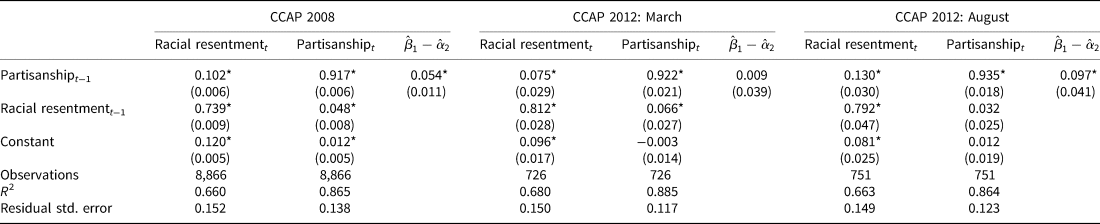
I begin with the 2008 CCAP, using the March and October waves and present the results in Columns 1–3 of Table 2. The first column supports the partisanship influence hypothesis. White strong partisans, over 40 per cent of the sample, separate by an average of 0.102 points in racial resentment (p < 0.05), about one and a half categories on a scale item. The racial attitude influence hypothesis also receives support. The difference in partisanship between the least and most racially resentful (about 16 per cent of whites) increases by an average of 0.048 points, over one-fourth a category on the seven-point item.
Relationship between whites' partisanship and racial resentment in the 2008 and 2012 elections

Partisanship also appears more substantively influential.Footnote 16 Column 3, which presents the difference in coefficient estimates, shows that partisanship's influence is reliably greater ( $\hat{\beta} _1-\hat{\alpha} _2 = 0.054$, p < 0.05). Moreover, the effect of moving across partisanship's range implicates a much larger proportion of people than that related to the estimated theoretical influence of racial attitudes. Attitude change appears to better explain the relationship between partisanship and racial attitudes than party switching in these data.Footnote 17
The remaining columns of Table 2 consider dynamics in 2012. Each week during the campaign a representative sample of the nearly 45,000 respondents who completed the December 2011 CCAP baseline survey were re-interviewed. I focus on the two waves reassessing racial resentment, one in March and the other in August.
The results again support the partisanship influence hypothesis. Column 4 shows that between December and March, the roughly 35 per cent of the white sample who identified as strong partisans separates by an average of 0.074 points on racial resentment (p < 0.05). Partisanship also matters for the August group. As the results in Column 7 indicate, strong partisans divide by 0.130 points on racial resentment, over two categories on a scale item (p < 0.05).
The results inconsistently support the racial attitude influence hypothesis. Column 5 indicates that the 14 per cent of whites in the March re-interview group placing at the extremes of the racial resentment scale separate by an average of 0.066 points on the partisanship item (p < 0.05), two-fifths of a category on the seven-point measure. This effect halves for the August re-interview group. The gap in partisan attachments grows by only 0.032 points, an insignificant difference (p > 0.10).
Further, partisanship again appears to be more substantively influential. Its influence on racial attitudes is greater in both waves, albeit only reliably so for the August re-interview group. In addition, in both waves partisanship's influence concerns a group 2.5 times that implicated by a maximal change in racial resentment. Racial resentment's substantive effect is thus, if anything, overstated and the difference in magnitudes indicates a restrictive characterization. Analyses in Appendix D using standardized measures complement this. As with the 2008 analyses, partisanship shapes racial attitudes in this context; but attitude change, not sorting, appears to better characterize dynamics.
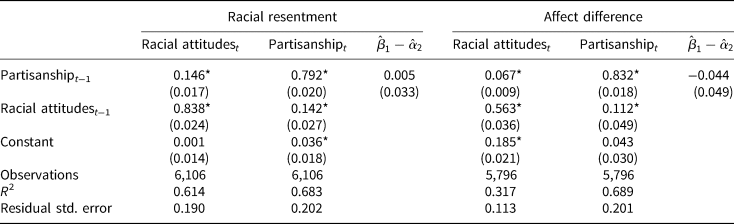
But these results only address election year patterns. Although helpful for unpacking attitude change dynamics, particularly for those made salient (Valentino and Sears Reference Valentino and Sears1998), a campaign context does not shed light on whether the partisanship influence hypothesis holds over longer periods of time. The results in Table 3 from the 2012–2016 VOTER survey help address this issue. And analyses in Appendix G using data from General Social Survey panels and the 2010–2014 Cooperative Congressional Election Study reveal that the dynamics I identify are not merely a function of surveys conducted during presidential elections. Midterm election year surveys fielded in this period show similar patterns.
Relationship between whites' partisanship and racial attitudes (2012–2016 VOTER survey)

The evidence in Table 3 again supports the partisanship influence hypothesis. Strong partisans (40 per cent of whites) separate by an average of 0.146 points in racial resentment (p < 0.05). This is equivalent to three and a half categories on a single scale item.
Racial attitudes also contribute to the relationship's dynamics. Those scoring at racial resentment's poles divide by an average of 0.142 points on partisanship, or one response category (p < 0.05).
Considering substantive importance, the test comparing the difference in estimated effects offers inconclusive evidence of whether attitude change or sorting drive the dynamics I observe. Column 3 reveals an estimated difference of near 0. But again, this is a comparison of theoretical differences across each measure's range. Racial resentment's effect is likely overstated because relatively few whites (13 per cent) populate the scale endpoints, a possibility reinforced by results from standardizing each measure that suggests partisanship matters more. While the evidence indicates that partisanship's influence can extend beyond campaign contexts, it is mixed as to whether partisanship is more substantively important between 2012 and 2016.Footnote 18
The VOTER survey also allows for assessing partisanship's influence using the group affect dimension of racial animus.Footnote 19 The results in Column 4 indicate that partisanship's influence persists. Partisanship shapes how much more negatively whites feel about blacks relative to whites ( $\hat{\beta} _1 = 0.067$, p < 0.05). Partisanship's influence is not confined to a measure that some contend contains racial policy content (Huddy and Feldman Reference Huddy and Feldman2009; Sniderman and Carmines Reference Sniderman and Carmines1997), making its influence all the more consequential. This is not simply another story of partisans adopting their party's policy positions (Lenz Reference Lenz2012), but rather one about whites updating their views about a marginalized group in society.
Affect also relates to changing party loyalties. Whites who rate blacks more negatively than whites identify as more Republican ( $\hat{\alpha} _2 = 0.130$, p < 0.05). These results do not support, however, the result that partisanship matters more when comparing theoretically possible changes (
 $\hat{\beta} _1-\hat{\alpha} _2 = -0.042$, p >0.1). But again, the estimated effect for racial attitudes on partisanship is overstated because respondents are not distributed similarly across the measure. Results reported in Appendix D standardizing the variables to adjust for this suggest partisanship has more substantive influence. As with racial resentment, attitude change is thus at least as likely as sorting to explain the growing correlation between racial attitudes and party loyalties, and potentially more so given that the estimated attitude change effect implicates many more respondents.Footnote 20
These results provide substantial evidence to support my argument that partisanship can shape racial attitudes. In the Obama era whites adopted racial views consistent with their party loyalties, and this holds for multiple dimensions of racial animus; partisans are not simply following on racial policy attitudes.Footnote 21 While less clear, the evidence also suggests that attitude change rather than sorting does more to explain the growing correlation between partisanship and racial attitudes.
2016: Sustained Party Influence
As a final test I examine whether these results are unique to President Obama. My argument is not simply about reactions to his administration. While the available panel data do not allow us to conclusively rule out any influence from Obama, I consider a period during which he was a less central political actor – the 2016 presidential election. The election featured Donald Trump, a politician more open than most to denigrating racial and ethnic minorities. Trump's actions, and the media coverage they received, provide considerations on race separate from Obama that whites could respond to by changing their attitudes or partisanship. Similarly, Hillary Clinton's strategy of attacking Trump more than advancing her own platform suggests considerations about Trump and his rhetoric were more plentiful, even if Clinton's platform consisted in large part of strengthening Obama's legacy on race-related issues (Sides et al. Reference Sides, Tesler and Vavreck2018). But Trump's ascendance also revealed a fracturing Republican Party. Democrats displayed similar divides, with Bernie Sanders challenging Clinton by appealing to economic dissatisfaction. Therefore during this period there are two possibilities: partisanship could still matter (that is, whites' partisanship could shape their racial attitudes) or other topics could matter more (that is, partisanship no longer changes racial attitudes).
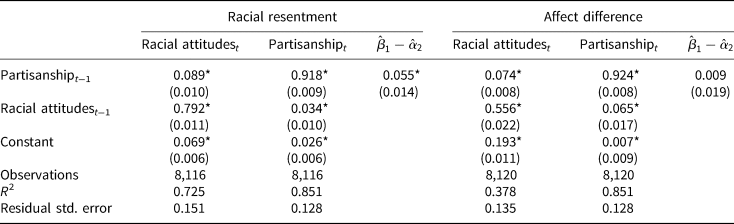
For this test I use data from the 2016 CCAP's June and November–December interviews. The results, included in Table 4, again support both hypotheses. The first column indicates that strong partisans, nearly 42 per cent of whites, separate by an average of 0.089 points in racial resentment, a difference of one scale item category on this three-item version (p < 0.05).
Relationship between whites' partisanship and racial attitudes (2016 CCAP)

That is not to say that whites did not also adopt new partisan allegiances. Column 2 suggests that racial attitudes encouraged changes in partisanship. The 20 per cent of the white sample located at the extremes of the racial resentment measure moves apart by 0.034 points on partisanship, or about one-fifth of an item category (p < 0.05).
The results also suggest that partisanship has greater substantive influence than racial resentment. Column 3 shows that the difference between partisanship and racial resentment is positive and significant ( $\hat{\beta} _1-\hat{\alpha} _2 = 0.055$, p < 0.05). This occurs despite racial resentment's effect being somewhat overstated because it still implicates fewer people than the same shift for partisanship.Footnote 22
The partisanship and racial attitude influence hypotheses also receive support when considering group affect. Here, respondents rated blacks and whites on five-point favorability scales rather than feeling thermometers as in the prior affect analyses.Footnote 23 Table 4’s remaining results show that partisanship changes affect ( $\hat{\beta} _1 = 0.074$, p < 0.05), and that affect relates to changing party loyalties (
 $\hat{\alpha} _2 = 0.065$, p < 0.05). These estimates offer no clear insight into substantive influence (
 $\hat{\beta} _1-\hat{\alpha} _2 = 0.009$, p > 0.10). But as with the VOTER survey results, racial attitudes' influence is likely overstated because few whites score at the measure's extremes. The dynamic relationship between partisanship and racial attitudes again manifests on a measure that contains no policy content, reinforcing the view that whites are updating their attitudes about a social group rather than merely adopting new policy positions.Footnote 24
That racial attitudes still align with partisanship even when Barack Obama is a less focal political actor suggests the dynamic relationship does not depend solely on him. Partisanship's relevance persists in a racialized electoral campaign created in part by the rhetoric from both major party candidates (Sides et al. Reference Sides, Tesler and Vavreck2018). Further, the evidence again suggests that the growing correlation between partisanship and racial attitudes likely comes more from attitude change than sorting.
Discussion
To synthesize these results, in this section I present each predisposition's relative effect across data collections. Figure 1 provides the estimated change in the outcome for a one-standard-deviation shift in the lagged predictor (β 1orα 2). This speaks to substantive effects by focusing on the most likely source of variation in the explanatory variable.
Change in present racial resentment (partisanship) produced by a standard deviation shift in lagged partisanship (racial resentment)
Estimated effect, Lagged partisanship, Lagged racial resentment
Note: figure denotes 84 per cent (thicker) and 95 per cent (thinner) confidence intervals. Results from models in Tables 1–4.

Figure 1 reinforces the insights from the preceding analyses that each predisposition's substantive primacy varies. While racial attitudes are more influential in one case, with an effect twice that of partisanship, partisanship is more influential in the rest – from 1.5 to nearly 6 times so – and this difference is reliable in three of five instances. Not only is the relationship dynamic, but partisanship has been a particularly potent force in recent years.
Partisan Lenses for All? Awareness Moderates Dynamics
While the evidence I provide indicates partisanship can shape whites' racial attitudes, I estimate an average effect throughout. Scholarship investigating the dynamics between issue orientations and partisanship suggests individual-level characteristics may condition such dynamics (Carsey and Layman Reference Carsey and Layman2006). To address these complexities and offer evidence to support my argument that partisans are likely responding to features in the information environment, I briefly consider whether political awareness conditions dynamics. Awareness captures individual differences in whether people encounter information and can incorporate what they hear into their existing attitudes (Zaller Reference Zaller1992). If partisans are responding to the information environment as I claim, then the most politically aware should change the most.
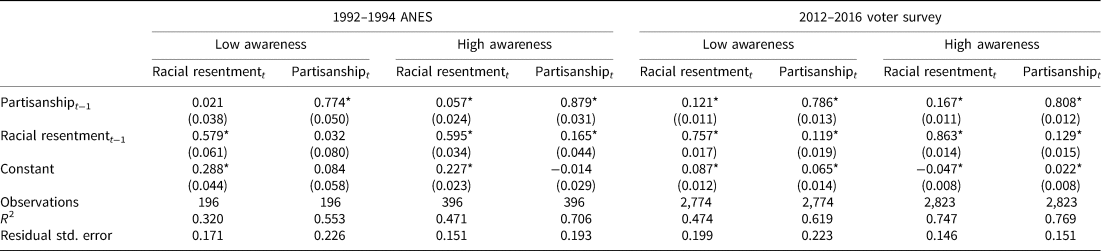
I focus on the 1992–1994 ANES and the 2012–2016 VOTER survey. I use the same model specification but generate separate estimates for high- and low-awareness individuals who I define, respectively, as scoring at and above, or below, the median political awareness score in each dataset.Footnote 25 Table 5 presents the results. The first two columns offer no evidence of a dynamic relationship between racial resentment and partisanship for low-awareness whites in the 1990s. They neither update their racial attitudes nor sort on these beliefs. The next column pair, however, reveals different patterns, and evidence in line with my expectations. The politically aware appear to update their racial attitudes ( $\hat{\beta} _1 = 0.057$, p <0.05) and adopt new party loyalties (
 $\hat{\alpha} _2 = 0.165$, p <0.05), with racial attitudes offering more substantive influence.Footnote 26 In this context, those who are likely to receive information and have the ability to respond to it appear to be more willing to switch parties than update their views of black Americans. That the politically aware change more supports my claim that individuals are likely responding to the information environment.
Political awareness's moderating effect on the relationship between racial resentment and partisanship

The results from the VOTER survey reveal different patterns. Between 2012 and 2016, the least politically aware both change their racial attitudes ( $\hat{\beta} _1 = 0.123$, p < 0.05) and adopt new party loyalties (
 $\hat{\alpha} _2 = 0.122$, p < 0.05). Even the least politically attuned appear willing to update their attitudes. But the results also indicate that the more politically aware are more responsive, suggesting the patterns I identify come from whites responding to the information environment. High-awareness whites' partisanship relates to changing racial attitudes (
 $\hat{\beta} _1 = 0.167$, p < 0.05), a substantively large difference that is also greater than that for low-awareness whites.Footnote 27 Further, while the results suggest sorting on racial attitudes (
 $\hat{\alpha} _2 = 0.128$, p < 0.05), this is substantively less important than partisanship. Only 7 per cent of the most aware white sample place at racial resentment's poles whereas strong partisans make up 46 per cent of the sample. While the evidence suggests the most aware are more likely to change their racial attitudes, both groups appear similarly likely to adopt new party loyalties.Footnote 28
These results support my argument that the information environment facilitates dynamics. With the politically aware the most engaged and attentive, they should be the most responsive to information they receive about race; my findings support this view.
Conclusion
I demonstrate that the relationship between partisanship and racial animus is not unidirectional as prior scholarship at least implicitly believes (Hutchings and Valentino Reference Hutchings and Valentino2004; Kinder Reference Kinder, Huddy, Sears and Levy2013). Rather, partisanship's centrality in whites' belief systems grounds my claim that it may contribute to racial attitude changes. I offer evidence that partisanship relates to changes on two dimensions of racial attitudes, and report results that it shapes stereotyping in Appendix I. Finally, while partisans of all stripes may update their racial attitudes, the politically aware change the most.Footnote 29 This aligns with my claim that partisans are responding to the information environment.
My results recast our understanding of the relationship between two predispositions presumed to be fundamental to individuals. Racial attitudes arguably form early in life and persist in much the same form through adulthood (Goldman and Hopkins Reference Goldman and Hopkinsforthcoming; Henry and Sears Reference Henry and Sears2009). Similarly, although partisan allegiances form somewhat later, the evidence suggests they typically shift the most following substantial changes in the party system (Campbell et al. Reference Campbell1960; Green et al. Reference Green, Palmquist and Schickler2002). Racial attitudes' early development and persistence encourages placing them causally prior to other outcomes, including partisanship, but this conceptualization blinds scholars to potential changes in causal dynamics. That partisanship and racial attitudes appear to have similar cognitive characteristics (Sears Reference Sears, Iyengar and McGuire1993) perhaps makes it less surprising that whites' partisan ties can motivate them to update their beliefs about black Americans in response to new information given received wisdom that similar processes motivate party switching (Green et al. Reference Green, Palmquist and Schickler2002).
While less conclusive, patterns in the results I present suggest that variation in partisanship's importance in the relationship may come from changes in the political environment. This is possible because political contexts make some predispositions more central in belief systems than others (Highton and Kam Reference Highton and Kam2011), with greater centrality increasing the predisposition's causal influence on other attitudes (Converse Reference Converse and Apter1964). Evidence that racial attitudes shape party loyalties comes in large part from the 1960s–1980s, a period when many Americans were adjusting their partisanship to account for changes in the party system caused by an issue that was more important to them than their partisan ties (Carmines and Stimson Reference Carmines and Stimson1989; Green et al. Reference Green, Palmquist and Schickler2002; Sears and Funk Reference Sears and Funk1999). But by defining conflict more in terms of partisanship than other concerns, the current polarized and competitive political environment has made partisanship a much stronger political force (Azari and Hetherington Reference Azari and Hetherington2016). The results I report here and in the Appendix are consistent with this contextual change influencing dynamics.
By elevating partisanship over other lines of conflict, partisan biases in information seeking and processing become more likely (Henderson and Theodoridis Reference Henderson and Theodoridis2018; Mason Reference Mason2018), giving people few incentives to change their party loyalties and more cause to adopt party-consistent attitudes (Highton and Kam Reference Highton and Kam2011). That partisanship's influence increases in the 2000s relative to the 1990s, and is typically greater than the impact of racial attitudes, is consistent with context affecting dynamics by shaping which orientation(s) people use to understand the world around them. Such context-specific dynamics are also consistent with recent work revealing that partisanship shapes religious affiliations in specific life-cycle moments (Margolis Reference Margolis2018). Partisanship appears to be capable of shaping presumptively fundamental orientations, but the extent of this influence may be conditional.
That whites are likely to change their racial attitudes potentially introduces perverse incentives for political campaign strategy. For decades politicians have faced the ‘electoral temptations of race’ to generate support through racial campaign appeals (Kinder and Sanders Reference Kinder and Sanders1996; Mendelberg Reference Mendelberg2001). Republican candidates may increasingly find success using this messaging because their core supporters' increasingly negative racial attitudes give these tactics greater purchase. Moreover, my results suggest such appeals could lead to additional party-driven attitude change, therefore introducing a vicious cycle. It seems unlikely that these attitude change dynamics are a short-term phenomenon.
Recent work suggests that negative racial appeals could have even more deleterious outcomes because the set of racial appeals available to politicians may be increasing. Whereas prior work demonstrated that social norms shape how politicians talk about race (Mendelberg Reference Mendelberg2001), new evidence suggests these prohibitions may be changing (Valentino et al. Reference Valentino, Neuner and Vandenbroek2018). Whites do not appear to shun explicit racial cues like they used to. If party elites who employ negative racial appeals are not punished, then these appeals may become increasingly common. Such an outcome could produce pernicious consequences because the current party-centric era makes party elites particularly influential sources of social norms. Elites using negative racial appeals, particularly explicitly hostile ones, can validate this same behavior in the mass public (Crandall et al. Reference Crandall, Miller and White2018). Changing norms can lead the racial tensions built into the party system to surface, with normatively troubling consequences.
Conversely, my results also indicate that politics, through partisanship, may reduce racial animus. That white Democrats' attitudes are becoming more positive towards blacks suggests that political processes need not exclusively amplify racial animus. Motivation appears to be a key component of effective prejudice reduction techniques (Paluck and Green Reference Paluck and Green2009), and my results suggest that partisanship may provide some of the encouragement whites need to re-evaluate racial categories. Further, that the politically aware exhibit more attitude change suggests some combination of information exposure and willingness and/or ability to update existing attitudes. Future work could consider the discrete factor(s) at work among Democrats to identify paths for mitigating racial animus.
But all of this assumes that the patterns of change I describe reflect actual attitude change. While changes in survey reports that relate to partisanship could indicate patterns of expressive responding and social desirability concerns rather than true attitude change (Bullock et al. Reference Bullock2015), analyses in Appendix N suggest that the meaning of racial resentment does not appreciably change over time in ways that suggest responses contain additional considerations. Attitude change, not expressive responding, appears to best explain the patterns I present. Left unaddressed, though, is how this likely attitude change relates to behavior. It could be the case that white Democrats look little different than white Republicans when considering observed intergroup behaviors despite having markedly different attitudes. This is an important question, and investigating it will help explore the potential disconnect between stated and revealed preferences.Footnote 30
These lessons reorient the perspective that race is fundamental to politics by demonstrating that politics are also fundamental to race. Politics shape how whites view black Americans. Despite the Founders' desires, proper institutional arrangements appear insufficient to stifle group-based antagonisms (Hamilton et al. Reference Hamilton, Madison and Jay2006[1788]). In fact, the processes these structures establish can stoke, or quell, racial animus.
Supplementary material
Data replication sets are available in Harvard Datraverse at: https://doi.org/10.7910/DVN/V7TQOZ and online appendices are available at https://doi.org/10.1017/S0007123419000437
Acknowledgements
I thank Allison Anoll, Larry Bartels, Marc Hetherington, Cindy Kam, Efrén Pérez, Ronald Rapoport, Alex Theodoridis, Marc Trussler, the Vanderbilt Research on Individuals, Politics, and Society lab group, and the University of California, San Diego's Race Workshop for helpful feedback and discussions during this project. A previous version of this article was presented at the 2015 annual meeting of the Midwest Political Science Association.