Introduction
Nest-site selection refers to the selection of the breeding habitat (Jones Reference Jones2001) and is crucial for birds as nest-site characteristics can have significant effects on their breeding success (Gaillard et al. Reference Gaillard, Hebblewhite, Loison, Fuller, Powell, Basille and Van Moorter2010, Chalfoun and Schmidt Reference Chalfoun and Schmidt2012, Subedi et al. Reference Subedi, Anadón, Baral, Virani and Sah2019). Breeding birds may select areas with abundant resources to improve the development of their chicks (Crampton and Sedinger Reference Crampton and Sedinger2011, Machin et al. Reference Machin, Fernandez-Elipe, Flinks, Laso, Aguirre and Klaassen2017). Yet they are also expected to adjust their nest-site selection according to the perceived predation risk (Watts Reference Watts1989, Segura et al. Reference Segura, Masson and Gantchoff2012). Thus, the choice of breeding sites is actually a dynamic process and should vary in space and time depending on the availability of suitable conditions (Wiens Reference Wiens1992, Forstmeier and Weiss Reference Forstmeier and Weiss2004, Gjerdrum et al. Reference Gjerdrum, Elphick and Rubega2005). This seems particularly true for species whose range is expanding (Veech et al. Reference Veech, Small and Baccus2011, Perez-Granados et al. Reference Perez-Granados, Lopez-Iborra and Seoane2017). For threatened but recovering species such as the Crested Ibis Nipponia nippon (BirdLife International 2021), a sufficient knowledge of drivers of nest-site selection is therefore required to achieve the most effective conservation and management planning.
The Crested Ibis was once widely distributed in North-east Asia. Deforestation, habitat loss, environmental pollution and unsustainable hunting pressure have decimated populations since the late 19th century (Ding Reference Ding2004, Li et al. Reference Li, Tian and Li2009), resulting in the supposed extinction in the wild, until the rediscovery of seven birds in Yangxian County, Shaanxi Province of central China in 1981 (Liu Reference Liu1981). Through a series of long-term and strenuous efforts including in-situ and ex-situ conservation and reintroductions, the wild population of Crested Ibis has increased to more than 2,500 individuals in 2019 (Wang et al. Reference Wang, Zhang, Zeng, Gao, Yan and Liu2020). However, the only wild population is restricted to a limited area, and as the habitat quality continuously declines, the Crested ibis is still listed as ‘Endangered’ (BirdLife International 2021). Following the current population increase, more and more ibises dispersed from the mountains (mostly within the core protected area; hereafter “original nesting area”) to hills and plains at lower elevations. The species now breeds partly outside of protected areas, representing a new challenge to its conservation and effective habitat management.
Crested Ibises dispersing to lower elevations encounter totally new environments, because of the different land use (Ding Reference Ding2010, Hu et al. Reference Hu, Song, Ding, Ye, Qing and Wang2016) and especially much higher anthropogenic pressure. Dispersing individuals have shown different responses to habitat features under new circumstances. For example, the winter-flooded paddy fields, which were previously considered the key foraging habitat in winter, are no longer regarded as limiting within the recently colonised range, because of the high food availability in other wetland types (Sun et al. Reference Sun, Skidmore, Wang, van Gils, Wang, Qing and Ding2014, Hu et al. Reference Hu, Song, Ding, Ye, Qing and Wang2016). Previous research showed that nest-site selection of Crested Ibis depends on a combination of multiple environmental factors including terrain, vegetation, food availability and human disturbance (Li et al. Reference Li, Ma, Li, Ding, Zhai and Lu2001, Ding Reference Ding2004, 2010). Typically, breeding Crested Ibises prefer to nest in tall trees, within thick canopy, and select sites in the middle and lower parts of the mountain slope with winter-flooded paddy fields and low human disturbance (Ding Reference Ding2010). However, these findings are restricted to the original nesting area. Interestingly, previous studies found that the ibises breeding in low plains had higher brood size and better fledging success than those in mountain areas (Song Reference Song2018). However, there is still a lack of knowledge on how the ibises select habitat features within the expanding range, especially in areas with higher human disturbance. Such information is crucial for guiding future conservation actions for the Crested Ibis.
We surveyed nests and investigated nest-site characteristics of Crested Ibis among its current distribution range, in order to identify the major factors affecting nest-site selection and to determine if those differ in recently expanded areas. We also address how these results should provide a key scientific basis for conservation management of the endangered Crested Ibis and for the spatial planning of future reintroduction programs.
Material and methods
Study area
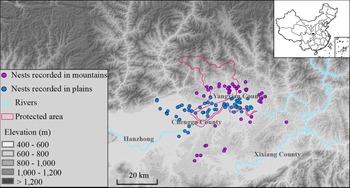
The study area is located on the south slope of the Qinling Mountains, at the intersection of the Han River Plain in the south-west of Shaanxi Province, central China (32°53’N to 33°41’N, 106°40’E to 107°57’E; Fig. 1). It includes most of the current distribution range of the wild Crested Ibis with an elevation ranging from 440 to 800 m. It is characterized by flat or rolling mountains, with major land cover types being forest, shrub, grass, open water, cropland, and built-up areas. The croplands comprise dry and flooded paddy-fields during the breeding season.
Map of the study region and nests recorded.

The mountain areas are characterized by complex terrain featuring woodland, raw cropland, and few settlements, while the lowland plains mostly consist of intensive anthropogenic landscapes such as farmlands, orchards, roads, and towns.
Data collection
The nests of Crested Ibis were regularly reported and checked by Shaanxi Hanzhong Crested Ibis National Nature Reserve each year. We conducted surveys and nest-site investigation based on the records from the nature reserve during incubation and chick-rearing period (April to June) in 2015–2019. Nest-site selection was assessed by characterizing the nest sites and neighbouring unused sites that were supposed to be less suitable, i.e. each nest site was paired with one random site at a distance of 50 to 100 m. No random site was placed if there was no tree in the surroundings of a nest site. We focused on habitat variables associated with terrain, nest conditions, vegetation, human disturbance, and food conditions. Measurements were carried out within a 10 × 10 m plot around each nest and random site (Appendix S1 in the online supplementary material).
Statistical analysis
We first compared the differences in nest characteristics between mountains and plains. We divided the nest sites into these two groups according to elevation (Hu et al. Reference Hu, Song, Ding, Ye, Qing and Wang2016); nest sites with elevation >600 m were classified within the ‘mountain’ group, while those under 600 m were part of the ‘plain’ group. For continuous variables, we used Mann-Whitney U-tests, as the data were not normally distributed based on Kolmogorov-Smirnov tests. The chi-square test was conducted for the categorical variables.
In a second step, we examined the important environmental drivers for nest-site selection using logistic regression in a generalized linear mixed-effects model (GLMM) with the binomial presence (0/1) as response variable. Models were fitted using the function glmer from the package lme4 with habitat variables as fixed effects, while pair ID (a nest and its random counterpart) and nest year were designated as random effects. As a model selection approach, we generally followed the procedure described in Barras et al. (Reference Barras, Marti, Ettlin, Vignali, Resano-Mayor, Braunisch and Arlettaz2020). The habitat variables involved were standardised beforehand. Prior to the regression, the collinearity among variables was examined by Spearman’s correlation test, retaining only those with |r| <0.7, and carefully checking that all variables had variance inflation factors (VIF) <3 in all fitted models. From a full model containing all habitat variables, a list of candidate models with all possible variable combinations was generated and ranked according to the AICc (AIC with correction for small samples) using the function dredge from the package MuMIn (Bartoń Reference Bartoń2018). The best-supported models were defined as those within ΔAICc <2 from the first-ranked one, after excluding models with uninformative parameters (Arnold Reference Arnold2010). The importance of each variable was assessed by summing the Akaike’s model weight (wi) from all the possible candidate models (Burnham and Anderson Reference Burnham and Anderson2002). To better understand the effect of habitat variables on current nest-site selection of the Crested Ibis, plots of nesting probability (i.e. suitability) against each significant variable (with P < 0.05) were drawn using the first-ranked model within the best-supported ones, with other retained variables set to their mean, and 95% credible intervals (as 2.5% and 97.5% quantiles) drawn from 10,000 simulations using the package arm (Gelman and Su Reference Gelman, Su, Yajima, Hill, Pittau, Kerman, Zheng and Dorie2018).
Lastly, to explore how major factors may differ or not under new circumstances, we further included the habitat type (mountain or plain) as a fixed factor in the top-ranked GLMM (with interactions) to see if selection curves vary accordingly. In addition, for variables associated with characteristics of nesting trees (DBH, nest height, height of nesting tree and distance to trunk), we used Mann-Whitney U test (data were not normally distributed based on Kolmogorov-Smirnov test) to compare them between main nesting trees in mountain areas and plains. All analyses were conducted in R 3.5.3 (R Development Core Team 2019).
Results
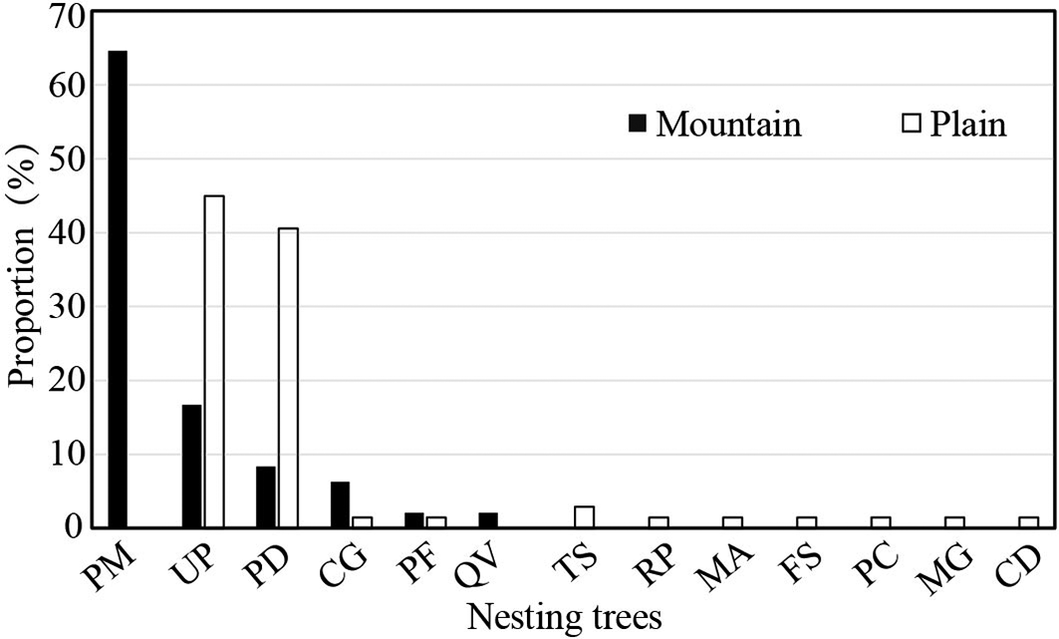
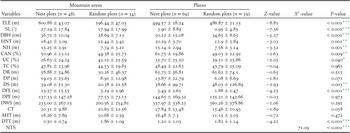
We located a total of 117 nest sites during 2015–2019, and collected information for 73 random sites, for a total of 190 sampled sites. The surveyed nests were found across the distribution range of wild Crested Ibis (Fig. 1), with 48 nests (41.0%) located in mountain areas and 69 nests (59.0%) in lowland plains. In mountain areas, six nesting-tree species were recorded, of which Masson pine (64.6%) was the most frequent. In plains, there were 11 nesting-tree species, of which the majority were elm (44.9%) and aspen (40.6%) (Fig. 2). Eleven habitat variables showed significant difference between mountains and plains (P <0.05; Table 1). As expected, the elevation and slope were lower in plains. Six variables, DBH, height of nesting tree, nest height, cover above nest, understorey coverage and distance to tree trunk, were larger in plains. Distance to settlement was larger in mountain areas, while the distance to forest edge was lower. Besides, use of nesting-tree species differed between mountain areas and plains. Nest height and the height of nesting tree showed high correlation with each other (r = 0.86, P < 0.05), we retained the height of nesting tree in the multivariate models since it was more instructive concerning habitat conservation. All variables in our models had a VIF <3.
Proportion of nesting trees of Crested Ibis in mountain areas (n = 48) and plains (n = 69), respectively. PM, Pinus massoniana; UP, Ulmus pumila; PD, Populus davidiana; CG, Cyclobalanopsis glauca; PF, Paulownia fortunei; QV, Quercus variabilis; TS, Toona sinensis; RP, Robinia pseudoacacia; MA, Morus alba; FS, Firmiana simplex; PC, Pistacia chinensis; MG, Metasequoia glyptostroboides; CD, Cedrus deodara.

Habitat variables measured at each nest and random plot. Mean ± SD values are displayed. Results of comparison of habitat variables in nest plots between mountains and plains was also shown.

ELE Elevation, SL Slope, DBH Diameter at breast height, HNT Height of nesting tree, NH Nest height, CAN Cover above nest, UC Understorey coverage, TC Tree cover, DR Distance to road, DP Distance to Path, DS Distance to settlement, DFE Distance to forest edge, DPF Distance to paddy field, DWS Distance to water source, CT Count of trees, AHT Average height of trees, DTT Distance to tree trunk, NTS Nesting-tree species
* P <0.05;
** P <0.01;
*** P <0.001
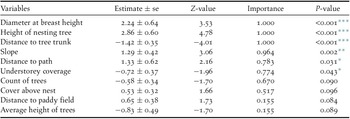
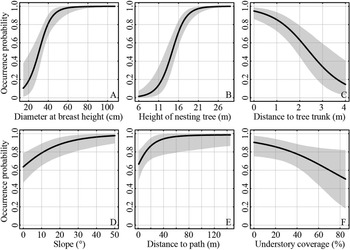
A final set of five top models within ΔAICc <2 was obtained in the model selection approach (Table S1). The results supported inclusion of 10 variables (Table S1), which showed consistent coefficient estimates in the best-supported models, thus the effect of each variable was well represented by the first-ranked model (Table 2). Within the 10 variables, six were significant (P < 0.05), of which DBH, height of nesting tree and distance to trunk showed the highest importance weight (1.000), followed by slope (0.964), distance to paths (0.783) and understorey coverage (0.774) (Table 2). DBH had a positive effect on nest-site selection of the Crested Ibis (β ± SE = 2.24 ± 0.64), and nesting probability reached an optimum as it increased above 65 cm (Fig. 3A). Height of nesting tree was also strongly, positively correlated with nest-site selection (β ± se = 2.86 ± 0.60), when it increased more than 23 m, the nesting probability reached a steady optimum (Fig. 3B). The distance to trunk had a negative effect (β ± SE = −1.42 ± 0.35), i.e. Crested Ibises tended to nest closer to tree trunk. The slope (β ± SE = 1.29 ± 0.42) and distance to path (β ± SE = 1.33 ± 0.62) were both positively correlated with nest-site selection, while understorey coverage had a negative effect (β ± SE = −0.72 ± 0.37).
Variables retained in the set of top models within ΔAICc <2 in the analysis of generalized linear mixed-effects models. Coefficient estimates, Z and P-values are from the top-ranked model in each analysis, whereas importance of the variable (from 0 to 1) is the sum of Akaike weights from all the possible candidate models.

* P <0.05;
** P <0.01;
*** P <0.001
Regression line of nesting probability against all the significant habitat variables from the top-ranked GLMM, along with 95% credible intervals (shaded grey areas).

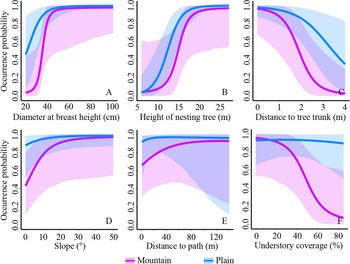
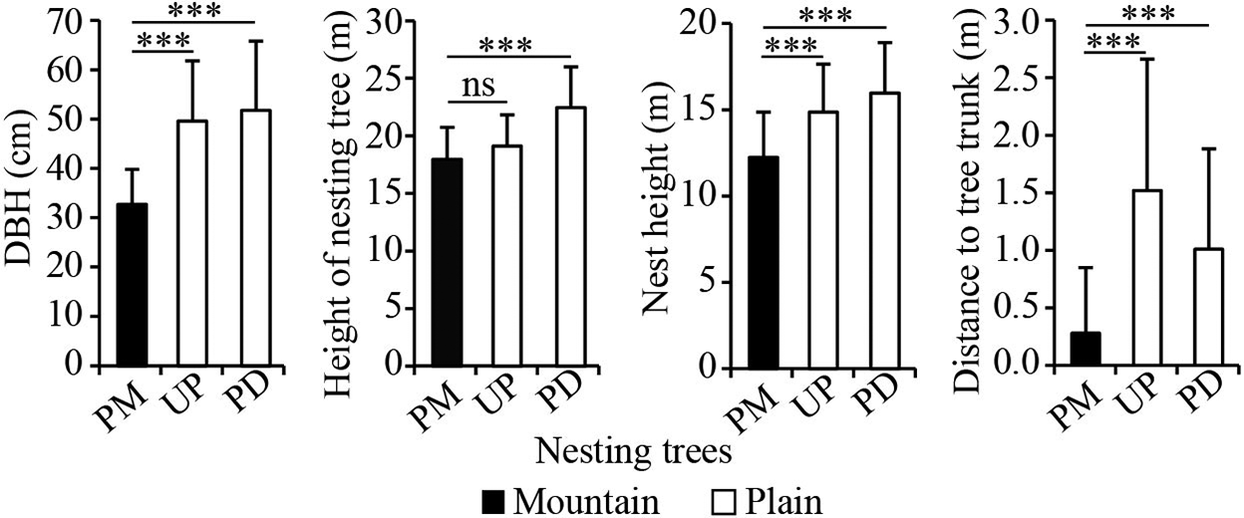
The top-ranked GLMM including habitat (mountain and plain) as a fix factor showed consistent coefficient estimates in the six significant variables above, and only plain factor showed interactions, especially with understorey coverage (Table S2). Although no interaction was found in mountain factor, nest-site selection pattern appeared to vary between different habitats according to the selection curves. We found consistent selection pattern for both DBH and height of nesting tree, with positive response (Fig. 4A and Fig. 4B). The distance to tree trunk had a negative effect within both habitats, but ibises in mountain areas preferred nesting closer to trunk (Fig. 4C). The three variables, slope, distance to path and understorey coverage, showed similar effects within mountain areas as those in top-ranked GLMM without ‘habitat’ variable, but within plains these variables seemed to have no clear effect on the nest-site selection of Crested Ibises (Fig. 4D, Fig. 4E and Fig. 4F). Analysis of Mann-Whitney U test showed that four variables associated with nesting trees tended to be larger in the most used trees in plains (Fig. 5).
Regression line of nesting probability within mountain areas and plains, against all the significant habitat variables from the top-ranked GLMM, along with 95% credible intervals (shaded coloured areas).

Comparison of the nest characteristics in the main nesting trees between mountain areas and plains. Heights of bars represent mean values and error bars represent standard errors. PM, Pinus massoniana (n = 31); UP, Ulmus pumila (n = 31); PD, Populus davidiana (n = 28).

Discussion
Knowledge of breeding habitat selection is crucial for understanding bird ecology (Cody Reference Cody1985) and can thus provide vital information for the conservation management of endangered species (McKellar et al. Reference McKellar, Kesler and Walters2016). Our study indicated that nesting-tree species of wild Crested Ibises vary in different habitats, and that DBH, height of nesting tree, distance to trunk, slope, distance to nearest path and understorey coverage are important factors affecting the nest-site selection of this bird species.
Our analysis showed that the Crested Ibis prefers nesting in specific trees (Fig. 2). Among the 13 nesting-tree species recorded in this study, Masson pine, elm and aspen were most frequently used (Fig. 2). Selecting specific trees for nesting has also been observed in other tree-nesting ibis species such as Giant Ibis Pseudibis gigantea (Keo Reference Keo2008), Red-naped Ibis Pseudibis papillosa (Soni et al. Reference Soni, Sharma and Soni2010) and Black-headed Ibis Threskiornis melanocephalus (Senma and Acharya Reference Senma and Acharya2010). Most of those studies have shown that these relationships are driven by nesting opportunities, such as an adequate support for nesting structures, suitable height, and thick canopy. Similarly, the Crested Ibis prefers Masson pine, elm and aspen for nesting probably because these trees are larger in DBH and enable nesting high above ground but still within thick canopy. More importantly, these trees, especially elm and aspen in plains, are usually located in the direct vicinity of suitable feeding grounds (in most cases flooded paddy fields). Furthermore, the difference of nesting-tree species between mountain areas and plains (Table 1, Fig. 2), is related to the distinct vertical distribution of forest types (Ding Reference Ding2004), with aspen and elm being more abundant than Masson pines at low elevations.
We found consistent positive effects of DBH and height of nesting tree on nest-site selection within both mountain areas and plains, suggesting that this ibis prefers nesting in trees that are larger and higher in size. Trees with larger DBH are usually older and have thicker branches and can offer adequate support to Crested Ibis nests. Previous studies on other ibis species found that nests built in smaller trees had less structural support and were more likely to collapse (Garrett Reference Garrett1996), especially during storms and windy days (Olmos and Silva Reference Olmos and Silva e Silva2001), resulting in breeding failure. Therefore, the physical stability of a nesting substrate is an important prerequisite for breeding success (Si Bachir et al. Reference Si Bachir, Barbraud, Doumandji and Hafner2008, Vlachos et al. Reference Vlachos, Bakaloudis, Alexandrou, Bontzorlos and Papakosta2008, Raimilla et al. Reference Raimilla, Rau and Niklitschek2015). Compared with mountain areas, the DBH of nesting trees in plains was larger (Table 1, Fig. 5), mostly because selected nesting-tree species, elm and aspen, are usually larger than Masson pine. Another reason is that branches of Masson pine commonly grow crosswise, thus being favourable to nesting and resting of the Crested Ibis (Ding Reference Ding2004), while branches of elm and aspen grow obliquely upward, such that only large trees may offer branches thick and flat enough for nesting.
Selection of taller nesting trees and nesting higher above ground have also been evidenced in other Ciconiiformes species such as the Great Egret Ardea alba (Post Reference Post1990). Nesting higher would be beneficial for landing and take-off (Chaudhury and Koli Reference Chaudhury and Koli2018), and thus easy access to nests, as the nesting trees are generally taller than the surrounding trees. Besides, nesting higher may protect nestlings from potential terrestrial predators, as breeding success is generally better in nests high above ground (Nias Reference Nias1986; Rodrigues et al. Reference Rodrigues, Jesus and Campos2018). In plains, the main nesting trees were on average taller than those in mountain areas (Table 1, Fig. 5) and hence provide suitable branches for nesting higher above ground, which might compensate for the increased human disturbance resulting from higher human population density (Hu et al. Reference Hu, Song, Ding, Ye, Qing and Wang2016).
Distance to trunk was also one of the most important predictors for nest-site selection, with birds selecting places close to trunk. Similar preferences were observed in Cattle Egret Bubulcus ibis, with nests situated close to trunk showing higher fledging success (Si Bachir et al. Reference Si Bachir, Barbraud, Doumandji and Hafner2008). The nest of the Crested Ibis is typically constructed like a simple platform of flimsy sticks (Ding Reference Ding2004), so that branches close to trunk, hich are thicker and sturdier (Horn Reference Horn1971), offer increased support and stability for nest structures. This is particularly true for ibises nesting in Masson pines, whose branches far from trunk are usually rather slender. In the plains, however, Crested Ibises used different nesting trees which offer thicker and bifurcated branches spreading outward as discussed above, hence enabling nest placement farther from the trunk (Table 1, Fig. 4C, Fig. 5).
We found three other variables, namely slope, distance to path and understorey coverage, have significant impact on nest-site selection of Crested Ibises (Table 2, Fig. 3D, Fig. 3E and Fig. 3F). However, these factors seem to matter more in mountain areas, whereas they had only little impact in plains (Fig. 4D, Fig. 4E and Fig. 4F). This suggests that in spatially heterogeneous environments, considering distinct habitats is necessary when assessing species-habitat relationships, especially for conservation planning. One of the main differences between the two habitats is that the human population density is higher in plains. In mountain areas, human activities could be lower in areas with higher slope, thus ibises built their nests in steeper areas and farther from paths, presumably to avoid human disturbance as previously evidenced (Li et al. Reference Li, Ma, Li, Ding, Zhai and Lu2001). Another reason might be the higher availability of Masson pines in steeper slopes. For ibises in plains, the limited influence of slope and distance to path on nest-site selection suggests reduced sensitivity to human disturbance, which is consistent with regional differences in tolerance to human activity (Zou Reference Zou2017). Nests in mountain areas are usually built close to forest, and nesting trees have relatively width and thick canopy, thus lower understorey coverage in nest sites may be explained by the reduced light. In this case, the ground biomass may decrease and hence be not attractive to snakes or weasels, which are potential predators of Crested Ibis (Ding Reference Ding2004), whereas in plains the terrestrial predation risk would be lower due to higher human activity.
Conservation implications
Our study indicated that tall trees with suitable nesting places are key in driving nest-site selection of the Crested Ibis, particularly in recently colonized lower elevation plains. Tall trees available for nesting are relatively restricted in the plains in comparison to mountain areas, and many are threatened by felling due to insect pests or shading the light from houses. For example, we documented three and five cases of anthropogenic damage to nesting trees in the field in 2018 and 2019, respectively (authors’ unpubl. data), such that those could not be used as nest sites anymore. Therefore, we stress the importance of establishing an inventory of large trees like elms and aspens in plains, especially the trees already used for nesting, for their protection and preservation. As the population of the wild Crested Ibises continues to increase and expand, only a proactive approach might be effective for conservation. As most nests are built outside the protected area (73.9% recorded in this study), further efforts to establish new monitoring programmes in recently colonized areas with high-density nests are needed. Furthermore, we found that Crested Ibises’ responses to different habitats could vary, and such variation should be addressed in conservation planning, especially in future reintroduction. Future reintroduction projects could be based on the successful development of the wild population and prioritize habitat in mountain areas with low human disturbance. Besides tall and large trees, the low understorey coverage should also be considered when choosing releasing sites, in order to reduce potential terrestrial predation risk.
Supplementary Materials
To view supplementary material for this article, please visit https://doi.org/10.1017/S0959270921000526.
Acknowledgements
We are grateful to the staff of the Shaanxi Hanzhong Crested Ibis National Nature Reserve for their field assistance. We thank Dr. Zitan Song and Dr. Canshi Hu for their contribution in data collection. This project was funded by the National Natural Science Foundation of China (No. 31772483 and 31900371) and the Biodiversity Survey, Monitoring and Assessment Project of Ministry of Ecology and Environment, China (No. 2019HB2096001006).