Survival of individuals with complex congenital heart malformations has increased over the past decades. Children born with univentricular hearts undergo stepwise surgical interventions to a Fontan circulationReference Fontan and Baudet 1 , Reference Kanakis, Petropoulos and Mitropoulos 2 and the majority will survive into adult life. There is increasing concern, not only about cardiovascular complications over time, but also about the children’s quality of life.Reference Dulfer, Bossers and Utens 3 Several studies have shown lower self-perceived quality of lifeReference Dulfer, Bossers and Utens 3 – Reference Uzark, Jones, Slusher, Limbers, Burwinkle and Varni 6 and reduced physical performance also in Fontan patients with satisfactory surgical results and heart function.Reference Goldberg, Avitabile, McBride and Paridon 7 – Reference Muller, Christov, Schreiber, Hess and Hager 10 There seems to be a general understanding that there is a positive correlation between quality of life and physical capacity and performance. Hence, several studies have been performed to improve physical capacity through different training programmes, showing varying results.Reference Duppen, Etnel and Spaans 11 – Reference Sutherland, Jones and d’Udekem 13 There is, however, to our knowledge, no published study about the effects of physical training on quality of life in young Fontan patients compared with a healthy control group. The aim of the present study was accordingly to measure physical capacity and quality of life before and after an individualised endurance training programme in young Fontan patients and healthy age- and gender-matched control subjects.
Material
All children with Fontan palliation born between 1990 and 2005 in the Stockholm region, n=53, were considered for participation. Exclusion of 23 patients was made after hospital charts had been reviewed or the patients had declined participation. Exclusion criteria were neurodevelopmental disorder (n=5), heart transplant (n=2), acute myocarditis (n=1), under investigation for further surgery (n=1), muscle weakness (n=1), moved to other geographical region (n=2), and short stature below 125 cm (n=1). The number of families who declined to join the study was ten. Each patient and their parents were asked to suggest a healthy peer of the same age and gender to serve as a healthy control.
Fontan circulation was completed at a median age of 2.4 (1.1–6.4) years, all with a synthetic extracardiac conduit and without any fenestrations.
Methods
6-minute walk test
All participants performed a 6-minute walk test at the hospital before the ergometer cycle test, as a surrogate test for submaximal exercise capacity in patients with cardiac disease.Reference Lammers, Hislop, Flynn and Haworth 14 The participants were instructed to walk as fast and far as possible on an indoor lane during 6 minutes. Variable speed was allowed but not running. Encouragement and information about time remaining were given by study leaders every minute of the test. Total walking distance was measured after 6 minutes. The heart rate was measured before, directly after, and 2 and 4 minutes after the test.
Cardiopulmonary exercise testing
The patients performed symptom-limited exercise tests using a stationary, calibrated upright cycle ergometer (Monark Ergomedic 839E; Monark Exercise AB, Vansbro, Sweden) with a continuous increase in load, connected to a testing system (GE CASE Exercise testing system; Davis Medical Electronics Inc., Vista, California, United States of America). Start and increment of load during the test were chosen individually based on the self-reported physical capacity and activity, in order for each individual to reach exhaustion within approximately 10 minutes. Body mass (kg) and height (m) were measured before the test. Echocardiography was made on all individuals before the test in order to detect signs of thrombosis, intracardiac shunting, or significant valvular incompetence. The children were instructed to maintain a constant pedalling rate of 60 rpm and were actively encouraged throughout the test. Standard 12-lead electrocardiogram, blood pressure, and pulse oximetry were monitored before, during, and for 10 minutes after the test. Blood pressure was measured with cuff and radial artery Doppler signals during the test.
Breath-by-breath analyses of metabolic variables (V-max Encore; Viasys HealthCare Inc., Ohio, United States of America), including oxygen consumption and respiratory parameters, were performed continuously using a mouth-piece and a nose clip. The mass flow metre was calibrated with a fixed volume and the gas analyser with two reference gases before every test. The patients and control subjects were encouraged throughout the test to perform and continue until maximal exhaustion. Maximal cardiopulmonary data were obtained by averaging the last 20 seconds of each test and correcting for each individual’s weight in kg (e.g. maximal oxygen uptake, ml/minute·per kg).
Quality of life
Quality of life was assessed using the Pediatric Quality of Life Inventory Version 4.0 generic core scales (Mapi Research Trust, Lyon, France). The Pediatric Quality of Life Inventory Version 4.0 has been validated for health-related quality of life assessment in children and adolescents with acute or chronic health conditions and in healthy children and adolescents.Reference Varni, Burwinkle and Seid 15 The Swedish translation of the generic module used has also been validated.Reference Petersen, Hagglof, Stenlund and Bergstrom 16 The Pediatric Quality of Life Inventory Version 4.0 generic core scales encompass eight items of physical functioning, five items of emotional functioning, five items of social functioning, and five items of school functioning. The questionnaire can be divided into two parts: a physical domain and a psychosocial domain, which covers emotional, social, and school functions. The patients, controls, and their parents answered separate questionnaires concerning quality of life during the preceding month. The parental questionnaire assessed the parent’s perceptions of their child’s health-related quality of life. Each answer was transformed into a five-step score, summed up, and divided by the number of items answered. The highest possible quality of life score was 100.
Endurance training for 12 weeks and 1-year follow-up
Each Fontan patient and control subject, together with at least one parent, was interviewed about the subject’s organised physical exercise during an average school week. Duration in minutes was stated and average perceived intensity was estimated using the Borg scale, which is a method by which a subject can quantify self-perceived exercise effort on a scale from six to 20.Reference Eakin, Finta, Serwer and Beekman 17 An individualised endurance training programme was designed for each subject based on this history, the results of the ergometer and oxygen uptake tests, time of year, and available sports and instructors near school or home. The contract was to include 2×45 minutes of extra instructor-led endurance training every week for 12 consecutive weeks, with maintained baseline activities such as physical education in school and other sports. The endurance training programmes included sports such as running, jogging, skiing, cycling, riding, swimming, dancing, football, and so on. The purpose of the training programme was to increase endurance training at a submaximal level with the aim to increase load gradually during the training programme. The patients were instructed not to perform exercise training at maximal effort. Type of activity, duration, and intensity (Borg scale) were reported in a logbook and analysed by the study leaders together with the study subjects and a parent. Duration and intensity of the training were recorded as weekly average during the training period.
All cardiopulmonary tests, 6-minute walk test, and quality of life measurements were repeated after the 12-week endurance training programme and again after 1 year, without further encouragement regarding extra exercise from the study leaders.
Statistical analysis
The statistical analyses between the groups were performed using t-tests and χ2 tests as appropriate. Repeated measures ANOVA was carried out to perform analyses over time. A multiple stepwise regression analysis was performed with quality of life as a dependent variable and having a heart defect, distance in a 6-minute walk test, maximal oxygen uptake, maximal work-load, maximal heart rate, maximal blood pressure, and oxygen saturation at maximal effort as independent variables. Statistical significance was set at p<0.05. The statistical programme used was Statistica 12 (StatSoft Inc., Tulsa, Oklahoma, United States of America).
Results
After parental consent and child assent, the study group comprised 30 patients with Fontan circulation and 25 healthy control subjects. In all, 17 patients brought a peer each to serve as a healthy control subject. The remaining 13 patients did not want to, or could not, bring a control subject. For the patients who could not bring a peer, we recruited eight age- and gender-matched controls (independent controls) from families and friends of the hospital staff.
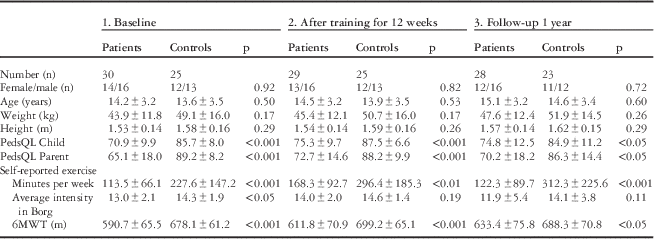
The patient group comprised 14 females and 16 males. The control group comprised 12 females and 13 males. Mean age in years was 14.2±3.2 for patients and 13.6±3.5 for controls, p=0.50. Weight and height did not differ significantly between patients and controls; see Table 1. Body mass index was 18.3±2.2 kg/m2 for patients and 19.2±3.3 kg/m2 for controls, p=0.22.
Characteristics and results.

6MWT=6-minute walk test; PedsQL=Pediatric Quality of Life Inventory Version 4.0
Values presented as mean±1 SD
Pacemakers with epicardial leads were present in three patients owing to sinus node dysfunction as bradycardia protection. All patients were on anticoagulation treatment with aspirin (n=28) or warfarin (n=2). Enalapril or captopril was prescribed for 19 patients.
Baseline before training
Self-reported exercise in minutes per week was lower for patients than for controls before the training programme (113.5±66.1 minutes/week versus 227.6±147.2 minutes/week, p<0.001). Average intensity on the Borg scale for all activities was significantly lower for patients than for controls (13.0±2.1 versus 14.3±1.9, p<0.05), as described previouslyReference Hedlund, Lundell, Villard and Sjoberg 18 (see also Table 1).
6-minute walk test
The 6-minute walk test distance was significantly shorter for the patients (591±66 m) than for the controls (678±61 m), p<0.001 (Table 1). Heart rate directly after 6 minutes of walking was similar in patients (126±16 beats/minute) and controls (133±22 beats/minute) (p=0.15). Heart rate recovery did not differ between the groups.
Cardiopulmonary exercise testing
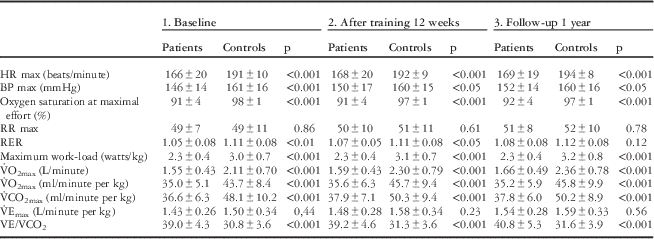
Start load was set lower for patients than for controls (0.67±0.12 watts/kg versus 0.79±0.15 watts/kg, p<0.05). Increase of load during the test was similar in patients and controls (0.24±0.07 watts/minute·per kg versus 0.27±0.06 watts/minute per·kg, p=0.07). Test duration was shorter for patients than for controls (7.0±1.9 minutes versus 8.2±1.8 minutes, p<0.05). Respiratory ratios at maximal oxygen uptake were >1 for both patients and controls, but significantly lower for the patient group (1.05±0.08 versus 1.11±0.08, p<0.01).
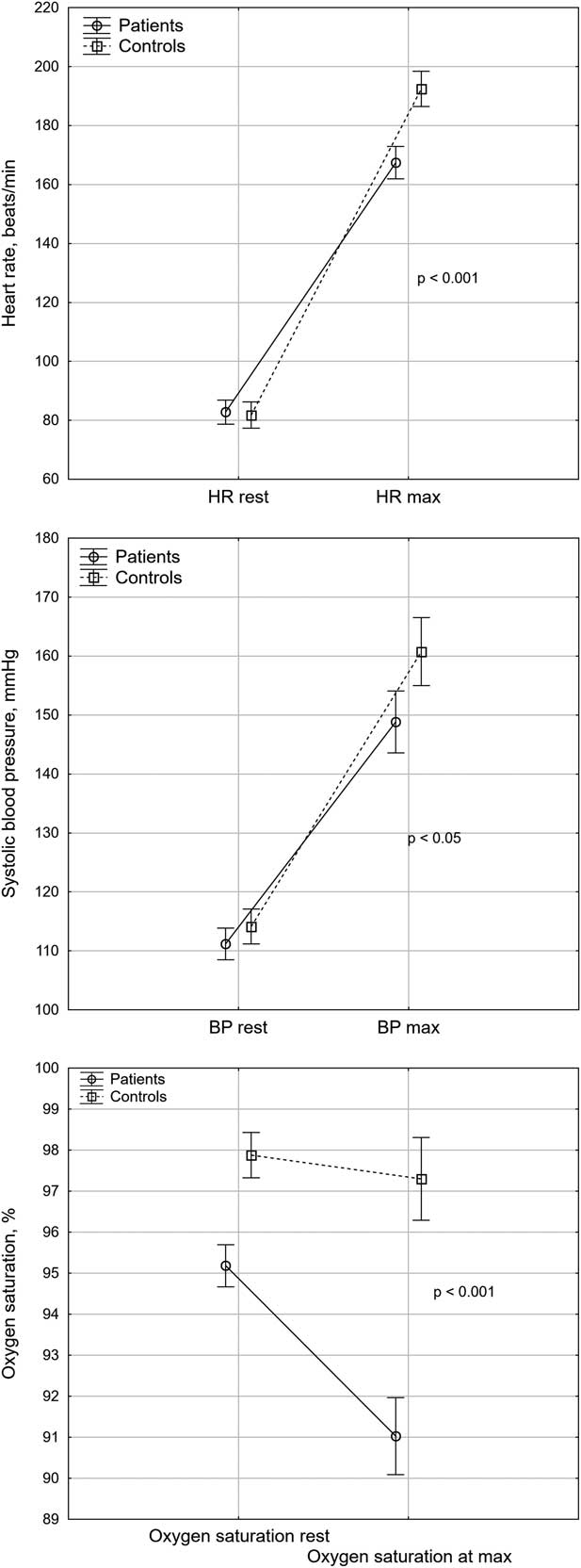
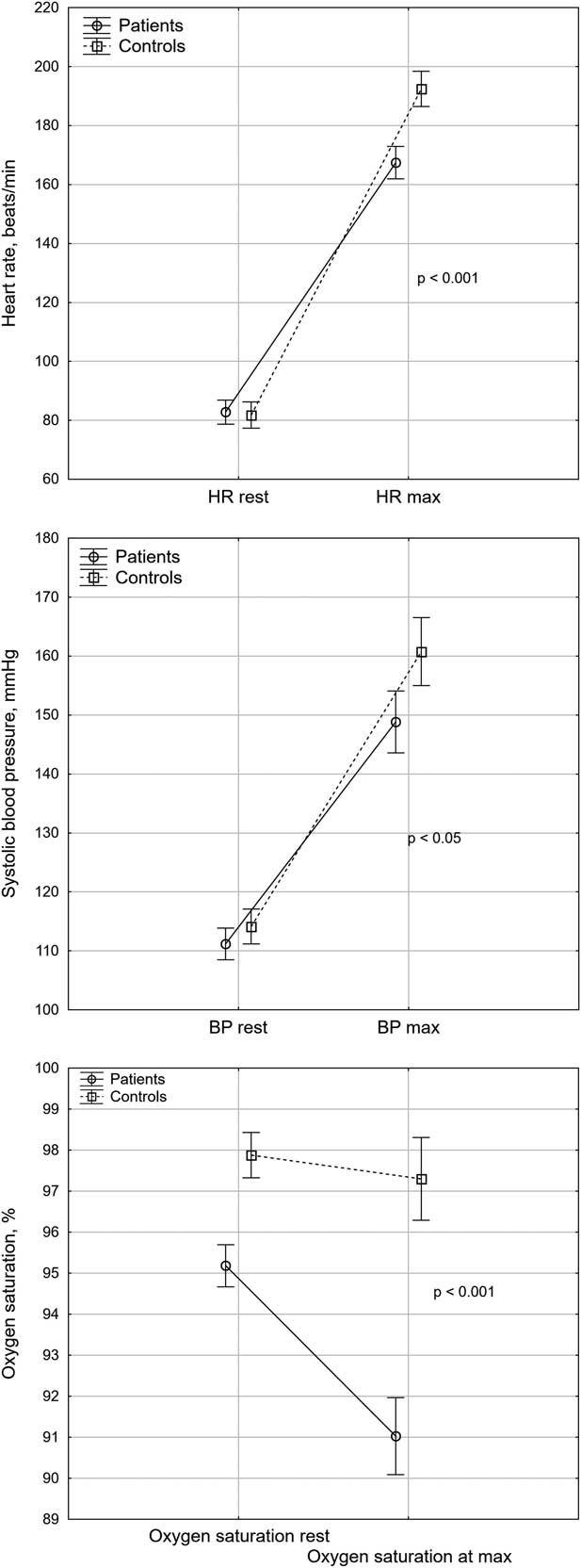
At rest, heart rate (83±15 beats/minute versus 82±12 beats/minute, p=0.80) and systolic blood pressure (111±9 mmHg versus 114±9 mmHg, p=0.14) were similar in patients and controls. However, oxygen saturation at rest was significantly lower for patients than for controls (95±3% versus 98±1%, p<0.001). Heart rate at maximal effort was also significantly lower for patients than for controls (166±20 beats/minute versus 191±10 beats/minute, p<0.001). Further, oxygen saturation and blood pressure at maximal effort were significantly lower for patients than for controls (Table 2). The patients responded to exercise with a lower increase of heart rate (p<0.001) and a lower increase of blood pressure (p<0.05) than the controls. The patients also responded with a significant decrease in oxygen saturation (p<0.001) (see Fig 1).
Change in heart rate (HR), systolic blood pressure (BP), and oxygen saturation from rest to maximal effort for patients and controls. p-Values for differences between patients and controls. Mean±1 SD.
Results from cardiopulmonary exercise testing at maximal effort.

BP=systolic blood pressure; HR=heart rate; RER=respiratory exchange ratio; RR=respiratory rate; V̇CO2max=maximal elimination of carbon dioxide; VE=minute ventilation; V̇O2max=maximal oxygen uptake; VE/VCO2=ventlatory equivalent for carbon dioxide
Values presented as mean±1 SD
Maximum work-load was lower for patients than for controls (2.3±0.4 watts/kg versus 3.0±0.7 watts/kg, p<0.001). Maximal oxygen uptake was also lower for patients than for controls (35.0±5.1 ml/minute per·kg versus 43.7±8.4 ml/minute per·kg, p<0.001) (Table 2). All patients had sinus rhythm during the ergometer tests and tolerated maximal exercise tests well, without any complications or significant arrhythmias.
Maximal elimination of carbon dioxide was significantly lower for patients than for controls. V̇Emax (maximal minute ventilation per kg) was similar in patients and controls, and thus ventilatory equivalent for carbon dioxide at maximal effort was significantly higher for patients than for controls; see Table 2.
Quality of life
Before training, the overall Pediatric Quality of Life Inventory Version 4.0 score was significantly lower for patients than for controls (70.9±9.9 versus 85.7±8.0, p<0.001). The parents’ Pediatric Quality of Life Inventory Version 4.0 score was also lower for patients than controls; see Table 1. When analysing the Pediatric Quality of Life Inventory Version 4.0 questionnaire in domains, the patients had a lower Pediatric Quality of Life Inventory Version 4.0 score than the controls in the physical domain (68.6±14.2 versus 89.6±10.1, p<0.001). The patients also had a lower Pediatric Quality of Life Inventory Version 4.0 score than the controls in the psychosocial domain (72.2±9.8 versus 83.7±9.7, p<0.001).
After endurance training for 12 weeks and at 1-year follow-up
One patient did not fulfil the training period of 12 weeks. One patient and two control subjects did not come back for the 1-year follow-up visit.
Both patients and controls reported an increase of exercise per week after the training programme to 168.3±92.7 minutes/week for patients and 296.4±185.3 minutes/week for controls. At follow-up after one year, patients reported a decreased amount of exercise as before the training programme, whereas controls reported a maintained amount of exercise as after the training programme (Table 1).
After training, patients reported a significant increase in average intensity on the Borg scale for all activities, whereas the controls reported similar average intensity. At follow-up after 1 year, patients and controls reported average intensity for all activities similar to after the training programme (Table 1).
6-minute walk test
The 6-minute walk test distance increased significantly for the patients after training (p<0.05), but not for the controls (p=0.08). At follow-up after one year, the patients’ 6-minute walk test distances were significantly longer than after training (p<0.05), whereas the control subjects’ 6-minute walk test distances were unchanged (p=0.49) (Table 1). Heart rate directly after 6 minutes of walking (120±16 beats/minute for patients and 133±19 beats/minute for controls) was similar as before training programme and did not change after the training programme for patients (p=0.13) or controls (p=0.97).
Cardiopulmonary exercise testing
After endurance training, maximum work-load increased for controls (p<0.05) but not for patients (p=0.28). At follow-up after 1 year, both patients and controls showed maximum work-loads similar to after training (Table 2).
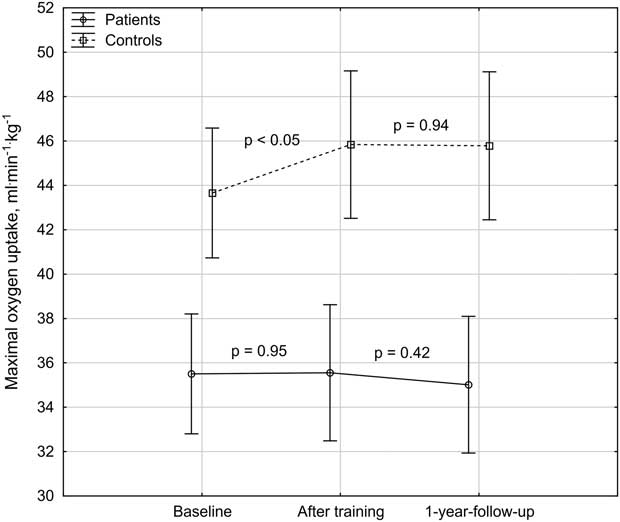
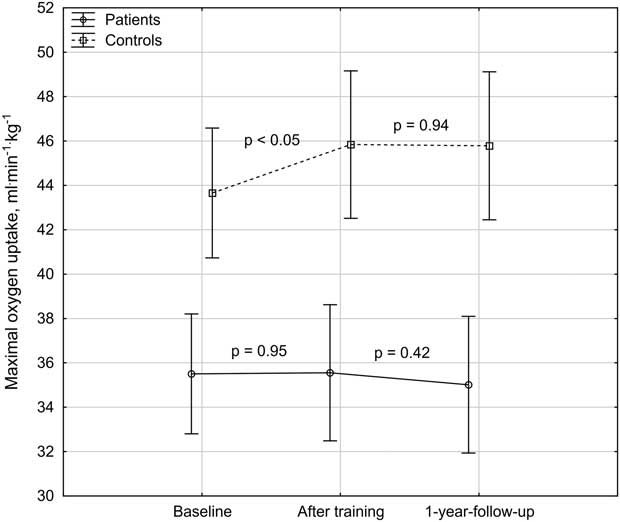
Maximal oxygen uptake increased significantly after training for controls, from 43.7±8.4 ml/minute·per kg to 45.7±9.4 ml/minute·per kg, p<0.05. In the patient group, however, maximal oxygen uptake did not increase after training (p=0.95). Both groups had similar maximal oxygen uptake at follow-up after 1 year as after training (Table 2 and Fig 2).
Maximal oxygen uptake (ml/minute·per kg) at baseline, after endurance training of 12 weeks, and at follow-up after 1 year for patients and controls.
Maximal elimination of carbon dioxide increased significantly after training for controls (p<0.05) but not for patients (p=0.54). V̇Emax was similar for patients and controls at all three visits and did not change after training or at follow-up visit after 1 year for patients or controls. Ventilatory equivalent for carbon dioxide at maximal effort did not change for patients or controls after training programme but increased significantly at follow-up after 1 year for patients (p<0.05) but not for controls (p=0.63) (Table 2).
Quality of life
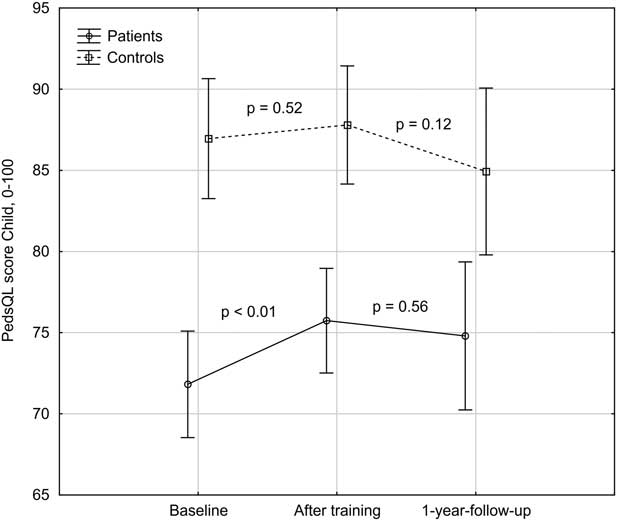
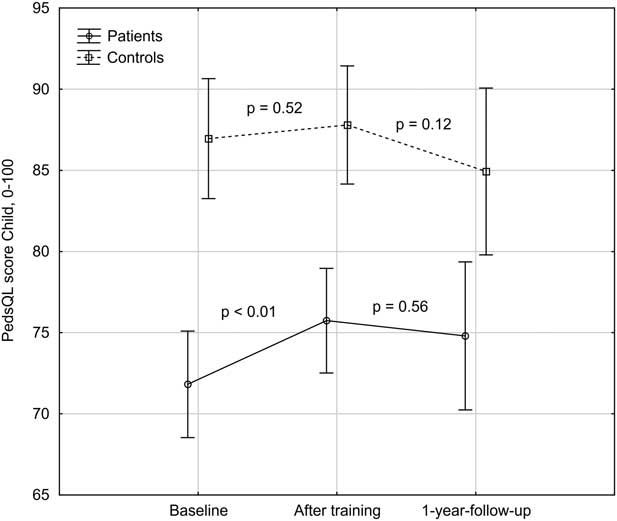
Fontan patients reported a significantly higher quality of life after training (p<0.01), but the controls did not (p=0.52). The patients reported a higher score in both the physical domain (p<0.01) and the psychosocial domain (p<0.05) after training. At the follow-up visit after 1 year, the improvement in Pediatric Quality of Life Inventory Version 4.0 score after training for the patients was sustained (p=0.56). The controls had a similar Pediatric Quality of Life Inventory Version 4.0 score at the follow-up visit after 1 year as before (p=0.35) and after training (p=0.12) (Table 1 and Fig 3).
Quality of life in Pediatric Quality of Life Inventory Version 4.0 (PedsQL) score at baseline, after endurance training for 12 weeks, and at follow-up after 1 year for patients and controls.
The parents’ Pediatric Quality of Life Inventory Version 4.0 score improved after training for patients (p<0.001), but not for controls (p=0.55). The patients’ parents reported a higher score in both the physical (p<0.05) and the psychosocial (p<0.05) domains after training. At the follow-up visit after 1 year, the improvement in patients’ parents’ Pediatric Quality of Life Inventory Version 4.0 score after training was sustained (p=0.97). The controls’ parents reported a similar Pediatric Quality of Life Inventory Version 4.0 score at the follow-up visit after 1 year as before (p=0.31) and after training (p=0.54) (Table 1).
In the multiple stepwise regression model, the only significant independent positive predictors of quality of life were not having a heart defect (p<0.001) and walking a longer distance in a 6-minute walk test (p<0.05).
Discussion
Physical capacityReference Goldberg, Avitabile, McBride and Paridon 7 – Reference Muller, Christov, Schreiber, Hess and Hager 10 and quality of lifeReference Dulfer, Bossers and Utens 3 – Reference Uzark, Jones, Slusher, Limbers, Burwinkle and Varni 6 have been reported by several research groups to be reduced in children after Fontan palliation. Several studies have shown that exercise training is safe and improves exercise tolerance in Fontan patientsReference Sutherland, Jones and d’Udekem 13 , Reference Rhodes, Curran and Camil 19 , Reference Takken, Hulzebos, Blank, Tacken, Helders and Strengers 20 and that the effects might be sustained.Reference Rhodes, Curran and Camil 12 Training effects have also been shown to improve peripheral muscular function in children with CHD.Reference Moalla, Elloumi and Chamari 21 Rehabilitation programmes have included promotion of physical activity in children with Fontan physiology and other CHD. Participation in exercise tests and programmes makes parents and patients aware that exercise is beneficial and usually harmless.Reference Fredriksen, Kahrs and Blaasvaer 22 , Reference Longmuir, Tyrrell, Corey, Faulkner, Russell and McCrindle 23 StudiesReference Fredriksen, Kahrs and Blaasvaer 22 , Reference Dulfer, Duppen and Kuipers 24 have also shown that exercise training can improve health-related quality of life in children with CHD, but these studies did not include a healthy control group. There is limited knowledge about the effects of exercise training on quality of life in Fontan patients as compared with a healthy control group.
Several patients in our study reported that they had no peer to suggest as a control. It is not known whether this is an expression of a psychosocial problem with few close peers and whether this differs from what would be found in healthy subjects. However, the controls brought by the Fontan patients were in the same social context as the patients and may have had a similar interest in physical activity and sports. This allows comparisons between matched groups with and without a heart defect, in similar contexts.
Our results confirm results from earlier studies, showing that physical capacity and quality of life are reduced in children after Fontan palliation when compared with a healthy matched control group. After endurance training, patients improved their submaximal exercise capacity and reported a higher quality of life, but did not improve their maximal exercise capacity or maximal oxygen uptake. At the follow-up visit after one year, submaximal exercise had increased further and the improvement of quality of life was sustained for the patients. The controls, however, improved their maximal exercise capacity, but not their submaximal exercise capacity or quality of life after training. The improvement of maximal exercise capacity was sustained at the follow-up visit after one year for the controls.
After endurance training and increase in self-reported physical activity with increased intensity, the patients did not improve their maximal oxygen uptake in our study. Other studies with training programmes as interventions, which did not show an improvement of exercise capacity after training intervention, perhaps had a too short training programme durationReference Brassard, Poirier and Martin 25 or a too low training programme intensity.Reference Longmuir, Tyrrell, Corey, Faulkner, Russell and McCrindle 23 Sutherland et al.Reference Sutherland, Jones and d’Udekem 13 have recommended that programmes should be at least 2 months with at least twice-weekly training sessions. With those recommendations in mind, we decided that our training programme would be 3 months long with twice-weekly training sessions. However, the study by O’Byrne et al.Reference O’Byrne, Desai, Lane, McBride, Paridon and Goldmuntz 26 could not show an association between reported exercise and maximal exercise capacity in Fontan subjects as compared with healthy subjects. In that study, they speculated whether aerobic training is less effective in increasing maximal oxygen uptake in Fontan patients than in healthy subjects, and it could be that exercise restrictions for Fontan patients influence how vigorously they engage in activities. The lack of change in maximal exercise capacity for the patients could also reflect the limitations of the Fontan circulation. However, our patients did increase the average intensity of all activities after the training programme. The individual endurance exercise activities for each child were chosen by the child together with at least one parent and the study leaders. The reason for this was that every child had different exercise capacities at inclusion in the study and different interests. We wanted the child to choose an exercise form that he or she would want to continue with at the end of the study in their home/school environment. In our study, we could not show an association between maximal exercise capacity and self-reported exercise or quality of life, similar to the report by O’Byrne et al.Reference O’Byrne, Desai, Lane, McBride, Paridon and Goldmuntz 26 Maximal exercise capacity might not be of relevance for daily life, instead our results could imply that submaximal exercise capacity is of greater importance. Moreover, maximal elimination of carbon dioxide was significantly higher for controls than patients, and this could simply reflect that controls performed a greater work at the cardiopulmonary exercise testing than patients. Further research is needed to understand differences in the response to exercise among Fontan patients compared with the response in healthy children.
Patients walked a longer distance in a 6-minute walk test after the training programme. The 6-minute walk test is a simple method for assessing exercise capacity at a submaximal level and is practical for use also in young children.Reference Lammers, Hislop, Flynn and Haworth 14 , Reference Moalla, Gauthier, Maingourd and Ahmaidi 27 Our results showing that the patients walked a longer distance in a 6-minute walk test after training may support earlier suggestions that Fontan patients may be better adapted to perform physical activities at submaximal, rather than maximal, effort. Possible mechanisms for this could be more efficient oxygen extraction by the working muscles in response to a decrease in oxygen saturation before completion of Fontan palliation. This peripheral effectiveness may compensate for central limitations at submaximal exercise levels as reported by Banks et al.Reference Banks, McCrindle, Russell and Longmuir 28 Our results also showed that heart rate directly after 6 minutes of walking did not change after training programme for patients. Increased 6-minute walk test distance with similar maximal heart rate before and after training programme suggests peripheral rather than central adaptation to exercise training.
Patients and controls reported an increase of exercise in minutes per week after the training programme but at follow-up after 1 year patients reported a decrease, similar to the amount of exercise reported before the training programme. In addition, patients reported a lower intensity on the Borg scale for all activities before the training programme than controls. After the training programme and at the follow-up after 1 year, the average intensity was similar for both groups (Table 1). Thus, even though the amount of exercise in minutes per week had decreased to baseline levels at the follow-up after 1 year, patients may be engaged in activities at higher intensity or may have changed their physical behaviour outside of organised activities. This could explain why submaximal capacity had increased further and the improvement of quality of life for the patients was sustained at follow-up after 1 year. The benefit of this could be of importance for Fontan patients in their daily life.
Our results also showed that heart rate, blood pressure, and oxygen saturation at maximal effort were significantly lower for patients than for controls (Table 2). The patients responded with a lower increase of heart rate, lower increase of blood pressure, and decreasing oxygen saturation at exercise as compared with the controls (Fig 1). A limited ability to increase cardiac output in response to exercise is the most likely explanation and would reduce maximal exercise capacity. Limitation in heart rate response, however, may not influence submaximal exercise capacity.Reference Banks, McCrindle, Russell and Longmuir 28 The limitations in exercise capacity are more pronounced at peak levels of exercise and relate to both central cardiovascular factors and peripheral muscular factors.Reference Goldberg, Avitabile, McBride and Paridon 7 Maximal exercise capacity may also be limited in our patients because of lack of experience and motivation, fear of complications, or severe symptoms.
In addition, abnormal lung function and gas exchange are common among children after Fontan palliation and seem to be associated with reduced exercise capacity.Reference Opotowsky, Landzberg and Earing 29 A reduction in pulmonary diffusing capacity has been shown in Fontan patients and seems to be associated with reduced pulmonary capillary blood volume.Reference Idorn, Hanel and Jensen 30 The small but significant fall in oxygen saturation during exercise may also reflect intrapulmonary shunting, which will limit gas exchange. Further research is needed to investigate lung function in Fontan patients in relation to exercise capacity and quality of life.
The patients and their parents reported a higher quality of life, in both the physical and psychosocial domains of the Pediatric Quality of Life Inventory Version 4.0 questionnaire, after the training programme. The controls and their parents did not report a change in quality of life after the training programme. A change in quality of life after a training programme is perhaps not to be expected in a group of healthy children with a relatively high quality of life at baseline, but it seems that promotion of a structured endurance training programme can improve the quality of life in Fontan patients. The effect also appears to be sustained. A ceiling effect of physical training on quality of life cannot be excluded. This is supported by our observations that both patients and controls with the lowest quality of life seem to benefit the most from exercise training.
Furthermore, the increased 6-minute walk test distance and improvement of quality of life after training in Fontan patients is supported by the results of the multiple stepwise regression model, showing that independent positive predictors of quality of life were not having a heart defect and walking a longer distance in a 6-minute walk test.
If an instrument for quality of life is used a measure on well-being and functioning in daily life, our results show that endurance training can improve quality of life and thus also daily life of our patient group. This supports that rehabilitation programmes should be included in the healthcare of these children from early age.
Limitations
The number of patients was limited by the size of our Fontan cohort. One may speculate as to whether the patients who chose to participate represented a group with more favourable outcomes than the patients who chose not to participate. The self-selection of control subjects can be questioned, but we felt it was important to compare quality of life and physical activity in peers that the patients are likely to compare themselves with. All patients and controls underwent the same tests, thus avoiding comparisons with reference material in a period with changing physical behaviour and decline in physical activity in the general population.Reference Ortega, Konstabel and Pasquali 31 , Reference Raustorp, Pagels, Froberg and Boldemann 32
The peers brought by the patients reported spending less time in physical exercise and a lower quality of life than the independent controls, as described previously.Reference Hedlund, Lundell, Villard and Sjoberg 18 Moreover, compared with a Swedish reference material,Reference Petersen, Hagglof, Stenlund and Bergstrom 16 the peers brought by Fontan patients had significantly lower Pediatric Quality of Life Inventory Version 4.0 scores, whereas the independent controls recruited by the research team had similar Pediatric Quality of Life Inventory Version 4.0 scores. The independent controls recruited among hospital staff and their friends may represent a more health-conscious and physically active group than the peers selected by the Fontan patients.
Conclusions
Endurance training in children with Fontan palliation improved their submaximal exercise capacity and quality of life but did not improve their maximal exercise capacity or maximal oxygen uptake. Healthy controls improved their maximal exercise capacity, but not their submaximal exercise capacity or quality of life. At the follow-up visit after 1 year, submaximal exercise capacity had increased further and the improvement of quality of life was sustained for the patients. The improvement of maximal exercise capacity for the controls was sustained at the follow-up visit after 1 year.
Thus, it seems that promotion of a structured individualised training programme can improve submaximal exercise capacity and quality of life in Fontan patients and that the effect on quality of life is long-lasting. Rehabilitation programmes should include structured individualised endurance training.
Acknowledgements
The Pediatric Quality of Life Inventory Version 4.0 was developed by Dr James W. Varni. Statistical analysis was supervised by Elisabeth Berg, statistician at Unit for Medical Statistics, Department of Learning, Informatics, Management and Ethics (LIME), Karolinska Institutet.
Financial Support
This research was financed by The Swedish Order of Freemasons, The Mayflower charity foundation for children, The Samariten foundation for paediatric research, Sällskapet Barnavård, and The Swedish Heart-Lung Foundation.
Conflicts of Interest
None.
Ethical Standards
The study was approved by the Ethical Review Board at Karolinska Institutet (DNR 2010/84-31/4), Stockholm.