Introduction
It has been established that individuals receiving a diagnosis of a psychotic disorder (e.g. schizophrenia) experience high rates of suicidal phenomenon, including completed suicide (lifetime prevalence 4.9–6.6%; Palmer et al. Reference Palmer, Pankratz and Bostwick2005; Nordentoft et al. Reference Nordentoft, Mortensen and Pedersen2011), suicide attempt (lifetime prevalence 30.2%; Radomsky et al. Reference Radomsky, Haas, Mann and Sweeney1999; Baca-Garcia et al. Reference Baca-Garcia, Perez-Rodriguez, Diaz Sastre, Saiz-Ruiz and de Leon2005) and ideation (15-day prevalence 20.4%; Young et al. Reference Young, Nuechterlein, Mints, Ventura, Qitlin and Liberman1998; Kontaxakis et al. Reference Kontaxakis, Havaki-Kontaxaki, Margariti, Stamouli, Kollias and Christodoulou2004). Self-harm, which may or may not include any intent to die, is also pronounced in this population (lifetime prevalence 29.9%; Mork et al. Reference Mork, Walby, Harkavy-Friedman, Barrett, Steen, Lorentzen, Andreassen, Melle and Mehlum2013). Studies examining the earlier stages of psychotic illness suggest that suicidality may be particularly pronounced in the early stages of the disorder (Palmer et al. Reference Palmer, Pankratz and Bostwick2005). Suicide attempts occurring during the first episode of psychosis (FEP), for example, make up around half of all the suicide attempts associated with those with psychosis (Nielssen & Large, Reference Nielssen and Large2009). Understanding such periods of risk is vital for services to effectively manage suicide risk and self-injury in this population.
Recently there has been increasing focus on the period preceding the initial transition into psychosis. This prodromal stage, referred to as ultra-high risk (UHR; also called the at-risk mental state) is typically characterized by a triad of putative and overlapping syndromes, including either the presence of attenuated positive psychotic symptoms, short-term psychotic symptoms, or a decline in general functioning combined with a parental history of psychotic illness suggesting a genetic vulnerability to the disorder (Schultze-Lutter, Reference Schultze-Lutter2009; Correll et al. Reference Correll, Hauser, Auther and Cornblatt2010; Fusar-Poli et al. Reference Fusar-Poli, Borgwardt, Bechdolf, Addington, Riecher-Rossler, Schultze-Lutter, Keshavan, Wood, Ruhrmann, Seidman, Valmaggia, Cannon, Velthorst, De Haan, Cornblatt, Bonoldi, Birchwood, McGlashan, Carpenter, McGorry, Klosterkotter, McGuire and Yung2013a ). In addition to UHR, the ‘basic symptoms’ criteria describes more subtle cognitive and perceptual abnormalities (Correll et al. Reference Correll, Hauser, Auther and Cornblatt2010), and may precede the development of the more pronounced UHR syndromes (Rausch et al. Reference Rausch, Eifler, Esser, Esslinger, Schirmbeck, Meyer-Lindenberg and Zink2013). The focus on this UHR period arises from the possibility of early intervention and prevention of psychosis. Initial evidence already supports the efficacy of treatments delivered to this UHR group in preventing subsequent transition to psychosis (Stafford et al. Reference Stafford, Jackson, Mayo-Wilson, Morrison and Kendall2013; Hutton & Taylor, Reference Hutton and Taylor2014).
While there has been much focus on the risk of transition to psychosis within the UHR population, there is currently no clear picture concerning the level of suicide risk and self-injury within this group. This is an issue as understanding the size of the problem posed by self-injury in this population and understanding the risk factors associated with this is important in enabling services to best organize their resources to support the well-being of UHR individuals. Notably, whilst transition rates appear low in this group (Ruhrman et al. Reference Ruhrmann, Klosterkotter, Bodatsch, Nikolaides, Julkowski, Hilboll and Schultze-Lutter2012) this does not negate the possibility of additional clinical need, such as high risk of suicide.
UHR individuals may be considered free of many of the challenges faced by those in the FEP population, including traumatic experiences of symptoms and hospitalization, and the heightened stigma tied to diagnosis (Dinos et al. Reference Dinos, Stevens, Serfaty, Weich and King2004; Jackson et al. Reference Jackson, Knott, Skeate and Birchwood2004; Tarrier et al. Reference Tarrier, Khan, Cater and Picken2007). However, risk factors for suicidality (Hawton et al. Reference Hawton, Sutton, Haw, Sinclair and Deeks2005) are apparent in those in the UHR population including fears around what their experiences mean and concerns of ‘going mad’, and co-morbid mood and substance use disorders (Ben-David et al. Reference Ben-David, Birnbaum, Eilenberg, Schienles, DeVlyder, Gill and Corcoran2013; Byrne & Morrison, Reference Byrne and Morrison2010; Fusar-Poli et al. Reference Fusar-Poli, Nelson, Valmaggia, Yung and McGuire2014).
The primary aim of the current study is to provide a systematic review and meta-analysis, where appropriate, of the prevalence of suicidality and self-harm within those judged to be in the UHR group. A secondary aim is to provide a systematic review of the risk factors, predictors and correlates of suicidality and self-harm in this population.
Method
Search strategy
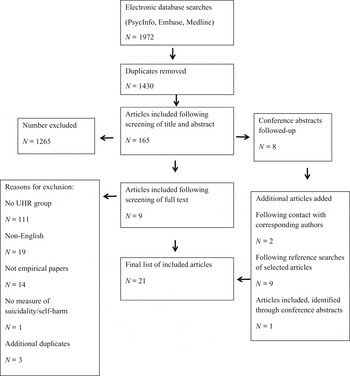
The electronic databases PsycINFO, EMBASE and Medline were searched up to October 2013, using the following key words: (‘at risk’ OR CAARMS OR prodromal OR ARMS OR ‘ultra-high risk’ OR UHR OR prevention) AND (psychosis OR schizo*) AND (self-harm OR suicid* OR self-injury OR self-mutilation). Screening was undertaken independently by two authors (P.J.T., L.W.). First, abstracts and titles were screened, followed by the full text of remaining articles. Conference abstracts and theses that were identified through the database search were also followed up. Presenters were contacted regarding the eligibility of research related to conference abstracts, whether published or unpublished. All corresponding authors of selected articles were contacted regarding any additional published or unpublished work that had been involved in that may be eligible for the review. References within selected articles were hand-searched for further eligible articles. Finally, recent reviews concerning the UHR population, including Fusar-Poli et al. (Reference Fusar-Poli, Bonoldi, Yung, Borgwardt, Kempton, Valmaggia, Barale, Caverzasi and McGuire2012, Reference Fusar-Poli, Borgwardt, Bechdolf, Addington, Riecher-Rossler, Schultze-Lutter, Keshavan, Wood, Ruhrmann, Seidman, Valmaggia, Cannon, Velthorst, De Haan, Cornblatt, Bonoldi, Birchwood, McGlashan, Carpenter, McGorry, Klosterkotter, McGuire and Yung2013a ), Hutton & Taylor (Reference Hutton and Taylor2014), and Stafford et al. (Reference Stafford, Jackson, Mayo-Wilson, Morrison and Kendall2013) were hand-searched for eligible studies. Fig. 1 presents a flow chart outlining the search process. Twenty-one eligible articles were eventually identified.
Flow chart detailing the literature search process.

Inclusion and exclusion criteria
Inclusion criteria were that studies had to be (a) in English language; (b) include individuals' classified as being UHR as determined via a validated tool designed for this purpose [e.g. the Comprehensive Assessment of At Risk Mental States (CAARMS); Yung et al. Reference Yung, Yuen, McGorry, Phillips, Kelly, Dell'Olio, Francey, Cosgrave, Killackey, Stanford, Godfrey and Buckby2005]; (c) include an assessment of either self-harm or suicidality; (d) provide, as a minimum, descriptive statistics relating to the measure of suicidality/self-harm. Exclusion criteria included (a) a history of frank psychotic episodes; (b) previous extended use of antipsychotic medication; (c) a diagnosis of an intellectual disability or autistic spectrum disorder (ASD).
For the purposes of this review we define the UHR state based upon a definition adapted from Fusar-Poli et al. (Reference Fusar-Poli, Bonoldi, Yung, Borgwardt, Kempton, Valmaggia, Barale, Caverzasi and McGuire2012), requiring (i) that individuals are aged between 8 and 40 years and (ii) the presence of one or more of the following: attenuated psychotic symptoms, brief limited intermittent psychotic episode, and trait vulnerability (e.g. genetic risk) plus a marked decline in psychosocial functioning.
Suicidal ideation was broadly defined as some form of explicit cognition relating to a desire to die, to permanently cease consciousness or to commit suicide. Likewise, we defined suicide attempts as any self-injurious behaviour (irrespective of lethality) committed with at least the partial aim of ending one's life, although ambivalence and uncertainty are common (Freedenthal, Reference Freedenthal2007). Definitions of self-harm are more problematic as they vary, with some emphasizing a lack of suicidal intent as being necessary in defining self-harm (Laye-Gindhu & Schonert-Reichl, Reference Laye-Gindhu and Schonert-Reichl2005), whereas others do not specify this criterion (Royal College of Psychiatrists, 2010). Again, we adopted a broad definition of self-harm as an act of non-accidental self-injurious behaviour irrespective of intent. The above definition may introduce uncertainty in regards to whether an act is described as self-harm or a suicide attempt. We managed this by adopting the term used by the study authors, unless there was a clear indication this not appropriate such as where an act is described as a suicide attempt but where it is noted that there was no intent to die. The term suicidality is used to describe the full continuum of suicidal phenomena (from ideation to behaviour).
Data extraction
Extraction of study details was undertaken independently by two authors (P.J.T., P.H.) using a pre-specified data-collection form, with disagreements resolved through discussion and arbitration by the third author (L.W.). In eight cases clarifying information was obtained from corresponding authors. This led to the correction of typographical errors and the receipt of additional data. Consequently, reported details may differ from those in the original papers in some instances.
Proportions and related statistics were estimated from the complete dataset with missing cases excluded. It was felt that the likelihood of large proportions for some outcomes (e.g. suicidal ideation) would make basic imputation methods, such as assuming all non-completers did not experience the outcome, unrealistic. More complex imputation strategies were also not an option as they would require access to the original datasets in order to generate probable estimates for missing values.
Methodological quality
Methodological quality of studies was assessed independently by two authors (P.J.T., P.H.) using a tool for assessing the quality of observational studies adapted from the Agency for Healthcare Research and Quality (Williams et al. Reference Williams, Plassman, Burke, Holsinger and Benjamin2010). This measure required ratings of whether studies met, did not meet or partially met quality criteria in a number of key methodological areas. A copy of the adapted measure is displayed in online Supplementary Appendix 1. Quality ratings made by the two authors were combined, with disagreements resolved through arbitration by the third author (L.W.).
Data synthesis and analysis
We employed meta-analysis where there were three or more studies contributing suitable data. Meta-analyses of prevalence were undertaken for binary outcomes. Proportions were subjected to a double arcsine transformation to stabilize the variance, following the recommendations of Barendregt et al. (Reference Barendregt, Doi, Lee, Norman and Vos2013). These analyses were undertaken using the MetaXL software (http://www.epigear.com/index_files/metaxl.html). Meta-analyses of continuous means were undertaken using the DerSimonian & Laird (Reference DerSimonian and Laird1986) inverse variance method in Stata v. 9.2 (StataCorp, 2005). A random-effects model was used so as to distinguish true heterogeneity in prevalence (due to differences in measurement, sample, etc.) from sampling error.
Results
Study characteristics
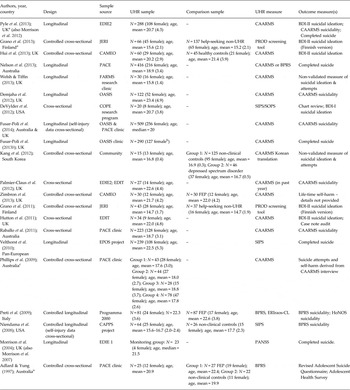
Study characteristics are outlined in Table 1. Studies were predominantly cross-sectional, although a number of longitudinal designs were present (k = 8). The majority of studies took place in the UK, with the remainder occurring in Western societies (Australia, USA, Finland, Italy) with one exception (South Korea; Kang et al. Reference Kang, Park, Yang, Oh, Shim and Chung2012). The CAARMS was the most common tool used to determine UHR status.
Characteristics of included studies

BDI, Beck Depression Inventory; BPRS, Brief Psychiatric Rating Scale; CAARMS, Comprehensive Assessment of At-Risk Mental States; ERIroas-CL, Early Recognition Inventory Retrospective Assessment of Symptoms checklist; FEP, first-episode psychosis; HoNOS, Health Of the Nation Outcome Scale (Wing et al. Reference Wing, Beevor, Curtis, Park, Hadden and Burns1998); PANSS, Positive and Negative Symptoms Scale (Kay et al. Reference Kay, Fiszbein and Opler1987); SIPS, Structured Interview for Prodromal Syndromes (Miller et al. Reference Miller, McGlashan, Rosen, Cadenhead, Ventura, McFarlane, Perkins, Pearlson and Woods2003); SOPS, Scale of Prodromal Symptoms (Miller et al. Reference Miller, McGlashan, Rosen, Cadenhead, Ventura, McFarlane, Perkins, Pearlson and Woods2003); UHR, Ultra-high Risk of Psychosis.
a Unpublished data obtained.
b Percentages and reported numbers do not match in paper.
c Characteristics described separately for four randomized UHR groups at baseline but prevalence combined for meta-analyses.
Study quality
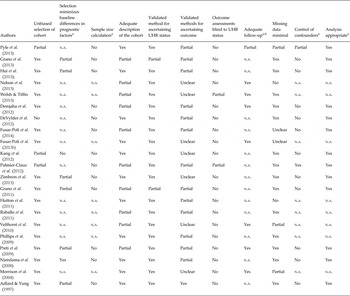
The assessment of study methodological quality is presented in Table 2. The most common methodological problems related to the measurement of outcome, justification of sample size, blinding of researchers and control of confounders in analyses. Suicidality and self-harm was often determined with single self-report items or continuous subscale measures of suicidality, such as from the CAARMS or Brief Psychiatric Rating Scale (BPRS). These scales were not developed as stand-alone measures, may lack reliability and may provide a limited coverage of suicidal phenomena (Gratz, Reference Gratz2001). This is problematic as factors such as the ambivalence and uncertainty that surround suicidal phenomena can complicate assessment (Freedenthal, Reference Freedenthal2007). However, there is support for the predictive and convergent validity of the Beck Depression Inventory – II (BDI-II; Beck et al. Reference Beck, Steer and Brown1996) suicidal ideation item (Brown, Reference Brown2000), which was commonly used. Specifically this item has demonstrated a large correlation with scores on the Beck Scale for Suicidal Ideation (Beck & Steer, Reference Beck and Steer1991) and was found to significantly predict the likelihood of patients committing suicide (Brown, Reference Brown2000). No studies justified their sample size in terms of power calculations. This may mean that analyses focusing on predictors and correlates of suicidality and self-harm may have been underpowered in some cases, leading to inflated Type II error rates. However, it is important to recognize that often self-harm or suicidality were not primary outcomes of the study. Attempts at blinding researchers or interviewers to participants' UHR status were rarely undertaken. This may introduce bias where researchers pre-existing assumptions about UHR individuals influence ratings. In a single-arm study, blinding may still be possible, for example by bringing in external assessors who are blind to participants' clinical status. Four of the seven studies involving group comparisons did not attempt to match UHR individuals and those in comparison groups on sociodemographic variables (e.g. age, gender, ethnicity, socioeconomic status) and attempts were not made, where analyses were undertaken, to adjust for group differences statistically. Hence confounding variables may have biased group comparisons. Confounding variables were also rarely considered in analyses looking at predictors and correlates of self-harm/suicidality (for exception, see Palmier-Claus et al. Reference Palmier-Claus, Taylor, Gooding, Dunn and Lewis2012).
Overview of assessment of study methodological quality

N.A., Not available.
a Criteria only applicable to certain designs.
b Note that this criteria only applied to those studies with follow-up data on self-harm or suicidality or those undertaking analyses whereby suicidality/self-harm predicted other variables at follow-up.
Prevalence of self-harm and suicidality
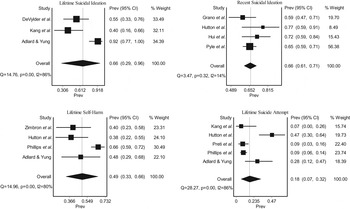
The results of the meta-analysis of prevalence for binary self-harm and suicidality outcomes are displayed as forest plots in Fig. 2. Too few studies contribute to any one outcome to allow exploration of heterogeneity via techniques such as meta-regression (Borenstein et al. Reference Borenstein, Hedges, Higgins and Rothstein2009). Instead, we undertook sensitivity analyses to further explore the role of individual studies in contributing to heterogeneity.
Forest plots of meta-analysis of prevalence.

Suicidal ideation
For recent (2-week) suicidal ideation the meta-analysis suggested a prevalence of 66.08% (95% CI 60.57–71.39, N = 402, Q = 3.47, p = 0.33, I 2 = 13.59). All studies providing data on recent suicidal ideation used the BDI-II suicide item, dichotomized to capture the presence or absence of suicidal ideation. A further study used the BDI-I, which only assesses a 1-week period, and so as expected observed a slightly lower prevalence of suicidal ideation of 30.00% (n = 6/20) (DeVylder et al. Reference DeVylder, Oh, Ben-David, Azimov, Harkavy-Friedman and Corcoran2012).
Only three studies contributed data to the meta-analysis of lifetime suicidal ideation, and substantial heterogeneity was present, with the meta-analysis suggesting a prevalence of 66.25% (95% CI 28.76–95.78, N = 60, Q = 14.76, p < 0.01, I 2 = 86.45). Notably, this heterogeneity was largely attributable to a single study (Adlard & Yung, Reference Adlard and Yung1997). Removing this study reduced the heterogeneity to non-significant levels (Q = 0.71, p = 0.40, I 2 = 0.00), and led to a smaller prevalence estimate of 48.61% (95% CI 32.21–65.16).
Self-harm
The meta-analysis of lifetime self-harm indicated a prevalence of 49.38% (95% CI 33.08–65.74, N = 279, Q = 14.96, p < 0.01, I 2 = 79.94), but was affected by substantial heterogeneity. The heterogeneity again appeared attributable to a single study (Phillips et al. Reference Phillips, Nelson, Yuen, Francey, Simmons, Stanford, Ross, Kelly, Baker, Conus, Amminger, Trumpler, Yun, Lim, McNab, Yung and McGorry2009). Excluding this study gave a prevalence of 41.72% (95% CI 31.70–52.10, Q = 0.58, p = 0.75, I 2 = 0.00). It is unclear why rates of self-harm were higher in this study than the other three. Notably, the estimated prevalence is similar regardless of whether this study is included or excluded from the analysis. In regards to more recent self-harm, Adlard & Yung (Reference Adlard and Yung1997) report that 32.00% (n = 8/25) of their sample engaged in self-harm in the past year, while Welsh & Tiffin (Reference Welsh and Tiffin2013) report that 53.33% (n = 16/30) of their sample engaged in self-harm in the past 6 months.
Suicide attempt
The meta-analysis of lifetime suicide attempt indicated a prevalence of 17.74% (95% CI 6.67–32.24, N = 345, Q = 28.27, p < 0.01, I 2 = 85.85), but was affected by substantial heterogeneity. A large degree of this heterogeneity was attributable to the high rate of reported suicide attempts in one study (47.06%, n = 16/34; Hutton et al. Reference Hutton, Bowe, Parker and Ford2011). In contrast the prevalence reported in the other four studies ranged from 6.67% to 28.00%. The exclusion of this study led to a smaller prevalence estimate and more moderate levels of heterogeneity (11.64%, 95% CI 6.16 – 18.50, Q = 6.04, p = 0.11, I 2 = 50.35). Two studies also assessed the presence of suicide attempts within the past 6 months, with prevalence rates reported at 30.00% (n = 9/30; Welsh & Tiffin, Reference Welsh and Tiffin2013) and 0.00% (n = 0/15; Kang et al. Reference Kang, Park, Yang, Oh, Shim and Chung2012), while Adlard & Yung (Reference Adlard and Yung1997) report a prevalence of 24.00% (n = 6/25) for the previous 12 months. There were only two studies that assessed suicide attempts prospectively, suggesting prevalence rates of 5.26% over 12 months (n = 3/57; Preti et al. Reference Preti, Meneghelli, Pisano, Cocchi and Programma2009) and 3.70% over 24 months follow-up (n = 1/27; Welsh & Tiffin, Reference Welsh and Tiffin2013). Notably, in these prospective studies the participants may have been receiving treatment that could have attenuated rates.
Completed suicide
There was little available data concerning completed suicide, with few prospective designs that would allow the assessment of this outcome. No completed suicides were reported for 1-year (n = 57 and n = 16), 2-year (n = 31), 3-year (n = 10) and 10-year (n = 290) follow-up periods but samples were often small (Morrison et al. Reference Morrison, French, Walford, Lewis, Kilcommons, Green, Parker and Bentall2004, Reference Morrison, French, Parker, Roberts, Stevens, Bentall and Lewis2007, Reference Morrison, French, Stewart, Birchwood, Fowler, Gumley, Jones, Bentall, Lewis, Murray, Patterson, Brunet, Conroy, Parker, Reilly, Byrne, Davies and Dunn2012; Preti et al. Reference Preti, Meneghelli, Pisano, Cocchi and Programma2009; Fusar-Poli et al. Reference Fusar-Poli, Byrne, Badger, Valmaggia and McGuire2013b ). However, four individuals died of suicide (1.25%, n = 4/320) within a variable follow-up of UHR individuals, ranging from 2.4 to 14.9 years (Nelson et al. Reference Nelson, Yuen, Wood, Lin, Spiliotacopoulos, Bruxner, Broussard, Simmons, Foley, Brewer, Francey, Amminger, Thompson, McGorry and Yung2013), and a further death (0.55%, n = 1/182) by suicide was reported within a 12-month follow-up period in a pan-European study (Velthorst et al. Reference Velthorst, Nieman, Linszen, Becker, de Haan, Dingemans, Birchwood, Patterson, Salokangas, Heinimaa, Heinz, Juckel, von Reventlow, French, Stevens, Schultze-Lutter, Klosterkotter and Ruhrmann2010). The low base rate of completed suicide means that stable estimates are unlikely to be obtained even over a follow-up period of several years (Goldney, Reference Goldney2005).
Suicidality
Three studies reported continuous mean data for the CAARMS suicidality subscale, a 7-point subscale capturing suicidal thinking and self-injurious behaviour. Meta-analysis suggested an aggregate mean score of 2.27 (95% CI 2.12–2.42, N = 537, Q = 2.39, p = 0.30, I 2 = 16.30) with minimal heterogeneity. A score of 2 on the CAARMS corresponds to occasional, passive suicidal ideation (e.g. tired of living) or thoughts of self-harm but no active suicidal ideation plans or behaviour. This result is perhaps inconsistent with the high prevalence of suicidal ideation observed with the BDI-II, and may reflect the interview-based nature of the CAARMS, which could inhibit disclosure (Kaplan et al. Reference Kaplan, Asnis, Sanderson, Keswani, De Lecuona and Joseph1994).
Group comparisons
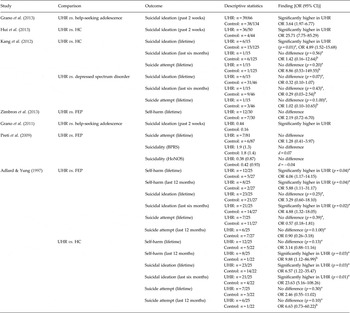
Seven studies allowed for comparisons between UHR and other clinical or non-clinical control groups. As these comparisons varied by outcome and comparison group meta-analyses were not appropriate. Instead, the results of these comparisons are provided on a study-by-study basis in Table 3. Across the studies suicidal ideation was typically greater in the UHR groups compared to non-clinical controls (including help-seeking youths who did not meet UHR status). In contrast, there was little evidence of a significant difference between UHR and non-clinical controls for self-harm and suicide attempt, although the small numbers of attempts may have limited power in these analyses. There was also little evidence of greater levels of suicidality in UHR individuals compared to other clinical groups, including FEP and young people on the depression spectrum (see exceptions in Adlard & Yung, Reference Adlard and Yung1997).
Overview of studies comparing suicidality and self-harm rates between UHR and comparison groups

Significance = p < 0.05; odds ratio (OR) and associated 95% confidence intervals (CIs) calculated from study data for purposes of this review.
BPRS, Brief Psychiatric Rating Scale; HC, healthy controls; HoNOS, Health of the Nation Outcome Scale; FEP, first-episode psychosis; UHR, ultra-high risk of psychosis.
a Two-tailed Fisher's exact test calculated from summary data as no comparison made in the paper.
b Very few cases present, interpret tests and odds ratios with caution.
Correlates and predictors of self-harm and suicidality
Demographic variables
Two studies reporting on cross-sectional relationships between demographic variables and suicidality or suicide attempts did not identify any relationships with occupation, age, gender, ethnicity, education or marital status (Preti et al. Reference Preti, Meneghelli, Pisano, Cocchi and Programma2009; Demjaha et al. Reference Demjaha, Valmaggia, Stahl, Byrne and McGuire2012), despite relatively large samples (n = 81–122).
Previous suicide attempts
Previous UHR suicide attempters were more likely to make subsequent suicide attempts over a 12-month period (2/4) than those without this history (1/53; Preti et al. Reference Preti, Meneghelli, Pisano, Cocchi and Programma2009).
Co-morbidity, functioning and symptoms
Greater psychiatric co-morbidity was typically associated with greater suicidality. Obsessive-compulsive symptom severity was associated with both suicidality and suicidal ideation across two US samples (Niendama et al. Reference Niendama, Berzaka, Cannona and Beardena2008; DeVylder et al. Reference DeVylder, Oh, Ben-David, Azimov, Harkavy-Friedman and Corcoran2012). Substance abuse was associated with previous suicide attempts in an Italian sample of UHR individuals [odds ratio (OR) 97.33, 95% CI 8.18–1158.72, p < 0.01; Preti et al. Reference Preti, Meneghelli, Pisano, Cocchi and Programma2009]. Less problematic substance use was not related to previous suicide attempts. Studies employing continuous subscales measures of suicidality, such as from the CAARMS or BPRS, reported correlations with poorer global and social functioning and health (r = 0.28; Preti et al. Reference Preti, Meneghelli, Pisano, Cocchi and Programma2009; Demjaha et al. Reference Demjaha, Valmaggia, Stahl, Byrne and McGuire2012).
Suicide attempters had a greater risk of suicide attempts and psychiatric history in the family than non-attempters, but no significant increase in suicidality was observed for individuals with past trauma or a longer duration of untreated illness (Preti et al. Reference Preti, Meneghelli, Pisano, Cocchi and Programma2009). This study observed a small positive correlation between suicidality and symptoms when the latter were assessed with a screening instrument (the Early Recognition Inventory Retrospective Assessment of Symptoms checklist; Spearman's ρ = 0.25; Rausch et al. Reference Rausch, Eifler, Esser, Esslinger, Schirmbeck, Meyer-Lindenberg and Zink2013). Although this relationship did not reach significance (p = 0.06) when psychotic symptoms were measured using the BPRS, a similar effect size was observed (Spearman's ρ = 0.21).
Preti et al. (Reference Preti, Meneghelli, Pisano, Cocchi and Programma2009) found that those who showed an improvement in symptoms over the follow-up period also experienced a decrease in suicidality, but there was no comparison against those who did not experience symptomatic improvement. Psychopathology at baseline did not predict suicide attempts at 12-month follow-up.
Treatment
In an observational study, DeVylder et al. (Reference DeVylder, Oh, Ben-David, Azimov, Harkavy-Friedman and Corcoran2012) found no relationship between suicidal ideation and medication use, though the details of this analysis were not clearly reported. Preti et al. (Reference Preti, Meneghelli, Pisano, Cocchi and Programma2009) did not observe a relationship between prescribed medication at baseline and suicide attempts at 12-month follow-up.
Emotion and cognition
Depressive symptoms and greater risk of comorbid affective disorder were associated with increased suicidality in two studies (Fusar-Poli et al. Reference Fusar-Poli, Nelson, Valmaggia, Yung and McGuire2014; Pyle et al. Reference Pyle, Stewart, French, Byrne, Patterson, Gumley, Birchwood and Morrison2013). In a third study, the CAARMS suicidality subscale was positively associated with greater daily instability in negative affect, though not positive affect, while controlling for the average intensity of affect. This study employed an experience-sampling methodology to estimate daily affect intensity and instability across a 6-day period (Palmier-Claus et al. Reference Palmier-Claus, Taylor, Gooding, Dunn and Lewis2012).
One study found that greater endorsement of negative appraisals of psychosis-related experiences (e.g. describing experiences as frightening) and less perceived social acceptance of experiences (e.g. feeling unable to talk to others about these experiences) had small correlations (r = 0.24) with suicidality (Pyle et al. Reference Pyle, Stewart, French, Byrne, Patterson, Gumley, Birchwood and Morrison2013). Notably the measure of social acceptance of experienced had low internal reliability (α = 0.52) that may have attenuated correlations. Beliefs about psychosis at baseline did not appear to predict changes in scores on the CAARMS suicidality scale over a 6-month period, however.
Transition to psychosis
One study with a 24-month follow-up period found baseline scores on the CAARMS suicidality subscale were unrelated to the rate of transition to psychosis (hazard ratio 1.06, 0.83–1.35, p = 0.662), defined as the emergence of frank psychotic symptoms that did not resolve within 1 week (Demjaha et al. Reference Demjaha, Valmaggia, Stahl, Byrne and McGuire2012).
Discussion
The results of the meta-analyses suggested that suicidal and self-injurious thinking and behaviour were highly prevalent in the UHR population, particularly with regards to suicidal ideation and self-harm. Approximately half of individuals reported acts of self-harm in their lifetime, and over half reported both recent and lifetime suicidal ideation. Group comparisons indicated that suicidal ideation is more prevalent in UHR individuals than healthy controls, although differences were less clear for self-injurious behaviour.
The substantial rates of suicidality and self-harm observed in the UHR samples are similar to the high prevalence of suicidality reported in FEP samples (Nordentoft, Reference Nordentoft2002; Barrett et al. Reference Barrett, Sundet, Faerden, Agartz, Bratlien, Romm, Mork, Rossberg, Steen, Andreassen and Melle2010a , Reference Barrett, Sundet, Faerden, Nesvag, Agartz, Fosse, Mork, Steen, Andreassen and Melle b ; Upthegrove et al. Reference Upthegrove, Birchwood, Ross, Brunett, McCollum and Jones2010; Challis et al. Reference Challis, Nielssen, Harris and Large2013). Thus, the high levels of suicidality in the FEP population may precede the onset of frank diagnosis. While the UHR population might be expected to be protected from some of the challenges associated with a first episode of psychosis, such as heightened psychotic symptoms and distressing treatment experiences (e.g. hospitalization), they may still struggle with making sense of their unusual experiences, fears of stigma, and co-morbid difficulties (Byrne & Morrison, Reference Byrne and Morrison2010; Fusar-Poli et al. Reference Fusar-Poli, Nelson, Valmaggia, Yung and McGuire2014). The high risk of self-injury observed in this study may also extend beyond UHR as psychotic symptoms occurring among adolescents in the general population are predictive of suicide risk (Kelleher et al. Reference Kelleher, Corcoran, Keeley, Wigman, Devlin, Ramsay, Wasserman, Carli, Sarchiapone, Hoven, Wasserman and Cannon2012).
The finding that co-morbid mood and substance use problems and previous suicidality were risk factors for self-injurious thinking and behaviour also mirrors similar findings in those diagnosed with psychotic disorders (Haw et al. Reference Haw, Hawton, Sutton, Sinclair and Deeks2005; Hawton et al. Reference Hawton, Sutton, Haw, Sinclair and Deeks2005; Challis et al. Reference Challis, Nielssen, Harris and Large2013). Other risk factors identified in the current review were unstable negative affect and family history of psychiatric problems. Findings were mixed, however, for negative beliefs about psychosis and symptom severity (replicating findings in FEP; Challis et al. Reference Challis, Nielssen, Harris and Large2013) and further prospective studies are required. Another risk factor identified in FEP populations, duration of untreated illness, was not supported here (Challis et al. Reference Challis, Nielssen, Harris and Large2013).
Suicidality and self-harm were rarely the primary focus of the included studies (with some exceptions, e.g. Preti et al. Reference Preti, Meneghelli, Pisano, Cocchi and Programma2009; Palmier-Claus et al. Reference Palmier-Claus, Taylor, Gooding, Dunn and Lewis2012) and measures were often single items and subscales taken from other instruments. Future research would benefit from the use of validated, dedicated measures of self-harm and suicidal phenomena. Precise definitions for self-injurious acts were rarely provided by studies, and this can be problematic considering the wide variety of behaviours that could potentially be classified as self-harm. Classification systems of nomenclature for defining self-injurious thinking and behaviour have been developed (Silverman et al. Reference Silverman, Berman, Sanddal, O'Carroll and Joiner2010) and could be drawn upon by future researchers. Where rates of self-injurious behaviour and thinking are assessed retrospectively across the lifetime it is also unclear exactly when the event occurred, and whether it coincided with or preceded the emergence of the UHR state. Longitudinal cohort studies are required to better understand the temporal pattern of suicidality and self-harm in this population.
Studies were too few to allow any systematic exploration of heterogeneity, such as via techniques like meta-regression, or publication bias. As more studies emerge focusing on suicidality and self-harm within the UHR population, it will be possible to explore in more depth heterogeneity and publication bias. The total N for the analyses were, however, large for this area of research, and even with the removal of outlying studies the prevalence rates remained high.
Our findings indicate a concerning prevalence of self-injurious thinking and behaviour in the UHR population and suggest that further research is urgently needed in this area. The results support the routine monitoring of risk of self-injurious thinking and behaviour by clinicians working with those at risk of developing psychosis. Likewise, clinicians working in Accident and Emergency settings may benefit from a greater awareness of UHR criteria when evaluating the mental state of those presenting with self-harm. Our findings also suggest a need to develop acceptable and effective treatments to reduce suicide risk in this group. Although cognitive behavioural therapy reduces the risk of developing psychosis (Hutton & Taylor, Reference Hutton and Taylor2014), whether it is effective for reducing suicidal ideation in this group will remain unclear until trials start reporting data on this outcome. Dialectical behaviour therapy has demonstrated efficacy in reducing self-injurious behaviour in other populations (Feigenbaum, Reference Feigenbaum2007), and might be usefully adapted and tested for the psychosis at-risk group.
Recent estimates of rates of transition into psychosis for those in the UHR population have been lower than earlier estimates leading to a debate over whether specialized clinical services should be created for this population (Ruhrmann et al. Reference Ruhrmann, Klosterkotter, Bodatsch, Nikolaides, Julkowski, Hilboll and Schultze-Lutter2012). However, recent work has demonstrated a high level of comorbid difficulties and need for care in the UHR group (Fusar-Poli et al. Reference Fusar-Poli, Nelson, Valmaggia, Yung and McGuire2014). Our review supports the view that, irrespective of the risk of developing frank psychosis, many in this group may still benefit from some form of service intervention.
Supplementary material
For supplementary material accompanying this paper visit http://dx.doi.org/10.1017/S0033291714002074.
Acknowledgements
We thank all the authors who provided additional information and data for this review, and Dr Kerry Dwan for her statistical advice.
PROSPERO Registration: CRD42014007549.
Declaration of Interest
None to declare.