Romantic relationships are complex, dynamic and multifaceted voluntary unions that can be compromised by an array of variables, including jealousy. Jealousy is commonly evoked when people perceive something may be taken from their possession (White & Mullen, Reference White and Mullen1989). In the context of romantic relationships, jealousy arises when a threat to the relationship is perceived between the relational partners via a third-party rival (White, Reference White1981). Researchers have identified jealousy as a salient variable that can spark varied consequences in relationships, albeit some positive, such as increased love (Mathes, Reference Mathes1986) and relational improvement (Fleischmann, Spitzberg, Andersen, & Roesch, Reference Fleischmann, Spitzberg, Andersen and Roesch2005). However, a wealth of scholars (e.g., Afifi & Reichert, Reference Afifi and Reichert1996; Aylor & Dainton, Reference Aylor and Dainton2001; Guerrero, Eloy, Jorgensen, & Andersen, Reference Guerrero, Eloy, Jorgensen, Andersen and Kalbflesisch1993; Mullen & Martin, Reference Mullen and Martin1994) have noted that jealousy can birth a range of negative feelings in romantic partners that can subsequently not only hinder a romantic relationship, but facilitate its termination. Given the potential consequences of jealousy in romantic relationships, it is important to identify core precipitators of jealousy, and recent research (e.g., William, Reference Williams2005) suggests cross-sex friendships constitute key catalysts for jealousy among intimate partners. This leads us to question the possible impact of cross-sex best friendships on romantic relationships.
Best friendships are important to humans’ overall wellbeing (e.g., Birditt & Antonucci, Reference Birditt and Antonucci2007). However, Rawlins’ (Reference Rawlins1992) work pointed out that outside of cross-sex marital relationships, best friends tend to be of the same sex. Some have even argued that ‘cross-sex friendships seem to occupy an unusual place in the landscape of heterosexual relationships’ (Afifi & Faulkner, Reference Afifi and Faulkner2000, p. 206). Despite their unique composition, cross-sex friendships are becoming increasingly commonplace (Malachowski & Dillow, Reference Malachowski and Dillow2011), which has triggered scholarly inquisitions aimed at better understanding the interpersonal dynamics of this relationship type. Researchers have examined a mix of features associated with cross-sex friendships, including motivations for development (e.g., Messman, Canary, & Hause, Reference Messman, Canary and Hause2000; Werking, Reference Werking1997), relationship outcomes (e.g., Weger & Emmett, Reference Weger and Emmett2009; Worley & Samp, Reference Worley and Samp2014), and the benefits and challenges associated with cross-sex friendships (e.g., Bleske-Rechek et al., Reference Bleske-Rechek, Somers, Micke, Erickson, Matteson, Stocco and Ritchie2012; O'Meara, Reference O'Meara1989). These previous studies are limited, however, by a focus on general cross-sex friendships, as opposed to cross-sex best friendships. Best friends are characterised by a range of close interactions generated by attachment processes (Miller & Hoicowitz, Reference Miller and Hoicowitz2004). Considering the close attachment of best friends, Akbulut and Weger (Reference Akbulut and Weger2016) measured cross-sex friendship as a type of best friendship, and the results indicated that 62.5% of 309 participants reported having a cross-sex best friend. In light of this relatively high percentage, the relational implications associated with having a best friend of the opposite sex deserve exploration, as the nature of cross-sex best friendships can present unique challenges, particularly concerning the experience and expression of jealousy from one's romantic partner.
Using two jealousy models as a theoretical framework, the present study seeks to expand upon previous research by examining how attitudes toward cross-sex best friendships influence jealousy experiences and expressions among romantic partners. This study is warranted because being in a romantic relationship with someone who has a cross-sex best friend has the potential to ignite jealous feelings that may spiral into relationship stress, conflict, or even dissolution, sparking a desire in partners to protect the relationship from jealousy-inducing third-party threats (Bevan, Reference Bevan2013; White & Mullen, Reference White and Mullen1989). Prior research has also revealed the mediation potential of attitudes, suggesting that certain cognitive and affective dispositions help in accounting for the connection between certain variables (e.g., Parks & Roberton, Reference Parks and Roberton2004). Building on the legacy established by prior research on attitudes and jealousy among intimate partners, we consider how attitudes regarding cross-sex best friendships can potentially mediate experiences and expressions of jealousy within romantic relationships. We begin by conceptualising jealousy.
The Nature of Jealousy
Jealousy has been conceptualised as both an emotion and cognition. In their recognition of jealousy as a distinct emotion, Buunk and Bringle (Reference Buunk, Bringle, Perlman and Duck1987) regarded jealousy as ‘an aversive emotional reaction evoked by a relationship involving one's current or former partner and a third person’ (p. 124). Similar to Buunk and Bringle, White (Reference White1981) noted that the emotional complexity of jealousy can threaten one's self-esteem or the existence or quality of the relationship. Scholars have noted the multifaceted nature of jealousy as an emotion (Sabini & Silver, Reference Sabini and Silver2005) and have, therefore, separately tested individual emotions that are most commonly believed to form an individual's mixed jealousy experience (Bevan, Reference Bevan2013). For example, Parrott (Reference Parrott and Salovey1991) identified jealousy as anxious insecurity, while Sharpsteen (Reference Sharpsteen and Salovey1991) found jealousy to be a combination of the emotions of anger, sadness and fear.
Complementing the researchers who characterised jealousy as an emotion, others have compellingly depicted jealousy as a cognition, including Guerrero and Afifi (Reference Guerrero and Afifi1999), who divided jealousy into two cognitive attributes: (a) worry over a rival's interest in the partner, and (b) suspicion over the partner's interest in a rival. A study by Pfeiffer and Wong (Reference Pfeiffer and Wong1989) explored cognitive jealousy in relation to how individuals express jealousy, and results indicated that cognitive jealousy was moderately and positively correlated with behavioural jealousy, while an investigation by Theiss and Solomon (Reference Theiss and Solomon2006) found that cognitive jealousy was negatively correlated with jealousy communication directness.
Along with clearly denoting both emotional and cognitive aspects of jealousy, researchers have unequivocally concluded that jealousy is ignited by the presence of a real or perceived rival (Buunk & Bringle, Reference Buunk, Bringle, Perlman and Duck1987; White, Reference White1981). Hence, when individuals experience jealousy, they have a need to protect and defend the valued relationship from a third-party rival (White & Mullen, Reference White and Mullen1989). Jealousy responses from a partner can birth an array of outcomes that may be either positive (e.g., an improved relationship; Fleischmann et al., Reference Fleischmann, Spitzberg, Andersen and Roesch2005) or negative (e.g., diminished relational closeness; |Guerrero, Reference Guerrero1998, Reference Guerrero1999). To better understand the forms and consequences of jealousy, the following section explicates two leading jealousy models: Bunnk's jealousy typology and the communicative responses to jealousy.
Jealousy Models
Holistically, the focal point of Buunk's model (i.e., reactive, preventive, and anxious jealousies) is to test how individuals experience jealousy if their partners demonstrate specific behaviours with a rival. Buunk (Reference Buunk1997) identified three forms of jealousy: reactive, preventive, and anxious. Reactive jealousy is considered a provoking response, such that jealous partners perceive they have a reason to experience heightened feelings. Reactive jealousy may result from a relational transgression (e.g., infidelity; Hoffman & DeGroot, Reference Hoffman, DeGroot, Gilchrist-Petty and Long2016) or even touching, which can be viewed as either friendly or flirtatious (Miller, Denes, Diaz, & Buck, Reference Miller, Denes, Diaz and Buck2014; Morrison, Loken, & Olausson, Reference Morrison, Loken and Olausson2009; Rawlins, Reference Rawlins1992). Second, Buunk (Reference Buunk1997) viewed preventive jealousy as removing any potential intimate contact with one's partner and the third party. In other words, preventive jealousy involves a feeling of ownership and territory (Frampton & Linvill, Reference Frampton and Linvill2017). Scholars consider preventive jealousy to be at the forefront of jealousy communication (Guerrero & Andersen, Reference Guerrero, Andersen, Andersen and Guerrero1998; White & Mullen, Reference White and Mullen1989), and some researches have elected to rename it possessive jealousy (Frampton & Linvill, Reference Frampton and Linvill2017). Lastly, anxious jealousy is cognitive in nature and deals with individuals imagining their partners becoming involved with someone else, which can lead to obsession and worry (Buunk, Reference Buunk1997). The basic premise of anxious jealousy meshes well with the findings of other scholars who have argued that cognitive experiences such as worry and suspicion, motives and goals, and ruminative thoughts about the rival play a role in the jealousy experience (e.g., Guerrero, Andersen, Jorgensen, Spitzberg, & Eloy, Reference Guerrero, Andersen, Jorgensen, Spitzberg and Eloy1995; Pfeiffer & Wong, Reference Pfeiffer and Wong1989).
Guerrero, Hannawa, and Babin (Reference Guerrero, Hannawa and Babin2011) used the Communicative Responses to Jealousy (CRJs) to study behaviour within romantic relationships after jealous feelings have emerged. Guerrero et al. (Reference Guerrero, Andersen, Jorgensen, Spitzberg and Eloy1995) used both qualitative and quantitative methods to expand jealousy research by underscoring jealousy expressions that consist of both messages and behaviours. Two behavioural types (i.e., interactive responses and general behavioural responses) and 11 CRJs surfaced from their findings. Interactive responses are face to face and partner directed, whereas the general behavioural responses are aimed at the partner, but the jealous individual does not necessarily involve direct communication with his or her partner. The 11 CRJs include: negative communication, violent communication, counterjealousy induction, integrative communication, compensatory restoration, silence, denial, surveillance, signs of possession, rival contact, and rival derogation. Guerrero et al. (Reference Guerrero, Hannawa and Babin2011) organised the 11 CRJs into four primary superordinate categories: (a) constructive communication, which includes integrative communication and compensatory restoration responses meant to preserve the relationship; (b) avoidant communication, which consists of the silence and denial/inhibition responses; (c) destructive communication, which reflects negative communication, violent communication, and counter-jealousy induction; and (d) rival-focused communication, which pertains to protective strategies, such as rival contact, derogation of a rival, surveillance/restriction, and signs of possession. Previous research has noted targets’ emotional responses to their partners’ jealousy expressions are rather reciprocal, whereas negative jealousy communication, such as destructive and rival-focused communication, leads to negative responses from targets and constructive communication stimulates positive responses from targets (Yoshimura, Reference Yoshimura2004).
While Buunk's (Reference Buunk1997) model has informed our knowledge of jealousy experiences and Guerrero et al.’s (Reference Guerrero, Hannawa and Babin2011) model has enhanced our understanding of jealousy expressions, the importance of studying jealousy experiences and expressions in unison has also been recognised. As noted by Bevan and Lannutti (Reference Bevan and Lannutti2002), once romantic jealousy is experienced, it is likely to be expressed in some form to a romantic partner. Thus, combined jealousy experience and expression studies have concluded that these variables work together to impact a couple's level of relationship uncertainty (Afifi & Reichert, Reference Afifi and Reichert1996), satisfaction (Andersen, Eloy, Guerrero, & Spitzberg, Reference Andersen, Eloy, Guerrero and Spitzberg1995), and investment (Bevan, Reference Bevan2008), and the experience and expression of jealousy is overall similar regardless of the individuals’ sex (Bevan & Lannutti, Reference Bevan and Lannutti2002). Romantic jealousy is so common in real-life relationships that its experience and expression has also been portrayed in mediated romantic comedies (Frampton & Linvill, Reference Frampton and Linvill2017). Given that compelling evidence exists denoting that jealousy experiences and expressions operate together in the holistic spectrum of romantic relationships, this study seeks to add to our knowledge within the context of jealousy as motivated by opposite-sex best friendships. Toward this end, we pose the following hypothesis:
H1:
When opposite sex best friendships induce jealousy in romantic partners, the experience and expression of jealousy will be positively related.
Attitudes Toward Cross-Sex Best Friendships
Jealousy experiences and expressions could stem from one's attitude toward cross-sex best friendships. Attitudes, which refer to learned and relatively stable predispositions to respond positively or negatively toward some attitude object, are classified as cognitive and affective (Fishbein & Ajzen, Reference Fishbein and Ajzen1975). Cognitive-based attitudes stem from information that is available to the individual, whereas affective-based attitudes reflect one's emotions. A positive or negative position toward cross-sex best friendships can be indicative of both forms of attitudes, as these individuals can be perceived as romantic rivals. For example, O'Meara (Reference O'Meara1989) viewed cross-sex friendships as nonfamilial personal relationships that are ‘nonromantic in the sense that the actors involved purposefully dissociate its function from courtship rites’ (p. 546). O'Meara cautioned, however, that nonromantic does not mean that sexuality and passion are necessarily absent from the relationship. This perspective adds credence to findings by Worley and Samp (Reference Worley and Samp2011), who observed that romantic partners may experience four different types of jealousy from a partner's extradyadic friendship: (a) sexual jealousy, encompassing the fear that a partner may become sexually involved with the friend; (b) intimacy jealousy, which includes concerns about emotional and communicative intimacy between the romantic partner and the friend; (c) power jealousy, defined by the belief that the friend may gain unwanted power or influence over one's partner; and (d) companionship jealousy, which is focused on the concern that a partner's friendship may take away time and activities experienced with one's partner. It is important to note that it is the perception and not necessarily the actuality of a partner's friend interfering with the relationship that influences jealousy (Worley & Samp, Reference Worley and Samp2011).
Past experiences of romantic and/or physical attraction could impact perceptions of jealousy and also be an indicator of one's stance on the legitimacy of cross-sex friendships. Heteronormative assumptions have historically socialised men and women to consider one another as potential romantic/sexual partners (Jackson, Reference Jackson2006; O'Meara, Reference O'Meara1989), suggesting it is difficult for men and women to just be friends, let alone best friends. Hence, some people presume that cross-sex relationships inevitably blossom into romantic or sexual relationships (Werking, Reference Werking1997). For instance, Monsour, Harris, and Kurzweil (Reference Monsour, Harris and Kurzweil1994) found that 64% of men and 44% of women reported that their cross-sex friends became their sexual partners. Comparably, Bleske-Rechek et al. (Reference Bleske-Rechek, Somers, Micke, Erickson, Matteson, Stocco and Ritchie2012) found that men experienced more attraction to their cross-sex friends than did women. While results from Bell's (Reference Bell1981) study suggested that participants desired a sexual component from their cross-sex friendship, 39% of women and 20% of men said that they abstained from sexual involvement with cross-sex friends out of fear that it would damage the friendship. Werking's (Reference Werking1997) study substantiated the concerns that emerged from Bell's research by indicating that 24% of terminated cross-sex friendships were due to one or both friends craving romance/sexual activity. Given these potential negative consequences to cross-sex friendships, it is not surprising that both emerging adults (i.e., late adolescent teens) and middle-aged adults queried in Bleske-Rechek et al.’s (Reference Bleske-Rechek, Somers, Micke, Erickson, Matteson, Stocco and Ritchie2012) study reported that attraction in cross-sex friendships is more of a cost than a benefit.
Reeder (Reference Reeder2000) identified four distinct types of attraction found in cross-sex friendships: (a) subjective/physical attraction (i.e., feeling physically or sexually attracted to the person); (b) objective physical/sexual attraction (i.e., thinking that the other person is attractive in general, but not to oneself); (c) romantic attraction (i.e., wanting to turn the friendship into a romantic relationship); and (d) friendship attraction (i.e., feeling close and connected as friends). Among the four types, Reeder found that most cross-sex friends only had a friendship attraction. However, whether cross-sex friendship attraction is present or not, jealousy from one's romantic partner can still occur when an opposite-sex member is perceived as a threat. For example, Williams (Reference Williams2005) used a narrative approach to illustrate how jealousy experiences and expressions can lead to adversarial and conflicting interactions between a couple when a partner is accused of having a romantic relationship with an opposite-sex friend. This finding yet again speaks to the power of perceptions and informs that whether or not one is actually attracted to an opposite-sex friend may be inconsequential if the relationship partner perceives that attraction is present.
While the focus of this study concerns partners’ jealousy toward cross-sex friends, we would be remiss not to mention that anecdotal evidence also suggests that opposite-sex friends can become jealous of romantic partners and express the jealousy in a flurry of ways that range from irrationally hating the partner to finding pleasure in arguments that occur between the intimates (Tepfenhart, Reference Tepfenhart2018). Regardless of the precise source or target of the jealousy, the complexity of the relationship between jealousy experience and expression has motivated investigations that query the impact of potential mediating variables. Simply stated, a mediator variable explains or accounts for the relationship between two other variables (Baron & Kenny, Reference Baron and Kenny1986). In a jealousy study by Bevan (Reference Bevan2008), commitment was examined as a mediator in the investment model. Another jealousy study interrogated organisational image as a mediator between jealousy and turnover intention within the healthcare sector (Gunalan & Ceylan, Reference Gunalan and Ceylan2014). Moreover, findings from an investigation by Worley and Samp (Reference Worley and Samp2014) pointed to the central role of threat appraisals in mediating associations between rival characteristics and jealousy about a partner's friendships. While these studies lend credence to the idea that outside entities can account for how jealousy is experienced and/or expressed, this study is particularly interested in how attitudes affect the relationship between jealousy experience and expression.
A long list of previous research has noted the impact of attitudes as mediators. For example, we now know that attitudes toward women mediate the gender effect on attitudes toward sexist language (Parks & Roberton, Reference Parks and Roberton2004); attitudes about smoking mediate environmental messages and children's smoking intentions (Pires, Ribas, & Borzekowski, Reference Pires, Ribas and Borzekowski2015); and attitudes mediate the relationship between spirituality and women coping with breast cancer (Gall, Kristjansson, Charbonneau, & Florack, Reference Gall, Kristjansson, Charbonneau and Florack2009). These studies provide testament to attitudes as important mediators that can help us better understand how or why the relationship between certain variables occurs. While the relationship between jealousy experience and expression has been assumed in many studies (e.g., Afifi & Reichert, Reference Afifi and Reichert1996; Andersen et al., Reference Andersen, Eloy, Guerrero and Spitzberg1995; Bevan, Reference Bevan2008; Bevan & Lannutti; Reference Bevan and Lannutti2002), to our knowledge, previous research has not considered how attitudes potentially mediate the relationship between the experience and expression of jealousy. Yet, it is plausible to assume that when individuals have positive attitudes toward opposite-sex best friends, their experience of a jealousy episode might temper how they express their jealousy. Conversely, harbouring negative attitudes about opposite-sex best friends may intensify expressions of jealousy after a jealousy-inducing occurrence. Hence, we propose that attitudes toward opposite-sex best friendships function as a mediator, and, therefore, make the following threeFootnote 1 predictions:
H2:
Attitudes toward opposite-sex best friendships will mediate the relationship between preventive jealousy experience and rival-focused jealousy expression.
H3:
Attitudes toward opposite-sex best friendships will mediate the relationship between reactive jealousy experience and constructive jealousy expression.
H4:
Attitudes toward opposite-sex best friendships will mediate the relationship between reactive jealousy experience and destructive jealousy expression.
There are many types of romantic relationships, including dating, engaged and marital, and previous research has found that jealousy can occur in each type (e.g., dating, Guerrero et al., Reference Guerrero, Hannawa and Babin2011; engaged, Williams, Reference Williams2005; and married, Kennedy-Lightsey & Booth-Butterfield, Reference Kennedy-Lightsey and Booth-Butterfield2011). However, different levels of uncertainty and assumptions of longevity exist in each relationship type, which can affect how various couples experience and express jealousy. For example, individuals in casual dating relationships may be unsure of their own desire to stay in a relationship, their partner's desire to preserve the relationship, or even the norms that should or should not govern the relationship (Knobloch & Solomon, Reference Knobloch and Solomon1999). Research by Aylor and Dainton (Reference Aylor and Dainton2001) lends support to these assumptions, as their findings revealed married partners experienced and expressed less jealousy than dating partners. Subsequent research by Sheldon, Gilchrist-Petty, and Lessley (Reference Sheldon, Gilchrist-Petty and Lessley2014) found that while married and dating couples both experienced relationship stressors, dating couples were less bothered by the stressors because there was no expectation of permanence.
While married couples generally have expectations of longevity, uncertainty and jealousy can occur between married partners, especially when the couple is experiencing low intimacy levels (Guerrero & Andersen, Reference Guerrero, Andersen, Andersen and Guerrero1998; Knobloch & Solomon, Reference Knobloch and Solomon1999). Armed with an understanding that relationship status can affect jealousy's impact within the dyad, Kennedy-Lightsey and Booth-Butterfield (Reference Kennedy-Lightsey and Booth-Butterfield2011) projected that married and dating couples would differ in how jealousy is both experienced and expressed. While their findings supported a significant distinction in how married and dating couples experience jealousy, the data revealed that married and dating couples were quite analogous in their communicative responses to jealousy. Interestingly, examinations of how engaged couples experience and express jealousy is relatively absent in the literature. Yet, the engaged-to-be married population represents a noteworthy group to consider because they are not only transitioning to become assumed life partners, but they are often dealing with the stress of merging lives and planning a wedding. While wedding planning ranks seventh among 43 major stressful life events (Cramer & Lafreniere, Reference Cramer and Lafreniere2003), planning a wedding represents only one major stress that confronts engaged couples. Other sources of stress for engaged couples include family problems, financial constraints, and a fast approaching wedding date (Cramer & Lafreniere, Reference Cramer and Lafreniere2003). Given the unique characteristics of engaged couples, we are compelled to distinguish the jealousy experiences of engaged couples from general dating couples. Hence, in order to further flush out how relationship status impacts jealousy, we pose the following research question to explore the attitudes individuals in different relationship types have toward opposite-sex best friendships:
RQ:
Which relationship status type (i.e., single, dating, engaged, and married) will have the most positive attitude toward opposite-sex best friendships?
Method
Participants and General Procedures
The sample initially consisted of 425 participants recruited through convenience and snowball sampling procedures. Specifically, the sample was comprised of: (a) students enrolled in lower and upper-level communication courses at two mid-sized universities — one located in the Southern region and the other housed in the Northeastern region of the United States and (b) volunteer participants obtained via social media (i.e., Facebook and Twitter) and the Communication Research and Theory Network (CRTNET) listserv. Participation was voluntary, and respondents’ answers were confidential. We eliminated partially completed surveys and completed surveys from individuals who did not meet the study's purposes (e.g., not having a current or former partner with an opposite-sex best friend). The resulting sample consisted of 346 (92 males and 254 females) participants, who reported being in a heterosexualFootnote 2 romantic relationship with a current or former partner who has or had at the time they dated a cross-sex best friend. The participants ranged in ages from 18–64 years, with an average age of 22 years. The sample was predominately Caucasian/White (n = 261; 75.4%), but there were also participants who self-identified as African American/Black (n = 49; 14.2%), Hispanic/Latino (n = 13; 3.8%), Asian/Pacific Islander (n = 9; 2.6%), Native American (n = 3; 0.9%), Other (n = 10; 2.9%), and one person declined to report his/her race (n = 1; 0.3%). With regard to their present relationship status, 157 (45.4%) individuals in the sample stated they were currently in a dating relationship, while 10 (2.9%) were engaged to be married, 28 (8.1%) were married, and 151 (43.6%) were singleFootnote 3.
Measures
Attitudes toward cross-sex best friendships
To assess attitudes toward cross-sex best friendships, the authors devised a brief 5-item, 5-point Likert-type scale, where scores ranged from 1 (completely disagree) to 5 (completely agree). The measure was pilot tested in an undergraduate introductory communication course of 24 students (15 women, 9 men). A factor analysis was performed using a principal components analysis, and the varimax with Kaiser normalisation was used for the rotated component matrix. Results of the factor analysis indicated that the cross-sex best friendship attitude measure was a unidimensional scale that had an overall alpha coefficient of .82 from the pilot study data. Narrative comments from the pilot study students also indicated that the items were clear and relevant to the understanding of attitudes toward cross-sex best friendships. Table 1 lists the standardised factor loadings for each item from both the pilot study and the main study. In the main study (N = 346), the alpha coefficient was .80.
Standardised Factor Loadings for Attitudes toward Cross-Sex Best Friendships Scale

Note: Pilot (α = .82), Main study (α = .80).
Jealousy experience
The jealousy experience was measured using Buunk's (Reference Buunk1997) 15-item jealousy scale, which ranges from 1 (not applicable) to 5 (very much applicable). The multidimensional scale is comprised of three constructs with five questions each devoted to reactive jealousy, preventive jealousy, and anxious jealousy. With each question, participants were instructed to think about times they felt jealous in a current or past romantic relationship. Sample reactive jealousy questions include: ‘How would you feel if your partner would discuss personal things with someone else?’ and ‘How would you feel if your partner would flirt with someone else?’ Preventive jealousy items consist of: ‘It is not acceptable for me if my partner sees many people of the opposite sex on a friendly basis’, and ‘I demand/demanded from my partner that he/she does not look at other women/men.’ Select items from the anxious construct are: ‘I am afraid that my partner is sexually interested in someone else’, and ‘I worry that my partner might leave me for someone else.’ Buunk's (Reference Buunk1997) reliabilities included: reactive jealousy (α = .76), preventive jealousy (α = .89), and anxious jealousy (α = .89); and the reliabilities, means, and standard deviations in this investigation were: reactive jealousy (α = .82; M = 3.91, SD = 0.80), preventive jealousy (α = .78; M = 2.04, SD = 0.85), and anxious jealousy (α = .91; M = 2.43, SD = 0.98).
Romantic jealousy expression
Participants were asked to report their romantic jealousy behaviour in a current or past romantic relationship with a cross-sex best friend by using the 52-item Communicative Responses to Jealousy (CRJ) scale (Guerrero et al., Reference Guerrero, Hannawa and Babin2011). The CRJ scale is designed in a 7-point, Likert-type format, scored from 1 (never) to 7 (always), and consists of 11 subscales under four superordinate categories of jealous responses: destructive communication, constructive communication, avoidant communication, and rival-focused communication. Table 2 provides the number of items, alphas, means, and standard deviations of each superordinate category and the respective subscales. This study followed the lead of Guerrero (Reference Guerrero2014) and conducted analyses based on the four superordinate categories of jealous responses.
Communicative Responses to Jealousy Descriptive Statistics

Note: *Total number of subscale items for each superordinate category.
Results
The first research question queried the relationship status type (i.e., single, dating, engaged, or married) that would have the most positive attitude toward opposite-sex best friendships. A one-way analysis of variance (ANOVA) was calculated, and a main effect of attitude toward cross-sex best friendships was found for relationship status, F(3, 342) = 3.63, p < .01, η2 = .02. A Tukey post hoc was conducted, which indicated that there was a significant difference between single (M = 3.86, SD = .65) and engaged (M = 3.10, SD = 1.28), as well as dating (M = 3.76, SD = .76) and engaged; no significant differences were found between married individuals (M = 3.66, SD = .91) and the other relationship statuses.
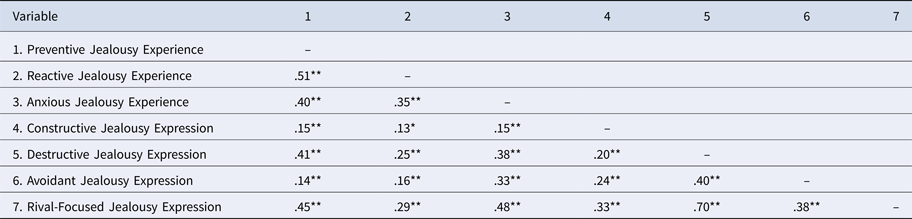
We projected with the first hypothesis that when opposite-sex best friendships induce jealousy in romantic partners, the experience and expression of jealousy will be positively related. To test this prediction, a series of Pearson correlations were calculated, and all correlations were positive and significant, lending support to our hypothesis, though most correlations between the jealousy experience and expression variables, as noted in Table 3, were low to moderate.
Pearson Correlations Between Jealousy Experiences and Expressions in the Context of Cross-Sex Best Friendships

Note: **p < .01; *p < .05.
The second hypothesis predicted that attitudes toward cross-sex best friendships will mediate the relationship between preventive jealousy experience and rival-focused jealousy expression. Following the suggestions of Baron and Kenny (Reference Baron and Kenny1986) for mediation analysis, we initially ran a linear regression between preventive jealousy experience and rival-focused jealousy expression. A significant regression and beta weight were found between the two variables: F(1, 343) = 87.09, p < .001, (β = -.45, p < .001). Next, we re-ran the regression, but added attitudes toward cross-sex best friendships as a suspected mediator between the two variables. While a significant regression was found, F(2, 342) = 43.42, p < .001, there was a nonsignificant beta (β = .07, p > .05), indicating a lack of mediation.
The third and fourth hypotheses were analysed using a procedure comparable to what was used with the second hypothesis. H3 stated that attitudes toward cross-sex best friendships will mediate the relationship between reactive jealousy experience and constructive jealousy expression. The linear regression between reactive jealousy experience and constructive jealousy expression was significant, as noted by the regression model, F(1, 344) = 5.90, p < .01, and beta (β = .13, p < .01). The addition of attitudes toward cross-sex best friendships as a potential mediator resulted in a significant regression, F(2, 343) = 3.59, p < .05, but no mediation (β = .06, p > .05).
The fourth hypothesis predicted that attitudes toward cross-sex best friendships will mediate the relationship between reactive jealousy experience and destructive jealousy expression. The linear regression between reactive jealousy experience and destructive jealousy expression was significant, F(1, 344) = 23.61, p < .001, (β = .25, p < .001). The analysis of attitudes toward opposite-sex best friendships as a suspected mediator yielded significant results, F(2, 343) = 15.471, p < .001, (β = -.14, p < .01), suggesting that attitudes toward cross-sex best friendships mediate the relationship between reactive jealousy experience and destructive jealousy expression.
Discussion
This study was birthed from a lucid understanding that romantic relationships are complex entities that can be affected by a myriad of factors, including jealousy. We were less clear at this study's onset regarding the connection between cross-sex best friendships and jealousy experiences and expressions among relational partners. Hence, we initially questioned what relationship status type would have the most positive attitude toward opposite-sex best friendships. Results indicated that single individuals (i.e., those not presently in a relationship) had the most positive attitudes about having a cross-sex best friend. This finding is very plausible, given that at the time of this study these individuals did not have a relationship partner; but in the past, they did have positive attitudes about a former romantic partner who had a cross-sex best friend. Yet, there is no guarantee that these same favourable dispositions would persist in a current relationship.
Outside of the single individuals, we found that dating individuals had the most positive attitudes toward opposite-sex best friendships. This finding also makes sense because casual dating relationships are more likely to have a short history and, therefore, be less likely to have experienced jealousy-provoking episodes (Kennedy-Lightsey & Booth-Butterfield, Reference Kennedy-Lightsey and Booth-Butterfield2011). Moreover, it is possible that dating couples perceive opposite-sex best friendships more positively because they are not that invested in the relationship, and/or they have little to no expectations of relationship permanence (Sheldon et al., Reference Sheldon, Gilchrist-Petty and Lessley2014). Interestingly, this study found that engaged-to-be-married couples had the least favourable attitudes regarding cross-sex best friends. This finding accords well with former research that noted engaged couples deal with several stressors, spanning wedding planning, merging families, financial constraints, and a fast approaching wedding date (Cramer & Lafreniere, Reference Cramer and Lafreniere2003). It appears that navigating the official coupling process coalesced with the potential threats of a cross-sex best friend may compound the anxiety and stress engaged couples are already experiencing, which leads them to have a negative disposition toward cross-sex best friends.
Along with examining relationship status type and attitudes toward opposite-sex best friendships, another goal of this study was to explore how the experience and expression of jealousy impacts attitudes toward cross-sex best friendships. Thus, we initially hypothesised that jealousy experience will be positively related to jealousy expression, and the results supported our prediction. While several correlations were low, three moderate and positive correlations were detected between: (a) preventive jealousy experience and destructive jealousy expression, (b) preventive jealousy experience and rival-focused jealousy expression, and (c) anxious jealousy experience and rival-focused jealousy expression. These findings follow a long line of researchers (e.g., Afifi & Reichert, Reference Afifi and Reichert1996; Andersen et al., Reference Andersen, Eloy, Guerrero and Spitzberg1995; Frampton & Linvill, Reference Frampton and Linvill2017; Guerrero & Andersen, Reference Guerrero, Andersen, Andersen and Guerrero1998) who have acknowledged the at least partial fusion of the experience and expression of jealousy, suggesting that when a person experiences jealousy in a relationship, he/she communicates those jealousy feelings (Bevan & Lannutti, Reference Bevan and Lannutti2002). This finding also adds further credence to prior research that regarded jealousy as a mixture of varied and expressed emotions (Sabini & Silver, Reference Sabini and Silver2005).
Armed with the understanding that people simultaneously experience and communicate feelings about jealousy, a prime subsequent goal of this study was to follow the lead of other scholars (e.g., Gunalan & Ceylan, Reference Gunalan and Ceylan2014; Worley & Samp, Reference Worley and Samp2014) who have queried possible mediation between the experience and expression of jealousy. Specifically, we assumed that if individuals have positive attitudes toward opposite-sex best friends, their experience of a jealousy-inducing occurrence might mitigate how they express jealousy, whereas having negative attitudes about opposite-sex best friends may intensify expressions of jealousy upon experience. In light of these assumptions, we explored attitudes toward opposite-sex best friendships as a mediator of the relationship between preventive jealousy experience and rival-focused jealousy expression (i.e., H2). While our analyses did not detect attitudinal mediation, the results indicated that the preventive jealousy experience is a predictor of the rival-focused jealousy expression. In other words, when a relational partner perceives that a cross-sex best friend is a potential threat to the romantic relationship, he/she experiences preventive jealousy and is therefore motivated to minimise the potential threat by using communication that conveys possession and degrades and/or restricts access to the cross-sex best friend. This finding meshes well with earlier research that found higher than expected rival-focused responses to possessive/preventive jealousy experiences (Frampton & Linvill, Reference Frampton and Linvill2017). The finding also makes sense given that anxious insecurity and fear are associated with jealousy (Parrott, Reference Parrott and Salovey1991; Sharpsteen, Reference Sharpsteen and Salovey1991), which can motivate one to attempt to prevent a partner's contact with a potential threat (Hoffman & DeGroot, Reference Hoffman, DeGroot, Gilchrist-Petty and Long2016). Considering this finding's implications, it is quite possible that a romantic partner who feels threatened by a cross-sex best friend may become possessive and attempt to preserve the relationship and minimise potential threats by expressing that the relationship partner and cross-sex best friend spend less time together.
As we dove deeper into the potential mediation of attitudes on the experience and expression of jealousy, we presupposed with our third hypothesis that attitudes toward opposite-sex best friendships would mediate the relationship between reactive jealousy experience and constructive jealousy expression. Again, no mediation was detected, yet our findings revealed that the reactive jealousy experience predicted the constructive jealousy expression. This means that if a relational partner is provoked into perceiving that a cross-sex best friend is being too friendly or flirtatious (i.e., reactive jealousy experience), the relational partner may engage in integrative or positive communication to discuss the issues and maintain the relationship. This suggests that despite feeling jealous, the partner perceives that the relationship is worth preserving and thus chooses communication tactics that are likely to sustain the relationship. Several scholars have lamented that the constructive jealousy expression is not only frequently used, but results in less negative outcomes and more relationship satisfaction (Andersen et al., Reference Andersen, Eloy, Guerrero and Spitzberg1995; Bevan, Reference Bevan2013; Guerrero & Andersen, Reference Guerrero, Andersen, Andersen and Guerrero1998; Guerrero et al., Reference Guerrero, Hannawa and Babin2011; Yoshimura, Reference Yoshimura2004), which could explain this finding in our study.
While the constructive use of communication strategies to manage jealousy surfacing from a cross-sex best friend rival is encouraging, our fourth hypothesis assumed that attitudes toward opposite-sex best friendships would mediate the relationship between reactive jealousy experience and destructive jealousy expression, and the data analysis supported this assumption. This finding is rather striking and implies that when a relational partner perceives that his/her significant other's cross-sex best friend is being too friendly or flirtatious and the relational partner has a negative attitude about cross-sex best friendships, he/she is more prone to lash out with negative or even violent communication. This finding has two important implications. First, it not only speaks to the powerful affective component of attitudes (Fishbein & Ajzen, Reference Fishbein and Ajzen1975), but supports previous research that has emphasised attitudes as important mediators that help us better understand the relationship between variables (Gall et al., Reference Gall, Kristjansson, Charbonneau and Florack2009; Parks & Roberton, Reference Parks and Roberton2004; Pires et al., Reference Pires, Ribas and Borzekowski2015). Previous research has already concluded that instances of reactive jealousy may be expressed with a high number of destructive responses (Frampton & Linvill, Reference Frampton and Linvill2017), but based on this study's findings, we can now assume that the relationship between the reactive jealousy experience and the destructive jealousy expression can be explained, at least in part, by one's negative attitudes of cross-sex best friendships.
Additionally, our findings align nicely with earlier inquiries that posited jealousy experiences and expressions regarding cross-sex friends can lead to adversarial and conflicting interactions between the romantic couple (Williams, Reference Williams2005). The destructive jealousy expression is rather troubling given that it can have an undertone of anger and hostility and is intended to harm the self-concept of the relationship partner (Evans, Reference Evans2003). It is even plausible to assume that if a partner's destructive jealousy goes to the extreme, one could fall prey to harassment, violence, and abuse — all issues the #MeToo Movement is fighting against.Footnote 4 While altering negative attitudes about cross-sex best friends is beyond the scope of this investigation, in light of the adverse and even harmful consequences of the destructive jealousy expression (Evans, Reference Evans2003; Williams, Reference Williams2005), it is essential for researchers to delve deeper into understanding and mitigating the negative attitudes associated with cross-sex best friends.
Limitations and Recommendations
Though this study has enhanced our knowledge regarding how cross-sex best friendships can affect jealousy experiences and expressions in romantic relationships, limitations are apparent, as with all research endeavours. First, in spite of the authors’ efforts to recruit diverse participants through various means, the sample is rather homogeneous, with most participants self-classifying as Caucasian/White (i.e., 75.4%) in terms of race, and women (i.e., 73.4%) in terms of sex. The study's findings would only be strengthened with a more diversified sample that captured the attitudes of more men and people of various races. For example, had we had a more even distribution of women and men, we could have performed analyses of sex differences. It could have added more breadth and depth to this investigation's findings to examine whether men and women differ in their jealousy experiences and expressions of cross-sex best friendships, especially since several studies have noted sex differences in jealousy resulting from cross-sex friendships (e.g., Bevan, Reference Bevan2013; Frampton & Linvill, Reference Frampton and Linvill2017; Guerrero & Andersen, Reference Guerrero, Andersen, Andersen and Guerrero1998; Werking, Reference Werking1997; Williams, Reference Williams2005). Likewise, if the sample was more racially diverse, we could have explored racial differences. Considering that previous researchers (e.g., Fiori et al., Reference Fiori, Rauer, Birditt, Marini, Jager, Brown and Orbuch2018) have detected that couples, especially Black and White couples, differ in their disapproval of a partner's friends, it would have added more inclusiveness to this study's findings to explore racial differences in cross-sex best friendships. Moreover, this study relied on the jealousy experiences and expressions of many relationship types, including single individuals. While the single participants reported on former relationship partners with cross-sex best friends, it is possible that their attitudes and responses might be different than individuals who are currently in relationships with partners who have cross-sex best friends. To alleviate this concern, future research should only consider the jealousy experiences and expressions of individuals who are presently in a relationship.
While this study had many significant findings, we acknowledge that stronger findings are desirable, as illustrated by the small and moderate correlations found with H1, and attitude mediation was only detected with the relationship between reactive jealousy experience and destructive jealousy expression. Hence, we must temper the conclusion that attitudes toward cross-sex best friends mediate the experience and expression of jealousy in romantic relationships. Given that little to no research has interrogated attitudinal mediation in the experience and expression of jealousy in romantic relationships when cross-sex best friends are involved, the authors urge future scholars to continue these investigations, with the hope of not only validating this study's findings, but also gaining a better understanding of the multitude of variables that can impact jealousy in intimate relationships that have cross-sex best friends.
Conclusion
Broadly, this investigation's overarching goal was to examine the experience and expression of jealousy among relational partners within the context of opposite-sex best friendships. This study makes several important contributions. First, whereas previous research had detected relationships between general cross-sex friendships and jealousy, this study has enhanced our knowledge base regarding cross-sex best friendships and jealousy. Additionally, our findings suggest that based on relationship status, single and dating individuals have the most positive attitudes regarding cross-sex best friendships, while engaged-to-be-married individuals harbour the most negative attitudes. Findings from this study further speak to the importance of understanding relational partners’ attitudes regarding cross-sex best friendships, as these attitudes can mediate the relationship between how jealousy is both experienced and expressed, especially in the context of reactive jealousy experience and destructive jealousy expression. Taken together, findings from this study have further unpacked the complexity of jealousy in romantic relationships as precipitated by cross-sex best friendships. It is our hope that this study will stimulate future inquisitions that can continue illuminating the fine nuances and implications of variables that challenge the development and maintenance of intimacy when relationship partners have cross-sex best friends.
Financial support
This research received no specific grant from any funding agency, commercial or not-for-profit sectors.
Conflict of interest
None
Ethical standards
The authors assert that all procedures contributing to this work comply with the ethical standards of the relevant national and institutional committees on human experimentation and with the Helsinki Declaration of 1975, as revised in 2008.