


INTRODUCTION
Since the Tiananmen Square movement of 1989 there have been no national protest movements in the People's Republic of China (PRC). This is the longest period without such a movement in the history of the PRC. However, there has been a dramatic increase in the number of local protests (“mass incidents”) since the early 1990s, rising from about 9,000 in 1994 to over 74,000 in 2004 (Wedeman Reference Wedeman2009, 2; Chung, Lai, and Xia Reference Chung, Lai and Xia2006). The Atlantic (February 17, 2012) reports that researchers at the Chinese Academy of Government estimated that the total number of local protests had doubled between 2006 and 2010 to 180,000.Footnote 1
Chan, Backstrom, and Mason (Reference Chan, Backstrom and Mason2014, 92) point out that these local protests are fundamentally different from the 1989 Tiananmen Square movement and previous waves of protests in 1986, 1978 (the “Democracy Wall” movement), and 1976. First, while those earlier movements were national in scope and sought political reform of China's Communist Party regime, the “mass incidents” of the last thirty years are largely local events that target local officials and local firms, are motivated by specific local grievances, such as land seizures, factory closings, layoffs, or environmental issues generated by local firms, and seek immediate tangible relief. Second, they rarely, if ever, coalesce into a sustained social movement that extends beyond the local community. Third, while the national protests of the 1970s and 80s were instigated by and involved mainly students, the local protests of the post-Tiananmen Square era involve mainly peasants and workers.
Given that the motivation of these protests is not national political reform, some have proposed that they instead reflect dissatisfaction with local government officials and firms over specific local grievances; their dissatisfaction is not with the central authorities. Local protests, then, represent an appeal by locals to the central authorities to remedy local grievances (Li Reference Li2016; Chen Reference Chen2017; Huang Reference Huang2018). This expectation, for example, has been reinforced by the central authorities’ use of the institutionalized inspection system as a mechanism to expose publicly and hold accountable local government officials who have come to the attention of central authorities for corruption or abuse of their authority and of citizens (Xi Reference Xi2017, 460).
Two assumptions can be made based on the discussion above. First, Chinese people have different levels of trust toward different authorities. This assumption is confirmed empirically: some scholars have found that, compared to local government, the central government of China generally is viewed more positively by citizens. The second assumption is that certain categories of Chinese people are more likely than others to participate in protest. In this article, we expect that people who have more trust in the central party/government than they do in local officials tend to believe that central authorities, once they are made aware of citizens’ grievances with local officials and firms, will step in and compel local authorities to accommodate citizens’ demands. As a result, Chinese citizens with this trust profile will see protests as a means for getting the attention of central authorities. In other words, they have faith in the willingness and ability of central authorities to take action against local authorities and firms whose actions are the source of local grievances. By protesting, they attract the attention of the trusted central authorities to remedy their grievances that are caused by the distrusted local authorities.
We use survey data from the Asia Barometer Survey in the PRC to test the proposition that those who manifest a high level of trust in central authorities combined with a low level of trust in local authorities will be more likely to protest than those who manifest other combinations of trust. Following Li (Reference Li2016), Chen (Reference Chen2017), and Wu and Wilkes (Reference Wu and Wilkes2018), we propose a fourfold typology of citizen trust composed of high versus low level trust in central versus local authorities, and we expect that the combination of high trust in central authorities and low trust in local authorities gives citizens more confidence that protests will be effective because central authorities will respond to their grievances and protect their rights and properties. By contrast, we expect those who manifest low trust in both central and local government to be less likely to protest because they view protest as an act of futility—neither government is likely to take any remedial action—and protest carries the risk of incarceration, injury, or loss of their job (Cai Reference Cai2008a; Reference Cai2008b; Tong and Lei Reference Tong and Lei2010). Similarly, we expect those with high levels of trust in local government to be less likely to protest and more likely to avail themselves of more conventional institutional mechanisms to seek redress of grievances, such as petitions, mediation, and arbitration processes or contacting government officials to voice their opinions. Among those with high trust in local government, those who also have low trust in central authorities are even less likely to protest for fear of a repressive response by the central authorities. Our tests provide support for the proposition that, among the four categories of trust in central versus national authorities, it is people with low trust in local authorities and high trust in central authorities that are most likely to participate in protests.
THEORIES OF PROTEST PARTICIPATION
Explanations of who participates in protests and their motivations include relative deprivation theories, resource mobilization theories, rational actor models, and combinations of these frameworks (Gurr Reference Gurr1970; McAdam, Tarrow, and Tilly Reference McAdam, Tarrow and Tilly2001; Somma Reference Somma2010; Kurer et al. Reference Kurer, Häusermann, Wüest and Enggist2018). Deprived actor theories start from the observation that poverty and inequality motivate people to protest these conditions, especially when they are attributable to the government (Russett Reference Russett1964; Huntington Reference Huntington1968). Relative deprivation theories argue that one's sense of deprivation relative to that of others or to one's condition in the past motivates protest participation (Gurr Reference Gurr1970; Davies Reference Davies1962). Rational actor models focus upon collective action problems and people's incentives to free ride since the benefits of protest are collective goods that they will be able to enjoy regardless of whether or not they participate in their production by protesting (Olson Reference Olson1965). Resource mobilization theory focuses on how dissident leaders overcome free rider temptations to mobilize individuals for collective action (McCarthy and Zald Reference McCarthy and Zald1973; McAdam, Tarrow, and Tilly Reference McAdam, Tarrow and Tilly1996, Reference McAdam, Tarrow and Tilly2001; Kitschelt Reference Kitschelt and Rucht1991). They point to the presence of mobilizing structures, framing processes, and changes in the opportunity structure that affect the individual's willingness to participate in protest.
None of these explanations considers how citizens’ attitudes about the government lead people to believe that protest is an effective method to get what they want. Provided that citizens have grievances and a basis for collective action, citizens’ trust in government may influence their willingness to protest to influence government policy. Trust in government has this effect on protest participation through its effect on citizens’ estimates of the prospects for protest to compel government to remedy their grievances. Kaase (Reference Kaase1999) studies individuals’ protest participation in nine European countries and finds that the lower political trust is, the higher is the probability of taking actions in protests. Using the European Social Survey to assess the relationship between political trust and political participation in more than twenty European countries, Hooghe and Marien (Reference Hooghe and Marien2013) and Braun and Hutter (Reference Braun and Hutter2016) both find that political trust is negatively related to participating in demonstrations.Footnote 2 They argue that people who distrust the government will seek to intervene directly in the decision-making process via non-institutional forms of participation, such as demonstration. Given the absence of major national protests in China since 1989, one central puzzle is whether this pattern is also true in the contemporary China, where citizens participate in local protests but not national movements.
WHY LOCAL PROTESTS IN CHINA?
Since the early 1980s China's economic reforms have resulted in record rates of economic growth and improvements in the standard of living. However, the benefits of this remarkable era of development are not equally enjoyed across all sectors of Chinese society (Gustafsson and Shi Reference Gustafsson, Shi and Riskin2001; Li and Sicular Reference Li and Sicular2014). The reforms have involved local policy initiatives that, while generating growth and development in the local economy, impose costs on certain segments of the local population. For instance, reform of State-Owned Enterprises (SOEs) has been intended to make those firms profitable and self sufficient, but it has also resulted in 30 million layoffs between 1989 and 2004 (Hurst Reference Hurst2004, 94) and the loss of “iron rice bowl” guarantees of benefits that made SOE workers China's “labor aristocracy” (Won Reference Won2004; Ralston et al. Reference Ralston, Terpstra-Tong, Terpstra, Wang and Egri2006; Lee Reference Lee2007). In rural areas, local governments may evict farmers from their land or residents from their homes to use those lands for industrial development or infrastructure expansion (Tong and Lei Reference Tong and Lei2010; Li Reference Li2006; Li and O'Brien Reference Li and O'Brien2008; Lee Reference Lee2007; Lee and Friedman Reference Lee and Friedman2009). Citizens often perceive local officials as deriving private benefits from these projects in what amounts to a form of official corruption, for which villagers pay the price (Cai Reference Cai2003; Li Reference Li2006). Therefore, affected Chinese citizens engage in protest activities to demand redress of those grievances, and the targets of these protests are the local officials and local firms (O'Brien Reference O'Brien1996; Li and O'Brien Reference Li and O'Brien2008; Chen Reference Chen2000; Hurst et al. Reference Hurst, Liu, Liu and Tao2014).
What factor makes Chinese protesters believe that protest would bring them justice? Unfortunately, existing theories have not addressed the question of why citizens would come to believe that protest would be effective and, therefore, worth joining. In other words, there is still a crucial question to answer: why do potential protesters believe that protest will solve their problems? We believe part of the answer to this question lies with individuals’ hierarchical political trust. Scholars have pointed out that in China people have more trust in the central government than in their local governments (Li Reference Li2016; Wu and Wilkes Reference Wu and Wilkes2018; Chen Reference Chen2017; Huang Reference Huang2018), but the broader effect of this hierarchical pattern of political trust on protest participation has not been tested empirically. In the following section we explain how variations in political trust across different levels of China's power structure affect protest participation.
POLITICAL TRUST, POWER STRUCTURE, AND PROTEST PARTICIPATION IN CHINA
Political trust can be conceived of as citizens’ belief in how well the political system is functioning to produce outcomes consistent with citizens’ needs and expectations (Easton Reference Easton1965; Mishler and Rose Reference Mishler and Rose2001; Li Reference Li2016; Hetherington Reference Hetherington1998). Existing empirical studies on China find that the source of political trust is citizens’ evaluation of government's economic and political performance (Chen Reference Chen2017; Yang and Tang Reference Yang and Tang2010). However, a citizen could hold different levels of political trust toward different levels of government based on their differing performance. For example, Wu and Wilkes (Reference Wu and Wilkes2018, 437) point out that in the United States, Western Europe, and most Asian societies, citizens tend to have higher levels of political trust in local government than in the central government. Chinese citizens, however, generally have higher levels of political trust in the central government than in local government (Li Reference Li2004; Reference Li2008; Reference Li2016; Chen Reference Chen2017; Wu and Wilkes Reference Wu and Wilkes2018). This phenomenon can be explained by analyzing the power structure of China.
Although China is a unitary state, the central party authorities in Beijing do not maintain a monopoly on power over the day-to-day exercise of political authority and policy at the local level. The central government formulates broad and general plans for the entire nation and grants a degree of conditional autonomy to local governments, assigning them responsibility for policy implementation on local issues, including matters related to economic development (Cai Reference Cai2008a; Reference Cai2008b; Chen Reference Chen2009; Tong and Lei Reference Tong and Lei2010). Some scholars go so far as to refer to this refer to this system as “Chinese Federalism” or “Federalism Chinese style” (Blanchard and Shleifer Reference Blanchard and Shleifer2001; Jin, Qian, and Weingast Reference Jin, Qian and Weingast2005; Zheng Reference Zheng2006).
This power structure generates different priorities for the two levels of government (Chen Reference Chen2017; Li Reference Li2008; Reference Li2016). The central government's main concern is the regime's legitimacy: it wants robust economic development, political and social stability, and popular respect for the Chinese Communist Party. In contrast, the main priority of local governments is policy implementation: they have responsibility for developing the local economy and preserving social stability, which includes dealing with mass incidents. Local officials’ career advancement depends in part on their success at achieving growth while preserving stability. Although the central government grants autonomy to local authorities, the central government still holds the power to intervene and investigate local issues if it deems it necessary and perceives local instability as a threat to the regime's legitimacy (Xi Reference Xi2017).
Some scholars argue that China's power structure also generates different sets of expectations on the part of citizens, and corresponding differences in the sense of satisfaction, regarding the central government versus the local governments (Bernstein and Lü Reference Bernstein and Lü2000; Li Reference Li2004; Reference Li2008; Su et al. Reference Su, Ye, He and Huang2016; Huang Reference Huang2018; Chen Reference Chen2017). They find that central government authorities generally enjoy greater political trust than lower level authorities: people tend to blame local authorities for unfavorable situations, while having greater respect for the central authorities. The central government reinforces this hierarchical pattern of trust with its control over media, with its often highly publicized anticorruption campaigns that target local officials, and with regular inspection tours of local governments by officials from national or provincial government (Xi Reference Xi2017). This enhances citizens’ political trust in central government as the entity that can and will root out the corruption that is the source of many local grievances that motivate local protests (Wu and Wilkes Reference Wu and Wilkes2018; Yang and Tang Reference Yang and Tang2010).
In contrast to the central government, local governments’ economic development initiatives are often seen as the source of citizens’ grievances. Local issues that generate grievances among the local population often emerge as the side effects of local development initiatives (Chen Reference Chen2017; Li Reference Li2004; Reference Li2008; Reference Li2016; Tong and Lei Reference Tong and Lei2010). In response to the rise in such local grievances, China has built several legal channels, such as mediation or arbitration, for citizens to seek remedies for certain classes of grievances. These channels often do not function as they were designed to, however: they either cannot process the volume of demands from all the people (Chen and Tang Reference Chen and Tang2013), or their judgments are viewed as unfair, and the institutions are seen as having been “captured” by the very local officials (and their private sector partners) whose actions are the cause of citizen grievances (Friedman and Lee Reference Friedman and Lee2010). At some point popular perceptions of the failure of these institutions to adjudicate their grievances fairly leave people with few alternatives other than protesting or suffering in silence (Tong and Lei Reference Tong and Lei2010; Hess Reference Hess2010; O'Brien Reference O'Brien1996; Reference O'Brien2009; Cai Reference Cai2002; Reference Cai2008a; Reference Cai2008b).
Given that there are no meaningful regular elections, protest incidents can be a way for citizens to signal the central authorities that they have grievances for which local officials are responsible. Protest requires central authorities to evaluate local officials’ performance regarding their major responsibility (besides economic development) of maintaining local order and social stability. Protesting thus allows Chinese citizens not only to express their demands to the responsible local authorities but also to signal upper-level authorities that local officials’ actions are motivating protests that undermine their responsibility to maintain social stability. In effect, people participate in protest as part of a strategy to appeal to upper-level authorities for justice and to redress of unfair treatment by local authorities.
The question then becomes which segments of the population are more or less likely to share this perception of the efficacy of protests and, therefore, to participate in such actions. The foregoing analysis implies that the division of power and responsibility between central and local authorities in China can engender in a given individual different levels of political trust toward local versus central government officials and institutions. Beyond what we already know, this study offers a more comprehensive analysis of this question by examining how variations in people's level of trust in central government versus local government affect their willingness to participate in protest.
Given that people have different levels of political trust in the multiple levels of government, individuals may have equal trust in both levels of government, equal distrust in both levels of government, stronger trust in local government than in the central government, or stronger trust in the central government than in local government (Li Reference Li2016; Chen Reference Chen2017). We present these four possible variants in Table 1.
Four Possible Variants of Chinese Political Trust toward Different Levels of Governments

Individuals in the first category (Type I) place high levels of political trust in both the central and the local government and are likely to have very few grievances toward either level of government. They are likely to believe that demands will be treated properly by the local government, so there is no need to participate in protests, especially since doing so entails opportunity costs (e.g., lost wages from time spent protesting) and risks (e.g., arrest, incarceration, or injury). The second category (Type II) comprises individuals who have a higher level of political trust in the local government but a lower level of political trust in the central government. Individuals in this group also believe that their demands would be treated properly by the local government, while protests might invite the intervention from the central government, which they do not trust. They fear that protest would incur the wrath of central authorities without bringing relief, so they are less likely to protest. Individuals in the third category (Type III) have a low level of political trust in both the central and the local government. Such individuals are likely to believe that no authority is likely to bring them justice, so participating in protests is simply a dangerous act of futility.
The last category (Type IV) consists of individuals with a lower level of political trust in the local government but a higher-level trust in the central government. Li (Reference Li2016) calls this “hierarchical trust.” We think these individuals are more likely to believe that protests send a signal to central authorities regarding the poor performance of the local government that can invite the central government to bring justice by pressuring the local officials responsible for the policies that generated their grievances to take remedial action. We believe that potential protest participants are fearful of the repression that participating in protest may incite from the local government. Type IV individuals, however, trust that central authorities will respond with action to protect them from repression and compel local officials to take corrective measures. Because of this, Type IV individuals should have a higher estimate than other individuals of the probability that protest will produce concessions from local government or firms. Therefore, given the absence of meaningful elections or other legal channels of influence over local officials, Type IV citizens are more likely to see protest as an effective strategy to attract the attention of central government authorities (the trusted authorities) to compel the local government and local firms (the distrusted authorities) to take actions to redress their grievances. Based on these analyses, we derive the following hypothesis:
H1: Individuals with higher levels of political trust in the central government and lower levels of political trust in the local government will be more likely to participate in protests than those with other combinations of local versus national government trust.
In contrast to our hypothesis, Li (Reference Li2004; 2008) points out another possible situation: protest occurs when people have petitioned the central government but not had the problem resolved. In this situation they see protest as a last resort. Therefore, when their trust in the central government is diminished as a result of their petitions being ignored or rejected, they resort to protest. Li, therefore, would reverse the above hypothesis to say that protest is most likely to occur when trust in both the local and central governments are low (Type III individuals).
H1a: Individuals with low levels of political trust in the central government and low levels of political trust in the local government will be more likely to participate in protests than those with other combinations of local versus national government trust.
RESEARCH DESIGN
This study employs survey data from Asian Barometer Wave 4 for the empirical analysis. The information about respondents’ protest participation comes from the following question:
Here is a list of actions that people sometimes take as citizens. For each of these, please tell me whether you, personally, have never once, or more than once done any of these things during the past three years. Q76: Attended a demonstration or protest march. Answers to this question are “(1) I have done this more than once,” “(2) I have done this once,” “(3) I have not done this, but I might do it if something important happens in the future,” “(4) I have not done this and I would not do it regardless of the situation.”
The dependent variable of our models, Protest, is a binary outcome variable indicating whether the respondent has participated in protests. As is typical in most nations, the percentage of respondents reporting having protested is very small (2.02 percent).
The two main independent variables for the hypotheses are measures of the individuals’ political trust in different levels of government. These variables are measured with responses to the questions:
Q9 (Q15): How much trust do you have in the national (local) government? (1) A Great Deal of Trust, (2) Quite a Lot of Trust, (3) Not Very Much Trust, (4) None at All.
For both variables, the scales were reversed so that higher values represent greater levels of trust in government. We used these variables to investigate their independent relationships with the dependent variable, but we also created a variable representing the difference in the respondents’ trust in the central versus local governments. This variable is simply the level of trust in the local government subtracted from the level of trust in the national government. Consistent with other research concerning China (e.g. Su et al. Reference Su, Ye, He and Huang2016; Huang Reference Huang2018), the mean for trust in the central government is higher than the mean for trust in local government, 3.34 compared with 2.74. The differential trust measure also shows that individuals generally trust the central government at least as much as local governments. Only 2.31 percent of the respondents expressed higher levels of trust in local governments than in the central government—and no one had a “great deal” of trust in local governments and no trust in the central government. In contrast, more than 45 percent of the respondents expressed greater trust in the central government than in local governments, including 10 percent whose score on trust in the central government was at least two points higher than their corresponding score for local governments.
We also included several control variables in our models. First, existing literature finds that younger and unmarried people, who tend to have fewer social and familial burdens, are more likely to participate in protests (Schussman and Soule Reference Schussman and Soule2005; Wiltfang and McAdam Reference Wiltfang and McAdam1991), so we created variables to measure respondents’ age and marital status. Second, McAdam (Reference McAdam1992) finds that males are more likely than females to participate in political protests, so we included a variable for respondents’ gender. Machado, Scartascini, and Tommasi (Reference Machado, Scartascini and Tommasi2011) argue that well-educated people are better informed and more critical of government, so they are more likely to participate in protests. We included a variable for education that ranges from a value of 1 for “No formal education,” to 10 for “Post-graduate degree.” Grievances also motivate protest participation, so we measure respondents’ sense of grievance with the question “Considering all the effort that you and your family members have made in the past, do you think the income that your family currently receives is fair or not fair?” Response options are (1) Very fair, (2) Fair, (3) Unfair, (4) Very unfair. Finally, to account for the possibility that protest participation is largely an urban phenomenon, we included the dichotomous variable Rural to control for possible rural-urban differences in protest participation.
EMPIRICAL FINDINGS
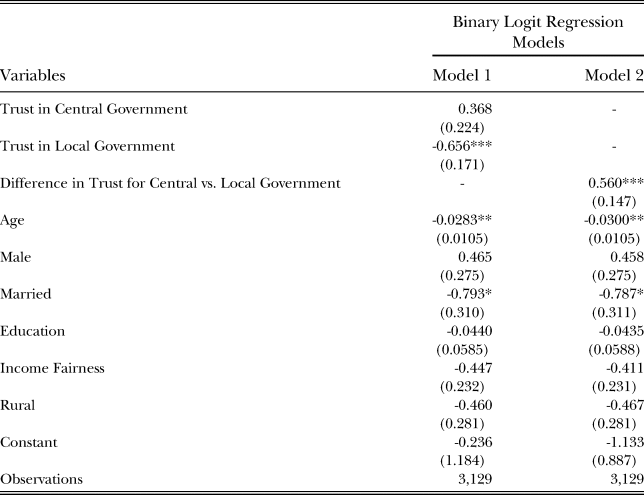
Table 2 presents the findings from the two binary logistic regression models.Footnote 3 Model 1 presents the findings with the direct effects of trust in local and central government on the probability that an individual participated in protests and reveals that higher levels of political trust in the central government have a positive effect on protest participation, albeit short of conventional levels of statistical significance, p < .11, while lower levels of political trust in local government made individuals significantly more likely to participate in protests, p < .001. Model 2 tests the effect of the difference in trust toward central versus local government on the probability that one participated in protests and corroborates these findings by showing that the difference in political trust between the central and local levels of government affects decisions to protest: the greater the political trust in the central government compared to local government, the more likely the individual is to protest.
Logistic Regression Models: Impact of Trust in Central Government vs. Local Government on Protest Participation

Note: Robust standard errors in parentheses
*** p < 0.001, ** p < 0.01, * p < 0.05
The logit coefficients, however, are not the relevant quantities of interest. Figure 1a presents the predicted probabilities and 95 percent confidence intervals of protest participation for respondents representing the four combinations of high and low levels of trust in the local and central governments. First, consistent with our expectations about Type I and Type II individuals, the probability of protest is very low when trust in the local government is high. The predicted probability of protest when trust in the local government is high ranges from .004 (se = .002) when trust in the central government is low to .011 (se = .003) when trust in the central government is high. In contrast, protest was more likely when local trust is low, ranging from .026 (se = .014) when trust in the central government is also low to .073 (se = .023) when trust in the central government is high. In other words, among those with low trust in local government, those with high trust in central government (Type IV individuals) were almost three times more likely to protest than those with low trust in central government (Type III individuals). The change in the predicted probability of protest of moving from the minimum to the maximum level of trust in the central government when local trust is low is .048 (se = .027, p < .10). Finally, the difference between the effect of low and high trust in the local government on protest increases as trust in the central government increases. At low levels of trust in the central government, the difference in the predicted probability of protest is only .022 (se = .012), but at high levels of trust in the central government, the corresponding difference in the probability of protest is .062 (se = .024).
The Predicted Probabilities of Protest Participation for the Four Combinations

The weight of the evidence presented in Figure 1b provides more support for the combination of low local government trust in conjunction with high central government trust as influencing the likelihood of protest than the combination of low trust in both levels of government. Figure 1b shows the predicted probabilities of protest when the value of the trust differential reflects greater trust in the local government than the central government (-2), equal trust in both levels of government (0), and maximum trust in the central government relative to the local government (+3). The predicted probability of participating in protests when trust in the central government is highest relative to the local government compared to when trust in both levels of government is equal increases to 0.072 from .014, an increase of .058 (se = .024). These results confirm those above that protest is most likely to occur when people have low levels of trust in the local government combined with high levels of trust in the central government.
The Predicted Probabilities of Protest Participation for the Three Trust Differentials

In sum, the empirical results support our hypothesis that the difference in the level of political trust in central versus local governments makes a difference in people's protest participation: people with a higher level of political trust in the central government combined with a lower level of political trust in the local government are more likely than others to participate in protests. These findings are consistent with our theoretical argument that when actions by local governments generate grievances among the local population, those citizens who do not trust in the local government's willingness or ability to address those grievances, but who do trust the central government are most likely to use protest in order to appeal to the central authorities to redress grievances.
DISCUSSION
Existing research on protests in China has offered insights into the patterns and causal dynamics of protest in today's China. Scholars argue that feelings of relative deprivation, frustration, and grievances push people to go to the street. However, deprivation theory explains only the incentive to participate in protests, and resource mobilization explains the capacity to revolt. Neither addresses the question of why some segments of the population believe that protests could bring them some redress of their grievances, given the high risks and potential costs of participation.
Our theory is that in a society without meaningful elections, participating in protest is an effective strategy for attracting the attention from the upper-level authorities in hopes of redressing unfavorable local situations when citizens trust the upper-level authorities. Using the Asian Barometer Survey dataset, we present evidence supporting a specific theory of how trust in the central government to remedy grievances combined with a lack of trust in local government to act motivates people to participate. Low trust in local government combined with high trust in the central government gives people some expectation that protest will not be an exercise in futility. This interpretation is reinforced by the findings that people with low trust in both levels of government are less likely to protest. People protest because they consider themselves to be victims of injustice. But those who engage in protests to redress those injustices do so because they have some trust that central authorities will respond, not with repression to support the targeted local authorities, but with pressure on those authorities to take remedial action. The patterns of trust in local versus central authorities that correlate with protest participation perhaps thus reflect not disaffection with central authorities but more faith in the central authorities than their local government. Findings supporting this conclusion are robust across our models.
The authors thank for the American Association for Chinese Studies 2019 Conference participants for extremely helpful comments.
CONFLICTS OF INTEREST
The authors declare none.
SUPPLEMENTARY MATERIAL
The supplementary material for this article can be found at https://doi.org/10.1017/jea.2021.26.