Introduction
The two well-known types of malignant lymphomas are Hodgkin's lymphoma and non-Hodgkin's lymphoma. Extra-nodal lymphomas are predominantly non-Hodgkin's lymphoma. Second to the gastrointestinal tract, the head and neck is one of the most common regions for extra-nodal lymphomas to arise in. These lymphomas arise in Waldeyer's ring mostly, because it contains abundant lymphoid tissue. Primary lymphoma in the larynx is very rare, accounting for less than 1 per cent of laryngeal malignance.Reference Ansell, Habermann, Hoyer, Strickler, Chen and McDonald1,Reference Kato, Sakura, Takooda, Sakurai and Izumo2 In 2015, it was still believed that less than 100 cases had been reported in the global literature.Reference Khamassi, Mahfoudhi, Jaafoura, Ouertani, Kaabachi and Bougacha3 Although the incidence of primary laryngeal lymphoma is very low, it represents an important differential diagnosis of laryngeal malignance.
China is the most populous country in the world, thus potentially providing a large source of cases of rare diseases. However, in the last 25 years, the Chinese medical databases published mainly Chinese-language articles only, resulting in the isolation of all kinds of rare cases from English-language literature. This study investigated Chinese-language articles on primary laryngeal lymphoma published in the last 25 years in China, in order to enrich the literature on this rare disease.
Materials and methods
We searched the two largest and most widely used Chinese-language databases: China National Knowledge Infrastructure and Wanfang Data. Our search terms were ‘larynx’, ‘laryngeal’ and ‘lymphoma’.
Firstly, we excluded irrelevant articles by the title. Then, we examined every relevant article and excluded those that did not provide the necessary clinical information. Articles from the same institute were carefully examined, in order to avoid the possibility of data duplication.
Articles were included if they at least provided information regarding patient gender, age and pathology result. We also analysed the following characteristics, if provided: disease course, symptoms, focal site, lymph node involvement, treatment and follow-up result.
Results
Article selection
A total of 55 studies were considered to be relevant. Nine reports of multiple cases were excluded for lacking the necessary information for each patient. Two reports from the same institute were excluded because of the possibility of data duplication. Finally, 44 reports were included in this study, comprising 115 cases. The earliest case was reported in 1990 and the latest one was in 2015.
Overall information
Information about these 115 cases covered several clinical characteristics. Only patient gender, age and pathology results were provided for all cases; details of other characteristics were not available for every case. The following data were available: symptoms, for 72 cases; course time, for 67; laryngoscope results, for 87; lymph node status, for 84; treatment information, for 82; and follow-up results, for 63. Details of all the characteristics studied were only provided for 47 cases.
Gender and age
There were 89 male patients (77.4 per cent) and 26 female patients (22.6 per cent) (Table 1), with a male-to-female ratio of 3.4:1. The average age of male and female patients was 46.10 years (range, 17–88 years) and 42.38 years (range, 18–71 years), respectively (p = 0.305).

Pathology results
All 115 patients were diagnosed as having non-Hodgkin's lymphoma. Forty-two patients had B-cell (including B-cell mucosa-associated lymphoid tissue (‘B-MALT’)) non-Hodgkin's lymphoma and 57 had T-cell (including natural killer or T-cell (‘NK-T’)) non-Hodgkin's lymphoma; the specific pathological subtype details of 16 cases were not provided.
Symptoms
The time interval from symptom onset to hospitalisation ranged from 1 month to 84 months (mean of 8.8 months; median of 3 months). Common symptoms included hoarseness (65 out of 72, 90.3 per cent), pharyngalgia (24 out of 72, 33.3 per cent), dyspnoea (18 out of 72, 25.0 per cent) and dysphagia (11 out of 72, 15.3 per cent). B symptoms occurred in 13 patients (18.1 per cent), with fever being the most common (10 out of 13), followed by unintentional weight loss (4 out of 13).
Focal site
In the 87 cases with laryngoscope results, the involved sites were recorded. The number of cases in which focal sites involved only one area was: 27 (31.0 per cent) for the supraglottic area, 16 (18.4 per cent) for the glottic area and 7 (8.0 per cent) for the subglottic area. In these cases, it is safe to say that the involved sites were where the primary tumour originated. However, in cases where more than one area might have been involved, the original site could not be distinguished in many cases. Supraglottic area involvement was seen in 56 of the 87 cases (64.4 per cent), followed by glottic area involvement in 44 cases (50.6 per cent) and subglottic area involvement in 17 cases (19.5 per cent).
Treatment
Proper treatment options for lymphoma primarily included three modalities: radiotherapy, chemotherapy and combined therapy (radiochemotherapy). The number of patients who received radiotherapy, chemotherapy and combined therapy was 25, 11 and 40, respectively, for cases in which details were provided. In these 76 patients, 7 were misdiagnosed with laryngeal cancer and had surgery before the final pathological diagnosis. Because most reports did not provide detailed information about the therapies applied, we were not able to conduct further evaluation.
Five patients refused to receive any treatment. Four of these patients died, at 0.5, 1, 3 and 10 months, respectively; one patient was lost to follow up. Another patient, whose foci was subglottic, received surgery alone and no further treatment. This patient was still alive after eight years of follow up.
Survival
In order to evaluate treatment effects, we only included patients who received proper treatment (radiotherapy, chemotherapy or combined therapy). The five patients who received no treatment and the one patient who received surgical treatment alone were excluded.
The follow-up time ranged from 0.1 to 240 months. The results of 62 non-Hodgkin's lymphoma patients were acquired. The average and median follow-up time was 37.4 and 23 months, respectively.
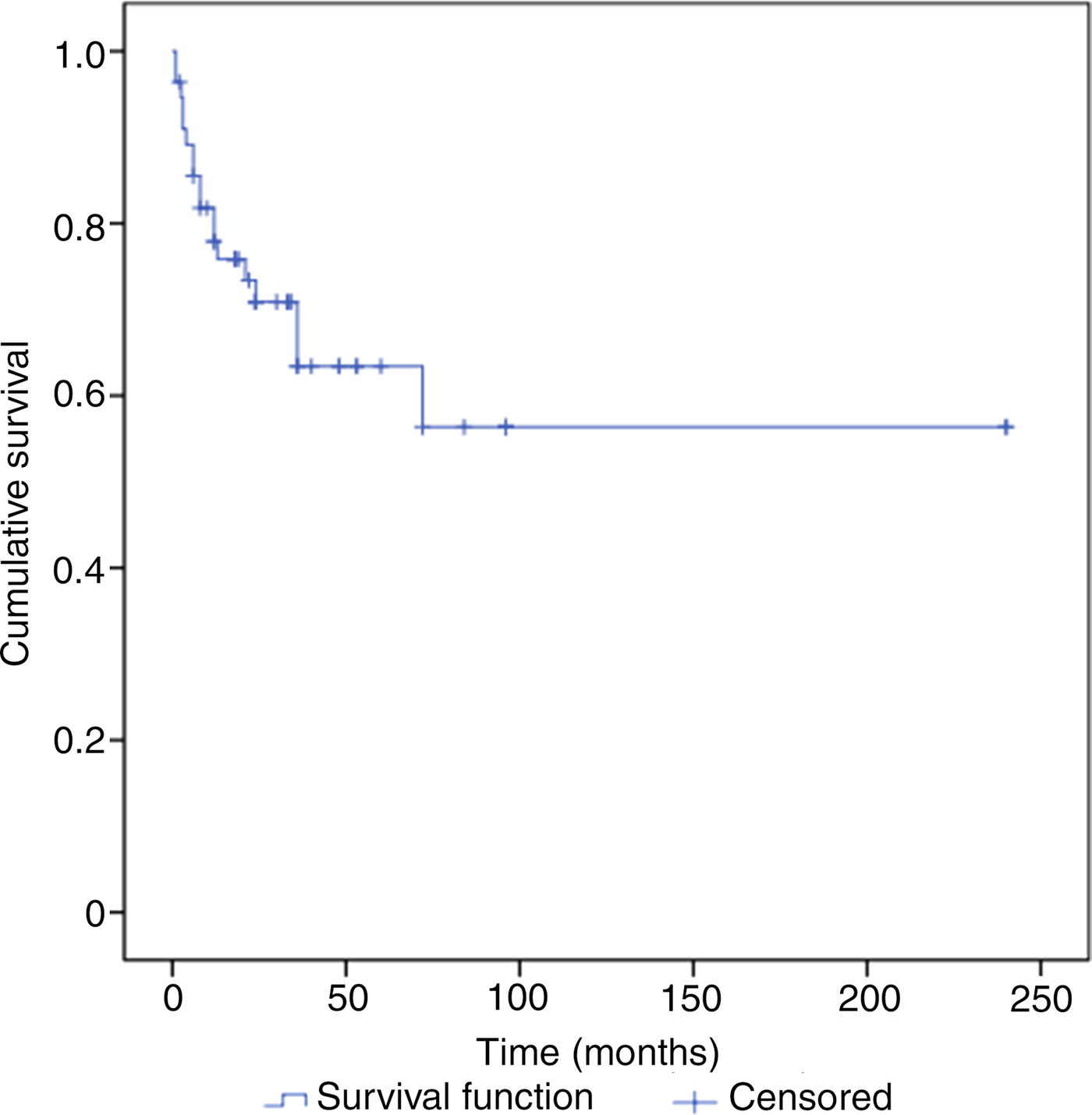
The total survival rate was 69.4 per cent (43 out of 62). In order to better evaluate the survival of non-Hodgkin's lymphoma patients, Kaplan–Meier analysis was applied (Figure 1). The estimated 3-year, 5-year and 10-year survival rates were 70.9 ± 6.4 per cent, 63.4 ± 7.6 per cent and 56.4 ± 9.5 per cent, respectively.
Kaplan–Meier survival plot.

Factors associated with prognosis
Disease stage at diagnosis
Information about lymph node status at diagnosis was available for 81 non-Hodgkin's lymphoma patients. Fifty-four of these patients received proper treatment and had follow-up results.
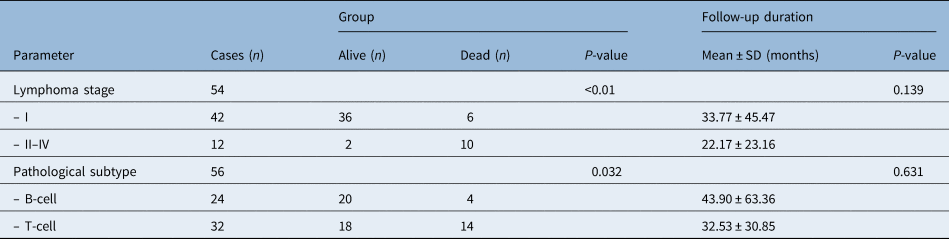
Based on Ann Arbor staging criteria for lymphomas,Reference Carbone, Kaplan, Musshoff, Smithers and Tubiana4 we divided the 54 patients into 2 groups: a stage I group and a stage II–IV group. The stage I group contained 42 patients, and 36 were still alive at follow up (Table 2). The stage II–IV group contained 12 patients, and only 2 of them were still alive at follow up. A cross-table test performed to analyse the difference between the two groups yielded significant results (p < 0.01). The average follow-up time of the stage I group and the stage II–IV group was 33.77 ± 45.47 months and 22.17 ± 23.16 months, respectively (p = 0.139).

Pathological subtype
Patients who were properly treated were divided into a B-cell group and a T-cell group. The B-cell group comprised 24 cases; after a follow up of 43.90 ± 63.36 months, 20 of these patients were still alive. The T-cell group consisted of 32 cases; after a follow up of 32.53 ± 30.85 months, 18 of these patients were still alive. There was no significant difference between the follow-up time of the two groups (p = 0.631), but the prognosis was significantly different (p = 0.032). B-cell group patients had a better outcome (Table 2).
Discussion
When it comes to laryngeal lymphoma, non-Hodgkin's lymphoma seems to be the exclusive type. To our knowledge, no English-language article has reported any laryngeal Hodgkin's lymphoma cases. In this study, no Hodgkin's lymphoma cases were found in the last 25 years of Chinese-language literature either.
As a result of the limited case numbers, the male-to-female ratios of laryngeal lymphoma varied between reports.Reference Siddiqui, Branstetter, Hamilton, Ginsberg, Glastonbury and Harnsberger5,Reference King, Yuen, Lei, Ahuja and Van Hasselt6 In a retrospective study of English-language articles,Reference Kim, Kim and Woo7 which contained the largest number of patients, involving 57 laryngeal lymphoma patients from multiple countries, there were 35 males and 22 females, with a male-to-female ratio of 1.6:1. Our study showed a ratio of 3.4:1. As there were no published studies containing more cases, we might assume a difference in the male-to-female ratio between China and many other countries. This could be a result of different factors associated with lymphoma, one of which is smoking.
In a meta-analysis of 50 studies and over 200 000 participants, smoking was associated with a higher risk of developing non-Hodgkin's lymphoma.Reference Sergentanis, Kanavidis, Michelakos and Petridou8 In China, the overwhelming majority of smokers are males, and very few females smoke. According to a survey conducted in 2010, the smoking rate of Chinese adult males and females was 53.3 per cent and 2.5 per cent, respectively.Reference Zhang, Wang, Li, Li, Jiang and Hu9 In contrast, the proportion of female smokers in Western countries is much larger. For example, from 2005 to 2016, 17.5 per cent of males and 13.5 per cent of females were smokers in the USA.Reference Jamal, Phillips, Gentzke, Homa, Babb and King10 However, patients’ history of smoking was not provided, and we could not further evaluate the role of smoking on the occurrence of primary laryngeal lymphoma in this study.
The diagnosis of laryngeal lymphoma can be challenging. On the one hand, the symptoms of laryngeal lymphoma are non-specific.Reference Yilmaz, Ibrahimov, Mamanov, Rasidov and Oktem11,Reference Monobe, Nakashima and Tominaga12 In this study, hoarseness (90.3 per cent) was the most common symptom, followed by pharyngalgia (33.3 per cent), dyspnoea (25.0 per cent) and dysphagia (15.3 per cent). Some patients had B symptoms (18.1 per cent), such as fever and weight loss. These symptoms could also present in infectious or neoplastic diseases of the larynx. On the other hand, the macroscopic appearance of laryngeal lymphoma is not specific either. As a result, laryngeal lymphoma can easily be misdiagnosed.
In this study, 17 patients (14.8 per cent) were misdiagnosed as having chronic laryngitis. It was apparent that 11 patients (9.6 per cent) were misdiagnosed with laryngeal cancer and underwent laryngectomy, after which the pathology results revealed non-Hodgkin's lymphoma. As lymphoma can be cured by chemo/radiotherapy, laryngectomy, which would definitely compromise patients’ quality of life, should have been avoided. Histopathological examination is essential. In fact, more than one biopsy might be needed to obtain the correct diagnosis.Reference Tardio, Moreno, Perez, Hernandez-Rivas and Lopez-Carreira13–Reference Markou, Goudakos, Constantinidis, Kostopoulos, Vital and Nikolaou15 In this study, the biopsy frequency ranged from one to four.
• This study examined 115 laryngeal lymphoma cases reported in Chinese literature, and represents the largest number of cases to date
• The male-to-female ratio was 3.4:1, for which smoking might be a contributory factor
• All 115 patients were diagnosed with non-Hodgkin's lymphoma
• Chemo/radiotherapy was effective; Kaplan–Meier analysis survival rates are promising
• More than one biopsy might be needed for correct diagnosis; performing laryngectomy without a definite pathology result should be avoided
• Lymph node involvement at diagnosis and T-cell subtype were associated with poorer prognosis
The supraglottic region is considered the most commonly involved area, as it contains more lymphoid tissue compared with the glottic and subglottic areas.Reference Andratschke, Stelter, Ihrler and Hagedorn16–Reference Pisani, Dosdegani, Policarpo, Ramponi, Gambaro and Pia18 In cases with only one area involved, it is safe to say that the involved area was where the lymphoma originated. In this study, out of the 87 cases for which details of the involved areas were provided, 27 (31.0 per cent) involved the supraglottic area only, which was more than the other two areas combined (16 and 7 cases, 26.4 per cent). However, compared with single-area involvement, multiple-area involvement was more common, and this makes determining the site of origin more difficult. Nevertheless, the supraglottic area appeared to be the most commonly involved area (in 64.4 per cent of patients), followed by the glottic area (50.6 per cent). The subglottic area was the least involved, seen in 19.5 per cent of patients only.
Generally, the prognosis of non-Hodgkin's laryngeal lymphoma patients was good.Reference Kim, Kim and Woo7,Reference Stephenson, Peer, Govender and Fagan19 Chemotherapy or radiotherapy can cure most patients at the early stages. Combined radiochemotherapy was effective for patients at later stages of disease.Reference Elmazghi, Elkacemi, Lalya, Zaidi, Harmouch and Kanouni20–Reference Kania, Hartl, Badoual, Le Maignan and Brasnu22 In this study, the mean follow-up time was 38.8 ± 49.8 months. The total survival rate was 69.4 per cent (43 out of 62). Kaplan–Meier analysis showed estimated 3-year, 5-year and 10-year survival rates of 70.9 ± 6.4 per cent, 63.4 ± 7.6 per cent and 56.4 ± 9.5 per cent, respectively.
In order to identify prognostic factors, Ann Arbor lymphoma stage, and B-cell or T-cell subtype were examined. In patients who received proper treatment and for whom there was follow-up information, 85.7 per cent of stage I patients (36 out of 42) were still alive after a follow up of 33.77 ± 45.47 months. However, only 16.7 per cent of stage II–IV patients (2 out of 12) were alive after a follow up of 22.17 ± 23.16 months (p < 0.01). T-cell non-Hodgkin's lymphoma seemed to be associated with poorer prognosis, compared with B-cell non-Hodgkin's lymphoma (p = 0.032). This result is in accordance with other studies.Reference Kim, Kim and Woo7,Reference Kania, Hartl, Badoual, Le Maignan and Brasnu22
Conclusion
Primary laryngeal lymphoma represents a rare laryngeal malignancy entity. Given the lack of reported cases, it is important for us to gather details on each case in order to better understand this disease. We retrospectively analysed 115 Chinese non-Hodgkin's lymphoma cases, providing some useful information on primary laryngeal lymphoma. In China, over 77 per cent of laryngeal lymphoma patients were male, for which smoking might be a contributory factor. Neither the symptoms nor the macroscopic appearance of laryngeal lymphoma are specific, which makes it easy to misdiagnose this disease. Even histopathological examination findings can be uncertain. In order to make the correct diagnosis before further intervention, more than one biopsy might be needed. The high portion of patients with an early disease stage and the efficacy of chemo/radiotherapy contributed to a generally promising prognosis. Higher disease stage and a T-cell subtype seemed to be associated with a poorer outcome.
Competing interests
None declared