




No CrossRef data available.
Article contents
Semantic priming in patients with right frontal lobe lesions
Published online by Cambridge University Press: 11 April 2005
Abstract
Patients with unilateral, right frontal lobe damage (N = 13) and matched controls (N = 20) performed a task of lexical ambiguity resolution in order to explore the contribution of right frontal regions to lexical-semantic priming. Word triplets consisting of balanced homographs were presented to participants in four conditions: concordant, discordant, neutral, and unrelated. Controls demonstrated facilitation for concordant meanings of homographs, as evidenced by their faster reaction times in the concordant relative to the unrelated (baseline) condition, as well as a lack of facilitation for the discordant meaning relative to the neutral and concordant conditions. Results in patients with right frontal lobe damage differed depending on the site of the lesion. Patients with lesions restricted to the right medial frontal lobe only showed facilitation in the neutral condition, while those with lesions encroaching upon the right dorsolateral region demonstrated facilitation of both discordant and concordant meanings relative to the baseline condition. These results support a role for the right frontal lobe in semantic priming and suggest possible specialization within the right prefrontal cortex for the processing of lexical-semantic information. (JINS, 2005, 11, 132–143.)
Information
- Type
- Research Article
- Information
- Journal of the International Neuropsychological Society , Volume 11 , Issue 2 , March 2005 , pp. 132 - 143
- Copyright
- © 2005 The International Neuropsychological Society
INTRODUCTION
Semantic priming refers to the facilitation of target information when it is preceded by related information, presumably due to the proximity of associated concepts in semantic memory. There is a large body of literature implicating several different brain regions in semantic priming (Copland et al., 2003; Kotz et al., 2002; Rissman et al., 2003; Rossell et al., 2003; Seger et al., 2000; for a review, see Henson, 2003), but one emerging idea is that the left prefrontal cortex plays an important role in this process due to its proposed role in the retrieval of semantic information (Buckner et al., 1995; Demb et al., 1995; Gabrieli et al., 1996; Kapur et al., 1994; Tulving et al., 1994; Wagner et al., 2001), use of contextual cues and source information to facilitate semantic processing (Janowsky et al., 1989; Shimamura et al., 1990), and/or selection of target information among competing alternatives in semantic memory (Thompson-Schill et al., 1997, 1999).
There is also a growing body of literature to suggest that the right prefrontal cortex contributes to semantic priming, although its exact role in priming has not been fully elaborated. Recent neuroimaging and event-related potentials (ERP) studies provide some evidence that the right frontal lobe is involved in processing both typical and atypical semantic relationships (i.e., noun–verb relations), whereas the left frontal lobe is only adept at processing typical semantic associations (Beeman, 1998; Kiefer et al., 1998; Seger et al., 2000). Divided visual field studies implicate the right hemisphere in the processing of remote associations and indicate that a wider range of word meanings is represented in the right hemisphere as compared to the left (Chiarello & Richards, 1992; Coney & Evans, 2000; Faust & Chiarello, 1998; Nakagawa, 1991; Titone, 1998). In addition, evidence from lesion studies suggests that the right frontal lobe contributes to discourse comprehension and interpreting metaphorical expressions (Brownell, 1988), as well as in the use and appreciation of humor (Shammi & Stuss, 1999). Together, these studies suggest that the right prefrontal cortex is involved in several aspects of semantic processing that may contribute to semantic priming effects and appear to be qualitatively different from those afforded to the left frontal lobe.
There are several methods that can be used to evaluate semantic processes, and one well-established method is to examine priming effects when participants use contextual cues to resolve lexical ambiguities in speech or text (Copland et al., 2000a). To date, most studies of lexical ambiguity resolution in patient populations have focused exclusively on patients with left hemisphere damage (Blumstein et al., 1982; Grinrod & Baum, 2002; Hagoort, 1993; Milberg & Blumstein, 1981; Milberg et al., 1987) or subcortical lesions (Copland et al., 2000a, 2000b). However, there is some recent patient data to suggest that right hemisphere damage also disrupts lexical-semantic priming. In a series of studies by Tompkins and colleagues, patients with right hemisphere damage showed difficulty suppressing contextually inappropriate word meanings in sentence comprehension relative to a group of healthy controls (Tompkins et al., 1997, 2000, 2001). In these studies, however, damage to the right hemisphere was diffuse and the degree to which the right frontal lobe contributed uniquely to this effect could not be determined.
We are aware of only one study that has examined semantic priming using a lexical-ambiguity resolution task in patients with discrete right and left frontal lobe lesions. Metzler (2001) studied lexical-ambiguity resolution in patients with right, left, and bilateral frontal lobe lesions on a word-reading task. In her study, patients were presented with word triplets in which the second word in each triplet was always a homograph and the first and third words were either related to the same (concordant) or different (discordant) meanings of the homograph. Whereas the former condition produces semantic facilitation (i.e., faster reaction times to the target word), the latter condition does not produce facilitation (i.e., slower reaction times to the target) in young healthy participants. Using proportional reaction time scores (i.e., discordant–concordant/concordant), Metzler found that semantic priming for concordant meanings of homographs was abolished in patients with left and bilateral frontal lobe lesions relative to discordant meanings, whereas semantic priming for concordant meanings was facilitated in patients with right frontal lobe lesions relative to those with left frontal lesions and healthy controls. Although admittedly post hoc, Metzler proposed that the increased facilitation of patients with right frontal lobe damage in the concordant condition may reflect an overreliance on responses that are prepotent and expected, and that this may explain the role of the right frontal lobe in perseveration (Lombardi et al., 1999).
Although the study by Metzler helped to provide important insights into the role of the right frontal lobe in semantic priming, there are two potential limitations of that study that make it difficult to determine the exact nature of semantic-priming deficits in patients with right frontal lobe lesions. One limitation is that only patients with right medial and/or bifrontal lesions were included in the study, and in several cases the location of the lesion was uncertain (see Metzler, 2001; Table 1). Thus, it is unclear whether patients with lesions that extend beyond the right medial frontal lobe produce the same or a different pattern of semantic priming. Second, an experimental baseline condition was not included in the study by Metzler, but rather priming was defined as the proportional facilitation of the concordant relative to the discordant condition. Without a baseline condition, it is difficult to determine exactly which condition (i.e., concordant or discordant) is abnormal in patients with right frontal lobe lesions.
Patient group, etiology, surgery location, demographic information, and neuropsychological performances for individual patients

In the present study, we further examined semantic priming in patients with right frontal lobe lesions using a lexical-ambiguity resolution task very similar to the one used by Metzler. However, in our study, we addressed the limitations of previous work in this area by examining a group of patients with more diverse lesion locations and by including two additional experimental conditions in our task. Exploring regional differences in semantic priming within the right frontal lobe is important because there is a vast literature indicating that the frontal lobe is not a unitary region, but rather contains many subregions that subserve different cognitive functions (e.g., Gabrieli et al., 1998). In particular, neuroimaging studies that have found right frontal activation in semantic tasks have identified region specific differences (e.g., Seger et al., 2000). Therefore, in the present study, we examined a group of patients similar to Metzler's who had lesions restricted to the right medial frontal lobe, as well as a group of patients with lesions that included the right dorsolateral region. The latter group was of interest because the right dorsolateral frontal cortex has been implicated in other types of priming (i.e., negative priming in selective attention; see Stuss et al., 2002), and we wished to determine whether or not this region is also involved in semantic priming. In addition, we included a baseline condition in which the three words were unrelated (i.e., the unrelated condition), as well as a condition in which there was no context to influence meaning selection (i.e., the neutral condition). These conditions allowed us to isolate facilitation effects within each group in order to clarify the exact nature of semantic-priming deficits in patients with right medial and dorsolateral frontal lobe lesions.
Based on previous literature on lexical-ambiguity resolution (Copland et al., 2000a; Hagoort, 1989), we hypothesized that control participants would show faster responses in the concordant condition relative to all other conditions, since in the concordant condition, attention is directed toward the context-appropriate meaning of the word. In addition, we predicted that controls would show slower responses in the discordant condition relative to the neutral condition and either slower or equivalent responses in the discordant condition relative to the unrelated condition. This pattern of responses would provide strong evidence that context is influencing meaning selection by facilitating context-appropriate meanings (i.e., concordant) but not context-inappropriate responses (i.e., discordant) or irrelevant (i.e., unrelated) meanings. Based on Metzler's study, we hypothesized that patients with damage to the right medial (RM) frontal lobe would show increased facilitation (i.e., a hyperpriming effect), as evidenced by significantly faster responses in the concordant condition relative to the baseline conditions, and that facilitation in the concordant condition would significantly exceed that of the controls. We also hypothesized that due to the functional heterogeneity within the frontal lobes, lesions involving the right dorsolateral cortex would produce a different pattern of semantic priming than patients with lesions circumscribed to the RM frontal lobes. This hypothesis was based on existing research implicating the right dorsolateral cortex in the ability to abolish or filter irrelevant information (Braver et al., 2001; Perlstein et al., 2003; Stuss et al., 2002). Therefore, we hypothesized that patients with involvement of the right dorsolateral frontal lobe may show disrupted priming characterized by an inability to abolish priming in the discordant condition.
METHODS
Participants
Participants in this investigation included 13 patients (22 to 51 years of age) who underwent a right frontal lobe resection for treatment of intractable epilepsy. All patients were recruited from the University of Florida Comprehensive Epilepsy Program (UFCEP) and were included in the investigation if they had evidence of unilateral, focal frontal lobe damage and a documented Full Scale IQ (FSIQ) above 70. Precise lesion location was based on the operative reports and determined by the neurosurgeon that performed the resections (S.N.R.) and a second neurosurgeon that assisted with the lesion descriptions (R.J.B.). The sample of participants consisted of six patients with RM frontal lobe resections and seven with right extramedial frontal (RDL/M) lobe resections (three dorsolateral, four dorsolateral plus medial). The patient sample consisted of eight females and five males. All participants were left-hemisphere dominant for language as determined by pre-surgical Wada evaluations. Table 1 displays the seizure etiology, surgical lesion location, gender, age, education level, and neuropsychological data for each individual patient who received a right frontal resection.
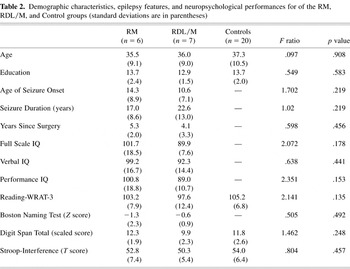
Twenty age- and education-matched healthy participants were recruited as the control group. Fifteen were female and five were male. Table 2 provides the mean demographic characteristics, epilepsy information, and neuropsychological data for the RM and RDL/M groups, and demographic characteristics and neuropsychological data for the control group. One-way analysis of variances (ANOVAs) revealed no significant differences among the three groups in age or in level of education (see Table 2). A 3 × 2 chi-squared Test did not reveal any differences among the three groups in gender distribution, χ2 = 1.4, p = .502. Independent t tests were also conducted between the RM and RDL/M groups and revealed no reliable differences in age of seizure onset, seizure duration, or years since surgery.
Demographic characteristics, epilepsy features, and neuropsychological performances for of the RM, RDL/M, and Control groups (standard deviations are in parentheses)

To better characterize the patients with RM and RDL/M lesions cognitively, a short battery of neuropsychological tests was administered, which included the Digit Span subtest of the Wechsler Memory Scale–III (Wechsler, 1997), the Reading subtest of the Wide Range Achievement Test–Third Edition (WRAT–3; Wilkinson, 1993), the Boston Naming Test (BNT; Kaplan et al., 1983), and the Stroop Color-Word Test (Golden, 1978). The normal controls were also administered a subset of these tests. One-way ANOVAs did not reveal any significant differences among the three groups on the Digit Span Test, WRAT standard score or the Interference index from the Stroop Test. T tests indicated that the RM and the RDL/M groups did not differ on full scale IQ (FSIQ), performance IQ (PIQ), verbal IQ (VIQ), or the BNT. In general, these comparisons indicated that the RM and RDL/M groups were not demonstrating significant neuropsychological deficits and they did not differ from one another. Further, neither performance on the Word Picture Matching subtest of the Western Aphasia Battery nor behavioral observations made during the time of testing revealed any obvious aphasia in any of the patients.
Stimuli
A modified version of the word triplet semantic-priming paradigm described by Copland et al. (2000a) was used as a measure of lexical-ambiguity resolution. Stimuli in this experiment consisted of word triplets presented visually on a computer screen, in which the first word was a word providing the context (context prime), the second word represented an ambiguous prime (homograph), and the third word was the target word. Stimuli consisted of 12 lexically ambiguous balanced homographs (i.e., bank) that had two unrelated, distinct, and common meanings for which there are relatively strong associates (Twilley et al., 1994). Four word triplets were constructed for each lexical ambiguity and presented within the context of four different experimental conditions—concordant, discordant, neutral, and unrelated conditions (see Table 3). In the concordant condition, the context prime and the target were related to the same meaning of the ambiguous prime. In the discordant condition, the context prime and the target were related to different meanings of the ambiguous prime. In the neutral condition, the context prime was unrelated to the meaning of the ambiguous prime indicated by the target. In the unrelated (baseline) condition, the target remained the same, while the two primes were words unrelated to each other or to the target. While the concordant and discordant conditions evaluate the effects of a preceding context on target performance, the neutral condition allowed us to examine the effects of target performance in the absence of contextual constraints (i.e., neither meaning of the homograph is primed). Previous studies using a neutral condition have shown that this condition produces less priming than the concordant condition, but that some priming is observed as responses are typically faster in the neutral condition compared to the discordant and unrelated conditions (Hagoort, 1989). Therefore, response times in the discordant and concordant conditions are directly compared to the unrelated and neutral conditions when determining the effects of context on meaning selection.
Four experimental conditions in the Word Triplets Task

Each critical target was presented four times (once for each condition) at each of two interstimulus intervals (ISIs; 100 ms and 1250 ms) in the experiment. Two ISIs were included in this experiment since there is data to suggest that lexical-semantic priming effects at short ISIs (i.e., 100 ms) may reflect automatic processes, whereas priming effects at longer ISIs (i.e., 1250 ms) reflect controlled, attention-based processes that are more susceptible to contextual constraints (Simpson, 1984). For both ISIs, the order of presentation for each triplet with the same target was counterbalanced to reduce repetition effects. In addition, no experimental condition occurred more than three times in a row throughout the experiment and there were a minimum of four intervening trials between triplets with the same target. Twelve word sequences were also created in which the target stimulus is a set of three question marks instead of a word. On these trials, participants were required to recall the first two words on the trial. The “recall” triplets were presented twice in a session and were included to insure that participants attended to all stimuli. Overall, 60 triplets (48 critical and 12 recall) were presented to the participant. An initial block of 10 practice trials was completed prior to testing. During the practice trials, the sensitivity of the relay was adjusted to each participant's voice.
Procedure
Participants were tested individually and seated in front of a computer screen. They were told that they would see three stimuli presented in succession in the center of the screen and that the third stimulus would either be a word or set of three question marks. They were instructed that if the third stimulus was a word, they should read the word aloud as quickly and as accurately as possible. On the other hand, if the third stimulus was a set of three question marks, they should quickly try to recall the first two words presented on that trial. A single trial consisted of a ready signal followed by a fixation cross which was presented in the center of the screen for 200 ms, followed by the context prime, the ambiguous prime, and the target presented for 200 ms each in succession. In one block of trials, an ISI of 100 ms was placed between the words in each triplet, while in another block of trials, an ISI of 1250 ms was placed between the word triplets. The two blocks were counterbalanced across participants so that some received the 100-ms ISI first and others received the 1250-ms ISI first. In both blocks, participants initiated each trial by pressing the space bar. Reaction time (RT) to the target word was measured and was recorded from the onset of the target word to the onset of the participant's vocal response on all trials. Errors were recorded by the examiner on each trial.
RESULTS
The dependent variable in this study was the vocal RT to the target word. Statistical analyses were carried out on RTs to the target after outliers (RTs > 2 SD from the mean) and errors (incorrect responses and microphone failures) were removed. Removal of outliers resulted in the exclusion of 8.3% of the controls' data, 9.4% of the RM groups' data, and 8.5% of the RDL/M groups' data. Because errors accounted for less than 1% of the data in each group, error analyses were not conducted. Median RTs for each group across the four conditions are displayed in Table 4. RTs for each trial were normalized by log transformations in order to help improve variance homogeneity. Prior to computing these difference scores, a one-way ANOVA was conducted on the three groups' log transformed RTs in the baseline (unrelated) condition in order to make sure there were no baseline differences in RTs among the groups. This analysis did not reveal any significant differences among the three groups, F(2, 38) = 1.3, p = .057, although the test approached significance.
Average median reaction times (RT) in msec and standard deviations (SD) for the RM, RDL/M, and Control groups in the four experimental conditions

Semantic-priming effects were examined by computing difference scores between the log-transformed RTs from the unrelated condition and the log-transformed RTs from the concordant, discordant, and neutral conditions. An initial Group × ISI × Condition repeated-measures ANOVA revealed a main effect for condition, F(2, 60) = 3.46, p = .031, but no main effect for group, F(2, 30) = 2.06, p = .145, or ISI, F(1, 30) = 3.8, p = .061. The main effect for condition was mediated by a significant Group × Condition interaction, F(4, 60) = 5.17, p = .001, indicating that the three groups demonstrated different patterns of semantic priming across the experimental conditions. There was no Group × ISI interaction, F(2, 30) = .61, p = .524, nor was there a Condition × ISI interaction, F(2, 60) = 2.51, p = .112. In addition, the Group × Condition × ISI interaction was not significant, F(4, 60) = .28, p = .887. Because the analyses did not reveal any main effect or interactions with ISI, we examined group differences in the various conditions collapsed across ISI using one-way ANOVAs with group (controls vs. RM vs. RDL/M) as the factor.
Discordant Condition
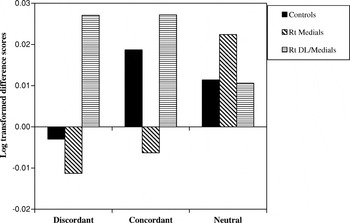
Performance in the discordant condition was defined as the average log-transformed RT in the unrelated condition minus the average log-transformed RT in the discordant condition. Thus, a small or negative value indicates the expected slowing in the discordant condition relative to baseline. A one-way ANOVA in the discordant condition revealed significant differences among the three groups, F(2, 32) = 6.45, p = .005. Follow-up comparisons using Tukey's HSD tests indicated that the control group was significantly different from the RDL/M group, p = .002, and that the RDL/M group was significantly different from the RM group, p = .012. The controls were not significantly different from the RM group, p = .692. As can be seen in the figure, the control group and the RM group showed significantly slower performances in the discordant condition relative to the RDL/M group. In contrast, the RDL/M group demonstrated faster performances in the discordant condition relative to the baseline condition, suggesting priming of the contextually inappropriate word meaning.
To determine if the finding in either patient group was due to a subset of participants with highly deviant scores, we examined each participant's score in the discordant condition. In the control group, 14/20 of the patients demonstrated the typical pattern, that is, slower responses to the discordant meaning relative to baseline. Similarly, 5/6 of the patients in the RM group showed this pattern. In contrast, all 7 of the RDL/M patients displayed faster responses (i.e., facilitation) to the discordant meaning. Furthermore, there was no difference in the degree of facilitation between patients with pure dorsolateral damage and those with dorsolateral plus medial damage, t(5) = 1.25, p = .265, indicating that the group findings were not due to a subset of patients.
Concordant Condition
Priming for the concordant meaning was defined as the average log-transformed RT in the unrelated condition minus average log-transformed RT in the concordant condition. Thus, a greater positive value means greater facilitation of the concordant meaning of the words. Results of a one-way ANOVA indicated that the three groups differed reliably on this index, F(2, 32) = 4.8, p = .016. Tukey's HSD tests indicated that both the control and RDL/M groups were significantly different from the RM group, p's = .025 and .004, respectively. The control and the RDL/M groups did not differ significantly from one another, p = .616. As can be seen in the figure, the control group and the RDL/M group demonstrated the typical facilitation effect for the concordant meaning (i.e., faster responding in the concordant relative to baseline condition). In contrast, the RM group did not demonstrate facilitation in the concordant condition, and obtained a slightly negative score. Individual participant analyses revealed that 15/20 of the controls, 2/6 of the RM, and all 7 of the RDL/M patients demonstrated facilitation in the concordant condition.
Neutral Condition
To determine group differences in priming when contextual constraints are not imposed, a neutral condition was included. A one-way ANOVA (unrelated condition–neutral condition) indicated no group differences in priming for targets presented in a neutral context, F(2, 32) = 0.51, p = .603. As can be seen in the figure, all three groups had positive scores in the neutral condition. Analysis of individual participants revealed that 13/20 of the controls, 3/6 of the RM patients, and 4/7 of the RDL/M patients (2/4 “mixed” and 2/3 “pure dorsolateral”) showed facilitation in the neutral condition.
Within-Group Comparisons
Because the control and patient groups showed different patterns of priming across the experimental conditions, we examined priming effects within each group in order to determine how context influences meaning selection. To determine whether or not each group demonstrated facilitation of the context-appropriate meaning, RTs in the concordant condition were compared to RTs in the unrelated, discordant, and neutral conditions. Planned pairwise comparisons revealed that the control group displayed faster responses to the concordant condition relative to the discordant, t(19) = 3.72, p = .001, and unrelated, t(19) = 3.72, p = .001 conditions, whereas facilitation of the concordant relative to the neutral condition only approached significance, t(19) = 2.70, p = .068. This pattern suggests that the control group demonstrated the expected facilitation of the context-appropriate meaning, although facilitation was not significantly greater than when no context was provided. The RDL/M group demonstrated facilitation of the concordant meaning relative to the unrelated t(6) = 7.78, p = .000, and neutral, t(6) = 2.55, p = .050, conditions, but they did not show greater facilitation of the concordant meaning relative to the discordant meaning, t(6) = 0.03, p = .976. This pattern suggests that while RDL/M group do show facilitation effects for the context-appropriate meaning, facilitation does not appear to be greater than that displayed for the inappropriate meaning. Unlike the control and RDL/M groups, the RM group did not demonstrate facilitation of the concordant meaning relative to the discordant, t(5) = 2.13, p = .086, neutral, t(5) = 1.95, p = .108, or unrelated, t(5) = .75, p = .486, conditions.
To establish whether or not each group demonstrated the expected lack of facilitation for the context-inappropriate meaning, RTs in the discordant condition were compared to RTs in the neutral and unrelated conditions. Planned pairwise comparisons revealed that the control group was significantly slower in the discordant condition relative to the neutral condition, t(19) = 2.95, p = .008, suggesting that the context-inappropriate meaning received less facilitation than the condition in which there was no context to guide meaning selection. In addition, there was no difference between the discordant and unrelated conditions t(19) = 1.00, p = .522, suggesting that the discordant meaning was not facilitated relative to baseline. The RM group showed a similar pattern to the controls in that their discordant condition was slower than the neutral, t(5) = 3.7, p = .013, but no different than the unrelated, t(5) = 1.0, p = .365, condition. Conversely, the RDL/M group showed greater facilitation in the discordant condition relative to both the neutral, t(6) = 2.43, p = .036, and unrelated, t(6) = 4.04, p = .007, conditions. Inspection of Figure 1 reveals that the RDL/M group displayed a level of facilitation for the discordant meaning that was similar to that seen for the concordant meaning. These results suggest that for the RDL/M group, context does not influence meaning selection, and therefore, contextually appropriate and inappropriate meanings both receive facilitation.

Log transformed difference scores (unrelated condition − experimental condition) for the Controls, RM, and RDL/M groups.
Repetition Effects
Since previous research has suggested that target repetition can differentially affect priming in different experimental conditions (Hagoort, 1989; but also see Milberg & Blumstein's response, 1989), we tested whether or not target repetition impacted priming and/or whether or not the effects of repetition on priming differed among the groups in a Group × Repetition × Condition repeated-measures ANOVA. Results of this analysis revealed a main effect of repetition, F(7, 210) = 3.14, p = .004, a main effect of group, F(2, 30) = 5.3, p = .011, and a main effect of condition, F(2, 60)=13.99, p = .000. As expected, based on our previous analysis, these effects were mediated by a Group × Condition interaction, F(4, 60) = 5.7, p = .001. Importantly, group did not interact with repetition, F(10, 210) = .745, p = .681, and there was no Group × Repetition × Condition interaction, F(30, 450) = 1.2, p = .174, suggesting that the effects of repetition on priming were uniform across the groups. There was, however, a Repetition × Condition interaction, F(14, 420) = 1.26, p = .034. To further examine the different effects of repetition on condition, we conducted paired t tests on the difference scores between the first and last presentation of each target in each condition. These results indicated that the unrelated condition showed a greater effect of repetition (i.e., greater reduction in RTs) than the neutral, t(32) = 2.65, p = .012, and concordant, t(32) = 2.01, p = .049, conditions, but not the discordant condition, t(32) = 1.9, p = .096. Taken together, while target repetition had a significant effect on priming of unrelated word targets, repetition effects cannot account for our group differences in priming.
Comparison to Previous Findings
To provide a more direct comparison between our results and those obtained by Metzler, we reanalyzed our data using the proportional facilitation scores used by Metzler (i.e., [(discordant raw RT − concordant raw RT)/concordant raw RT]). Using proportional RT scores, Metzler's right (medial) frontal group showed a semantic facilitation effect of .060 and her control group showed a facilitation effect of .020. Conversely, our RM group showed a semantic facilitation effect of only .031 and our control group showed semantic facilitation effect of .048. Thus, our RM group did not demonstrate the abnormal “hyperpriming” effect that Metzler reported, but rather, the RM patients in the present study look more like the controls when proportional priming scores are used.
Lesion Analysis
In this study, we compared a group of patients with pure RM lesions (N = 6) to those with lesions extending beyond the RM cortex (N = 7; right dorsolateral, right medial plus dorsolateral) so that we could compare our RM group directly to Metzler's RM group.a
A group of six patients with left medial frontal damage were also studied using this paradigm and showed facilitation of the concordant and discordant meanings at both ISIs—a pattern of performances similar to our RDL/M group. This finding is consistent with lesions studies and the fMRI literature implicating the left frontal lobe in lexical-semantic priming (Metzler, 2001). However, we wished to focus the current paper on the role of the right frontal cortex in semantic priming since there is little information available on this topic, and therefore, we do not present data on our patients with left frontal lobe lesions in this manuscript. A full description of their performances is reported elsewhere (McDonald et al., 2003).
DISCUSSION
This study addressed lexical-ambiguity resolution in patients with RM and RDL/M frontal lobe lesions and controls in order to determine whether differences in semantic priming could be identified within regions of the right hemisphere. Results indicated that whereas healthy controls and patients with RM frontal lesions did not show facilitation of the contextually inappropriate meaning of homographs, all 7 patients with lesions that included the right dorsolateral cortex demonstrated facilitation of the contextually inappropriate meaning relative to a baseline condition. This finding suggests that lesions including the right dorsolateral frontal lobe may disrupt selective access to the appropriate homograph meaning, and instead allow for activation of multiple meanings within a single context. Thus, we concluded that regional differences in semantic priming do appear to exist within the right frontal lobe, at least for the processing of lexically ambiguous information.
The nature of semantic priming within each patient group is complex and should be further elaborated. First, the control group showed a pattern of performances suggesting that they possess selective access to context-appropriate meanings during lexical-ambiguity resolution. That is, they showed facilitation of the concordant condition relative to baseline and discordant conditions and facilitation of the neutral condition relative to the discordant. They also showed a trend toward facilitation of the concordant relative to the neutral condition. In addition, they did not show facilitation of the discordant meaning. It is of note that their performances were not significantly slower in the discordant relative to the baseline condition, suggesting that the discordant meaning was not necessarily inhibited, but rather, was unaffected by the context prime. Overall, this pattern of performances is consistent with previous research of lexical-ambiguity resolution in healthy controls suggesting that context influences meaning selection (Grinrod & Baum, 2002; Hagoort, 1993).
Conversely, patients with lesions to the RDL/M region showed significant facilitation of both concordant and discordant meanings relative to baseline. Unlike controls and patients with damage restricted to the RM region, these patients primed to both conditions, regardless of the preceding context. This may indicate that the right dorsolateral frontal cortex, alone or in combination with right medial regions, contributes to the selection of contextually appropriate meanings and that selective access is abolished when the right dorsolateral lobe is damaged. As a result of problems abolishing the contextually inappropriate meaning, facilitation appears equivalent for both concordant and discordant meanings. Impaired ability to abolish or filter irrelevant information following right dorsolateral damage is consistent with other research that has implicated this region in response selection (Braver et al., 2001; Perlstein et al., 2003) and in filtering irrelevant information in selective attention (Stuss et al., 2002). The results of this study suggest that the involvement of the right dorsolateral region in selective access to relevant information might also extend to lexical-semantic priming. It is important to note, however, that when patients with pure RM and pure right dorsolateral lesions were directly compared to one another, there was not a statistically significant difference in their priming effects in the discordant condition. Instead, there was a trend for patients with pure right dorsolateral damage to show greater facilitation in the discordant meaning relative to the pure RM group. There are two possible explanations for this lack of a difference. First, it may be that damage to the right dorsolateral region is necessary, but not sufficient to cause a disruption in lexical-semantic priming. Second, it is possible that our sample size was too small to detect a true difference. Because our individual participant analyses revealed that all three of the patients in the pure dorsolateral group showed facilitation of the discordant meaning, whereas only 1/6 of the RM patients demonstrated facilitation, we believe that the latter explanation contributed to our lack of a group difference.
Unlike our RDL/M patients, those with RM damage did not show facilitation of the contextually inappropriate meaning relative to baseline. However, patients with RM damage in our study also failed to show facilitation of the context-appropriate meaning of the homograph, and actually showed a trend toward suppression of the appropriate meaning, p = .08. The fact that they failed to show facilitation of either word meaning is difficult to explain since they showed significant facilitation in the neutral condition—a condition that theoretically produces less priming than the concordant condition in healthy controls (Copland et al., 2000a). While these data suggest that patients with RM damage also show impaired lexical-semantic priming, their pattern is very different from that observed in patients with RDL/M lesions and may indicate a more basic problem with semantic processing (i.e., difficulty accessing and/or initiating a response to either meaning in the presence of contextual constraints).
On the surface, the results from our study and the study by Metzler (2001) suggest that controls and patients with RM frontal lesions show the expected pattern of slower responses to the context-inappropriate relative to the appropriate meaning. However, the results of our study are not entirely consistent with those found by Metzler. Specifically, when we reanalyzed our data using the same approach as Metzler, we found that our RM group did not demonstrate the abnormal “hyperpriming” effect that she reported, but rather, the RM patients in the present study look much like the controls. In addition, by including a baseline condition, we demonstrated that those with RM lesions do not show normal facilitation for the contextually appropriate homograph meaning. Therefore, whether or not the RM group shows an abnormal pattern of semantic priming may depend on how the data are analyzed (i.e., inclusion of a baseline versus proportional scores). Another possibility, however, is that our use of multiple ISIs versus Metzler's use of a single ISI may have differentially impacted patient performances. Finally, our divergent findings may reflect differences between the patient groups in each study. In particular, Metzler's patients were of diverse etiologies (i.e., multiple sclerosis, closed head injury) and the lesion locations were uncertain in several patients. In contrast, all of our patients had unilateral frontal resections for treatment of intractable epilepsy. Therefore, it is possible that methodological and/or patient differences account for the discrepancies between our results and those of Metzler.
Despite differences in the exact nature of semantic-priming effects, it is important to point out that both our study and that of Metzler's provide support for the role of the right frontal lobe in semantic priming, that is, lexical-ambiguity resolution. These data are consistent with much of the divided visual field literature with healthy controls implicating the right hemisphere, more generally, in aspects of lexical-ambiguity resolution (Chiarello & Richards, 1992; Coney & Evans, 2000; Faust & Chiarello, 1998; Nakagawa, 1991; Titone, 1998) and with a handful of patient studies suggesting that the right hemisphere is involved in suppressing contextually inappropriate meanings of homographs in discourse comprehension (Tompkins et al., 1997, 2000, 2001). Furthermore, our data provide evidence that regional differences in semantic priming exist within the right frontal lobe, a finding that has not been reported in the patient literature previously.
On the other hand, results from neuroimaging studies have been mixed and implicate a variety of frontal and temporal regions in lexical-semantic priming (for a review, see Henson, 2003). In the only functional magnetic resonance imaging (fMRI) study that we found using lexically ambiguous primes, Copland et al. (2003) reported decreased activations in the left middle temporal and left inferior prefrontal regions thought to reflect semantic priming, but no evidence of right prefrontal involvement. In an auditory lexical-decision task, Kotz et al. (2002) reported decreased activations in several frontal and temporal lobe regions, including the right and left deep frontal operculum, for unrelated compared to related target words. Other researchers have found decreased activations in the superior and middle temporal gyri, left precentral gyrus, right caudate (Rissman et al., 2003) and left anterior temporal lobe (Rossell et al., 2003), in studies of semantic priming. Thus, results from neuroimaging studies have been quite mixed and suggest that a network of regions within the left and right hemisphere may contribute to lexical-semantic priming. These studies, however, have generally employed tasks that were quite different from one other and from the task used in the present study (i.e., lexical decision vs. word naming; use of different ISIs and stimulus-onset asynchronies (SOAs); auditory vs. visual word presentation; ambiguous vs. nonambiguous primes). In addition, our use of a “recall” condition within the experimental paradigm differs from previous studies of lexical-semantic priming. Therefore, it is possible that methodological differences contribute to the variability within the neuroimaging literature and may explain inconsistencies between existing fMRI priming studies and ours.
Another point that deserves mention is that, unlike many studies (Copland et al., 2000a; Hagoort, 1993), we did not obtain an effect for ISI. This finding contrasts with some literature on lexical-ambiguity resolution that suggests that both meanings of an ambiguous word are initially activated, followed by suppression, or decreased activation, of the contextually inappropriate meaning. Conversely, our results are consistent with other literature suggesting that healthy controls can use context to select meaning across all stages of lexical-ambiguity resolution (Coney & Evans, 2000; Grinrod & Baum, 2002; Simpson & Kreuger, 1991) and this may be especially the case when the context created is sufficiently constraining (Tabossi et al., 1987). However, it is possible that the repetitive nature of the stimuli in our experiment resulted in expectancy effects that diluted the effect of our ISI manipulation. It is of note, however, that since repetition effects did not appear to differ significantly among the groups, expectancy effects cannot explain the most interesting findings in our study, that is, group differences in priming. Other methodological differences between our study and existing studies may also account for these discrepancies with regard to ISI. In particular, our use of question marks as opposed to nonwords and/or the use of a word reading as opposed to a button press response may have affected our results. In addition, we included a recall condition that may have invoked more controlled processing at the early ISI and accounted, in part, for the discrepancies between our study and previous studies.
Finally, although we feel that our results provide evidence for the disruption of lexical-semantic priming in patients with right frontal lesions, these conclusions should be viewed with caution given our small sample sizes (particularly in the subgroup analyses). For example, although we did not find a significant main effect or any interactions with ISI, the main effect of ISI approached significance (p = .061). Therefore, it is possible that our study was somewhat underpowered and that the effect of ISI would have reached significance with a larger patient sample. Similarly, there was a trend for the groups to differ in their reaction times to the baseline condition from which we computed our priming scores (p = .057). Significant differences among the groups in the baseline condition somewhat complicates the interpretation of between-group differences in priming. However, it is important to point out that between-group differences in the baseline condition cannot explain the different pattern of lexical-semantic priming within each group.
In summary, our results suggest that healthy controls use context to guide meaning selection when resolving ambiguities in language, and therefore, they show normal lexical-semantic priming. Conversely, patients with right frontal lobe damage show disrupted patterns of lexical-semantic priming that differ depending on the lesion location within the right frontal lobe. These results, however, are very preliminary and should be replicated in a larger sample of patients with well-circumscribed, right medial and dorsolateral frontal lobe damage.
ACKNOWLEDGMENTS
This project was supported by the Epilepsy Foundation through the generous support of the American Epilepsy Society and by an American Psychological Association Dissertation Award.
References
REFERENCES
Beeman, M.
(1998).
Coarse semantic coding and discourse comprehension. In
M. Beeman &
C. Chiarello (Eds.),
Right hemisphere language comprehension: Perspectives from cognitive
neuroscience (pp.
255–284).
Mahwah:
Erlbaum.
Blumstein, S.E.,
Milberg, W., &
Shrier, R.
(1982).
Semantic processing in aphasia: Evidence from an auditory lexical
decision task.
Brain and Language,
17,
301–315.Google Scholar
Braver, T.S.,
Barch, D.M.,
Gray, J.R.,
Molfese, D.L., &
Snyder, A.
(2001).
Anterior cingulate and response conflict: Effects of frequency,
inhibition and errors.
Cerebral Cortex,
11,
825–836.Google Scholar
Brownell, H.H.
(1988).
Appreciation of metaphoric and connotative word meaning by
brain-damaged patients.
In
C. Chiarello (Ed.),
Right hemisphere contributions to lexical semantics (pp.
19–31).
New York:
Springer.
Buckner, R.L.,
Petersen, S.E.,
Ojemann, J.G.,
Miesin, F.M.,
Squire, L.R., &
Raichle, M.D.
(1995).
Functional anatomical studies of explicit and implicit memory
retrieval tasks.
Journal of Neuroscience,
15,
12–29.Google Scholar
Chiarello, C. &
Richards, L.
(1992).
Another look at categorical priming in the cerebral
hemispheres.
Neuropsychologia,
30,
381–392.Google Scholar
Coney, J. &
Evans, K.D.
(2000).
Hemispheric asymmetries in the resolution of lexical
ambiguity.
Neuropsychologia,
38,
272–282.CrossRefGoogle Scholar
Copland, D.A.,
Chenery, H.J., &
Murdoch, B.E.
(2000a).
Processing lexical ambiguities in word triplets: Evidence of
lexical-semantic deficits following dominant nonthalamic subcortical
lesions.
Neuropsychology,
14(3),
379–390.Google Scholar
Copland, D.A.,
Chenery, H.J., &
Murdoch, B.E.
(2000b).
Understanding ambiguous words in biased sentences: Evidence of
transient contextual effects in individuals with nonthalamic subcortical
lesions and parkinson's disease.
Cortex,
36,
601–622.Google Scholar
Copland, D.A.,
Zubicaray, G.I.,
McMahon, K.,
Wilson, S.J.,
Eastburn, M., &
Chenery, H.J.
(2003).
Brain activity during automatic semantic priming revealed by
event-related functional magnetic resonance imaging.
Neuroimage,
20,
302–310.CrossRefGoogle Scholar
Demb, J.B.,
Desmond, J.E.,
Wagner, A.D.,
Vaidya, G.H.,
Glover, G.H., &
Gabrieli, J.D.E.
(1995).
Semantic encoding and retrieval in the left inferior prefrontal
cortex: A functional MRI study of task difficulty and process
specificity.
Journal of Neuroscience,
15,
5870–5878.Google Scholar
Faust, M. &
Chiarello, C.
(1998).
Sentence context and lexical ambiguity resolution by the two
hemispheres.
Neuropsychologia,
36,
827–835.CrossRefGoogle Scholar
Gabrieli, J.D.E.,
Desmond, J.B.,
Demb, J.B.,
Wagner, A.D.,
Stone, M.V.,
Vaidya, C.J., &
Glover, G.H.
(1996).
Functional magnetic resonance imaging of semantic memory processes
in the frontal lobes.
Psychological Science,
7,
278–283.Google Scholar
Gabrieli, J.D.E.,
Poldrack, R.A., &
Desmond, J.E.
(1998).
The role of the left prefrontal cortex in language and
memory.
Proceedings of the National Academy of Sciences, U.S.A.,
95,
906–913.Google Scholar
Golden, C.J.
(1978).
Stroop Color and Word Test.
Chicago, Illinois:
Stoelting.
Grinrod, C.M. &
Baum, S.R.
(2002).
Sentence context effects and the time course of lexical ambiguity
resolution in nonfluent aphasics.
Brain and Cognition,
48,
381–385.Google Scholar
Hagoort, P.
(1989).
Processing of lexical ambiguities: A comment on Milberg, Blumstein,
and Dworetzky.
Brain and Language,
36,
335–348.CrossRefGoogle Scholar
Hagoort, P.
(1993).
Impairments of lexical-semantic processing in aphasia: Evidence from
the processing of lexical ambiguities.
Brain and Language,
45,
189–232.Google Scholar
Henson, R.N.A.
(2003).
Neuroimaging studies of priming.
Progress in Neurobiology,
70,
53–81.CrossRefGoogle Scholar
Janowsky, J.S.,
Shimamura, A.P., &
Squire, L.R.
(1989).
Memory and metamemory: Comparisons between patients with frontal
lobe lesions and amnesic patients.
Psychobiology,
17,
3–11.Google Scholar
Kaplan, E.F.,
Goodglass, H., &
Weintraub, S.
(1983).
The Boston Naming Test
(2nd ed.).
Philadelphia, Pennsylvania:
Lea & Febiger.
Kapur, S.,
Craik, F.I.M.,
Tulving, E.,
Wilson, A.A.,
Houle, S., &
Brown, G.M.
(1994).
Neuroanatomical correlates of encoding in episodic memory: Levels of
processing effect.
Proceedings of the National Academy of Sciences, U.S.A.,
91,
2008–2011.CrossRefGoogle Scholar
Kiefer, M.,
Weisbrod, M.,
Kern, I.,
Maier, S., &
Spitzer, M.
(1998).
Right hemisphere activation during indirect semantic priming:
Evidence from event-related potentials.
Brain and Language,
64,
377–408.Google Scholar
Kotz, S.A.,
Cappa, S.F.,
von Cramon, D.Y., &
Friederici, A.D.
(2002).
Modulation of the lexical-semantic network by auditory semantic
priming: An event-related functional MRI study.
Neuroimage,
17,
1761–1772.Google Scholar
Lombardi, W.J.,
Andreason, P.J.,
Sirocco, K.Y.,
Rio, D.E.,
Gross, R.E.,
Umhau, J.C., &
Hommer, D.W.
(1999).
Wisconsin Card Sorting Test performance following head injury:
Dorsolateral frontostriatal circuit activity predicts
perseveration.
Journal of Clinical and Experimental Neuropsychology,
21,
2–16.Google Scholar
McDonald, C.R.,
Bauer, R.M.,
Filoteo, J.V.,
Grande, L.,
Roper, S., &
Gilmore, R.
(2003).
Inhibition in memory and attention in patients with frontal lobe
epilepsy following unilateral frontal resections.
Epilepsia,
S44,
319.Google Scholar
Metzler, C.
(2001).
Effects of left frontal lesions on the selection of
context-appropriate meanings.
Neuropsychology,
15,
315–328.Google Scholar
Milberg, W. &
Blumstein, S.E.
(1981).
Lexical decision and aphasia: Evidence for semantic
processing.
Brain and Language,
14,
371–385.Google Scholar
Milberg, W. &
Blumstein, S.E.
(1989).
Reaction time methodology and the aphasic patient: A reply to
Hagoort (1988).
Brain and Language,
36,
349–353.CrossRefGoogle Scholar
Milberg, W.,
Blumstein, S.E., &
Dworetzky, B.
(1987).
Processing of lexical ambiguities in aphasia.
Brain and Language,
31,
138–150.CrossRefGoogle Scholar
Nakagawa, A.
(1991).
Role of anterior and posterior attention networks in hemispheric
asymmetries during lexical decisions.
Journal of Cognitive Neuroscience,
3,
313–321.CrossRefGoogle Scholar
Perlstein, W.M.,
Dixit, N.K.,
Carter, C.S.,
Noll, D.C., &
Cohen, J.D.
(2003).
Prefrontal cortex dysfunction mediates deficits in working memory
and prepotent responding in schizophrenia.
Biological Psychiatry,
1,
25–38.Google Scholar
Rissman, J.,
Eliassen, J.C., &
Blumstein, S.E.
(2003).
An event-related fMRI investigation of implicit semantic
priming.
Journal of Cognitive Neuroscience,
15,
1160–1175.Google Scholar
Rossell, S.L.,
Price, C.J., &
Nobre, A.C.
(2003).
The anatomy and time course of semantic priming investigated by fMRI
and ERPs.
Neuropsychologia,
41,
550–564.CrossRefGoogle Scholar
Seger, C.A.,
Desmond, J.E.,
Glover, G.H., &
Gabrieli, J.D.E.
(2000).
Functional magnetic resonance imaging evidence for right-hemisphere
involvement in processing unusual semantic relationships.
Neuropsychology,
14,
361–369.Google Scholar
Shammi, P. &
Stuss, D.T.
(1999).
Humour appreciation: A role of the right frontal lobe.
Brain,
122,
657–666.CrossRefGoogle Scholar
Shimamura, A.P.,
Janowsky, J.S., &
Squire, L.R.
(1990).
Memory for temporal order of events in patients with frontal lobe
lesions.
Neuropsychologia,
28,
803–813.Google Scholar
Simpson, G.B.
(1984).
Lexical ambiguity and its role in models of word recognition.
Psychological Bulletin,
96,
316–340.Google Scholar
Simpson, G.B. &
Kreuger, M.A.
(1991).
Selective access of homograph meanings in sentence context.
Journal of Memory and Language,
30,
627–643.Google Scholar
Stuss, D.T.,
Binns, M.A.,
Murphy, K.J., &
Alexander, M.P.
(2002).
Dissociations within the anterior attentional system: Effects of
task complexity and irrelevant information on reaction time speed and
accuracy.
Neuropsychology,
16(4),
500–513.CrossRefGoogle Scholar
Tabossi, P.,
Colombo, L., &
Job, R.
(1987).
Accessing lexical ambiguity: Effects of context and
dominance.
Psychological Research,
49,
161–167.CrossRefGoogle Scholar
Thompson-Schill, S.L.,
D'Esposito, M.,
Aguirre, G.K., &
Farah, M.J.
(1997).
Role of left inferior prefrontal cortex in retrieval of semantic
knowledge: A reevaluation.
Proceedings of the National Academy of Sciences, U.S.A.,
94,
14792–14797.CrossRefGoogle Scholar
Thompson-Schill, S.L.,
D'Esposito, M., &
Kan, I.P.
(1999).
Effects of repetition and competition on activity in left prefrontal
cortex during word generation.
Neuron,
23,
513–522.CrossRefGoogle Scholar
Titone, D.
(1998).
Hemispheric differences in context sensitivity during lexical
ambiguity resolution.
Brain and Language,
65,
361–394.Google Scholar
Tompkins, C.A.,
Baumgaertner, A.,
Lehman, M.T., &
Fassbinder, W.
(2000).
Mechanisms of discourse comprehension impairment after right
hemisphere brain damage: Suppression in lexical ambiguity
resolution.
Journal of Speech, Language, and Hearing Research,
37,
896–912.Google Scholar
Tompkins, C.A.,
Baumgaertner, A.,
Lehman, M.T., &
Fossett, T.R.D.
(1997).
Suppression and discourse comprehension in right brain-damaged
adults: A preliminary report.
Aphasiology,
11,
505–519.CrossRefGoogle Scholar
Tompkins, C.A.,
Lehman-Blake, M.T.,
Baumgaertner, A., &
Fassbinder, W.
(2001).
Mechanisms of discourse comprehension impairment after right
hemisphere brain damage: Suppression in inferential ambiguity
resolution.
Journal of Speech, Language, and Hearing Research,
44,
400–415.CrossRefGoogle Scholar
Tulving, E.,
Kapur, S.,
Craik, F.I.M.,
Moscovitch, M., &
Houle, S.
(1994).
Hemisphere encoding/retrieval asymmetry in episodic memory:
Positron emission tomography findings.
Proceedings of the National Academy of Sciences, U.S.A.,
91,
2016–2020.Google Scholar
Twilley, L.C.,
Dixon, P.,
Taylor, D., &
Clark, K.
(1994).
University of Alberta norms of relative meaning frequency for 566
homographs.
Memory and Cognition,
22,
111–126.CrossRefGoogle Scholar
Wagner, A.D.,
Pare-Blagoev, E.J.,
Clark, J., &
Poldrack, R.A.
(2001).
Recovering meaning: Left prefrontal cortex guides controlled
semantic retrieval.
Neuron,
31,
329–338.CrossRefGoogle Scholar
Wechsler, D.
(1997).
Wechsler Memory Scale—Third Edition.
New York:
Psychological Corporation.
Wilkinson, G.S.
(1993).
WRAT3. Administration Manual.
Delaware:
Wide Range.

Patient group, etiology, surgery location, demographic information, and neuropsychological performances for individual patients
Demographic characteristics, epilepsy features, and neuropsychological performances for of the RM, RDL/M, and Control groups (standard deviations are in parentheses)

Four experimental conditions in the Word Triplets Task

Average median reaction times (RT) in msec and standard deviations (SD) for the RM, RDL/M, and Control groups in the four experimental conditions
Log transformed difference scores (unrelated condition − experimental condition) for the Controls, RM, and RDL/M groups.
 You have
Access
- 18
- Cited by