Wrasse (order Perciformes: family Labridae) comprise the second largest family of marine fish, with 509 species and 68 genera, the majority of which inhabits coastal waters (Nelson, Reference Nelson2006; Eschmeyer & Fong, Reference Eschmeyer and Fong2012). The taxonomic history is complicated for many labrids, as juveniles, males and females can have different colour patterns and morphology, and some early descriptions were limited. The razor fish, genus Iniistius Gill 1862 was considered a synonym of Xyrichtys Cuvier 1814, but the former was resurrected to generic level by Randall & Earle (Reference Randall and Earle2002). This genus contains 19 valid species (Eschmeyer & Fong, Reference Eschmeyer and Fong2012), and the characteristics of the genus are that the origin of the dorsal fin is over or less than half an orbit diameter behind the eye and that the first two dorsal spines are flexible (Randall & Earle, Reference Randall and Earle2002). Nine species are known to occur in the Indian Ocean for at least part of their range: I. aneitensis, I. bimaculatus, I. cyanifrons, I. dea, I. griffithsi, I. jacksonensis, I. melanopus, I. pavo and I. pentadactylus (Eschmeyer & Fong, Reference Eschmeyer and Fong2012) (in which five of these species: I. bimaculatus, I. cyanifrons, I. dea, I. pentadactylus and I. pavo are known from Indian waters (Froese & Pauly, Reference Froese and Pauly2012)).
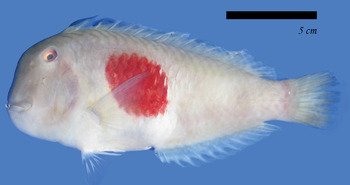
The razor fish originally described as Novacula twistii (Bleeker, Reference Bleeker1856), based on material from Molucca Islands, Indonesia is distributed in the western Pacific from Japan to Indonesia (including Malaysia, Philippines and Taiwan). On 20 December 2008 a single specimen of Iniistius twistii was collected by the authors from Cochin fisheries harbour, Kochi (Kerala), India (Figure 1). Subsequently in February 2012 an additional specimen was collected (CMFRI. GB. 31. 78. 30. 6), which formed the material for this report. Measurements were taken following the methods of Randall et al. (Reference Randall, Earle and Robertson2002). The morphometric and meristic characters of the specimens collected agree with the descriptions of Bleeker (Reference Bleeker1856), Günther (Reference Günther1861) and De Beaufort (Reference De Beaufort1940), but showed some colour variation; the red colour on the dorsal fin region as shown in Masuda et al. (Reference Masuda, Araga and Yoshino1975) and the red colour of the opercular region shown in Kuiter & Debelius (Reference Kuiter and Debelius2006) were absent in the present specimen of I. twistii. Records of I. twistii are limited and are only known from a few specimens and there is little published information on its biology and ecology or the status of its populations (Russell & Choat, Reference Russel and Choat2010). This report of I. twistii from the south-western coast of India extends its known distribution.
Iniistius twistii, Arabian Sea, collected off Cochin.

SYSTEMATICS
Synonyms: Novacula twistii; Hemipteronotus twistii; Xyrichtys twistii.
MATERIAL EXAMINED
Iniistius twistii (CMFRI. GB. 31. 78. 30. 6), (182 mm total length), collected at Cochin fisheries harbour, Kerala, India.
DIAGNOSIS
Dorsal fin rays IX + 12; anal fin rays III, 12; pectoral fin rays 13; pelvic I, 5; a band of scales from below eyes to down to the posterior of mouth corner. Body depth 2.59 in standard length (SL). First and second dorsal spines flexible. Space between second and third dorsal spine broader than third and fourth spines. A prominent red spot on the side of body. A lighter spot below the red spot. Caudal fin rounded.
DESCRIPTION
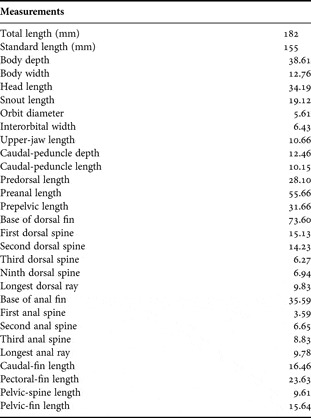
Proportional measurements in percentage of SL are given (Table 1). A razor fish, with very compressed body, body width 3.02 in body depth. Body depth 2.59 in SL. Dorsal profile of snout nearly vertical and nearly convex above eyes. A band of scales from below eyes to down to the posterior of mouth corner. Cheek naked, but with a band of scales below eye. First and second dorsal spines flexible and larger than the third one. Space between second and third greater than first and second. Membrane between second and third incised. Head length (HL) 34.19% SL; snout length 1.78 in HL; upper jaw length 10.65% SL; pelvic-fin spine 9.61% SL; caudal peduncle depth 12.46% SL; caudal peduncle length 10.15% SL, 9.84 in SL; eye diameter 5.6% SL; shorter than interorbital; interorbital 6.43% SL. Caudal fin rounded. Scales cycloid. Lateral line interrupted.
Morphometric measurements of Iniistius twistii from south-west coast of India (in % standard length).

COLOUR
Colour of fresh specimen: body hyaline with a large red spot positioned between and below 4th and 10th spines below lateral line on sides. A lighter spot below the red spot. Oblique yellow and blue bands on dorsal fins. Edges of dorsal and anal fins yellowish. Caudal fin with blue and yellow spots.
ACKNOWLEDGEMENTS
The authors are grateful to the Director, CMFRI for support and encouragement. We thank Dr John E. Randall, Bishop Museum, Honolulu, USA and Dr Barry Russel for the support they extended. Thanks are also due to the referees for their helpful comments on the manuscript.