The prenatal period is full of transformations that are crucial for the wellbeing of both mothers and their developing offspring. While both mother and baby undergo tremendous biological and physical changes, the mother may also undergo complex psychological reorganization. That is, the prenatal period is a time when women are faced with the important developmental challenge of transitioning from being a receiver of care to a provider of care (Solomon & George, Reference Solomon and George1996). While this process is welcomed and joyful for some mothers, it is marked by painful reminders of abuse, neglect, and other adverse childhood experiences for others. Although the impact of past harms on the psychological transition to motherhood may be largely unconscious, this transition has significant implications for caregiving behavior and child outcomes (Slade & Sadler, Reference Slade, Sadler and Zeanah2019).
During pregnancy, women begin to develop thoughts and feelings about who their baby will be, what they will be like as mothers, and the relationship they will have with their baby (Slade & Sadler, Reference Slade, Sadler and Zeanah2019). These collective thoughts and feelings are often referred to as “maternal representations of the child.” Maternal representations of the child are grounded in the mother's early experiences of being parented by her caregivers (Bowlby, Reference Bowlby1983; Main & Goldwyn, Reference Main and Goldwyn1984). They function as an internalized template that guides a mother's interpretation of her child's behavior as well as her own thoughts, feelings, and behaviors as a parent (Bowlby, Reference Bowlby1983; Bretherton & Munholland, Reference Bretherton, Munholland, Cassidy and Shaver2008; George & Solomon, Reference George, Solomon, Cassidy and Shaver2008). The content, organization, and consistency of a mother's representations are thought to influence her interpretations, expectations, and behavior in relation to, or interactions with, her infant.
Representations are typically assessed through caregiver interviews, one of which is the Working Model of the Child Interview (WMCI; Zeanah, Benoit, Barton, & Hirshberg, Reference Zeanah, Benoit, Barton and Hirshberg1996; Zeanah, Benoit, Hirshberg, Barton, & Regan, Reference Zeanah, Benoit, Hirshberg, Barton and Regan1994). Research on the WMCI has identified four types of representations of the child: balanced, disengaged, distorted, and disrupted (Benoit, Parker, & Zeanah, Reference Benoit, Parker and Zeanah1997a; Crawford & Benoit, Reference Crawford and Benoit2009). Balanced representations are characterized by, for example, coherency, flexibility, joy, and sensitivity. Disengaged representations are characterized by, for example, detachment, emotional withholding, indifference, lack of detail about the infant, and rigidity, whereas distorted representations are characterized by, for example, inconsistency, heightened affect, preoccupation with closeness, and confusion (Benoit, Zeanah, Parker, Nicholson, & Coolbear, Reference Benoit, Zeanah, Parker, Nicholson and Coolbear1997b).
Balanced representations tend to be associated with optimal child outcomes, such as secure mother–infant attachment (Benoit et al., Reference Benoit, Parker and Zeanah1997a; Huth-Bocks, Theran, Levendosky, & Bogat, Reference Huth-Bocks, Theran, Levendosky and Bogat2011). Disengaged and distorted representations have been found to be associated with avoidant and ambivalent mother–infant attachment, respectively, and other poor social–emotional child outcomes, such as failure to thrive, negative affect, and poorer quality of play (Benoit et al., Reference Benoit, Zeanah, Parker, Nicholson and Coolbear1997b; Korja et al., Reference Korja, Ahlqvist-Björkroth, Savonlahti, Stolt, Haataja, Lapinleimu and Lehtonen2010; Rosenblum, McDonough, Muzik, Miller, & Sameroff, Reference Rosenblum, McDonough, Muzik, Miller and Sameroff2002). Although balanced representations are considered more favorable than disengaged and distorted representations, all three are considered organized types of representations, meaning there is a specific and consistent set of “rules” that the mother uses to process information and guide behavior regarding protection and care for her child (Solomon & George, Reference Solomon and George1996).
In contrast to organized types of representations, disrupted representations are characterized by incoherence, contradictory styles of responding to infant needs, fearfulness, helplessness, prioritizing one's own needs over the needs of the child, and disorientation, among other things (Crawford & Benoit, Reference Crawford and Benoit2009). Limited research has been conducted on disrupted representations of the child thus far; however, a notable finding has been an association with disorganized mother–infant attachment (Crawford & Benoit, Reference Crawford and Benoit2009). Other important work has demonstrated associations between postnatal disrupted representations and mother–infant attachment insecurity and maternal interactive behavior, including insensitivity, withdrawal, and intrusiveness (Hall et al., Reference Hall, Hoffenkamp, Tooten, Braeken, Vingerhoets and van Bakel2015; Niccols, Smith, & Benoit, Reference Niccols, Smith and Benoit2015). However, child-focused outcomes resulting from disrupted prenatal representations, such as toddler social–emotional problems, have yet to be examined.
Because other attachment-based representations, such as parental states of mind, have been linked with child social–emotional outcomes (e.g., Cowan, Cohn, Cowan, & Pearson, Reference Cowan, Cohn, Cowan and Pearson1996; Greenberg, Speltz, & Deklyen, Reference Greenberg, Speltz and Deklyen1993; Madigan, Moran, Schuengel, Pederson, & Otten, Reference Madigan, Moran, Schuengel, Pederson and Otten2007), it stands to reason that prenatal disrupted representations of the child may also be associated with child outcomes. Furthermore, the specific mechanisms through which disrupted representations of the child might be associated with toddler social–emotional problems have gone unexamined. One viable mechanism, consistent with a wealth of research examining mechanisms of transmission from parental states of mind with respect to attachment and child attachment (see Madigan et al., Reference Madigan, Bakermans-Kranenburg, van IJzendoorn, Moran, Pederson and Benoit2006a), may be the manifestation of observable forms of disrupted maternal caregiving behavior.
Disrupted maternal caregiving behavior refers to anomalous behaviors and communications during mother–child interactions, including maternal role reversal, disorientation, apprehension, and/or withdrawal from the child, as well as hostility. It has been purported that disrupted behavior may stem from unresolved experiences of trauma and/or traumatic grief and loss during childhood (Ballen, Bernier, Moss, Tarabulsy, & St-Laurent, Reference Ballen, Bernier, Moss, Tarabulsy and St-Laurent2010; Goldberg, Benoit, Blokland, & Madigan, Reference Goldberg, Benoit, Blokland and Madigan2003; Lyons-Ruth, Bureau, Holmes, Easterbrooks, & Brooks, Reference Lyons-Ruth, Bureau, Holmes, Easterbrooks and Brooks2013; Madigan, Moran, & Pederson, Reference Madigan, Moran and Pederson2006c; Madigan et al., Reference Madigan, Moran, Schuengel, Pederson and Otten2007). Disrupted caregiving behavior has been shown to be associated with disrupted representations in at least one study (Crawford & Benoit, Reference Crawford and Benoit2009).
The construct of disrupted caregiving behavior is rooted in early theoretical work conducted by Solomon and George on disorganized/helpless caregiving (George & Solomon, Reference George, Solomon, Cassidy and Shaver2008; Solomon & George, Reference Solomon and George1996), by Main and Hesse on frightened/frightening caregiving behavior (Hesse & Main, Reference Hesse and Main2006; Main & Hesse, Reference Main, Hesse, Greenberg, Cicchetti and Cummings1990), and by Lyons-Ruth and colleagues on disrupted/atypical caregiving behavior (Lyons-Ruth, Bronfman, & Parsons, Reference Lyons-Ruth, Bronfman and Parsons1999). Despite slightly differing labels and definitions, this class of caregiving behaviors is consistently associated with increased risk for poor social–emotional development across early childhood and adolescence, and even into adulthood (Lyons-Ruth et al., Reference Lyons-Ruth, Bureau, Holmes, Easterbrooks and Brooks2013; Madigan et al., Reference Madigan, Moran, Schuengel, Pederson and Otten2007; Shi, Bureau, Easterbrooks, Zhao, & Lyons-Ruth, Reference Shi, Bureau, Easterbrooks, Zhao and Lyons-Ruth2012). In infancy, disrupted maternal behavior is significantly associated with disorganized mother–infant attachment (Lyons-Ruth et al., Reference Lyons-Ruth, Bronfman and Parsons1999; Madigan et al., Reference Madigan, Hawkins, Goldberg and Benoit2006b, Reference Madigan, Moran, Schuengel, Pederson and Otten2007; Main & Hesse, Reference Main, Hesse, Greenberg, Cicchetti and Cummings1990), a particularly concerning category of infant attachment that has been shown to be associated with a range of negative outcomes across development (Lyons-Ruth, Alpern, & Repacholi, Reference Lyons-Ruth, Alpern and Repacholi1993; O'connor, Bureau, Mccartney, & Lyons-Ruth, Reference O'connor, Bureau, Mccartney and Lyons-Ruth2011; van IJzendoorn, Schuengel, & Bakermans-Kranenburg, Reference van IJzendoorn, Schuengel and Bakermans-Kranenburg1999).
In sum, disrupted prenatal representations of the child and disrupted caregiving behavior are each associated with increased social–emotional problems for children, although empirical work examining disrupted representations is quite sparse due to the recency of an established and valid coding system. Furthermore, disrupted representations and disrupted caregiving behavior as predictors of child social–emotional functioning have not been examined in the same study. Specifically, we are not aware of any research to date that examines disrupted caregiving behavior as a mediator of the association between disrupted thoughts and feelings about a child in utero and poor social–emotional outcomes in toddlerhood. Identifying links between disrupted parental representations during pregnancy and later child social–emotional difficulties, as well as factors mediating these links, is important as it creates an opportunity for researchers and clinicians to develop interventions that could target specific disrupted caregiver representations (before the child is born) and/or specific postnatal disrupted caregiver behavior (after the child is born) to use with those considered to be most at risk for problematic caregiving. The ultimate goal of such interventions before and soon after a child is born is to prevent later social–emotional problems and/or improving children's developmental trajectories.
In the study reported here, we hypothesized that disrupted prenatal representations would predict poorer toddler social–emotional functioning. Next, we explored disrupted maternal behavior as a mediator of the relation between disrupted prenatal representations and social–emotional functioning in toddlerhood. It was hypothesized that disrupted maternal behavior would mediate the relation between disrupted prenatal representations of the child and toddler social–emotional functioning.
Study Method
Participants
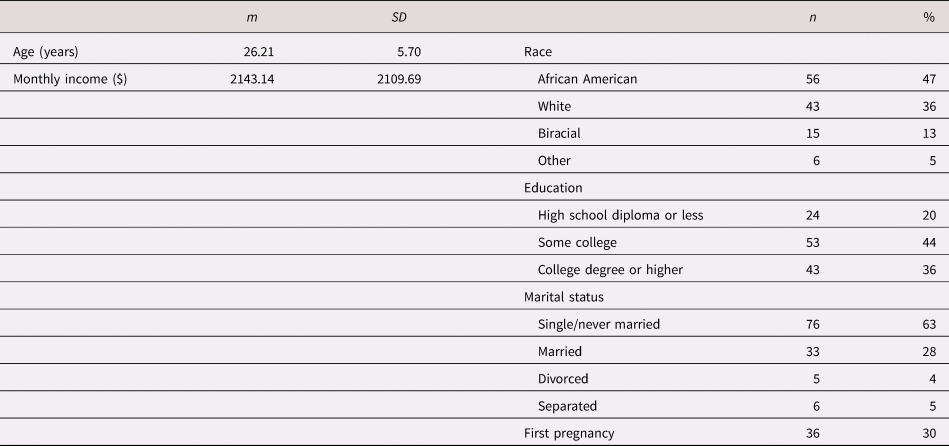
Data were drawn from a sample of 120 women participating in a prospective longitudinal study. Participants were recruited via the posting of flyers in areas accessed by low-income women (e.g., social service offices, community baby showers) and other locations including public health clinics. Participants were first assessed during the third trimester of pregnancy with additional assessments at 3 months (n = 119, 99% retained), 1 year (n = 114, 95% retained), and 2 years postpartum (n = 99, 83% retained). Participants were predominantly economically disadvantaged and diverse in terms of race, education, and marital status (see Table 1 for further demographic information). Of the participants, 73% reported receiving services from the Women, Infants, and Children (WIC) program, 52% were receiving food stamps, 75% were receiving public health insurance, and 17% were receiving supplemental income. At the time of the first interview, 45% of the participants were employed. This was a non-treatment-seeking, community sample; only 11.7% reported having sought mental health services in the past year.
Demographic information of participant mothers

Note: Some columns add up to greater than 100% due to rounding.
Procedures
Data from assessment waves during pregnancy and 1 and 2 years postpartum were used in the present study. Questionnaire and observational data were collected during in-home interviews. Consent for participation was obtained at each wave of data collection. The larger study was approved by the institutional review board at the institution where the data were collected.
Measures
Disrupted prenatal maternal representations
Disrupted maternal representations of the child were coded from verbatim transcripts of WMCIs (Zeanah et al., Reference Zeanah, Benoit, Hirshberg, Barton and Regan1994; Zeanah et al., Reference Zeanah, Benoit, Barton and Hirshberg1996) obtained at T1 (the third trimester of pregnancy) using the WMCI-Disrupted (WMCI-D) coding scheme (Crawford & Benoit, Reference Crawford and Benoit2009). The WMCI is a semi-structured interview that assesses a caregiver's perception and subjective experience of her infant, including her anticipated responses to her infant in various attachment-relevant situations, her perception of herself as a mother, and her perception of her relationship with her infant. It can be administered prenatally or postnatally, and is considered to be a valid and useful measure of maternal representations of the child (see Vreeswijk, Maas, & van Bakel, Reference Zeanah, Benoit, Hirshberg, Barton and Regan2012 for a review).
The WMCI-D coding scheme was derived from the Atypical Maternal Behavior Instrument for Assessment and Classification (AMBIANCE; Bronfman, Madigan, & Lyons-Ruth, Reference Bronfman, Madigan and Lyons-Ruth2009–2014) described later in the paper. It involves coding both the content of the WMCI transcript, as well as the process by which that content is communicated by the mother during the interview, along five dimensions using 7-point Likert-type scales. These five dimensions are affective communication errors, role/boundary confusion, fearfulness/dissociation/disorientation, intrusiveness/negativity, and withdrawal. Further details about what is coded within each dimension are available elsewhere (Crawford & Benoit, Reference Crawford and Benoit2009). Although the existing psychometric properties of the WMCI-D coding scheme are limited, they have thus far demonstrated adequate validity. As would be expected, the WMCI-D classification is not associated with infant gestational age, child gender, or mother's residence, but it is associated with more parenting stress, the Adult Attachment Interview (AAI) unresolved classification, atypical and less sensitive maternal behavior, and both insecure and disorganized infant attachment (Crawford & Benoit, Reference Crawford and Benoit2009; Hall et al., Reference Hall, Hoffenkamp, Tooten, Braeken, Vingerhoets and van Bakel2015; Niccols et al., Reference Niccols, Smith and Benoit2015; Tooten et al., Reference Tooten, Hall, Hoffenkamp, Braeken, Vingerhoets and van Bakel2014).
Based on five dimensional scores coded from a transcript, an overall classification (disrupted or not disrupted) and an overall total score (level of disruption ranging from 1 = not disrupted to 7 = severely disrupted) are then given. In the current study, transcripts were coded by the second author, with Diane Benoit, PhD, double coding approximately 20% (n = 24) for inter-rater reliability (IRR). The IRR for the total/level of disruption score was assessed using intraclass correlation (r = .70). There was a 96% match on the disrupted versus not disrupted representation classification between the two coders (k = .65). In the present study, the 1–7 total score of disruption was used in analyses.
Disrupted maternal caregiving behavior
Disrupted caregiving behavior was coded from videotaped mother–infant interactions at T3 (1 year postpartum) using the AMBIANCE (Bronfman et al., Reference Bronfman, Madigan and Lyons-Ruth2009–2014). As already noted, the AMBIANCE consists of five related, but distinct, dimensions of disrupted caregiving behavior: affective communication errors, role/boundary confusion, fearfulness/dissociation/disorientation, intrusiveness/negativity, and withdrawal. Further details about the behaviors coded within each dimension are available elsewhere (Lyons-Ruth et al., Reference Lyons-Ruth, Bronfman and Parsons1999). Disrupted caregiving behavior on the AMBIANCE has demonstrated consistent associations with past unresolved trauma and mother–infant attachment disorganization (Madigan et al., Reference Madigan, Bakermans-Kranenburg, van IJzendoorn, Moran, Pederson and Benoit2006a), as well as stability across early childhood (Madigan, Voci, & Benoit, Reference Madigan, Voci and Benoit2011). A 7-point rating scale for each dimension is based on the frequency and severity of behaviors observed within each dimension, with higher values indicating more disrupted behaviors of each type. Based on the five dimensional ratings, a 1–7 total score is also assigned that captures the overall quality of caregiving behavior. Using the total score, caregivers are classified as not disrupted (with a score of 1–4) or disrupted (a score of 5–7).
In the present study, a 7-minute segment was coded from a larger 12-minute mother–infant interaction that included 10 minutes of free play followed by 2 minutes of cleanup (a mildly stressful condition). We began coding at the 5-minute mark of the interaction to allow the dyad to adjust to the paradigm, thus 5 minutes of free play and the 2-minute cleanup were coded as one 7-minute segment. The interaction was filmed in the home (with infrequent exception of filming in the research office (about 6%)). Parents were instructed to play and interact with their children as they normally would. They were instructed on when to begin the cleanup portion, but were otherwise not given further instruction during the interaction. Coding using the AMBIANCE has been previously supported in free play settings with mild stressors such as a cleanup (Guyon-Harris, Madigan, Bronfman, Romero, & Huth-Bocks, Reference Guyon-Harris, Madigan, Bronfman, Romero and Huth-Bocks2020) and a no-toys paradigm (Madigan, Moran, & Pederson, Reference Madigan, Hawkins, Goldberg and Benoit2006b).
Videotaped mother–infant interactions were coded by the first author, with Elisa Bronfman, PhD, double coding approximately 33% (n = 35) for IRR. The IRR for the total/level of disrupted caregiving behavior score was assessed using intraclass correlation (r = .86). There was 97% match on the disrupted versus not disrupted classification between the two coders (k = .94). In the present study, the 1–7 total score of disrupted caregiving behavior across dimensions was used in analyses.
Mother-reported toddler social–emotional functioning
The Brief Infant–Toddler Social and Emotional Assessment (BITSEA; Briggs-Gowan & Carter, Reference Zeanah, Benoit, Hirshberg, Barton and Regan2006) was used to assess mothers’ perceptions of toddler social–emotional problems at age 1 and 2 years. In this assessment, 42 items are used to assess social–emotional problems or delays and social–emotional competence in young children aged 12–36 months on a 3-point scale (0 = not true/rarely, 1 = somewhat true/sometimes, 2 = very true/often). The BITSEA total problem score (31 items) was used in the present study. Higher scores indicate more maternal perception of toddler social–emotional problems. Various studies have assessed the psychometric properties of the BITSEA and found that it has strong reliability and validity (Briggs-Gowan & Carter, Reference Zeanah, Benoit, Hirshberg, Barton and Regan2007; Briggs-Gowan, Carter, Irwin, Wachtel, & Cicchetti, Reference Zeanah, Benoit, Hirshberg, Barton and Regan2004; Karabekiroglu et al., Reference Zeanah, Benoit, Hirshberg, Barton and Regan2010). Internal consistency was excellent in the present study (α = .83). The BITSEA total problem score at age 1 year (α = .77) was used as a control variable.
Data analysis
Bivariate associations between study variables were examined using correlations. The relation between prenatal disrupted maternal representations of the child and toddler social–emotional functioning was examined using regression. Then, disrupted maternal caregiving behavior was tested as a mediator of the relation between disrupted prenatal maternal representations of the child and mother-reported toddler social–emotional functioning at age 24 months. Direct effects from prenatal disrupted representations to disrupted caregiving behavior and toddler social–emotional functioning and from disrupted caregiving behavior to toddler social–emotional functioning were tested along with the indirect effect (mediation) of prenatal representations on toddler social–emotional functioning through disrupted caregiving behavior. Social–emotional functioning at age 12 months was included as a control variable to control for the effect of prior social–emotional functioning. This provided for a more robust test of the mediation of disrupted caregiving behavior in the relation between prenatal disrupted representations and toddler social–emotional functioning. All analyses were completed in Mplus version 7.4 with missing data estimated using maximum likelihood estimation with robust standard errors (MLR), a type of full information maximum likelihood (FIML) estimation.
Results
All the major study variables were normally distributed and did not require transformation. As detailed in Table 2, bivariate associations were revealed between the level of disruption in prenatal maternal representations of the child, the level of disruption in maternal behavior at age 12 months, and social–emotional functioning at both 12 and 24 months, supporting the testing of mediation. Of note, the relation between disrupted maternal behavioral at 12 months and infant social–emotional functioning at 12 months was not statistically significant at the p < .05 level. The strength of the association between the level of disruption in prenatal maternal representations of the child and mother-reported infant and toddler social–emotional problems appeared to increase over time; however, the increase (i.e., the difference in correlations) only trended toward statistical significance (z = −1.48, p = .069). A similar pattern emerged for the relation between disrupted caregiving behavior and mother-reported social–emotional problems from infancy to toddlerhood, but this time the difference in correlations was statistically significant (z = −3.17, p < .001); the correlation between disrupted caregiving behavior at 12 months postpartum and mother-reported social–emotional problems was significantly stronger at 24 months postpartum than at 12 months postpartum.
Bivariate associations between study variables

*p < .05, **p < .01, ***p < .001.
Note: Income-to-needs ratio was averaged from pregnancy through 24 months postpartum.
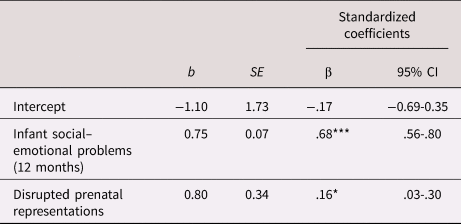
Associations between prenatal disrupted representations and mother-reported toddler social–emotional functioning were tested in a regression model (Table 3). As hypothesized, prenatal disrupted representations of the child predicted toddler social–emotional problems at age 24 months after accounting for prior infant social–emotional problems at age 12 months.
Regression model depicting disrupted prenatal representations of the child predicting toddler social–emotional problems

*p < .05, ***p < .001.
Prior to testing for mediation, bivariate associations between maternal age, child sex, and income-to-needs ratio (average score from pregnancy to 24 months postpartum) and disrupted maternal representations and behavior were examined to explore the potential for additional covariates beyond infant social–emotional problems. As a result, the income-to-needs ratio was included as a covariate in the mediation model due to significant associations with the WMCI-D (r = −.35, p < .001) and AMBIANCE (r = −.32, p < .001) total scores.
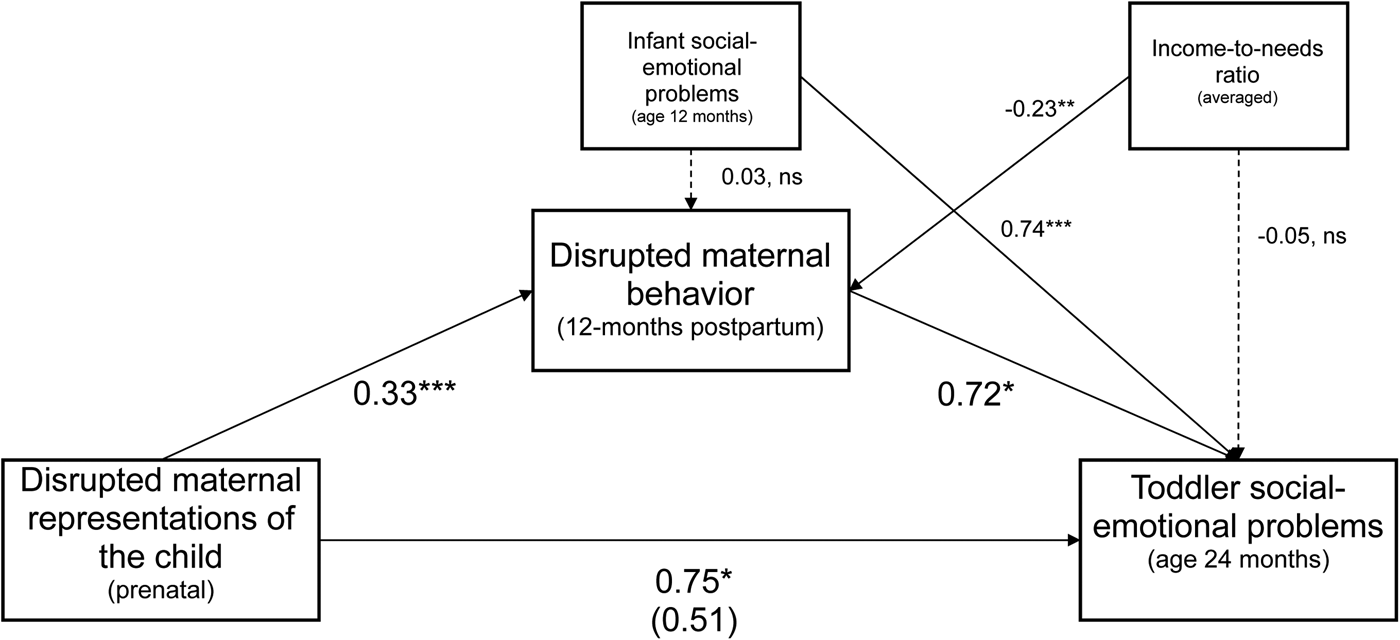
As hypothesized, disrupted maternal behavior mediated the relation between disrupted prenatal maternal representations and mother-reported toddler social–emotional problems (see Figure 1). Disrupted maternal behavior accounted for 32% of the effect of disrupted prenatal maternal representations on toddler social–emotional problems while controlling for associations between social–emotional problems at 24 and 12 months (i.e., those concurrent with the assessment of disrupted caregiving behavior) and between AMBIANCE total score and income-to-needs ratio. Of note, mediation was more strongly supported without the inclusion of covariates (indirect effect = 0.46, p = .04, 95% confidence interval (CI) [0.04, 0.87]).
Disrupted maternal behavior at 12 months postpartum mediates the association between prenatal disrupted maternal representations of the child and mother-reported toddler social–emotional problems at 24 months postpartum. Indirect effect = 0.24, 95% CI [0.00, 0.48]. Mother-reported social–emotional problems at age 12 months postpartum and income-to-needs ratio (average from pregnancy through 24 months postpartum) were included as covariates; nonsignificant paths depicted by dashed lines were not included in the final model. Values are unstandardized. *p < .05, **p < .01, ***p < .001.

Discussion
Pregnancy is a pivotal time for the development of mothers’ thoughts and feelings about their unborn babies. The current study demonstrated that disrupted representations of an unborn child can have a cascading effect onto disrupted maternal behavior and, in turn, toddlers’ social–emotional outcomes. Therefore, it will be important for future work to elucidate mechanisms for how disrupted representations both pre- and postnatally may lead to poor child outcomes, so that interventions that aim to change disrupted representations and caregiving behavior can be provided to mothers as they transition to parenthood.
A third of the relations between representations and toddler outcomes was explained by observable disrupted caregiving behavior. Although this is the first study to demonstrate such associations, the findings are not necessarily surprising, given similar findings by Hall et al. (Reference Hall, Hoffenkamp, Tooten, Braeken, Vingerhoets and van Bakel2015) who reported that maternal insensitivity and intrusiveness mediated the relation between postnatal disrupted representations of the child and mother–infant attachment insecurity. However, the present study is unique in that it is the first to examine the construct of disrupted caregiving behavior (i.e., compared with more traditional forms of caregiving behavior) as a mechanism for the association between disrupted caregiver representations assessed prenatally and toddler social–emotional problems. Thus, the present study highlights a need for researchers and clinicians working with at-risk families to develop and utilize interventions that could target specific disrupted caregiver representations before the child is born and/or specific postnatal disrupted caregiver behaviors. Yet, two thirds of the associations between the level of disruption in mothers’ representations and toddler social–emotional functioning remained unexplained, indicating the need to explore additional mechanisms.
Of note, the income-to-needs ratio was significantly correlated with both disrupted representations of the child and disrupted caregiving behavior. It may be that the added burden of economic strain and associated risk factors contribute to the emergence of disrupted representations and caregiving behavior, and thus play an important role alongside these variables on children's social–emotional functioning. Although extensive research has demonstrated the effects of economic strain and poverty on children's development, future work is needed to further understand the role of economic and other adversities in the development of disrupted caregiving. Variables not examined in the present study, such as perceived parenting stress or maternal mental health, could also help explain associations between disrupted caregiver representations and adverse toddler outcomes – parenting stress has been associated with both disrupted maternal representations (Niccols et al., Reference Niccols, Smith and Benoit2015) and toddler social–emotional difficulties (Barroso, Hungerford, Garcia, Graziano, & Bagner, Reference Barroso, Hungerford, Garcia, Graziano and Bagner2016; McDonald, Kehler, & Tough, Reference McDonald, Kehler and Tough2018). Furthermore, maternal mental health, particularly symptoms of posttraumatic stress disorder (PTSD), may be an important mechanism between caregivers’ disrupted representations and children's problematic social–emotional functioning. Although maternal PTSD symptoms have demonstrated associations with negative toddler social–emotional functioning in prior studies (Bosquet Enlow, Egeland, Carlson, Blood, & Wright, Reference Bosquet Enlow, Egeland, Carlson, Blood and Wright2014; Bosquet Enlow et al., Reference Bosquet Enlow, Kitts, Blood, Bizarro, Hofmeister and Wright2011) and nondisrupted categories of maternal representations (Schechter et al., Reference Schechter, Coots, Zeanah, Davies, Coates, Trabka and Myers2005), we are not aware of any studies that have demonstrated associations between maternal PTSD and maternal disrupted representations. Future studies are needed to examine these and other potential mechanisms to further explain how disrupted prenatal maternal representations are associated with later child outcomes. This continued line of work will also highlight additional intervention targets for reducing risk for poor toddler social–emotional outcomes.
The current study suggests that toddler social–emotional problems may be reduced and/or prevented by providing clinical interventions to women with disrupted representations during pregnancy and throughout the postpartum period. Furthermore, the relation between disrupted maternal behavior and mother-reported social–emotional problems may strengthen or become more entrenched with time, and therefore early intervention may be critical for mitigating risk. That is, when a mother has disrupted representations of her child prenatally and disrupted maternal behavior during the first year of the child's life, without intervention, the child's social–emotional problems may grow increasingly problematic and potentially impairing. Importantly, past work has demonstrated that attachment-based interventions delivered early in childhood can foster positive social–emotional outcomes for children in high-risk families, while preventing the progression of poor social–emotional functioning (Cicchetti, Rogosch, & Toth, Reference Cicchetti, Rogosch and Toth2006; Cicchetti, Toth, & Rogosch, Reference Cicchetti, Toth and Rogosch1999; Toth, Rogosch, Manly, & Cicchetti, Reference Toth, Rogosch, Manly and Cicchetti2006).
Prenatal identification of mothers with disrupted representations of the child is an important first step. However, there are challenges worth mentioning. Most notably, assessment of mothers using the WMCI (Zeanah et al., Reference Zeanah, Benoit, Barton and Hirshberg1996; Reference Zeanah, Benoit, Hirshberg, Barton and Regan1994) is time consuming and requires specialized training, as does the subsequent coding of the mother's responses using the disrupted coding scheme (WMCI-D; Crawford & Benoit, Reference Crawford and Benoit2009). To move identification and prevention to a broader scale, more feasible assessments for the prenatal period that can be implemented with fidelity in broader settings (i.e., outside of research), such as primary care and community mental health, should be developed.
Assessment of disrupted maternal behavior using the AMBIANCE is also time consuming and requires specialized training (Bronfman et al., Reference Bronfman, Madigan and Lyons-Ruth2009–2014). To address this, Madigan and colleagues have recently developed the AMBIANCE-brief measure (Madigan, Bronfman, Haltigan, & Lyons-Ruth, Reference Madigan, Bronfman, Haltigan and Lyons-Ruth2018) for the detection of parents displaying disrupted caregiving behavior in broader applied settings, such as in child family services and primary care. The AMBIANCE-brief measure can be coded in “real-time” and provides a 90% reduction in coding time compared with the full AMBIANCE measure, making it more feasible for use in practice settings to identify targets for intervention (Cooke, Eirich, Racine, Lyons-Ruth, & Madigan, Reference Cooke, Eirich, Racine, Lyons-Ruth and Madigan2020).
One advantage of the full versions of AMBIANCE and the WMCI-D scale (an AMBIANCE-derived tool), however, is that they examine several dimensions of parental representations and behavior, and therefore identify specific aspects of caregiving that can assist clinicians in terms of pinpointing critical targets of intervention. Unfortunately, we are not aware of any interventions that have demonstrated reductions in disrupted maternal representations. Niccols et al. (Reference Niccols, Smith and Benoit2015) demonstrated the stability of disrupted representations across an 8-month period during infancy among participants receiving one of two interventions – a community parenting group or a supportive home visiting program. They noted that such interventions, while impactful in other areas, were not able to address disrupted representations, and astutely highlighted the need for interventions that specifically target disrupted representations in the service of improving social–emotional outcomes for infants and toddlers.
Only a few attachment-based interventions with the goal of improving caregiver–child relationships and child social–emotional outcomes have demonstrated reductions in disrupted caregiver behavior, including Attachment and Biobehavioral Catch-up (ABC; Dozier, Dozier, & Manni, Reference Dozier, Dozier and Manni2002), Modified Interaction Guidance (Benoit, Madigan, Lecce, Shea, & Goldberg, Reference Benoit, Madigan, Lecce, Shea and Goldberg2001; McDonough, Reference McDonough and Zeanah2000), and the French infant mental health home visiting program CAPEDP (Saïas et al., Reference Saïas, Greacen, Tubach, Dugravier, Marcault, Tereno and Guédeney2013; Tereno et al., Reference Tereno, Guedeney, Dugravier, Greacen, Saïas, Tubach and Guédeney2013; Tubach et al., Reference Tubach, Greacen, Saïas, Dugravier, Guedeney, Ravaud and Guedeney2012). Specifically, using randomized controlled trials (RCTs), the ABC and CAPEDP interventions have shown that reducing disruptive forms of caregiving behaviors can in turn reduce rates of disorganized attachment, highlighting that reducing disrupted caregiving behavior serves as an important mechanism in promoting optimal attachment outcomes for young children (Tereno et al., Reference Tereno, Madigan, Lyons-Ruth, Plamondon, Atkinson, Guedeney and Guedeney2017; Yarger, Bronfman, Carlson, & Dozier, Reference Yarger, Bronfman, Carlson and Dozier2019). However, more RCTs are needed to replicate this work and to verify whether changes in disrupted caregiving can be attributed to intervention exposure.
Some limitations of the present study should be noted. First, our sample consisted only of high-risk mothers; therefore, the results are not generalizable to fathers or other significant caregivers in children's lives or to higher income families. Unfortunately, there is a dearth of research on fathers’ representations, caregiving behaviors, and contributions to young children's social–emotional functioning, particularly in the perinatal period, although a few exceptions exist (e.g., Dayton et al., Reference Dayton, Buczkowski, Muzik, Goletz, Hicks, Walsh and Bocknek2016; Tooten et al., Reference Tooten, Hall, Hoffenkamp, Braeken, Vingerhoets and van Bakel2014; Vreeswijk, Maas, Rijk, Braeken, & van Bakel, Reference Vreeswijk, Maas, Rijk, Braeken and van Bakel2014a; Vreeswijk, Maas, Rijk, & van Bakel, Reference Vreeswijk, Maas, Rijk and van Bakel2014b). With regard to disrupted representations in particular, Tooten et al. (Reference Tooten, Hall, Hoffenkamp, Braeken, Vingerhoets and van Bakel2014) identified disrupted and nondisrupted representations in a sample of mothers and fathers, and demonstrated that fathers too can have disrupted representations. Second, our sample size was small: future studies with larger samples with multiple types of primary caregivers are needed to increase confidence in our results through replication. Third, although we had strong, objective measures of prenatal disrupted representations and disrupted caregiving behavior, our social–emotional functioning outcome was mother-reported and thus may have been subject to biased interpretation. Future work is needed to replicate associations between disrupted prenatal representations and disrupted caregiving behavior and objective measures of toddler functioning, such as disorganized attachment behavior. These limitations aside, the strengths of the present study include a high retention of the sample over time and the use of gold-standard methods for reliably assessing the complex constructs of disrupted caregiver representations and behavior.
Several important future directions have been noted thus far, including identifying other important mechanisms that may help explain associations between disrupted caregiver representations, caregiving behavior, and toddler social–emotional functioning, such as caregivers’ experiences of interpersonal trauma and mental health symptoms. The development of more feasible assessments for disrupted representations and behavior is also needed, as noted earlier in the paper. Another important future research direction is exploring potential buffers against harmful outcomes in the context of disrupted caregiver representations and/or behavior, given that not all caregivers with disrupted representations or behavior have children with serious social–emotional difficulties such as disorganized attachment. It is possible, for example, that factors such as social support or the presence of other caring, nurturing adults lessen the burden of caregiver disruption on child outcomes: social support is often reported as a buffer against various negative outcomes related to caregiving and the caregiver–child relationship in the context of experiencing interpersonal trauma and/or suffering from PTSD symptoms (Aspelmeier, Elliott, & Smith, Reference Aspelmeier, Elliott and Smith2007; Busuito, Huth-Bocks, & Puro, Reference Busuito, Huth-Bocks and Puro2014; Guyon-Harris, Ahlfs-Dunn, & Huth-Bocks, Reference Guyon-Harris, Ahlfs-Dunn and Huth-Bocks2017; Huth-Bocks, Levendosky, Bogat, & von Eye, Reference Huth-Bocks, Levendosky, Bogat and von Eye2004; Levendosky, Leahy, Bogat, Davidson, & von Eye, Reference Levendosky, Leahy, Bogat, Davidson and von Eye2006).
In sum, this study is the first to examine pathways from disrupted maternal representations of the child during pregnancy to mother-reported toddler social–emotional functioning at 24 months. It was found that nearly a third of the impact is explained by disrupted maternal behavior observed at 12 months. The development of social–emotional problems in toddlerhood may be mitigated by providing clinical interventions to women with disrupted representations of the child during pregnancy and/or disrupted caregiving behavior in the postpartum period.
Financial Statement
This research was supported by grants from the American Psychoanalytic Association (Ahlfs-Dunn; Huth-Bocks), the Psi Chi International Honor Society in Psychology (Huth-Bocks), the International Psychoanalytical Association (Ahlfs-Dunn; Huth-Bocks), Eastern Michigan University Office of Research Development (Huth-Bocks), the Blue Cross Blue Shield of Michigan Foundation Student Award Program (Ahlfs-Dunn; Guyon-Harris), the International Society for Traumatic Stress Studies Frank W. Putnam Trauma Research Scholars Award (Guyon-Harris), and T32 HP22240 (Guyon-Harris).
Conflicts of Interest
None.