Increasing frequency and complexity of anaesthetic care for infants, children, adolescents, and even adults with CHD have resulted in the need for a formal training curriculum in paediatric and congenital cardiac anaesthesia. This curriculum ideally would extend to anaesthesia residents, general paediatric anaesthesia fellows, adult cardiac anaesthesia fellows, and specialised paediatric cardiac anaesthesia fellows. This manuscript will describe the brief history and the current state of training in paediatric cardiac anaesthesia in the United States of America. The material in this article was presented at the Johns Hopkins All Children’s Heart Institute Andrews/Daicoff Cardiovascular Program International Symposium on Postgraduate Education in Pediatric and Congenital Cardiac Care on 12 February, 2016.
Training in paediatric cardiac anaesthesia: 1970s–1990s
During this era, there were only a few general paediatric anaesthesia fellowships, and aside from intermittent exposure to CHD or a 1- to 2-month rotation, there was limited exposure to extended training in CHD. This author’s training was typical of the approach during that era. After completing the full 3-year paediatric residency at the University of California, San Francisco, there was a 3-year anaesthesia residency at the same institution. The third year of anaesthesia residency, then new, was 11 months of paediatric anaesthesia and paediatric intensive care, with 2 months of paediatric cardiac anaesthesia. After becoming an attending anaesthesiologist, interest in congenital cardiac anaesthesia became an increasing focus until it became full time 7 years after completion of training.
At this time, there were a few specialised experiences in paediatric cardiac anaesthesia, most notably at major children’s hospitals in Boston and Philadelphia, and at combined adult/paediatric cardiac surgery centres such as the Texas Heart Institute in Houston and the University of California, San Francisco. By the late 1990s, paediatric anaesthesia fellowships were much more widespread, and in 2000 the 12-month Accreditation Council for Graduate Medical Education (ACGME) general paediatric anaesthesia fellowship was approved. By this time, there were five 6–12-month fellowships in paediatric cardiac anaesthesia – in Boston, Philadelphia, Stanford, Atlanta, and at Texas Children’s Hospital in Houston.
Training in paediatric cardiac anaesthesia, 2000–2010
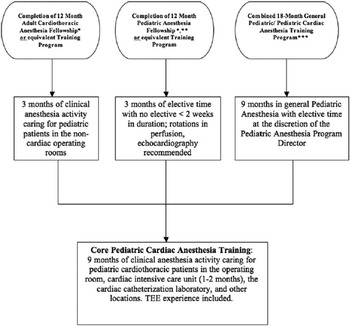
During 2000–2010, paediatric and CHD treatment evolved significantly as a field with an increasing number of specialised centres with dedicated paediatric cardiology and cardiac surgery departments, as well as cardiac ICUs. Leaders in paediatric cardiac anaesthesia saw the need for further specialisation as well, and collaborated to form the Congenital Cardiac Anesthesia Society (CCAS) in 2005. This Society was open to all anaesthesiologists with an interest in CHD, and started with 113 members the first year. Education and training was a major focus of the CCAS, and according to the mission statement of the society “Assisting in developing and supporting guidelines for residency and fellowship training for congenital heart disease, with the Society for Pediatric Anesthesia and the Society of Cardiovascular Anesthesiologists” is a mission area. 1 A task force of the CCAS was formed, which solicited input from members and general paediatric anaesthesia programme directors about desired duration of paediatric cardiac anaesthesia fellowship training, rotations, case numbers, skills such as echocardiography training, and research requirements. This work culminated in a journal article containing recommendations for training.Reference DiNardo, Andropoulos and Baum 2 It also surveyed residency and paediatric and cardiac anaesthesia fellowship programme directors to quantify exposure to paediatric and congenital cardiac anaesthesia cases at each level of training. At that time, recommendations were that specialised paediatric cardiac anaesthesia fellows could qualify for this training by completing any of the following three pathways: a full 12-month ACGME Pediatric Anesthesia Fellowship; a full 12-month ACGME Adult Cardiac Anesthesia Fellowship; or a combined 18-month pathway where 9 months of general paediatric anaesthesia fellowship was followed by 9 months of paediatric cardiovascular anaesthesia fellowship (Fig 1). All three pathways would serve a 9-month core clinical experience in paediatric cardiovascular anaesthesia, with substantial experience in the operating rooms, catheterisation laboratories, cardiovascular ICUs, remote locations, and echocardiography. The adult cardiovascular anaesthesia-trained fellows would serve 3 months in the general paediatric operating rooms, and the paediatric general anaesthesia-trained fellows would have 3 months of elective rotations such as research, perfusion, or additional echocardiography experience. Minimum cardiopulmonary bypass case numbers were specified for the 9-month core experience, and included 50 cardiopulmonary bypass cases in patients <1 year of age, half of which had to be in neonates <30 days of age. Anaesthesia for a minimum of 50 diagnostic or therapeutic non-operating room procedures – that is, catheterisation laboratory and cardiac MRI – was also recommended.
A schema for training in paediatric cardiac anaesthesia from 2010 recommendations of the Congenital Cardiac Anesthesia Society (CCAS).Reference DiNardo, Andropoulos and Baum 2 Trainees would enter one of the three arms on the basis of their previous training after basic training in anaesthesiology. ACGME=Accreditation Council for Graduate Medical Education; TEE=transoesophageal echocardiography. As of 2012, the far right. 18-month pathway was no longer recommended; the full 12-month second-year fellowship in paediatric cardiac anaesthesia was required for inclusion in the Pediatric Anesthesia Leadership Council–CCAS network. See text for further details. *In the United States of America, meets ACGME certification requirements. **Time spent in Pediatric Cardiac Anesthesia during a Pediatric Anesthesia Fellowship or equivalent Training Program may be counted towards the 9-month requirement at the discretion of the Pediatric Cardiac Anesthesia Program Director. ***In the United States of America, would meet ACGME certification requirements for general Pediatric Anesthesia Fellowship.

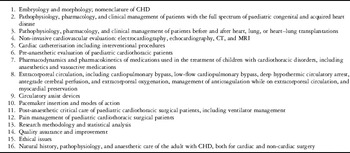
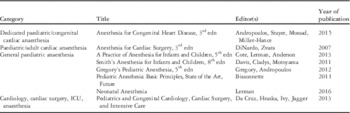
In addition to recommendations for qualifications for training, duration of training, and rotations, core didactic components were recommended (Table 1) that covered a broad range of topics including developmental physiology of CHD, nomenclature, pharmacology, evaluation, and preparation for anaesthesia including imaging studies, echocardiography, intraoperative and postoperative management, and intensive care. In addition, didactic experiences in perfusion, pacemakers, pain management, research, quality improvement, ethics, anaesthesia for non-cardiac surgery, and adult CHD were specified. Major textbooks were recommended that were either solely devoted to anaesthesia for CHD or were major general paediatric anaesthesia texts with extensive space devoted to CHD (Table 2). Although discussion occurred regarding ACGME certification of paediatric cardiovascular anaesthesia fellowships, it was decided not to pursue it because of the small numbers of programmes involved and because of the still significant opposition to specialised paediatric cardiac anaesthesia training. Those opposed to organising specialised training felt that it was not needed, and that such a requirement would be disadvantageous to those anaesthesiologists without such training. A specialised training requirement would also in their view place a significant burden on programmes to hire anaesthesiologists with this training, but would be unable to do so because of inadequate supply. By 2010, there were eight programmes with organised advanced fellowship training in paediatric cardiac anaesthesia.
Didactic components of a proposed paediatric cardiac anaesthesia training programme.

From DiNardo et al2
Major textbook references for paediatric cardiac anaesthesia (US editors).

The survey component of this article revealed important facts about exposure to paediatric cardiac anaesthesia at that time. All 131 programme directors of ACGME anaesthesia residencies were reached, and in 64% exposure to paediatric cardiac anaesthesia was “none” or “rare”; of the remainder of programmes, most residents had exposure to 5–10 cardiopulmonary bypass cases. Of the 45 ACGME-accredited paediatric anaesthesia fellowship programmes at the time, all had a requirement for at least 2 months’ total experience in paediatric cardiac anaesthesia. Most programmes achieved 25–50 cardiopulmonary bypass cases for each fellow in that time, with 2/3 of programmes having 1-month block rotations in cardiac anaesthesia, and the remainder had cardiac cases interspersed throughout the year; one-quarter of the programmes offered an additional 3rd elective month of paediatric cardiac anaesthesia. Of the adult cardiovascular anaesthesia fellowships, 44 were ACGME accredited and 29 lacked accreditation. In the ACGME-accredited programmes, 34% mandated at least 1 month of paediatric cardiac exposure; this ranged from 1–2 months and typically consisted of 20–30 cardiopulmonary bypass cases. Of the non-ACGME adult fellowships, only 7% had any requirement for paediatric cardiac anaesthesia.
Paediatric cardiac anaesthesia training, 2010–2015
As part of a larger effort to organise and standardise advanced second-year fellowship training in paediatric anaesthesiology in Pain Medicine, Cardiac Anesthesia, Education, Research, and Quality Improvement, the Pediatric Anesthesia Leadership Council (PALC) and the CCAS re-assessed paediatric cardiac anaesthesia fellowship training in 2012. In an effort to standardise duration of training for all of these fellowships, recommendations for options for duration of training for paediatric cardiac anaesthesia were reduced to only a full 12-month second-year fellowship, after successful completion of a general paediatric or adult cardiac anaesthesia fellowship.Reference Andropoulos, Walker, Kurth, Clark and Henry 3 Oversight by a graduate medical education authority, either the medical school or the hospital, was required. Although ACGME accreditation was not in effect, administration of the fellowship according to ACGME guidelines was recommended. The recommended rotations and didactic curriculum were the same as the 2010 recommendations; however, the case numbers were increased to 100–200 cardiopulmonary bypass cases with 50% of cases <1 year of age, and 25% <1 month of age. Echocardiography, ICU, and perfusion rotations were specified, as well as a research, quality, or education project, resulting in a presentation at a major national US meeting. In 2014, 17 of the 56 ACGME-accredited base paediatric anaesthesia fellowship programmes were offering or planned to offer in the next year the 12-month paediatric cardiac anaesthesia fellowship.
Current state of paediatric cardiac anaesthesia training in 2016
In 2016, the ACGME Anesthesia Residency Core Program Requirements stated the following: “During the 36 months of clinical anesthesia education, there must be a minimum of two identifiable one-month rotations in obstetric anesthesia, pediatric anesthesia, neuroanesthesia, and cardiothoracic anesthesia”. 4 There is no mention of any requirement for exposure to paediatric cardiac anaesthesia. For ACGME Pediatric Anesthesia Core Program Requirements, paediatric cardiac anaesthesia is recognised: the fellow “Must manage pediatric patients requiring general anesthesia for elective and emergent surgery … including … cardiopulmonary bypass …”. 4 In 2015–2016, there is now a requirement for a minimum of 15 cardiopulmonary bypass cases and five non-cardiopulmonary bypass cases during the 12-month fellowship. Nearly all 56 ACGME fellowship programmes have 2 months of cardiac training.
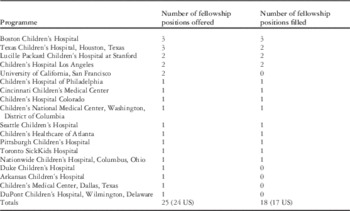
In January, 2016, a telephone and electronic mail survey of the 17 US Pediatric Cardiac anaesthesia fellowship programmes and one in Canada (Toronto SickKids Hospital) were undertaken. A total of 25 positions were available, but only 18 of these positions were filled. Among postulated reasons for the inability to fill all positions were the following: stressful clinical duties in paediatric cardiac anaesthesia with more frequent on-call duties in many cases; only about 10 new dedicated attending paediatric cardiac anaesthesia positions are needed each year in the United States of America; the extra training time may not be worth the extra income (if any) for a cardiac anaesthesia position; and many institutions do not have a dedicated paediatric cardiac anaesthesia team and do not require an extra fellowship to perform cardiac anaesthetics. The current programmes in 2015–2016 offering second-year, advanced, 12-month paediatric cardiac anaesthesia fellowships according to the CCAS–PALC guidelines and the number of positions available as well as numbers filled are listed in Table 3.
Advanced second-year, 12-month paediatric cardiovascular anaesthesia fellowship programmes in United States of America and Canada in 2015–2016.

The future of paediatric cardiac anaesthesia training
The field of Pediatric and Congenital Cardiac Anesthesia has grown significantly over the past 15 years; as of 2016, the CCAS has 700 active attending anaesthesiologist members in the United States of America and a total of 1231 members when international, resident, and fellow members are included. The CCAS Annual Meeting is well attended by 200–250 anaesthesiologists each year, demonstrating sustained interest in education in this field; however, with current demand for paediatric anaesthesiologists in general slowing, and requirement for only about 10 new dedicated paediatric cardiovascular anaesthesiologists per year, coupled with 1/3 of current fellowship positions vacant, it is not clear that additional fellowship positions are needed. In addition, ongoing pressure on finances for advanced fellowship training and graduate medical education (GME) positions in general make it unlikely that additional programmes will take on the burden of an advanced paediatric cardiovascular anaesthesia fellowship. In order to overcome financial barriers for trainees to serve an extra year of fellowship, “faculty–fellowship” models have evolved, whereby the second-year advanced fellow serves as a general paediatric anaesthesia attending physician for 1–3 days per week; the professional fee revenue allows a higher salary intermediate between that of a fellow and a full-time faculty member. This arrangement has been beneficial for some non-clinical advanced fellowships such as research, education, or quality improvement. “Diluting” the cardiac anaesthesia fellowship with such an arrangement may be undesirable and prevent adequate case numbers and other experiences necessary for full training. In addition, many GME bodies do not allow such clinical work as an attending physician in advanced fellowship programmes that they administer, citing dilution of the training experience.
Texas Children’s Hospital paediatric cardiac anaesthesia training, 1998–2016
Texas Children’s Hospital and Baylor College of Medicine have sponsored a Pediatric Cardiac Anesthesia fellowship since the 1998–1999 academic year, and the outcomes of this fellowship programme inform the larger discussion. From 1998 to 2016, a total of 21 advanced second-year paediatric cardiovascular anaesthesia fellows have been trained. Of these, five were 6-month duration fellowships, offered until 2010, and 16 were 12-month fellows. In total, 19 of these fellows had completed a full 12-month ACGME-accredited paediatric general anaesthesia fellowship and two a 12-month adult cardiovascular anaesthesia fellowship. In all, 15 of 21 graduates are in full- or part-time paediatric cardiac anaesthesia practices in paediatric academic centres; three are in mixed general operating room/catheterisation laboratory/non-cardiac surgery in CHD patients practice in academic centres, that is, no cardiac operating room cases; one in an adult cardiac anaesthesia practice with some adult congenital cases; and two are in private anaesthesia practice with mixed paediatric/adult general cases, that is, no paediatric cardiac anaesthesia. By 2012, three advanced second-year cardiac anaesthesia fellowship positions were offered, and in 2015–2016 two of the three were filled.
In addition to the second-year advanced fellowship training, 75 general paediatric anaesthesia fellows serving 2–3-month rotations have been trained since 1998. In total, 80 adult cardiovascular anaesthesia fellows from the Baylor College of Medicine/Texas Heart Institute Fellowship have rotated through the Texas Children’s Hospital service; this rotation is an elective, with 30–40% choosing this elective in recent years. Finally, 45 third-year anaesthesiology residents from Baylor College of Medicine have served 1-month rotations since 1998.
Although not strictly trainees, Texas Children’s Hospital has also hosted 13 international observing physicians in 2013–2015, for periods of 1 week to 1 year, from countries including Spain, China, Egypt, Mexico, Vietnam, New Zealand, Scotland, Pakistan, Iran, and India.
Conclusion
Training in paediatric cardiovascular anaesthesia has evolved from essentially non-existent in the 1970s and 1980s to specified 12-month, advanced, second-year fellowship programmes administered according to ACGME guidelines, although not ACGME accredited. In North America, 18 institutions offer this training, with 18 of 25 positions filled in 2015–2016. Despite steady growth in the CCAS and interest in the field, it appears unlikely that fellowship opportunities will grow further, with the financial pressures of funding fellowships and the need for only about 10 new attending paediatric cardiac anaesthesiologists annually in the United States of America.