INTRODUCTION
Sacred forests around the world represent a traditional form of community-based conservation. Sacred forests, also sometimes referred to as sacred groves, are sites that have cultural or spiritual significance to the people who live around them. There is a wide variation in the size of sacred forests. Some of them are small fragments of forest less than one hectare, and others are more extensive, spanning several hundred hectares (Ntiamoa-Baidu Reference Ntiamoa-Baidu1995; Malhotra et al. Reference Malhotra, Gokhale, Chatterjee and Srivastava2007). Sacred forests have been protected around the world for a variety of reasons, including for religious practices or ceremonies, as burial grounds and for their watershed value (Lebbie & Freudenberger Reference Lebbie, Freudenberger, Schelhas and Greenberg1996; Chandran & Hughes Reference Chandran and Hughes1997; Greene Reference Greene2002; Blench Reference Blench2004; Malhotra et al. Reference Malhotra, Gokhale, Chatterjee and Srivastava2007). These areas are known to provide ecosystem services, such as erosion control and maintenance of high water quality (Tiwari et al. Reference Tiwari, Barik and Tripathi1998).
India has the highest concentration of sacred forests in the world. Estimates suggest that there might be between 100 000 and 150 000 sacred forests around the country (Malhotra et al. Reference Malhotra, Gokhale, Chatterjee and Srivastava2007). These community-protected forests are often associated with or believed to house a god or gods, and are typically named after deities (Chandrakanth et al. Reference Chandrakanth, Bhat and Accavva2004). Globally, sacred forests often have associated myths and taboos on the use of specific plants and hunting of certain species of animals within the area. These traditions can serve a conservation role because some of the sacred forest fragments represent the sole remaining forests and the last remaining locations with potential for conservation of flora and fauna. For example, church forests in Ethiopia protect some of the last remaining fragments of tropical afromontane forests (Aerts et al. Reference Aerts, Van Overtveld, Haile, Hermy, Deckers and Muys2006), while sacred forests on the south-east coast of India are the only remnants of dry evergreen forest habitat (Ramanujam & Kadamban Reference Ramanujam and Kadamban2001; Ramanujam & Praveen Kumar Cyril Reference Ramanujam and Praveen Kumar Cyril2003; Mani & Parthasarathy Reference Mani and Parthasarathy2005).
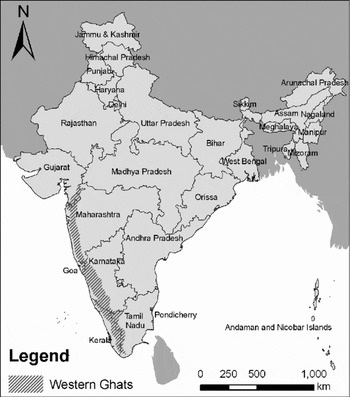
One region in India, the Western Ghats (Fig. 1), not only has a very high number of sacred forests (Kushalappa & Bhagwat Reference Kushalappa, Bhagwat, Shaanker, Ganeshaiah and Bawa2001), it is also recognized globally as a ‘biodiversity hotspot,’ meaning that it simultaneously has a high concentration of unique species and is under extreme resource use pressure (Myers et al. Reference Myers, Mittermeier, Mittermeier, Fonseca and Kent2000). The Kodagu district of the Western Ghats alone contains over 1200 sacred groves (Boraiah et al. Reference Boraiah, Vasudeva, Bhagwat and Kushalappa2003). Yet, in the Western Ghats region, it is estimated that only 7% of the original vegetation now remains (Myers et al. Reference Myers, Mittermeier, Mittermeier, Fonseca and Kent2000). Although sacred forests are often small fragments, they may be the only remaining reservoirs of biological diversity outside protected areas (PAs). They may also represent important traditions that are being lost as new generations do not continue oral histories and cultural practices. In addition, sacred forests conserve habitats that are not represented within the current PA system (Bhagwat & Rutte Reference Bhagwat and Rutte2006) and may serve as refugia for endemic species (Jamir & Pandey Reference Jamir and Pandey2003). These are reported to be relict forests and may be the only remaining climax vegetation of an area, although many are now disturbed as a result of human actions (Khiewtam & Ramakrishnan Reference Khiewtam and Ramkrishnan1989; Tiwari et al. Reference Tiwari, Barik and Tripathi1998).
Map of India, showing the location of the Western Ghats.

Globally, conservation biologists and resource managers are starting to take note of sacred forests as potential storehouses of biodiversity (for example Castro Reference Castro, Chaiken and Fleuret1990; Lebbie & Freudenberger Reference Lebbie, Freudenberger, Schelhas and Greenberg1996; Ramakrishnan Reference Ramakrishnan, Harmon and Putney2003; Bhagwat & Rutte Reference Bhagwat and Rutte2006; Sheridan & Nyamweru Reference Sheridan and Nyamweru2007). For example, many threatened plants in Meghalaya, a state in north-eastern India, are known to be confined to sacred forests which are remnants of climax vegetation (Khan et al. Reference Khan, Menon and Bawa1997). Yet these sites typically have no legal protection; they are managed and protected by local residents. For instance, in the Western Ghats of India, there is confusion over the ownership of sacred forests with a history of three separate government departments claiming their ownership (Garcia & Pascal Reference Garcia, Pascal, Cederlöf and Sivaramakrishnan2006).
This paper provides a review of sacred forests as a form of community-based natural resource management (CBNRM), with a particular focus on the sacred forests of India. We give specific attention to the Western Ghats region of southern India and Meghalaya state in north-eastern India. Both these regions have a high concentration of sacred forests, and have also been identified as key areas for biodiversity conservation owing to their high species diversity and high levels of endemism (Khan et al. Reference Khan, Menon and Bawa1997). Based on an extensive review of published studies on sacred forests, we suggest that these forests can serve a valuable function in protection of both biological and cultural resources whilst providing a tangible model for CBNRM. A large number of studies on sacred forests have been published over the last decade; by synthesizing the research to date on the sacred forests of India, this review aims to help the conservation community and policy-makers to (1) acknowledge the value of sacred forests and (2) consider the needs for future study and action to avoid the loss of these important community-conserved areas.
SACRED GROVES AS COMMUNITY-CONSERVED AREAS
Recently, the international conservation community has taken interest in both the conservation value of sacred forests (see for example Wild & McLeod Reference Wild and McLeod2008; and the International Union for Conservation of Nature (IUCN) World Commission on Protected Areas (WCPA) Specialist Group on Cultural and Spiritual Values URL http://www.csvpa.org/) and the historical and future roles of communities in the conservation of sacred forests (for example Berkes Reference Berkes2009). The potential role of faith communities in conservation is also receiving attention (for example Dudley et al. Reference Dudley, Higgins-Zogib and Mansourian2009).
Sacred forests across the world are conserved primarily for spiritual reasons. Harming the forest is forbidden by tradition and it is typically believed that any alteration of the forest, such as cutting wood for construction or firewood, hunting animals or other forms of resource extraction, will result in negative consequences to the person taking the resources (Gadgil & Vartak Reference Gadgil and Vartak1976; Chandrakanth et al. Reference Chandrakanth, Gilless, Gowramma and Nagaraja1990; Barre et al. Reference Barre, Grant and Draper2009). According to Chandrakanth et al. (Reference Chandrakanth, Bhat and Accavva2004, p. 105), resource extraction from a sacred forest in India was perceived as a serious offence and ‘traditional people believed that the punishment for such crimes would be to be reborn as urchins for thousands of years’. At Mawphlang sacred grove in Meghalaya, several residents recalled events when outsiders tried to harvest trees from the sacred grove but then fell ill (A. A. Ormsby, unpublished data). Thus, belief in the negative consequences of actions that harm sacred groves serves as a method of maintaining the grove and keeping it intact and preserved.
CBNRM has been suggested as a way to ensure that conservation projects are effective (Western et al. Reference Western, Wright and Strum1994). Subsequently, CBNRM has been criticized for not truly and authentically involving communities, or by still having expatriate control of projects (for example see Leach et al. Reference Leach, Mearns and Scoones1999). The participation continuum developed by Pretty et al. (Reference Pretty, Guijt, Thompson and Scoones1995) offers a useful method of measuring how authentically communities are involved in a project, ranging from manipulative participation to self-mobilization. Applying the model of sacred forests in India to this continuum, it is evident that these are a true example of self-initiated community participation. As Berkes (Reference Berkes2004, p. 625) pointed out, ‘If local common property institutions are consistent with conservation objectives, as in the case of traditional sacred areas, that is an ideal situation’.
SACRED GROVES AS A TRADITIONAL CONSERVATION PRACTICE
It is believed that the sacred grove conservation tradition in India began around the same time as the start of settled agriculture (Hughes & Chandran Reference Hughes, Chandran, Ramakrishnan, Saxena and Chandrashekara1998). The motivation behind keeping patches of forest may have been the ecological services that such patches provide. These include soil conservation, maintaining watersheds and provision of forest products. The communities may have protected groves in honour of pagan gods, animistic deities or ancestral spirits (Kosambi Reference Kosambi1962). In India, many of these original gods, deities and spirits underwent transformation over the years into mainstream gods and goddesses, although the tradition of conserving patches of forest has been maintained until today (Chandrakanth et al. Reference Chandrakanth, Bhat and Accavva2004). Traditional forest conservation practices are seen in current society in various forms. For example in Udaipur district (Rajasthan, north-west India), the sprinkling of saffron water around a piece of land is a common practice (Gandhi Reference Gandhi1997). The attempts of the local forest department to conserve an area of forest at a site near Udaipur were largely unsuccessful because of persistent transgressions by local people. Frustrated, the forest officers decided to sprinkle saffron water around the site, in accordance with the local tradition. This was greeted with enthusiasm by the local people and, since then, they have respected the boundaries of the conservation area (Gandhi Reference Gandhi1997).
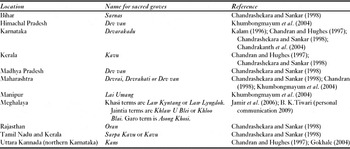
Today, there are a variety of arrangements for sacred forest ownership and management. Chandrashekara and Sankar (Reference Chandrashekara and Sankar1998) noted that management of sacred groves in Kerala (India), was undertaken by individual families, groups of families or statutory agencies for temple management. Chandrakanth et al. (Reference Chandrakanth, Bhat and Accavva2004) studied sacred groves in Kodagu (India) and noted two types of management systems, either family-owned or community-managed. Tiwari et al. (Reference Tiwari, Barik and Tripathi1998) observed that the sacred groves in Meghalaya (India) were managed by a committee from the community which was chaired by a community priest who performed the ceremonies associated with the forest. The local names for sacred forests vary by region in India (Table 1).
Examples of terminology for sacred forests in different regions of India.

CONSERVATION VALUE OF SACRED FORESTS
As a result of the long-term conservation of forest patches by communities who consider them to be sacred, relict patches of once extensive forest have been preserved (Gadgil & Vartak Reference Gadgil and Vartak1976). Sacred forests have consistently been found to have higher species diversity than surrounding areas and, in some cases, even more than government-protected areas in similar regions. Sacred forests also contain a high diversity of medicinally important plants. In a study of five sacred groves in Kodagu (Karnataka, India), Boraiah et al. (Reference Boraiah, Vasudeva, Bhagwat and Kushalappa2003) found that 60% of the regenerating species (136 of 241 species) were medicinally important.
Sacred forests cover a wide variety of habitats and protect many species in landscapes outside PAs (Bhagwat & Rutte Reference Bhagwat and Rutte2006). For example, sacred forests in coastal parts of Karnataka (India) protect swamps inhabited by a species of nutmeg, Myristica fatua. Surveys suggest that this species is exclusively found in coastal swamps and is outside the boundaries of PAs in the region, all of which cover mountain habitat (Chandran & Mesta Reference Chandran, Mesta, Shaanker, Ganeshaiah and Bawa2001). In addition, the species Myristica magnifica and Pinanga dicksoni are now mainly confined to a Myristica swamp in a sacred grove (kan) of Uttara Kannada in northern Karnataka (Chandran Reference Chandran, Grove, Damodaran and Sangwan1998). In southern Karnataka, in the Kodagu district of the Western Ghats, sacred forests were found to protect threatened tree species such as Actinodaphne lawsonii, Hopea ponga, Madhuca neriifolia and Syzygium zeylanicum, which are not found within PAs (Bhagwat et al. Reference Bhagwat, Kushalappa, Williams and Brown2005a).
Ecological theory states that patches of forest that are fragmented lose species and have low biodiversity, suggesting that such patches have limited value for biodiversity conservation (Hill & Curran Reference Hill and Curran2001). However, a network of patches is known to support higher biodiversity than a single patch alone (Tabarelli & Gascon Reference Tabarelli and Gascon2005). Furthermore, if the patches are connected by corridors, they can potentially support an even higher number of species (Wadley & Colfer Reference Wadley and Colfer2004). In the Kodagu district in the southern part of Karnataka state, more than 1200 sacred forests form an informal network of reserves with one forest grove for every 300 hectares of land (Bhagwat et al. Reference Bhagwat, Kushalappa, Williams and Brown2005b). Interspersed between these patches are coffee plantations which support trees kept in plantations for shade. The conservation of sacred groves is integrated within the surrounding landscape matrix because the presence of trees in coffee agroforestry in Kodagu has been helpful in protecting forest-dwelling biodiversity within groves. The tree-covered nature of the landscape matrix means that ecological boundaries between the patches and surrounding plantations are indistinct and thus the patches are not as fragmented (Bhagwat et al. Reference Bhagwat, Kushalappa, Williams and Brown2005b). Protection and active management of trees (for example, replanting of native species when old shade trees die out) requires support from local communities, particularly coffee planters. Whilst the local communities respect the ‘spiritual fence’ around sacred forests, it is necessary that they also realize the importance of keeping native trees in their own plantations near sacred forests, rather than replacing native trees with fast-growing exotics such as Grevillea robusta (Garcia et al. Reference Garcia, Bhagwat, Ghazoul, Nath, Nanaya, Kushalappa, Raghuramulu, Nasi and Vaast2010).
BIODIVERSITY IN SACRED FORESTS
Many sacred forests in India have been studied, primarily to measure their species richness, with a general focus on plant species. Jamir and Pandey (Reference Jamir and Pandey2003) measured plant species diversity of three sacred forests in Meghalaya and found a total of 395 species, 14% of which were endemic. Tiwari et al. (Reference Tiwari, Barik and Tripathi1998) studied 79 sacred forests in Meghalaya, ranging from 0.01 to 900 hectares in size, and found that the species diversity was much higher than in disturbed forests. Upadhaya et al. (Reference Upadhaya, Pandey, Law and Tripathi2003) studied two sacred forests in Meghalaya and found that the groves had high species richness and represented high diversity forest. Khan et al. (Reference Khan, Menon and Bawa1997) surveyed the botanical literature for Meghalaya and realized that 4% of species (133 species) were found only in sacred groves. They advocate for systematic botanical surveys, predicting that this would lead to the discovery of new species, as well as an inventory of the number, size and distribution of sacred groves. In addition, Khan et al. (Reference Khan, Menon and Bawa1997) recommend that sacred groves should be included within the legal PA network.
Also in the north-east of India, the sacred groves of Manipur have been found to contain abundant medicinal plants (Khumbongmayum et al. Reference Khumbongmayum, Khan and Tripathi2005a, Reference Khumbongmayum, Khan and Tripathi2006). Khumbongmayum et al. (Reference Khumbongmayum, Khan and Tripathi2004, Reference Khumbongmayum, Khan and Tripathi2005b) inventoried 166 sacred groves in Manipur, ranging in size from a few trees to 40 hectares, and identified a number of species of sacred plants that were found within forest groves. Most groves, as in other areas of India, did not have demarcated boundaries. Dash (Reference Dash2005) and Arora (Reference Arora2006) studied the Kabi sacred grove in North Sikkim. This grove, measuring 3 km2, was found to have 241 species of plants (Dash Reference Dash2005). Dash (Reference Dash2005), however, observed that the size of the grove was decreasing due to anthropogenic pressures and recommended that the state government collaborate with the local community to strengthen the management of the grove. Conversely, Arora (Reference Arora2006) noted that the groves rely on socioreligious fencing for their continued conservation, which is rejuvenated by regular rituals that are required to maintain the practices of social fencing. Therefore, a combination of approaches may be necessary to maintain the integrity of sacred groves.
THREATS TO SACRED FORESTS
There are several key threats that have led to the reduction in size or lack of protection of sacred forests in India (Chandrakanth et al. Reference Chandrakanth, Bhat and Accavva2004; Khan et al. Reference Khan, Khumbongmayum and Tripathi2008; Wild & McLeod Reference Wild and McLeod2008). Historic forest policy in many cases took away local rights to the forests (Gokhale Reference Gokhale2004) and in some cases gave forest concessions to companies. In many cases, the process of the Indian Government nationalizing forests has taken away community land rights to sacred forests (Chandrakanth et al. Reference Chandrakanth, Bhat and Accavva2004).
There is a great demand to use the natural resources within the sacred forests. Coffee from the Kodagu area is a major export from the state of Karnataka. There has been encroachment on numerous sacred groves to grow coffee (Chandrakanth et al. Reference Chandrakanth, Bhat and Accavva2004). Furthermore, the legal ownership of many sacred groves is also uncertain (Chandrakanth et al. Reference Chandrakanth, Bhat and Accavva2004). In Kodagu, for example, the sacred groves are owned by the forest department and managed by village temple committees. However, historically, ownership of sacred groves has been ambiguous, with forest department and revenue department being entrusted with management at different periods. As a result, management has not been consistent and this has led to confusion about the groves' status among local stakeholders. Chandrakanth et al. (Reference Chandrakanth, Bhat and Accavva2004) argued that sacred groves should not be allowed to be classified as State Reserve Forests. This would take management control away from community members. Furthermore, people are not motivated to conserve land that does not belong to them (Hardin Reference Hardin1968); government ownership can cause alienation of local people from their groves.
Cultural change over time has led to weakening of sacred forest protection and traditions. Sacred forests in the Kodagu region of South India are disappearing due to commercial agriculture, changing beliefs and weak property rights systems (Chandrakanth et al. Reference Chandrakanth, Bhat and Accavva2004). Younger generations are losing interest in the sacred grove traditions. Agricultural labourers and timber harvesters from outside the region do not share local beliefs. Changes in religious traditions and belief systems have also led to a weakening of the protection and conservation of sacred forests. In some cases, Hinduism has subsumed the sacred forests that were established for older folk deities, yet the groves are still maintained while Hindu gods are worshipped. This may involve Hindu temples being built within the sacred forests (Bhagwat & Rutte Reference Bhagwat and Rutte2006). The removal or use of wood from the forests for religious purposes is allowed (Kalam Reference Kalam1996; Tiwari et al. Reference Tiwari, Barik and Tripathi1998). According to Chandran and Hughes (Reference Chandran and Hughes1997, p. 416), ‘In Uttara Kannada, the deities of the groves were not, and in many cases still are not, the characteristic gods of Hindu devotion such as Shiva, Vishnu, Parvati, Lakshmi, Ganapati, etc., but pre-Brahmin deities, mostly indistinct beings that may be represented aniconically’. Furthermore, ‘The local deities to whom the sacred groves were dedicated have been in many cases identified with, or absorbed into, the great gods of the pantheon. . .’ (Chandran & Hughes Reference Chandran and Hughes1997, p. 420). Chandran and Hughes (Reference Chandran and Hughes1997) further contended that ‘These have often resulted in the erection of temple buildings and the diminution of the groves. There is also a tendency to relax the rules protecting the groves as the center of ritual moves away from the trees and toward the temple building’ (p. 420). Sanskritization, a term used to refer to the replacement of local folk deities with Hindu deities in sacred forests, often results in temples being built within forests (Bhagwat & Rutte Reference Bhagwat and Rutte2006).
Changes in the society's structure and composition, as well as economic status and religious values, pose another challenge. In Meghalaya, tribal religion and culture has been replaced by Christianity. Tiwari et al. (Reference Tiwari, Barik and Tripathi1998) interviewed residents near 79 sacred groves, and 95% of respondents attributed degradation of the grove to this change in religious beliefs. In Kodagu, increasing urbanization has caused dilution of religious and cultural values, often leading to desecration of sacred groves (Kalam Reference Kalam1996). In some cases, the neighbouring landowners have encroached upon groves to expand their plantations. Urbanization has also led to movement of rural dwellers to cities. At the same time, immigrant plantation workers have settled in the district as permanent residents. The immigrants often do not share the same cultural and spiritual values that local people have concerning sacred groves. In some cases, this has led to further desecration of sacred groves owing to forest clearance for immigrant settlements (Bon Reference Bon, Ramakrishnan, Chandrashekara, Elouard, Guilmoto, Maikhuri, Rao, Sankar and Saxena2000). Whilst it may not be possible to reverse the immigration pattern, it may be possible to establish certain safeguards against desecration of sacred groves. This is where the local communities and government representatives need to operate together.
MANAGEMENT OF SACRED FORESTS
Although currently under threat, sacred forests represent a strong tradition of CBNRM that has existed for hundreds of years. There is no one answer for a specific approach to sacred forest management globally due to the challenges posed by a wide variety of land rights and management systems. These include family-owned and managed forests, community-owned and/or managed forests, as well as those owned and/or managed by the government, meaning that ‘one size fits all’ management solutions are unlikely to succeed.
Government and international conservation policy should support traditional institutions of sacred forest management, whether at the family, community or even regional level. Given that each sacred site has its own history of protection and formation, the form that this support should take is unclear. However, what is clear is that one general policy, such as designating sacred forests as formal government-managed protected areas, will not work for all sacred forests. As Dudley et al. (Reference Dudley, Higgins-Zogib and Mansourian2009, p. 568) noted, ‘Bringing a sacred natural site into a national protected-area system can increase protection for the site, but may compromise some of its spiritual values or even its conservation values’.
In some cases, outside support for sacred forest conservation is needed. For example, in the case of the sacred groves of Meghalaya, Tiwari et al. (Reference Tiwari, Barik and Tripathi1998) called for external intervention. There are cases in other countries where such external intervention has been successful. For instance, at Tafi Atome Monkey Sanctuary, a sacred forest in Ghana, community members elicited the support of an Accra-based non-governmental organization to develop ecotourism to the site and support sacred grove conservation traditions (Ormsby & Edelman Reference Ormsby, Edelman, Wild and Verschuren2010). When the sacred monkeys at the Boabeng-Fiema Monkey Sanctuary (Ghana) were threatened by religious leaders who supported monkey hunting to undermine traditional belief systems, the community asked for government support for a hunting ban, which was successful (Fargey Reference Fargey1992; Saj et al. Reference Saj, Mather and Sicotte2006; Ormsby Reference Ormsby, Pungetti, Oviedo and Hooke2011).
In order to counter the current threats posed to sacred forests due to religious and cultural changes as well as by natural resource pressures, a renewal of community traditions is needed. Local residents must continue to be involved in forest management (Bhagwat et al. Reference Bhagwat, Kushalappa, Williams and Brown2005a). This may come through revival of past ceremonies related to a grove, or through awareness campaigns and education programmes highlighting the ecological and spiritual benefits of the forests (Chandrashekara & Sankar Reference Chandrashekara and Sankar1998). The community tradition of protecting sacred forests provides an example of a way to achieve landscape-level conservation that is implemented and maintained at a local level.
For effective conservation of sacred forests, it is important to consider and respect community values behind such conservation. This approach to conservation is very different to that of maintaining formal PA networks. Whilst formal protection is bound by legal framework, informal conservation traditions are governed by customs and taboos (Colding & Folke Reference Colding and Folke2001; Barre et al. Reference Barre, Grant and Draper2009). An approach that is sensitive to local peoples' traditions, such as sacred forest conservation, is likely to work better than an approach that alienates local people. Recognizing and incorporating such traditions is important for successful conservation programmes.
CONCLUSIONS
Sacred forests present an alternative view of conservation that is led by norms and taboos rather than formal legal frameworks. They protect a wide variety of habitats and hold considerable potential for biodiversity conservation. Such sites offer protection to habitats and species that are excluded from formal PAs, and this approach to conservation has greater acceptance among local people. However, sacred forests face a number of challenges that need to be addressed. Greater sensitivity towards these conservation traditions is necessary. For effective conservation management of sacred forests, their importance must be established in international fora in order to attract conservation funding. Sacred forests are not just cultural monuments, they are conservation areas that can provide a culturally-sensitive model for CBNRM.