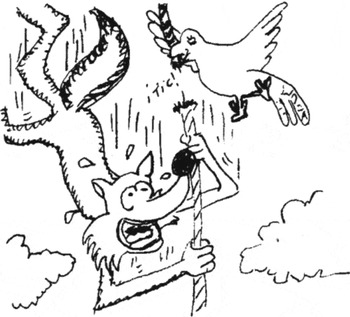
1. IntroductionFootnote 1
Within the field of language contact there has been a discussion about the nature of cross-linguistic transfer and linguistic vulnerability. The discussion revolves around the question of what can (and what cannot) be transferred from one language to another. There is especially a lack of consensus about the possibility of (direct) syntactic transfer. There are essentially two positions regarding the possibility of syntactic transfer. One position, which was originally proposed by Thomason and Kaufman (Reference Thomason and Kaufman1988), is that syntactic transfer is possible. Thomason and Kaufman (Reference Thomason and Kaufman1988) argue that “anything can be transferred from any language to any other language” (Thomason & Kaufman, Reference Thomason and Kaufman1988, p. 14). This position is restated in later work by Thomason (Reference Thomason, Eliasson and Hakon1997, Reference Thomason2001, Reference Thomason2008), as well as in Campbell (Reference Campbell, Aertsen and Jeffers1993) and Harris and Campbell (Reference Harris and Campbell1995). The other position, whose main proponents are Prince (Reference Prince1988, Reference Prince, Kramsch and McConnell-Ginet1992, Reference Prince, Schmid, Austin and Stein1998) and Silva-Corvalán (Reference Silva-Corvalán, Ashby, Mithun, Perissinotto and Raposo1993, Reference Silva-Corvalán1994, Reference Silva-Corvalán, Schwegler, Tranel and Uribe-Extebarria1998, Reference Silva-Corvalán2008), is that syntax is relatively impermeable to influence from another language. Prince and Silva-Corvalán argue that direct syntactic transfer is rare and that transfer is often limited to a transfer of pragmatic uses.
The issue has not been resolved; there seems to be support for both positions. Thomason and Kaufman (Reference Thomason and Kaufman1988) and Thomason (Reference Thomason2001, Reference Thomason2008) cite various cases of what seems to be syntactic transfer. Among these cases are a change from S(ubject)O(bject)V(erb) to SVO word order in Finnish under Indo-European influence, and a change from SVO to SOV word order in Austronesian languages of New Guinea under Papuan influence (Bradshaw, Reference Bradshaw1979, cited in Thomason & Kaufman, Reference Thomason and Kaufman1988, p. 55). However, based on a study of the English of Yiddish–English bilinguals, Prince (Reference Prince1988, Reference Prince, Kramsch and McConnell-Ginet1992, Reference Prince, Schmid, Austin and Stein1998) argues that what at first seems to be syntactic transfer often turns out to be pragmatic or lexical transfer. Silva-Corvalán (Reference Silva-Corvalán, Ashby, Mithun, Perissinotto and Raposo1993, Reference Silva-Corvalán1994, Reference Silva-Corvalán, Schwegler, Tranel and Uribe-Extebarria1998, Reference Silva-Corvalán2008) reaches a similar conclusion in her study on the Spanish of Spanish–English bilinguals in the United States. She argues that “speakers of the secondary language simplify or overgeneralize grammatical rules but do not introduce elements which cause radical changes in the system of this language” (Silva-Corvalán, Reference Silva-Corvalán, Ashby, Mithun, Perissinotto and Raposo1993, p. 20). The issue concerning the possibility of direct syntactic transfer is a complex one that is not easily solved because we often lack the data to determine the exact nature of cross-linguistic transfer. The type of data needed to settle the issue is data that allow us to tease apart syntactic properties from pragmatic properties.
This paper presents a case study of transfer of word order in Andean Spanish, taking into account both syntactic and pragmatic properties. The canonical word order of non-Andean Spanish is SVO. In Andean Spanish, the object frequently appears in preverbal position, giving rise to alternative word orders, such as OVS:
(1)

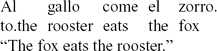
Previous studies (Camacho, Reference Camacho1999; Escobar, Reference Escobar2000; Muysken, Reference Muysken and Andersen1984; Ocampo & Klee, Reference Ocampo, Klee and Silva-Corvalán1995) have attributed this phenomenon to an (indirect) influence of Quechua, where the object typically precedes the verb. However, they have not discussed in detail which linguistic properties are transferred. It is important to ask this question because the answer will provide a better understanding of the mechanisms of language contact. The focus of this paper is on the difference between the syntax and pragmatics of word order. The syntax of word order refers to the structure of the different word orders: the same surface word order does not necessarily have the same syntactic structure in different languages. The pragmatics of word order refers to the use and interpretation of the different word orders. In non-Andean Spanish alternative word orders (e.g. OVS) are possible, but fronted elements encode focus or topic (when used with a resumptive pronoun). Given that focus fronting could explain the high frequency of preverbal objects in Andean Spanish, we need to study focus fronting in this variety, in non-Andean Spanish and in Quechua.
This study attempts to separate syntactic transfer from pragmatic transfer. Specific syntactic and pragmatic properties are studied to determine the nature of transfer from Quechua into Andean Spanish. The paper is organized as follows: In Section 2, word order, topic and focus in Spanish are discussed. Section 3 deals with word order, topic and focus in Quechua. In Section 4, the research questions and hypotheses of the study are presented. In Section 5, the methodology used for the data collection is discussed. Section 6 is dedicated to the results of the studies on the syntax and pragmatics of focus in non-Andean Spanish, Andean Spanish and Quechua. Finally, Section 7 contains a summary of the main findings and the conclusions, as well as a discussion of the limitations of the study.
2. Word order, topic and focus in Spanish
The canonical word order of non-Andean Spanish is SVO. Following Zagona (Reference Zagona2002), we assume that the verb moves to INFL, where the verb features of INFL are checked, and the subject moves to the Specifier of IP to check its D-features (Zagona, Reference Zagona2002, p. 207):Footnote 2
(2) [ip Sj [inflvi + infl] [vp tj [v′ ti O-]]]
Alternative word orders are possible to encode topic and focus. In non-Andean Spanish there are three strategies to encode focus: (i) the focus can appear at the end of the sentence where it receives nuclear stress, (ii) the intonation and the place of the stress can be changed, a strategy that is called stress strengthening, and (iii) the focus can appear at the beginning of the clause via focus fronting. These strategies are discussed below.
2.1 Nuclear stress rule
The first strategy used to mark focus involves prosodic prominence and the nuclear stress rule. According to Chomsky (Reference Chomsky, Steinberg and Jakobovits1971), Jackendoff (Reference Jackendoff1972) and Zubizarreta (Reference Zubizarreta1998), focus is the non-presupposed information, while the rest of the sentence is presupposed information, i.e. information that is shared by the speaker and the listener. Question–answer pairs help us determine the focus–presupposition structure of a sentence. The focus of a declarative sentence is that part of the sentence that replaces the wh-phrase in the question (Rooth, Reference Rooth and Lappin1996; Zubizarreta, Reference Zubizarreta1998). Question (3) below elicits broad focus (i.e. focus on the entire sentence), (4) narrow focus on the VP, and (5) narrow focus on the object:
- (3)
a. ¿Qué pasó?
“What happened?”
b. [F Juan leyó el libro.]
“Juan read the book.”
- (4)
a. ¿Qué hizo Juan?
“What did Juan do?”
b. Juan [F leyó el libro].
“Juan read the book.”
- (5)
a. ¿Qué leyó Juan?
“What did Juan read?”
b. Juan leyó [F el libro].
“Juan read the book.”
Zubizarreta (Reference Zubizarreta1998, Reference Zubizarreta, Bosque and Demonte Barreto1999) makes a distinction between neutral focus (the focus that is identified by a wh-question, as in the examples above) and contrastive focus. Contrastive focus denies information in the presupposition and provides new information. Example (6) is based on Zubizarreta (Reference Zubizarreta, Bosque and Demonte Barreto1999, p. 4228, example (58)). Sentence (6b) contradicts (6a) and has a contrastive focus interpretation. It is not the case that Juan read a magazine; Juan read a book.
- (6)
a. Juan leyó una revista.
“Juan read a magazine.”
b. Juan leyó [F un libro] (no una revista).
“Juan read a book (not a magazine).”
Prosodic prominence is important in identifying focus in Spanish (Cinque, Reference Cinque1993; Zubizarreta, Reference Zubizarreta1998, Reference Zubizarreta, Bosque and Demonte Barreto1999). Neutral focus is indicated by neutral nuclear stress. Nuclear stress is the stress that is associated with the most prominent word in the intonation group (Zubizarreta, Reference Zubizarreta1998, Reference Zubizarreta, Bosque and Demonte Barreto1999). It falls on the most deeply embedded constituent (Cinque, Reference Cinque1993), which in Spanish is the rightmost constituent. Contrastive stress is indicated by emphatic stress and is relatively free; it can occur on any morpheme (Zubizarreta, Reference Zubizarreta, Bosque and Demonte Barreto1999, pp. 4229–4230).
To focus it, the subject can appear at the end of the sentence, where it receives nuclear stress, as shown in (7). Sentence (7b), which has word order VOS, is an answer to question (7a). The subject receives narrow focus.
(7)
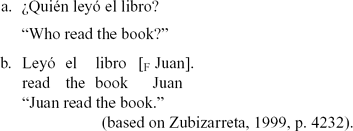
The order VOS is derived from SVO via A′-movement of the object (Zagona, Reference Zagona2002, pp. 255–256):
(8)
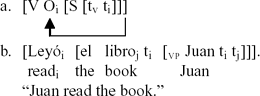
In (8) the verb moves to INFL, the object moves to a position outside the VP and the subject stays in the Specifier of VP (Zagona, Reference Zagona2002, p. 255). This movement is prosodically motivated (Zubizarreta, Reference Zubizarreta1998, Reference Zubizarreta, Bosque and Demonte Barreto1999); the word order is changed to align the focused element, Juan, with nuclear stress. According to Zubizarreta (Reference Zubizarreta1998, Reference Zubizarreta, Bosque and Demonte Barreto1999), VOS is the only possible word order in response to (7a) (Zubizarreta, Reference Zubizarreta1998, p. 125; 1999, p. 4233). There is, however, another option, which involves stress strengthening.
2.2 Stress strengthening
A second strategy to encode focus is changing the intonation and the location of the nuclear stress (Zagona, Reference Zagona2002, p. 211). In (9b), which is an answer to (9a), SVO is used, but the intonation and the location of the stress are changed: the stress is on the subject.
- (9)
a. ¿Quién leyó el libro?
“Who read the book?”
b. [F Juan] leyó el libro.
“Juan read the book.”
This strategy corresponds to what Cinque (Reference Cinque1993), Reinhart (Reference Reinhart, Wilder, Gärtner and Bierwisch1997) and Neeleman and Reinhart (Reference Neeleman, Reinhart, Butt and Geuder1998) call stress strengthening: an element without the main stress is strengthened. Example (9b) above sounds natural as an answer to question (9a); the focus does not receive a contrastive interpretation, against Zubizarreta (Reference Zubizarreta1998, Reference Zubizarreta, Bosque and Demonte Barreto1999), who argues that the order SVO cannot be used as an answer to (9a). In her view, the subject necessarily receives a contrastive focus interpretation (Zubizarreta, Reference Zubizarreta1998, p. 20; 1999, p. 4229).
2.3 Fronting
A third strategy to mark focus is focus fronting, in which a constituent is preposed to the left periphery of the sentence and assigned (contrastive) stress. The constituent that moves has a [Foc] feature (Rizzi, Reference Rizzi and Haegeman1997). The constituent moves in syntax to check this feature. In the semantic/pragmatic component, the moved constituent is interpreted as focused (because of its [Foc] feature). In non-Andean Spanish focus fronting is possible for the object and the subject, as shown in (10a) and (10b), respectively, but not for the VP, as shown in (10c):
(10)
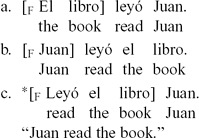
In non-Andean Spanish, focus fronting is similar to a construction with a left-dislocated topic. Topic is what the sentence is about, whereas comment is what is said about the topic (Rizzi, Reference Rizzi and Haegeman1997; Zubizarreta, Reference Zubizarreta, Bosque and Demonte Barreto1999). The topic–comment structure in Spanish also involves the left periphery of the sentence, as shown in (11). According to Zagona (Reference Zagona2002), clitic left-dislocation does not involve movement. In her view, left-dislocated topics are base-generated as adjuncts (Zagona, Reference Zagona2002, p. 226). In (11), the topic is a direct object. As shown in (11b), the topic is adjoined to IP and co-indexed with a pro in the VP, which is licensed by the clitic lo in INFL.
(11)
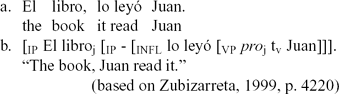
One of the differences between topic and focus in Spanish is that a topic occurs with a resumptive pronoun, whereas focus does not. If the topic is the direct object of the sentence, the resumptive pronoun is required, see (12). As shown in (13), focus cannot appear with a resumptive pronoun (Rizzi, Reference Rizzi and Haegeman1997; Zagona, Reference Zagona2002; Zubizarreta, Reference Zubizarreta, Bosque and Demonte Barreto1999):
(12)
(13)
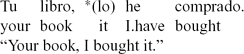
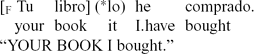
In Spanish the preposed focal element must be adjacent to the verb, while clitic left-dislocation does not require adjacency to the verb. In other words, focus leads to subject–verb inversion, whereas clitic left-dislocation does not (Zagona, Reference Zagona2002; Zubizarreta, Reference Zubizarreta, Bosque and Demonte Barreto1999). Example (14), with the subject between the preposed object and the verb, is unacceptable; (15) is acceptable:
(14)
(15)
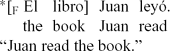
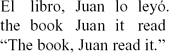
There can be more than one topic in a sentence, as is shown in (16a), but there can only be one focus (Rizzi, Reference Rizzi and Haegeman1997; Zagona, Reference Zagona2002; Zubizarreta, Reference Zubizarreta, Bosque and Demonte Barreto1999). The sentence with two foci in (16b) is unacceptable.
(16)

A focused element can co-occur with one or more topics (Rizzi, Reference Rizzi and Haegeman1997). In Spanish, topic precedes focus (Zagona, Reference Zagona2002; Zubizarreta, Reference Zubizarreta, Bosque and Demonte Barreto1999):
(17)

Furthermore, focus leads to weak crossover effects, whereas topic does not (Rizzi, Reference Rizzi and Haegeman1997, p. 290). A crossover configuration arises when a quantified phrase undergoes A′-movement across a co-indexed pronoun, as is shown in (18a):
(18)
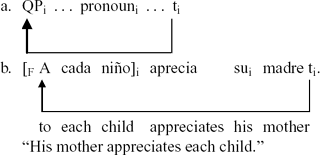
In (18b), an example of focus fronting, the quantified phrase a cada niño “each child” undergoes A′- movement crossing the co-indexed pronoun su “his”. The quantified phrase c-commands both the co-indexed pronoun and the trace; both are interpreted as variables bound by the quantified phrase. The pronoun does not c-command the trace, which results in weak crossover violations. These sentences typically lead to (weak) unacceptability, with variation among speakers.
Topics do not lead to weak crossover effects (Rizzi, Reference Rizzi and Haegeman1997, p. 290), as is illustrated by the full acceptability of (19):
(19)

Another syntactic property of focus fronting in Spanish is the possibility of long distance movement of object and subject. The acceptability of (20) shows that in non-Andean Spanish long distance movement of the object or subject is possible with focus fronting. In (20a), the object is displaced from its position in the VP of the subordinate clause (as is indicated by the co-indexed trace left behind) and preposed to the left periphery of the main clause. In (20b), the subject is moved. In non-Andean Spanish, long distance movement of the VP is not allowed.
(20)

Of the strategies to encode focus in Spanish, focus fronting is particularly relevant to the present study because it could explain the high frequency of preverbal objects. The main syntactic properties of focus fronting in Spanish, which are sensitivity to weak crossover and long distance movement, are used to study a possible syntactic transfer from Quechua into Andean Spanish.
3. Word order, topic and focus in Quechua
The Quechua language family is spoken in the Andes of Colombia, Ecuador, Peru, Bolivia, Chile and Argentina. Torero (Reference Torero1964) distinguishes two main branches: Quechua I and II. Quechua I is spoken in the central highlands of Peru, and Quechua II to the north and south of Quechua I (Adelaar & Muysken, Reference Adelaar and Muysken2004).
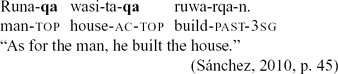
The canonical word order of Quechua is SOV, but in main clauses the word order is relatively free; other word orders are possible for discourse reasons (Cerrón-Palomino, Reference Cerrón-Palomino1987). In many varieties of Quechua topic and focus are encoded morphologically and syntactically. The morpheme -qa is used to mark topics, whereas focus is marked by the morpheme -mi, which also has an evidential meaning.Footnote 3 As an evidential -mi expresses direct experience or direct information (Faller, Reference Faller2002; Muysken, Reference Muysken and Kiss1995; Weber, Reference Weber1996). The suffix -mi appears at the end of a phonological word and cannot co-occur with a topic marker within the same word. According to Muysken (Reference Muysken and Kiss1995, p. 378), “although other particles can contribute to focus, the evidentials are most directly involved in marking focus”.
The morpheme -mi is limited to one per clause (Muysken, Reference Muysken and Kiss1995), as shown by the unacceptability of (21). There can, however, be more than one -qa per clause, as (22) shows. Both -mi and -qa are restricted to main clauses or subordinate clauses with tensed verbs, and cannot occur within nominalizations (Lefebvre & Muysken, Reference Lefebvre and Muysken1988), see (23).
(21)
(22)
(23)
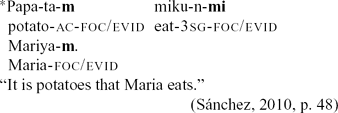

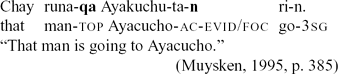
Topic and focus can co-occur within a sentence, following the pattern in (24) below, which indicates that there can be no more than two phrases marked by -qa at the beginning of the sentence. After the -qa phrase(s), there can be a verb or a constituent marked with -mi and up to three other phrases with -qa. An example is given in (25).
(24)
(25)

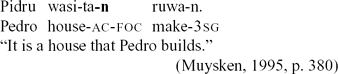
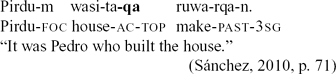
Focused elements and topics such as those in (26) and (27), respectively, can remain in situ. In (26), with SOV order, the direct object is marked for focus. In (27), the direct object is marked as topic.
(26)
(27)
Following Kayne (Reference Kayne1994) and Sánchez (Reference Sánchez2010), we assume that the representation of canonical SOV is as in (28). The object starts as complement of V and moves to the Specifier of the first VP. The subject appears in the Specifier of vP; the verb stays within the VP (Sánchez, Reference Sánchez2010).
(28)

Topic and focus can also be preposed to the left periphery of the sentence. In (29), the direct object is preposed and marked with -mi to encode focus, resulting in the order OSV; in (30) the preposed direct object is marked with -qa to express topic. Object fronting in Quechua can also give rise to OVS. The subject can also move for focus reasons, resulting in SOV. Finally, in Quechua verb fronting is possible as well, giving rise to VOS and VSO, as in (31):
(29)
(30)
(31)
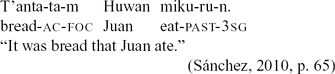
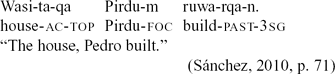
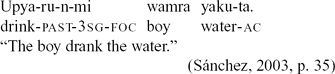
As is shown in (32) and (33), respectively, topics can also be moved to a post-verbal position, but focused elements cannot (Muysken, Reference Muysken and Kiss1995; Sánchez, Reference Sánchez2010). In (32), right adjunction of the topic leads to the word order Subject–Indirect Object–Verb–Object. A subject can appear in the right periphery as topic as well, resulting in OVS.
(32)
(33)
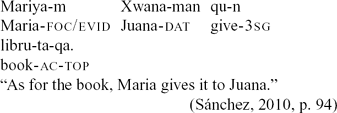
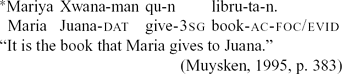
So far we have shown that topic and focus are marked morphologically and/or syntactically in Quechua. For Cuzco and Ayacucho Quechua, it has been argued that topic and focus are not encoded intonationally (Cusihuamán, Reference Cusihuamán1976/2001; O'Rourke, Reference O'Rourke2005; Parker, Reference Parker1969). However, Cole (Reference Cole1982) argues that contrastive focus is marked intonationally in Imbabura Quechua, a variety spoken in Ecuador.
Another property of Quechua relevant to the topic of this paper is the existence of nominalizations. Lefebvre and Muysken (Reference Lefebvre and Muysken1988) characterize nominalizations in Quechua as “mixed categories”, because they show properties of both nouns and verbs, as illustrated in (34):
(34)

The nominalization in (34) is marked accusative, as a noun. The nominalized verb rantinantan also has verbal features: it appears with a subject and a direct object, which can also be marked accusative. The nominalization is also specified for Tense. The Tense features are, however, not fully specified; the nominalizing suffix -na indicates a relative tense. Specifically, it indicates that the proposition in the nominalized clause happens after the one in the main clause. Given that nominalizations are not fully specified for Tense, they are not full CPs; Sánchez (Reference Sánchez2010) analyzes them as DPs. Importantly, evidentiality cannot be checked within DPs (Sánchez, Reference Sánchez2010).
Lefebvre and Muysken (Reference Lefebvre and Muysken1988) show that wh-movement from the nominalization to the left periphery of the clause is possible:
(35)

Extraction of a constituent out of a nominalized clause for focalization or topicalization is also possible in some varieties of Quechua. Lefebvre and Muysken (Reference Lefebvre and Muysken1988) show that in Cuzco Quechua, extraction of the subject or the object from a complement clause is allowed, as in (36)–(37). In (36) below the subject is extracted from the complement clause and moved to the main clause. In (37) it is the object that is moved. As shown in (37), the fronted element can optionally be marked morphologically for focus. Extraction from a nominalized clause is also possible in Imbabura Quechua (Cole & Hermon, Reference Cole and Hermon1981). According to Lefebvre and Muysken (Reference Lefebvre and Muysken1988) movement is possible with any verb that assigns case. Embedded verbs, however, cannot be fronted.
(36)
(37)


Extraction from subordinate clauses with finite verbs is not allowed. Example (38), in which a wh-phrase is extracted from a finite clause and moved to the left periphery, is unacceptable. The clause is fully specified for Tense; because it is a CP (and not a DP), the wh-phrase does not need to move to the left periphery of the main clause. Extraction for focalization and topicalization is thus only allowed from clauses that are not fully specified for Tense and do not have a C-domain. It should be noted that the examples of extraction in (36)–(38) are not accepted by all Quechua speakers (Sánchez, Reference Sánchez2010, p. 128). There thus seem to be dialectal differences.
(38)

4. Research questions and hypotheses
In Sections 2 and 3 above it was shown that Spanish and Quechua differ with respect to word order and the marking of topic and focus. The canonical word order of non-Andean Spanish is SVO, whereas that of Quechua is SOV. In both languages other word orders are possible for discourse reasons. In non-Andean Spanish, topic and focus are encoded in syntax and phonology. In Quechua, however, topic and focus are encoded in syntax and (in many varieties) in morphology, but not in phonology. In both non-Andean Spanish and Quechua focus fronting seems to be possible. In non-Andean Spanish fronted constituents encode contrastive focus, whereas in Quechua the preverbal constituents are also used in broad focus and narrow neutral focus. The main syntactic properties of focus fronting in non-Andean Spanish are sensitivity to weak crossover and long distance movement. Less is known about the syntactic properties of focus fronting in Quechua.
The question that arises is what happens when the two languages (Spanish and Quechua) are in contact, as in the case of bilingual speakers. The research questions of this study are:
(i) Is there a transfer from Quechua into Andean Spanish?
(ii) If there is a transfer, what is the precise nature of the transfer?
There are essentially two hypotheses regarding the influence from Quechua into Andean Spanish. The first hypothesis is that there has been a transfer of both syntactic properties and pragmatic uses. This hypothesis implies that syntax can change in a contact setting. The second hypothesis is that there has been a transfer of pragmatic uses but not of syntactic properties. Changes in word order do not necessarily imply a change in syntax then.
The pragmatics of word order refers to the given/new and topic/focus interpretations that are assigned to constituents. We have seen above that in non-Andean Spanish fronted constituents have a focus feature and are used in contrastive focus contexts, whereas in Quechua they are also used in broad focus and narrow neutral (i.e. non-contrastive) focus contexts. If fronted constituents are used in more contexts in Andean Spanish than in non-Andean Spanish, and more specifically if they are not exclusively used for contrastive focus, then there is a pragmatic influence from Quechua into Andean Spanish. As discussed above, the fundamental syntactic properties of focus fronting in non-Andean Spanish are weak crossover and long distance movement of the subject and object. If focus fronting in Andean Spanish does not share these syntactic properties with non-Andean Spanish and behaves like Quechua instead, then there is a syntactic influence from Quechua into Andean Spanish.
To test the hypotheses, we collected naturalistic data and elicitation data. In particular, we conducted elicitation studies on weak crossover and long distance movement to study the syntax of focus in Spanish and Quechua (Section 5.1), and we conducted an analysis of naturalistic data and elicited data on question–answer pairs to study the pragmatics of focus (Section 5.2).
The data seem to confirm the second hypothesis that there has been a transfer of pragmatic uses but not of syntactic properties. It will be shown that the transfer from Quechua into Andean Spanish is restricted to the domain of pragmatics; syntactically Andean Spanish is similar to non-Andean Spanish, and there is no evidence for a syntactic transfer from Quechua into Andean Spanish. The data lend support to the position advanced by Prince (Reference Prince1988, Reference Prince, Kramsch and McConnell-Ginet1992, Reference Prince, Schmid, Austin and Stein1998) and Silva-Corvalán (Reference Silva-Corvalán, Ashby, Mithun, Perissinotto and Raposo1993, Reference Silva-Corvalán1994, Reference Silva-Corvalán, Schwegler, Tranel and Uribe-Extebarria1998, Reference Silva-Corvalán2008).
5. Methodology
In this section, the methodology used for the data collection is discussed. Section 5.1 is dedicated to the data that were collected to study the syntax of focus, whereas Section 5.2 deals with the data that were collected to study the pragmatics of focus.
5.1 Data on the syntax of focus in non-Andean Spanish, Andean Spanish and Quechua
To study the syntax of focus in Spanish and Quechua oral sentence-judgment tasks on weak crossover and long distance movement were conducted. As discussed in Section 2, sensitivity to weak crossover and long distance movement are the main syntactic properties of focus in Spanish. Below, the participants, stimulus materials and procedures for the studies on weak crossover and long distance movement in non-Andean Spanish, Andean Spanish and Quechua are discussed.
Study 1: Weak crossover
The Andean Spanish and Quechua data for this study come from Tarata (Bolivia) and Juncal (Ecuador). Tarata is located approximately 22 miles from the city of Cochabamba in central Bolivia. The participants for this study were from the urban area of Tarata, which has a population of 3,323 (Instituto Nacional de Estadística, 2002, p. 3). Juncal is located approximately 12 miles from the city of Cañar and has a population of 2,339 (INEC Censo de Población, 2001). Both Tarata and Juncal are characterized by a high degree of bilingualism in Quechua and Spanish. Spanish is used at home, at school, in church and with Spanish-speaking people in town. Quechua is used at home, with some people in town and with people from rural areas.
According to Torero's (1964) classification, the Quechua varieties spoken in Tarata and Juncal are Quechua II varieties. It should be noted that in most varieties of Bolivian Quechua (except for some varieties of Quechua in northern Potosí), the morphemes -mi and -qa are obsolete.
The participants for Andean Spanish and Quechua were adult bilingual speakers of Quechua and Spanish. In informal conversations, the participants were asked about their age, the age and context of acquisition of Quechua/Spanish, the languages spoken by their parents and siblings, their home language, the functions/domains of use of Quechua/Spanish, their education and occupation. The participants for Andean Spanish were 15 adult Quechua–Spanish bilinguals (10 from Bolivia and five from Ecuador). The Bolivian participants were seven simultaneous bilinguals and three early sequential bilinguals whose first language was Quechua. Their ages ranged between 23 and 63 years, with a mean of 45 years. The Ecuadorian participants were five early sequential bilinguals whose first language was Quechua. Their ages ranged between 21 and 52 years, with a mean of 35 years.
The participants for Quechua were eight adult Quechua–Spanish bilinguals from the same communities (four from Bolivia and four from Ecuador). The Bolivian participants were three simultaneous bilinguals and one early sequential bilingual whose first language was Quechua. Their ages ranged between 49 and 63 years, with a mean of 55 years. The Ecuadorian participants were four early sequential bilinguals whose first language was Quechua. Their ages ranged between 21 and 50 years, with a mean of 31 years.
Thus, the study involved two types of Quechua–Spanish bilinguals: simultaneous bilinguals and early sequential bilinguals. The simultaneous bilinguals in the study acquired Quechua and Spanish at the same time at home; both Quechua and Spanish were used at home by both parents. The sequential bilinguals acquired Quechua prior to Spanish; the age of acquisition of Spanish was around four or five years of age. For these sequential bilinguals the home language was Quechua, whereas education was in Spanish. None of the participants received bilingual education. The reason for using two types of bilinguals was that the data had to be representative of the area and age group under study: in Bolivia most adult bilinguals are simultaneous bilinguals, whereas in Ecuador they are early sequential bilinguals.
In order to compare the data from Andean Spanish with data from non-Andean Spanish and to ensure that the results were not an effect of the study, data were also collected from 12 adult Spanish speakers who did not speak Quechua or another indigenous language. There were six participants from Argentina, three from Colombia, one from Spain, one from Venezuela, and one from Mexico. Monolingual speakers from the Andes were excluded because the regional variety of Spanish shows some influence from Quechua due to long-term contact between Spanish and Quechua. All the participants in the non-Andean Spanish group lived in Urbana–Champaign at the time of the study and had spent between two months and two years in the United States. Participants who had spent more than two years in the United States were excluded from participation in the study to minimize possible influence from English in the participant's Spanish. The participants’ ages ranged between 22 and 32 years, with a mean age of 28 years. For more information on the characteristics of the participants the reader is referred to Muntendam (Reference Muntendam2009).
The researcher was a near-native speaker of Spanish and a second language speaker of Quechua with experience doing fieldwork and living in the Andes of Bolivia, Ecuador and Peru.
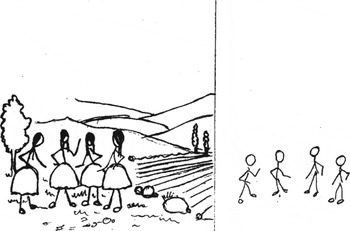
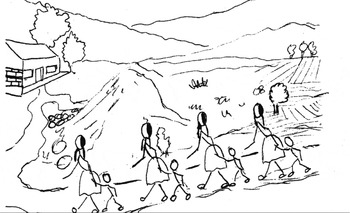
To determine whether focus fronting in Spanish and Quechua is sensitive to weak crossover, three picture-story tasks and sentence-judgment tasks were created. Given that the bilingual participants were illiterate in Quechua and/or Spanish, invented short stories with pictures were used, which provided a semantic context for the sentences under study. An example of the pictures is shown in Figures 1 and 2 in the Appendix; the participants first saw a picture with four women and their children and then a picture in which the mothers brought their children to school.Footnote 5 The questions in (39) below and corresponding answers in (40) illustrate the type of sentences that were constructed to test for weak crossover with focus fronting in Spanish. The active-voice wh-question in (39a), the passive-voice wh-question in (39b) and the passive-voice statement in (40b) are control sentences, whereas the active-voice statement in (40a) is the experimental sentence. In the active-voice statement in (40a) (the experimental sentence) quantified phrase is preposed to the left periphery of the sentence and assigned stress. In this sentence, the quantified phrase crosses a co-indexed pronoun. Weak crossover effects are generally not stable; judgments on weak crossover vary among speakers of the same language or dialect. Therefore, the following types of control sentences were used: active-voice and passive-voice wh-questions and passive-voice statements. In Spanish, wh-movement also gives rise to weak crossover (Rizzi, Reference Rizzi and Haegeman1997), because, as in focus fronting, a quantified phrase undergoes A′-movement across a co-indexed pronoun. In (39a), the wh-prase a qué niño undergoes A′-movement crossing the co-indexed pronoun su. The pronoun does not c-command the trace, which leads to weak crossover violations. Questions were included to determine whether there was a correlation between the judgments for weak crossover in questions and those for weak crossover with focus fronting. Passive sentences were also included as control sentences. In passive constructions, the wh-phrase (39b) and the quantified phrase (40b) are also co-indexed with a pronoun and move to a preverbal position, but because the preposed elements do not cross a pronoun, weak crossover effects are not expected.
(39)
(40)


The data were interpreted as follows. If the participant did not accept (39a) or if s/he preferred (39b) over (39a), then that was taken as evidence of weak crossover in questions. Similarly, if the participant did not accept (40a) or if s/he preferred (40b) over (40a), that was taken as evidence of weak crossover in focus fronting. For the non-Andean Spanish participants, we expected sensitivity to weak crossover violations, i.e. we expected that these participants would not fully accept (39a) and (40a). If the Andean Spanish participants also show sensitivity to weak crossover, there has not been a syntactic change in their Spanish. If, however, these participants do not display weak crossover, there has been a syntactic change with respect to this property.
Similar questions and answers were designed to test for weak crossover in Quechua. As with the Spanish sentences, the context of the sentences (the questions and the stories depicted in the pictures) indicated that the fronted elements were focused. Examples (41)–(42) illustrate the sentences used for Bolivian Quechua. If the participants do not accept these sentences, then that is interpreted as evidence for weak crossover in Quechua. If, on the other hand, the participants do accept them, there is no weak crossover in Quechua. A lack of weak crossover in Andean Spanish may then be due to Quechua influence.
(41)
(42)


All sentences in this study were presented with and without -mi and -qa on the fronted elements. As explained above, however, in most Bolivian varieties of Quechua -mi and to some extent -qa are obsolete. Given that the absence or presence of -mi or -qa did not affect the judgments, the examples here are presented without those morphological markers. Because there is no passive construction in Quechua, the participants only judged the acceptability of the questions and the sentences with focus fronting.
The data were collected in an informal setting. At the beginning of the sessions the participants were asked for their consent to participate in the study. The sessions were recorded with a microphone and recorder. Together with the studies on long distance movement and question–answer pairs the sessions lasted an hour and a half.
Study 2: Long distance movement
The participants for non-Andean Spanish and Andean Spanish for this study were the same as the ones for the study on weak crossover. The participants for Quechua were four adult simultaneous bilinguals from Tarata. Their ages ranged between 49 and 64 years, with a mean of 56 years.
The following questions and corresponding answers were used to test for long distance movement of the object, subject and VP in Spanish.
(43)
(44)
(45)


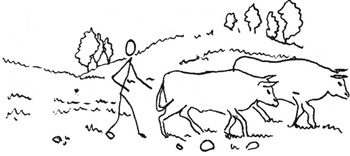
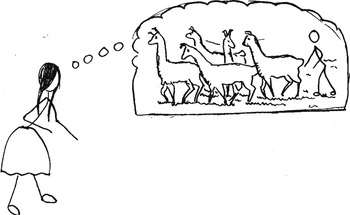
For this study, three different stories and series of question–answer pairs were used. The stories all involved a contrast. Figures 3 and 4 in the Appendix correspond to (43); Figure 3 shows a man taking bulls, whereas Figure 4 shows a woman who thinks that the man is taking llamas. This situation of confusion was created as a context for the sentence with long distance movement of the object in (43b). The participants were shown the pictures and asked to judge the sentences for acceptability.
A similar set of questions and answers was used to test for long distance movement of the object, subject and VP in Quechua. The examples in (46)–(48) illustrate the answers:
(46)
(47)
(48)


If the participants accept the sentences in (43)–(45) and (46)–(48), then that is interpreted as evidence for long distance movement with focus fronting. The expectation is that the non-Andean Spanish participants accept long distance movement of the subject (43b) and the object (44b), but not long distance movement of the VP (45b). If the Andean Spanish participants behave the same as the non-Andean participants, there has not been a syntactic change. However, if the Andean Spanish participants do not accept long distance movement with focus fronting, then there has been a syntactic change in their Spanish with respect to this syntactic property. If the Quechua participants do not accept sentences (46)–(48), then that shows that Quechua does not allow long distance movement with focus fronting. If the Andean Spanish participants behave like the Quechua participants, there may have been a syntactic influence from Quechua into Andean Spanish.
5.2 Data on the pragmatics of focus in non-Andean Spanish, Andean Spanish and Quechua
To study the pragmatics of focus both naturalistic data and elicitation data were collected. The naturalistic data were used to study the frequency, use and interpretation of preverbal objects in a natural setting. The elicitation data consisted of a study on question–answer pairs and were used to study the frequency, use and interpretation of preverbal objects in a more controlled setting.
Naturalistic data
The naturalistic data were collected in Tarata and Juncal/Cañar and consisted of sociolinguistic interviews in Spanish with Quechua–Spanish bilinguals. The participants were 33 adult Quechua–Spanish bilinguals (16 from Bolivia and 17 from Ecuador). They were asked about their education and occupation, age, place of birth, age and context of acquisition of Quechua/Spanish, the languages spoken by their parents and siblings, their home language, and the functions and domains of use of Quechua and Spanish. The Bolivian participants were 16 adult simultaneous bilingual speakers of Quechua and Spanish. Their ages ranged from 29 to 50 years, with a mean of 41 years. The Ecuadorian participants were 17 adult early sequential bilingual speakers of Quechua and Spanish whose first language was Quechua. Their ages ranged from 22 to 59 years, with a mean of 39 years. Half of the Bolivian participants and eight of the Ecuadorian participants were male. Half of the Bolivian participants and nine of the Ecuadorian participants were professionals; professionals in this study received some form of higher education after secondary school (e.g. teacher training college, university), whereas non-professionals received no more than secondary education.
The data consisted of recordings of sociolinguistic interviews in Spanish. Among the topics included were: local traditions, holidays, family, daily life, the political and economic situation, bilingual education, language attitudes, dreams, beliefs, the participant's childhood, and important events in the participant's life. At the beginning of the recording, the researcher explained the purpose of the study to the participants and told them participation was voluntary and anonymous. The participants gave their consent to be audio-recorded. The sessions lasted 40–60 minutes each and were held at the participants’ home or work.
The naturalistic data were transcribed orthographically by the researcher. Both a quantitative analysis and a qualitative analysis of the data were carried out. The aim was to show the frequency and use of preverbal objects in these varieties of Andean Spanish. For the quantitative analysis, the sentences were coded and classified according to their word order. For the coding and classification of the sentences, we followed Ocampo's (1994) study of Spanish word order in informal conversations with speakers from La Plata, Argentina. The rationale for following his methodology was to be able to compare the results for Andean Spanish with his results for Argentinean Spanish. The following sentences were taken into consideration: (i) sentences with a subject, a verb and an object/predicate, (ii) sentences with a verb and an object/predicate, and (iii) sentences with a verb and a subject. Following Ocampo (Reference Ocampo, Downing and Noonan1994), only declarative sentences and main clauses were analyzed. Furthermore, only lexical NPs were considered. The frequencies of the different word orders were calculated and compared to the results reported in Ocampo (Reference Ocampo, Downing and Noonan1994). Chi-square tests were performed to determine whether there were significant differences between Andean Spanish and Argentinean Spanish.
For the qualitative analysis, the context in which preverbal objects were used was studied, specifically question–answer pairs. Given that question–answer pairs are not frequent in naturalistic data an elicitation study on question–answer pairs was designed.
Study 3: Question–answer pairs
As discussed in Section 2, question–answer pairs help us study focus structures. The participants for this study were the same as the ones for the study on weak crossover (see Section 5.1 above).
For this study, three traditional Andean stories were used, which provided a context for the sentences under study. The stories (La lora y la zorra “The parrot and the fox”, La zorra y el gallo “The fox and the rooster”, and La zarigüeya y el utuskuru “The opossum and the worm”) come from Martínez-Parra (Reference Martínez1999). The participants were shown a series of pictures and narrated the stories depicted in Spanish and/or Quechua, which enabled the researcher to check for understanding. For the complete series of pictures the reader is referred to Muntendam (Reference Muntendam2009). In the sentence-judgment tasks the participants were presented with question–answer pairs about the pictures.
The sentence-judgment tasks comprised questions to elicit broad focus (49), neutral focus on the subject (50), neutral focus on the VP (51), neutral focus on the object (52), contrastive focus on the subject (53), contrastive focus on the object (54) and contrastive focus on the VP (55). The context for these questions was Figure 5 (see Appendix) from the story “The parrot and the fox” (Martínez-Parra, Reference Martínez1999). There were five series of seven questions, giving a total of 35 questions.
(49) Q1: ¿Qué pasa?
“What happens?”
(50) Q2: ¿Quién corta la soga?
“Who cuts the rope?”
(51) Q3: ¿Qué hace la lora?
“What does the parrot do?”
(52) Q4: ¿Qué corta la lora?
“What does the parrot cut?”
(53) Q5: ¿El cóndor corta la soga?
“Does the condor cut the rope?”
(54) Q6: ¿La lora corta la cola del zorro?
“Does the parrot cut the fox's tail?”
(55) Q7: ¿La lora agarra la soga?
“Does the parrot grab the rope?”
The questions with contrastive focus were included to determine whether preverbal objects always receive a contrastive interpretation in Spanish, as argued by Zubizarreta (Reference Zubizarreta1998, Reference Zubizarreta, Bosque and Demonte Barreto1999). They also showed whether focus fronting is the only strategy to encode contrastive focus. The picture corresponding to questions (49)–(55) shows a parrot cutting a rope. Question (53) elicits a sentence that contradicts the presupposition: it is not the case that the condor cuts the rope; the parrot cuts the rope.
For each question, the participants judged seven sentences for acceptability:
(56)

The participants first gave a spontaneous answer to each of the questions, and then judged the acceptability of the sentences as an answer to each of the questions. The acceptance of the different word orders in answer to the questions was studied.
For Quechua, a similar set of questions and answers was designed. Questions (57)–(63) were used for Bolivian Quechua.
(57)
(58)
(59)
(60)
(61)
(62)
(63)
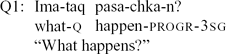






The participants judged the sentences in (64) in answer to the questions above:
(64)

Given that the bilingual participants were illiterate (in Spanish and/or Quechua), the researcher asked the questions and read the sentences in Spanish and Quechua. The mode of presentation in the non-Andean Spanish group was also oral to avoid differences in the tasks between groups.
5.3 Summary
For this study, both naturalistic data and elicitation data were used. The naturalistic data provided information about the frequency and pragmatic use and interpretation of preverbal objects in Andean Spanish. However, the research questions of the study cannot be answered on the basis of the naturalistic data alone because these data do not provide information about what is not possible. Moreover, question–answer pairs occur infrequently in naturalistic data.
The elicitation data enabled us to examine the syntactic and pragmatic properties of focus in non-Andean Spanish, Andean Spanish and Quechua in a more controlled setting. Specifically, they allowed us to study weak crossover effects and long distance movement as well as focus structures. The elicitation data also provided information about what is not possible. The fact that the same study was conducted in Andean Spanish, Quechua and non-Andean Spanish allowed a systematic comparison between the language varieties. Elicitation data also have weaknesses: it is well known that the participants’ judgments regarding particular sentences do not always correspond to their use of those sentences (Labov, Reference Labov1972). This is especially the case for non-standard varieties. We believe that the use of two types of data offers a more complete data set for the description and explanation of the phenomenon under study.
6. Results
What have we learned about the syntax and pragmatics of focus in non-Andean Spanish, Andean Spanish and Quechua? Section 6.1 discusses the syntax of focus, while Section 6.2 deals with the pragmatics.
6.1 The syntax of focus in non-Andean Spanish, Andean Spanish and Quechua
In this section, the results of the elicitation studies designed to test for weak crossover and long distance movement in non-Andean Spanish, Andean Spanish and Quechua are discussed. It will be shown that Andean Spanish is syntactically similar to non-Andean Spanish regarding these properties and that there is no evidence for a syntactic transfer from Quechua into Andean Spanish.
Study 1: Weak crossover
Table 1 shows the number and percentage of participants who showed weak crossover (WCO) effects in questions and focus fronting (FF) for non-Andean Spanish, Andean Spanish and Quechua. The data come from 12 participants for non-Andean Spanish, 15 participants for Andean Spanish and eight participants for Quechua. There were three sentences to test for weak crossover in questions and three to test for weak crossover in focus fronting. If a participant showed weak crossover in two of three sentences, that participant was counted as displaying weak crossover. If a participant showed weak crossover effects in only one of the three sentences, that participant was counted as not displaying weak crossover.
Number and percentage of participants who display sensitivity to weak crossover in non-Andean Spanish, Andean Spanish and Quechua.

WCO = weak crossover; FF = focus fronting
Table 1 shows that in non-Andean Spanish and Andean Spanish there is weak crossover in questions and focus fronting. For non-Andean Spanish, 83.3% of the participants (10 of 12) showed weak crossover in questions. All of the participants (12 of 12) showed sensitivity to weak crossover in focus fronting. The results for Andean Spanish revealed that 66.7% of the participants (10 of 15) showed weak crossover in questions and 73.3% (11 of 15) showed weak crossover in focus fronting. Typically there is variability among speakers of the same dialect or language with respect to weak crossover, which explains that the percentages are not 100%. What is important is the correlation between weak crossover effects in questions and focus fronting. For non-Andean Spanish 10 of 10 participants who showed weak crossover in questions also showed weak crossover in focus fronting. For Andean Spanish, eight of 10 participants who were sensitive to weak crossover effects in questions were also sensitive to weak crossover effects in focus fronting. The data thus indicate that focus fronting in Andean Spanish, as focus fronting in non-Andean Spanish, is sensitive to weak crossover effects. It should be noted that the percentages for Andean Spanish in Table 1 are lower than those for non-Andean Spanish. Andean Spanish seems to be somewhere in between non-Andean Spanish and Quechua. More data is needed to determine whether the differences between non-Andean Spanish and Andean Spanish are significant and whether there are differences between speakers.
The data in Table 1 clearly show that in Quechua focus fronting is not sensitive to weak crossover effects: none of the eight participants showed weak crossover in questions or focus fronting.
In sum, the data revealed that focus fronting in non-Andean Spanish and Andean Spanish is sensitive to weak crossover for most speakers, whereas in Quechua it is not. This syntactic property of focus fronting in Andean Spanish seems not to be affected by contact with Quechua in most speakers.
Study 2: Long distance movement
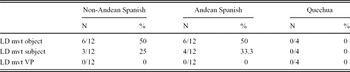
Table 2 shows the number and percentage of participants who accepted long distance movement (LD mvt) of the object, the subject and the VP for non-Andean Spanish, Andean Spanish and Quechua. The results are based on data from 12 participants for non-Andean Spanish, 12 for Andean Spanish, and four for Quechua. The data from three participants for Andean Spanish had to be discarded because those participants gave inconclusive answers, i.e. they did not express a clear judgment for these sentences.
Number and percentage of participants who allow long distance movement (LD mvt) in non-Andean Spanish, Andean Spanish and Quechua.

The results showed that in non-Andean Spanish long distance movement of the object and the subject is possible (for 50% and 25% of the participants respectively). Long distance movement of the VP is clearly not possible: none of the participants accepted long distance movement of the VP. The results for Andean Spanish were similar to those for non-Andean Spanish. Table 2 shows that 50% of the participants (six of 12) accepted long distance movement of the object and 33.3% (four of 12) accepted long distance movement of the subject. Andean Spanish does not allow long distance movement of the VP: none of the 12 participants accepted long distance movement of the VP.
The data for Quechua convincingly show that in this variety of Quechua long distance movement is not possible: none of the participants accepted long distance movement of the object, the subject or the VP.
As discussed in Section 3, the Quechua examples of long distance movement involve extraction from a nominalized clause (a DP), whereas the Spanish ones involve extraction from a tensed clause. The differences between Spanish and Quechua could have affected the type of transfer we find. Some varieties of Quechua, however, do allow extraction from nominalizations for focalization (Cole & Hermon, Reference Cole and Hermon1981; Lefebvre & Muysken, Reference Lefebvre and Muysken1988). The Quechua variety studied here seems to be more similar to the one spoken in Apurímac, where extraction from a nominalized clause is not accepted (Sánchez, Reference Sánchez2010, p. 128). More research on nominalizations in different varieties of Quechua is needed.
To summarize, the results of the elicitation study on long distance movement showed that non-Andean Spanish and Andean Spanish allow long distance movement of the object and the subject but not of the VP, and that the Quechua variety studied here does not allow long distance movement. The data presented here show no evidence for a syntactic transfer from Quechua into Andean Spanish with respect to long distance movement. The data should be interpreted with care, however, given that the number of participants in the study was relatively small.
The data on weak crossover and long distance movement together suggest that Andean Spanish is syntactically similar to non-Andean Spanish, whereas Quechua is different. On the basis of these data, there is no evidence for a syntactic transfer from Quechua into Andean Spanish. In the next section it will be shown that there is evidence for a pragmatic transfer from Quechua into Andean Spanish.
6.2 The pragmatics of focus in non-Andean Spanish, Andean Spanish and Quechua
To determine whether there is a pragmatic transfer from Quechua into Andean Spanish the frequency, use and interpretation of preverbal objects were investigated. First, naturalistic data in Andean Spanish were studied and compared to monolingual Spanish as well as to other varieties of Andean Spanish. Second, an elicitation study on question–answer pairs was carried out to study the use of preverbal objects more in detail.
Naturalistic data
In this section the frequency of the orders OV/VO in the Andean Spanish naturalistic data is discussed. Table 3 shows the frequency of the orders VO and OV in sentences with only a verb and an object or predicate in the naturalistic data from Bolivia and Ecuador, in comparison to Argentinean Spanish and two other varieties of Andean Spanish. The results of the quantitative analysis reveal that the order OV accounts for 18.5% (468/2530) of the sentences with a verb and an object or predicate in the Andean Spanish data from this study. To compare, Ocampo (Reference Ocampo, Downing and Noonan1994) found only 7.9% OV order in the speech of 21 monolingual Spanish speakers from Buenos Aires (Argentina). A chi-square test shows that the difference between Andean Spanish and monolingual (Argentinean) Spanish is statistically significant (χ2 (1, N = 54) = 40.79, p < .0001). It can thus be concluded that preverbal objects are relatively frequent in Andean Spanish.
Percentage of VO/OV in Argentinean Spanish and three varieties of Andean Spanish.

Note: Ocampo (Reference Ocampo, Downing and Noonan1994): Spanish monolinguals from Buenos Aires; This study: Quechua–Spanish bilinguals from Bolivia and Ecuador; Muysken (Reference Muysken and Andersen1984): Quechua–Spanish bilinguals from Ecuador; Klee (Reference Klee, Roca and Jensen1996): Quechua–Spanish bilinguals from Peru.
The results for Andean Spanish presented here confirm those of previous studies on word order in Andean Spanish. In Table 3, the present study is compared to Muysken's (1984) study on the Andean Spanish of Ecuador and Klee's (1996) study on the Andean Spanish of Peru. As shown in Table 3, the percentage of OV in the Andean Spanish data from the present study is very similar to that reported for Quechua–Spanish bilinguals from Peru in Klee (Reference Klee, Roca and Jensen1996) (18.5% versus 18.3%). Muysken (Reference Muysken and Andersen1984) reports a slightly higher percentage of OV (20%) for Quechua–Spanish bilinguals from Ecuador.
It should be noted that Muysken (Reference Muysken and Andersen1984) and Klee (Reference Klee, Roca and Jensen1996) differentiate between objects and predicates, while the present study combines the two, following Ocampo (Reference Ocampo, Downing and Noonan1994). The frequencies for VO/OV and Copula Predicate/Predicate Copula combined are 81.2% VO and 18.8% OV for Klee (Reference Klee, Roca and Jensen1996), and 77.8% VO and 22.2% OV for Muysken (Reference Muysken and Andersen1984) (see Table 3).
To summarize, the data reveal that sentences with preverbal objects (OV) are more frequent in Andean Spanish than in non-Andean Spanish, as shown by the comparison between the Andean Spanish data and Ocampo's (1994) data from Buenos Aires. The results of the quantitative analysis are in agreement with the results reported in previous studies on Andean Spanish.
The qualitative analysis of the Andean Spanish naturalistic data reveals that in Andean Spanish preverbal objects are used in more contexts than in non-Andean Spanish. Specifically, in the Andean Spanish data sentences with preverbal objects appear in answer to wh-questions with the focus on the object. In (65), from the naturalistic data, the order OV is used in answer to a wh-question with the focus on the object.
(65)
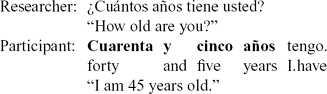
This shows that in Andean Spanish wh-questions with the focus on the object can be answered with the order OV, which suggests that preverbal objects in Andean Spanish are less restricted than in non-Andean Spanish. A quantitative analysis was performed to determine if this is a common strategy to answer a wh-question. Specifically, the frequency of OV/VO in answer to a question with the focus on the direct object in the naturalistic data was calculated. The results showed that of all the wh-questions with the focus on the object, 51.5% (17 of 33 sentences with a verb and an object) were answered with the order OV, whereas 48.5% (16 of 33) were answered with the order VO. These results are based on 29 tape recordings of 40–60 minutes each, but the numbers are relatively low; question–answer pairs are generally not frequent in naturalistic data, due to the nature of the interview situation. Moreover, participants answered the questions in different ways, for instance with one word. The information that the naturalistic data provide is therefore limited. An elicitation study on question–answer pairs was designed to study the use of preverbal objects more in detail (see Study 3). The elicitation study also provides us with comparable data for non-Andean Spanish, Andean Spanish and Quechua.
Study 3: Question–answer pairs
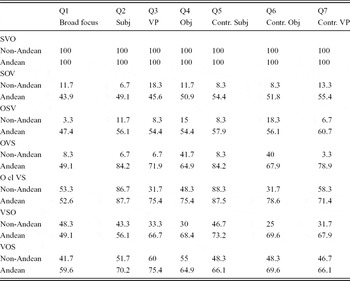
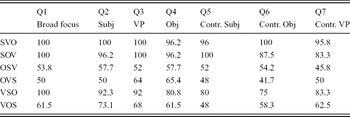
As explained in Section 5.2, the study on question–answer pairs consisted of questions to elicit broad focus, neutral focus on the subject, neutral focus on the VP, neutral focus on the object, contrastive focus on the subject, contrastive focus on the object and contrastive focus on the VP (see examples (49)–(55) and (57)–(63) above). After answering the questions, the participants judged the acceptability of different word orders in answer to the questions, see (56) and (64). Tables 4 and 5 show the acceptance rates for the different word orders (in percentages) in answer to the seven questions for non-Andean Spanish and Andean Spanish (Table 4) and Quechua (Table 5). The results are based on data from 12 participants for non-Andean Spanish, 15 participants for Andean Spanish and eight participants for Quechua.
Acceptance rates (in %) of different word orders in answer to seven questions (Q1–Q7) for non-Andean Spanish and Andean Spanish.

Acceptance rates (in %) of different word orders in answer to seven questions (Q1–Q7) for Quechua.

The results for non-Andean Spanish and Andean Spanish show that the participants accepted the order SVO in answer to all of the questions, including questions that elicit focus on the subject (Q2). As discussed in Section 2, Zubizarreta (Reference Zubizarreta1998) argues that in non-Andean Spanish VOS is the only acceptable order in answer to a wh-question with the focus on the subject. The data examined in the present study, however, show that for questions with the focus on the subject (Q2) the acceptance rate for SVO was 100 percent, whereas that for VOS was slightly more than 50 percent (51.7%) in the group of non-Andean Spanish speakers. This shows that preverbal focused subjects do not necessarily receive a contrastive interpretation.
In non-Andean Spanish, there is a clear correlation between preverbal objects and focus; the percentages of sentences with a preverbal object (e.g. OSV and OVS) were considerably higher for questions with focus on the object (Q4 in Table 4) and questions with contrastive focus on the object (Q6 in Table 4) than for the other questions.
In Andean Spanish, there is no correlation between preverbal objects and focus: the percentages of sentences with a preverbal object (e.g. OSV and OVS) were high for all questions. As shown in Table 4, the percentages ranged between 47.4% and 60.7% for OSV and between 49.1% and 84.2% for OVS. The data show that in Andean Spanish preverbal objects are more frequent than in non-Andean Spanish and are also used when the object is not focused. In Andean Spanish, there is thus a more general use of preverbal objects than in non-Andean Spanish.
In Quechua, there is no correlation between preverbal objects and focus: the percentages of OSV were high for all questions. The percentages were between 45.8% and 57.7% (Table 5).
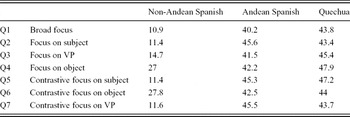
The sentences with preverbal objects (SOV, OSV and OVS) were examined in more detail. Table 6 shows the acceptance rates (in percentages) of answers with preverbal objects in non-Andean Spanish, Andean Spanish and Quechua. The results reported in Table 6 include SOV, OSV and OVS; given that in Quechua there is no construction with a clitic, the order O–clitic–VS was excluded from the analysis.
Acceptance rates (in %) of SOV/OSV/OVS in answer to seven questions (Q1–Q7) for non-Andean Spanish, Andean Spanish and Quechua.

The results presented in Table 6 show that overall the acceptance rate for sentences with preverbal objects was considerably higher in Quechua and Andean Spanish than in non-Andean Spanish. For non-Andean Spanish, the acceptance rates of sentences with preverbal objects were clearly higher for question 4 (27%), with focus on the object, and question 6 (27.8%), with contrastive focus on the object, than for the other questions. The percentages of SOV/OSV/OVS for the other questions ranged between 10.9% and 14.7%. This demonstrates that in non-Andean Spanish there is a correlation between preverbal objects and focus on the object.
In Quechua and Andean Spanish there is no correlation between preverbal objects and focus on the object. Table 6 clearly shows that in Quechua and Andean Spanish the orders SOV/OSV/OVS are also used when the object is not focused. For Quechua, the acceptance rates for sentences with preverbal objects ranged between 43.4% and 47.9% for all sentences. For Andean Spanish, the acceptance rates ranged between 40.2% and 45.6% for all sentences. The patterns found for Andean Spanish and Quechua are thus very similar. Moreover, the results presented in Table 6 show that in Quechua and Andean Spanish sentences with preverbal objects were more frequently accepted than in non-Andean Spanish.
To summarize, the data show that in non-Andean Spanish there is a clear correlation between preverbal objects and focus, whereas in Quechua and Andean Spanish there is not. In Andean Spanish, sentences with preverbal objects are also used when the object is not focused. From these results it can be concluded that in Andean Spanish fronting of objects is not as pragmatically restricted as in non-Andean Spanish. In other words, preverbal objects have a more general use in Andean Spanish than in non-Andean Spanish. The data thus show that Andean Spanish differs from non-Andean Spanish in that it has weaker pragmatic restrictions on the preverbal placement of objects as a result of influence from Quechua.
7. Conclusion
In this paper, we have tried to determine the precise nature of the transfer from Quechua into Andean Spanish word order. Naturalistic data and elicitation data were collected to tease apart syntax from pragmatics. The data on weak crossover and long distance movement showed that syntactically Andean Spanish is similar to non-Andean Spanish and different from Quechua. Focus fronting in non-Andean Spanish and Andean Spanish leads to weak crossover effects, but not so in Quechua. Furthermore, both Andean Spanish and non-Andean Spanish allow long distance movement of the object and the subject, but restrict VP fronting. In Quechua, long distance movement is not possible. The data thus show that non-Andean Spanish, Andean Spanish and Quechua have focus fronting, but that in Quechua focus fronting is not sensitive to weak crossover and does not allow long distance movement. The results for Andean Spanish were similar to those for non-Andean Spanish, and the data thus suggest that there has been no syntactic transfer from Quechua into Andean Spanish.
The results of the naturalistic data and the elicitation study on question–answer pairs revealed that in Andean Spanish preverbal objects are more frequent and are used in more discourse contexts than in non-Andean Spanish. In non-Andean Spanish, there is a correlation between preverbal objects and focus, whereas in Andean Spanish and Quechua there is not. Preverbal objects seem to be less restricted in Andean Spanish than in non-Andean Spanish. It can thus be concluded that Andean Spanish differs from non-Andean Spanish in that the restrictions on the interface between the syntactic system determining placement of constituents and the pragmatic system assigning given/new and topic/focus interpretations to these constituents differ between the two varieties: preverbal placement of objects is pragmatically restricted in non-Andean Spanish, but not so in Andean Spanish, as a result of influence from Quechua.
The study has implications for theories of language contact and syntax. The results of the study support only one hypothesis regarding cross-linguistic transfer: that there has been a transfer of pragmatic uses and interpretations but not of syntactic properties. Syntax seems to be more resistant to influence from another language, even in situations of long-term contact and intensive bilingualism. The results are thus in accordance with studies by Prince (Reference Prince1988, Reference Prince, Kramsch and McConnell-Ginet1992, Reference Prince, Schmid, Austin and Stein1998) and Silva-Corvalán (Reference Silva-Corvalán, Ashby, Mithun, Perissinotto and Raposo1993, Reference Silva-Corvalán1994, Reference Silva-Corvalán, Schwegler, Tranel and Uribe-Extebarria1998, Reference Silva-Corvalán2008), who argue that direct syntactic transfer is rare.
The study has some limitations. First, the number of participants in the elicitation studies was relatively low, as was the number of target sentences. A statistical analysis of the elicitation data was therefore not possible. Future studies need to include more participants and more sentences. Second, as discussed in Section 5, there were some differences among the participants. For instance, the bilingual data included simultaneous bilinguals and early sequential bilinguals whose first language was Quechua. There did not seem to be differences in the results between the two types of bilinguals, but ideally the data would have included only one type of bilinguals. In addition, the monolingual Spanish participants were from different geographic areas. Third, at the time of the study no comparable naturalistic data in Quechua were available. An analysis of naturalistic data in Quechua could provide more information on the frequency and use of different word orders in Quechua. Preferably, the Quechua data should come from monolingual Quechua speakers. Finally, the intonation of Andean Spanish was not discussed here but it needs to be examined in future studies.
Appendix. Figures
Weak crossover.

Weak crossover.

Long distance movement object.

Long distance movement object.

Question–answer pair.