When disasters strike, performing an accurate triage is critical to assign correct priority of evacuation/treatment and achieve a reduction in mortality. Reference Bouzat, Ageron and Brun1 Although several triage systems have been proposed, the aim remains the same: to identify individuals who would most likely survive with intervention mindful of the limited resources.
The Simple Triage and Rapid Treatment (START) Reference Kahn, Lerner, Triage, Koenig and Schultz2 is used by most regional emergency medical service operation centers in Italy, classifying patients into 4 categories according to their clinical condition: red/immediate; life-threatening injuries requiring rapid intervention: yellow/delayed; casualties requiring treatment that can be delayed: green/minimal; walking patients with minor injuries: and black/expectant; victims with low likelihood of survival.
Importantly, both undertriage and overtriage may occur during this classification process leading, respectively, to the erroneous assignment of critically injured victims to a lower priority category or inappropriate resource consumption. Reference Frykberg3 At the prehospital level, these errors could be mitigated by re-evaluating patients at multiple casualty collection points, such as advanced medical posts (AMP), strategically located between the disaster scene and the hospital. Reference Frykberg3
In this regard, point-of-care ultrasound (POCUS) performed on the scene as an extension of primary and secondary triage could represent a promising technique for the management of patients in mass casualty incidents (MCIs). Reference Sajed4 In particular, POCUS may prove useful in supporting decision making in those patients with hemodynamic and respiratory stability having conditions that are not apparent but would require time-dependent intervention.
On this basis, this study assessed the impact of point-of-care ultrasound on secondary triage conducted at the AMP in enhancing the detection of patients who may benefit from earlier evacuation and treatment.
Methods
Study Design
A prospective, quasi-experimental controlled pilot study was conducted.
Study Population
Four emergency medicine physicians volunteered to participated in the study. All of them had similar postgraduate experience and Extended Focused Assessment with Sonography in Trauma (eFAST) skills Reference Neri, Storti and Lichtenstein5,Reference Ketelaars, Reijnders and van Geffen6 ; none of them had received training in disaster management. Two physicians, A and B, composed the control group, while C and D represented the intervention group.
Study Protocol
Scenario Description
This study was carried out in the context of a live full-scale exercise organized by an Italian Emergency Medical Organization. The scenario was centered on a bomb blast occurring in a remote area in Lombardy, a province of Northern Italy, where fire brigades and police had already granted a safe scene and primary triage according to the START algorithm. There were no life-saving interventions, such as endotracheal intubation, fluid replacement, and chest needle decompression performed. Participants functioned as the physicians-in-charge of secondary triage at the AMP. Evacuation time to the nearest health facility was 90 min. Three patients could be evacuated at a time. Before each participant entered the AMP, a short briefing was conducted to allow a full understanding of both the scenario and their role in the simulation. Five minutes were permitted for each participant to familiarize themselves with the equipment and materials present in the AMP.
Simulation Exercise
Ten simulated patients (SPs), carrying a triage-tag with a “YELLOW” code but presenting with 10 different clinical conditions, entered the AMP at 5-min staggered intervals (Supplementary Material 1). SPs underwent appropriate moulage by professional artists of the Italian Red Cross, and a real AMP was set up. Every SP carried a Dynamic Casualty Card (DCC) in which all clinical data resulting from a regular head to toe examination was reported. While all patients had normal or nearly normal vital signs, 3 patients also had 1 of the following traumatic conditions: hemoperitoneum (HPN), pneumothorax (PTX), and hemothorax (HTX). The remaining patients presented with “distracting” clinical conditions.
The same simulation session, with the same SPs entering in identical sequence and timing, was repeated for a total of 4 times, 1 time for each physician. All SPs were instructed to behave the same and to represent the same clinical conditions in every session.
The control group, physicians A and B, performed secondary triage based on the clinical assessment data written on the DCCs, which considered the presence of basic medical equipment, namely, oxygen, stethoscope, and a multiparameter monitor. The intervention group, physicians C and D, performed secondary triage with the integration of POCUS information, acquired according to the eFAST Airway Breathing Circulation Disability Exposure (ABCDE) protocol (Supplementary Material 1). Reference Neri, Storti and Lichtenstein5 Sonographic information was delivered in real-time dynamic 2D by a portable laptop-based ultrasound simulator (SonoSim®, 2016, U.S. Pat. No. 8,297,983). 7 Real probe manipulation was synchronized with a 2D frame display of prerecorded 3D videos including both positive findings or negative patterns, depending on each SP’s underlying clinical condition.
Data Collection
After 50 min, all SPs had entered the AMP. Only after this time, physicians were asked, first, to rank the 3 patients with the highest evacuation priority based on the lack of advanced medical equipment, and second, to do the same given instead the availability of a ventilator, and kits for endotracheal intubation, fluid replacement, and chest needle decompression.
None of the 4 physicians was informed about the purpose of the study, the added value of ultrasound, the diagnosis they were expected to make or who were the patients with critical ultrasound findings.
Outcomes and Measures
The study measured the accuracy (ACC), sensitivity (SN), specificity (SP), positive (PPV), and negative (NPV) predictive values of secondary triage with and without POCUS in establishing the priority of evacuation in both scenarios (Supplementary Material 2). In addition, secondary triage promptness, that is the time elapsed for doctors to come to a final top-3-priority evacuation list, was also recorded.
Ethical Clearance
This study was approved by the Institutional Review Board Comitato Etico Milano Area C, 18/09/2015 n° 445-092015.
The participants’ anonymity was carefully protected, each signed informed consent where each subject understood their role in the study. Participant confidentiality was ensured, the data were kept secure, and the participants were aware that their participation was voluntary, fee of coercion, and they could withdraw from the study at any time without penalty or fear of retribution.
Results
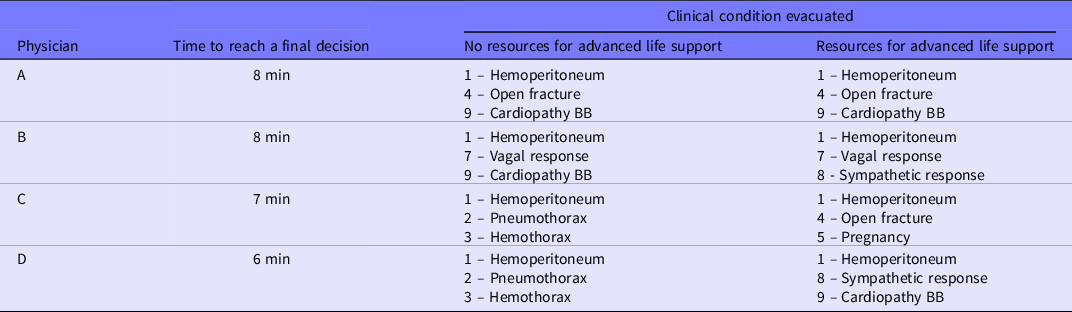
All participants completed the clinical examination of all SPs within 50 min. However, before making a decision, all of them quickly reassessed the clinical condition of SPS, with a time requested to make a final priority list being: 8 min for both physician A and B, and 7 and 6 min for physician C and D, respectively (Table 1).
TOP 3 priority evacuation list and time to reach a final decision by every physician

Assuming the unavailability of resources, the control group physicians A and B decided to evacuate the HPN, missing the other 2 predetermined critical conditions (PTX and HTX). Therefore, they achieved a Secondary Triage ACC of 60%, SN 33.3%, SP 71.4%, PPV 33.3%, and NPV 71.4%, respectively. In the scenario with lack of resources, the decision of physicians A and B did not change.
The intervention group physicians C and D were able to correctly recognize all pathological sonographic patterns in both scenarios, thus achieving an ACC of 100%, SN 100%, SP 100%, PPV 100%, NPV 100%, respectively. In the scenario with resources, patients with HPN, PTX, HTX were evacuated first, while when advanced medical equipment was available, transfers of PTX and HTX were momentarily delayed, not for a missed diagnosis, rather for an early supportive management strategy before referral.
Discussion
The development of strategies enhancing traditional triage is still today 1 of the most challenging issues in disaster medicine research. In MCIs, important goals are to perform few live-saving interventions, such as rapid bleeding control or tension pneumothorax needle decompression, and to establish priority of transportation. This pilot study suggests that POCUS can detect live-threatening conditions in otherwise stable patients, thus limiting the mortality associated with delayed or missed diagnoses.
Most of the previously published research on this topic consists mainly of retrospective or narrative studies. Reference Sztajnkrycer, Baez and Luke8,Reference Teixeira, Inaba and Hadjizacharia9 This prospective study supports POCUS as a valuable tool in the prehospital MCI setting during primary and secondary triage. Moreover, POCUS has been proven feasible and cost-effective in the hospital setting and when performed using portable devices; essential minimal requirements related to battery life, size, weight, water and temperature resistance are satisfied in the prehospital setting. Reference Sajed4
The importance of this research lies on the fact that, although YELLOW codes are, by definition, expected to survive even after delayed treatment, YELLOW codes with similar heart rate, blood pressure, and neurological status may have different injuries in terms of nature and severity. In this regard, HPN, PTX, and HTX are among the most frequent avoidable causes of death associated with delayed diagnosis in trauma patients. Reference Davis, Hoyt and McArdle10,Reference Paddock, Bailitz and Horowitz11 Unfortunately, these conditions can be often deceitful in the presence of other distracting factors, such as panic attacks, pregnancy, or concomitant chronic diseases. Patients injured in an MCI may rapidly deteriorate into shock or even cardiac arrest if not promptly diagnosed and treated. Therefore, identifying those patients with higher risk of deteriorating into a RED-MCI triage category, because of nonapparent conditions where immediate treatment would be life-saving, is of paramount importance when making evacuation decisions.
All physicians were able to suspect HPN as a possible critical condition to be evacuated first to the hospital; probably, because the sole clinical presentation provided enough information to suspect this life-threatening situation. However, only intervention physicians C and D were able to detect PTX and HTX and act accordingly in view of the resources available, that is, evacuating them immediately when no life-saving maneuvers could be provided or, conversely, stabilizing them if adequate medical equipment was present.
Triage is a dynamic process in which many additional factors must be considered such as the arrival of medical equipment at the scene over time and priority of evacuation to definitive care as more ambulances or transportation vehicles arrive. In this regard, the response to an MCI in urban settings may decrease the negative impact of lack of life-saving interventions at the scene and inappropriate priority evacuation due to the proximity of several medical facilities capable of attending to the injured. Reference Frykberg3 Conversely, remote locations may lead to a worsening of injured patients’ outcomes explained by a long evacuation time and delay in care. Of note, this study was designed with both control and intervention group SPs to face a long evacuation time; therefore, to maximize their chance of survival, patients’ condition had to be optimized, if possible, before evacuation with PTX and HTX treated at the AMP with chest decompression and endotracheal intubation.
This study suggests that POCUS-enhanced triage in an MCI response may improve triage sensitivity, because true positives may be better diagnosed, this would arguably lead to a reduction in undertriage. Specificity was also improved in the POCUS-enhanced triage group, meaning that overtriage could be minimized. In practical terms, POCUS enhanced triage may be useful in an MCI response in rural areas as it could uncover clinical conditions presenting with nonapparent or late specific symptoms and signs.
Even if the average time to establish the priority of evacuation was slightly more in the intervention group compared with the control group, such a difference was small and cannot be considered to assess the impact of POCUS-enhanced triage when compared with potential life-saving interventions if a condition was diagnosed.
Limitations
Although the results are promising and may serve as an initial proof of concept, this research presents several limitations; first, the sample size of participants was not determined before the study. Moreover, the simulated nature of this MCI scenario may restrict the impact of the results, because in a real disaster, events may have unfolded differently. For instance, a larger number of victims may have entered the AMP, also, in a chaotic manner; under these circumstances the use of POCUS-enhanced triage may be limited, depending on the rate of patient influx and the number of POCUS devices and staff skilled to use POCUS. While this study had no patients with a poor acoustic window, this condition could represent a real challenge to use POCUS. Finally, while knowledge, clinical experience, and familiarization with the injury patterns resulting from different types of disasters are paramount for triage officers, it is reasonable to assume that, because all physicians in this study were naïve to an MCI response, the results were not affected because this gap of knowledge was equally distributed between both groups.
Conclusions
This study suggests that POCUS-enhanced secondary MCI triage in an AMP may represent an effective methodology to accurately detect nonapparent injuries that require time-dependent life-saving interventions. Further studies with larger samples conducted in varied MCI scenarios are warranted.
Supplementary material
To view supplementary material for this article, please visit https://doi.org/10.1017/dmp.2022.82
Acknowledgments
We thank “A.V.P.S.” NGO, the Italian Emergency Medical Technicians (EMT) Association for its valuable support in the organization of the full-scale simulation exercise. We also thank all the participants in the simulation scenario. This manuscript is the result of the thesis submitted in partial fulfillment of the requirements for the European Master in Disaster Medicine.
Conflicts of interest
None.