As competences are transferred to the European Union (EU) and the ordinary legislative power of the European Parliament (EP) increases, national parliaments are fundamentally challenged. Scholarly literature has closely examined how national parliaments have adjusted to the European integration process, but it is split in its estimation of the overall power that national parliaments have in EU affairs. One branch of the literature reaches the conclusion that national parliaments are the main losers in the European integration process (Auel Reference Auel2007; Judge Reference Judge1995; Katz and Wessels Reference Katz and Wessels1999; Maurer and Wessels Reference Maurer and Wessels2001; Rometsch and Wessels Reference Rometsch and Wessels1996; Wessels et al. Reference Wessels, Maurer and Mittag2003). This branch relies on the so-called ‘deparliamentation thesis’, according to which the powers of national parliaments have been eroded by the shift of more and more policy areas to the EU, the increased use of supranational decision-making rules and the opaque nature of EU decision-making. The other branch of the literature questions the ‘deparliamentation thesis’ by painting a more optimistic picture where national parliaments have gradually claimed power back by institutionalizing various mechanisms of parliamentary oversight (Auel and Benz Reference Auel and Benz2007; Duina and Oliver Reference Duina and Oliver2005; O’Brennan and Raunio Reference O’Brennan and Raunio2007; Raunio and Hix Reference Raunio and Hix2000).
This article demonstrates how national parliaments are facing severe challenges concerning their control in EU affairs. These challenges imply that the parliaments are currently undergoing a phase of disempowerment with regard to the EU, which supports the ‘deparliamentation thesis’. In parallel to the enhanced use of the co-decision procedure empowering the European Parliament and giving it equal co-legislative status, the increased use of so-called early agreements between the European Parliament and the Council of Ministers also affects the ‘dual legitimacy’ of EU decision-making – a concept that emphasizes national parliaments as the other important source of democratic legitimacy (Benz Reference Benz2004). Meanwhile, co-decision has increased the number of formal veto players, and early agreements have reduced the circle of de facto decision-makers and accelerated decision-making (Farrell and Héritier Reference Farrell and Héritier2004: 1209). This development benefits systemic performance but disturbs the established procedures for national parliamentary control and blurs the natural access point for such control. In line with this argument, the research question can be formulated as follows: How have national parliaments adapted to the increased use of early agreements in EU decision-making?
In order to answer that research question a mixed method approach will be used. Survey data on national parliaments’ scrutiny process and response to early agreements have been collected for 26 EU countriesFootnote 1 and combined with case study examinations of national parliaments in Denmark, the UK and Germany, comparing scrutiny grounds on a set of parameters. The article first examines how decision-making has been accelerated in the EU and suggests more general implications for national parliaments. The burgeoning research agenda on EU timescapes is applied. The research design and data are then presented. Subsequently, the survey analysis on national parliaments and early agreements is conducted, followed by the three case studies. Finally some concluding remarks are provided.
OUT OF TIME? NATIONAL PARLIAMENTS AND EARLY DECISION-MAKING IN THE EU
Early agreements demonstrate how the EU timescape for decision-making has changed profoundly during the first decade of the twenty-first century. EU time can be defined as ‘the manner in which political time in the EU is institutionalized along the dimensions of polity, politics and public policy’ (Goetz and Meyer-Sahling Reference Goetz and Meyer-Sahling2009: 325; for the research agenda on timescapes, see in particular Goetz Reference Goetz2009; Goetz and Meyer-Sahling Reference Goetz and Meyer-Sahling2009; Grzymala-Busse Reference Grzymala-Busse2011; Meyer-Sahling and Goetz Reference Meyer-Sahling and Goetz2009). Political time – or more precisely temporality – can be disaggregated into four constitutive parts: (1) duration (the length of an event); (2) tempo (speed of change); (3) acceleration (whether changes speed up or slow down); and (4) timing (when changes occur) (Grzymala-Busse Reference Grzymala-Busse2011: 1268).
The timescape of supranational governance greatly affects the political time in the surrounding multilevel setting. Temporality is a significant feature in national parliaments’ ability to scrutinize their governments’ actions in EU affairs, as the frequency and timing of scrutiny is an essential part of this parliamentary task. Early agreements imply an acceleration of decisions (Goetz and Meyer-Sahling Reference Goetz and Meyer-Sahling2009: 180) and highlight the importance of the temporal rules which govern political decision-making: ‘If we understand how “the EU ticks”, we will also gain insights into how it distributes opportunities for effective participation in decision-making’ (Goetz and Meyer-Sahling Reference Goetz and Meyer-Sahling2009: 181).
As demonstrated below, early agreements are significant in political time in the EU and have quite fundamentally changed not only the ‘basic rhythm’ (Goetz and Meyer-Sahling Reference Goetz and Meyer-Sahling2009: 206) but also the locus and actors of EU decision-making. By inquiring into changes of EU temporality, we show how such changes have systemic consequences for the system’s performance, the distribution of power and legitimacy.Footnote 2 So far the study of EU timescapes has mainly concentrated on the EU level (Goetz Reference Goetz2009; Goetz and Meyer-Sahling Reference Goetz and Meyer-Sahling2009; Meyer-Sahling and Goetz Reference Meyer-Sahling and Goetz2009), but this examination will demonstrate how timings at the EU and national level have become increasingly desynchronized – with implications for the ‘dual legitimacy’ of EU politics, according to which the European Parliament and national parliaments are complementary sources of democratic legitimacy in the political system of the EU (Benz Reference Benz2004; Töller Reference Töller2006).
Accelerated Decision-making; Early Agreements in the EU
The Maastricht Treaty introduced the co-decision I procedure in an attempt to democratize the EU, granting the European Parliament equal co-legislative status within a defined set of policy areas (Shackleton and Raunio Reference Shackleton and Raunio2003). Since then, the co-decision procedure has been extended to an increasing number of policy areas. With the Lisbon Treaty, it has become the main legislative mode, now referred to as ‘the ordinary legislative procedure’.Footnote 3 The increased involvement of the European Parliament could potentially ‘render European decision processes, already much too complicated and time-consuming, even more cumbersome’ (Scharpf Reference Scharpf1994: 3). Despite such expectation, the co-decision procedure has proved to work efficiently (Maurer Reference Maurer2003). The system’s performance has been secured by formal institutional amendments and ‘informal institutional turns in shared decision-making’ (Farrell and Héritier Reference Farrell and Héritier2004: 1209). The Amsterdam Treaty amended the co-decision procedure and thereby the temporal rules that governed decision-making and thus interaction between the institutions, known as co-decision II. Since 1999, it has thus been possible to adopt proposals after the first reading in the European Parliament and the Council (Rasmussen and Shackleton Reference Rasmussen and Shackleton2005). As Farrell and Héritier (Reference Farrell and Héritier2004) point out, this amendment of the co-decision procedure introduced an important innovation by means of ‘early agreements’, making it possible to fast-track proposals and avoid a second reading or conciliation. Early agreements are made possible by informal trialogues in which key actors from the Council and the European Parliament meet regularly and gradually form the contours of a compromise with the Commission before formal political positions are taken by national ministers and MEPs. Scholars have pointed out that these trialogues have considerable implications for the distribution of power and democratic legitimacy: ‘The trialogue is the biggest challenge to democratic legitimacy, for it centralises power in those actors who represent the Council and the Parliament in the trialogue’ (Chalmers et al. Reference Chalmers, Hadjiemmanuil, Monti and Tomkins2006: 155).
The frequency of fast-tracked EU decision-making has increased considerably, as demonstrated in Figure 1. From being a procedure applied to technical and less controversial proposals (Farrell and Héritier Reference Farrell and Héritier2004: 1197), early agreements have grown to be the dominant decision mode of co-legislation and are increasingly applied to controversial and important proposals (House of Lords 2008–9: 12). In the legislative year 2008–9, 80 per cent of all co-decision dossiers were adopted at the first reading. It is important to distinguish between first reading agreements based on real early agreements and those that came about due to the fact that the European Parliament did not propose any amendments or propose trivial amendments which the Council accepted (Toshkov and Rasmussen Reference Toshkov and Rasmussen2012: 5). However, in the period from 1999 onwards the number of genuine early agreements has risen, so that more recently they account for above 68 per cent of the adopted proposal (Toshkov and Rasmussen Reference Toshkov and Rasmussen2012: 5).
Number of Cases under the Co-decision Procedures Concluded after Different Readings Source: http://ec.europa.eu/codecision/concluded/index_en.htm.

Early agreements mean increasing the system’s performance, but they also have considerable consequences for the legislative process and are likely to have implications for the ‘dual legitimacy’ of EU decision-making (Benz Reference Benz2004; Töller Reference Töller2006). The decision mode has decisive consequences for the EU institutions involved, implying that de facto decisions are being negotiated, detailed and prepared by a smaller set of key actors: the rapporteur and eventually shadow rapporteurs in the European Parliament, the Council presidency and sometimes mediated by the Commission officials. As Farrell and Héritier point out, the decision mode clearly empowers a selected set of actors, allowing the European Parliament rapporteur and the Council presidency to command their own sets of information, exchange views, build reciprocal trust and thus accelerate decision-making (Farrell and Héritier Reference Farrell and Héritier2004: 1200–4).
In order to conclude a dossier by its first reading, negotiations need to begin as soon as the Commission has presented its proposal (Rasmussen Reference Rasmussen2011: 43). An informal trialogue meeting is held when the European Parliament has appointed its rapporteur and the Council working group has had a first look at the text. This meeting will be followed by others in which the representatives will report back to their institutions on the progress of the discussion. When the vote in the relevant parliamentary committee approaches, the representatives begin to exchange compromise texts (Farrell and Héritier Reference Farrell and Héritier2004: 1198). If the representatives can reach an informal compromise, the European Parliament can include the Council’s position in its first reading amendments and the Council can later adopt the proposal as amended by the European Parliament (Reh et al. Reference Reh, Héritier, Bressanelli and Koop2013). However, as the informal negotiations unfold and disagreements are gradually resolved, it becomes increasingly difficult for the formal arenas such as COREPER or the parliamentary committee to reopen the negotiations as this would imply that all the prepared details are discarded again. The final stage – where the compromise text is presented to the Council of Ministers and voted on in the plenary of the European Parliament – will generally simply approve what has been put in place much earlier.
The close early contact between the institutional representatives is foremost an informal one, which makes it difficult for those who are not involved to know how far negotiations have developed (European Parliament 2009: 27). However, informal decision-making seems to be preferred by both legislators (Häge and Kaeding Reference Häge and Kaeding2007). The European Parliament has a greater ability to influence the compromise negotiated when it is put together in close contact with far fewer Council actors (Farrell and Héritier 2003). The Council has its own motives for preferring to close a deal early. In a council with 28 member states it has become increasingly difficult to find a common position, meaning that early input from the European Parliament may facilitate internal consensus-building in the Council (European Parliament 2009: 11; Farrell and Héritier 2003; Shackleton and Raunio Reference Shackleton and Raunio2003). Furthermore, the rotating Council presidencies are eager to close an early deal during their presidency, and seem ‘to favour 1st reading negotiations for which the arrangements are much more flexible than in later stages of the procedure’ (European Parliament 2009: 12).
Compared with previous timescapes under the co-decision I procedure, early agreements under the co-decision II procedure are characterized by the acceleration and delegation of mandates to negotiate to representatives. This means that fewer actors are the de facto negotiators trusted to strike a deal with the other co-legislator. Inter-institutional relations are characterized by much more regular, but also more informal contacts between the representatives; moreover, mutual dependence has grown between the institutions. Finally, a key aspect of the decision mode is timing. The earlier negotiations are commenced, the more likely a successful and efficient outcome is. Early agreements thus affect key dimensions in contemporary EU affairs – power, performance and democratic legitimacy – with implications for national parliaments.
Early Agreements and the Challenge to National Parliaments
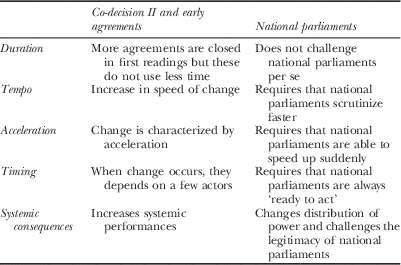
Early agreements, unfolding between the few, also have direct consequences for external actors trying to influence and control EU policymaking. The national parliaments are among these key external actors. The informal contact and meetings in which decisions are prepared and negotiated are essentially policy spaces that exclude all other EU and national actors. Established checks and balances in EU multilevel governance to a large extent depend on negotiations taking place in a transparent and predictable way, where there is time to form opinions and access information in order to pose again the relevant questions as a means of control. It is important not to equate early agreements with fast decision-making, as initial studies tended to do, because recent scholarly evidence suggests that the duration of first readings is longer than the later stage of the decision-making procedure (Toshkov and Rasmussen Reference Toshkov and Rasmussen2012: 5). The change that early agreements make to the national timescape is not in the absolute time spent from a proposal being put on the table by the Commission to its adoption by the European Parliament and Council, but rather the change is that negotiations between a few privileged actors are ‘bunched together over a short time period’ (House of Lords 2008–9: 18). In other words, it is not the duration of early agreements which constitutes a challenge for national parliaments and thus the ‘dual legitimacy’ but the acceleration of decision-making where the content of the proposal changes rapidly with only a few privileged actors being present. The changed EU timescape implies a need for national parliaments to adapt their scrutiny process. Table 1 summarizes how early agreements challenge national parliaments according to the four constitutive parts of temporality as well as its systemic consequences.
Temporality in Early Agreements and National Parliaments
RESEARCH DESIGN AND DATA
This article uses a mixed-method strategy by combining survey data and three case studies (Lieberman Reference Lieberman2005). The survey provides a descriptive chart on how national parliaments are involved in pre-legislation and early decision-making, how they scrutinize and the resources available for scrutiny.Footnote 4 The data have been gathered via an online survey conducted in early 2010. Before the survey was officially sent out, it was tested on a group of people with expertise in data collection and/or parliamentary control. The survey was then sent via emails addressed personally to the academic secretaries of the European Affairs Committees (EAC) in the respective national parliaments of the 27 member states of the EU in 2010 using the COSAC network contact information.Footnote 5 In the vast majority of cases the academic secretary of the European Affairs Committee is the respondent. A total of 39 surveys were sent out, 37 of which were answered. Data were ultimately collected for all of the parliaments with the exception of the two chambers of the Spanish legislature.
Based on the survey data, we conducted three explorative case studies on how the Danish, UK and German parliaments scrutinize their respective governments, in order to get a more detailed understanding of how the three very different parliaments are handling early decision-making. The three parliaments are examined by applying ‘the method of structured-focused comparison’, whereby the three cases are studied and contrasted using the same parameters, examining the main remedy for scrutiny, number of cases examined, grounds for scrutiny, role of special committees, pre-legislation as well as involvement in early agreements (George and Bennett Reference George and Bennett2004: 67–72). Each case is comprehensively examined and compared by applying the process-tracing method, where a number of sources such as interviews conducted with key respondents in 2009–10Footnote 6 official reports for the European Affairs Committees and secondary literature is used and triangulated to obtain the most accurate picture possible (George and Bennett Reference George and Bennett2004: 205–32).
EARLY AGREEMENTS: ARE NATIONAL PARLIAMENTS LEFT OUT?
According to the survey data, most national parliaments are not involved in early agreements. For this reason, they have no information on and cannot control the drifts of the EU decision-making taking place in this accelerated form (see Figure 2).
Parliamentary Involvement in Early Agreements Note: Question 21 was formulated: ‘How is parliament involved in early agreements, i.e., first reading agreements between the European Parliament and the Council?’. The categories indicated in the figure were given as possible answers.
In Figure 2, 16 chambers of parliaments are labelled ‘not informed’, whereas three note that they are sometimes informed after agreements are made. Three chambers are informed before early agreements are closed but cannot give instructions. Seven parliaments note that they are involved in early agreements and can issue binding instructions to their governments. The remaining eight chambers of parliaments have answered ‘other’, and have provided answers elaborating on why they do not fit the predefined categories. The Estonian Riigikogu notes that the information flow depends on the sensitivity of the issue. The Danish Folketing is to be informed about all cases and can in principle instruct the government; in practice, however, information arrives too late and instructions are only given in a minority of cases. The Dutch Eerste Kamer and Slovenian Državni svet write that they are informed if they request such information. The Hungarian Országgyűlés writes that involvement depends on the cooperation with the government. In sum, these parliaments are not involved in early agreements on a systematic basis, rendering their ability to exert control conditional. The Latvian Saeima, on the other hand, notes that if the European Affairs Committee has already approved a national position but early agreements imply changes or shifts in national positions, the government is obliged to receive a new mandate.Footnote 7 Finally, the Swedish Riksdag has responded ‘other’. Its response appears to encapsulate some of the main challenges to parliamentary scrutiny when decision-making is accelerated:
The co-decision procedure poses difficulties from the point of view of parliamentary scrutiny. In its practical application, the procedure is lacking in transparency, and any ‘real’ negotiations are only as an exception taking place when the proposal is on the table at Council meetings. These difficulties are particularly pronounced in the case of deals being struck in the early stages of the procedure, when the content of the deal has been negotiated in informal trialogues with no ‘natural’ points at which to apply parliamentary scrutiny. (Survey, answer to question 21)
In a secluded actor space, national parliamentarians represent a set of actors which are left out. The decision mode is characterized by its own flow, whereas parliamentary scrutiny requires a temporal ‘stand still’ in order to allow control to be exerted. Informal contact and trialogues between the mandated representatives leave no ‘natural’ point of intervention for national parliaments. In the informal trialogue setting, the emerging consensus between the Council presidency and European Parliament representatives renders the state of flux even more pronounced. The original Commission proposal which the national parliaments face may no longer be the relevant text, but de facto negotiations are likely to proceed on the basis of a significantly different text (House of Lords 2008–9: 16). As concluded by the UK House of Lords, informal trialogues and accelerated decision-making render parliamentary scrutiny ‘very difficult’ due to a lack of transparency and the fact that the Council presidency appears to have the upper hand in this decision mode and to ‘hold its cards close to its chest’ (House of Lords 2008–9: 16).
A Call for Early Involvement: Accelerating National Scrutiny?
Early decision-making calls for the earlier involvement of national parliaments. As noted in the survey, ‘“real” negotiations are an exception once the proposal is on the table at Council meetings’ (Survey data, answer to question 21). The ministerial level tends to approve what has already been agreed on (Häge Reference Häge2007; Hayes-Renshaw and Wallace Reference Hayes-Renshaw and Wallace2006). The survey data substantiate the idea that the majority of the national parliaments issue binding instructions to their respective governments in EU matters in the late stages of decision-making. In other words, instructions are given at the ministerial level immediately before agreements are adopted in the Council (see Figure 3).
Instruction Level Note: Question 11 was formulated: ‘At what level in the EU decision-making process does instruction generally take place?’ The question only addresses the parliaments that are able to issue binding instructions to their governments. The categories indicated in the figure were given as possible answers.
Figure 3 shows that nine chambers are not able to issue instructions at all; 17 chambers give instructions at the level of the minister; five chambers note that they provide instructions when negotiations start in the relevant Council working group or at the COREPER level. Six chambers state that they provide instructions at all levels, depending on the character of the dossier. Not only are national parliaments latecomers in the control of policymaking in the decision mode in early agreements, but when instructions are given at the ministerial level, before the Council meeting, the timing is inadequate for them to exert scrutiny with the executive. The real deals are made much earlier. The increased use of early agreements suggests that the working group is a more relevant level to give instructions to.
This development also suggests that in order to be able to respond adequately at the earliest stage in the decision-making process, national parliaments would need to gain information before the Commission presents its proposal. This means that agenda-setting becomes an increasingly relevant part of the policy process for all actors seeking to influence or control the flow of EU affairs (Börzel Reference Börzel2002; Wallace Reference Wallace2005).
The survey data demonstrate how national parliaments inform themselves regarding the Commission’s Green and White Papers in the policy design phase (see Figure 4). Some parliaments also scrutinize early position papers from their governments. Only the Belgian Chambre des Représentants, the Hungarian Országgyűlés, the Maltese Kamra tad-Deputati, the Polish Sejm, the Polish Senate and the Slovakian Národná rada note that they are not involved in the policy design phase (see Figure 4).
Parliamentary Involvement in the Policy Design Phase Note: Question 16 was formulated: ‘Is the parliament involved in the pre-legislation phase?’ The categories indicated in the figure were given as possible answers.
Such pre-legislative involvement prepares the national parliaments to some extent for what may come. However, early agreements are likely to disorient the actors in the policy design phase, since Green and White Papers may at best weakly indicate how negotiations will proceed. Pre-legislative involvement does not tackle the state of flux of early agreements which challenge the ability of parliaments to control and scrutinize what is essentially a fast-moving target.
The institutionalization of the yellow and the orange card system in the Lisbon Treaty may somewhat compensate for the loss of powers due to early agreements. The procedures give national parliaments the possibility of submitting reasoned opinions on draft legislation, which the Commission is obliged to take account of. The institutionalization of the procedures and the scholarly studies of them are still in their early days but evidence suggests that national parliaments are also challenged here on temporality as their reviews of proposals are not completed in time (Kaczyński Reference Kaczyński2011).
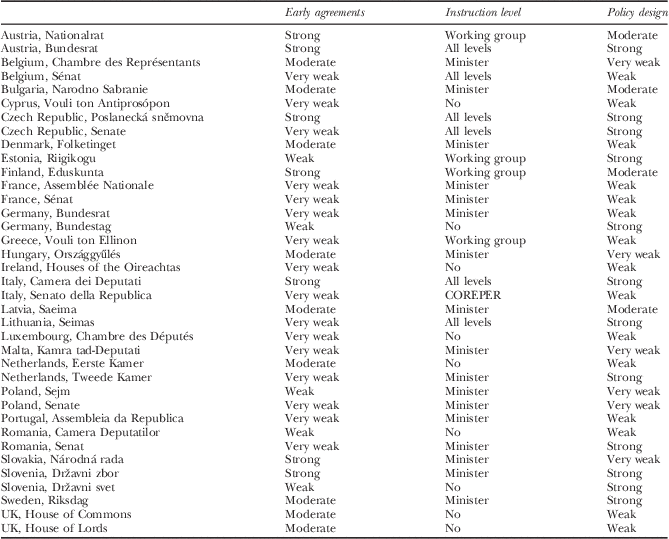
Table 2 summarizes the findings provided in Figures 2–4, arranged according to the name and type of chamber that responded to the survey. The table does not show a systematic pattern for why some parliaments are better equipped to deal with accelerated decision-making. In order to gain that information, the article now turns to the case studies of Denmark, the UK and Germany to find out how their national parliaments have organized their scrutiny process and – eventually – adapted to the new timescape of EU decision-making. The three parliaments display some variation in this and they score differently in the scrutiny-level assessment by Raunio (Reference Raunio2005: 335): Denmark ranked highest, Germany in between and the UK ranked as a relatively weak scrutiny model. Moreover, they have been selected because they are representative of ‘majoritarian’ and ‘consensual’ government configurations (Auel and Benz Reference Auel and Benz2007; Lijphart Reference Lijphart1999) and because they represent different scrutiny systems – that is, the procedural and the document-based model, which will be elaborated below (Sprungk Reference Sprungk2010).
National Parliaments and Early Agreements
Notes: Early agreements: ‘Strong’ – parliament is informed before early agreements and can give instructions; ‘Moderate’ – parliament is informed before early agreements but cannot give instructions; ‘Weak’ – parliament is sometimes informed after agreements are made; ‘Very weak’ – parliament is not informed; ‘Other’ – allocated according to the highest degree of fit with the previous mentioned categories. Policy design: ‘Strong’ – commenting on Green/White Papers and scrutinizing position papers; ‘Moderate’ – scrutinizing position papers; ‘Weak’ – commenting on Green/White Papers; ‘Very weak’ – parliament is not involved in this phase; ‘Other’ – allocated according to the highest degree of fit with the previous mentioned categories.
PARLIAMENTARY SCRUTINY AND EARLY AGREEMENTS IN DENMARK
Denmark is often held to be the member state in which the national parliament has the greatest power in EU affairs and it has been considered the ‘scrutiny leader’ (Holzhacker and Albæk Reference Holzhacker and Albæk2007; Raunio Reference Raunio2005; Sprungk Reference Sprungk2010). The centre of parliamentary control of the government in EU affairs is the European Affairs Committee. The Danish control system is a procedural system focusing on the government position in the Council and giving direct mandates (COSAC 2007). According to the procedure, the government must present a position paper in cases of considerable significance and must inform the committee about important cases (Market Committee 1974). The government, however, presents position papers on most cases and has these accepted by the European Affairs Committee in approximately 90–95 per cent of these cases due to the comprehensive consultation of affected interests beforehand and because it has anticipated the mandate allocation in the committee beforehand, when framing its proposal (Jensen Reference Jensen2003: 156). On the Friday before the Council meeting, the relevant minister will go to the European Affairs Committee and make an oral presentation of the proposed negotiating position. The position is approved (mandated) unless members of the European Affairs Committee representing 90 mandates or more explicitly assert that they are against it (Damgaard and Jensen Reference Damgaard and Jensen2005).
Political time in the Danish scrutiny model is increasingly desynchronized with the timing of EU decision-making. The European Affairs Committee has repeatedly requested more detailed information and the need for consultation earlier in the negotiation process (Esmark Reference Esmark2002; Sousa Reference Sousa2008). It has, however, proved difficult to institutionalize a way of achieving this, and early agreements thus pose significant challenges to the Danish model. Early agreements imply that giving a mandate at the ministerial level is one stage too late. It would be reasonable to give the mandate at the COREPER level, or better timing to give the mandate at the working group level in the Council – and to renew such mandates when informal negotiations produce new positions. At the ministerial level, it is almost impossible to alter an agreement between the Council and European Parliament in cases where the Danish government fails to obtain its mandate.
It has also been pointed out that although early positions are formulated in the government, they are not systematically presented to the parliament (Interview I). In some situations, the government holds that the establishment of compromise involving trialogues prior to the first reading in the European Parliament is a delicate and rather confidential process which renders the presentation of positions impossible (Interview IV). In other situations, the government may not have sufficient information itself from the Council presidency (Interview VII). The European Affairs Committee members have noted that first reading agreements are an increasing problem for parliamentary control, since the information provided by the government to the parliament is too little, too late – often after COREPER has mandated the presidency (COSAC 2009: annex, 30; Interview VII). At this stage, the Danish government as a Council member has already given the presidency a mandate to negotiate, without having received any mandate from the Danish parliament. This development severely challenges the ability of the parliament to control the government. It thus challenges the distribution of power in the Danish polity.
As early as March 2006, the former president of the European Affairs Committee pointed out that early agreements had outdated the Danish mandating system which scrutinized proposals in the late stages of decision-making (Auken Reference Auken2006). In light of the acceleration of policymaking, he suggested that parliamentary mandates should be given much earlier. This was followed by an official request from the European Affairs Committee to the government to present its position as early as possible (Danish European Affairs Committee 2006). The government responded by noting that in cases of early agreement, it would aim to present its position before COREPER mandates the presidency to negotiate (Danish Foreign Ministry 2011). Ideally, this would mean that the government would request its mandate from the European Affairs Committee when the presidency asks for a mandate from COREPER to initiate negotiations in the first trialogue. However, in practice, the government appears to request its mandate when the presidency asks COREPER for a mandate to close a deal with the European Parliament (Interview VII). Issuing a mandate in the late phase of COREPER negotiations stands out as being another stage that is too late, since negotiations between Council representatives must have begun far earlier in order to reach a common position in the Council. To take part in such negotiations, the individual governments must have formed their positions at an earlier stage, presumably when the relevant working group started to act. Furthermore, the government response does not consider the flow of fast-track decision-making and does not guarantee that it will return to the European Affairs Committee when positions change during negotiations. However, even the government may not have sufficient information to present, as it may be far from fully informed itself regarding the progress in trialogues.
Finally, the Danish European Affairs Committee is not very engaged in the preparatory stages of EU policymaking. The involvement of the European Affairs Committee is limited when it comes to influencing the European Commission on a more direct, concrete level by uploading its own regulatory models or attempting to shape proposals which are in the pipeline (Survey question 16). The general view seems to be that actions taken by ministers before proposals are officially launched by the European Commission fall within the jurisdiction of the government (Interviews I, II, III).
In sum, the changed temporality of EU decision-making imposes severe challenges on the Danish parliament’s ability to control its government when agreements are prepared and negotiated in the EU political system. The tempo of the Danish scrutiny model was established in accordance with the old Community clock and has so far been unable to adapt to the EU political time of early agreement.
PARLIAMENTARY SCRUTINY AND EARLY AGREEMENTS IN THE UNITED KINGDOM
In contrast to Denmark, the British parliamentary scrutiny system does not mandate the minister before agreements can be made in the Council (Survey question 10). The British system is an example of a classical document-based system (COSAC 2007) in which EU documents are sifted through at the early stage of the decision-making process. Some scholars have found the model to have a low level of scrutiny (see, for example the scoreboard of Raunio Reference Raunio2005: 335) and others claim that it actually carries out quite detailed parliamentary scrutiny (Auel Reference Auel2007: 501–2).
As such, the British scrutiny system does not control the executive in a strict sense, instead examining the content and impact of proposals through scrutiny. This form of parliamentary scrutiny is divided between the House of Commons and House of Lords. The two chambers have each established a European Affairs Committee responsible for holding the government accountable. The main mechanism is the so-called scrutiny reserve, which implies that the government is not allowed to give consent to EU cases which the two houses have not yet examined or are still examining (Cygan Reference Cygan2007: 172–3; Hazell and Paun Reference Hazell and Paun2010). The government must await the clearance of the scrutiny reserve before taking action.
Beginning with the House of Commons, which is the elected body of the two chambers, the European Scrutiny Committee processes more than 1,000 documents annually.Footnote 8 According to the rules of procedure, the government must submit documents from the Commission within two days of receiving them (Cygan Reference Cygan2007: 165–9). The government must then submit a so-called explanatory memorandum within two weeks, with a description of the proposal and its implication (Cygan Reference Cygan2007: 165–9). Based on this information, the committee will decide whether the document is politically and/or legally significant (Interview VI). All documents deemed politically and/or legally important are reported on at length in the committee’s weekly reports. The committee also has the power to recommend documents for debates, which take place in a European Committee or (more rarely) in the House of Commons. Under the scrutiny reserve resolution of 17 November 1998 passed by the House, ministers should not vote in the Council of Ministers on proposals which the committee has not cleared or which are awaiting debate. Moreover, the committee may refer documents to departmental select committees, although the most common option is to refer the documents to one of the subcommittees on EU affairs. As the House of Commons applies a document-based scrutiny system, the earliest stage at which the system is initiated is when the Commission launches a Green or White Paper (Survey question 16), but the system is not activated before a formal proposal is placed on the table. The House of Commons should be informed before an early agreement is reached but it is not in a position to instruct (Survey question 21). Initially, the House of Commons assumed that contentious proposals would not be subject to early agreements (Interview VI). This assumption has, however, been challenged as first reading agreements are prevalent and are also used on proposals which are politically salient (Interview VI). Early agreements thus challenge the scrutiny system due to their fast tempo and the opaque nature of the decision mode which makes it difficult to apply the scrutiny reserve. The House of Commons has informed the government about this difficulty but no concrete measures have been set in place to better synchronize the European and the national timescape (Interview VI).
The House of Lords, which is the unelected, second chamber of the UK parliament, exercises control via its EU Committee. Every week, the committee chair and legal adviser sift through all of the documents which the government has deposed (Interview V). Approximately half of the cases of a routine nature are cleared by the committee chair, meaning that the government can go ahead and decide on them. The other dossiers, which raise political or legal questions, are allocated to one of the seven subcommittees under the select committee. The subcommittees meet weekly, where a background note will be prepared for each case by a committee clerk (Interview V). Committee clerks will also prepare a draft letter for the minister if something needs to be clarified before the committee can lift the scrutiny reserve. Based on the information provided by the minister, the committee will decide whether to clear the proposal or to investigate further by inviting the minister to provide evidence before the committee (Cygan Reference Cygan2007: 169–71). Before the minister arrives at the session, committee clerks and specialists will have prepared a number of questions, which are divided between the members. In cases of greater significance, the committee will produce a report. In comparison with the House of Commons, many members of the House of Lords European Union Committee have considerable expertise in EU matters, having held high positions such as commissioner, COREPER ambassadorships and European Parliament presidency in the course of their professional lives (Interview V).
The extended use of early agreements and the informal trialogues have caused considerable concern in the House of Lords over how to respond to these challenges in order to hold the government accountable. These concerns are raised in one of the House of Lords’ reports, dealing exclusively with co-decisions and national parliamentary scrutiny (House of Lords 2008–9). In order to deal with the challenges implied by co-decisions and early agreements, the EU Committee suggests adjusting the existing systems of parliamentary scrutiny in a number of ways (House of Lords 2008–9). Firstly, it suggests that the government must update the parliament without any delay if there have been changes in the proposal that have policy implications. Secondly, it is suggested that the House of Lords office in Brussels should be allowed access to documents that are being negotiated under the co-decision procedure in the Permanent British Representation in order to be up to date on how the negotiations evolve. Thirdly, the British government is expected in the future to send documents from the Council which are marked LIMITE. Fourthly, the importance of the above-mentioned need for sending reports to MEPs who are involved in cases negotiated under the co-decision procedure is emphasized, together with the need to inform other national parliaments via a common database. Despite these explicit recommendations from the House, the amendments have so far not been transformed into reality (Interview X).
The practice in the two Houses differs as to how scrutiny is exercised and how the changes of EU temporality are faced. The House of Lords carries out in-depth inquiries early in the decision-making phase of a limited number of key cases, whereas the House of Commons produces a weekly report summarizing the background notes of all of the proposals under scrutiny. The established division of labour between the Houses and their respective manners of EU dedication means that parliamentary EU control is tackled from different angles and forums. The earlier actions of the Lords can bring information to the Commons on when to be aware and on what to focus. The document-based system may therefore contain different ways of tackling the new challenges of tempo, acceleration and timing that the mandating system has not (yet) fully developed.
PARLIAMENTARY SCRUTINY AND EARLY AGREEMENTS IN GERMANY
Like the British system, and in contrast to the Danish one, the German system is a document-based system in which proposals from the EU institutions are singled out for scrutiny (COSAC 2007: 15). The German parliament has been criticized for not making full use of its formal rights to scrutinize the government and thus performs relatively weakly compared with other models (Auel Reference Auel2007: 493; Sprungk Reference Sprungk2010; Töller Reference Töller2004, Reference Töller2006).
The Committee on the Affairs of the European Union (Ausschuss für die Angelegenheiten der Europäischen Union), also called the EU Committee, is the hub of coordination in the Bundestag. The committee is responsible for cases concerning European integration, whereas specialized committees are responsible for scrutinizing sector-specific proposals from the EU. All documents from the government go through the EU Committee, which allocates them to relevant committees (Interview VIII). The transmitted documents have attached forwarding letters with information on the main substance, the legal basis, the applicable procedure and the leading federal ministry (EUZBBG 2013: section 5). A special administrative unit under the auspices of the EU Committee, called PA1 (Europa Referat), sifts the documents and suggests a prioritization to the parliamentary groups (Interview VIII).
The prioritized dossiers will then be allocated to the relevant special committee(s) of the Bundestag. The responsible committee(s) will make use of questions to the government, together with written reports, as the basis for its scrutiny before crafting a resolution. The EU Committee can suggest amendments or adjust the resolution from the lead committee before transmitting it to the plenary (Rules of Procedure of the German Bundestag 2013: Rule 93b (7)). Based on the resolution, the plenary adopts a motion, which the federal government must follow in the Council of Ministers (EUZBBG 2013: section 9). However, the government can deviate from that motion if it has compelling reasons, in which case it will have to appear before the relevant committee in the Bundestag to explain the reasons for the deviation (Survey question 10; Linn and Sobolewski Reference Linn and Sobolewski2010: 59–62).
On 28 September 2006, the Bundestag made an agreement with the government that tightens the procedural demands.Footnote 9 This agreement was adjusted on 30 September 2009 to accommodate the 30 June 2009 ruling from the German Federal Court (Bundesverfassungsgericht) which found the role of the two chambers of parliament to be insufficient to counteract the transfer of competencies to the EU. This implied that the agreement governing the relationship between the parliament and the government was changed, most significantly by making it legally binding (Beichelt 2012: 145). The adjusted cooperation law also stresses the importance of a subsidiary check, according to which the Bundestag should consider within eight weeks whether or not a case fulfils the principles of the Treaty of Lisbon.
Despite the empowering of the Bundestag following the ruling from the Constitutional Court, the parliament has severe problems dealing with early agreements. There is no advanced system in place in the Bundestag which can keep up with accelerated legislative process at the European level and the chamber is sometimes only informed after an agreement has been made (Interview VIII; Survey question 21). The Bundestag only receives non-papers (that is, informal and non-binding papers) regarding early agreement, if it receives any information at all from the government (Survey question 16). This makes it extremely difficult for the Bundestag to monitor and control what is happening and in the vast majority of cases the government is not held accountable.
The government is obliged to inform the second chamber of the German parliament, the Bundesrat, about new dossiers emanating from the EU as early as possible. Upon receipt, the EU Secretariat of the Bundesrat goes through the proposals and decides which to scrutinize (Interview IX). On average, 100–150 documents are preselected for inspection per year. Based on the preselection process, the secretary general on behalf of the president of the Bundesrat allocates the proposals to relevant sector committee(s). The sector committees then scrutinize the proposals and give a statement to the Committee on European Union Questions (EU Committee, Ausschuss für Fragen der Europäischen Union). The federal government will appear before both the sector committees and the EU Committee to engage in dialogue. Based on the views given by the relevant sector committees, the EU Committee deliberates on the proposal. It is the EU Committee that is competent to decide whether or not to support the views from the sector committees. Regarding early agreements, the Bundesrat is even more challenged than the Bundestag because it is not informed and there is no infrastructure in place which is synchronized with fast-track decision-making at the European level (Interview IX; Survey question 21).
In sum, when EU temporality requires the German Bundestag and Bundesrat to act faster and to be poised to act in order to control its government in EU affairs, the national parliament cannot do so due to lack of information. At the same time as the Bundestag has gained powers in relation to subsidiarity checks, a lack of information prevents it from adapting to the accelerated and secluded decision-making forums of the EU. The changed tempo and timing of the EU makes it increasingly difficult to scrutinize the government in a sufficient and systematic manner.
CONCLUSION
Co-decision is now the ordinary legislative mode in a European Union enlarged to 28 member states. Scholars have noted that neither the increased powers of the European Parliament nor enlargement have slowed down supranational decision-making, which seems to operate according to ‘business as usual’ (Meyer-Sahling and Goetz Reference Meyer-Sahling and Goetz2009: 329; Wallace Reference Wallace2007). This is, however, not the case. The accelerated and growing informality of decision-making has wide implications beyond time-estimated performance. Performance by means of efficiency may be largely intact, but the distribution of power and democratic legitimacy is not. The analysis in this article has demonstrated how EU early agreements have considerable implications for national parliaments’ ability to scrutinize their executives.
EU decision-making and the national scrutiny of it operate in many cases according to different, desynchronized timescapes. It has been pointed out that ‘EU institutions do not run to the same clock’ (Goetz Reference Goetz2009: 210). The findings of this article add that national parliaments’ ability to control EU decision-making rely on the clock of yesterday, thus reinforcing desynchronized timescapes. The changes in the decision mode upset national models of parliamentary scrutiny as they were institutionalized at a very different time, when member states were fewer, the European Parliament had much less power and decisions were normally taken on the basis of consensus. National executives were thus more directly responsible for their EU actions, whereas today many decisions are prepared and de facto taken on behalf of the large majority of national executives. The minister comes to lack full information when represented by the Council presidency in the trialogues, where certain pressure exists to close a deal as early as possible. The degree of closure and acceleration in the informal setting may essentially sideline the object of control itself: the government. One way to remedy this problem could be to exploit informal linkages between European and national levels, for instance where members of the same national political party provide inside information about the negotiations (Jensen and Nedergaard Reference Jensen and Nedergaard2012). Existing empirical evidence suggests that linkages between MEPs and national parliamentarians are weak (Raunio Reference Raunio2009: 324) but informal linkages are tools which carry potential for enhancing national parliamentarians level of control.
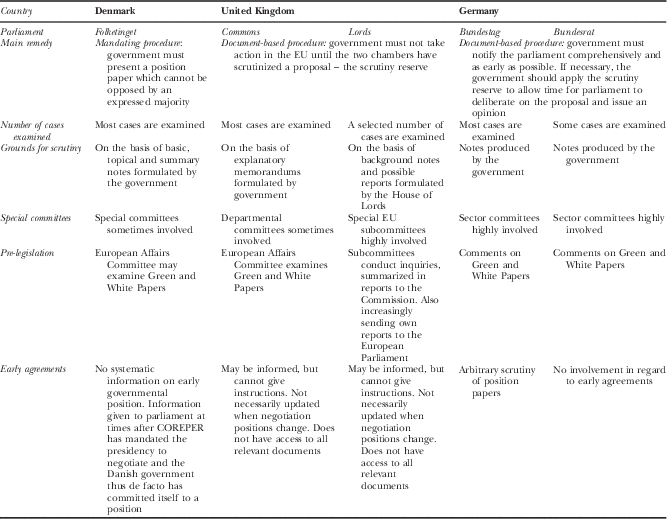
The three case studies indicate that none of the scrutiny models is keeping pace with the acceleration of EU decision-making. Nevertheless, important differences are apparent, which may better enable the House of Lords in the UK system to tackle the increased need for early action. When comparing the scrutiny process on different parameters, the House of Lords stands out as the more proactive chamber (see Table 3).
Comparing Parliamentary Scrutiny
The House of Lords handles a limited, selected number of cases but subsequently invests significantly greater resources in the scrutiny process and carries out much more detailed examination. Furthermore, its grounds for scrutiny do not depend on explanatory memorandums or summary notes from the government, operating instead on the basis of its own reports or notes worked out by its own employees. Thus, the independent analytical capacity is higher. Moreover, the high involvement of special committees enhances the scrutiny capacity of the House of Lords. The Lords proactively attempts to influence both the Commission and the European Parliament by scrutinizing developments and initiatives and sending its own reports to the agenda-setters in the Commission and the decision-makers in the European Parliament, including the powerful rapporteurs. In this manner, the House of Lords appears to have adapted to the increased need for early action in the EU policy cycle. In contrast, the European Affairs Committee in Denmark continues to concentrate on the late stage of decision-making when a mandate is given to the minister. Although Denmark is renowned for its strong model of parliamentary control, it lags behind in its efforts to adapt to the new temporal rules of EU decision-making. Germany has not yet accelerated its national scrutiny either and experiences a lack of information on position formation in the informal trialogues. So far no infrastructure has been put in place which is synchronized with fast-track decision-making at the European level.
This article has examined the implications of early agreements in EU decision-making for the national legislators’ ability to scrutinize their executives. The temporal rules that govern EU politics have changed (Goetz Reference Goetz2009), but many national clocks have far from adapted and are out of time. Whereas the performance of the system may be intact, the implications for power and democratic legitimacy stand out. As far as the distribution of power is concerned, these findings support the ‘deparliamentation’ thesis. More than half of the national legislators have lost power, not this time to the executive (Goetz Reference Goetz2000; Raunio Reference Raunio2006; Wessels et al. Reference Wessels, Maurer and Mittag2003), but instead to the few actors of delegated responsibility. Regarding democratic legitimacy, the findings suggest that the ‘dual legitimacy’ of EU politics (Benz Reference Benz2004; Töller Reference Töller2006) is more challenged than is often assumed.