1. Introduction
A thick Ediacaran to Lower Cambrian sedimentary succession crops out in the Central Iberian Zone, in a NW–SE-trending band from northern Portugal to south-central Spain (Fig. 1a). This succession is dominated by siliciclastics, including laminated mudrock and matrix-rich sandstone and conglomerate, with an overall depositional environment up-section shallowing from slope deposits (sandy and muddy turdibites) to shallow marine deposits (sandstone and carbonates) (e.g. Herranz, San José & Vilas, Reference Herranz, San José and Vilas1977; Vidal et al. Reference Vidal, Palacios, Díez Balda, Gámez Vintaned and Grant1994; Valladares et al. Reference Valladares, Barba, Ugidos, Colmenero and Armenteros2000; Liñán et al. Reference Liñán, Gozalo, Palacios, Gámez Vintaned, Ugidos, Mayoral, Gibbons and Moreno2002). Some of the most intensively studied sections are located in the Ibor, Navalpino and Valdelacasa anticlines (Fig. 1b), where two intervals of fossil-bearing carbonates provide important chronostratigraphical reference points. A lower carbonate interval, cropping out in the Ibor and Navalpino anticlines (Ibor-Navalpino Group), contains the early skeletal tubular metazoan Cloudina (Palacios, Reference Palacios1989; Vidal et al. Reference Vidal, Palacios, Díez Balda, Gámez Vintaned and Grant1994; Jensen, Palacios & Martí Mus, Reference Jensen, Palacios, Martí Mus, Vickers-Rich and Komarover2007) considered to be an index fossil for the latest Ediacaran (e.g. Hua et al. Reference Hua, Chen, Yuan, Zhang and Xiao2005). A younger carbonate interval, the Navalucillos Formation, crops out just north of the Valdelacasa anticline. It contains late Early Cambrian (Cambrian Series 2 of Babcock & Peng, Reference Babcock and Peng2007) archaeocyathans and trilobites of the Upper Ovetian Regional stage, which has been correlated with the Siberian Botoman Stage (e.g. Moreno-Eiris, Reference Moreno-Eiris1987; Perejón & Moreno-Eiris, Reference Perejón and Moreno-Eiris2006). Correlation across these anticlines, in part by Cloudina-bearing olistostromic beds shed from the Ibor Group into what is now the Valdelacasa anticline, suggests that the time separating the deposition of these carbonates is represented by the siliciclastic Pusa and Azorejo formations, in the western portion of the Toledo Mountains (Montes de Toledo) (Fig. 1b) with a combined thickness of at least 2.5 km. Fossils in the Pusa Formation include trace fossils, carbonaceous compressions, rare acritarchs, and, in the upper part, skeletal fossils (Brasier, Perejón & San José, Reference Brasier, Perejón and San José1979; Vidal et al. Reference Vidal, Palacios, Díez Balda, Gámez Vintaned and Grant1994, Reference Vidal, Palacios, Moczydłowska and Gubanov1999; Jensen, Palacios & Martí Mus, Reference Jensen, Palacios, Martí Mus, Vickers-Rich and Komarover2007; Martí Mus, Palacios & Jensen, Reference Martí Mus, Palacios and Jensen2008). Among the fossils from the upper part of the Pusa Formation, the report of trilobites (Palacios & Vidal, Reference Palacios, Vidal, Palacios and Gozalo1996a,Reference Palacios, Vidal, Liñán, Gámez Vintaned and Gozalob) is particularly noteworthy, since it had been generally believed that the Pusa Formation significantly antedated the global appearance of trilobites. One interpretation of the significance of these trilobites, first suggested by Palacios, Vidal & Moczydłowska (Reference Palacios, Vidal, Moczydłowska, Liñán, Gámez Vintaned and Gozalo1996), is that the age of the upper part of the Pusa Formation needs to be revised and that it is significantly younger than had been previously thought. Another interpretation is that these are genuinely old trilobites, a view consistent with preliminary identifications of the Pusa Formation trilobites with Hupetina and Bigotinops (Palacios et al. Reference Palacios, Gámez, Fernández-Remolar and Liñán1999a,Reference Palacios, Gámez Vintaned, Fernández-Remolar and Liñánb; Liñán in Vidal et al. Reference Vidal, Palacios, Moczydłowska and Gubanov1999), which are some of the earliest described trilobites from the Eofallotaspis Zone of Morocco (Sdzuy, Reference Sdzuy1978). Together with the oldest trilobites in Siberia and western Laurentia, those of the Eofallotaspis Zone of Morocco have been considered among the earliest known (Geyer & Shergold, Reference Geyer and Shergold2000; Hollingsworth, Reference Hollingsworth, Laurie, Paterson and Jago2007, Reference Hollingsworth, Rábano, Gozalo and García-Bellido2008). Moreover, Liñán et al. (Reference Liñán, Gozalo, Díes Álvarez, Gámez Vintaned and Zamora2008) recently suggested that Serrania palaciosi Liñán et al. Reference Liñán, Gozalo, Díes Álvarez, Gámez Vintaned and Zamora2008, from the basal part of the Alconera Formation in the Ossa Morena Zone of southern Spain is the oldest trilobite described from Gondwana. Given that the Pusa Formation has been widely considered to be substantially older than the Alconera Formation, this would make its trilobites among the earliest globally.
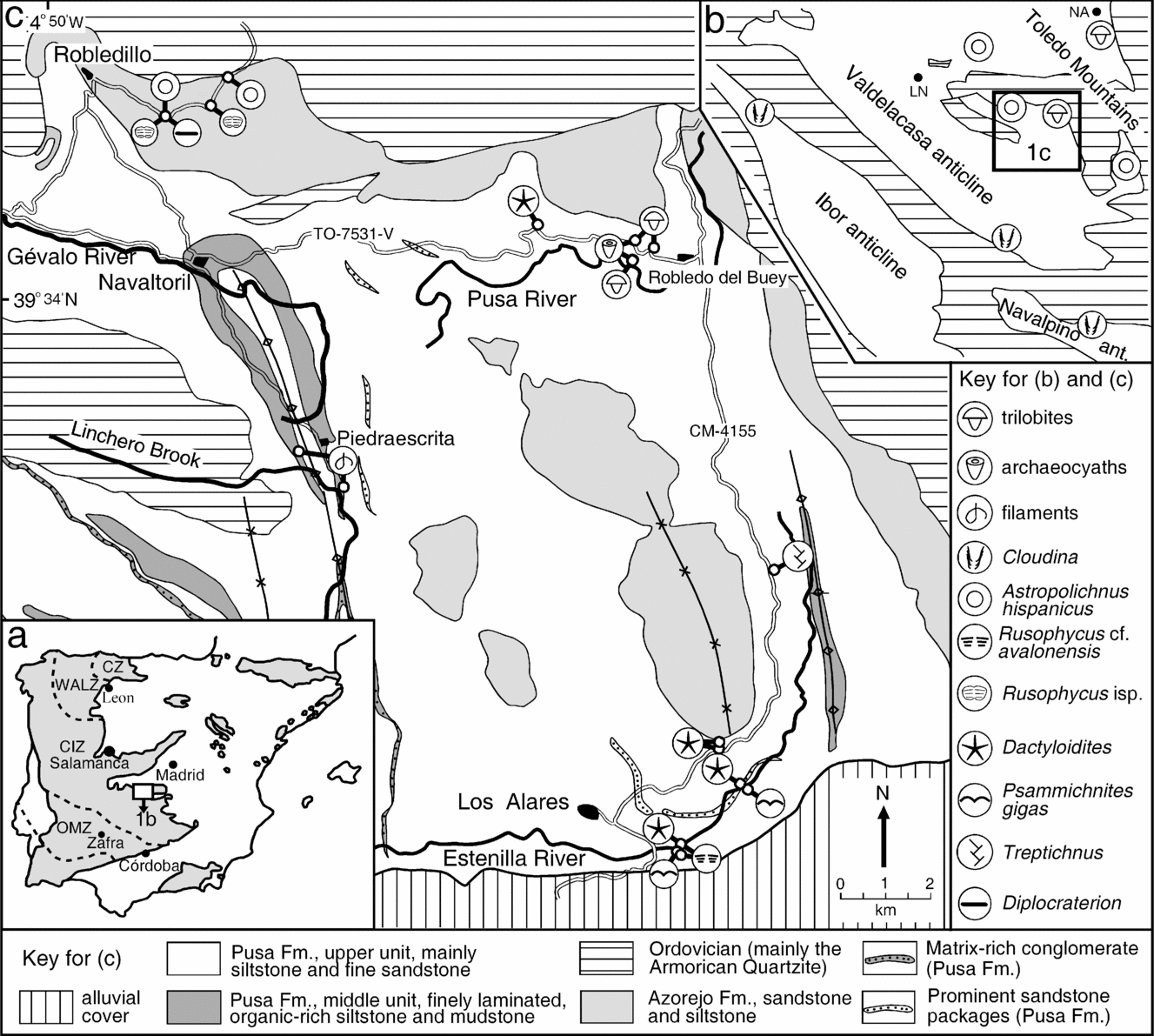
(a) Map of Iberian peninsula showing location of study area (marked by rectangle) and major structural (tectonostratigraphical) divisions. CIZ – Central Iberian Zone; CZ – Cantabrian Zone; OMZ – Ossa Morena Zone; WALZ – West Asturian-Leonense Zone. (b) Location of the study area (marked by rectangle) in the western part of the Toledo Mountains with relation to major Variscan structural elements. Area within contour of anticlines consists of Ediacaran and Cambrian material; area outside (with horizontal lines) is post-Cambrian. Also shown are locations of confirmed occurrences of Astropolichnus hispanicus in the Azorejo Formation; from left to right, at Gevalo River, Robledillo and Navas de Estena. Trilobite symbol in upper right corner refers to occurrence of Granolenus midi. LN – La Nava de Ricomalillo; NA – Los Navalucillos. (c) Sketch map of the geology in the study area (adapted and slightly modified from Nozal Martín & Martín Serrano, Reference Nozal Martín and Martín Serrano1989 and Moreno Serrano & Gómez Pérez, Reference Moreno Serrano and Gómez Pérez1989), showing locations of the fossils discussed in this paper.

The purpose of this paper is to present the first detailed description of the trilobite-bearing upper part of the Pusa Formation, in order to provide an improved understanding of the biostratigraphical context of these trilobites. We conclude that the upper part of the Pusa Formation is indeed significantly younger than had been previously thought. An important outcome of this study is a substantially revised correlation between Lower Cambrian strata of the Central Iberian and Ossa Morena zones.
2. Geological setting
This study is based on strata located in the western part of Toledo Province, about 100 km southwest of Madrid (Fig. 1a). In ascending stratigraphical order, the Lower Cambrian in the study area comprises the Pusa, Azorejo and Navalucillos formations (Fig. 2) (e.g. Liñán et al. Reference Liñán, Gozalo, Palacios, Gámez Vintaned, Ugidos, Mayoral, Gibbons and Moreno2002; Gozalo et al. Reference Gozalo, Liñán, Palacios, Gámez Vintaned and Mayoral2003). The distribution and stratigraphy of these units are detailed in the 1:50 000 scale geological maps of Espinoso del Rey (Moreno Serrano & Gómez Pérez, Reference Moreno Serrano and Gómez Pérez1989) and Anchuras (Nozal Martín & Martín Serrano, Reference Nozal Martín and Martín Serrano1989). The trilobite-bearing strata that are the focus of this paper have been variously referred to as the Pusa Formation (or Pusa shale) or the Rio Huso Group. The two are approximately equivalent (see Vidal et al. Reference Vidal, Palacios, Díez Balda, Gámez Vintaned and Grant1994, for a discussion). Palacios & Vidal (Reference Palacios, Vidal, Palacios and Gozalo1996a,Reference Palacios, Vidal, Liñán, Gámez Vintaned and Gozalob; see also Vidal et al. Reference Vidal, Palacios, Moczydłowska and Gubanov1999) divided the Rio Huso group into a lower, middle and upper unit at the rank of formations or members. The upper two units can be readily identified in the study area and, for the purpose of this paper, will be referred to as the middle and upper units of the Pusa Formation. The middle unit is characterized by fine horizontal lamination from the alternation of siltstone and mudstone laminae (Appendix Fig. A1c at http://multimediafluids.uam.elogim.com/journals/geo), a high content of organic matter and, locally, a moderately high content of phosphate (Gabaldon et al. Reference Gabaldón López, Hernández Urroz, Lorenzo Álvarez, Picart Boira, Santamaría Casanovas, Solé Pont, Notholt, Sheldon and Davis1987; Vidal et al. Reference Vidal, Palacios, Díez Balda, Gámez Vintaned and Grant1994). This unit can be traced widely across the Valdelacasa anticline. In fresh samples the rock is dark but it rapidly weathers to various shades of brown, red and yellow. This unit is well exposed in the area of La Nava de Ricomalillo (Fig. 1b) where it contains diverse organic filamentous fossils and a Scenella-like, centimetre-sized fossil mollusc (Jensen, Palacios & Martí Mus, Reference Jensen, Palacios, Martí Mus, Vickers-Rich and Komarover2007; Martí Mus, Palacios & Jensen, Reference Martí Mus, Palacios and Jensen2008). In this unit there are intervals with intense bed collapse as well as thin sandstone beds with rippled tops, including fading ripples. Trace fossils are rare. This unit can also be recognized in the surroundings of Navaltoril and south of Piedraescrita (Fig. 1c), where it yields filamentous fossils (Appendix Fig. A1a, b). A further outcrop area is located east of Los Alares, along the upper reaches of the Estenilla River (Fig. 1c) but is unfortunately within inaccessible fenced-in property. The upper unit of the Pusa Formation typically consists of greenish planar-bedded siltstone and fine sandstone (Appendix Fig. A2a, b at http://multimediafluids.uam.elogim.com/journals/geo). Small-scale ripples may be present. The sandstone beds are often readily identified by red-brown weathering of carbonate cement (Appendix Fig. A2b). East of Los Alares the upper unit contains a potent (> 50 m thick), apparently lenticular, series of thick-bedded sandstone (Fig. 1c; Appendix Fig. A2g) as well as sandy heterolithic facies. Intervals with significant syn-sedimentary slumps are common (Appendix Fig. A2e), and trace fossils are abundant at certain levels (Appendix Fig. A2f, h). Representative outcrops are found along the Estenilla River and Pusa River and along the road from Los Alares to Robledo del Buey (Fig. 1c). This unit has a thickness of at least 600–700 metres. The overlying Azorejo Formation is more than 500 metres thick, with considerable lateral facies changes (Nozal Martín & Martín Serrano, Reference Nozal Martín and Martín Serrano1989), but compared to the Pusa Formation there is a higher proportion of sandstone, often with a characteristic heterolithic bedding with lenticular sandstone beds (Appendix Fig. A3). Hummocky cross-stratification is also present, and locally there are intervals with carbonate-rich sandstone. Trace fossils in the Azorejo Formation include Astropolichnus hispanicus, Diplocraterion isp. and various arthropod-type trace fossils (e.g. Moreno, Vegas & Marcos, Reference Moreno, Vegas and Marcos1976; Liñán et al. Reference Liñán, Perejón, Gozalo, Moreno-Eiris and de Oliveira2004).
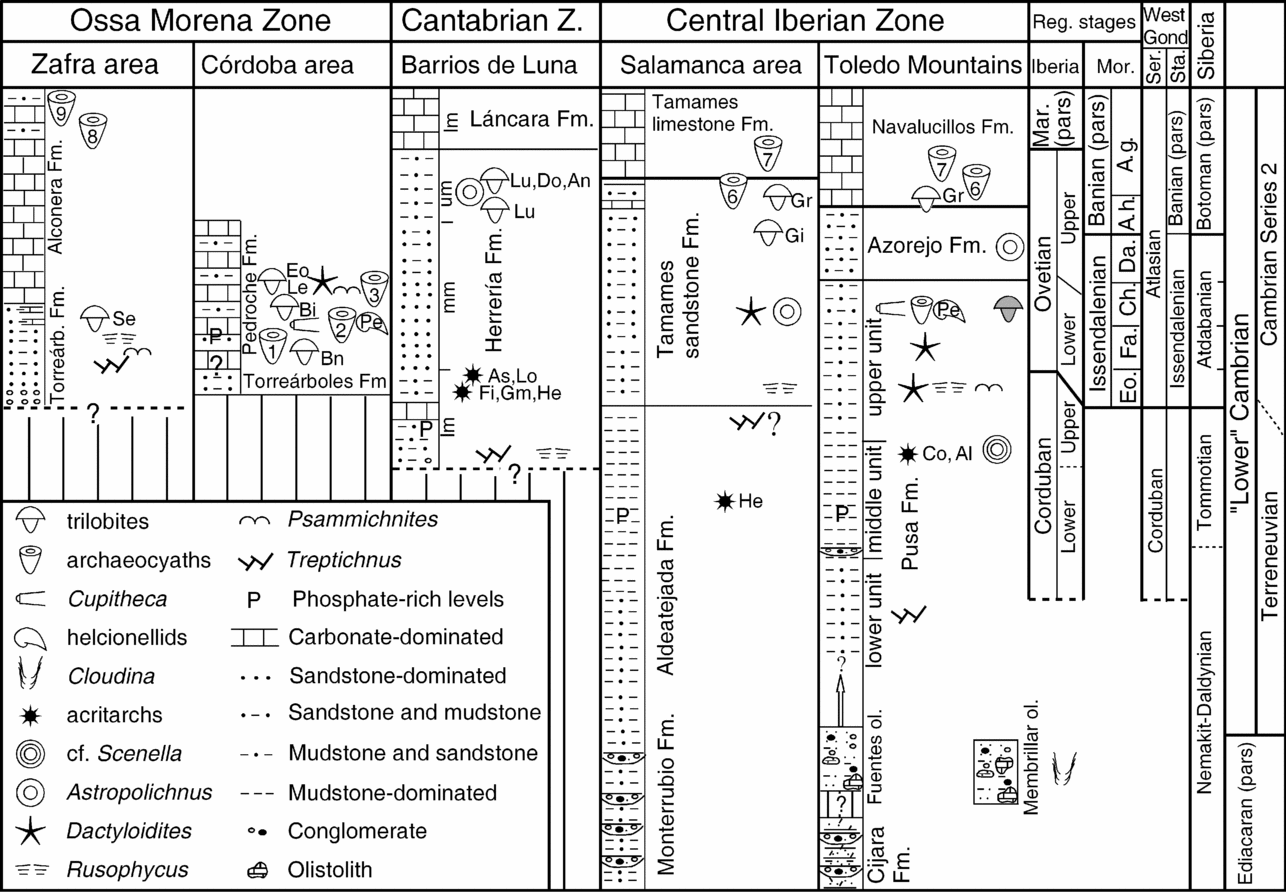
Proposed correlation scheme of the Lower Cambrian of selected regions in Spain. Vertical scale is approximately proportional in time. Fossil symbols show lowest occurrence within a region, and in selected cases additional occurrences. See Figure 1a for approximate location of sections. See text for details. Numbers associated with archaeocyathan symbols refer to zonation of Perejón & Moreno-Eiris (Reference Perejón and Moreno-Eiris2006). Diagonal and dashed lines indicate uncertainties in position or correlation. Fossil abbreviations: Al – Allumiella; An – Anadoxides; As – Asteridium; Bi – Bigotina; Bn – Bigotinella; Co – Comasphaeridium; Do – Dolerolenus; Eo – Eoredlichia; He – Heliosphaeridium; Fi – Fimbriaglomerella; Gi – ?Giordanella; Gm – Granomarginata; Gr – Granolenus; Le – Lemdadella; Lo – Lophosphaeridium; Lu – Lunolenus; Pe – Pelagiella; Se – Serrania. Other abbreviations: A.h. – Antatlasia hollardi Zone; A.g. – Antatlasia guttapluvia Zone; Ch. – Choubertella Zone; Da. – Daguinaspis Zone; Eo. – Eofallotaspis Zone; Fa. – Fallotaspis tazemmourtensis Zone; lm – lower member; Mar. – Marianian; mm – middle member; Mor. – Morocco; ol. – olistostrome; um – upper member; West Gond. – West Gondwanan Standard of Geyer & Landing (Reference Geyer and Landing2004).

The Pusa Formation has been interpreted to contain both platform and slope facies (e.g. Gabaldon et al. Reference Gabaldón López, Hernández Urroz, Lorenzo Álvarez, Picart Boira, Santamaría Casanovas, Solé Pont, Notholt, Sheldon and Davis1987; Vidal et al. Reference Vidal, Palacios, Díez Balda, Gámez Vintaned and Grant1994; Valladares et al. Reference Valladares, Barba, Ugidos, Colmenero and Armenteros2000). The transition between the Pusa and Azorejo formations is gradual and shows interfingering. Nozal Martín & Martín Serrano (Reference Nozal Martín and Martín Serrano1989) interpreted the upper unit of the Pusa Formation as a platform deposit with evidence for storm influence, with the Azorejo Formation representing a further shallowing.
3. Description of sections
In addition to the trilobite-bearing section at Robledo del Buey, the upper part of the Pusa Formation was studied in the area of Los Alares and Piedraescrita (Fig. 1c). The combined data from these sections makes it possible to place the trilobites, and other fossils, within a well-constrained stratigraphical context. Outcrops of the Azorejo Formation near Robledillo were also studied because of the occurrence of trace fossils typical of this unit, and because they can be traced to the Robledo del Buey section, where outcrops of the Azorejo Formation have yielded relatively scarce trace fossils, mostly Monomorphichnus isp.
3.a. Robledo del Buey
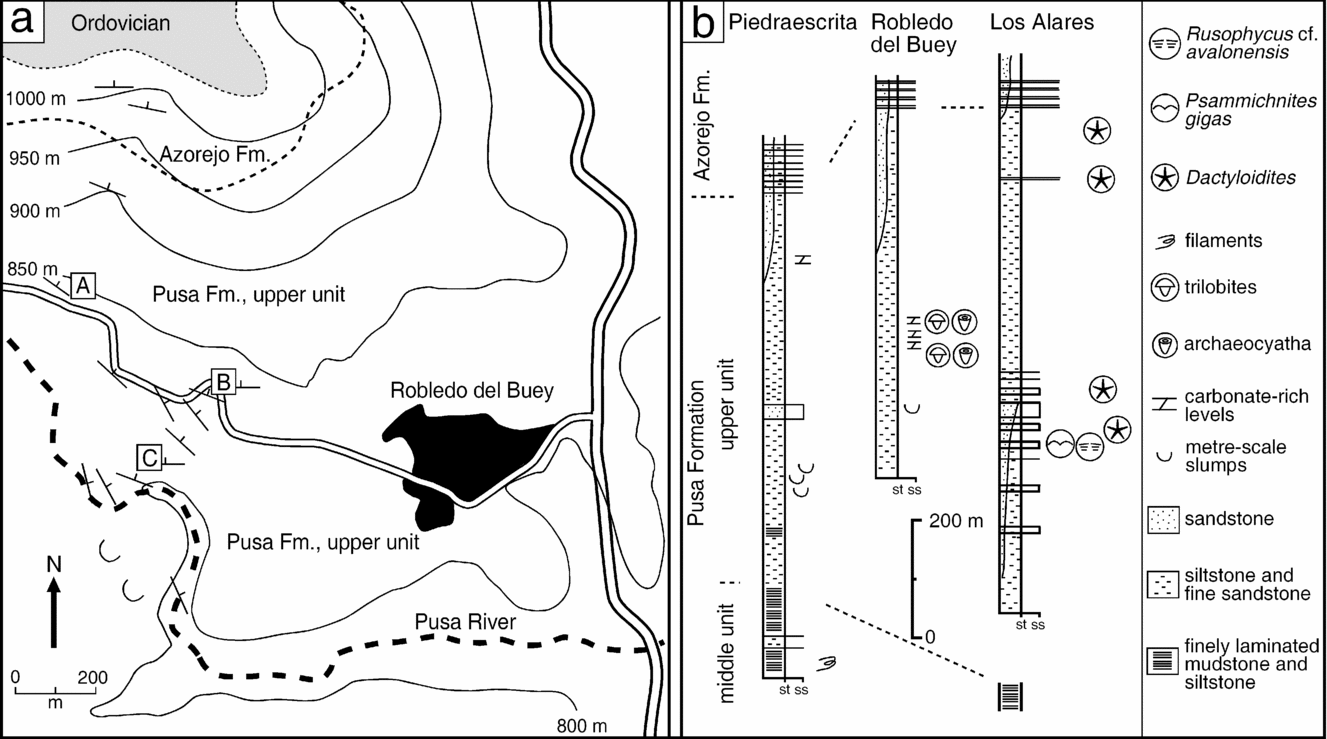
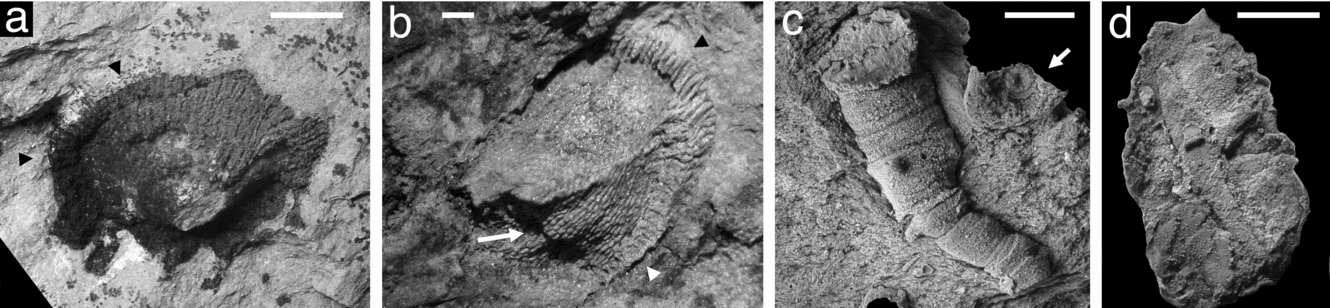
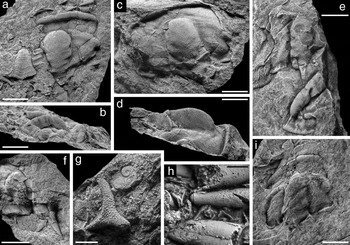
This section is located west of the village of Robledo del Buey, starting along the Pusa River and extending up a south-facing mountainside comprising more than 500 m of section (Figs 1c, 3a, b). Outcrop is scattered but a general succession can be established from the upper unit of the Pusa Formation into the Azorejo Formation (Fig. 3a, b). The lower part of the section consists of facies typical of the upper unit of the Pusa Formation, with laminated greenish siltstone and fine sandstone with levels with small and large (metre-scale) slumps. Trace fossils are locally common on bedding planes including unidentified simple forms and Treptichnus isp., and there are also vertical spreiten-burrows. Body fossils have been found at three closely situated localities, all in siltstones with some degree of carbonate cement. A lower horizon (locality C in Fig. 3a) yields archaeocyathans, typically preserved as moulds (Fig. 4a–c). Trilobites at this locality are represented by a single poorly preserved librigena with an advanced, relatively blunt, genal spine (Fig. 4d), and there are also rare chancellorid spicules (Jensen, Palacios & Martí Mus, Reference Jensen, Palacios, Martí Mus, Vickers-Rich and Komarover2007, fig. 7c). A richer trilobite material (Fig. 5), described in more detail below, comes from two localities about 100 m up-section (localities A and B in Fig. 3a; Appendix Fig. A2c), which in addition have yielded small shelly fossils and fragmentary archaeocyathans. Among the small shelly fossils are helcionellids (Fig. 5g) that can be identified as Pelagiella sp. (Alexander Gubanov, pers. comm. 2008). Particularly well-preserved small shelly fossils, including Cupitheca sp. (Fig. 5h), hyoliths and chancellorid spicules, were found in a loose block of partly silicified carbonaceous siltstone from locality B. The contact with the Azorejo Formation is largely covered, but facies typical of this unit crop out higher on the mountainside (Fig. 3a; Appendix Fig. A3b, c at http://multimediafluids.uam.elogim.com/journals/geo).
(a) Location of stratigraphical sections yielding trilobites, archaeocyathans and other skeletal fossils west of Robledo del Buey. A, B and C refer to localities described in the text. (b) Simplified stratigraphical logs of examined sections. The Piedraescrita section runs up a mountainside east of Linchero Brook (Arroyo de Linchero), south of Piedraescrita (see Fig. 1c). Robledo del Buey section extends from Pusa River up a mountainside west of Robledo del Buey. The Los Alares section combines information from outcrops east and northeast of Los Alares.

Fossils from the upper unit of the Pusa Formation, locality C, west of Robledo del Buey (see Fig. 3a). (a, b) Moulds of unidentified conical archaecyathans showing narrow septate intervallum (arrowheads) and in (b) pores of the internal wall (arrows). Scale bar in (a) is 5 mm, in (b) 1 mm. (a) UEXP683Rb1:002. (b) UEXP683Rb1:003. (c) Latex cast of external mould of unidentified archaeocyathan. Fragment to the right of column (arrow) showing septae belong to the same specimen. Scale bar is 3 mm. UEXP683Rb1:004. (d) Poorly preserved librigena of unidentified trilobite. Scale bar is 5 mm.UEXP683Rb1:001.

Trilobites and other skeletal fossils from the upper unit of the Pusa Formation, localities A (a, b, e–g, i) and B (c, d, h), west of Robledo del Buey (see Fig. 3a). (a, b) Cranidium with reticulate to pitted surface sculpture. Also seen are pleural fragments and an unidentified fossil. Photograph of latex cast of external mould. Scale bars are 5 mm. UEXP683Rb3:001. (c, d) Cranidium with well-developed reticulate sculpture. Photograph of latex cast of external mould. Scale bars are 5 mm. UEXP683Rb2:001. (e) Deformed cranidia, one with prominent occipital spine. Natural internal mould. Scale bar is 5 mm. UEXP683Rb3:002. (f) Fragment of a cranidium with a prominent occipital spine. Photograph of latex cast of external mould. Scale bar is 5 mm.UEXP683Rb3:003. (g) Isolated occipital ring with basal portion of occipital spine. In upper part of image the helcionellid Pelagiella sp. is visible. Photograph of latex cast of external moulds. Scale bar is 2 mm. (h) Tubular fossils, including Cupitheca sp., in partly silicified carbonaceous siltstone. Scale bar is 2 mm. UEXP683Rb2:002. (i) Deformed cranidium with a wide preglabellar field, one well-preserved eye lobe, and the basal portion of an occipital spine. Photograph of natural internal mould. Scale bar is 5 mm. UEXP683Rb3:004.

3.b. Los Alares
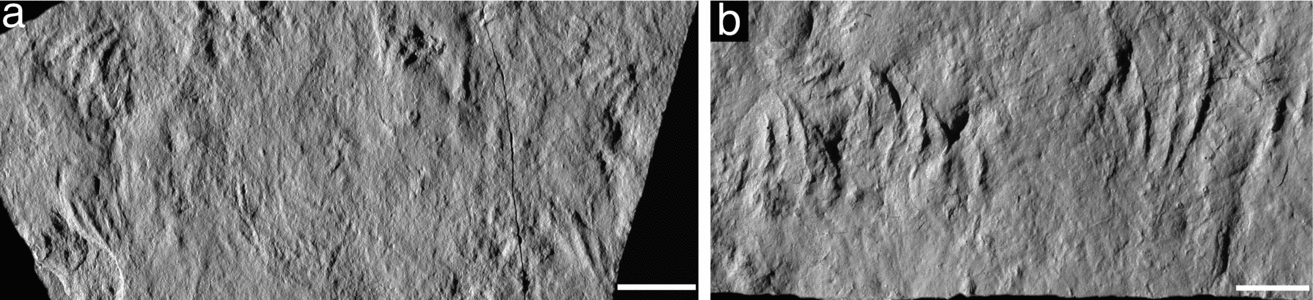
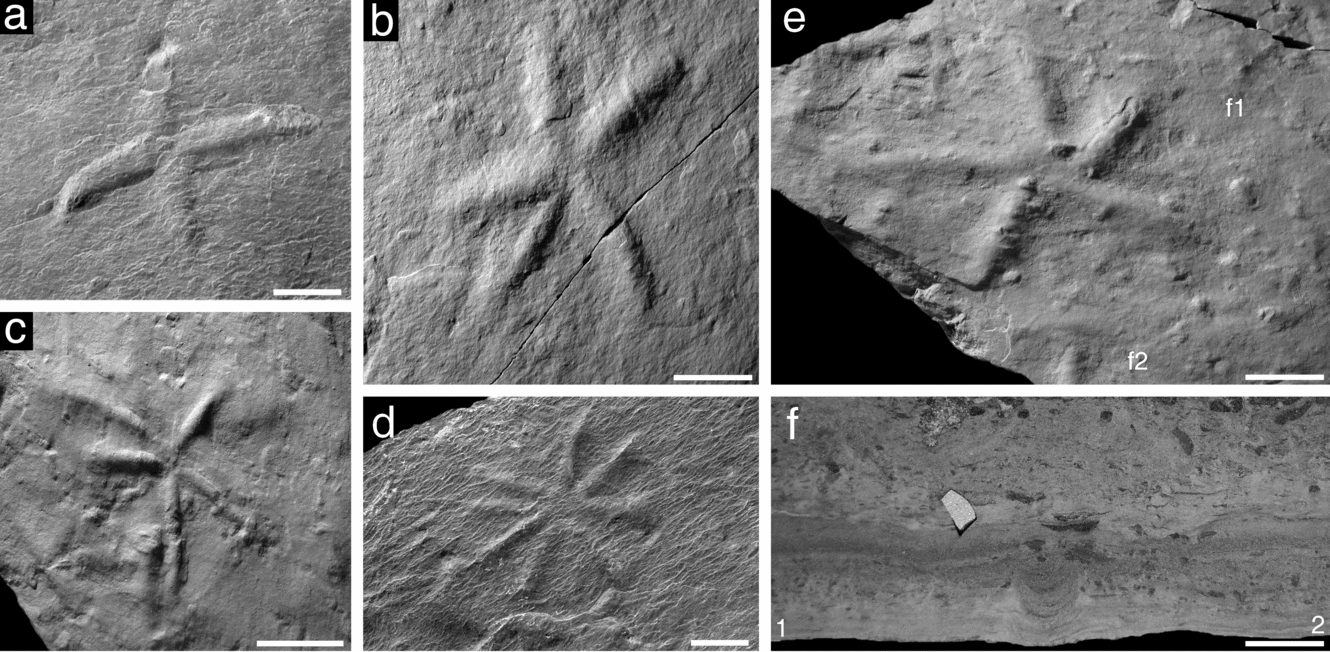
Outcrops east of Los Alares village (Fig. 1c) contain exposures of the upper unit of the Pusa Formation, including sandstone-rich portions intercalated within the typical siltstone facies (Appendix Fig. A2d, g at http://multimediafluids.uam.elogim.com/journals/geo). This includes matrix-rich sandstone beds but also prominent banks of quartz arenite. There is a general similarity in facies to the Azorejo Formation, but mapping demonstrates that this sandier interval is enclosed in facies typical of the upper part of the Pusa Formation (Figs 1c, 3b) (Nozal Martín & Martín Serrano, Reference Nozal Martín and Martín Serrano1989). The large ribbon-like trace fossil Psammichnites gigas occurs in this sandstone-rich interval, together with Rusophycus cf. avalonensis and other arthropod-type trace fossils (Fig. 6a, b). Seilacher (Reference Seilacher1997, pl. 23; Reference Seilacher2007, pl. 27) has illustrated spectacular P. gigas from this locality. The star-shaped trace fossil Dactyloidites isp. occurs at several levels (Figs 3b, 7), some in close stratigraphical proximity to the Azorejo Formation on the south side of the synclinal structure NE of Los Alares. Teichichnus is common and Treptichnus isp. also occurs.
Arthropod-type trace fossils from the upper unit of the Pusa Formation along Estenilla River, SE of Los Alares. (a) Rusophycus isp., consisting of shallow paired sets of arched scratch marks preserved in negative relief on bed top. Photograph of epoxy cast. UEXP709Al1:001. (b) Scratch-marks preserved in negative relief on top of bed. Photograph of epoxy cast. UEXP709Al1:002. Scale bars are 20 mm.

Dactyloidites isp. from the upper unit of the Pusa Formation, NE of Los Alares (b, c, e, f) and west of Robledo del Buey (a, d). All preserved on bed base. Letter and number combinations on (e) correspond to numbers on polished section in (f). (f) Polished vertical section of specimen in (e) showing that the radiating rays seen on bedding-planes are vertical retrusive spreiten. Also note large pyrite crystal. Scale bars are 20 mm in (a–c, e–f) and 10 mm in (d). (a) UEXP683Rb4:003; (b) UEXP709Al2:001; (c) UEXP709Al2:002; (d) UEXP709Rb4:001; (e) UEXP709Al2:003.

3.c. Piedraescrita
Dark laminated mudstone and siltstone typical of the middle unit of the Pusa Formation crops out in the area of Piedraescrita (Fig. 1c). Also typical for the middle unit is the occurrence in the section of carbonaceous filamentous fossils (Appendix Fig. A1a, b at http://multimediafluids.uam.elogim.com/journals/geo). Further up-section are siltstone and fine sandstone typical of the upper unit of the Pusa Formation. Slumped bedding is common and there are, apparently lenticular, sandstone-dominated intervals comparable to those in the area of Los Alares (Fig. 3b).
3.d. Robledillo
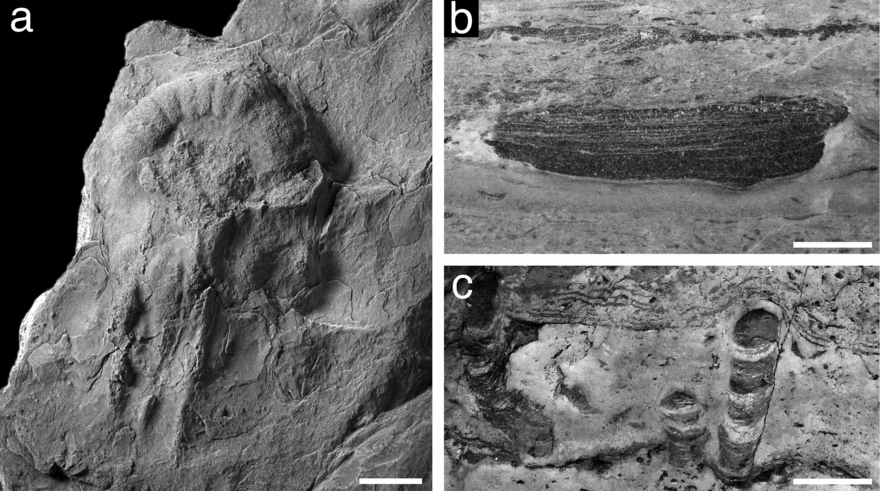
Outcrop of the Azorejo Formation on a minor road leading east from the village of Robledillo (Fig. 1c) can be traced laterally to outcrops of the Azorejo Formation NW of Robledo del Buey. This section yields trace fossils, including Astropolichnus hispanicus (Fig. 8a), a form typical of the Azorejo Formation.
Trace fossils from the Azorejo Formation (a) and upper unit of the Pusa Formation (b, c). (a) Astropolichnus hispanicus from road section east of Robledillo. The three ridges lining up with the central area of the trace fossils are post-depositional deformational structures caused by movement of a lower sand bed over the central plug. UEXP683Ro1:004. (b) Vertical spreiten. From same locality as Dactyloidites isp. in Figure 7e. UEXP709Al2:004 (c) Field photograph of retrusive teichichnids from section along Pusa River, south of Robledo del Buey. Scale bars are 10 mm in (a–c).

4. Description of selected fossils
The synonymy lists are limited to reports from the area of the Toledo Mountains. Figured material is housed in the collections of Área de Paleontología, Universidad de Extremadura, Badajoz.
4.a. Trilobites
Order REDLICHIIDA
Family abadiellidae Hupé, Reference Hupé1953
cf. Abadiella bourgini Hupé, Reference Hupé1953
Figure 5a–g, i
1999 aff. Hupetina; Palacios et al. a, p. 256 (mentioned in text).
1999 aff. Bigotinops; Palacios et al. b, p. 1017 (mentioned in text).
1999 Bigotinops sp.; Liñán in Vidal et al. p. 141 (mentioned in text).
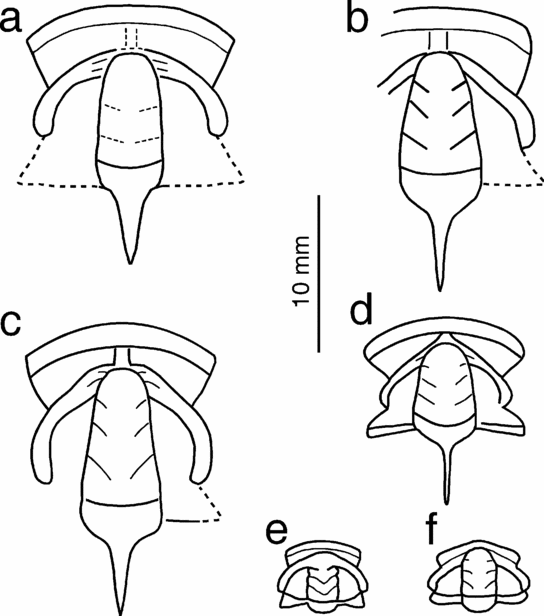
Material and description. The description is based on five reasonably well-preserved, but tectonically deformed, cranidia (specimens in Fig. 5a–d have antero-posterior deformation), consisting of internal and external moulds, from localities B and C at Robledo del Buey (see Fig. 3a). The glabella is long (70–75 % of length of cranidia), relatively narrow, parallel-sided or gently forward-tapering with a relatively blunt anterior end. Glabellar furrows are faintly marked and backwardly directed (Fig. 5a, c). The preglabellar field is wide, in some specimens with a faint medial ridge or depression. The anterior border is upturned, though this may be exaggerated by compaction in some specimens (Fig. 5b, d). The eye ridge is gently curved to arcuate, wider towards the glabella, apparently becoming three-ridged, with the anterior branch sometimes forming a faint parafrontal band. The interocular area is wide and swollen. There is a stout occipital spine (Fig. 5a, f, g). The cranidia are covered with a prominent reticulate pattern of low ridges forming cells about 100 μm wide. This reticulate pattern is particularly strongly developed on the occipital ring and occipital spine (Fig. 5f, g). The pleura are spinous with deep furrows. There is no information on hypostome or pygidium.
Remarks. Because information about these trilobites is mostly limited to the dorsal part of relatively poorly preserved cranidia, their affinity must remain tentative. The material does, however, show a number of characters that make it possible to narrow down their affinities among early trilobites (Fig. 9). This includes a strongly raised, relatively long and narrow glabella with faint glabellar furrows, a raised interocular area, a wide pre-glabellar field, a faint parafrontal band and a strong occipital spine. The state of preservation does not make it possible to recognize facial lines, which is considered an important taxonomic character by some workers. The majority of the characters mentioned above can be found in Abadiella bourgini from the Lower Cambrian of Morocco (Fig. 9b, c). Pillola (Reference Pillola1993) suggested that Abadiella, Lunolenus and Granolenus could be included in a strictly defined Abadiellidae. We suggest that comparison of the Pusa Formation trilobites should be made with trilobites in this group rather than with the small bigotinids Hupetina antiqua and Bigotinops from the Eofallotaspis Zone in Morocco, as previously suggested (Fig. 9e, f). Overall, the morphological features of the present material fit well with the diagnosis of Abadiella provided by Jell (Reference Jell, Bengtson, Conway Morris, Cooper, Jell and Runnegar1990), who considered the differences between Hupé's (1953) two Moroccan species of Abadiella to be preservational. A striking and apparently unique feature of the Robledo del Buey material is the prominent reticulate surface sculpture. According to Zhang et al. (Reference Zhang, Babcock, Xiang, Sun, Luo and Jiang2001), Moroccan Abadiella have a surface sculpture of small but variably sized granules, and Jell (Reference Jell, Bengtson, Conway Morris, Cooper, Jell and Runnegar1990) reported a similar surface sculpture on Australian material of Abadiella houi. A reticulate surface pattern is found in many olenellids but, to the best of our knowledge, a similarly prominent reticulate patern is not known from Lower Cambrian redlichids, which typically have a granular or punctate surface. Among Lower Cambrian trilobites from Spain, comparison can be made with Lunolenus lunae from the upper part of the Herrería Formation (Fig. 9d). However, L. lunae has a more prominent parafrontal band and plectrum, more pronounced glabellar furrows and a more slender occipital spine. Poorly preserved material of Granolenus midi has been reported from the Navalucillos Formation by Gil Cid (Reference Gil Cid1988), who remarked that it shows some similarities to Lunolenus but differs in the absence of occiptal spine and in having a less well marked preglabellar area, features that also set it apart from the Robledo del Buey material. Given the limited information available from the present material and the uncertain relationships among early redlichids (such as the relationship between Abadiella and Wutingaspis, e.g. Jell, Reference Jell, Bengtson, Conway Morris, Cooper, Jell and Runnegar1990; Zhang et al. Reference Zhang, Babcock, Xiang, Sun, Luo and Jiang2001; Jago, Lin & Dunster, Reference Jago, Lin and Dunster2002; Paterson & Brock, Reference Paterson and Brock2007), we propose that the Robledo del Buey trilobites represent either a new genus close to Abadiella, or a new species within this genus.
Schematic interpretative drawing of trilobite from the upper unit of the Pusa Formation (a), compared to selected Lower Cambrian trilobites from Spain and Morocco. (b) Abadiella bourgini from Morocco (based on Hupé, Reference Hupé1953, fig. 45:2). (c) Abadiella meteora from Morocco (based on Hupé, Reference Hupé1953, fig. 45:3). (d) Lunolenus lunae from northern Spain (based on Sdzuy, Reference Sdzuy1959, pl. 1, fig. 2). (e) Bigotinops dangeardi from Morocco (based on Hupé, Reference Hupé1953, fig. 49). (f) Hupetina antiqua from Morocco (based on Sdzuy, Reference Sdzuy1978, fig. 2b).

4.b. Trace fossils
Ichnogenus Dactyloidites Hall, Reference Hall1886
Dactyloidites isp.
Figure 7
1996 Asteriacites; Palacios & Vidal a, p. 179 (mentioned in text).
1996 Asteriacites; Palacios & Vidal b, p. 26 (mentioned in text).
1999 Asteriacites; Vidal et al. p. 138 (mentioned in text).
1999 Dactyloidites ichnosp.; Palacios et al. a, p. 265 (mentioned in text).
1999 Dactyloidites ichnosp.; Palacios et al. b, p. 1017 (mentioned in text).
2000 Dactyloidites ichnosp.; Gámez Vintaned et al. p. 96 (mentioned in text).
Material and description. Star-like trace fossils 3–8 cm wide consisting of radially arranged vertical retrusive spreiten occur at various levels of the upper part of the Pusa Formation (Fig. 3b). Among the eight best-preserved specimens there are two with four rays (Fig. 7a), five with five rays (Fig. 7b, c) and one specimen with eight, or possibly nine, rays (Fig. 7d). Rays range from narrow to swollen, depending on the specimen. The presence of a spreite is not obvious in bedding plane view (Fig. 7a–d) but is evident in sectioned material (Fig. 7f). There is no evidence on how, or indeed if, the spreiten are connected in the central area of each trace fossil.
Remarks. The type ichnospecies Dactyloidites asteroides from the upper Lower Cambrian Middle Granville Formation (terminology of Landing, Reference Landing and Landing2007) of New York State has been reconstructed as radially arranged, curved, protrusive spreiten (Fürsich & Bromley, Reference Fürsich and Bromley1985). The Pusa Formation material shows greater similarity to Fürsich & Bromley's (Reference Fürsich and Bromley1985) reconstruction of Dactyloidites canyonensis, as radially arranged relatively low retrusive spreiten. However, Dactyloidites canyonensis has been convincingly reinterpreted as a pseudofossil (e.g. Runnegar & Fedonkin, Reference Runnegar, Fedonkin, Schopf and Klein1992). Gámez Vintaned et al. (Reference Gámez Vintaned, Liñán, Mayoral, Dies, Gozalo and Muñiz2006) redescribed the star-shaped trace fossil Dactyloidites cabanasi (Meléndez in Cabanás, Reference Cabanás1966) from the Lower Cambrian Pedroche Formation of the Córdoba area, southern Spain. In their diagnosis of Dactyloidites cabanasi, Gámez Vintaned et al. (Reference Gámez Vintaned, Liñán, Mayoral, Dies, Gozalo and Muñiz2006) reported that this species has four to six radial horizontal retrusive spreiten connected to a narrow central shaft. The Córdoba material has wider rays (lobes), but as discussed above, this feature is quite variable in the Pusa Formation material. Gámez Vintaned et al. (Reference Gámez Vintaned, Liñán, Mayoral, Dies, Gozalo and Muñiz2006) tentatively suggested that the Pusa Formation material be included in Dactyloidites cabanasi. If differences in the shape of the rays is assigned minor importance, then the majority of Cambrian radial spreite burrows could probably be grouped into Dactyloidites asteroides or Dactyloidites cabanasi, based on whether they have protrusive or retrusive spreiten. The Pusa material also compares well with Seilacher's (Reference Seilacher2007, pl. 41) reconstruction of Teichichnus stellatus as radially arranged, moderately curved retrusive spreiten. It might, however, be preferable to restrict Teichichnus to simple spreiten and consider the radial arrangement of the spreiten as an ichnogeneric characteristic. Nevertheless, because of the uncertain relationships between Dactyloidites asteroides, D. cabanasi and Teichichnus stellatus we refer the Pusa Formation material to Dactyloidites isp. Spreiten without obvious radial arrangement but otherwise identical to those of Dactyloidites were observed in sectioned slabs (Fig. 8b) and in outcrop (Fig. 8c). They may represent Teichichnus but could also be parts of Dactyloidites isp.
Star-shaped trace fossils comparable to the material described herein also occur in the upper part of the Lower Cambrian Tamames Sandstone Formation, south of Salamanca (Díez Balda, Reference Díez Balda1986, pl. 6c; Rodríguez Alonso et al. Reference Rodríguez Alonso, Alonso Gavilán, Liñán, Gámez Vintaned, Pérez García, Rodríguez Alonso and Alonso Gavilán1995)
Ichnogenus Rusophycus Hall, Reference Hall1852
Rusophycus cf. avalonensis
Figure 6a
2006 Rusophycus cf. bonnarensis; Jensen et al. p. 35 (mentioned in text).
2007 Rusophycus bonnarensis; Jensen, Palacios & Martí Mus, p. 226 (mentioned in text).
Material and description. Large Rusophycus specimens consisting of paired, separate, bundles of shallow curved grooves preserved on upper bedding plane of micaceous horizontally laminated fine-grained sandstone from the upper unit of the Pusa Formation in the area of Los Alares. On one slab there are two Rusophycus, both about 6 cm wide and 2 mm deep, 10 cm apart but with a similar orientation and they line up along an imaginary mid-line (Fig. 6a). The sediment between these two Rusophycus has faint curved grooves suggesting that they were made by the same individual.
Remarks. We previously (Jensen et al. Reference Jensen, Palacios, Martí Mus, Contreras Sánchez and Cortijo2006; Jensen, Palacios & Martí Mus, Reference Jensen, Palacios, Martí Mus, Vickers-Rich and Komarover2007) compared this material to Rusophycus bonnarensis because they are large Rusophycus with a somewhat moustache-like arrangement of the two lobes. The type material of Rusophycus bonnarensis comes from the Lower Cambrian Herrería Formation of northern Spain (Crimes et al. Reference Crimes, Legg, Marcos, Arboleya, Crimes and Harper1977), and the ichnospecies has also been reported from the Random Formation of Newfoundland (Crimes & Anderson, Reference Crimes and Anderson1985). The Pusa Formation Rusophycus have substantially shallower (2 mm as opposed to 2 cm) lobes than the specimens from the Herreria Formation, although this could possibly be preservational. In being large shallow Rusophycus, with poorly defined, often separate lobes, this material is arguably more similar to Rusophycus avalonensis (Crimes & Anderson, Reference Crimes and Anderson1985). However, the diagnosis of this ichnospecies refers to fine scratch marks in bundles of five or more (Crimes & Anderson, Reference Crimes and Anderson1985), not clearly observable on the Pusa Formation material. Given the relatively poor preservation of Pusa Formation material, we refer to these trace fossils as Rusophycus cf. avalonensis.
On the same bedding surfaces as the large Rusophycus there are non-paired bundles of three to five, parallel or diverging, grooves (Fig. 6b). A further arthropod-type trace fossil on these surfaces consists of rows of at least seven filled circular depressions, some of which connect to long sharp ridges.
5. Discussion
5.a. Biochronology of the upper part of the Pusa Formation
With the assemblage of fossils described here it is now possible to constrain the age of the trilobite-bearing upper unit of the Pusa Formation. Although the Pusa Formation trilobite material is left in open nomenclature, we propose comparison with Abadiella. The stratigraphical range of Abadiella bourgini in Morocco, given by Hupé (Reference Hupé, Asklund and Paulsen1960, fig. 1), spans the Daguinaspis and Antatlasia hollardi zones, which Geyer & Landing (Reference Geyer and Landing2004) correlate to the upper part of the Ovetian (Fig. 2). No directly comparable trilobites have been reported from the Lower Cambrian of Spain, but the Upper Ovetian Lunolenus from the upper part of the Herrería Formation in the Cantabrian Mountains share some morphological features with the Pusa Formation trilobites. Among the small shelly fossils, the decollating tubular fossil Cupitheca has also been described (as Actinotheca) from the lower part of the Lower Ovetian Pedroche Formation in the Córdoba area (Fernández Remolar, Reference Fernández-Remolar1999, Reference Fernández-Remolar, Gámez Vintaned, Liñán and Valenzuela–Río2005). On a global scale, Cupitheca holocyclata has a stratigraphical range that spans the Atdabanian and Botoman (e.g. Wrona, Reference Wrona2003), and we are not aware of older records of this genus. The helcionellid Pelagiella (Fig. 5g) has also been reported from the Pedroche Formation of the Córdoba area (Fig. 2), where it occurs with additional helcionellid taxa known from the upper Atdabanian of Siberia (Gubanov, Fernández-Remolar & Peel, Reference Gubanov, Fernández-Remolar and Peel2004). All species of Pelagiella are post-Tommotian. The information from small shelly fossils and trilobites shows that the trilobite-bearing portion of the upper unit of the Pusa Formation is Ovetian.
An upper age constraint on the Pusa Formation trilobites is provided by fossils from the Navalucillos Formation, which in its lower part contains Granolenus midi (Gil Cid, Reference Gil Cid1988; Liñán & Gámez-Vintaned, Reference Liñán and Gámez Vintaned1993). This trilobite was first described from the Pardailhan Formation of Montagne Noire, southern France, which contains Botoman-age archaeocyathans (see Courtessole & Jago, Reference Courtessole and Jago1980; Vizcaïno, Alvaro & Monceret, Reference Vizcaïno, Álvaro and Monceret2004). Higher in the Navalucillos Formation there are archaeocyathans, which in a recent synthesis are assigned to archaeocyathan Zone VI (represented by Anthomorpha) and the more diverse archaeocyathan Zone VII (comprising 12 genera), both Upper Ovetian, and respectively correlated to the lower and middle part of the Botoman Stage (Perejón & Moreno-Eiris, Reference Perejón and Moreno-Eiris2006). Perejón & Moreno-Eiris (Reference Perejón and Moreno-Eiris2006) considered Granolenus midi a trilobite characteristic of archaeocyathan Zone VI. Other authors (e.g. Liñan et al. Reference Liñán, Dies, Gámez Vintaned, Gozalo, Mayoral and Muñiz2005) have placed Granolenus midi in archaeocyathan Zone IV (basal Upper Ovetian), although the reasoning behind this is not known to us. In addition to its occurrences in the Navalucillos Formation, this trilobite has been reported, as Granolenus cf. midi, from the upper part of the Tamames Sandstone Formation, south of Salamanca, where it has been found a short stratigraphical distance below archaeocyathans of Zone VI (Rodríguez Alonso et al. Reference Rodríguez Alonso, Alonso Gavilán, Liñán, Gámez Vintaned, Pérez García, Rodríguez Alonso and Alonso Gavilán1995). The Navalucillos Formation is Upper Ovetian, with its basal part probably middle Upper Ovetian. The biostratigraphical information from the Azorejo Formation is limited to the trace fossil Astropolichnus hispanicus. In southern Europe, Astropolichnus hispanicus is an index fossil for the Ovetian, with an upper range in the middle Upper Ovetian (Pillola et al. Reference Pillola, Leone, Gámez-Vintaned, Liñán, Dabard, Chauvel, Matteucci, Carboni and Pignatti1994; Vizcaïno, Álvaro & Monceret, Reference Vizcaïno, Álvaro and Monceret2004). In the region of the Toledo Mountains, Astropolichnus hispanicus has been reported from the Azorejo Formation at Gevalo River, Robledillo and Navas de Estena (Fig. 1b) (Moreno, Vegas & Marcos, Reference Moreno, Vegas and Marcos1976; Crimes et al. Reference Crimes, Legg, Marcos, Arboleya, Crimes and Harper1977; Pillola et al. Reference Pillola, Leone, Gámez-Vintaned, Liñán, Dabard, Chauvel, Matteucci, Carboni and Pignatti1994; this paper). Zamarreño, Vegas & Moreno (Reference Zamarreño, Vegas and Moreno1976) mentioned a possible further occurrence of Astropolichnus in quartzitic beds of the Azorejo Formation south of Los Navalucillos, but the material has not been illustrated or described. The occurrence of Astropolichnus hispanicus in the Azorejo Formation has in several correlation charts been plotted in a basal Lower Ovetian position (e.g. Liñán et al. Reference Liñán, Gozalo, Palacios, Gámez Vintaned, Ugidos, Mayoral, Gibbons and Moreno2002, fig. 3.2; Reference Liñán, Perejón, Gozalo, Moreno-Eiris and de Oliveira2004, fig. 2). However, the revised age for the upper part of the Pusa Formation suggests that they are younger.
The stratigraphical information from trace fossils in the upper part of the Pusa Formation also merits comment, in particular the occurrence of Psammichnites gigas, Rusophycus cf. avalonensis. and Dactyloidites isp., an estimated 200 m down-section of the trilobite-bearing levels. Álvaro & Vizcaïno (Reference Álvaro and Vizcaïno1999) reviewed the stratigraphical distribution of Psammichnites gigas and concluded that in SW Europe this trace fossil is upper Corduban–middle Ovetian. The occurrence of Rusophycus reported here from the Pusa Formation is the stratigraphically lowest record of this trace fossil in the Toledo Mountains to date (Figs 2, 10). In terms of the Iberian chronostratigraphical framework, this indicates Upper Corduban or higher. The star-shaped trace fossil Dactyloidites isp. occurs at various levels within the upper part of the Pusa Formation in sections near Los Alares, and also about 2 km west of Robledo del Buey, at a level probably corresponding to that of the trilobites. There is no record of Dactyloidites, or Teichichnus, below the upper unit of the Pusa Formation. Simple spreiten-burrows are known from Tommotian-age strata worldwide, but the radially arranged spreiten-burrows that we are aware of are all Atdabanian (trilobite-bearing) or younger (e.g. Alpert, Reference Alpert1976; Landing, Reference Landing and Landing2007; Luchinina & Meshkova, Reference Luchinina, Meshkova and Zhuravleva1969). No firm conclusions can be drawn on the basis of this trace fossil assemblage, which could be Upper Cordubian or Lower Ovetian.
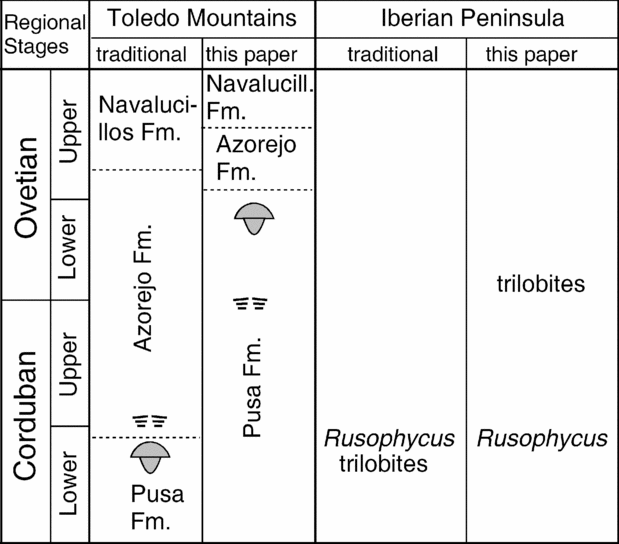
Diagram showing differences between traditional schemes (e.g. Liñán et al. Reference Liñán, Gozalo, Palacios, Gámez Vintaned, Ugidos, Mayoral, Gibbons and Moreno2002; Gozalo et al. Reference Gozalo, Liñán, Palacios, Gámez Vintaned and Mayoral2003) and that proposed here for the biochronological context of the lowest occurrences of trilobites and Rusophycus in the Toledo Mountains, and broader implications for the definition of Iberian Lower Cambrian stages.

The combined biostratigraphical evidence shows that the trilobite-bearing levels of the Pusa Formation are Ovetian, and, more tentatively, upper Lower Ovetian, without excluding the possibility that they are lower Upper Ovetian. Future work on archaeocyathans in the upper unit of the Pusa Formation, first reported by Palacios, Eguiluz & Martí (Reference Palacios, Eguíluz, Martí, Álvaro and Clausen2002), might provide additional insight into whether it is Lower Ovetian (archaeocyathan zones I-III) or Upper Ovetian (archaeocyathan zones IV-VII). The revised age for the upper part of the Pusa Formation results in the Azorejo Formation being entirely Ovetian (Fig. 10).
5.b. Regional Cambrian chronostratigraphical units
Cambrian regional stages for the Iberian peninsula were developed relatively late but have since been applied also to other European regions such as Italy and Germany. The foundation for the modern usage of these regional stages largely stems from Liñán, Perejón & Sdzuy (Reference Liñán, Perejón and Sdzuy1993) in a paper in which stratotypes and boundary definitions were proposed for Lower and Middle Cambrian stages of the Iberian Peninsula. Recently Geyer & Landing (Reference Geyer and Landing2004) proposed a unified West Gondwanan chronostratigraphical framework and called for abolishing the Ovetian Stage because of an improperly defined basal stratotype and because the current use of the Ovetian differs from that originally proposed by Sdzuy (Reference Sdzuy1971). On the other hand, Geyer & Landing (Reference Geyer and Landing2004) considered the Corduban Stage to be appropriately defined but raised it to the rank of series. We agree in that the definition of the base of the Ovetian is not entirely satisfactory but consider that stratigraphical correlation of the Lower Cambrian within the Iberian Peninsula is more conveniently discussed within the currently existing regional framework. The revised biochronology of the upper part of the Pusa Formation has important consequences for the characterization of the Corduban and Ovetian regional stages and their correlation to other regions, and prompts a critical examination of the definition of the Ovetian and Corduban stages.
5.b.1. The Ovetian Stage
The type region for the Ovetian Stage (sensu Liñán, Perejón & Sdzuy, Reference Liñán, Perejón and Sdzuy1993) is in the Ossa Morena Zone. Liñán, Perejón & Sdzuy (Reference Liñán, Perejón and Sdzuy1993) proposed the La Tierna section in the Córdoba area as the lower boundary reference section for the Ovetian Stage. This was done without direct reference to a horizon or definition, although their figure 5 suggests that it is at the first appearance of archaeocyathans and trilobites in the Pedroche Formation. The La Tierna section consists largely of the siliciclastic Torreárboles Formation, with limestone nodules appearing near the top of the section that have been taken as representing the basal portion of the Pedroche Formation (Liñán Guijarro, Reference Liñán Guijarro1978, fig. 9). However, as pointed out by Geyer & Landing (Reference Geyer and Landing2004, p. 183), there appears to be no published information on archaeocyathans or trilobites from this section. A better suited stratotype section is the Arroyo de Pedroche 1 section (Pedroche Formation), which Liñán, Perejón & Sdzuy (Reference Liñán, Perejón and Sdzuy1993) considered a hypostratotype for the lower part of the Ovetian Stage. From this section, Liñán et al. (Reference Liñán, Dies, Gámez Vintaned, Gozalo, Mayoral and Muñiz2005) described Lemdadella linaresae, L. perejoni, Bigotina bivallata and Eoredlichia cf. ovetensis from the archaeocyathan Zone III, and recorded cf. Bigotinella close to the base of the section in strata assigned to archaeocyathan Zone I. A disadvantage with this section is that a short distance below the lowest trilobites there is a covered interval, and below this are andesites of the San Jeronimo Formation, which makes its relation to the La Tierna section problematic. No boundary level has been defined for the base of the Ovetian but it can be inferred to be close to the base of the Arroyo de Pedroches 1 section. The temporal and spatial relationship of this level to the Torreárboles Formation needs further consideration but it is suggested here that the Torreárboles and Pedroche formations are, at least in part, time equivalent (Fig. 2). Correlation of the base of the Ovetian across Iberia is not straightforward, as archaeocyathan Zone I (as well as II and III) has been recognized exclusively from the Córdoba area, and the record of basal Ovetian trilobites is sparse outside this area.
There have been different opinions about how to correlate the Lower Ovetian Iberian archaeocyathan zones to those of Siberia. Perejón & Moreno-Eiris (Reference Perejón and Moreno-Eiris2006) correlated the Iberian archaeocyathan Zone I to the lower part of the first Atdabanian zone, whereas Debrenne & Debrenne (Reference Debrenne, Debrenne, Geyer and Landing1995) suggested that it correlates to the upper part of this zone. The trilobites Bigotina, Lemdadella and Eoredlichia occur in archaeocyathan Zone III in the Córdoba area, which Perejón & Moreno-Eiris (Reference Perejón and Moreno-Eiris2006) correlated to the second zone of the Atdabanian, whereas Geyer & Landing (Reference Geyer and Landing2004) correlated the Bigotina-bearing levels in the Córdoba area to the Choubertella Zone in Morocco, which they correlated to the third archaeocyathan zone of the Atdabanian. Gubanov, Fernández-Remolar & Peel (Reference Gubanov, Fernández-Remolar and Peel2004) described helcionellid molluscs including Aldanella iberica, Pelagiella adunca, Michniakia minuta and Bestashella tortilis, from sections at Cerro de Las Ermitas and Pay-Jimenez, and noted that the last three species occur in northern Siberia in a late Atdabanian community. Both of these sections contain archaeocyatha but we are not aware of specific information relating the small shelly fossils to the archaeocyathan zones I, II or III, all of which have been reported from these sections. However, if proximity to the base of the section is considered, it appears likely that these small shelly fossils appear already in archaeocyathan Zone I.
5.b.2. The Corduban Stage/Series
Liñán, Peréjon & Sdzuy (Reference Liñán, Perejón and Sdzuy1993) proposed the Rio Huso section near La Nava de Ricomalillo (Fig. 1b) as a stratotype section for the base of the Corduban Stage, positioned at the first occurrence of the arthropod-type trace fossil Monomorphichnus lineatus. The base of the Corduban, as defined in the Rio Huso section, has been suggested to correspond to the base of the Cambrian, as defined at the GSSP in Newfoundland (e.g. Liñán et al. Reference Liñán, Gámez Vintaned, Gozalo, Dies and Mayoral2006), but it probably is somewhat younger (see Jensen, Palacios & Martí Mus, Reference Jensen, Palacios, Martí Mus, Vickers-Rich and Komarover2007). Liñán, Peréjon & Sdzuy (Reference Liñán, Perejón and Sdzuy1993) recognized a Lower and Upper Corduban with the latter coinciding with the appearance of Rusophycus. More specifically, Gámez Vintaned & Liñán (Reference Gámez Vintaned, Liñán, Liñán, Gámez Vintaned and Gozalo1996) recognized the appearance of Rusophycus avalonensis (also reported as Rusophycus fasciculatus) or Rusophycus bonnarensis, followed at a somewhat higher stratigraphical level by Cruziana cantabrica, as characterizing the Upper Corduban. No stratotype has been specified to define the base of the Upper Corduban, but Liñán, Perejón & Sdzuy (Reference Liñán, Perejón and Sdzuy1993, fig. 4) plotted a Lower/Upper Corduban boundary at the appearance of Rusophycus in the Torreárboles Formation in the La Tierna section, which was considered a stage reference stratotype. The Torreárboles Formation contains no diagnostic body fossils, and the coarse-grained, marginal marine lower part has a poor trace fossil record. As stated by Fedonkin, Liñán & Perejón (Reference Fedonkin, Liñán and Perejón1985), the increased diversity of trace fossils in the upper part of the Torreárboles Formation in this section is clearly a matter of permissive facies. Indeed, the age of the earliest Rusophycus in the Iberian Peninsula merits further study, considering that there are limited independent age constraints for many of the occurrences (see Fig. 2). Relevant to this question is that the basal part of the Rusophycus-bearing Torreárboles Formation in the Ossa Morena zone may be younger than about 522 Ma, on the basis of underlying volcanic units and reworked zircons (Bandres et al. Reference Bandres, Eguíluz, Gil Ibarguchi and Palacios2002). This would place the earliest Rusophycus in the Ossa Morena Zone in a time range close to, or younger than, widely cited dates for the earliest trilobites globally (e.g. Geyer & Shergold, Reference Geyer and Shergold2000), whereas on a global scale the first Rusophycus are thought to be substantially older. Recent chronostratigraphical correlation schemes of the Iberian peninsula have placed the lowest occurrence of trilobites below the first occurrence of Rusophycus (e.g. Gozalo et al. Reference Gozalo, Liñán, Palacios, Gámez Vintaned and Mayoral2003, fig. 3; Liñán et al. Reference Liñán, Dies, Gámez Vintaned, Gozalo, Mayoral and Muñiz2005, fig. 8; Liñán et al. Reference Liñán, Gozalo, Díes Álvarez, Gámez Vintaned and Zamora2008, fig. 1). This, however, was based solely on the Pusa Formation trilobites (e.g. Liñán et al. Reference Liñán, Gozalo, Palacios, Gámez Vintaned, Ugidos, Mayoral, Gibbons and Moreno2002, fig. 3.2; Reference Liñán, Perejón, Gozalo, Moreno-Eiris and de Oliveira2004, fig. 2), but as shown here these trilobites are not Corduban (Fig. 10).
The lowest record of Rusophycus is a potentially important level for subdivison of the Corduban. However, on present evidence, the appearance of Rusophycus in Spain is poorly constrained.
6. Conclusions
(1) A detailed examination of the fossil record in the upper unit of the Lower Cambrian Pusa Formation, Toledo Mountains, central Spain, demonstrates that it is substantially younger than previously thought. In terms of Iberian Lower Cambrian regional stages, the trilobite-bearing upper unit of the Pusa Formation is Ovetian, not Corduban. The presence of trilobites in the Corduban was based solely on the occurrences in the upper part of the Pusa Formation.
(2) The trilobites in the upper unit of the Pusa Formation were potentially among the oldest worldwide, but this notion can no longer be maintained. These trilobites are described under open nomenclature but probably represent a new genus close to Abadiella Hupé, Reference Hupé1953, or a new species of this genus.
(3) The most complete Corduban sections are located in the Central Iberian Zone. In the Ossa Morena Zone, possibly only the upper part of the Corduban Stage is represented. This raises questions as to the age of the oldest Rusophycus in the Ossa Morena Zone and in Spain in general.
Acknowledgements
We gratefully acknowledge funding from the Spanish Ministry of Education and Sciences (MEC) through Programa Ramon y Cajal and projects CGL-2004-02967/BTE (co-financed by FEDER) and CGL-2008-04373/BTE (co-financed by FEDER). Olaf Elicki and Eladio Liñán are thanked for their constructive reviews, and Jane Holland and Lori Snyder for invaluable editorial assistance in the preparation of this paper.