1. INTRODUCTION
The interaction of intense laser beams with plasmas is a topic of current research interest (Kulagin et al., Reference Kulagin, Cherepenin, Hur, Lee and Suk2008; Nakamura et al., Reference Nakamura, Mima, Sakagami, Johzaki and Nagatomo2008) for many applications including laser fusion (Deutsch et al., Reference Deutsch, Furukawa, Mima, Murakami and Nishihara1996, Reference Deutsch, Bret, Firpo, Gremillet, Lefebvre and Lifschitz2008; Hora, Reference Hora2007), plasma based charged particle accelerators (Mckenna et al., Reference Mckenna, Carroll, Lundh, Nurnberg, Markey, Bandyopadhyay, Batani, Evans, Jafer, Kar, Neely, Pepler, Quinn, Redaelli, Roth, Wahlstrom, Yuan and Zepf2008; Xie et al., Reference Xie, Aimidula, Niu, Liu and Yu2009), and new radiation sources (Jonathan, Reference Jonathan1994; Modena et al., Reference Modena, Najmudin, Dangor, Clayton, Marsh, Joshi, Malka, Darrow, Danson, Neely and Walsh1995; Bingham et al., Reference Bingham, Mendonca and Shukla2004; Hong et al., Reference Hong, He, Wen, Du, Teng, Qing, Huang, Huang, Liu, Wang, Huang, Zhu, Ding and Peng2009; Bessonov et al., Reference Bessonov, Gorbunkov, Ishkhanov, Kostryukov, Maslova, Shvedunov, Tunkin and Vinogradov2008). There has been much less study of the laser plasma interactions at high power lasers in magnetized plasma. It has been seen that intense magnetic fields are generated in the laser plasma interaction (Fuchs et al., Reference Fuchs, Malka and Adam1998). These fields affect the propagation of laser pulses in plasma since the canonical momentum for magnetized plasma interacting with radiation is not conserved, as in the case of unmagnetized plasma (Rena & Mori, Reference Rena and Mori2004; Jha et al., Reference Jha, Mishra, Upadhyaya and Raj2006).
Magnetic fields play an important role in many nonlinear interactions such as excitation of an upper hybrid waves (UHW) to heat the plasma near upper hybrid frequency (Sodha et al., 1979a, 1979b; Purohit et al., Reference Purohit, Chauhan and Sharma2008a, Reference Purohit, Chauhan and Sharma2008b), radiation from Cerenkov wakes (Yoshii et al., Reference Yoshii, Lai, Katsouleas, Joshi and Mori1997; Spence et al., Reference Spence, Katsouleas, Muggli, Mori and Hemker2001), collective particle accelerators, modulation instability (Jha et al., Reference Jha, Kumar, Raj and Upadhyay2005) and could play a role in the fast ignition scheme in inertial confinement fusion (ICF) (Borghesi et al., Reference Borghesi, Mackinnon, Gaillard, Willi, Pukhov and Meyer-Ter-Vehn1998), in which either self generated or external magnetic fields could be important. Such magnetic fields can be applied externally or they can be self-consistently induced in the plasma as a result of nonlinear self focusing. The effect of such fields on parametric processes in laser produced plasmas has not been widely examined. When a laser beam propagates through plasma embedded in a uniform magnetic field, the plasma electron motion will be modified due to the magnetic field, and will give rise to changes in the dispersion of the laser beam and nonlinear current density. The coupling of an intense radiation field and a plasma is thus of great interest in the case of magnetized plasma. Moreover, the nature and polarization of the incident laser beam also play an important role during laser plasma interaction in magnetized plasma.
Recently, a strong research effort has been focused on the acceleration of electrons to ultrahigh energies. Various schemes are operative for acceleration of electrons by lasers, like beat wave acceleration, Wakefield acceleration, etc. Particularly, in beat wave acceleration scheme, a large amplitude plasma wave can be generated by the beating of two lasers differing frequencies (Δω = ω1 − ω2) by plasma frequency (Mori, Reference Mori1987; Esarey et al., Reference Esarey, Sprangle, Krall and Ting1996; Lindberg et al., Reference Lindberg, Charman, Wurtele and Friedland2004; Shvets, Reference Shvets2004; Filip et al., Reference Filip, Narang and Tochitsky2004). This plasma wave interacts with the plasma particles and transfers its energy to the particles by wave particle interaction (Umstadter, Reference Umstadter2003) and hence the acceleration of particles takes place. Very high power lasers having the powers in relativistic regime are required for the acceleration of electrons through these schemes. Magnetic field also plays an important role in beat-wave acceleration scheme. When two intense laser beams having their electric vector polarized along the static magnetic field propagate perpendicular to the static magnetic field through plasma, the (v × B) force is finite along the direction of propagation at frequency difference (FD) Δω = ω1 − ω2; where v is the drift velocity of electrons in the pump field, B is the magnetic field of the pump wave, and ω1 and ω2 are the angular frequencies of the two laser beams, and the electron motion will be modified due to the magnetic field, which will give rise to changes in the dispersion of the laser beams and nonlinear current density.
Excitation of an UHW has been the motivation for many experimental and theoretical studies because of their impact on the heating of plasma during ICF and particle acceleration (Umeash & Sharma, Reference Umeash and Sharma1979; Sodha et al., Reference Sodha, Maheshwari, Sharma and Kaushik1979; Estabrook & Kruer, Reference Estabrook and Kruer1983). Resonant excitation of the UHW occurs if the FD Δω and the difference of the propagation vector of the two laser beams Δk satisfy the dispersion relation of the UHW. Resonant frequency ranges occupy two frequency domains, if plasma ions are immobile, that is ωLH < ω< min (ωp, ωc) and max (ωp, ωc) < ω< ωUH, where ωLH and ωUH are the lower hybrid and the upper hybrid frequencies, ωp and ωc are the plasma and the electron cyclotron frequencies, respectively. Recently, Krasovitskiy et al. (Reference Krasovitskiy, Turikov and Sotnikov2007) investigated the efficiency of electron acceleration by a short powerful laser pulse propagating across an external magnetic field and analyzed the conditions for the decay of a laser pulse with frequency close to the upper hybrid resonance frequency. Purohit et al. (Reference Purohit, Chauhan and Sharma2008b) studied excitation of the UHW and effect of laser spike on the excitation of an UHW at relativistic laser power. They concluded that the focusing nature of the UHW is highly dependent on the initial power of the laser beam, growth rate of the laser spike and the strength of the magnetic field. Grebogi and Liu (Reference Grebogi and Liu1980) considered the decay of a laser wave into electromagnetic and electrostatic (upper hybrid) waves in a magnetized plasma. They showed that the two plasmon decay growth rate decreases with increasing magnetic field. In a paper by Barr et al. (Reference Barr, Boyd, Gardner and Rankin1984), the effect of a self-induced magnetic field on the Raman and two-plasmon decay instabilities was investigated by numerically solving the nonlinear dispersion relation with allowance for the excitation of an upper hybrid and extraordinary waves. Shukla (Reference Shukla1999) showed that a short, extraordinary polarized laser pulse can generate a large-amplitude upper hybrid wake wave in magnetized plasma. Laham et al. (Reference Laham, Al Nasser and Khateeb1998, Reference Laham, Khateeb, Al Nasser and Odeh2000) considered the decay of an extraordinary wave into two electrostatic waves at frequencies close to the upper hybrid frequency.
Earlier studies (Gill & Sain, Reference Gill and Saini2007; Purohit et al., Reference Purohit, Chauhan and Sharma2008a, Reference Purohit, Chauhan and Sharma2008b) have been focused on the excitation of the UHW by a single laser beam, but no attempt has been made to study the resonant excitation of UHW by two intense laser beams and particle acceleration at relativistic powers. Although Sodha et al. (1979a, 1979b) have studied the resonant excitation of the UHW by two laser beams due to nonlinearities introduced by the ponderomotive force in a collisionless hot magnetoplasma. In this present paper, we investigate the resonant excitation of UHW by two relativistic laser beams that are propagating perpendicular to the static magnetic field and have their electric vectors polarized along the static magnetic field (ordinary mode), and study its role in the acceleration of electrons.
The paraxial approximation theory has been used to study the problem. Other analytical models are now available, such as variational approach (Anderson & Bonnedal, Reference Anderson and Bonnedal1997) and source dependent expansion method (Sprangle et al., Reference Sprangle, Ting and Tang1987). But when more than one beam is involved, these models have not yet been investigated. The present analysis is also applicable to an inhomogeneous magnetoplasma in the Wentzel-Kramers-Brillouin (WKB) approximation.
In Sections 2.1 and 2.2, we present the nonlinear dielectric constant of the magnetoplasma and drive the differential equations governing the nature of the dimensionless beam-width parameters of the laser beams in a magnetoplasma. Resonant excitation of the UHW and electron acceleration is studied in Section 3. A brief discussion and conclusion of the numerical results of the present investigation are presented in Section 4.
2. MODEL EQUATIONS
2.1. Nonlinear Dielectric Constant of the Magnetoplasma
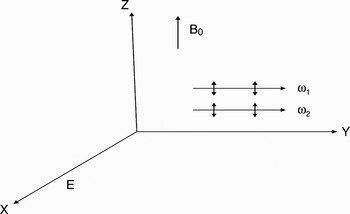
Consider the propagation of two coaxial Gaussian laser beams of frequencies ω1 and ω2 in a collisionless hot magnetoplasma, along a direction perpendicular to a static magnetic field B0 (z direction); the electric vectors of the two beams are polarized along the direction of the static magnetic field (Figure 1). The initial intensity distribution of the beams are given by
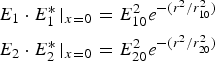
where r is the radial coordinate of the cylindrical coordinate system and r 10 and r 20 are their initial bandwidths. The dielectric constant of the plasma is given by
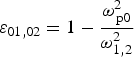
where ωp0 is the plasma frequency given by ωp0 = (4πe2n0/m0γ0)1/2, e is the charge of an electron, m0 is its rest mass, n0 is the density of plasma electrons in the absence of laser beam and γ0 is the relativistic factor given by

The electric vectors of beams polarized along a uniform static magnetic fields and perpendicular to the magnetic field B0.

The nonlinear dielectric constant of the plasma at frequencies ω1 and ω2 (denoted by ɛ1 and ɛ2) is given by

where
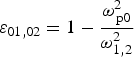
and
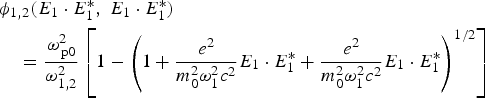
To investigate the cross focusing of two laser beams, we expand the dielectric constant in eq. (4) around r = 0 by Taylor expansion and write

where

and
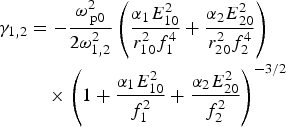
where α1,2 = e 2/m 02ω1,22c 2, E 10 and E 20 are the linearly polarized electric fields of the two laser beams and f 1 and f 2 are the dimensionless beam-width parameters of the laser beams.
2.2. Cross Focusing of Two Laser Beams
The wave equation governing the electric fields of two laser beams in the plasma can be written as

In writing Eq. (6), we have neglected the term ∇(∇ × E), which is justified as long as (ωp02/ω1,22) (1/ɛ1,2) In ɛ1,2 ≪ 1. To solve Eq. (6), we use the paraxial and WKB approximations and assume the solution (Akamanov et al., 1968)

Substituting for E1,2 from Eq. (7) in Eq. (6) and separating the real and imaginary parts, we obtain
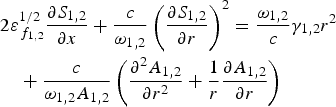
and
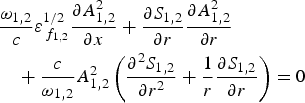
The solutions of eqs. (8a) and (8b) can be written as
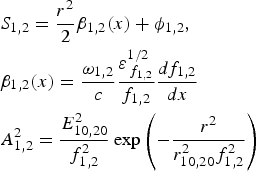
Using Eq. (9) in Eq. (8), the dimensionless beam-width parameter f 1,2 is given by

For an initially (x = 0) plane wave front of the beams, the initial conditions on f 1 and f 2 are

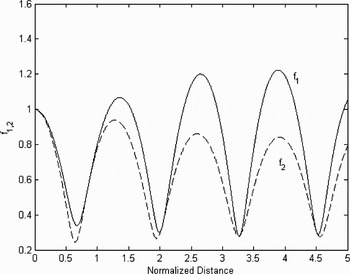
On neglecting the contribution of the second beam in Eq. (10), one can obtain the usual relativistic self focusing of the first beam. With the simultaneous propagation of two laser beams, the self focusing of one beam is affected by the presence of the second laser beam, and cross focusing takes place. The behavior of cross focusing is influenced by the coupling term; this coupling term comes from the expansion of the γ1,2 term in the powers of r 2. Figure 2 depicts the variation of the beam width parameters (f 1,2) of the two laser beams at different laser powers.
Variation of beam width parameters f 1,2 with the normalized distance of propagation (ξ = x/R d = xc/ω1r 12, where R d is the normalizing factor) at αE 012 = 1.25 and αE 022 = 1.5, respectively.

3. RESONANT EXCITATION OF THE UHW
To study the resonant excitation of the UHW by relativistic cross focusing of two high power laser beams in a collisionless hot magnetoplasma, we use the following basic equations:
(i) The continuity equation
(12a)
(ii) The momentum equation
(12b)(iii) Poisson's equation
(12c)
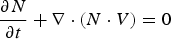
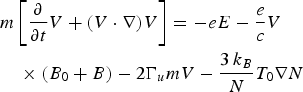

where N is the total electron density, 2Γu is the Landau damping factor (Krall, 1993), B 0 is the static magnetic field, B and E are the sums of the magnetic field vectors and the electric field vectors, respectively, of the two electromagnetic beams and the self consistent field, V is the sum of drift velocities of the electron in the fields of the laser beams and self consistent field of plasma, and other symbols have their usual meaning.
Taking the time derivatives of (12a) and using (12b) and (12c), we obtain the following equation governing the plasma wave in hot collisionless magnetoplasma:
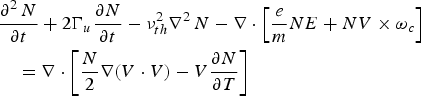
where νth2 (=3 k BT 0/m) is the square of the electron thermal speed, and ωc = eB 0/mc is the electron cyclotron frequency. This is the equation for the excitation of the plasma wave in the presence of magnetic field.
Now we analyze the excitation of a plasma wave that is propagating along the x-axis with its electric vector along the x-axis at the FD (Δω).We expresses N, V, and E which occur in Eqs (12a–12c) as




where

where N 0 is the background electron density modified by the relativistic nonlinearity. We obtain from Eq. (14d)
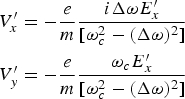
Substituting N, E, and V from Eqs (14a–14e) in Eq. (13), one obtains the following equation for the plasma wave at the difference frequency
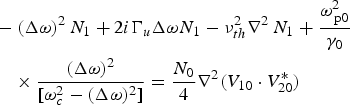
Eq. (15) contains two plasma waves at the FD Δω, the first one is a natural mode of the hot magnetoplasma and the second is driven by the source term. The first component in the absence of pump waves (right-hand side of Eq. (15)) neglecting damping (second term on left-hand side of Eq. (15)) and assuming N1 varying as exp(-ikx) in Eq. (15) gives
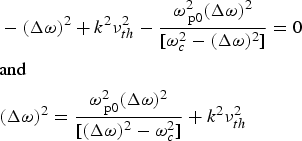
The solution of Eq. (15), within the WKB approximation, can be written as (Akhmanov et al., Reference Akhmanov, Sukhorukov and Khokhlov1968; Sodha et al., Reference Sodha, Ghatak and Tripathi1976)

where k 2 = [(Δω)2 − (ωp2/(1 − (ωc/Δω)2))]/νth2 and ωp2 = (ωp02/γ0), N 10 and N 20 are the slowly varying real functions of the space coordinate. Using Eq. (17) into Eq. (15), we obtain
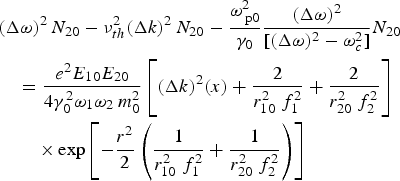
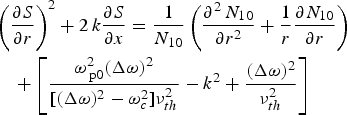
and the equation for N 10 after splitting into real and imaginary parts can be written as
and

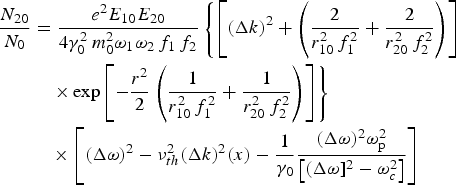
From Eq. (6) N 20 is given by
Following Akhmanov et al. (Reference Akhmanov, Sukhorukov and Khokhlov1968) and Sodha et al. (Reference Sodha, Ghatak and Tripathi1976) the solutions of Eqs. (19a) and (19b) within the paraxial ray approximation can be written as
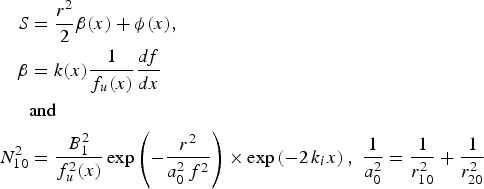
where k i = ΓuΔω/kνth2 and a 0 and B 1 are the constants to be determined by the boundary condition that the magnitude of the generated plasma wave at x = 0 is zero and f is the beam width parameter of the plasma wave.
Substituting N 10, S, and β from Eq. (21) in Eq. (19a) and equating the coefficient of r 2 in the resulting equation one obtains the following equation of f:
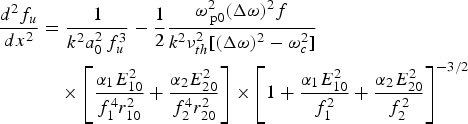
with the boundary condition f u = 1 and df u/dx = 0 at x = 0.
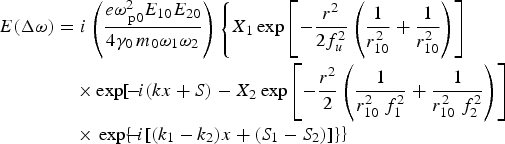
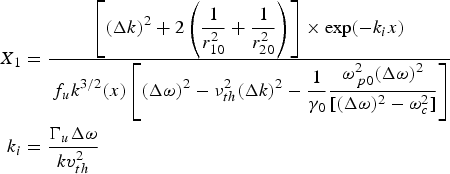
Using Poisson's equation, one can obtain the electric vector E(Δω) of the UHW generated at the FD as
where
and
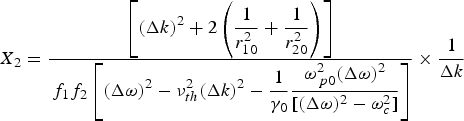
This is the expression for the electric field of the excited UHW at the FD (Δω) by two laser beams in a hot collisionless magnetoplasma, when the self focusing of two laser beams, focusing of the UHW, and modifications in the background electron concentration by a relativistic effect, is taken into account. When the beams are having uniform intensity distribution along their wave front (r 10, r 20 → ∞, f 1 = f 2 =1, S 1 = S 2 = 0) the electric vector of the UHW excited at the difference frequency reduces to
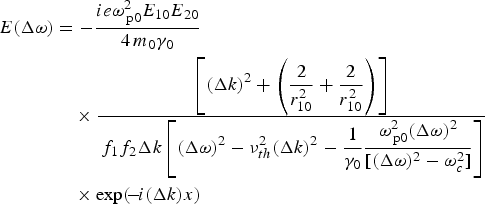
where k 1,2 = (ω1,2/c) (1 − (ωp02/ω1,22))1/2. It is obvious from Eq. (24) that resonant excitation of the UHW occurs if Δω and Δk satisfy the dispersion relation of the UHW

When the pump waves have Gaussian intensity distribution, the electrons are redistributed from the high field region and the cross focusing of the beams occur if the initial power is sufficient for the same. To have more physical insight into Eq. (23), the dispersion relation of the UHW supported by the hot plasma and the one arising because of source term of Eq. (15), will be further analyzed. If ωp0/Δω ≤ 1, the phase velocity (which depends on the strength of the magnetic field, electron concentration, and the FD (Δω) is almost equal to the thermal velocity of electrons and Landau damping occurs. However, for (Δω) 2 = ωp02 + ωc2, the upper hybrid frequency, phase velocity is very large in comparison to the electron thermal velocity, and Landau damping is negligible. The power associated with the UHW incident across the transverse section at x can be obtained by integrating E × E* over r from 0 to ∞ as
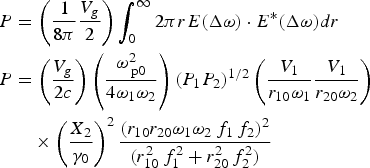
where P 1 = (c/8π) πr 102E 102 and P 2 = (c/8π) πr 202E 202 are the total powers of the two beams, V 1,2 = eE 10,20/m 0ω1,2 is the velocity of electron in the field and V g = v th2 [1 − (ωp0/Δω)2]1/2 is the group velocity.
At the FD (Δω = ω1 − ω2) of laser beams, the excited UHW transfers its energy to accelerate the electron. The equation governing electron momentum and energy are
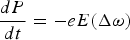
and
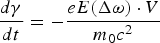
where
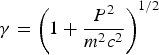
The Eq. (27) can be written as
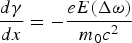
where E(Δω) is given by Eq. (24) and Eq. (28) gives the electron energy. This first order differential equation has been solved numerically, where we have used f 1 and f 2 by Eq. (10). The following sets of parameters have been used in the numerical calculations: ω1 = 1.778 × 10¹⁵ rad/s, ω2 = 1.771 × 10¹⁵ rad/s, r 1 = 15 µm, r 2 = 20 µm, ωp0 = 0.03ω2, k 1 = 5.99 × 10⁴/cm, k 2 = 5.9 × 10⁴/cm, Δk = k 1 − k 2, and ωc/Δω = 0.3, 0.5, and 0.7, respectively.
4. RESULTS AND DISCUSSION
We have studied the resonant excitation of the UHW by cross focusing of two high power laser beams in magnetized plasma and its effect on electron acceleration process. At ωp ~ ω1 − ω2, an effectively resonant UHW is generated, which accelerates the electrons to high energies.
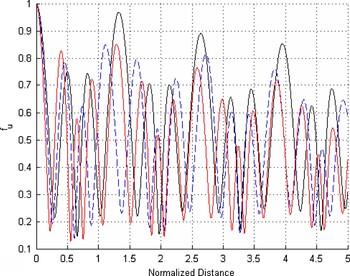
To study the focusing nature of the laser beams at FD and UHW in magnetized plasma, we have plotted the beam width parameters of the two laser beams and UHW versus distance of propagation in Figures 2 and 3 using Eqs. (10) and (22), respectively, with the boundary condition f = 1 and df/dx = 0 at x = 0. When the two laser beams simultaneously propagate through the plasma, then the density of the plasma varies due to relativistic electron mass variation, and the relativistic nonlinearity introduced in the plasma depends upon the total intensity of the two beams. Cross focusing of laser beams take place when the self focusing of one laser beam is affected by the presence of second laser beam and behavior of f 1 is also governed by f 2. The behavior of cross focusing is influenced by the coupling term in Eq. (10). This coupling term comes from the expansion of the γ1,2 term in the powers of r 2. We solve Eq. (10) for various combinations of initial fields of the lasers, which are greater than the critical value. The value of f 1 and f 2 are obtained from the numerical solutions. Figure 2 depicts the variation of the dimensionless beam width parameters f 1 and f 2 of the two beams when the powers of both beams are appropriate for relativistic self focusing (αE 012 = 1.25 and αE 022 = 1.5). It is apparent that when the power of the second beam is increased, the first beam starts oscillatory focusing/defocusing and second beam exhibits simultaneous self focusing, that is, the beam width of the first beam is increased. These two beams interact with each other and generate UHW in magnetized plasma. Similarly, the focusing nature of UHW depends on the relative magnitudes of the nonlinear coupling term, that is, second term on the right-hand side of Eq. (22), which is highly dependent on the strength of the magnetic field (ωc/Δω), power of the main beams and the diffraction term.
(Color online) Variation of beam width parameters f u of the upper hybrid wave with the normalized distance of propagation (ξ = x/R d = xc/ω1r 12, where R d is the normalizing factor) at fixed αE 012 = 1.25 and αE 022 = 1.5. Black, Blue and red lines are for ωc/ω0 = 0.3. 0.5 and 0.7, respectively.

The effect of initial power of the laser beams and the strength of the magnetic field on the focusing of the UHW with the distance of propagation is shown in Figure 3. It is obvious that the UHW exhibit oscillatory focusing for the different value of the static magnetic field. When the strength of the magnetic field is increased at a given laser powers, a similar effect has been found, but the beam width of the UHW is decreased, as it depends on the intensities and the beam widths of the laser beams. It is also clear from Figures 2 and 3 that the main beams are found to be focused at a longer distance as compared to the UHW.
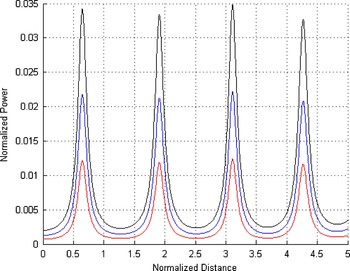
Figure 4 illustrates the variation of the power of the UHW with the distance of propagation when both the beams exhibit oscillatory self focusing at a given laser powers, when the effect of the resonantly excited UHW is taken into account, for different values of the static magnetic field. We solve Eq. (25) numerically by using the data of the solution of Eqs. (10) and (22). It is quite apparent that the power exhibits maxima and minima. Maxima correspond to the points where the matching condition is satisfied. The power is maximum for a particular value of the strength of the magnetic field and thus maxima are shifted as the beams advance through the plasma. The power of the UHW is maximum at those locations where the UHW and main laser beams are focused. When the strength of the magnetic field is increased, the position of maxima and minima is shifted. At very high magnetic fields the power reduces to a low value.
(Color online) Variation of power of upper hybrid wave (P/(P 1P 2)1/2) ith normalized distance of propagation (ξ = x/R d = xc/ω1r 12, where R d is the normalizing factor) at fixed αE 012 = 1.25 and αE 022 = 1.5. Black, Blue and red lines are for ωc/ω0 = 0.3. 0.5 and 0.7, respectively.

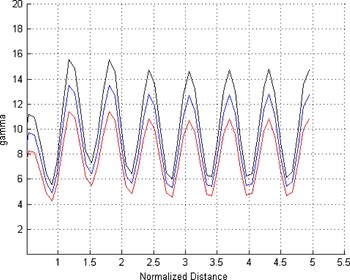
In order to observe the effect of resonantly excited UHW by cross focusing of two laser beams on electron acceleration process, we have studied the energy gain by the electron in the presence of the excited UHW. Figure 5 shows the variation of energy gain with the distance of propagation at the same set of parameters used in Figure 4. We observe that the maximum energy gain is reduced when the strength of the magnetic field is increased, the locations of the maximum energy gain of the UHW are still the same, but the gain level of electron is decreased. The energetic electrons emit radiation at high harmonics of the cyclotron frequency.
(Color online) Variation of electron energy gain (γ) by the electron with normalized distance of propagation (ξ = x/R d = xc/ω1r 12, where R d is the normalizing factor) at fixed αE 012 = 1.25 and αE 022 = 1.5. Black, Blue and red lines are for ωc/ω0 = 0.3. 0.5 and 0.7, respectively.

In conclusion, the present semi-analytical study using the paraxial approximation is the first effort to highlight the resonant excitation of the UHW and electron acceleration by cross focusing of two intense laser beams at a relativistic nonlinearity. If magnetic field is not present (ωc = 0), the UHW reduces to the electron plasma wave. The present investigation concludes that the focusing nature of the UHW, power carried by the resonantly excited UHW, and the energy gain are sensitive function of the strength of the magnetic field. The excited UHW transfers energy to the plasma particles and leads to enhanced heating of the plasma. This work is relevant to particle acceleration process and plasma heating near the upper hybrid frequency.
ACKNOWLEDGMENT
This work is supported by the Government of India, Department of Science & Technology (DST).