Introduction
Delirium and urinary tract infection (UTI) are both major health problems among frail, old people and cause much suffering (Gustafson et al., Reference Gustafson1988; Shortliffe and McCue, Reference Shortliffe and McCue2002). UTI is one of the most common bacterial infections in women of all ages but the incidence and prevalence increases with age. More than half of all women have at least one UTI in their lifetime and the risk of contracting a UTI increases in postmenopausal women (Harrington and Hooton, Reference Harrington and Hooton2000; Shortliffe and McCue, Reference Shortliffe and McCue2002; Foxman, Reference Foxman2002). UTIs in older patients are generally more complicated in terms of the approach to diagnosis, treatment and prevention (Shortliffe and McCue, Reference Shortliffe and McCue2002). Among very old women UTI has been found to be associated with factors such as delirium, fractures, urinary incontinence, inflammatory rheumatic disease, musculoskeletal complaints and multi-infarct dementia (Manepalli et al., Reference Manepalli, Grossberg and Mueller1990; Johansson et al., Reference Johansson, Molander, Milsom and Ekelund1996; Eriksson et al., Reference Eriksson, Gustafson, Fagerstrom and Olofsson2010).
Delirium, according to the Diagnostic and Statistical Manual of Mental Disorders, 4th edition (DSM-IV) (American Psychiatric Association, 2000), is defined as an acute disorder concerning cognition, perception and attention. A delirium develops during a short period of time, fluctuates during the course of the day and always has an underlying cause. It is a common syndrome among older patients and a frequent presenting symptom in relation to acute illness (Gustafson et al., Reference Gustafson1988). Delirium is associated with longer hospital stays and increased mortality, and has a negative impact on health outcomes (McCusker et al., Reference McCusker, Cole, Abrahamowicz, Primeau and Belzile2002; Young et al., Reference Young, Leentjens, George, Olofsson and Gustafson2008). Patients who have been delirious often describe the situation as very frightening (Fagerberg and Jonhagen, Reference Fagerberg and Jonhagen2002). Risk factors for delirium, apart from age, are earlier stroke, dementia, infections and surgery for hip fractures (Conn and Lieff, Reference Conn and Lieff2001; Lundstrom et al., Reference Lundstrom, Edlund, Bucht, Karlsson and Gustafson2003; Edlund et al., Reference Edlund, Lundstrom, Karlsson, Brannstrom, Bucht and Gustafson2006).
The commonest infections associated with delirium are UTIs; 40% of a frail in-hospital geriatric population with diagnosed delirium were shown to have a UTI (Laurila et al., Reference Laurila, Laakkonen, Laurila, Timo and Reijo2008). It has frequently been questioned whether UTI can cause delirium or if it is only accidentally detected when people with delirium are assessed. A large proportion of old women have so-called asymptomatic bacteriuria. One common clinical experience is that when the UTI in patients with delirium is treated the delirium disappears. It is, therefore, important to investigate whether UTI is associated with delirium in a representative sample of very old women.
The aim of the present study was to investigate whether UTI in very old women is associated with delirium.
Methods
Participants
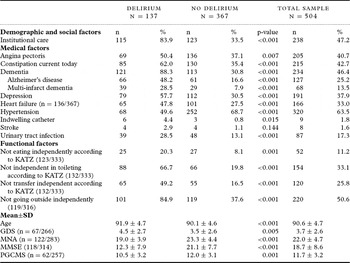
This study is a part of the GErontological Regional DAtabase project (GERDA project), which is a continuation of the Umeå 85+ study that took place in the urban municipality of Umeå and five rural municipalities in the county of Västerbotten in Sweden 2005–2007 and in the municipalities of Vaasa and Mustasaari in Finland during 2005–2006 (von Heideken Wagert et al., Reference von Heideken Wagert2006). The subjects were selected from the population record, acquired from the Swedish and Finnish tax agencies respectively. A random sample, comprising half of all 85-year-olds, and the total population of 90-year-olds and ≥95-year-olds was selected for participation. Of the total sample of 698 women, 271 (38.8%) were from Finland and 427 (61.2%) from Sweden. Fifty-five of the 698 (7.9%) died before they could be asked to participate and 124 out of the remaining 643 (19.3%) declined to participate. Their age distribution was the same as those who participated. Of the remaining 519 women, 504 could be evaluated for delirium. The final study sample, therefore, consisted of 504 women, 78.4% of the 643 who were asked to participate (Figure 1). These 504 women comprised 85-year-olds (n = 172), 90-year-olds (n = 169) and ≥95-year-olds (n = 163). The characteristics of the participants are shown in Table 1.
Flow chart of the study population.

Characteristics of women (n = 504) with and without delirium

KATZ = Katz Index of ADL; GDS = Geriatric Depression Scale; MNA = Mini Nutritional Assessment; MMSE = Mini-mental State Examination; PGCMS = Philadelphia Geriatric Center Morale Scale.
Procedure
The same procedure was used as in the Umeå 85+ study, which is described in detail elsewhere by von Heideken Wagert (von Heideken Wagert et al., Reference von Heideken Wagert2006). The investigator, who was a nurse, a physician, a physiotherapist or a medical student, made one or more home visits to those who gave their consent. Each home visit, including assessments and a structured interview, took approximately two hours to complete. Data were also collected from medical records, both from hospitals and from the patient's general practitioner, and from caregivers and relatives. Participants living in their own homes and those living in institutions were included. Medical history and current health status as well as current drug use – both prescription and non-prescription drugs – were also included in the information.
Reliable and well-known assessment scales were used; for example, independence in Activities of Daily Living (ADL) was assessed using the Staircase of ADL (including the Katz Index of ADL) (Katz et al., Reference Katz, Ford, Moskowitz, Jackson and Jaffe1963), nutritional status using the Mini Nutritional Assessment (MNA) (Vellas et al., Reference Vellas1999), morale or psychological well-being using the Philadelphia Geriatric Center Morale Scale (PGCMS) (Lawton, Reference Lawton1975) and depression using the Geriatric Depression Scale-15 (GDS-15) (Sheikh and Yesavage, Reference Sheikh and Yesavage1986) and the Montgomery-Åsberg Depression Rating Scale (MADRS) (Montgomery and Åsberg, Reference Montgomery and Åsberg1979).
The Mini-mental State Examination (MMSE) was used to assess the participant's cognition on a score from 0 to 30, with a score of 23 or lower indicating impaired cognition (Folstein et al., Reference Folstein, Folstein and McHugh1975). Delirium was assessed using the Organic Brain Syndrome (OBS) Scale (Jensen et al., Reference Jensen, Dehlin and Gustafson1993). The OBS Scale consists of two parts: the disorientation subscale, comprising a 15-item questionnaire, and the confusion subscale which is an observation scale covering 39 clinical features. This study used the confusion subscale which describes the participant's emotional reactions, suspiciousness, delusions, hallucinations, language and speech disturbances, neurological symptoms, spatial disorientation, impaired recognition, physical disability and various kinds of time-related variations and fluctuations in the clinical state. This subscale is based on observations of the participants and interviews with relatives and caregivers. The original OBS Scale has been evaluated and compared with other assessment scales and is judged as a concurrent valid instrument (Jensen et al., Reference Jensen, Dehlin and Gustafson1993). When compared with the Confusion Assessment Method (CAM), 100% conformity concerning the diagnosis of delirium has been shown (Eriksson et al., Reference Eriksson, Samuelsson, Gustafson, Aberg and Engstrom2002; Bjorkelund et al., Reference Bjorkelund, Larsson, Gustafson and Andersson2006). An experienced geriatrician later revised the medical diagnoses, using the same criteria for all participants. Delirium was registered if the participant had had episodes of delirium during the past month, based on assessment with the OBS Scale and MMSE and interviews with relatives and caregivers as well as documented delirium in the medical records. Dementia, depression and delirium were diagnosed according to the DSM-IV criteria, based on medical history, test results and medical record notes.
Definition of UTI
UTI was diagnosed if the person had a documented symptomatic UTI, with either short- or long-term ongoing treatment with antibiotics, or symptoms and laboratory tests judged to indicate a UTI by the responsible physician or the assessor. Medical records from the general practitioner, from the hospitals in the catchment area or records from the caring institutions were also investigated to evaluate and validate the UTI diagnosis. The UTI diagnosis in the medical records was based on urinary tests in combination with symptoms that were judged to be associated with UTI by the responsible physician. In addition, the results from all urinary cultures registered at the regional bacteriological laboratory were reviewed. This means that the UTI diagnoses were registered if the participants had symptoms or signs of UTI when they were assessed or had had a recent diagnosis of UTI with or without ongoing treatment.
Data analysis
The χ2 and Student's t-tests were used to analyze differences between groups. A series of multivariate logistic regression models were constructed based on a priori hypotheses concerning potential risk factors such as acute medical conditions (e.g. infections) and diseases known to precipitate delirium or to reduce the brain reserve capacity. Variables with a statistically significant association with delirium were included in multivariate logistic regression models to find the independent diagnoses associated with delirium. A p-value of <0.05 was regarded as statistically significant. The SPSS package 11.5 was used for calculations.
Ethics
The study was approved by the Regional Ethical Review Board in Umeå (registration number 05-063M) and the Ethics Committee of Vaasa Central Hospital (registration number 05-87).
Results
In the present study sample of 504 women, 87 (17.2%), were diagnosed to have a UTI with or without ongoing treatment when they were assessed and almost half of them (44.8%) were diagnosed to be delirious or having had episodes of delirium during the past month. One hundred and thirty-seven (27.2%) of the 504 women were delirious or had had episodes of delirium during the past month and 39 (28.5%) of them were diagnosed to have a UTI (Table 1). Of the 39 women with delirium and a UTI, 22 had an ongoing treatment for UTI, and in 17 cases, the assessor who made the home-visit, found documentation in the records and/or received information from the staff (responsible nurse) indicating a UTI. In 15 of the 39 cases the documentation of laboratory tests such as urinary cultures were found. Documentation included both symptoms and laboratory tests. In two cases it was documented that the physician might have interpreted the delirium as a symptom of the infection. In 10 of the 39 cases with delirium and UTI it was documented that the participants had been delirious in association with a previous infection and that the delirium had resolved after treatment of that infection.
Of the 85-year-old women, 33/172 (19.2%) were delirious, 41/169 (24.3%) of the 90-year-olds and 63/163 (38.6%) of the ≥95-year-olds (Figure 1). The characteristics of the women with delirium compared to those without are presented in Table 1.
Delirium among old women was significantly associated with angina pectoris, dementia, heart failure, hypertension and UTI. Women with delirium also suffered more often from constipation. Delirium was more common among those living in institutional care facilities compared to those living in ordinary housing.
Women with delirium had poorer ADL function according to the Katz ADL Index. These women also had poorer cognition according to the MMSE and poorer nutritional status measured with the MNA. Women with delirium had significantly higher GDS-15 and lower PGCMS scores, which indicates both more depressive symptoms and poorer psychological wellbeing (Table 1).
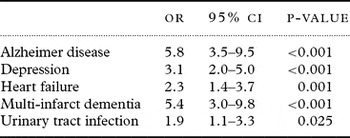
In the final multivariate logistic regression analysis factors independently associated with delirium were Alzheimer's disease (OR = 5.8), multi-infarct dementia (OR = 5.4), depression (OR = 3.1), heart failure (OR = 2.3) and urinary tract infection (OR = 1.9) (Table 2).
Multivariate logistic regression model of factors associated with delirium, n = 503

χ2 for the model = 133.2; p-value: <0.001; R2 = 0.233.
Discussion
Almost one-fifth of the participants in the present study had a diagnosed UTI with or without ongoing treatment and almost half of them were delirious or had had episodes of delirium during the past month. More than a quarter of the women with delirium had a UTI with or without ongoing treatment. In these very old women delirium was independently associated with Alzheimer's disease, multi-infarct dementia, depression, heart failure and UTI in a multivariate regression model. Although other well-known risk factors for delirium were included in the regression model, UTI remained independently associated with delirium. The old women with delirium in the present study had significantly lower psychological well-being according to the PGCMS, which highlights the importance of detection and treatment of the underlying causes of delirium.
Old people with chronic disorders such as dementia and heart failure seem to be predisposed to developing delirium, which is in line with previous research (Gustafson et al., Reference Gustafson1988; Conn and Lieff, Reference Conn and Lieff2001; Edlund et al., Reference Edlund, Lundstrom, Karlsson, Brannstrom, Bucht and Gustafson2006; Laurila et al., Reference Laurila, Laakkonen, Laurila, Timo and Reijo2008). The old person with depression also seems to be more vulnerable, which increases the risk of developing delirium. In a study including patients treated for femoral neck fracture, almost all of those who were depressed developed delirium (Gustafson et al., Reference Gustafson1988). One explanation might be that old age is associated with reduced reserve capacity and depression probably makes the person even more vulnerable, and thus a minor strain such as UTI can probably cause delirium. Patients have described their experiences of being delirious as very frightening, which might also increase the risk of depression (Fagerberg and Jonhagen, Reference Fagerberg and Jonhagen2002).
To differentiate dementia from delirium can be difficult and delirium is therefore often under-diagnosed and undetected (Gustafson et al., Reference Gustafson, Brannstrom, Norberg, Bucht and Winblad1991). Since delirium, by definition, always has an underlying cause that should be prevented and treated, it is important to make a distinction between delirium and dementia. Sometimes delirium might be the only symptom of an underlying disease, also in persons with dementia, and may cause problems in the areas of diagnostics, therapeutics and care (Lipowski, Reference Lipowski1989).
As mentioned earlier, studies have shown that chronic diseases such as dementia, heart failure and depression in old patients seem to increase the risk of developing delirium and these should, in most cases, be regarded as predisposing factors. Acute states such as UTI seem to precipitate delirium, especially in frail, old women with a reduced reserve brain capacity. In the present study almost half of the old women with UTI were delirious or had had episodes of delirium during the past month and more than a quarter of the delirious old women suffered from a UTI. Previous studies have shown that infections, such as UTI, are common among frail, old people (Shortliffe and McCue, Reference Shortliffe and McCue2002) and especially among those with delirium (Laurila et al., Reference Laurila, Laakkonen, Laurila, Timo and Reijo2008). One possible explanation for the relation between UTI and delirium could be the cytokine production that is associated with infections. Cytokines contribute to a cascade of events, such as synthesis of interleukin, which might play an important role in the pathogenesis of delirium (de Rooij et al., Reference de Rooij, van Munster, Korevaar and Levi2007; van Munster et al., Reference van Munster, Korevaar, Zwinderman, Levi, Wiersinga and de Rooij2008). In earlier studies, UTI is described as being frequent among both old men and women undergoing hip fracture surgery and that those patients with UTI are more likely to have delirium (Gustafson et al., Reference Gustafson1988; Kamel, Reference Kamel2005). Nevertheless, the pathophysiological relationship between UTI and delirium remains unclear in the present study and hence we can only ascertain associations between the potential predisposing and precipitating factors. However, our clinical experience is that several patients have served as their own control, becoming delirious every time they suffer from UTI and the delirium is successfully treated when the UTI is treated. In the present study, one fourth of participants with delirium and UTI had documentation of previous episodes of delirium, in association with infections, which had resolved when the infection was treated.
As both UTI and delirium can be prevented it is important to identify and be aware of associated risk factors in order to target more effective interventions for the benefit of these old women who are at great risk of contracting a UTI as well as delirium. It is important to identify old women at high risk regarding UTI and delirium. This could be done by increasing the knowledge about how to detect delirium and about risk factors associated with UTI and delirium and the possible connection between the two. Excellent and supportive care must be included in the management of these patients with the intention of reducing unnecessary suffering.
One limitation of the present study was that there were no comprehensive somatic examinations in connection with the patient's delirious state. We are, therefore, unable to be sure that they were delirious before the UTI diagnosis or if they had any other medical complications. The physician might have interpreted the delirium as a symptom of UTI and thus detected the UTI as a result of the delirium, but this was only documented in two of the 39 cases with delirium and UTI. Another limitation was that no assessments for delirium were used before and after the UTI treatment. From a methodological point of view, a randomized, placebo, controlled intervention study would have been preferable. The fact that the diagnosis of UTI in the present study was not always ascertained by means of urinary culture might also be considered a limitation. A larger proportion of participants with delirium were not able to perform the PGCMS and thus this study may underestimate the impact of delirium on morale or psychological well-being.
One strength of this study is that the number of participants is large and the sample is representative and includes very old women living both in the community and in institutions.
Conclusion
A large proportion of very old women with ongoing UTI suffered from delirium which might indicate that UTI is a common cause of delirium. There should be more focus on detecting, preventing and treating UTI to avoid unnecessary suffering among old women.
Conflict of interest
None.
Description of authors’ roles
Y. Gustafson and L. Fagerström were responsible for the study concept and design; B. Olofsson and Y. Gustafson undertook the acquisition of data, with I. Eriksson and Y. Gustafson being responsible for the statistical analysis. All authors were involved in the analysis and interpretation of data, and drafting of the paper. Critical revision of the paper for important intellectual content was undertaken by all authors.
Acknowledgments
This study was supported by grants from the Research Foundation of the Faculty of Medicine (ALF), the Detlof Research Foundation, Äldrecentrum Västerbotten, Interreg IIIA MittSkandia, Swedish Research Council (grant no. K2005-27vx15357-01 A) and the Dementia Foundation (Demensförbundet). The authors would like to thank Hugo Lövheim, Mia Conradsson, Ellinor Bergdahl, Maria Lundström, Lena Molander, Tove Norman, Magdalena Vähäkangas and Anne Hietanen for valuable assistance with the data collection.