Introduction
Neuropsychiatric or behavioral and psychological symptoms of dementia (BPSD) refer to a diverse range of symptoms pertaining to perception, mood, personality, behavior, and basic functioning (Finkel et al., Reference Finkel, Costa e Silva, Cohen, Miller and Sartorius1996). BPSD are reported to occur in up to 90% of people with dementia, usually increase in frequency and severity with declining cognitive function, and can also be seen in pre-dementia syndromes at the mild cognitive impairment stage (Gauthier et al., Reference Gauthier2010; Ismail et al., Reference Ismail2016). They are one of the most distressing outcomes of dementia and account for a large proportion of the burden and cost of dementia, poor quality of life, high institutionalization rate, and adverse caregiver outcomes (Tan et al., Reference Tan, Wong and Allen2005; Herrmann et al., Reference Herrmann2006; Missotten et al., Reference Missotten2008; Tew et al., Reference Tew, Tan, Luo, Ng and Yap2010; Brodaty et al., Reference Brodaty, Woodward, Boundy, Ames and Balshaw2014). Certain symptoms have also been found to be predictive of a rapid cognitive decline (Zahodne et al., Reference Zahodne, Ornstein, Cosentino, Devanand and Stern2015). Given their prevalence and severe negative outcomes for the person, families, and healthcare systems, BPSD have emerged as an important focus of research and interventions in dementia.
Research into BPSD over the last 30 years has generated large amount of data that support the hypothesis that BPSD are not independent symptoms, rather a group or cluster of related symptoms (Hope et al., Reference Hope, Keene, Fairburn, McShane and Jacoby1997; McShane, Reference McShane2000). Studies have reported co-occurrence of symptoms, such as hallucinations, and have hinted on a common etiology of these symptoms (van der Linde et al., Reference van der Linde, Dening, Matthews and Brayne2014). Literature also provides evidence of the potential clinical benefits of treating groups of BPSD over individual symptoms (Robert et al., Reference Robert2005). The identification of these clustered symptoms is hence believed to be important for targeted treatment and effective behavior control for people with dementia (Gauthier et al., Reference Gauthier2010). Considerable attention has since been given to the clustering of BPSD for the purpose of diagnosis, treatment, and management (McShane, Reference McShane2000; Lyketsos et al., Reference Lyketsos, Breitner and Rabins2001; Robert et al., Reference Robert2005; Gauthier et al., Reference Gauthier2010).
However, the presence of BPSD and their symptom groups identified so far have varied widely across populations (van der Linde et al., Reference van der Linde, Dening, Matthews and Brayne2014). While some studies have reported four groups of BPSD (Aalten et al., Reference Aalten2003; Proitsi et al., Reference Proitsi2011), others have found two or three symptom groups (van der Linde et al., Reference van der Linde, Dening, Matthews and Brayne2014; Travis Seidl and Massman, Reference Travis Seidl and Massman2016). Based on a recent review, while symptoms “observed effect” and “hyperactivity factors” have varied across studies, “apathy,” “aberrant motor behaviors,” and “appetite” were found to be most inconsistent in their affiliation with other symptoms and their factor structures (van der Linde et al., Reference van der Linde, Dening, Matthews and Brayne2014). This variation and absence of universally accepted BPSD symptom groups impose limitations in adopting a specific structure for their assessment and treatment. One objective approach is to identify whether groupings of symptoms exist in the population of interest and whether they correlate with important outcomes in people with dementia.
Singapore is a developed Southeast Asian country with a resident (citizen and permanent resident) population of 3.8 million comprising 74.2% Chinese, 13.2% Malays, 9.2% Indians, and 3.3% other races (http://www.singstat.gov.sg). The population age demographics have been following the global trend seen in developed economies, with the older adult population set to triple by the year 2030, imposing several challenges for the medical and social care arrangements needed for catering to health issues in the ageing population. A local study identified the prevalence of dementia to be 10% in the population aged 60 years and above (Subramaniam et al., Reference Subramaniam2015). A limited number of studies in the past have reported the extent of BPSD in dementia and showed its correlation with frequent institutionalization (Tan et al., Reference Tan, Wong and Allen2005; Tew et al., Reference Tew, Tan, Luo, Ng and Yap2010) in Singapore. More recently, the presence of at least one BPSD was found to be correlated with informal caregivers’ burden and psychological morbidity (Vaingankar et al., Reference Vaingankar2015; Vaingankar et al., Reference Vaingankar2016a). However, generalizable data on the prevalence and potential groups of BPSD in older adults with dementia in Singapore are unavailable.
This study aimed to assess the prevalence of BPSD in a community-based sample of older adults with dementia in Singapore, determine whether distinct symptom groups exist in this sample, and identify correlates of these groups.
Methods
Setting and sample
In Singapore, all residents’ particulars including name, age, address, and ethnicity are maintained in a national database. Using this database, a representative sample of Singapore residents aged 60 years and above was obtained through disproportionate stratified sampling for a national general population based cross-sectional survey, the Well-being of the Singapore Elderly (WiSE) study aimed to estimate the prevalence of dementia and depression in this population. The study methodology is explained in greater detail in an earlier paper(Subramaniam et al., Reference Subramaniam2015).
This study was approved by the National Healthcare Group Domain Specific Review Board and Singhealth Centralised Institutional Review Board. Residents randomly selected for the study were sent notification letters to inform about the study. Interviewers then visited the addresses to approach them. Those who had moved out of the country, deceased or were unable to complete the interview in English, Mandarin, Malay, or Tamil language were excluded. Every attempt was made to contact the selected residents by making up to ten contact attempts, arranging the interview at a location most convenient to the respondent and for those who were not residing at the address listed in the sampling frame, enquiries were made to find out about their new location, which included another residence or institutional address, such as a hospital or nursing home. Along with the selected resident, an adult informant who was a family member or friend and who knew the older adult best was also approached for the interview. Informed consent was obtained from all the participants or their legally acceptable representative or next-of-kin prior to the interview. Between August 2012 and December 2013, a total of 2,565 older adults and 2,421 informants participated in the study given a response rate of 66%. Adjusted prevalence of dementia was estimated at 10% (Subramaniam et al., Reference Subramaniam2015) and this sample of 399 residents served as the study sample for this investigation.
Measures
The WiSE study adopted the questionnaire developed by the 10/66 Dementia Research Group which has been used in over ten countries around the world (Prince et al., Reference Prince2007). All measures were available in English, Mandarin, Malay, or Tamil language. Several steps were taken to ensure validity and consistency across the four languages of the questionnaire. This included use of careful translation methods, cognitive testing of the questionnaires in the local population, second level validation using clinicians as gold standards, structured training of interviewers in multiple languages, and statistical analysis to ensure reliability and consistency. Full translations of the questionnaires were available for the Mandarin and Tamil versions. Most of the 10/66 questionnaire was used in a pilot study in Malaysia and translated in Malay language. The missing sections were translated during the WiSE study using strict translation protocol of two independent translations followed by an expert panel session for resolving discrepancies, comprising the translators, a language expert, a domain expert, and a lay person. All the four language versions of the questionnaires were then tested using cognitive interviews for appropriateness and understanding of the content in the local population. The study also included second level double blind validation, whereby those assessed as with or without dementia were re-assessed by clinicians that demonstrated high sensitivity (95.6%) and specificity (81.8%) for the tool (Subramaniam et al., Reference Subramaniam2015).
Dementia diagnosis and severity
Diagnosis of dementia was assessed by trained interviewers with the semi-structured Geriatric Mental State Examination (GMS-AGECAT) along with the Community Screening Interview for Dementia (CSI-D), Consortium to Establish a Registry for Alzheimer's Disease-10 (CERAD) test battery, and History and Aetiology Schedule – Dementia Diagnosis and Subtype (HAS-DDS), and also by applying the 10/66 protocol's diagnostic criteria (Prince et al., Reference Prince2007). The clinical dementia rating (CDR) assessed severity of dementia based on informant-rated older adults’ cognitive function on six domains of memory, orientation, judgment and problem solving, community affairs, home and hobbies, and personal care (Morris, Reference Morris1997). CDR scores of 0 (none), 1 (mild/questionable), 2 (moderate), and 3 (severe) dementia were used.
BPSD
The 12-item Neuropsychiatric Inventory Questionnaire (NPI-Q) (Kaufer et al., Reference Kaufer2000) was administered by trained lay interviewers to the older adults’ informant. This measure assesses 12 behavioral disturbances that may occur in dementia and other neuropsychiatric disorders: delusions, hallucinations, dysphoria, anxiety, agitation/aggression, euphoria, disinhibition, irritability/lability, apathy, aberrant motor activity, night time behavior/sleep, and appetite. It is a widely accepted measure for the assessment of BPSD. NPI-Q first screens for presence (yes = 1) or absence (no = 0) of each symptom. For those that are present, the symptom is then rated by the informants on a scale from 1– to 3, according to an increasing level of severity in the past month. To obtain clinically relevant scores, a symptom-severity score is then obtained by multiplying the stem item score by its severity score, where 0 indicates no symptom and 3 indicates severe symptomatology. The internal consistency of the measure was high in the sample with a Cronbach's α of 0.84 for the overall sample, 0.88 among those administered the English language questionnaire, and 0.80 each for the Mandarin, Malay, and Tamil versions.
Cognitive function
The CSI-D, a 32-item cognitive test questionnaire was administered to participants to assess their cognitive function. A cognitive score (COGSCORE) based on an item-weighted total score of each participant was obtained from the number of correct answers (0 = severe cognitive impairment, 32 = no cognitive impairment) (Hall et al., Reference Hall1993).
Disability
Disability was assessed with the 12-item World Health Organization Disability Assessment Schedule II (WHO-DAS II) that measures older adult's disability in the past 30 days using a five-point scale (none = 1, mild = 2, moderate = 3, severe = 4, extreme/cannot do = 5). Scores are summed with higher scores indicating greater disability (http://www.who.int/icidh/whodas/).
Caregiver burden
Zarit Burden Interview (ZBI) (Zarit et al., Reference Zarit, Reever and Back-Peterson1980) was administered to informants of older adults to measure burden faced by informants in relation to the functional/behavioral impairments and home care arrangement for the older adults. The measure includes 22 items rated on a five-point Likert scale ranging from never to nearly always present. Scores of individual items are summed to obtain a total score; higher total ZBI score denotes higher burden.
The interview also included self-reported socio-demographic characteristics and history of current physical conditions (hypertension, cardiological problems, stroke, transient ischemic attacks, diabetes, arthritis/rheumatism, chronic obstructive pulmonary disease, breathlessness or asthma, and cancer). Based on the older adults’ possession of eight common amenities (vehicle, television set, fridge, telephone/mobile phone, air conditioning, washing machine, cable TV, computer/internet access), their socio-economic status (SES) was categorized as low (access to 0–5) or high (access to more than 5) (Vaingankar et al., Reference Vaingankar2016b).
Statistical analysis
Sampling weights were generated based on the disproportionate sampling for age group and ethnicity. Non-response weights were also calculated based on attrition data for the WiSE survey. Lastly, post-stratification weights were generated based on the population proportion for the year 2011 when the sample was derived from the sampling frame. A composite of these three weights was then applied to the data to ensure generalizability of the findings. SPSS software version 18.0 complex samples module was used to conduct the weighted data analyses. Mean and standard errors were calculated for continuous variables, and frequencies and percentages were calculated for categorical variables. SPSS dimension reduction module was used to conduct exploratory factor analysis (EFA) on the NPI-Q symptom-severity items, where principal component analysis using promax rotation was employed. Promax rotation was used as an extant literature that supports correlation between BPSD groups indicating the presence of symptom clusters or syndrome. Factors with Eigen values > 1 were retained. Based on the observed factor structure, factor scores were generated for NPI-Q symptom-severity items using regression. Factor correlation was tested with Pearson's correlation coefficient. The factor scores were then used as dependent variables in linear regression analyses to identify common or unique correlates associated with each factor: age group, gender, ethnicity, marital status, education, SES, presence of at least one chronic physical condition, CDR rating (for dementia severity), COGSCORE (for cognition), WHODAS II score (for disability), and ZBI score (for caregiver burden).
Results
Sample characteristics
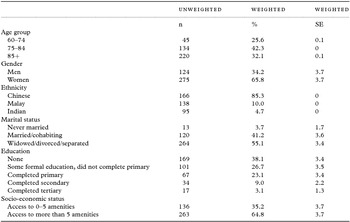
The mean age of the older adults with dementia was 80.2 (SE 0.3). The majority were aged 75–84 years (42.3%), women (65.8%), widowed/separated/divorced (55.1%) and with no formal education (38.1%) (Table 1). Among the older adults with dementia, 79.6% had at least one chronic physical condition. Their mean COGSCORE was 16.9 (SE 0.7, 95% CI: 15.6–18.3) and WHODAS II score was 51.7 (SE 2.3, 95% CI: 47.2–56.3). The mean CDR score for the sample was 2.2 (SE 0.6, 95% CI 2.1–2.3) with the majority (n = 286) having mild/questionable dementia (74.3%; SE 3.3), 20.1% (SE 2.9) had moderate (n = 96) and 1.6% (SE 0.9) severe (n = 6) dementia. A small proportion of older adults with dementia (n = 11, 3.9%, SE 1.7), however, fell into the “No dementia” for dementia severity as per the CDR criteria. Mean ZBI scores for the caregivers was 20.2 (SE 1.6, 95% CI:17.1–23.4).
Socio-demographic background of the sample of older adults with dementia (n = 399)

Prevalence of BPSD
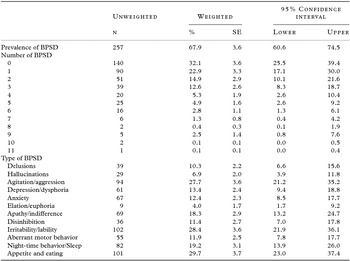
The prevalence of having at least one BPSD was 67.9% (95% CI 60.6–74.5%) among community-based older adults with dementia. Mean number of BPSD were 1.9 (SE 0.16, range 0–11), and about 30% of the population had experienced three or more BPSD in the month prior to the interview. The three most frequently reported BPSD were appetite/eating (29.7%), irritability/lability (28.4%) and agitation/aggression (27.7%) (Table 2).
Distribution of behavioral and psychological symptoms of dementia (BPSD) among older adults with dementia

Factor structure for BPSD
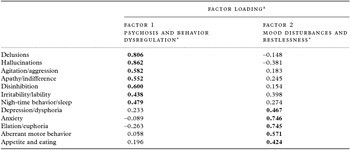
Results of the EFA on the symptom severity items showed two distinct symptom groups based on the Eigen values, rotated factor loading of items, and examination of the scree plot (Table 3, Figure 1). None of the items cross loaded on the factors and all were included in the subsequent analysis. Factor 1 comprised delusions, hallucinations, agitation/aggression, apathy/indifference, disinhibition, irritability/lability and night-time behavior/sleep measuring the underlying construct of “psychosis and behavior dysregulation.” Depression/dysphoria, anxiety, elation/euphoria, aberrant motor behavior and appetite/eating constituted Factor 2 representing the construct of “mood disturbances and restlessness.” The two factors showed significant moderate correlation with a Pearson's correlation coefficient of 0.484, p < 0.001.
Factor structure for BPSD among older adults with dementia

*Bold values show the item affiliation to each factor by higher loading and Eigen values.
aRotated factor loadings using principal component analysis with promax rotation.
Scree plot for Exploratory Factor Analysis

Correlates of BPSD factors
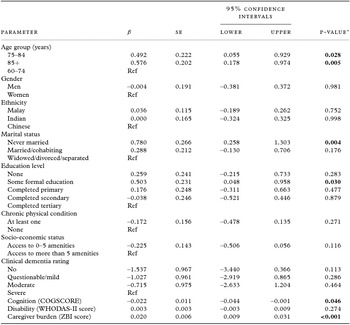
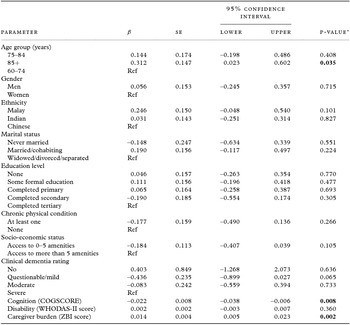
Estimates of the regression analysis for the two factors are presented in Tables 4a and 4b. Regression analyses of the factor scores indicated that Factor 1 was significantly and positively associated with age, compared to those aged 60–74 years, where Factor 1 scores significantly increased by 0.492 (95% CI 0.055–0.929) and 0.576 (0.178–0.974) for those aged 75–84 years and 85 years and above. Those never married (vs. widowed/divorced/separated) and with some formal (vs. tertiary) education also had higher scores. While COGSCORES were negatively associated with Factor 1 scores (denoting higher symptom-severity scores in those with poorer cognition), ZBI scores were positively correlated (Table 4a). Symptom-severity scores for BPSD under Factor 2 were significantly higher for those aged 85 years and above compared to those aged 60–74 years (β 0.312, 95% CI 0.023–0.602). For a unit increase in the COGSCORE, the Factor 2 scores reduced by 0.022. ZBI scores also positively correlated with Factor 2 scores (Table 4b).
Correlates of factor 1 “psychosis and behavior dysregulation”

*Bold values show statistically significant findings.
Correlates of factor 2 “mood disturbances and restlessness”

*Bold values show statistically significant findings.
Discussion
This study shows that BPSD are common among community-based older adults with dementia affecting 67.9% of the population. This is the first study that provides age and ethnicity adjusted population-based data on BPSD in Singapore, which were assessed with a widely used BPSD measure.
The association of dementia-induced cognitive impairments with mood disturbances and behavioral problems is well-established, and BPSD are believed to represent a “clinical dimension of dementia” (Lawlor, Reference Lawlor2004). Understandably, the high presentation of BPSD in people with dementia is not unexpected. However, the frequency and prevalence of BPSD varies widely across different countries, populations and settings. While a prevalence of 50% was observed in a large community-based sample with dementia in China, it was found to be as high as 80% in Hong Kong (Cheng et al., Reference Cheng, Kwok and Lam2012; Haibo et al., Reference Haibo2013) which is similar to that reported in American samples (Lyketsos et al., Reference Lyketsos, Lopez, Jones, Fitzpatrick, Breitner and DeKosky2002; Steinberg et al., Reference Steinberg2008). Our estimate of 67.9% lies within the range of 61–92% usually reported in community-based samples across different populations (Fernandez et al., Reference Fernández, Gobartt and Balañá2010). In the past, a much higher BPSD prevalence of 86% was reported amongst a clinical population with dementia in Singapore (Tan et al., Reference Tan, Wong and Allen2005). This higher prevalence is attributed to longer duration of the illness and severe cognitive impairment found in hospital-based or institutionalized people with dementia (Hersch and Falzgraf, Reference Hersch and Falzgraf2007). Community-based samples on the other hand tend to have lower severity and more recent diagnosis of dementia (Jorm et al., Reference Jorm, Korten and Henderson1987). Our results therefore follow the accepted trend in the population prevalence of BPSD among those with dementia.
Of the 12 BPSD, appetite/eating, irritability/lability, and agitation/aggression were found to be the three most common symptoms in the population. Irritability and aggression have been found to be especially distressing to caregivers and require pharmacological interventions (Hersch and Falzgraf, Reference Hersch and Falzgraf2007). Appetite change has been linked to dementia severity and often reported together with anorexia and hypo/hyperphagia in those with Alzheimer's disease (Swearer et al., Reference Swearer, Drachman, O'Donnell and Mitchell1988). Dietary management therefore becomes necessary for those with this symptom (Gauthier et al., Reference Gauthier2010). Contrary to studies that have observed almost equivalent proportions experiencing hallucinations and delusions (Canevelli et al., Reference Canevelli2013), a comparatively lower percentage of older adults had hallucinations (6.9% over 10.3% with delusions) in our sample. In an earlier study that established the prevalence of psychotic symptoms among older adults aged over 60 years in Singapore, hallucinations were also found to be lower among those aged over 75 years (Subramaniam et al., Reference Subramaniam2016). Both these symptoms are predictive of increased agitation/aggression and high functional and cognitive impairment, with hallucinations being associated with higher rates of institutionalization and mortality (Scarmeas et al., Reference Scarmeas2005). In the study by Tan et al. (Reference Tan, Wong and Allen2005) of a clinical sample in Singapore, the prevalence of both these symptoms was as high as 50% and linked to high caregiver distress. Although low in prevalence, these symptoms therefore deserve attention in the community.
Symptom-severity scores generated from the 12-item NPI-Q were used in the factor analysis as they provide clinically significant information on the co-occurrence and relationship of individual BPSD according to their severity level. Two groups of BPSD were identified in our population, with one group representing the construct of “psychosis and behavior dysregulation” and the other comprising “mood disturbances and restlessness” (Table 3). Despite over a decade of intense interest and research into BPSD sub-syndromes, BPSD groups differ extensively across populations. A recent review aimed to identify BPSD clusters using the NPI-Q found as many as 39 different clusters and authors reported “low concordance” on the “definition and composition” of these clusters (Canevelli et al., Reference Canevelli2013). The review however identified several symptom couples that were often observed together. These were “delusions and hallucinations,” “depression and anxiety,” and “agitation and irritation” which were reported together in over 80% of the studies that were included in the review. Our factors included these symptom couples and provided evidence of accepted clinical phenotypes. A number of studies with two or more factors have found items cross-loading on different groups. In that, our findings are superior as none of the items loaded on more than one factor and showed clear affiliation with moderate to high factor loadings (Table 3). Considering the emphasis on identification on BPSD syndromes for their management and treatment as a group, while the presentation of fewer factors could be beneficial in the assessment of BPSD, it can pose challenges in terms of planning pharmacological and non-pharmacological interventions for a wider and more complex composition of BPSD. Clinical judgment on the severity and relevance of individual BPSD is therefore still crucial for their treatment.
Symptoms of night time behavior, appetite/eating, and apathy have generated most inconsistent reports (Canevelli et al., Reference Canevelli2013). In our study, night-time behaviors grouped together with psychosis and appetite/eating loaded with mood disturbances which are partly similar to other studies (Aalten et al., Reference Aalten2003; Borroni et al., Reference Borroni2006). A possible explanation proposed for the observed variation is the fact that these items in the NPI-Q ask about “opposite behaviors” (e.g. either increase or decrease and the severity of the symptom) while the other items are “univocal” (presence and severity) (Canevelli et al., Reference Canevelli2013). Because of the high frequency of appetite/eating problems in our sample and sleep problems that were reported in an earlier study in Singapore (Tan et al., Reference Tan, Wong and Allen2005), study findings on their group affiliation are important. While some studies have reported apathy together with depression, other studies observed it to be an independent factor by itself (Lyketsos et al., Reference Lyketsos, Lopez, Jones, Fitzpatrick, Breitner and DeKosky2002; Aalten et al., Reference Aalten2003). Notably, the two latter studies found four symptom clusters in their samples. In our sample where we found two symptom groups, apathy did not emerge as an independent factor, instead it loaded on the “psychosis and behavior dysregulation” factor. Apathy and depression also loaded on different factors. Apathy is more frequently seen in people with neurobehavioral disorders such as Alzheimer's disease, where apathy has lower association with depression (Levy et al., Reference Levy, Cummings, Fairbanks, Bravi, Calvani and Carta1996). In the absence of data on specific dementia subtypes in our study, we are unable to speculate an explanation, however, given that Alzheimer's constitute up to 80% of the overall dementia cases in Singapore, this could be a possible explanation for our finding on apathy.
A number of important factors were found to be associated with these two factor scores after controlling for the effect of other covariates (Tables 4a and 4b). Scores for both groups were higher among those aged 85 years and above, while those for “psychosis and behavior dysregulation” were also higher among those between 75 and 84 years. Age has been linked to the frequency and severity of most BPSD (Steinberg et al., Reference Steinberg2008), which are believed to increase with increasing age. However, a longitudinal study that investigated fluctuation in BPSD factor scores for psychosis and affective syndromes over 2 years did not find any age difference among people with Alzheimer's disease of low/moderate severity experiencing stable or fluctuating factor scores (Garre-Olmo et al., Reference Garre-Olmo, López-Pousa, Vilalta-Franch, de Gracia Blanco and Vilarrasa2010). A study that has investigated the correlates of four BPSD factor scores have found age/age of onset to be associated with psychosis, agitation, moods but not with behavior dysfunction (Proitsi et al., Reference Proitsi2011). In our study, psychosis and behavior dysfunction comprised the same factor and it is possible that the influence of psychosis symptoms together with higher proportion of people aged over 75 years might have increased the overall factor scores. A large body of evidence suggests gender differences in the association with BPSD possibly arising from the higher prevalence of dementia and cognitive impairment among women, both for individual symptoms (Canevelli et al., Reference Canevelli2013) and factor scores (Garre-Olmo et al., Reference Garre-Olmo, López-Pousa, Vilalta-Franch, de Gracia Blanco and Vilarrasa2010; Proitsi et al., Reference Proitsi2011). Proitsi et al. (Reference Proitsi2011) found higher scores for psychosis and agitation for men, however they did not find any gender association with moods and behavior dysregulation. It is possible that the combination of these opposite effects in our factor model resulted in the lack of gender effect.
We found being never married (vs. being widowed/separated/divorced) and some formal education (vs. tertiary) to be associated with “psychosis and behavior dysregulation” (Table 4a). To the best of our knowledge, this is the first study that has identified the association of marital status with “psychosis and behavior dysregulation” and there are no comparable studies. One possible explanation is a history of schizophrenia or personality disorders which have been associated with both being never married and higher prevalence of BPSD (Skokou and Gourzis, Reference Skokou and Gourzis2014; Seitz et al., Reference Seitz, Purandare and Conn2010). Although this information was not collected during the study, history of mental illness should be considered as scope for further investigation. A study that investigated association of education with factors scores for negative/oppositional symptoms (agitation, irritability, apathy, depression, disinhibition, and delusions) and anxiety/restlessness (nighttime behavior disturbance, anxiety, hallucinations, and appetite changes) found that low education influenced the cognitive and activities of daily living impairment for anxiety/restlessness, but not for negative/oppositional symptoms in mild Alzheimer's disease (Travis Seidl and Massman, Reference Travis Seidl and Massman2016). Due to the overlap of symptoms between our factor structure and that of Travis Seidl and Massman (Reference Travis Seidl and Massman2016), we are unable to explain this finding and future studies should investigate the possible role of education and cognition in BPSD factor scores. Although high prevalence of BPSD is reported among those with severe dementia and cognitive impairment, their relationship still remains inconclusive (Fernandez et al., Reference Fernández, Gobartt and Balañá2010). In the three studies referenced earlier in the discussion, which investigated correlates of factor scores (Garre-Olmo et al., Reference Garre-Olmo, López-Pousa, Vilalta-Franch, de Gracia Blanco and Vilarrasa2010; Proitsi et al., Reference Proitsi2011; Travis Seidl and Massman, Reference Travis Seidl and Massman2016), cognitive impairment was not associated with affective symptoms, agitation, and negative/oppositional symptoms. Although the factor structures that emerged from these investigations varied slightly, all included agitation and irritability symptoms in the factor that were not associated with cognitive impairment and these should be investigated further in terms of cognition. Our findings add to the extant literature and provide support for the association between cognitive impairment and both the symptom-severity groups of BPSD.
The association of caregivers’ burden with BPSD and their severity has been well-established (Tan et al., Reference Tan, Wong and Allen2005; Tew et al., Reference Tew, Tan, Luo, Ng and Yap2010; Vaingankar et al., Reference Vaingankar2015; Brodaty et al., Reference Brodaty, Woodward, Boundy, Ames and Balshaw2014). This forms the basis of a number for psychosocial interventions and therapeutic approaches for the management of BPSD and avoiding caregiver burnout (Lawlor, Reference Lawlor2004; Hersch and Falzgraf, Reference Hersch and Falzgraf2007). This is the first study that investigated the association of caregivers’ burden with symptom groups. Our results strongly underscore the importance of caregiver interventions in the management of BPSD. Community-dwelling individuals with dementia often have family members who are overburdened by the demands of caregiving and lack the support services required to manage their relatives’ condition. There is a greater demand on dementia caregivers as compared with caregivers of persons with other chronic diseases which in-turn is associated with a number of physical and mental health problems among the caregivers. Much of this burden is attributed to BPSD and it is established as a predictor of institutionalization for older adults with dementia. (Hebert et al., Reference Hebert, Dubois, Wolfson, Chambers and Cohen2001). The evidence when BPSD impact caregivers and whether some of them contribute more adversely than the rest is inconclusive (Hemels et al., Reference Hemels, Lanctôt, Iskedjian and Einarson2001; Feast et al., Reference Feast, Moniz-Cook, Stoner, Charlesworth and Orrell2016). Although this study did not investigate the association of individual BPSD with caregivers’ burden, results indicate higher burden among caregivers for both the symptom clusters identified in the study. Psychosocial interventions that include “educational, behavioral, dementia-specific, supportive, and coping interventions” for dementia caregivers are therefore necessary to better manage older adults with dementia in the community (Health Quality Ontario, 2008). In addition, respite care has been identified as an important formal support to alleviate caregiver stress of caring (Vandepitte et al., Reference Vandepitte, Van Den Noortgate, Putman, Verhaeghe, Verdonck and Annemans2016) and could serve as an effective intervention reducing caregiver distress and institutionalization of people with dementia and BPSD. The strengths of the study lie in the use of a relatively large and representative sample in the general population, the inclusion of important correlates including cognition, disability, and severity of dementia and the use of widely accepted assessment tool for BPSD. Moreover, a systematic review of literature on BPSD in older people recommended future research to focus on prospective longitudinal studies, with large sample size, use of standardized instruments for BPSD, inclusion of wide age range of older adults, including the oldest old, capacity for comparability of results, and reporting the study characteristics clearly (Van der linde et al., Reference van der Linde, Stephan, Savva, Dening and Brayne2012). Barring the first, this study addressed all the other recommendations, thus addressing current gaps in the literature. In the rapidly ageing Singapore society, where one in ten community dwelling older adult has dementia (Subramaniam et al., Reference Subramaniam2015), the study provides reliable and generalizable information on the types and groups of BPSD prevalent in the population along with preliminary indication of their associated factors. Inclusion of residents belonging to all ethnicities also allows for planning of policies and services across the population.
Some limitations of the study should be considered while interpreting the results. While the diagnosis of dementia was established using the 10/66 dementia criteria (Prince et al., Reference Prince2007) that provides an organic diagnosis of dementia without indicating type of dementia; its severity was assessed using the CDR (Morris, Reference Morris1997). A majority of the study participants were those with mild dementia and the study also included those who were assessed to have no dementia according to the CDR. The association between CDR rating and BPSD varies with the type and stage of dementia (Hashimoto et al., Reference Hashimoto2015). However, these data were not collected during the study. The findings thus represent those of a mixed group of dementia with mild to moderate severity as assessed by the CDR. Although every attempt was made during the survey to reach hospitalized/institutionalized residents, out of the 45 present in the random sample list and found to be in nursing homes, only 19 were eventually interviewed. This might have led to some underestimation of the population estimates. Tan et al. (Reference Tan, Wong and Allen2005) have also reported variations in informal and professional caregiver rated symptoms in a clinical sample in Singapore. We obtained informal caregivers’ perspectives for this study which might have varied with a clinical assessment. Future research could focus on the congruence between the sources of BPSD report so that appropriate treatment could be provided to people with dementia. The study findings should be interpreted in light of possible cultural differences in the latent structure of the NPI-Q used to assess BPSD. Ethnic and cultural variation in the response patterns and latent structure of the scale have been associated with language, cultural norms and perceptions pertaining to dementia, and stigma associated with dementia (Sayegh and Knight, Reference Sayegh and Knight2013), and these could have influenced the scale structure among the multi-ethnic study sample. It is also important to note that BPSD fluctuate over the course of the illness and increase in intensity and frequency as dementia progresses. The current analysis provided cross-sectional information on the BPSD groups in the community. However, further research into their temporal progression and transition and their effect on adverse outcomes is necessary.
This community-based study identified a high prevalence of BPSD and distinct symptom groups that exist in the population. Clearly, there is a need for longitudinal studies to establish the factors that influence onset of BPSD. Currently, the etiology of BPSD is not yet established clearly. Evidence suggests that a combination of neuropathological and/or environmental factors may be responsible for the onset of BPSD (Zubenko, Reference Zubenko1996). Neurological changes, such as brain lesions and degeneration of the hypothalamic suprachiasmatic nucleus, commonly associated with increasing age and cognitive decline resulting from dementia, have been associated with a number of behavioral problems such as aggression/agitation, depression and sleep disturbances in people with dementia. This study provides evidence of the association of higher age and cognitive decline with BPSD symptom clusters (Tables 4a and 4b) denoting the importance of assessment and interventions in these groups in the community. Studies have also shown presence of unmet medical needs such as pain and fractures to be associated with increased verbal aggression and agitation (Cohen-Mansfield and Billing, Reference Cohen-Mansfield and Billing1986). On the other hand, improved social interactions and frequency of family contact are shown to reduce agitation in those with dementia (Cohen-Mansfield and Billing, Reference Cohen-Mansfield and Billing1986; Minematsu, Reference Minematsu2006). Further research is warranted to investigate their relationship with BPSD symptom clusters and etiology.
The study also emphasized the importance of adopting multiple strategies in the treatment of BPSD in dementia, which would be present in most patients and linked to poor cognition and caregiver burden. Literature suggests a combination of pharmacological and non-pharmacological approaches for the treatment and management of BPSD and highlights the importance of exploring alternative treatment options that offer better effectiveness and safety than antipsychotics (Ballard and Howard, Reference Ballard and Howard2006, Ballard et al., Reference Ballard2009). Several non-pharmacologic interventions are recommended for the treatment of BPSD over medications (Doody et al., Reference Doody2001). Abstinence from alcohol and increase in physical activity during the day have been found to be beneficial in the treatment of sleep disturbances and depression (Doody et al., Reference Doody2001). While pharmacological treatments are effective in managing severe BPSD particularly delusions, hallucinations and aggression/agitation, (Sink et al., Reference Sink, Holden and Yaffe2005), evidence on the multifactorial etiology of BPSD suggests that interventions need to be developed from a psychosocial perspective to be of added value to affected individuals and their families. Newer interventions that include a range of practical and customized psychological interventions, such as structured social interaction, and personalized music in home care settings were shown to be effective in reducing aggression (Ballard et al., Reference Ballard2009). In addition, caregiver training interventions that aim to equip families to identify and manage BPSD have shown evidence of reducing institutionalization and emergency department visits (Gitlin et al., Reference Gitlin, Winter, Dennis and Hauck2007; van der Linde et al., Reference van der Linde, Stephan, Savva, Dening and Brayne2012). Sub-groups in the community sample – residents aged over 85 years, residents with poor cognition and caregivers of people with dementia would benefit most from a combination of treatment approaches in the management of BPSD. Identification of BPSD is therefore crucial in everyday clinical practice for developing interventions and setting clear goals for their therapeutic management. Clinicians should focus on the cognitive disturbances as well as the caregivers’ burden associated with BPSD in people with dementia. The treatment goal should also be to manage BPSD using psychological and/or pharmacologic interventions to avoid caregiver burnout.
Conflict of interest
None.
Description of author roles
JAV designed the study, collected, verified and analyzed data, and wrote the manuscript. SAC and EA assisted in data interpretation and provided intellectual inputs on the manuscript. LP, AJ, and ES played an active role in data collection and drafting the manuscript. LLN provided clinical inputs into the findings and edited the manuscript. MP designed and developed the study questionnaires, provided intellectual inputs into the study design, analysis plan, and interpretation of findings. MS supervised the overall study design, provided inputs on the manuscript content, and approved the manuscript version to be published.
Acknowledgments
This work was supported by the Ministry of Health, Singapore (Grant no: RF-07-2011-02) and the Singapore Millennium Foundation of the Temasek Trust, Singapore.