A perennial question in the study of politics is just exactly who we are as political animals, and what we characteristically do when we interact. Is homo politicus essentially driven by power and primarily constrained by force, or are we creatures of a more social inclination, potentially persuaded by good arguments and constrained by norms and a sense of justice? Of course the answer is both—though scholars of politics have tended to emphasize the former even as the role of argument in our domestic and international relations has grown. The role of political argument in world politics is ubiquitous, consequential, and increasing over the longue durée. Gradually displacing the role of brute force coercion, the increased importance of political argument—its institutionalization—is one of the most significant changes in world politics over approximately the last 350 years. These claims are obviously opposed to the conventional wisdom, and in an era that is threatened by weapons of mass destruction, they might seem willfully blind. Yet it is vital to put political argument in context and brute force coercion in its place: if brute force sometimes trumps argument, it is not for long, because arguments must be deployed in the mobilization and maintenance of brute force.
International politics is the hard case for establishing the role of argument. Realists consistently argue that international politics is a struggle for power and often reject a role for persuasion. As E.H. Carr says, “the supreme importance of the military instrument lies in the fact that the ultima ratio of power in international relations is war.”Footnote 1 For Hans Morgenthau, power is defined as control of actions of others, the ability to make someone do what they otherwise would not like to do. The roots of national power for realists are found in geography, natural resources, industrial capacity, and a large population base.Footnote 2 The conventional wisdom is that genuine persuasion—changing how someone thinks or what they believe—is infrequently attempted and rarely successful in international politics. Interests are enduring and the emotions of actors (pride, anger, and stubbornness) often impede communication. Thus, both realists and rationalists hold that if one side changes their behavior, it was likely the result of compulsion, bribes, or fear; actors rarely change their minds because they were persuaded on the basis of good arguments. As German Chancellor Otto von Bismarck said in 1862, “The great questions of the age are not settled by speeches and majority votes … but by iron and blood.”Footnote 3 Or as Samuel Huntington said more recently in The Clash of Civilizations, “While culture has particular salience for post-Cold War global politics, power is the universal and everlasting essence of all politics, and now, as in the past, power considerations shape the policies of states and the relation among them.”Footnote 4
The view that narrowly defined self-interest and force, rather than persuasion, are the ultima ratio of world politics goes rather deep, and its corollary for many realists is the assumption that morality is neither a characteristic nor strong force among individuals or states.Footnote 5 For example, international relations theorists are fond of quoting the Athenians' arguments in Thucydides' history of the Peloponnesian War, that the strong do as they will and the weak as they must: “The standard of justice depends on the equality of power to compel and that in fact the strong do what they have the power to do and the weak accept what they have to accept.”Footnote 6 The Athenians base their claims that morality is irrelevant on an understanding of human nature: “Our opinion of the gods and our knowledge of men lead us to conclude that it is a general and necessary law of nature to rule whatever one can. This is not a law that we made ourselves, nor were we the first to act upon it when it was made. We found it already in existence, and we shall leave it to exist for ever among those who come after us.”Footnote 7 As E.H. Carr says, “In the international order, the role of power is greater and that of morality less.”Footnote 8 If power trumps, neither are individuals or states trustworthy. Thomas Hobbes proclaimed, “Covenants, without the sword, are but words, and of no strength to secure a man at all.”Footnote 9 Therefore, force is necessary to back international agreements, on the assumption that no one ever agrees to a treaty because they are genuinely persuaded by its virtues.
This truncated view of world politics rests on an equally truncated understanding of homo politicus. In other words, this view of the role of power in politics is intimately related to our understanding of human nature and decisionmaking. Many of us assume that actors in the political realm, homo politicus, are rather like the economists' view of homo economicus: political actors are rational power seekers who use force when necessary. Our interests are power; our reasoning is predictably (if imperfectly) rational, and our methods are, for most important things, brutal. Yet, too much of what is interesting in world politics (and domestic politics) cannot be explained using these assumptions.
Rather, I suggest, homo politicus is neither rational nor irrational, but a reasoning actor. As Aristotle argues, humans are political animals: “And why man is a political animal in a greater measure than any bee or any gregarious animal is clear…. man alone of the animals possesses speech [and] speech is designed to indicate the advantageous and the harmful, and therefore also the right and wrong.”Footnote 10 Further, the characteristic processes of world politics include power seeking but much more. Humans do fight for their interests; but we also feel, talk, and build institutions. When I say that we fight, I mean that humans attempt to coerce and compel through the threat and use of force. We feel for ourselves and others; we more or less identify with others and we have more or less developed capacities for empathy. Our feelings orient us toward justice and help us identify injustice. We talk; we engage in discourse, make arguments, tell stories and sometimes we listen, more or less well. Our talk follows certain rules or else it would not be comprehensible. We build institutions that constrain and orient and make some things more possible than others. All these activities are done with words and are often accompanied by efforts to persuade; we justify fighting through talk that takes the form of argument; we express and explain our feelings.
My view is thus less Hobbesian than Aristotelian. Where Hobbes says, “the Passions that encline men to Peace, are Feare of Death”, Aristotle says, “it is for the sake of advantage that the political community too seems to have come together originally and to endure.”Footnote 11 Or rather, I prefer Hobbes in context: he actually says, “The Passions that encline men to Peace, are Feare of Death; Desire of such things as are necessary to commodius living; and a Hope by their Industry to obtain them.” Hobbes' political actors are driven by hope and desire as much as by fear. Similarly, while Aristotle articulates the paradigm of practical argumentation he also stresses human sociality and affective ties in political communities. “Friendship seems to hold states together, and lawgivers to care more for it than for justice; for concord seems to be something like friendship, and this they aim at most of all, … and when men are friends they have no need of justice; while when they are just they need friendship as well, and the truest form of justice is thought to be a friendly quality.”Footnote 12
A richer understanding of homo politicus—what moves us and how we think—enables us to see that attempts to persuade are more common than is usually granted in world politics—at all levels of analysis—while the method of persuasion, political argumentation to promote belief and behavior change, is also more common than conventional wisdom holds. Argument, defined as the attempt to persuade, occurs at multiple levels—in diplomatic negotiations between states and within states. Indeed, political argument, what might be called public reasoning, is ubiquitous in domestic and international settings and engages not simply the rational but also the emotional elements of homo politicus. The questions I address here concern the limits of argument and persuasion processes in world politics. When do arguments matter? When does force trump argumentation and persuasion?
Talk is the characteristic or dominant activity of world politics, much the way it is in domestic politics. This talk is often an attempt to persuade others and thus argumentation is a fundamental process of world politics that is not separable from strategic action. Although argument is pervasive, its role varies in a continuum in inverse proportion to the role of strategic action. In other words, the characteristic elements of argumentation (framing, definition, analogical and syllogistic reason) are used in conjunction with the characteristic behaviors of strategic action. The realm of pure force/simple coercion is relatively small. The scope and necessity for argumentation is comparatively large. Homo politicus is quite different from what is even now recognized by many economists to be an incompletely formulated ideal type homo economicus. Homo politicus is a social actor who engages in reasoning and argument, who cares as much or more about their social relations with others as about personal advantage.
Thus, I agree with Thomas Risse on the importance of argument, but I go much farther in my claims about the role of argumentation, perhaps because my starting point is a re-reading of human nature, rather than of theoretical debates between rational choice and constructivism. Risse identifies three logics—consequentialism, appropriateness and arguing and says that “processes of argumentation, deliberation, and persuasion constitute a distinct mode of social interaction to be distinguished from both strategic bargaining—the realm of rational choice—and rule guided behavior—the realm of sociological institutionalism.”Footnote 13 Argumentation is not simply one form of political behavior or logic of action, as compared to say the logic of strategic action or the logic of appropriateness; argument is the process that underpins (almost) all other forms of action including strategic action and norm guided behavior. Without argument, there could be no mobilization for strategic action in politics and coercion could not be sustained. Without argumentation—public deliberation and persuasion—we could not come to consensus about the content of norms and where to apply them.
In sum, I make three claims. First, the characteristic behavior of international politics is not the search by states for material power. Rather, world politics is characterized by attempts at persuasion in the absence of a sturdy institutional framework that could facilitate discourse among individuals and corporate entities who don't know or care about each other. There are an increasing number of venues/international institutions where arguments may occur and the big change over the longue durée of world politics has been the increasing role of political argument as opposed to the use of force.
Second, argument, as an attempt to persuade, has limits, but the limits are so few in politics that it is possible to say it is argument all the way down (or nearly all the way down).Footnote 14 Even coercion and compellance in a political context depend more than we might at first think on persuasive argument. Argument is more common than the use of force, while political uses of force depend on argument. Force results from either a failure of argumentative discourse to yield a solution, or a calculation that argument will yield unfavorable results. It is thus perhaps misleading to suggest that there are distinct logics of argument and coercion or strategic action.
Third, although political argument and persuasion are certainly characterized by logic, they are not simple rational processes. Argument and persuasion are characterized by emotion and normative concerns as well as by rational or logical processes.
I proceed by first defining political argument, and refining the questions. Second, I summarize my claims about homo politicus as a reasoning actor. Third, in a section that forms the bulk of the article, I answer this question: what is the relationship of argument and persuasion to other forms of action? I contextualize political argument along a continuum of action that includes brute force coercion on one end and mutual communication on the other end. Fourth, I give a short example of how political arguments worked in the case of ending the slave trade. Fifth, returning to theory, I discuss the moral assumptions that underpin the ideal types of political action. Sixth, I briefly summarize the barriers to political argument and how they are overcome. Seventh, I describe the process of making persuasive ethical arguments in greater detail. Finally, I conclude by suggesting some of the implications for the study of politics of having a richer understanding of homo politicus and the role of argument in politics.
Political Argument as Public Reason
We all engage in acts of private reasoning on a daily basis when we make decisions or inferences. Public reason occurs when we attempt to persuade others with arguments. To engage in public reasoning is to find or demonstrate a conclusion based on what scholars of argument call premises, but what may also be called proof, evidence, or reasons. Not all arguments are convincing or persuasive, but the process of argumentation is nevertheless important and the content of argument even more so. Once we believe the contents of an argument, we think of its conclusions as valid. We can of course distinguish arguing from other sorts of communication, such as story telling, by the fact that arguments are attempts to persuade or justify rather than simply command, inform, coordinate actions, or express emotions (although informing and expressing emotions may lead to persuasion). Arguments are also distinguished from other forms of speech by their logical form. The steps and rules for going from evidence to conclusion may be top-down, logical inference, or sideways reasoning as in analogy or metaphor. The top-down form (premises X and Y yield conclusion Z), is known as Aristotelian practical inference or syllogism. Of course to be persuaded by an argument of this form requires that interlocutors share a linguistic and factual understanding of the terms of the premises and agree on how to test the truth of the assertions contained in the arguments. Specifically, analogical arguments take the form if X then Y; situation Z is like X in relevant ways; so then also Y.Footnote 15
While the form of arguments is generally either syllogism or analogy or a mix of the two, the substance of the argument may vary a great deal. To simplify, we can say, however, that there are several generic types of arguments that occur in world politics. Practical arguments are about how the social world works—for example, one may argue that great powers tend to balance against each other because they are preserving their interests against the rise of a potential hegemon. Scientific arguments are about how the natural world works—for example, that human nature is innately aggressive, therefore we will always have wars, or that the accumulation of greenhouse gasses will raise average global air temperature. Identity arguments are about who we are and how we should behave based on that identity—for example, that “we” are a powerful nation and powerful nations ought to have large standing armed forces. Ethical arguments are about what it is good and right to do—for example, that human rights are goods that ought to be protected. The rules for inference and the standards of evidence may vary across these types of argument. In all these cases, the advocate is trying to change another actor's understanding of how the social or natural world works (in the case of the practical and scientific arguments) or trying to change the actor's sense of who they are and how that they ought to be. Persuasive arguments may thus draw upon or change an actor's understanding about either the world or themselves (their interests and identities).
But of course before an argument can be successful, there must be another argument. Meta-arguments (arguments about the argument) are about whether we should have an argument and what that argument should be about. Meta-argument involves framing and representation, and can be driven in world politics either from above at the level of governments or below, at the level of social movements and public intellectuals. For example, the political argument of whether the U.S. should intervene in Kosovo or Bosnia in the 1990s turned on the framing of the issue: Was Serbia engaged in ethnic cleansing and if the answer was yes, was that policy analogous to genocide? If the answer was yes, then by historical analogy (to World War II) and logical inference based on a reading of the Genocide Convention, the U.S. ought to have intervened. The meta-argument was about framing the situation as ethnic cleansing and genocide. The subsequent political arguments were about what to do given a particular framing of the situation.
Two questions are key to understanding political argument in world politics. First, what is the relationship of argument and persuasion to other forms of action? If argument is as ubiquitous as I suggest, then we may have been missing a good deal of the action of world politics. Thus, as Jeff Checkel, Harald Müller, and Thomas Risse and I have suggested, argument in world politics deserves much more study.Footnote 16 Even if argument and persuasion are rare (or if argument is frequent, but genuine persuasion rare), argument and persuasion may still be interesting if persuasion occurs in important circumstances. Second, how do arguments “work” in world politics (as compared with private argument or internal reasoning)? Specifically, we may believe that arguments can be persuasive in interpersonal settings or in domestic politics when brute force has been taken out of the equation, but how do arguments have “force” in international political settings when the potential use of physically coercive force is omnipresent? And what is the role of emotion in political argument?
Reconceiving Homo Politicus, Power and Politics
Any understanding of the scope and limits of strategic action, argument, and persuasion cannot avoid making assumptions about human nature in politics.Footnote 17 For instance, Hans Morgenthau structures Politics among Nations on the assumption of rationality: “Presuming always that he [the statesman] acts in a rational manner.”Footnote 18 Theorists may then, he says, engage in the rational reconstruction of foreign policy using understanding of the alternatives available to foreign policy decisionmakers.Footnote 19 Kenneth Waltz assumes that states behave rationally because “the international arena is a competitive one in which the less skillful must expect to pay the price of their ineptitude.” Accordingly, Waltz argues, “actors become ‘sensitive to costs’ … which for convenience can be called an assumption of rationality.”Footnote 20 And Robert Keohane argues, “to say that governments act rationally … means that they have consistent, ordered preferences, and that they calculate costs and benefits of all alternative policies in order to maximize their utility in light both of those preferences and of their perceptions of the nature of reality.”Footnote 21
Yet, despite the extensive criticisms of simple rational choice models and the identification of limits to rationality (e.g., bounded and procedural rationality), most theories of world politics still assume that homo politicus is a rational actor, motivated by self-interest, who coolly calculates costs, risks, and benefits. Human decisionmaking might sometimes resemble this rational calculator model, but this view only captures part of the picture.Footnote 22 Emotions and normative belief are also important aspects of private individual decisionmaking and of homo politicus as political actor and decisionmaker.Footnote 23 As discussed later, emotional relationships are barriers and openings to arguments. Emotions get our attention and also often count as good reasons. So also does morality sometimes count as a good reason (or else, for example, why would actors go out of their way to claim that their wars are just). That is, actors judge a good argument not just by its practicality and truth value, but by what we consider is normatively right and how following it would make us feel. Further, actors make their choice about what mode of action to pursue—say the choice between strategic action (coercion or killing) and deliberation—based on their emotional relationship with the other and their sense of what is normatively right in a particular setting.
This enlarged view of human nature has implications for our understanding of the role of argument and how argument works.Footnote 24 If emotions and normative beliefs are characteristic features of political actors, then argument and persuasion are not simply rational processes in a narrow sense of communicating about interests, searching for possible points of coincidence, and settling on actions that fall on an indifference point or along an indifference curve. Nor are argument and persuasion simply rational in the broader sense of giving logical reasons for the validity of claims that one makes and where one's counterpart in argument either accepts those reasons, or challenges them on the basis of better reasons. Though both of the above describe aspects of argument and persuasion, we will miss important features of the process if we leave emotion and normative beliefs (morality) out of our account.Footnote 25 In sum, argument and persuasion are characterized by logic, emotion, and normative concerns. Homo politicus is a reasoning actor, not a rational one.
Further, theoretical models of world politics that extract and abstract individuals and states from their social setting—and their dependence on others—and proceed as if interactions were one time only, are deeply misleading. Moreover, political argument does not usually occur on a level playing field; persuasive power, like military and economic forms of power, is unevenly distributed and is often correlated with those other forms of power.Footnote 26 Actors have an unequal ability to frame discourse, set agendas, decide what is true, and how we shall know the truth. The scope of political argument, as well as the potential for persuasion, depends on the context of dialogue—its purpose and the political setting. The key difference between domestic politics and international politics in this regard is that the latter is characterized by attempts at persuasion in the absence of a strong, universally recognized, institutional framework that facilitates discourse among actors. Anarchy, in other words, is not simply the absence of a supreme enforcer, but a relatively thinly institutionalized realm. But as the theorists of international society, such as Hedley Bull, Adam Watson, and Evan Luard have long argued, there is a great deal of infrastructure for social interaction, rule making, and argument among states.
Scope and Limits of Argument and Persuasion
To make an argument is to give reasons for someone to believe and act in ways that are implied by the content of the argument. Reasons may include feelings as well as more dispassionate claims. When an interlocutor is persuaded by an argument, they “voluntarily” find those reasons to be valid. The interlocutor who has been persuaded then changes their previous beliefs and, if possible, acts in accordance with the conclusions of the argument.Footnote 27 Of course, the interlocutor may not be persuaded, but a bystander may change their views. Or both participants in the argument may be persuaded to change elements of their beliefs so that a third position emerges.
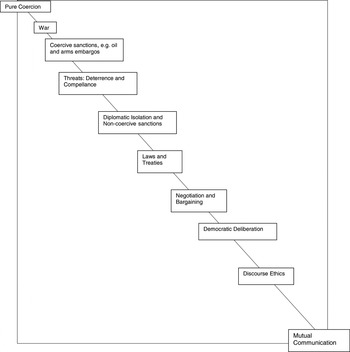
If this were the simple definition of argument and persuasion, we could reasonably say that argument and persuasion are either at work or not. But because social action is complex, consisting of communication, reflection, decision, and coordination of actions with others, we should rather say that argument and persuasion may be seen along a continuum, described below as ideal types. At one end of the continuum, there is no argument (killing and compulsion). In the middle of the continuum are interactions that mix argument with other forms of action: strategic action including war, the lifeworld and bureaucratic reason, and deliberative institutions. At the other end of the continuum, there is only argument (discourse ethics) or mutual communication. Figure 1 suggests the role and relative mix of force, strategic action, and argument in characteristic activities of world politics.
Degree of physical or rhetorical coercion

The Limit: Pure Coercion
No one can argue with annihilation. Killing someone who disagrees with you is obviously not persuasion, though killing may follow an argument and an unsuccessful attempt to persuade.Footnote 28 Nor is it persuasion to physically confine someone or to move the limbs of the other so that they do as you would like. That is compulsion.Footnote 29 The extreme act of pure compulsion does not involve language and persuasion. Hannah Arendt, who distinguishes violence as simple coercion from power as coordinated action, argues, “where violence rules absolutely, as for instance in the concentration camps of totalitarian regimes, not only the laws … but everything and everybody must fall silent … the point here is that violence itself is incapable of speech, and not merely that speech is helpless when confronted with violence.”Footnote 30
Nor is brainwashing genuine persuasion: the brainwasher has simply gotten the other to act as they desire without allowing the other to think through their options. Brainwashers replace the other's thoughts with their own, and though the brainwashed person moves his or her body and may even mouth the words dictated by the brainwasher, those actions are not truly voluntary.
Coercive sanctions such as oil and arms embargoes do not work primarily as persuasion; rather, coercive sanctions decrease the ability of the targets of sanctions to act by denying them some necessary commodity or tool. The targets of coercive sanctions can resist, for instance through import substitution industrialization, but here, even if the target manages to produce a substitution for the embargoed commodity, the coercive sanctions have essentially forced the target to use resources in a way that they would not have done otherwise. Thus, the main effect of embargoes of strategic materials and arms is to deny or constrain the target's capacities. Once imposed, blockades such as arms, oil, or food embargoes work by diminishing the physical capacity of others to act, and are thus coercive in the sense of limiting the agency of others. These embargoes usually do not change minds; in fact, they often harden resistance in the target.
Thus, I do not want to erase the role and significance of brute force. But though no one can argue with annihilation and simple compulsion, the scope for these activities in politics is limited by politics: one has to persuade others to engage in annihilation and compulsion. Moreover, we have to persuade others not to resist and punish those who would engage in annihilation and compulsion. In other words, even annihilation requires talk in the form of narratives (story telling about why someone deserves death) and persuasive argument.
Strategic Action: War, Non-Coercive Sanctions, Threats, Bargaining
In the case of strategic action, there is some scope for argument with the target, though the role of argument is intertwined with force and threats of more force. Military and economic coercion unlike killing, compulsion, and brainwashing, leave some scope for the objects of coercion to make a choice, but this choice is not one where the coerced was persuaded on the merits of an argument. Rather, the coerced was only “persuaded” that the cost of non-compliance with threats was too high to make resistance worthwhile. In sum, communication occurs when threats are made, but the “statements” made by coercers are not on the substantive merits of the issue at stake, nor is the choice made by the target of coercion based on the content of the argument. Rather, in such instances, the communication is primarily about the costs, risks, and benefits of compliance and non-compliance.Footnote 31
Schelling's discussion of the diplomacy of violence explicates how choice occurs in the absence of genuine persuasion. “In addition to seizing and holding, disarming and confining, penetrating and obstructing, and all that, military force can also be used to hurt…. it can cause an enemy pain and suffering.”Footnote 32 Schelling wants to make room for choice even “under the gun” because, unless the coercer directly moves the body of the coerced, the coerced still has a (painful) choice.
To inflict suffering gains nothing and saves nothing directly; it can only make people behave to avoid it. The only purpose, unless sport or revenge, must be to influence somebody's behavior, to coerce his decision or choice. To be coercive, violence has to be anticipated. And it has to be avoidable by accommodation. The power to hurt is bargaining power. To exploit it is diplomacy—vicious diplomacy, but diplomacy.Footnote 33
Force that is demonstrated or threatened, even deadly force, leaves room for actors who remain alive to make decisions. “If people have an influence on whether the war is continued or on the terms of a truce, making the war hurt people serves a purpose.”Footnote 34 We can thus distinguish between force as compulsion and force as coercion. In the former, the object of force has no choice; in the latter, the coerced has an (unfair) choice to comply or to suffer the pain attendant with non-compliance. The threatened pain may be so great as to seem as if there is no option at all. Again, if actors in such a situation were persuaded of anything, and I hesitate to use that word in this context, they were convinced on the level of the costs, risks, and benefits of following orders. But there is an option—and many who have faced certain pain or death have made the choice not to comply. If we agree with their choice, we call those resisters heroes or martyrs; if we disagree, we call them fools.
Similarly, non-coercive sanctions, conditionality, and the use of foreign trade as an instrument of power are coercive: targets have choices, but there is little or no room for genuine persuasion. Targets of non-coercive sanctions (e.g., travel restrictions, cultural embargoes), conditionality, and trade policy have options to both resist and argue against the policies or conversely to change their policies in conformity with the desires of those who are using economic force against them. But if targets comply with sanctions or conditionality, they were not voluntarily “persuaded” to act on the merits of the policy, they were simply avoiding pain imposed in the interests of the other actor. The threat to impose the sorts of coercive sanctions discussed above, which is essentially the threat of blockade, does leave room for choice.
In a political context there is always argument in the strategic action setting, albeit not with the murdered or coerced individual. The bystanders and supporters of a regime may be the focus of arguments since coercers and their agents must decide how far they will go and persuade others to go along with them. If someone plans on killing many or using force as compulsion, they must convince others that they should be supported in their efforts or at least not stopped or punished for killing or compulsion. This “convincing” may be coercive (the killer is supported out of fear) or it may be based on a higher level of argument such as political debate. Similarly, coercion and sanctions that are used in a political context require political support which must ultimately be based on persuasive arguments. Political protest threatens leaders with unrest or the loss of power. Thus, for E.H. Carr,
man-power is not reckoned by mere counting of heads. “The Soldan of Egypt or the Emperor of Rome,” as Hume remarked, “might drive his harmless subjects like brute beasts against their sentiments and inclinations. But he must at least have led his mamelukes or praetorian bands like men by their opinions.” Power over opinion is therefore not less essential for political purposes than military and economic power, and has always been closely associated with them. The art of persuasion has always been a necessary part of the equipment of a political leader.Footnote 35
Finally, bargaining frequently occurs in the strategic action setting. Arguments may be offered for one side to make a concession to the other, but what is going on in the bargaining setting is not usually characterized by genuine persuasion. If actors change their positions, they have done so because they see some advantage in doing so, not necessarily because they were persuaded of the merits of the other's views. The outcome of bargaining thus often reflects the pre-existing relations of power between interlocutors, while the content of the arguments may be little more than statements of threats and promises of the form, if you do x, I will do y. This is not to say that genuine persuasion never occurs in bargaining settings, just to say that the bargaining practice has less to do with persuasion, and more to do with threats, promises, and reciprocity.
The Lifeworld and Bureaucracies
International law, treaties, and the institutions where bargaining and negotiation occur, depend on a shared lifeworld—common beliefs and values. International law thus reflects and promotes a shared vision. There is greater, albeit still relatively little, scope for persuasive arguments if actors are not in a position to question many of their beliefs because they take many beliefs for granted. This is the case when individuals hold their beliefs unreflectively and in many ways are not even completely aware of the content of what they take for granted. For example, Plato believed that strong socialization or “enchantment” would form the values and habits of good citizens, and that citizens should be limited in their ability to question these background beliefs.Footnote 36 Habermas calls this background consensus that structures most of our understanding and action the lifeworld (the stock of background knowledge that gives meaning to the world) and Foucault called similar aspects of social reality subjectivity and governmentality (how we understand ourselves and what we consider rational and proper and irrational and improper for governments to be and do).Footnote 37 Although they are often unquestioned, both the lifeworld and governmentality can be problematized or denormalized and hence opened up to argument and persuasion.
Bureaucracies, to the extent that they simply apply rules and do not listen to even minimal objections, are not places where one would expect to or see much argument or persuasion. This is not to say that successful appeals do not occur, it is simply that appeals are rarely successful and that rules are generally unreflectively applied. The greatest scope for persuasive argument in these settings may be to suggest that a rule does or does not apply in a particular instance—framing the problem or dispute through a meta-argument.
The lifeworld and bureaucracy are relatively thin in international politics as compared to domestic politics, but like domestic politics, the scope of the shared lifeworld and the bureaucratization in international politics is increasing. Lifeworlds are thicker in regions, such as Europe and the North Atlantic, Asia, and the Middle East, and arguments across lifeworlds are often incomprehensible or plagued by misunderstanding. Cultures and histories have only recently become global and there are vast, if diminishing, areas of disagreement about basic assumptions, such as human rights, economic systems, and the role of religion. Bureaucracies are relatively thinly developed in world politics, although in some cases, such as the European Union and the World Trade Organization, bureaucracy is quite thick. The institutions of global governance—e.g., the United Nations system, the World Trade Organization, and regional organizations, are venues for argument.
In sum then, the lifeworld is a pre-condition for argument: without language and taken for granted beliefs we could not have coherent arguments. Further, arguments can be used to settle or increase the institutionalization of the lifeworld, and when the lifeworld is settled, there is less scope for argument, especially if those arguments clash with the dominant discourse. Conversely, persuasive arguments may also destabilize the lifeworld, as when anti-slavery arguments caused actors to change their beliefs about the humanity of slaves and their practices.
Deliberative Institutions
Deliberative institutions are settings for formal and informal argumentation. The process of building and maintaining political institutions is one of institutionalizing beliefs that are accepted through arguments. In turn, there is much greater scope for argument and persuasion within deliberative institutions—political, legislative, and judicial settings where argument is expected, institutionalized, protected, and ritualized.Footnote 38 The Assembly of the League of Nations is an early example of a deliberative institution in world politics; the United Nations General Assembly, the World Court, and the European Union Parliament are the best contemporary examples in world politics of deliberative institutions. But, even in these settings, the range of arguments is affected by self-imposed or unconscious (lifeworld) limits and by strategic action.Footnote 39 Nevertheless, scholars of global civil society and deliberative democracy have shown that deliberation is occurring on within and across international institutions and that it can be more or less democratic.Footnote 40
Persuasive argument has an important role during the institutionalization of new ideas, that is when agreed upon beliefs are turned into measurable benchmarks and standard operating procedures. Specifically, the process of institutionalization entails actors arguing about what the belief means in context (articulation and specification). Actors also argue as they devise the metrics for assessing whether actions comply with belief (standards of assessment); devise the standard operating procedures for implementing the belief (proceduralization); and decide where, when, and how to evaluate, judge, and revise the new practices and standards. Once new beliefs are institutionalized, however, the scope for persuasive argument may greatly diminish unless processes of review and challenge are institutionalized. Once highly institutionalized, and if there is limited scope for review and challenge, the limits described in previous discussion of argument in the setting of bureaucracies applies. But if the deliberative institution remains open to revision and challenge, and the norms of deliberation are themselves institutionalized, the scope for argument and persuasion can grow.
For example, in institutionalizing a new international consensus on the creation of a mandate system for former colonies (itself a product of years of argument) the members of the League of Nations had to make very specific decisions. League Mandates were the colonial territories of the losers of World War I that were not returned to the former colonizer. Instead, they were to be supervised by “mandatory” powers as a sacred trust of civilization whose inhabitants were to be brought to a level development that would lead to self-government. Specifically, through its Permanent Mandates Commission, the League articulated what a sacred trust of civilization was, set standards of assessing whether a mandatory power was administering its Mandate in line with those views, decided the procedures they would use to make the assessment and implement oversight (using annual reports in response to questionnaires) of the Mandates, and used the Permanent Mandates Commission as the venue where further arguments about the administration of Mandates could be heard. Argument was a part of each stage of the process of deciding how to institutionalize the concept of mandates as “trusts of civilization.” Further, the outcome of the process of argument within the Permanent Mandates Commission led to increased scope for argument within the mandates themselves.Footnote 41
“Pure” Argument
Discourse ethics, as articulated by Habermas, is the case of pure argument or ideal speech where actors hope to come to an uncoerced understanding with each other. In discourse ethics, the arguments are logical (coherent), actors' claims are open to challenge, and if challenged, their claims can be supported. All competent subjects are allowed to participate by making any assertion and expressing their attitudes, desires, and needs.Footnote 42 Actors come to understand each other through dialogue and the participants are willing to take on the obligations that result from reaching consensus.Footnote 43 Of course each participant must be willing and able to back up their assertions, and revise them if they are proven ill-founded. The focus of discourse ethics theory is the process by which normative agreements become understood as valid, “that every valid norm would meet with the approval of all concerned if they could take part in a practical discourse”Footnote 44 The content of conclusions that are binding must pass the procedural test.
In argumentation, proponents and opponents engage in a competition with arguments in order to convince one another, that is, in order to reach a consensus. This dialectical role structure makes forms of disputation available for a cooperative search for truth. Argumentation can exploit the conflict between success-oriented competitors for the purpose of achieving consensus so long as the arguments are not reduced to mere means of influencing one another. In discourse what is called the force of the better argument is wholly unforced. Here convictions change internally via a process of rationally motivated attitude change.Footnote 45
Although discourse ethics is extremely rare in world politics, it is neither undesirable nor impossible to approximate. In this “pure” case of argument, the underlying social order is based on empathy, commitment, and responsibility toward others.Footnote 46 Even here, however, persuasion may not occur. In discourse ethics we expect interlocutors to be truthful, whereas in other contexts for argument, such as negotiation we don't necessarily expect actors to be entirely forthcoming or truthful.
Critics of discourse ethics question Habermas' assumption that the aim of communication is for interlocutors to reach understanding. Rather, they suggest that this view of argument is apolitical and suffers from the failure to recognize that arguments can be coercive since discourses do not take place outside the realm of power—either material or discursive power. Moreover, since language itself, and the background consensus of the lifeworld, reflect material inequalities and the exclusion of certain types of beliefs, the phrase “force” of the better argument is all too apt. Even discourse ethical argument can be coercive or reflect pre-existing uses of force. Further, critics contend, there is a Western liberal bias to discourse ethics—a privileging of “rational” speech and Western values.Footnote 47 Nevertheless, Habermas' understanding of discourse ethics in an ideal speech situation might be take as a normative ideal, and as an approximation of what sometimes occurs among equally powerful actors.
Mutual Communication
Closely related to discourse ethics are the concepts of communicative action and mutual communication or conversation. For Habermas, communicative action is dialogue oriented toward achieving understanding, and discourse ethics depends on communicative action. Slightly different, the notion of mutual communication describes communication that occurs without a deliberate attempt to persuade; interlocutors are sharing information or coming to a mutual understanding of a new situation. There are some similarities between discourse ethics and mutual communication: brute force is not an option in either setting and actors are expected to pay careful attention to the other's arguments. The mutual communication environment is different from the discourse ethical environment, however, in the sense that with discourse ethics, one is trying to persuade the other through the force of the better argument—and one might be persuaded by the other's arguments as well. In mutual communication, both sides are open to learning from the other; views may change but conversion of another to ones' own beliefs is not the goal.
Similarly, Michael Oakeshott suggested a conversational encounter where the goal was not to persuade or coerce, but to communicate.Footnote 48 Building on Oakeshott, Fred Dallmayr has argued for non-coercive “thick conversation” or “thick dialogue,” where the goal is not so much persuasion as “an encounter between mutually decentred agents involved in a transformative” interaction.Footnote 49 As he suggests, the “appeal in such exchanges is no longer merely to the rational, cognitive capacity of participants, but rather to a full range of their situated humanity, including their hopes, aspirations, moral or spiritual convictions, as well as their agonies and frustrations.”Footnote 50
A concept of mutual communication was also articulated by Sally Miller Gearhart who believed that “any intent to persuade is an act of violence.”Footnote 51 Gearhart argued instead that communication occurred in settings where participants in conversation created a nurturing environment. “Communication can be a deliberate creation or co-creation of an atmosphere” in which there is a potential for persuasion.Footnote 52 Thus, like Habermas, Gearhart is concerned with process, but she is also quite concerned with the attitudes and expectations of those who are communicating, and regards the context of communication as equally as important as the content and process of communication. Gearhart proposes five conditions for mutual communication:
1. that no intent to enlighten or to persuade would be made but rather that each party would seek to contribute to an atmosphere in which change for both/all parties can take place;
2. that there are differences among those who participate—in the case of learning, differences of degree and quality of knowing specific subject matter, and in the case of conflict, genuine disagreements between/among people;
3. that although there are differences, persons involved feel equal in power to each other;
4. that communication is a difficult achievement, something to be worked at, since the odds are great that moments of miscommunication will outnumber moments of communication;
5. that each participant is willing on the deepest level to yield her/his position entirely to the other(s).Footnote 53
The bottom line, for Gearhart, seems to be that interlocutors drop their antagonistic stance. Mutual communication of the sort described by Gearhart seems to be extremely rare in what we normally consider world political settings. Yet mutual communication may occur in some instances, for example among heads of state or diplomats, or in cases of conflict resolution and reconciliation. And mutual communication may occur within groups of people during the initial stages of trying to understand a new phenomena—such as global climate change or a hole in the ozone layer; they share information, opinions, emotions, and goals in an effort to understand a situation or each other.
The creation of an environment of mutual communication that is without the pressure of one side trying to persuade another seems particularly well suited to settings where both sides in a dispute have come to an impasse. In this context, mutual communication seems to be the furthest from what is possible—interlocutors may only be talking in between exchanging blows. And much of that “talk” may be simply in the form of insults and threats tossed back and forth. Mutual communication in such a setting demands both more and less of interlocutors. Instead of continuing to “knock heads” in unproductive efforts to change the other's mind, the participants would stop seeking to get to a final point of resolution, but simply try to understand each other. Interlocutors may still, in a mutual communication setting, make arguments to support their views, but they are not trying to get the other to agree: persuasion is not the goal, though genuine persuasion may occur if the other can understand your position and vice versa.
Marc Lynch, in an evaluation of diplomacy between the U.S. and China during the Clinton administration has described a form of mutual communication between states that are in an antagonistic relationship when they are participating in dialogue as part of “constructive engagement.” Building on Habermas' ideas of communicative action, Lynch argues that, “communicative engagement aims at establishing common interpretations and mutual expectations governing both cooperative and competitive behavior.”Footnote 54 As Lynch suggests, dialogue is unlikely to be productive of increased understanding if actors lecture or try to change the other.
This does not mean, of course, that dialogue produces an automatic harmonization of preferences. It does mean, however, the construction of a thin common lifeworld within which it becomes possible to maintain more cooperative interaction. This clarifies the nature of the game being played, building common knowledge which stabilizes the intersubjective understandings of the interaction.Footnote 55
Further, in contrast to discourse ethics, mutual communication is not simply logical argument in the form of practical inference or analogical reasoning. Rather, it may involve other forms of communication, such as sharing myths, story telling, artistic visual and musical representations, rhetoric, and greeting. As the playwright Eve Ensler suggests, “When people are being backed into right and wrong, yes and no, pro and con, theater works to open people's hearts. Theater opens people up to duality, and complexity, and ambiguity so that other parts of the mind start to operate.”Footnote 56
As Iris Marion Young argues, alternative forms of communication are often devalued in politics, but they need not be and should not be discounted.Footnote 57 Indeed, to do so misses interesting phenomena in world politics when mutual communication is used alongside attempts to persuade, such as when states use emotional propaganda to move their people to war, or when NGOs show pictures of land mine victims, or when social movements use street theater and personal narratives to protest what they understand to be unjust practices by international institutions such as the World Bank and International Monetary Fund. Further, as Lynch and Müller suggest, constructive engagement and other regular dialogues between states may help build a common lifeworld between previously isolated groups.Footnote 58 In other words, even if they do not aim at producing binding agreements, mutual communication that occurs within these settings in an atmosphere of respect, can help build a common language, increase understanding and common knowledge, and help to open and soften the emotional relationship between interlocutors.
At this juncture skeptics may be asking just exactly where in world politics one can see evidence of discourse ethics and mutual communication. Indeed, even those who are sympathetic to discourse ethics are pessimistic about its actual use. For example, Jane Mansbridge argues:
Only genuine agreement, arrived at in conditions free from coercion, can produce fully legitimate outcomes…. I would emphasize that in the real world—as Foucault reminds us and Habermas grants—there are no conditions free from the threat of sanctions or use of force. The ideal of coercion-free deliberation resembles many important and useful democratic ideals in being impossible to achieve fully, although possible to approach.Footnote 59
While the advocates of discourse ethics and mutual communication would certainly grant that most interaction world politics is not characterized by either, there are instances of both forms of talk within states and perhaps sometimes among them. Further, discourse ethics and mutual communication often perform a role different from the logical arguments that speakers advance in strategic and deliberative settings. In the latter, speakers aim to change their interlocutors while in the former their aim is to understand them. And while in strategic contexts, in the lifeworld and bureaucracy, or in deliberative settings, actors have no incentive to be wholly forthcoming or truthful, settings of discourse ethics and mutual cooperation place truth and openness at a premium.
Shifting from Coercion to Deliberation and Persuasion
Of course, these neatly delineated ideal types are just that. Ordinary politics almost always consists of a mixture of these modes. Thus, when Clausewitz argues that war is a continuation of politics by other means he is describing a fluid spectrum where pure brute force coercion is certainly operating, but where threats, arguments, and diplomacy may coexist. Yet Clausewitz is wrong when he says that, “what remains peculiar to war is simply the peculiar nature of its means.”Footnote 60 To the extent that war displaces dialogue between antagonists, the logic of war is opposite that of politics understood as political argumentation in an attempt to persuade others with reasons.
Yet, as Clausewitz suggests, resort to war itself can be limited by culture and argument. “If wars between civilized nations are far less cruel and destructive than wars between savages, the reasons lie in the social conditions of the states themselves and in their relationships to one another. These are the forces that give rise to war; the same forces circumscribe and moderate it. They themselves are not part of war; they already exist before fighting starts. To introduce the principle of moderation into the theory of war itself would always lead to logical absurdity.”Footnote 61 The attempt to change the nature of war, understood in Clauswitzian terms for the moment as pure coercion, is an oxymoron: force negates the logic of non-coercive argument. Once force comes into play human rights and democracy are compromised. But the road to and away from brute force coercion, and the many elements of war that are not brute force, use and depend on the making of political arguments.
Although most international political action includes elements of both persuasion and coercion, we must ask when political actors will switch from strategic action to action characterized by at least a moderate level of argument and persuasion. In other words, why might actors switch from strategic action against their opponents to argument? First, they could already have, or develop, a normative preference for argument and persuasion. A normative preference for deliberation and argument—over coercion—is one of the hypotheses underpinning some versions of democratic peace theory.Footnote 62
Second, antagonists could switch from coercive or strategic action to argument because they have reached a military or economic stalemate where neither side can expect to prevail by using coercion. In this instance, nothing has changed fundamentally in terms of actor's identity beliefs or interests. Rather, strategic action has failed and actors see argument as a potential way of achieving their interests. Examples include the end of civil and international was, when parties go to the negotiating table after it becomes clear that neither can win decisively on the ground.
Third, a shift from coercion to persuasive action could occur when the parties to a dispute change. Specifically, elites who were opposed to negotiations and political argument could be deposed via election or elite fracture and a group more open to negotiation could come to hold authority. An example of parties to a dispute changing, and this facilitating negotiations, is change in elite Afrikaner consensus in South Africa during the late 1980s. A consensus among white South Africans had held the apartheid regime together and had opposed negotiations with representatives of black majority. Sanctions, a declining economy due to a fall in commodity prices, as well as declining racism among some white South Africans led to a fracture in the white community that allowed those who favored negotiations with black South Africans to rise to power.
Fourth, a transformation of the emotional relationship between antagonists could occur. Actors' beliefs about each other and their emotional relationships could change from suspicion and hostility to marginally greater trust and empathy such as when pluralistic or amalgamated security communities are formed (e.g., the U.S. relationship with Britain; development of European Union).Footnote 63 This transformation is more likely if there has been mutual communication between antagonists so that they come to understand each other differently. Any move from one form of power to another form will, of course, entail that actors make political arguments to their potential and actual supporters in order to persuade them to switch modes.
Conversely, the move from deliberation to coercive sanctions, war, and pure coercion or annihilation demands a different sort of transformation. The parties to a dispute shift their emotional relationship to antagonism and contempt and their moral relationship from relative equality to inequality. The violent assume they are right; or, to play on the common phrasing, the violent assume that right makes might. “Violence is for the morally infallible. If you are convinced that you alone have truth, there is little recourse but to threaten, intimidate, bribe or coerce those who disagree with you if they do not come around to your view—or ultimately of these methods are unavailing, to use force.”Footnote 64
The Scope of Political Argument
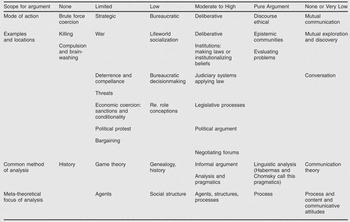
The forms of action and the scope of argument are summarized in table 1. There is not space here to discuss the all the rows of the table, nor does the table encompass all possible modes and mixes of strategic action and argument. Further, the table is illustrative rather than all-inclusive. And as the above discussion of the ways actors may come to shift their orientation from one mode of action to another suggests, process tracing can illuminate the transitions among modes of political action.
Potential scope for political argument

This table is suggestive. Specifically, in describing the common method of analysis of these modes of action, I mean only to suggest for example that game theory is commonly used to understand strategic action. I don't mean to limit the use of a particular method of analysis to a specific mode of action. For example, there is certainly much to be gained by, for instance, using game theory or genealogy to understand deliberative institutions. Further, in terms of meta-theoretical focus, I am noting that the dominant meta-theoretical category, whether agents, structures, or processes, may shift with the sort of action under consideration. This suggests that in understanding the range of human argument, no single meta-theoretical focus (level of analysis) trumps another.
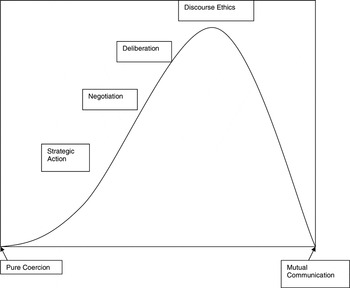
Although I have organized my description of the scope for argument in table form, the scope and role of argument could perhaps better be represented as a continuum or a modified bell-shaped curve with a long left tail and a short right tail. Figure 2 suggests this relationship. The scope for argument is low on the left and increases as one goes right. At the point of mutual communication, the use of argument is low again—approaching zero.
Level of argument

International Action to Suppress the Slave Trade
I do not have space here to illustrate and elaborate my arguments about homo politicus and the role of argument with detailed cases. Rather, my claims about the role of argument are illustrated with a very brief, and necessarily incomplete, example of international action to suppress the slave trade.
For many decades, the British government and British merchants were the world's most active participant in the international slave trade: British ships both private and under Charter to the King transported millions of African slaves across the Atlantic to the Americas from the 1600s to the early 1800s. Simple economic interests cannot explain the demise of the trade or slavery—both were still profitable when they were ended.Footnote 65 During the long British abolition movement, ethical arguments that drew nascent empathy for slaves were deployed to first regulate the slave trade, then to outlaw the British part in the international slave trade in 1807, and eventually to end slavery in Britain and its colonies.
The British then moved to suppress the international slave trade. As the world's preeminent naval power Britain could simply have imposed slave trade suppression through brute force coercion. Instead, Britain moved to suppress the international transatlantic slave trade through several methods that illustrate the scope and limits of strategic action and persuasion. Over a period of decades, the British negotiated an international slave trade regime that included not only the right to stop and search suspected slave ships, but what were arguably the first international criminal courts. Thus, rather than simple hegemonic imposition, the British created an international regime that included military, diplomatic and judicial elements.Footnote 66 Force and argument were deployed along a spectrum that changed the nineteenth century world.
Perhaps most well known of these were the anti-slave patrols that the British Navy ran off the coast of Africa to interdict slave ships: about 1,500 slave ships were captured by the Africa Squadron, which led to the release of an estimated 160,000 people.Footnote 67 This was in part possible because Britain both economically pressured lesser powers to submit to suppression but also acted multi-laterally, by negotiating treaties—for example with Portugal (1817), Spain (1817), the Netherlands (1818), France (1831), Texas (1844), and eventually the United States (1862)—for the right to search ships under their flags.Footnote 68 The treaty system was not inexpensive: for example the British paid Spain £700,000 for the right to search ships under the Spanish flag and for agreements to prohibit slave traffic north, and then three years later, south of the Equator. The vast majority of suspected slave ships—over 1,600 were captured by the British although the French captured several hundred ships, and the U.S. Navy captured at least 103 slave ships.Footnote 69
Perhaps least well known of the efforts to suppress the slave trade were the international courts of joint or mixed commission that sat in port cities between 1817 and 1871. These courts were established under the international treaties in Freetown, Sierra Leone; Luanda, Angola; Cape of Good Hope, South Africa; Boa Vista, Cape Verde; Rio de Janeiro, Brazil; Surinam, Spanish Town; Havana, Cuba; and New York. Under the treaties, suspected slave ships that had been captured would be taken to one of these ports. The Commission would decide if the vessel was an unlawful slave ship. If it was judged to be a slaver, the ship could be taken as a prize and the slaves were liberated.
Under these joint courts, some 600 ships were condemned as prizes and nearly 80,000 slaves were freed.Footnote 70 A court of mixed commission included commissioners from both sides to the anti-slave trade treaty. For instance, there were Anglo-Spanish, Anglo Portuguese, Anglo-Dutch, and Anglo-Brazilian commissions in Freetown, Sierra Leone. The British commissioners generally acted as prosecutors, but these courts were not pro forma exercises. Suspected slavers were allowed witnesses and legal representation. The courts of mixed commission acquitted some ships and “the ship, its cargo, and any slaves on board were generally restored at once to the owners, who were entitled to claim the costs of the suit and all losses and damages sustained as result of the capture and detention of their vessel.”Footnote 71 In the case of disagreement between the two commissioners, the courts used two commissioners of arbitration from the treaty countries who would then draw lots to see who would make the final determination.Footnote 72
As this short example illustrates, argument and attempts to persuade are ubiquitous in world politics. British action to suppress the international slave trade involved brute force compulsion, deterrent threats, negotiation, and diplomacy. Support for slave trade suppression was built over time through processes of democratic deliberation, discourse ethics, and mutual communication (when freed slaves gave testimony of the conditions of the trade). Indeed, the above framework—which includes the forms of political action and speech—can serve as a guide to scholars, helping them see what kinds of action and argument are possible to look for in particular episodes and institutions of world politics.
Moral Assumptions of Political Action
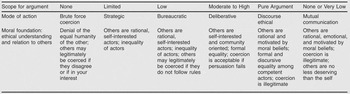
Each mode of political action rests on moral assumptions. Because realists believe that force is the decisive factor in world politics, many realists (though certainly not Morgenthau) also believe that morality is relatively unimportant, or is perhaps even irrelevant. Yet, morality is obviously important if one considers the fact that underpinning each form of action is a view about the rights and worth of others. In other words, each form of action entails a moral understanding. Table 2, “moral foundation” describes the underlying assumptions that actors hold about the other when they engage in each form of action—the assumptions that actors hold about human nature and their ethical obligations to others. These assumptions are also, to a degree, related to their self-conceptions of their historically developed identities.
Moral assumptions of action

In strategic interactions, most actors hold assumptions about themselves and others that are appropriately associated with rational actor theory and political realism. As Robert Keohane summarizes, “To say that governments act rationally … means that they have consistent, ordered preferences, and that they calculate costs and benefits of all alternative policies in order to maximize their utility in light both of those preferences and of their perceptions of the nature of reality.”Footnote 73 This view, for realists, rests on a particular understanding of human nature well articulated by Hans Morgenthau: “The drives to live, to propagate, and to dominate are common to all men…. The tendency to dominate, in particular, is an element of all human associations, from the family through fraternal and professional associations and local political organizations, to the state.”Footnote 74 Thus, Morgenthau argued, “in view of this ubiquity in the struggle for power in all social relations and on all levels of social organization, is it surprising that international politics is of necessity power politics?”Footnote 75 It follows, on this view, that if violence is expected and coercion is acceptable, antagonists live in a world of moral absolutes, where right is on their side, and might makes right.
Similarly, in bureaucracies and within organizations that emphasize the values of identity roles, rule and role-following are expected and actors who violate rules may be legitimately sanctioned or coerced. This is because the institutional cultures of most such organizations share strategic action assumptions about human nature, with the crucial difference that within these organizations or social groups, actors have agreed to be bound or are legally subject to the rules of the institution.
In the context of deliberative institutions actors are rational and self-interested, but they also care about preserving the community and assume that others do so as well. In this context, we assume that others are capable of reason and forgoing or at least constraining actions based on simple self-interest. The preference is for actors to make decisions deliberatively along the lines of an agreed-upon decision rule, such as majority rule. Coercion is still possible, indeed it is always implied, within deliberative institutions if persuasion fails.Footnote 76 Actors are assumed to be formally equal in democratic deliberative contexts.
In the context of discourse ethics, actors assume that others are both rational and capable of reasoning according to universalistic, as opposed to self-interested, reasons. Actors are both formally equal, and felt to be equal by participants in discourse ethics since all communicatively competent actors can make and challenge claims in an argument. Empathy is a prerequisite: “Where sociocultural distance is a factor, concern for the fate of one's neighbor—who more often than not is anything but close by—is a necessary emotional prerequisite for the cognitive operations expected in a discourse.”Footnote 77 Here, actors should be and are motivated by principled beliefs, the aim is consensus, and coercion is illegitimate.Footnote 78 But while empathy is important, the emphasis in discourse ethics is on the cognitive evaluation truth claims and normative or validity claims.
In the situation of mutual communication, the assumption is that actors are both rational and emotional. In other words, they are reasoning. When engaged in mutual communication with others, actors are highly empathetic and, as in the case of discourse ethics, they eschew coercion as illegitimate. In this form of action, one can say that actors are fully sensitive to others as both different from themselves—it is thus incorrect to make assumptions about how others think and feel—and that others are deserving of their full respect. In this sense, others are formally equal but always inescapably different. Emmanuel Levinas' ideas about relations between self and other are useful in helping us understand this sense of the empathetic but respectful moral relationship to the other that is entailed in a context of mutual communication. “Our relation with him [the other] certainly consists in wanting to understand him, but this relation exceeds the confines of understanding…. The other is a being and counts as such.”Footnote 79 Communication is the key to forging the relationship. “Is the person to whom we speak understood beforehand in his being? Not at all. The other is not first an object of understanding and then an interlocutor. These two relations are merged. In other words, addressing the other is inseparable from understanding the other.”Footnote 80
As the role of argumentation is made more prominent in various deliberative settings, norms for inclusion and exclusion in discourse are made more explicit. In coercive settings, participation in discourse is limited. In settings of negotiation and bargaining, the norms for participation will be more inclusive and sometimes quite explicit. In settings that are characterized as discourse ethical, the norm will be to include all those who are communicatively competent and who renounce the use of force. In mutual communication settings, norms of participation will include even those who use different forms of expression, that go beyond rational argumentation, including expressive action.
The Role of Argument Over the Longue Durée
Eras are characterized by dominant moral beliefs about self-other relationships—beliefs about what is legitimate to do to another. In the not too distant past, it was seen as legitimate to enslave and colonize others with brute force. The long-term trend in the nineteenth and twentieth century that underlies the end of slavery and colonialism is the growing belief that it is appropriate to extend human rights and democracy. The root of beliefs in both human rights and democracy is the idea that brute force coercion—whether in labor relations or against distant others—is illegitimate.
Democracy is not simply the sum of the political right to vote and freedoms to associate and speak freely, but the opportunity to deliberate—to argue. As Randy Forsberg argued, “democratic institutions have prompted, or paralleled, a growing rejection of violence as a means of achieving political or economic ends within and between nations.”Footnote 81 For Forsberg, it is not an exaggeration to say that democracy and a commitment to non-violence are synonymous—“commitment to non-violence lies at the core of democratic institutions….”Footnote 82
Though little recognized, the renunciation of violence as a means to any ends except defense is as much a cornerstone of democratic institutions as its widely recognized counterpart, freedom of expression and other civil liberties. Commitment to non-violence protects and preserves freedom of expression and other civil liberties by precluding intimidation or coercion by violence or the threat of violence. Within democracies, wherever nonviolence is not the rule … other democratic rights and freedoms are lost or severely compromised.Footnote 83
In sum, over the longue durée of the eighteenth, nineteenth and twentieth centuries, the role of coercive force has been gradually denormalized and delegitimized. Who may argue—who is considered human and deserving of human rights—and the topics that may or must be argued about, rather than simply asserted by divine right or authoritarian fiat, were enlarged by the human rights and democratization movements of the nineteenth and twentieth centuries. Thus, as world politics becomes more thickly institutionalized, the role of argument has increased, as have the venues where political arguments may occur. As the role of argument increases, the use of brute force declines. When brute force is used today among states, it is less often the result of a single state taking force into its own hands, but usually follows at least a pro forma but more often a necessary attempt within regional or global international organizations to persuade others to support that use of force. Such action was not conceivable 400 years ago.
Barriers to Argument and Persuasion
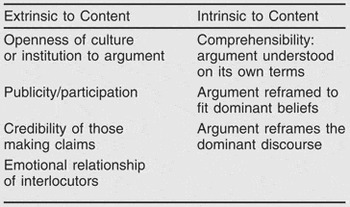
To say that argument and attempts to persuade are ubiquitous (and my emphasis has been on the process and role of argument) does not say when and why specific political arguments (which are obviously more complex than private arguments) will be persuasive. As noted above, arguments do not occur on a level playing field, so to be persuasive, political arguments must overcome extrinsic and intrinsic barriers to argument that exist because all arguments occur in a political (power) and discursive (cognitive, emotional, and normative) context. Extrinsic barriers are contextual and to overcome them is to allow the argument to be heard within the uneven power-political playing field of discourse. Intrinsic barriers are those that are posed by substance of the argument being made in their particular cognitive context. As Risse says, “ideas do not float freely.”Footnote 84 Neither do arguments.
An argument may overcome extrinsic barriers when the culture and the institution where the arguments occur are open to challenge. Or an advocate can make the situation more open by exploiting and enlarging what social movement scholars describe as structures of political opportunity. Extrinsic barriers are also overcome by gaining publicity for an argument. For example, the poor cannot be heard unless the media or the powerful publicize their arguments. This is the barrier of simple participation. Further extrinsic barriers are overcome when the advocates of a position are seen as credible, so that if they are heard, the might be deemed worth listening to. Credibility of actors making particular arguments is linked to the content of the argument: for example, we don't give credence to physicians making arguments about automobile mileage standards. Credibility is thus related to the hearer's sense of the communicative competence and authoritativeness of those who are making arguments. Extrinsic and intrinsic barriers to argument overlap when concerns about an actor's competence reduce the ability of a particular advocate to raise substantive arguments and challenges.
Emotional relationships between interlocutors may be another extrinsic barrier. Empathy and trust increase the likelihood that arguments will be heard while hostility will decrease receptivity. Some, for example Thomas Risse, argue that the process of argument “establishes trust among actors regarding mutual belief in truthfulness.”Footnote 85 This may certainly be so, but it is more likely that pre-existing trust enables arguments to be heard, increasing the potential for persuasion to occur. But distrust is not the only emotion which can get in the way of genuine persuasion. For example, extreme fear decreases the ability of potential interlocutors to hear and assimilate information and arguments.Footnote 86 Of course emotions can be evoked by the content of arguments, and here again, the extrinsic/instrinsic distinction between barriers to arguments becomes blurry.Footnote 87
Domestic and international institutions designed to facilitate democratic deliberation may lower the extrinsic barriers to argument, by increasing the ability of different actors to participate.Footnote 88 Environments thick with deliberative institutions increase the potential for argumentation. Yet because there are examples of ethical and practical argument and persuasion in world politics in the absence of established international institutions (such as the development of the anti-slave trade regime in the nineteenth century), it is not clear that argument in discourse ethical terms requires as thick a lifeworld of shared unproblematic beliefs that Habermas seems to suggest is a requirement for communicative action and discourse ethics in domestic politics.Footnote 89
Intrinsic barriers, which are related to the content of an argument, may hinder its reception. The first sort of intrinsic barrier is comprehensibility—statements by interlocutors should be minimally comprehensible in a grammatical and linguistic sense. If an argument can be understood within the lifeworld and the dominant discourse (shared means of understanding the world and evaluating the claims of an argument) it has a much better chance of being persuasive. Arguments can also be framed by their proponents to fit with existing dominant beliefs, actors, and identities, and within existing social structures. If the arguments do not fit the dominant beliefs and cannot plausibly be reframed, then actors may attempt to shift the dominant framework, or put it in question.
Deeper intrinsic barriers exist however—specifically, if a culture takes as legitimate only certain types of argument (e.g., arguments framed in terms of utility) and negates the importance of other types of argument (e.g., arguments framed in terms of morality, affection, or justice) then it does not matter if participants mean the same thing by particular linguistic expressions. The words may be heard, but because of their different Weltanshung, interlocutors find they are incomprehensible to each other. Thus, those with power will not hear or even consciously exclude those who do not speak in the terms of the dominant discourse. So, as noted above, intrinsic and extrinsic barriers to arguing are linked: actors who do not use the ontological and epistemological assumptions and the accepted modes of discourse dominant in a particular discursive venue or lifeworld will be excluded from participation.Footnote 90
Overcoming barriers to persuasive argument

Once extrinsic and intrinsic barriers are overcome, or at least attenuated, skillful advocates may attempt persuasion as they say why their views are better than the alternatives on practical, identity, scientific, or ethical grounds. Thus, we can think of argument and persuasion occurring in several phases though not all political arguments get through these steps. In phase 1, extrinsic barriers are overcome. In phase 2, intrinsic barriers are overcome. In phase 3, the interlocutors consider the reasons and evidence given for particular view. In phase 4, any objections to evidence and reasons are met and interlocutors agree to conclusions. Of course, political arguments occur in a context where not everyone agrees. In a political context, phase 5 involves using arguments to mobilize others to join you against the majority or so that your side becomes the majority. In this way, not everyone has to agree either internationally or domestically before a change in dominant belief and practice may occur. To make this schematic outline more comprehensible, I next say how arguments work in political contexts (if they work at all) in greater detail. I have yet to say how the particular content of arguments increases or decreases interlocutors' receptivity to arguments because the relation between content and receptivity is context dependent.
How Arguments Work: Ethical Argument
All political arguments occur in a context of belief and culture and are used for a purpose. Specifically, to take just one example that I have developed elsewhere, we may use ethical arguments, in the form of analogy or logical inference, to extend an already accepted belief or set of practices to a new area. For instance, the sovereignty norm was widely accepted in international politics as applying among Western European and North American states in the early twentieth century. Part of the decolonization process involved arguments about extending that norm to colonies. Ethical arguments may also be used to uphold beliefs or practices. Here advocates seek to normalize the practice—so that it seems natural. They also attempt to legitimize the practice—to persuade us that it is done under right authority for good reason. Then advocates may use arguments to support and reproduce existing cognitive, political, and institutional orders.Footnote 91 For example, once sovereignty norms were thought to apply globally, they were used in arguments against humanitarian intervention.
Advocates may also use ethical arguments in attempts to change dominant normative beliefs and the practices associated with them. Advocates do this by first denormalizing the dominant beliefs and practices—the taken-for-granted is defamiliarized and made strange. The denormalization process is itself a meta-argument where the advocates of change are saying, essentially, that what was taken for granted as normal or natural, actually is not so natural. Advocates must then delegitemize dominant practices so that they are no longer seen as being done for a good reason. Here advocates are trying to show that what was once thought of as unquestioningly good ought to be rethought and debated. Third, advocates must propose a new cognitive order by posing an alternative that is conceivable, desirable, and possible to achieve. Advocates are much more likely to succeed in changing the dominant beliefs and practices if they are able to provide at least the outlines of an alternative that is seen to be morally superior to the dominant practice. The articulation of a compelling alternative may lead some actors to develop new interests, which potentially challenges, weakens, and changes the existing cognitive order and helps actors construct a new understanding of themselves. Fourth, as the balance of belief changes within and among states, ethical arguments may change the capabilities of the powerful to act—thus altering the political balance of power.
Fifth, once an ethical argument has persuaded enough people, new beliefs and practices may be institutionalized. During institutionalization, actors argue about and articulate what it means to do the good, instantiate that understanding in new measures of the good, devise new rules of behavior and the standard operating procedures of organizations, and set benchmarks for monitoring compliance and sanctioning those who fail to comply. Institutionalization in turn creates a new starting point or topoi for subsequent debates: the social and political world is different, it has been changed by a political argument. Arguments are thus part of a larger political process which includes coalition building and institutionalization of beliefs. Thus, just as the above discussion of the scope and limits of persuasion suggests—it is argument all, or nearly all, the way down. But arguments never occur outside a political and social context and our analysis of arguments must always assess how this context affects and is changed by argument.
Implications
The claim that world politics is a struggle in the material realm for power is not the entire view of realists—nor should it be. As the advocates of “soft power” remind us, diplomats constantly use their persuasive power as well as the other attributes of state power. Mobilizing national power and (short of annihilation) successfully using military force against an opponent requires persuasion. Hegemons must persuade their citizens to pay taxes, send their children off to war, and to back the economic and military policies of states. Even leviathans and hegemons cannot crack the whip all the time, against everyone, and in all situations. Because world politics is not only the strategic interaction of unitary actors, but rather nearly always involves the mobilization of one's own political group and sometimes the mobilization of other groups, it is argument (and, potentially, persuasion) nearly all the way down.
The scope for argument and persuasion is thus both greater and different than rationalist, classical realist, and neoliberal institutionalist accounts suggest. Within political groups and between them, all argument is potentially coercive, while nearly all coercion requires persuasive argument. In other words, we cannot disentangle argument from force, nor force from argument. Even the classic realist, E.H. Carr, despite his rather categorical statements about war as the ultima ratio of power, understood the role of persuasion. Carr suggested that along with military and economic forms, “power over opinion is the third form of power.”Footnote 92
Yet, even as some forms of coercion are more or less violent, some forms of argument are more or less coercive. We have to look at particular instances of behavior and the arrangement of institutions in world politics to understand the scope and limits of argument and persuasion in each setting. What should be clear, however, is that the tendency to dichotomize between persuasion and argument on the one hand, and the use of force on the other, is unsustainable conceptually and if one pays careful attention to the historical processes of world politics.
Further, once one takes the role of argument and persuasion at all levels and in all venues of politics into account, it becomes clear that our study of the role of argumentation has been too limited to looking at its role in formal negotiations. Argumentation certainly occurs in formal negotiations as the work by Risse and Dietelhoff and Müller shows, but the process of argumentation is part of the action long before and long after formal negotiations.Footnote 93 Attention to the role of argument in all these settings highlights the need to examine the implicit and explicit barriers to high quality deliberation, including barriers to participation. The factor underlying the growth of human rights and democracy over the past three centuries has been, precisely, an increase in the notion of not simply who could vote and what they could cast their ballots about, but who could argue, and what they could argue about.
For too long, the burden of proof has been on those who want to say that talk and argument matter. Thomas Risse even goes so far to defend his interest in argumentation by titling a section of his well known “'Let's Argue!'” article, “So what? Does Arguing Matter?” An understanding of world politics that minimizes the role of talk and argument has been deeply misleading and at the same time it serves the interests of those who do not want to have to defend, with arguments, their views and the arrangement of power they favor. I would never say that we should study deterrence, compellance, the use of brute force or any other strategic form of action any less. Rather, recognizing that argument, in its various forms, underpins much of world politics—including strategic action—and believing that the scope and role of argument ought to be deliberately enhanced, suggests that we ought to study argument in world politics much more than we have. Once we recognize that human nature is not necessarily driven by unreflective urges, and controlled only by brute force, the scope for conscious deliberation is expanded and the limits to coercion are exposed.