The fall of 1883 found a “decided boom” for prohibition at work in Greenville, South Carolina, an upcountry marketing and manufacturing town of about 7,000 inhabitants. In early November, residents successfully petitioned municipal authorities to hold a referendum on whether to continue licensing the town's eighteen barrooms. For the next month, prohibitionists organized ward committees and held rallies around town, culminating in a series of four meetings in the five nights before the election. African Americans, who made up about 45 percent of the town's population, played an integral role on both sides of the contest. Two black men served on the prohibitionists’ six-member executive committee, and three of the town's black churches opened their doors for “no-license” rallies. On election day, black children marched through the streets singing hymns, while their mothers and sisters served lunch to prohibition supporters. Black men turned out in large numbers to vote both for and against the referendum, although, according to one observer, “a greater proportion . . . supported the License side.” When the final tally showed a narrow margin of eighty votes in favor of granting liquor licenses, “a mixed crowd of ill-behaved whites and blacks” took to the streets to celebrate, setting off fireworks and parading past the houses of leading prohibitionists in “the most riotous manner.” The campaign had failed in its immediate object, but in the process achieved something else: Half a dozen years after the end of Reconstruction, it had put African Americans back at the center of town politics.Footnote 2
The contest in Greenville was part of a wave of prohibitionist agitation that roiled politics in the South and around the nation during the 1880s. Eighteen states held referenda on the issue during that decade, including North Carolina in 1881 and Tennessee and Texas in 1887. Because the authority to license barrooms generally lay with local authorities, prohibitionists focused much of their effort on municipal governments. In 1883, Greenville was one of almost twenty towns and cities to hold no-license elections in South Carolina alone. Between 1881 and 1888, the liquor question dominated four different elections and referenda in Greenville. As an upcountry town that boomed with the growth of railroads and later of industry, Greenville had much in common with Charlotte, Atlanta, and larger New South cities that likewise experienced sharp fights over liquor. In those places and elsewhere, prohibition cut across party and racial lines, finding supporters and opponents among Republicans as well as Democrats, and among black as well as white southerners. As a student at Fisk University, a nineteen-year-old W. E. B. Du Bois “labored in the cause” of Tennessee's failed prohibition referendum in 1887 and saw how white politicians “who hitherto had seldom deigned to ask [for African Americans’] votes . . . were suddenly so very anxious for their suffrages.” For Du Bois, the prohibition campaign served as yet another reminder of the unsettled state of southern politics. “The South will not always be solid,” he noted, “and in every division the Negro will hold the balance of power.”Footnote 3
The article that follows has two goals: first, to examine how the contest over prohibition in one locale fit into the broader context of post-Reconstruction southern politics; and second, to emphasize the importance of municipal elections and governance as a field for African Americans’ political activity between Reconstruction and disfranchisement. In both respects, the findings here reassess aspects of earlier scholarship. A number of historians have explored how the temperance movement in the late nineteenth-century South mobilized ideas about religion, gender, and respectability and how the rise of Jim Crow complicated but, at least for a time, did not prevent cooperation across the color line. Although recognizing the importance of electoral politics for prohibition, however, these historians have been less attentive to the converse: that is, how, by making demands on state and local governments, the foes of liquor took part in and affected the already turbulent political currents of the era. Historians of southern politics, for their part, have examined a variety of groups that challenged white Democrats’ power between Reconstruction and the Populist rebellion—Greenbackers, Readjusters, and the Knights of Labor, to name some of the most studied—but have seldom accorded prohibitionists a spot on that list or looked closely at cities and towns as a site for such conflicts.Footnote 4
This focus on municipal elections and governance also departs from much recent scholarship on African American politics after Reconstruction. As part of his work on urban race relations more than thirty years ago, Howard Rabinowitz devoted close attention to black southerners’ participation in municipal politics. With a few notable exceptions, historians over the past generation have left behind not only Rabinowitz's questions about the timing and origins of segregation, but also his emphasis on the importance of the municipal arena for black southerners.Footnote 5 Although local studies of individual southern towns and cities abound, they often focus on the social history of the black community and de-emphasize electoral politics. Labor historians have examined issues of importance to white and black workers in southern cities, but they too have not paid great attention to the more general course of municipal politics. Some of the most innovative recent work has come from historians seeking explicitly to broaden the definition of the political, looking beyond the ballot box to other sites—including voluntary organizations, kinship networks, and the streets—where politics were practiced, and by a broader range of political actors, including women. Steven Hahn, in his acclaimed Nation Under Our Feet, has done the best job of integrating this broader conception of politics with the study of African Americans’ involvement in parties and elections. Even Hahn, however, regards black southerners’ real political accomplishments as coming outside the electoral sphere and devotes much of his attention elsewhere. Moreover, his focus on the rural South leaves urban dwellers out of the story altogether.Footnote 6
Greenville might seem an unlikely place to begin a reappraisal of black southerners’ participation in urban politics. However, small as it was, the town stood in the broad middle of what passed for the urban South during the late nineteenth century. Its 1890 population of 8,600 made it the third largest incorporated place in South Carolina, and it lay very close to the median among southern towns and cities that met the Census Bureau's definition of urban at the time.Footnote 7 Although no single place was representative of the whole, recovering black political activism in one locale suggests the range of places where municipal politics mattered. And in Greenville, matter they certainly did. When prohibition burst on the scene during the early 1880s, it reversed a steady decline in African Americans’ electoral strength that had followed Reconstruction. Black voter registration and participation rebounded as wets and drys vied for support, and African Americans used their influence to win a greater share of government services and resources. Measured by the full scope of black southerners’ aspirations, these were small accomplishments, of a sort that historians have largely neglected in search of more dramatic or heroic displays of political agency. Black residents, nonetheless, eagerly seized the opportunity for local influence and, for a time, achieved gains that made a tangible and daily difference in their lives. The ultimate significance of even that modest power became clear only with its loss. The revival of black municipal power in Greenville was part of a region-wide trend that Southern Democrats were careful to target in their stepped-up assault on black voting rights. South Carolina's 1895 constitution not only imposed new disfranchising measures but—for the first time—extended them to municipal elections. With the near total elimination of African Americans from the electorate, the town's white Democrats reversed the gains black voters had achieved during the 1880s and codified a rigid system of Jim Crow laws that would remain in place for decades.
A Freedmen's Bureau officer described Greenville as he found it in 1866: “It boasted an old and new courthouse, four churches and several chapels, a university (not the largest in the world), a female college (also not unparalleled), two or three blocks of stores, one of the best country hotels then in the South, [and] quite a number of comfortable private residences.” The place was not greatly changed—at least in its physical aspects—from what it had been before the Civil War, when it served as a marketing center and seat of local government in South Carolina's northwestern corner. In the surrounding district, about 70 percent of families owned no slaves in 1860. Some plantations could be found south of town, but the area to its north quickly give way to the foothills of the Blue Ridge Mountains, where small farms predominated and cotton was rare.Footnote 8 Although the area was spared the direct ravages of combat during the Civil War, Confederate defeat and the destruction of slavery triggered a thorough transformation of social and economic life. Like other parts of the upcountry South, Greenville County was drawn rapidly into the cotton economy after 1865, and within just fifteen years, cotton production had climbed to six times its antebellum level. The town of Greenville flourished with the cotton trade, especially after the completion during the 1870s of the Air-Line Railway, part of a rail corridor stretching from Georgia to Virginia and points beyond. The commercial profits of Greeenville's merchants helped finance the building of the Camperdown and Huguenot textile mills, which by the mid-1880s employed about 400 hands, most of them white women and children. The Greenville Coach Factory employed another fifty workers, and a handful of smaller concerns—an iron foundry, a lumber mill, a cottonseed mill, and a machine works—each counted ten to twenty-five wage earners during the early 1880s. On the whole, nonetheless, Greenville remained more a commercial than an industrial town as its population rose from 2,800 in 1870 to 6,200 in 1880.Footnote 9
Greenville's black residents performed much of the paid labor in its stores, workshops, and homes. Domestic service was the chief occupation among wage-earning black women, whereas men reported a wider range of occupations. The 1880 federal census listed 30 percent of black men aged eighteen and older simply as “laborers”; when servants, restaurant and hotel workers, and other unskilled laborers are added, that figure increases to more than 60 percent. About 20 percent of black men worked in skilled trades. A few blacksmiths, shoemakers, and others operated their own shops or businesses, but most worked as wage earners for white employers. Atop black society stood a handful of ministers, teachers, and storeowners. The wealthiest of their number was Wilson Cooke, a former slave artisan who operated a general store and tannery and owned property worth $5,000 in 1870. Although, as in other southern cities and towns, no rigid pattern of residential segregation was in evidence during the 1870s and 1880s, Greenville had several areas of concentrated black settlement, including a neighborhood called Bucknertown on its northern edge and the black-majority sixth ward to the south.Footnote 10
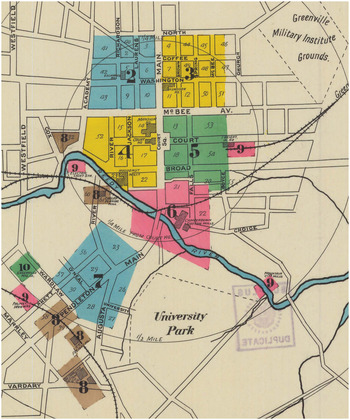
This Sanborn fire insurance map shows central Greenville during the early 1890s. Bisecting the town, the Reedy River provided water power for two textile mills, a coach factory, and several small shops. The town's saloons—as many as eighteen during the 1880s—clustered in its two main retail districts: one along Main Street, north of the central courthouse square, and the second across the river, in West Greenville. Source: Detail of 1893 Sanborn Fire Company map, courtesy of the South Caroliniana Library, University of South Carolina.

Black men's enfranchisement transformed politics as thoroughly and quickly in Greenville as it did throughout the South. The Union League appeared locally as early as July 1867, and the Republican Party followed shortly thereafter. From the beginning, Republicans in this white-majority county won support from most black men but from only a small fraction—perhaps 20 percent at most—of white voters. That coalition was enough to triumph in elections for delegates to the state constitutional convention in October 1867 and for state offices in April 1868. However, those successes would prove difficult to sustain once Democrats began organizing in earnest and turned to intimidation and violence through the Ku Klux Klan and other means. “Conservatives” swept elections for county and federal offices in the summer and fall of 1868 and retained control of the county thereafter. Despite their losses, the county's Republican leaders continued into the 1870s to nominate county and legislative tickets that received 40 percent or more of the vote. Although African Americans sometimes chafed at white Republicans’ disproportionate receipt of state and federal patronage, they remained active as Republican voters and organizers. Wilson Cooke, the only African American from Greenville to win election to the constitutional convention in 1867 and to the state legislature in 1868, continued to chair the county Republican Party after being defeated for re-election in 1870.Footnote 11
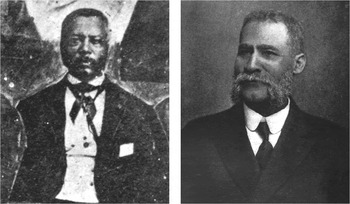
Wilson Cooke (left) sat in the state constitutional convention of 1868 and in the state legislature from 1868–70 and remained a prominent Republican afterwards. C. C. Scott (right) served as principal of the segregated Allen School and as head of the African American state lodge of the Independent Order of Good Templars in 1884–86. Sources: Detail of “Radical Members of the First Legislature after the War, South Carolina,” courtesy of the Library of Congress, LC-DIG-ppmsca-30572 (Cooke); Caldwell, History of the American Negro (Scott).

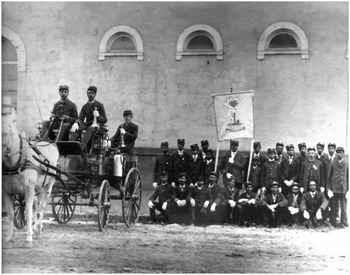
African Americans wielded political power longer and more successfully in the city of Greenville, where they constituted over 40 percent of the registered electorate. Under its 1869 charter, the municipal government consisted of a mayor and six aldermen. Each alderman represented a specific ward but was elected—annually through 1875 and biennially thereafter—by the voters of the city at large, a system that curtailed the strength of the black-majority sixth ward. City elections were open to all men twenty-one and older who had lived in South Carolina for at least a year and in the town for at least sixty days prior to the election.Footnote 12 The pattern that would prevail into the early 1870s emerged in November 1868, in the first municipal election after black men's enfranchisement. That election was carried by a slate of candidates nominated by the Neptune fire company. Formed in 1867 by black volunteers, the Neptunes served the combination of civic and social functions characteristic of nineteenth-century fire clubs. The Neptune company provided sick benefits and burial insurance, paraded on civic occasions, and offered a space for members to congregate, socialize, and politick. Although the company included some of the town's leading black Republicans, the tickets it nominated during the late 1860s and early 1870s were not explicitly identified as Republican. Indeed, only a few times did the Neptunes nominate active Republicans (including Wilson Cooke, who lost a race for alderman in 1870). Instead, the Neptune or “Firemen's” tickets were typically composed of white men not strongly associated with either party. Through the early 1870s, Firemen's nominees usually won the mayor's race and at least half of the council seats.Footnote 13
A number of issues dominated city politics during the late 1860s and early 1870s. The 1870 Firemen's ticket bore the label “Hog Out” to express their opposition to a city ordinance that operated as an urban equivalent of the fence law, requiring hogs to be penned up rather than allowed to roam freely. The ordinance was repealed in October 1870 but the issue remained controversial, and in 1872 the Neptunes petitioned the council in protest after the old ordinance was temporarily restored. Another issue was the building of a bridge across the Reedy River. Two of Greenville's six wards, home to half of its black population, lay southwest of the river, but they had no direct link other than a footbridge to the town's main commercial district until the building of a substantial bridge for horse and vehicle traffic in 1871. During the early 1870s, a city council dominated by Firemen's nominees also began the practice of appointing black policemen—usually, one or two men on a force of three to six officers. A black Republican also regularly served on the three-member board that supervised city elections.Footnote 14
Greenville's Democratic leaders chafed at the success of the Firemen's tickets but struggled to find an effective response. Insisting that municipal elections represented “no political contest,” they eschewed party labels and organized “Citizens” and “People's” tickets, sometimes trumpeting the participation of a few black men at their public meetings.Footnote 15 Those efforts, however, bore only limited success. A “conservative or ‘Low Tax’” slate carried the 1873 election, but voters returned a “split municipal ticket” to office the following year. By 1875, Greenville's Democrats were ready to drop their claims to non-partisanship and elect a party-line ticket. They organized ward meetings to select nominees and exhorted “every Conservative and Democrat in our city [to] sustain this ticket.” The Democratic slate triumphed over a bipartisan ticket advertised in the city's Republican newspaper. The new Democratic council discharged the police force's one black officer and appointed an all-white board of election managers; it also reinstituted an ordinance that required the fencing of livestock.Footnote 16
Democrats’ takeover of the state government after the 1876 election left Greenville Republicans with even bleaker prospects. With no more access to state patronage, leading white Republicans left the area or drifted into third-party politics by the early 1880s. Prominent black Republicans abandoned neither the area nor the party; but black voting in county and state elections fell sharply, and after 1880 county Republicans ceased making party nominations. In municipal elections as well, Democrats faced less opposition and rolled up larger margins of victory after 1876. The only opposition to the Democrats’ municipal candidates in 1879 came from a “Workingmen's ticket” organized with little apparent support from Greenville's black Republicans. Many of the nominees declined to run, and Democrats easily carried the election as voter turnout fell to its lowest level since black men's enfranchisement. Greenville's redemption, like that of the state as a whole, seemed complete.Footnote 17
But counterrevolutions, too, can sometimes go backwards, and it was the liquor question that set municipal politics spinning in the early 1880s. Temperance advocates led a successful drive for municipal prohibition during the 1850s. The movement fell moribund during the Civil War, and city officials in search of revenue returned to the issuing of liquor licenses during the late 1860s. By 1876, Greenville drew about a quarter of its revenue from the annual license fees paid by twelve barrooms.Footnote 18 Those saloons served a number of different clienteles and purposes. Hotel barrooms catered to guests and other patrons. The Mansion House, located on the courthouse square, was the town's finest hotel and had a barroom to match, with the “first cut-glass chandelier that was ever brought to Greenville.” Most saloons were less ornate affairs and catered to farmers and town working men. For them, the saloon functioned as a commercialized leisure space where a homosocial culture of treating, gambling, and occasional fighting prevailed. Along the commercial blocks north of the courthouse, and across the river in West Greenville, barrooms were interspersed among the cotton brokerages, hardware stores, and other places where farmers came to trade. The saloons of West Greenville also provided a convenient resort for men from the nearby Camperdown mills.Footnote 19
Some degree of racial segregation prevailed among Greenville's barrooms, but it was far from absolute during the 1870s and 1880s. White men operated most saloons, but at least two were under the control of black proprietors. Zion Collins—a free person of color before the Civil War and a substantial property owner and occasional Republican organizer afterwards—received a tavern license as early as 1870 and operated a bar in West Greenville well into the 1880s.Footnote 20 Richmond Williams, also an active Republican during the 1870s, ran a saloon with his brother Henry on Washington Street, a few doors off Main Street. Black men were the chief and perhaps only patrons of those barrooms; a white resident described the Williamses’ barroom as “an intolerable nuisance” that attracted a “boisterous crowd of negroes.”Footnote 21 Some white saloonkeepers, such as John Freel, served both white and black customers; others regarded their barrooms as places for white men only. When a black man entered N. B. Freeman's saloon in 1881 and asked for a drink, the barkeeper demanded twenty cents—twice the usual price—“he being a colored individual, and that being a white bar.”Footnote 22
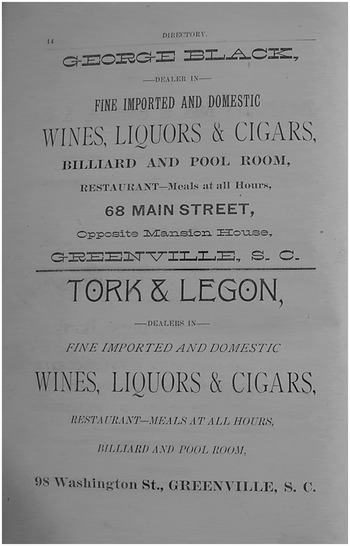
1888 advertisements for two Greenville saloons, showing the variety of attractions available. Source: Greenville City Directory, Spring 1888.

The temperance movement in Greenville, dormant through the late 1860s, began to stir as the number of saloons rose dramatically with the town's commercial growth during the 1870s. Organizationally, the movement's chief vehicle was the Independent Order of Good Templars. Founded in New York in the early 1850s, the group spread widely in the South after the Civil War. The Grand Lodge of South Carolina was organized in 1872, and a lodge of white Templars appeared in Greenville a year later. By 1876, black residents had formed a separate lodge. Both the black and white lodges operated as fraternal organizations for their members and also engaged the public at large. Greenville's white Templars helped organize lodges in the county's smaller towns and rural areas and held joint meetings with the county Grange. For their part, Greenville's black Templars organized a “Temperance Picnic” in the spring of 1876 and paraded along Main Street, complete with “music, banners and appropriate regalia.”Footnote 23
Who joined the Templars? The white and black lodges were open to both sexes and to members as young as fifteen. Greenville's white lodge drew its membership chiefly from a middling stratum of the commercial classes. Among forty-five white Templars active between 1873 to 1880, roughly three-quarters were men. About 40 percent of identified male members were clerks and salesmen, and another 20 percent were merchants; artisans, lawyers, teachers, and a minister accounted for most of the rest. Of the eleven identified female members, three were wives of male members, and a fourth was a widow; the seven unmarried women included two dressmakers and two teachers.Footnote 24 The region's black Templars, by comparison, were drawn much more heavily from the ranks of artisans and unskilled laborers. Among twenty officers of the Templars lodges in Greenville and nearby Spartanburg in 1879–80, five were women, including the teen-aged daughter of a huckster and her sister—a teacher—as well as the wives of two black laborers. Male members included three laborers, a shoemaker, a harnessmaker, two carpenters, a hotel waiter, and a domestic servant, as well as a minister, a grocer, and a teacher. In membership, at least, the Templars were hardly the sole preserve of what some historians have called the black “better classes,” that is, of ministers, teachers, and others distinguished by their education, occupation, and wealth.Footnote 25 Such members did, however, play a disproportionate role as organizers and public speakers. Greenville's most prominent black Templar was Cornelius C. Scott, who served as head of the state lodge from 1884 to 1886. Born a free person of color near Charleston, he graduated from South Carolina College in 1877 and served as principal of Greenville's one black public school.Footnote 26
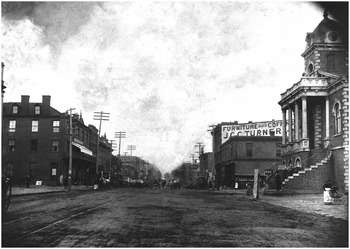
Greenville's Main Street, looking north from the courthouse square, in the early 1890s. The Mansion House, on the left, was Greenville's finest hotel and home to an ornate saloon. Across the street, the building marked “Restaurant” housed a more modest barroom. At various times, another six to eight saloons dotted the blocks to the north and the immediate side streets. Source: Courtesy of the Greenville County Historical Society.

Like Scott, many white and black Templars were active members of the upcountry's Baptist and Methodist denominations. For evangelicals of both races, the fight against liquor was part of a wider commitment to righteous personal conduct and social reform. In other ways, however, white and black Templars drew on distinct sets of ideas. White Templars relied heavily on a sentimentalized domestic ideal, casting the saloon as a threat to the home that enticed men away from the moral oversight of wives and mothers and undermined their role as providers and loving fathers and husbands. Those claims complemented more practical arguments that money and time spent in the saloon were better devoted to self-advancement through savings and hard work. Although black Templars sometimes made such arguments as well, they laid a heavier emphasis on temperance as a collective means of racial advancement. Thus, when Scott addressed an Emancipation Day celebration in 1880, his hour-long speech ranged from a discussion of civil rights and emigration to exhortations about the importance of “being sober, industrious, and economical.”Footnote 27
Although Templars had been active in Greenville since the mid-1870s, the liquor question became a serious political issue only after 1880. A number of factors—many of them part of broader developments in the state and region—pushed it to the fore. An 1880 state law banned the sale of liquor outside incorporated towns and cities, putting the focus squarely on municipal officials as the last obstacles to total prohibition. In early 1881, Frances Willard, head of the Woman's Christian Temperance Union, embarked on a fourteen-week, fifty-city tour through every state of the former Confederacy. Willard packed Greenville's white Methodist church for two meetings in March and met privately with a group of women who later founded the town's first WCTU chapter. Its all-white membership, although small, included the wives and daughters of a number of the town's business and political elite. Simultaneously, prohibitionists made their influence felt elsewhere as well. In South Carolina, prohibitionist tickets triumphed in Laurens, Lancaster, and a number of other upcountry towns. Across the state line, prohibitionists narrowly gained control of the Charlotte city council in the spring of 1881, and voters throughout North Carolina went to the polls for a prohibition referendum that August.Footnote 28
In cities and states throughout the country, prohibition often upset existing party alignments. In the Northeast and Midwest, much of its support came from Republicans; in the South, Democrats were its main backers. However, in neither region was either party united on the issue—a fact that created opportunities for the minority party. Thus, in 1881, North Carolina's Republican Party resolved to lead opposition to the statewide prohibition referendum there, hoping to build support toward state elections the following year. When prohibitionists in Greenville talked of running a dry ticket for the city council in 1881, they incited an editorial panic from A. B. Williams, editor of the Greenville Daily News. Williams opposed prohibition, largely for fiscal reasons. He had no kind words for the saloon but argued that the loss of barroom license fees would require a sharp rise in property taxes. His chief worry, however, was that the liquor question threatened the “preservation of the Democratic party in State, county and city.” Prohibition would divide white Democrats and produce an “unholy alliance of liquor dealers, Radicals, and negroes”; the final result would be “woe, ruin, and general destruction and desolation that must follow the loss of the Democratic organization.” Williams's language was overwrought, but the context for his fears was real enough. Prohibition was being pressed simultaneously in other parts of the South, and at both state and municipal levels. Although its consequences for partisan alignments remained unclear, it coincided with other challenges to white Democrats, including the threat of William Mahone's Readjuster Party in Virginia—a connection that Williams, a native Virginian, was quick to draw.Footnote 29
Greenville's white prohibitionists took those concerns to heart. In early June, “the friends of temperance” met to discuss the upcoming municipal election. The sixteen men present included no African Americans and only two white Templars; many were part of the town's political and economic elite. The meeting convened at the office of the town's leading commission merchant, J. C. Smith, and included the president of the Camperdown Mills and the co-owner and superintendent of the Greenville Coach Factory. Four of the men were past or current aldermen. Initially, the group asked that the city hold a referendum on prohibition separate from the council election. When the city attorney advised that the municipal charter granted no authority for such a referendum, white prohibitionists decided to make their stand within the Democratic Party, running a slate of candidates in the party's ward meetings. The result was a ticket of three wet and three dry nominees for aldermen; the renomination of the incumbent mayor, a wet, gave the ticket an anti-prohibition majority. Democrats in the fourth ward, home to many workers from the Camperdown Mills, voted against prohibition by a margin of two to one, and the meetings there and elsewhere generated levels of excitement that worried some Democrats. James T. Williams, a hardware merchant and future mayor (and no relation to the Daily News editor), was a dry but “not as crazy on the subject as some.” When his name was proposed as a candidate for alderman, he declined to run, confiding to his wife, “I do not care to make any enemies.” Williams—who had ridden as a paramilitary “Red Shirt” in 1876 and served as a Democratic poll watcher—did not think the issue belonged in the ward meetings at all. “I think it was very wrong to have anything to say about ‘Wet or Dry’ for it was a democratic nomination & politics had nothing to do with it nor did ‘Wet & Dry’ have anything to do with it.”Footnote 30
If white Democrats were split on the issue, so too were black Republicans. Even before the Democrats’ ward meetings, twenty-eight African Americans published a notice in a local newspaper, promising “that no Republican ticket shall be run . . . provided a ticket of men who will pledge themselves to stop liquor selling, be put in the field.” The signers included former state legislator Wilson Cooke, teacher and leading Templar C. C. Scott, and Frank A. Williamson, a harnessmaker and long-time Republican who had run for the state legislature in 1872. Fourteen of the signers were artisans or skilled wageworkers, and five were draymen or wagon drivers. At least eight owned real property. As with the white “friends of temperance” who met at J. C. Smith's office, the liquor question attracted the attention of more politically prominent and economically established men now that it threatened to infringe on partisan politics.Footnote 31
Other black leaders, however, not only took a different view of prohibition but also saw a political opportunity in the split among Democrats. Shortly before election day, reports began to circulate that “a meeting of colored voters was held . . . at one of the [fire] engine houses” to nominate several challengers to the Democratic ticket. The organizers were not named, but they likely included Benjamin F. Donaldson, a hotel worker, Republican activist, and president of the Palmetto fire company, Greenville's second company of black volunteers. Donaldson later addressed a similar meeting held above the saloon of black barkeeper Richmond Williams. Working quietly in conjunction with a group of wet Democrats, they decided to nominate white men to oppose two of the dry Democratic nominees. The move caught Democrats by surprise, and the pro-license challengers won by comfortable margins. Editor A. B. Williams reported that black men “solidly” voted the opposition ticket, but by his own calculations at least 30 percent of white voters did so as well.Footnote 32
The “hot municipal contest” of 1881 shattered the Democratic Party's short-lived dominance of city government and reoriented the course of politics in Greenville for the rest of the decade. The day after the election, A. B. Williams declared that the result was not a victory of “Wet or Dry” but “of Bolters—Independents—Deserters—the name is immaterial—combined with Radical negroes over the organized Democratic party.” The success of the opposition ticket produced acrimony and recriminations among Greenville's Democrats. One member of the party's executive committee resigned in anger over the bolt. Other Democrats wanted to expel from the party those who had voted for the independent nominees. Fearing that the rift in town elections might provide a cause and a precedent for splits at the county and state levels, party leaders decided the safer course was to stop making nominations for municipal offices altogether. A few months later, the South Carolina legislature authorized towns and cities across the state to hold the kind of municipal no-license referenda proposed in Greenville in 1881, providing a “safety valve” for “disseminating prohibition views without bringing the question into State politics.”Footnote 33
The first such election in Greenville came in December 1883 and entailed a degree of cooperation among black and white prohibitionists that was notable for both its extent and its limits. White prohibitionists reached across the color line in ways they had been reluctant to do while the issue was entangled with partisan politics. Two African Americans—Templar C. C. Scott and barber Thomas Mims—joined four white men on the prohibitionists’ executive committee. An election-eve rally at the courthouse featured addresses by two black and two white ministers. African Americans, nonetheless, remained distinctly junior partners in the effort. When they were invited to appear before audiences that included white men and women, they spoke less as moral authorities—with standing to instruct their white listeners—than as emissaries from the black community, present to assure white prohibitionists of their support. Thus, at the prohibitionists’ first mass meeting, C. C. Scott spoke “in behalf of the colored people [and] heartily endorsed the resolutions” proposed by a white speaker. If those mass meetings included both white and black members, the more frequent gatherings at Greenville's churches occurred before racially segregated audiences—and while white prohibitionists spoke at black churches, the reverse does not appear to have been true. This pattern continued on election day, when black and white Sunday school children paraded separately down Main Street, and the WCTU and “colored temperance women” hosted separate lunches.Footnote 34
The opposition to prohibition came from a cross section of white and black residents. Editor A. B. Williams reprised his earlier arguments, apparently aimed at property owners and businessmen, about the loss of license fees and rents paid by saloons. Greenville's saloonkeepers prepared quietly for the referendum through the Liquor Dealers Association. To circumvent the mayor's order closing their barrooms at six p.m. the night before the election, they rented halls and—in a counterpoint to the temperance women's hot lunches—provided free food and drink to their supporters. On election day, several white bar owners were present to monitor the voting. Also active around the polls was Benjamin F. Donaldson, the Republican activist who had helped engineer the successful challenge to prohibitionist city council nominees in 1881. Sentiment among white and black workingmen appeared to run strongly against prohibition. One prohibitionist claimed that “the main part of the better class of whites supported the No-License ticket,” suggesting what he thought of those who voted otherwise. Such condescension was consistent with the stigmatizing of the saloon and its denizens in prohibitionist rhetoric, and on election day, working-class voters repaid the prohibitionists’ self-conscious propriety with their own assertive rowdiness. Shortly after the polls opened at six a.m., two large columns of men— many of them African American and reportedly “boisterous and rude, seeming to be intoxicated”—marched to the polls to vote the license ticket. The day ended with another rowdy procession to celebrate prohibition's defeat. White and black men paraded together past the white Good Templars’ lodge and the houses of white and black prohibitionists, draping fences and doors in black crepe and making a mock display of “burial performances.”Footnote 35
Greenville's prohibitionists petitioned for another referendum in 1884 and with much the same outcome: a defeat for prohibition, by a slightly wider margin. After three elections in four years, the town remained stubbornly wet.Footnote 36 Similar battles played out across the New South, especially in rapidly growing towns and cities. Spartanburg and Anderson, the next largest towns in the South Carolina upcountry, each experienced at least four elections over prohibition from 1881 to 1886. Outside South Carolina, battles over the issue raged from Richmond and Charlotte to Jackson and Waco. More often than not, those contests ended in defeat for prohibition; in some cases, a place that voted the barroom out one year might reverse course at the next election. Atlanta, for example, adopted prohibition in an 1885 referendum only to abandon it two years later. However, everywhere those elections occurred and whatever the result, they engaged African Americans and worried white Democrats. During Tennessee's statewide referendum in 1887, an opponent of prohibition declared that the movement threatened “to super annuate the Democratic party.”Footnote 37
In Greenville as elsewhere, African Americans made the most of the split among white Democrats. Their political influence had waned since Democrats’ redemption of the city government in 1875, but that changed as black voters and leaders found themselves actively courted by both wets and drys during the early 1880s. Fearful of worsening the split within their ranks, Greenville's Democrats stuck to their policy of making no nominations for mayor and city council. White politicians—freed from demands for Democratic unity and racial solidarity—formed rival tickets in the general election and courted black voters with “much ardor.” The percentage of African Americans among registered municipal voters rebounded from a low of 30 percent in 1879 to 44 percent in 1887, and turnout increased from just over 70 percent to almost 90 percent over the same period.Footnote 38
Events in Greenville were part of a pattern of persistent and, in some cases, resurgent black political power in the urban South during the 1880s, a pattern whose scope and significance historians have yet to fully appreciate. The extent of that power and the forms it took varied from place to place, typically depending on local issues and circumstances that brought a split among white residents. In Virginia, the Readjuster movement provided the occasion for black voters to claim a greater share of influence in towns and cities across that state during the early 1880s. Later in the decade, the Knights of Labor organized municipal tickets that drew biracial support around the region, from Richmond to Jacksonville, Florida, and Vicksburg, Mississippi. In New Orleans, a city dominated by a Democratic “ring” since the 1870s, African American voters backed a slate of reform Democrats who carried the municipal election of 1888. Closer to Greenville, the nearby town of Spartanburg also experienced a series of sharp contests over prohibition, and in 1883 voters there elected a wet ticket that included one white and one black Republican. A black Republican would continue to serve on Spartanburg's council for the next eight years.Footnote 39
In all of these places, African Americans’ influence in municipal politics was often tenuous and always contested; it seldom approached the levels of Reconstruction and was constrained in various ways. Thus, in Greenville the 1880s brought no return to the Firemen's tickets of a decade before, nor did black men's influence in municipal politics lead to a revival of their strength at higher levels. Even a modest and local resurgence, however, was a remarkable development in South Carolina, where white Democrats suppressed the kind of challenges at the state level that threatened their counterparts elsewhere in the region. Suffrage in South Carolina had been sharply circumscribed by the Eight Box Law of 1882, which operated as a de facto literacy test and prevented the use of a single party ballot by requiring that votes for various county, state, and federal offices be deposited in different boxes. Because municipal elections were held separately, however, they were unaffected by the notorious law, and town and city politics remained a realm where African American voters preserved some degree of influence.Footnote 40
Limited though it was, that influence brought tangible rewards. For black residents of Greenville and other places, the gains typically came not on great matters of policy or principle, but rather in securing better treatment in the quotidian but vital services of local government. In New Orleans, the reform mayor who won election in 1888 appointed African Americans to the police force; in Nashville, black city councilman J. C. Napier secured a new fire company and better schools for African Americans. Gains in Greenville were along similar lines and on matters that generally found black residents united, whatever their stance in the contest over prohibition. Dissatisfaction was widespread, for example, with the town's “colored burial ground,” which had been allowed to languish during the late 1870s, even as the city council acted to enlarge the white Springwood Cemetery. After years of petitions and protests, the city in 1884 purchased a twelve-acre plot for a “colored cemetery” later known as Richland Cemetery. Black firefighters also found the city council newly attentive. For years, the Neptune and Palmetto companies used the cast-off equipment of Greenville's white firefighters. The city council promised the Neptunes a new engine shortly before the 1883 municipal election, and it arrived that fall. A year later, the city secured the company a new station, something the Neptunes had likewise sought for years. Also revealing are the choices that Greenville's white leaders made for the position of second assistant fire chief—an appointive office reserved for a senior black firefighter charged with authority over both black companies. For years, the post was held by Thomas Lewis, a respected but relatively apolitical figure. In 1884, Lewis was succeeded by John D. Buckner, who took an active part in the 1885 municipal campaign. Later in the decade, the city council bestowed the position on Thomas Briar, a blacksmith, former chairman of the county Republican Party, and president of the Neptune company at the height of its political influence during Reconstruction. Although town officials did not return to their former practice of hiring black police officers, Briar was employed on at least one occasion as a “secret detective” at a salary of $30 per month.Footnote 41
The Neptune volunteer fire company, shown in this 1894 photograph, was a fixture of black social and civic life in Greenville from the late 1860s until its dissolution in 1905. Source: courtesy of Mrs. Ruth Ann Butler.

Black residents also fought to win their share of improvements made to Greenville's schools during the 1880s. The meager revenue available under state law was enough only to fund two racially segregated schools for a term of four to five months. Both schools were located on the north side of town; the absence of schools in West Greenville fell heavily on an area whose population was disproportionately black. Amidst hopes that the city council might supplement the schools’ budget, a meeting of black residents—including both supporters and opponents of prohibition—resolved before the 1885 municipal election to back no candidate “who will not pledge his support to all the public free schools.”Footnote 42 The council later ruled that it had no authority to fund the public schools, and the state legislature stepped in to expand the powers of the local school district and authorize a property tax to provide additional funding. In the spring of 1886, a black minister was elected to the newly constituted school board of trustees, which approved an increase in the school term to nine months and the opening of two new schools in West Greenville—one for white and one for black students. Within two years, the West End Colored School enrolled more than half the black students in Greenville. From 1887 to 1889, average school attendance among black children more than doubled—about twice the rate of increase for white students.Footnote 43
Although labor organizations and issues did not figure prominently in Greenville politics for most of the 1880s, that threatened to change in 1886–87, amid the southern organizing drive and political successes of the Knights of Labor. The Knights formed their first assembly in Greenville in late 1886, but it played little discernible public role. A few months later, however, a former Knights organizer named Hiram Hover caused a stir when he traveled through the area on behalf of his own group, modeled on the Knights, called the “Cooperative Workers of America” (CWA).Footnote 44 Hover stayed in Greenville only briefly, but within weeks of his appearance, the CWA claimed fifteen clubs there with as many as 500 members, “most of the members being colored people.” Hover's most dedicated local follower was an African American barber, Lee Minor, who began organizing a network of CWA clubs among black farm laborers in the lower part of the county later that spring. Those efforts quickly provoked a violent response from local planters, who organized vigilante bands that seized and interrogated suspected CWA members and effectively quashed the rural clubs. The violence did not reach town but nonetheless seems to have chilled the CWA's public activities. Minor's last reported public appearance on the group's behalf was a speech in Greenville on July 4, which attracted an audience of about 150.Footnote 45
The CWA appeared in Greenville just as residents began to prepare for the 1887 municipal election. Former mayor Samuel Townes announced his plan to return to politics and challenge his successor, E. F. S. Rowley. A third candidate, William T. Shumate, was a long-time prohibitionist who ran on a platform of “decency in elections and reform in the city administration.” Both Townes and Rowley had strong support among African Americans, and interest in the campaign ran extremely high. “Meetings of negroes” were reportedly “held nightly for weeks” before the election, but the substance of those gatherings went unreported by white observers. As in 1883 and 1885, reports in the white press instead focused on the “hideous . . . hallowing and noisy demonstrations” that took place in the streets afterwards and insisted that the election was “altogether without issues.” The rowdiness continued on election day, when both Townes and Rowley were alleged to have “corralled” black voters and marched them to the polls. When the votes were counted, Townes edged Rowley by a margin of sixteen votes out of almost 1,300 cast, and Shumate received less than 10 percent of the vote. In celebration, the winner's “colored friends” staged a torchlight parade, during which Lee Minor, “a big Townes man,” shot a Rowley supporter in the face.Footnote 46
The election of 1887 represented a high water mark for African Americans’ political influence during the 1880s. If prohibition had opened new opportunities, the fading of that divisive issue would aid white Democrats in reasserting control. Having failed three times to oust the barroom in municipal elections, prohibitionists tried a new tack by securing a countywide referendum in March 1888. Two developments favored their strength in the countryside. One was the rapid spread of the Good Templars order outside the city of Greenville during the early 1880s. The second was a growing tide of rural unrest that led many farmers to look askance at railroads, merchants, and other manifestations of an urban-centered commercial order—including saloons that “infuse[d] deadly poison into the life-blood of . . . the yeomanry of the country.” Some of the early agrarian leaders in Greenville County were ardent prohibitionists, including Milton L. Donaldson, a “capital temperance lecturer” and future president of the state Farmers’ Alliance. In the March 1888 referendum, prohibitionists overwhelmingly carried the vote outside the county seat, by a margin of 901 to 199. Turnout was low, however, and the rural vote was more than overmatched by results in the city, where prohibition was defeated 1,017 to 161. City dwellers who had once voted for prohibition were prepared to vote against it when the city's autonomy was at stake and when the liquor question had become enmeshed in a larger struggle between town and country. That larger struggle also fueled the political rise of Benjamin Tillman, who, as governor in the early 1890s, pushed for and won legislation that closed barrooms around the state and replaced them with state-run “dispensaries” that sold liquor only in sealed packages.Footnote 47
With the battle over prohibition largely behind them, and no other major controversies over municipal policy to set them at odds, Greenville's Democrats proved more attentive to calls for party loyalty. The election of 1887—with its high black turnout, its disorderly conduct, and its conjunction with the CWA's fleeting labor radicalism—heightened concerns that a “return to Democratic organization” was necessary to “redeem [Greenville] from the rule of the negroes.” “Independentism in a city election,” one leader warned, “should be repudiated as sternly and strongly as in a County or State election.” Before the 1889 election, the city's Democratic clubs turned to a device increasingly popular with Southern Democrats as a means of imposing party discipline: the primary system. The county Democratic Party had selected its candidates through primaries since 1878, and the state party would follow in the 1890s. Anxious Democrats adopted the primary in other southern cities and towns as well, including Birmingham in 1888 and Nashville in 1893. In Greenville as elsewhere, Democratic primaries were effectively, if not explicitly, for whites only; to curtail bolters, Greenville's primary rules required that losing candidates pledge not to run independently. Meanwhile, county Democratic leaders in the state legislature also secured a revision to the city's charter, doubling the number of aldermen and thus decreasing the likelihood that disgruntled office seekers might be tempted to make an independent bid.Footnote 48
The results in Greenville were immediate and dramatic. In 1889, the Democratic nominees triumphed by a margin of almost two to one. Black residents tried to organize a “Citizens” ticket that included a number of prominent white men, but many had been named without their consent, and all but one refused nomination. In a pattern typical after the adoption of the primary system, the general election saw a drop-off in voter registration and participation—especially among African Americans. From its peak in 1887, black voter registration in Greenville fell 10 percent by 1889 and almost 70 percent by 1893. Black political leaders continued their electoral efforts but found them to be increasingly in vain. In 1891, one newspaper reported “some idle talk” of an independent municipal ticket, but none emerged. In 1893, African Americans held a meeting at the courthouse to try “to get Democrats to run on their ticket” but again failed.Footnote 49
Two events in the summer of 1895, nonetheless, gave a new jolt of urgency to black residents’ political organizing. One was the calling, at Ben Tillman's instigation, of a convention to write broad new disfranchising measures into the state constitution. Such changes posed a graver challenge to black voting than the white primary. The latter required application at each election, and party discipline was never assured, as events of the 1880s had demonstrated. Constitutional disfranchisement threatened to eliminate African Americans from the electorate altogether. In the election of convention delegates in August, Greenville's black voters made a strong showing in support of a ticket of anti-Tillman Democrats who opposed the most draconian disfranchising proposals; the ticket, nonetheless, went down to defeat two-to-one countywide.Footnote 50 The other event to galvanize African Americans was the first lynching in the town's history. The victim was a black man named Ira Johnson, who had shot and killed a white man in self-defense. Despite reports that a mob intended to seize Johnson from the county jail, the mayor declined to call out local militia units and instead ordered the arrest of armed black men who took to the streets to guard the jail. Only when Johnson was taken from jail and lynched outside town did the mayor finally call on the militia—to protect the city from a rumored attack by black arsonists. African Americans later packed the courthouse for a “peace meeting” and “ridiculed the idea of violence on the part of the negroes,” declaring that “if the authorities do their duty the violators of the law can be easily brought to justice.”Footnote 51
When the county grand jury failed to indict the lynchers, black leaders began quietly organizing a network of ward clubs in advance of the coming municipal election. Thomas Briar served as the “presiding genius” at a public meeting where some black residents “were very bitter against the present city administration” over Johnson's lynching and demanded a “fair and impartial enforcement of the laws.” The meeting nominated a ticket of white Democrats for mayor and city council. As usual, the nominees had not been consulted in advance and were expected to decline, but organizers hoped to demonstrate African Americans’ dissatisfaction with the incumbents and to create an organization that would “poll a much larger vote” at the next election in two years. Although the regular Democratic nominees easily won, African Americans cast about 300 votes for the opposition ticket, equal to a third of the total vote and their largest turnout in a municipal election since 1889.Footnote 52
It would prove as well to be their best showing in city politics until well past the midpoint of the next century. On the same day that Greenville held its municipal election in 1895, the state constitutional convention met for its opening session in Columbia. In a sign of the importance of municipal elections, their regulation was taken out of the hands of the Committee on Municipal Corporations and turned over to the Committee on Suffrage, chaired by Tillman himself. The new constitution, completed in December, not only contained new disfranchising measures but also extended them to the municipal arena. Prior to 1895, requirements for municipal elections were separate from those for state elections. Voters in municipal elections were not required to register for state elections, nor to have paid taxes. The 1895 constitution added both requirements and applied literacy and property tests as well. At Greenville's next municipal election, only thirty black voters managed to register, down more than 90 percent from two years before and equal to a mere 3 percent of the registered electorate. Those figures were a striking, but by no means isolated, example of how the rising tide of disfranchisement undercut black influence in municipal politics around the region. The same session of the Mississippi legislature that called that state's disfranchising convention in 1890 also revised Jackson's municipal charter, imposing tax and lengthy residency requirements for voting and redrawing ward boundaries to “give perpetual control . . . to the white people.” In 1898, Richmond elected its first all-white city council in almost thirty years, due largely to a complicated election-procedure law passed a few years before; disfranchising measures in the state constitution of 1902 would ensure that no African American sat on the city council again until 1948. In the region's most brutal assault on black municipal power, white supremacist Democrats in North Carolina staged the so-called Wilmington riot of November 1898, driving from office a biracial “fusionist” city government and killing ten or more African Americans in the process.Footnote 53
The loss of municipal power cost black southerners in numerous ways. Greenville's six school trustees included one African American during the late 1880s, when the board approved the creation of a school for black students in the West End. No African American served on the board after the early 1890s, and the inequalities that had long existed between white and black schools only grew over time. By the early 1910s, the city's schools spent almost three times as much per capita on white as on black students. Developments in the police and fire departments were hardly more encouraging. The 1895 lynching of Ira Johnson drove home in gruesome fashion the importance of police power and the cost of having it in the hands of unsympathetic officials. Tom Briar, Greenville's most prominent black Republican, lost his position as second assistant fire chief in 1890, and Greenville's black fire companies—fixtures of civic and social life for decades—were under threat by 1900. Over the prior decade, the city added several new white fire companies but no new black ones, and in 1902, Greenville began a gradual switch from a system of volunteer fire companies to a paid staff of full-time firefighters. The Neptunes survived as Greenville's last company of black firefighters until early 1905, when the city council voted to decommission the company and replace it with white firemen. During the early years of the new century, the city council also turned its attention to codifying Jim Crow. A 1905 ordinance provided for racial segregation in the city's streetcars. Seven years later, another ordinance went further still, mandating the color line in residential neighborhoods as well as in public accommodations and other businesses.Footnote 54
If these losses and reversals must be included in any reckoning of racism's depth at the nadir, they also serve as a reminder of what black southerners had been able to accomplish through the exercise of municipal power in the years that came before. The example of Greenville illustrates two larger but neglected stories in post-Reconstruction politics: one about the power of prohibition, along with other issues and movements, to challenge white Democrats’ hold on power and create opportunities for African Americans, and a second about the broader importance of black political strength in towns and cities across the region after Reconstruction. Like their counterparts in larger urban places, Greenville's black residents were able, for a time, to exploit divisions among white southerners and use that power to achieve modest but meaningful gains. The importance of town and city governments as an arena for these struggles also suggests a connection between the late nineteenth century and the “long civil rights movement” of the twentieth century, when local Jim Crow policies would be a prominent target of grassroots activists, and when black southerners would ultimately achieve some of their greatest and most lasting electoral successes in municipal politics.
In Greenville, a more immediate connection to the struggles of the twentieth century lay in the person of James A. Briar, son of Republican activist Thomas Briar. The son, born in 1870, received a teaching certificate in 1885 and served as a teacher and principal in Greenville's schools for decades. James Briar ventured into electoral politics as early as 1895, when he served as secretary to the meeting that nominated a municipal ticket in protest over the Ira Johnson lynching. Like his father, James held several minor federal patronage positions and served as a delegate to the Republican National Convention—the father for the last time in 1912, and the son for the first time in 1916. In the 1930s, James Briar founded Greenville's first chartered chapter of the NAACP, and as its president he led a 1939 voter registration campaign. The drive began after the city council blocked a federally funded housing project and park for Greenville's black residents. In response, the NAACP organized voter schools and talked of running independent candidates for mayor and aldermen. Perhaps 200 African Americans registered for the municipal election in September, apparently the most since 1895. Police harassment and Klan violence soon quashed the effort, and Briar himself was forced into hiding and later arrested. Still, he remained unbowed: “I've always been active in politics because my father before me was active in politics.”Footnote 55