Introduction
Globally, the number of people with dementia is predicted to reach 70 million by 2030 (Prince et al., Reference Prince, Guerchet and Prina2013). The majority of those currently affected live in low- and middle-income countries (LMICs) and the proportion of all dementia cases living in LMICs is expected to increase in the coming decades (Prince et al., Reference Prince, Guerchet and Prina2013). No curative therapies are currently available, and current worldwide health policies are increasingly focused on identification of potentially modifiable risk factors. Recent projections estimate that 30%–50% of Alzheimer's disease dementia (ADD) worldwide may be preventable (Norton et al., Reference Norton, Matthews, Barnes, Yaffe and Brayne2014).
Cognitive decline is frequently regarded as a prodrome to dementia, but exists on a continuum with normal aging. Definitions vary, but generally cognitive decline refers to a greater-than-expected decline for a given age and educational attainment. Individuals with cognitive decline are nevertheless at high risk of developing cognitive impairment and dementia. Given the lack of curative treatments, interventions at a prodromal stage and in high risk individuals are currently thought to offer the best possibility of delaying or preventing dementia onset (Norton et al., Reference Norton, Matthews, Barnes, Yaffe and Brayne2014; Ngandu et al., Reference Ngandu2015).
In high-income countries (HICs), a number of risk factors for dementia and cognitive decline are recognized, including increased age, lower educational levels, and vascular risk factors (Jin et al., Reference Jin, Di Legge, Ostbye, Feightner and Hachinski2006). Vascular risk factors appear to modify risk of both vascular dementia and ADD, the two most common dementia subtypes worldwide, and a significant degree of neuropathological overlap between these conditions is now recognized (Toledo et al., Reference Toledo2013). Interestingly, prevalence appears to be decreasing in some HICs (Schrijvers et al., Reference Schrijvers, Verhaaren, Koudstaal, Hofman, Ikram and Breteler2012; Matthews et al., Reference Matthews2013). This may be attributed, in part, to improved interventions for vascular health (Sposato et al., Reference Sposato2015).
In sub-Saharan Africa (SSA), very few data currently exist on risk factors for cognitive decline and dementia in older people. Existing data from other world regions suggest that risk factors for dementia are complex, and involve risks occurring in both early and later life. These risks are likely to vary between settings, depending on cultural, lifestyle, and genetic factors, among others. Furthermore, dementia prevalence varies markedly across different world regions, raising the possibility that dementia risk may be modifiable. Given the very limited mental healthcare resource available in SSA, identification of risk factors for cognitive decline may be more important in SSA than in many other settings. The disability burden of dementia per person is greater in LMICs than in HICs (Prince et al., Reference Prince2015). In most HICs, psychosocial support is available for carers and patients, as well as pharmacological treatment for palliation of symptoms. In most areas of SSA, interventions to help manage dementia are currently unavailable outside large urban centers. Community-based prevention programs have the potential to be highly influential in this setting. In order to develop such interventions for cognitive impairment, it is imperative to first determine risk factors and predictors of cognitive decline, so that those most at risk can be targeted. SSA-specific data are needed since demographic, lifestyle, diet, and genetic factors are likely to differ from those in HICs.
The aim of this study was to detail the prevalence of cognitive decline and identify potentially modifiable risk factors for decline over a two-year period in a community-dwelling, rural cohort of individuals aged 65 years or over in Northern Tanzania.
Methods
Ethics
This study formed part of the Identification and Intervention for Dementia in Elderly Africans (IDEA) study. Ethical approval for this study was granted by the National Institute for Medical Research, Tanzania, as an extension to the IDEA study. Informed consent for each participant was obtained after verbal explanation from a Tanzanian medical officer. Those individuals unable to give written consent due to illiteracy or severe visual impairment indicated consent using a thumbprint. Where the participant was deemed to lack capacity to consent due to cognitive impairment, assent was taken instead from a close relative.
Setting
The study was conducted in the Hai district of northern Tanzania. Tanzania is a low-income country (Gross National Income per capita: US$900) with an estimated population of 55.6 million people in 2016 (The World Bank, 2017). Life expectancy at birth is around 65 years, although this figure is rising rapidly, partly due to reduced infant mortality, but also increased survival at older ages (The World Bank, 2017). Hai district has included a demographic surveillance site (DSS) for over 20 years. The Hai DSS is in the Kilimanjaro region on the southern slopes of Mount Kilimanjaro. Each village has a census enumerator, well known to the local community and trained to assist both with epidemiological research and public health activities. Hai is a rural area, and many older individuals are subsistence farmers, although cash crops such as coffee and tomatoes are grown in more fertile upland areas. Over two-thirds of older women are illiterate (Longdon et al., Reference Longdon2013). The estimated prevalence of dementia was 6.4% (age adjusted) in a community-based door-to-door study of individuals aged 70 years and over in 2010 (Longdon et al., Reference Longdon2013). Hai district has relatively low rates of HIV/AIDS infection, compared to much of SSA, and this is currently unlikely to be a major contributor to cognitive decline in older age groups (Walker et al., Reference Walker2013; Tenu et al., Reference Tenu, Isingo, Zaba, Urassa and Todd2014).
Recruitment
Baseline
A cohort of 473 community-dwelling adults aged 65 years and over, was originally recruited in March–May 2014 as part of the IDEA study dementia awareness-raising and screening program. Recruitment took place in six villages within Hai, selected to be representative of upland and lowland areas and varying economic status. The study was advertized to older people and their family members at local religious and community meetings with assistance from community leaders. Village enumerators referred house-bound participants who were unable to attend these meetings, avoiding bias toward more physically able participants. Details of the recruitment process have been previously published (Gray et al., Reference Gray2016).
Follow-up
Two-year follow-up was conducted between March and May 2016. Due to resource, transport, and time constraints, we followed-up a sub-sample of four villages (comprising 374 participants) from the originally recruited cohort.
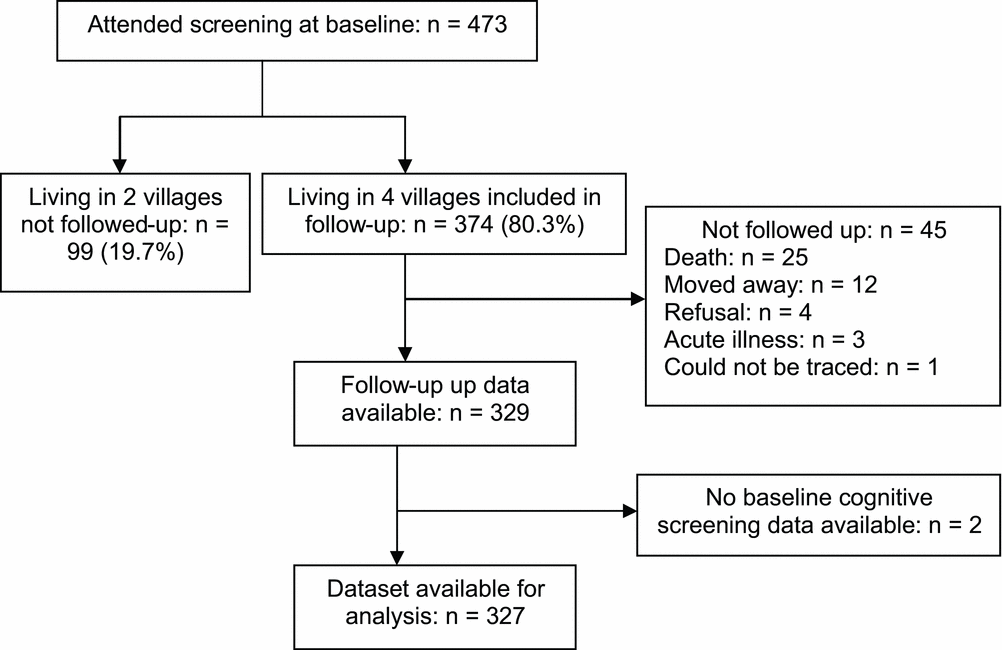
The recruitment process is summarized in Figure 1. Village enumerators invited participants seen at baseline to attend an assessment in a centrally located village office or healthcare facility. In order to avoid selection bias, participants who were unable to leave home for any reason (e.g. physical disability, ill-health, work, and caring commitments) were seen in their own homes.
Flow diagram of the recruitment process and patient flow.

Assessments
Baseline
Baseline assessment in 2014 was led by a UK-based psychiatry doctor (S-MP) and a UK-based medical student (CC) alongside a locally based multidisciplinary team of nurses, clinical officers, and occupational therapists. Data collected at baseline included demographic details, educational and occupational background. Age was calculated from birth year and confirmed using memory prompts (e.g. age at Tanzanian independence) where necessary. The method of using memory prompts to estimate age has been validated in similar settings (Paraiso et al., Reference Paraiso2010).
Cognition was assessed at baseline using the IDEA cognitive screen which has been previously validated in this setting (Paddick et al., Reference Paddick2015a). The IDEA cognitive screen includes tests of delayed recall (recall of ten words from a list), orientation (What day of the week is it? Who is the head of the village?), verbal fluency (Name as many animals as possible in one minute), abstract reasoning (What is a bridge?), and praxis (Arrange four matchsticks into the shape of a rake), and takes between 5–10 minutes to complete. Literacy and numeracy skills are not prerequisites for scoring well on this test. A score of ≤7 from a maximum possible score of 15 is classified as “probable cognitive impairment” and a score of 8–9 possible cognitive impairment. A score of ≥10 indicates normal cognition (Gray et al., Reference Gray2014). Blood pressure measurement followed the World Health Organization (WHO) STEPS protocol using an A&D UA-767™ (A&D Instruments Ltd, Abingdon, UK) blood pressure monitor. Blood pressure was measured after 5 minutes sitting, after which three measurements were taken with 1 minute between each recording. Averages of the second and third readings were taken for reporting purposes. Grip strength was assessed using a Jamar hydraulic hand dynamometer (Model J000105, Lafayette Instruments, Lafayette, IN, USA) with participants seated, elbow by their side and flexed to right angles, and a neutral wrist position. Three recordings of grip strength in the dominant hand were taken and the best effort used for the purposes of data analysis.
Two-year follow-up
At follow-up, data collection was completed by two UK-based fourth- year medical students (JH and LS), a Tanzanian assistant medical officer (JK), and village enumerators. Field supervision was by S-MP. Each village enumerator had previous experience of administering the IDEA cognitive screen and conducting blood pressure and grip strength assessment from the baseline study. Re-training was conducted prior to follow-up. Demographic data were re-collected as a check against baseline data including sex, age, village of residence, occupation, occupational status (retired or still working), literacy, and completed years of schooling. Data were collected on past medical history relating to known risk factors and possible predictors for cognitive impairment, including hypertension, stroke, diabetes, and family history of dementia. Lifestyle data included current and past alcohol consumption and chewed and smoked tobacco consumption. All of the above data were self-reported by the participant, with help from a close relative if required. Blood pressure and grip strength were recorded and the IDEA cognitive screen administered as at baseline. The 15-item Geriatric Depression Scale (GDS) was administered in order to account for possible depression as a cause of poor cognitive performance (i.e. depressive pseudodementia). As sensory impairment could adversely affect a participant's performance on the IDEA cognitive screen, data were also collected on participants’ eyesight and hearing, either self-reported (or relative-reported), objectively measured or observed. Vision was tested using a logmar broken-ring Landolt C chart. This is an adapted version of the Snellen chart suitable for use in illiterate populations. The ability to read the top line of the chart (equivalent to 0.1 logmar or 6/60) with either eye was deemed to be adequate as a prerequisite for being able to perform question 6 (arranging match sticks) of the IDEA cognitive screen. Hearing impairment was graded as either “normal,” “impaired,” or “severely impaired” based on difficulties observed in the clinical interview. Finally, due to historically low rates of stroke identification and diagnosis in this population, participants were assessed for signs of a previous stroke (Walker et al., Reference Walker2010). Data were collected on weakness due to an upper motor neuron lesion, dysphasia, dysarthria, pronator drift, and facial asymmetry. We did not attempt to provide a formal diagnosis of stroke.
Statistical methods
Sample size: The primary analysis to be conducted was a multivariable regression analysis. Twenty cases per predictor variable are generally considered adequate for simple regression modeling and since no model was likely to have more than 12 predictor variables, a minimum sample size of 240 was deemed sufficient.
Data analysis: Statistical analysis was undertaken using SPSS for Windows (version 22, IBM Corp, Armonk, NY, USA). Cognitive decline was defined as a change of two points or more on the IDEA cognitive screen which also results in a change from normal cognition (score 10–15) to possible cognitive impairment (8 or 9) or probable cognitive impairment (0–7) or a change from possible cognitive impairment to probable cognitive impairment (i.e. a decline of two points or more which results in a change in categorization). Based on our previous findings from the Hai dementia study, participants were identified as being illiterate if they had never attended school or adult education classes (Longdon et al., Reference Longdon2013). GDS scores were categorized as no depression (score 10–15), mild depression (score 5–9), and severe depression (score 0–4) (Almeida and Almeida, Reference Almeida and Almeida1999). Grip strength was dichotomized based on normative data specific to SSA, with scores for age and sex classified as above or below the median normative value (Leong et al., Reference Leong2016). Data for alcohol consumption and tobacco smoking were categorized as current, former, or never. For current and former alcohol drinkers, consumption data were additionally split into the categories <weekly, 1–3 days per week, >3 days per week (moderate volumes) and >3 days per week (large volumes).
In bivariate analysis, significance of any association between cognitive decline between 2014 and 2016 and other variables was tested using odds ratios. Multivariable binary logistic regression was performed on all factors found to be significant on bivariate analysis to identify independent associates of cognitive decline. A stepwise method, based on backwards elimination, was used to construct the model and the model checked for robustness and validity by examination of eigenvalues, residuals, and tolerance statistics. The demographic variables age, sex, and education level were forced into the model. Given that our aim was to identify potentially modifiable risk factors for cognitive decline, data on current working status (yes or no) were not considered for inclusion in the model. In this setting, where very few people are able to make financial provision for old age, few people retire for reasons other than ill-health. As such, retirement was likely to be due to cognitive impairment, rather than the cause of it. Likewise, data on self-reported previous stroke were not considered for inclusion in the model given the uncertainty over the date of stroke and whether this was before or after baseline assessment. Grip strength at baseline was considered for inclusion, but grip strength at follow-up was not, since poor grip strength at follow-up was likely to be due to cognitive decline rather than a cause of it. The significance level was set at 5% for all inferential tests.
Results
The six villages had a population of 473 people aged 65 years and over at baseline and four villages were selected for follow-up. Three-hundred and seventy-four people were living in the four villages at baseline of whom 329 (88.0%) were followed-up at two years. See Figure 1 for all inclusions and exclusions. Two people who were followed-up did not have a cognitive assessment at baseline and so were excluded, giving a final cohort of 327. There were 186 females (56.9%) and the mean age at follow-up was 76.2 years (standard deviation 8.414). Two-hundred and ninety-eight (91.1%) said they were farmers and 189 (57.8%) said they were still working. Eighty-one (24.8%) participants said they were illiterate and 82 (25.1%) had completed seven years of primary education.
Cognitive decline within the cohort
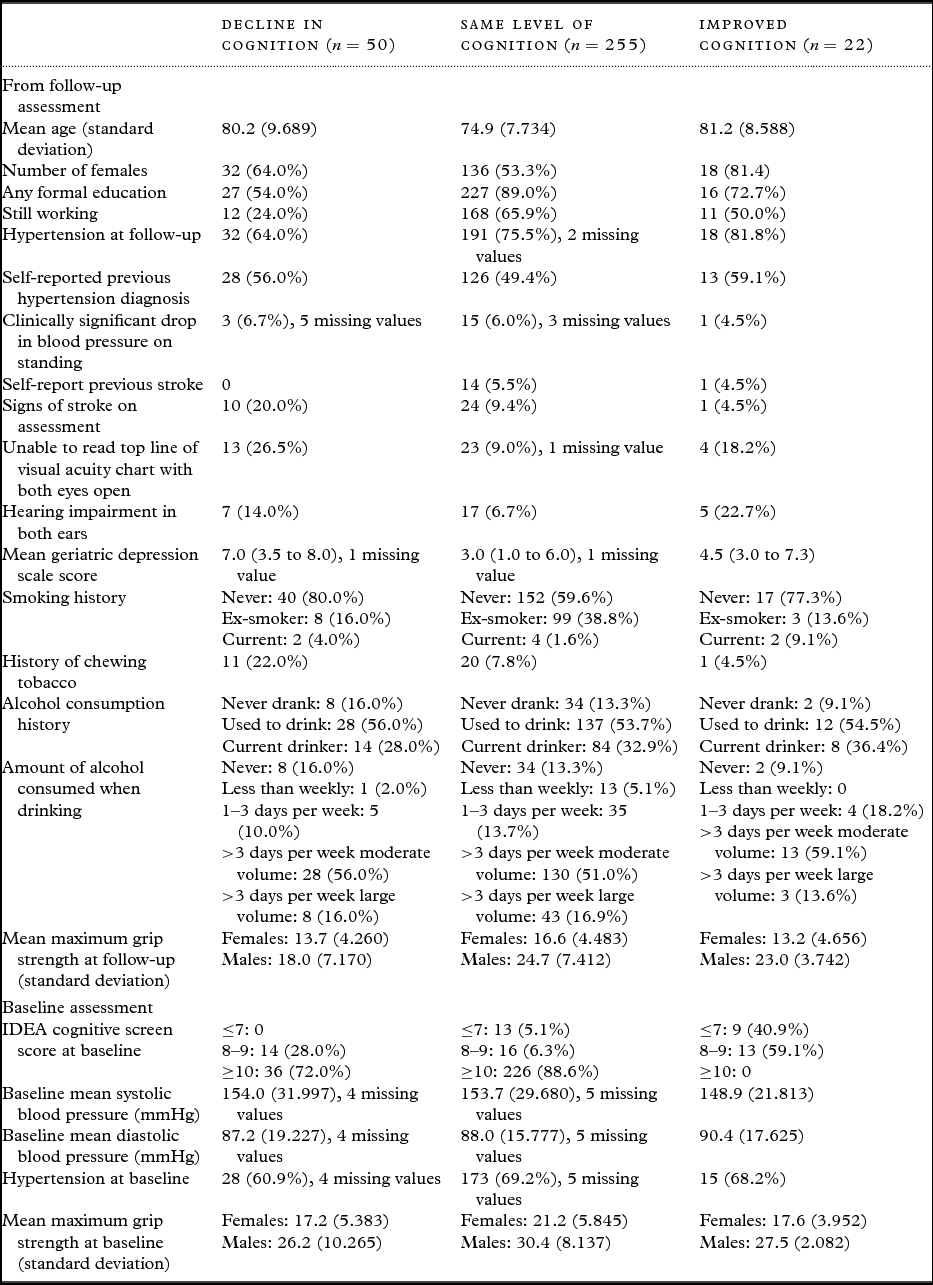
The characteristics of the group at follow-up, split into those with a clinically important decline in cognition, no change in cognition, and an improvement in cognition at follow-up are presented in Table 1. Of the cohort, 22 (6.7%) scored below the cut-off of ≤7 on the IDEA cognitive screen at baseline and so screened positive for probable cognitive impairment, of whom 13 (59.0%) still scored ≤7 at follow-up.
Characteristics of the cohort by level of cognitive change

Presence of possible risk factors for cognitive decline
Of the participants within the cohort, a brief medical history questionnaire revealed that 50.8% (n = 167) had previously been diagnosed with hypertension, 4.6% (n = 15) with stroke, 8.8% (n = 29) with diabetes mellitus, and 14.1% (n = 46) had a family history of dementia. Thirty-five participants (10.6%) had signs of a previous stroke, but the overlap between those self-reporting a previous stroke and those with signs was poor, with only four people falling into this group. Although only 8 (2.4%) of the cohort smoked at the time of the questionnaire, 33.6% were ex-smokers. Smoking was much more common in males than females, with only 12 (6.5%) females being a current or ex-smoker compared to 75.2% of males (χ 2 (1) = 164.244, p < 0.001). Over two-thirds (n = 225, 68.8%) of the participants drank alcohol on more than three days per week, reflecting the high volumes of home brewing and low cost of the traditional banana brew, mbege. Only four (13.5%) participants had never consumed alcohol. Although drinking was more common in males, with 65.6% of females and 73.0% of males drinking on more than three days per week, the difference was not significant (χ 2 (1) = 2.079, p = 0.149).
At follow-up, of 325 participants with complete data, 20 (6.2%) had severe depression, 117 (36.0%) had mild depression, and 188 (57.8%) had no depression based on GDS score. Of the 20 with severe depression, seven (35.0%) scored ≤7 (probable cognitive impairment) and a further five (25.0%) scored 8–9 (possible cognitive impairment) on the IDEA cognitive screen. Eight (40.0%) had a clinically important decline in cognition from baseline. GDS scores at baseline were only available for a sample of participants selected for follow-up (n = 87). Of these, six had severe depression, of whom three (50.0%) scored ≤7 and a further two (33.3%) scored 8–9. Only two participants had hypotension at follow-up, both of whom had normal cognition at baseline and follow-up.
Factors associated with cognitive decline
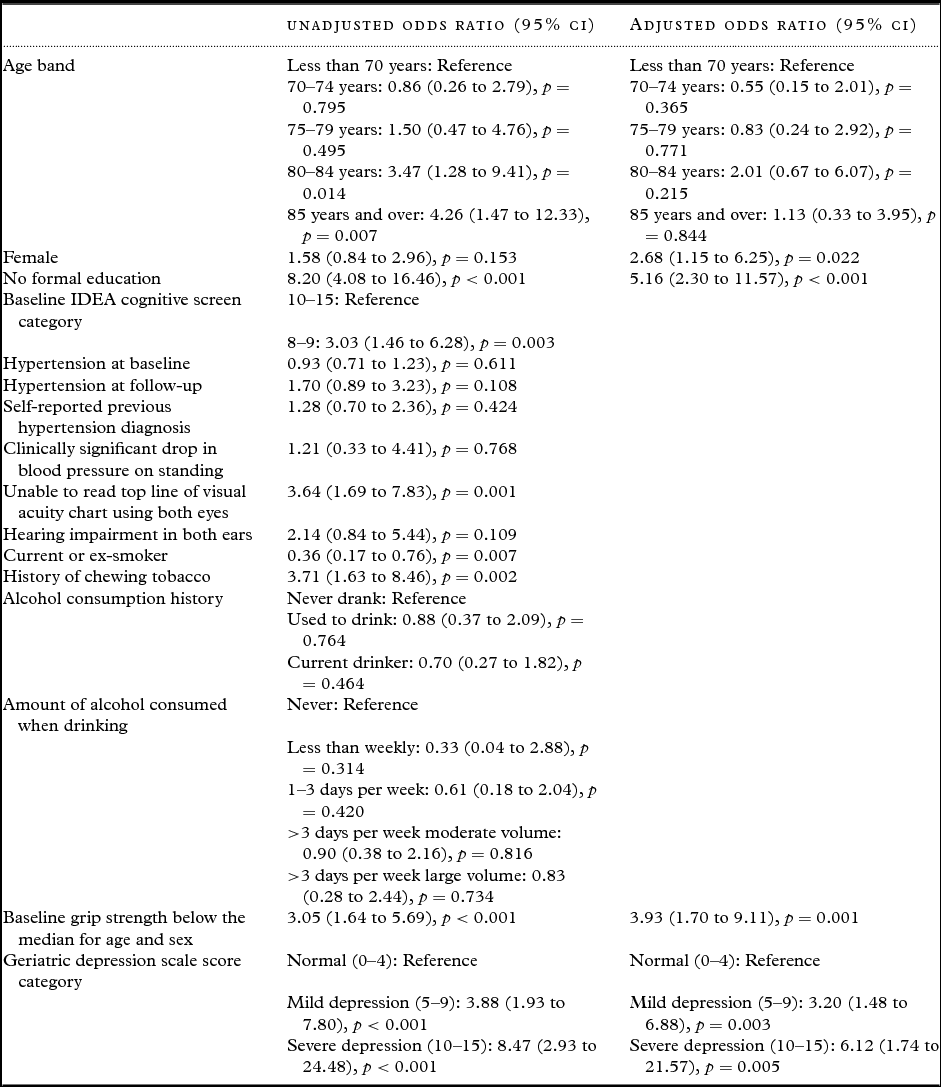
Twenty- two participants who scored ≤7 at baseline were excluded from the analysis of predictors of cognitive decline, (as they were likely to have pre-existing cognitive impairment) giving a cohort of 305, of whom 50 (16.4%) were identified as having significant cognitive decline. Factors associated with cognitive decline are presented in Table 2. In bivariate analysis, greater age, having had no formal education, lower baseline IDEA screen score, lower grip strength, depression, never having used tobacco, and poor visual acuity were all significantly associated with clinically significant cognitive decline. In multivariable regression being female, having received no formal education, lower grip strength, and depression were all independently associated with clinically significant cognitive decline.
Unadjusted and adjusted odds ratios for variables associated with cognitive decline

Change in individual IDEA cognitive screen test items
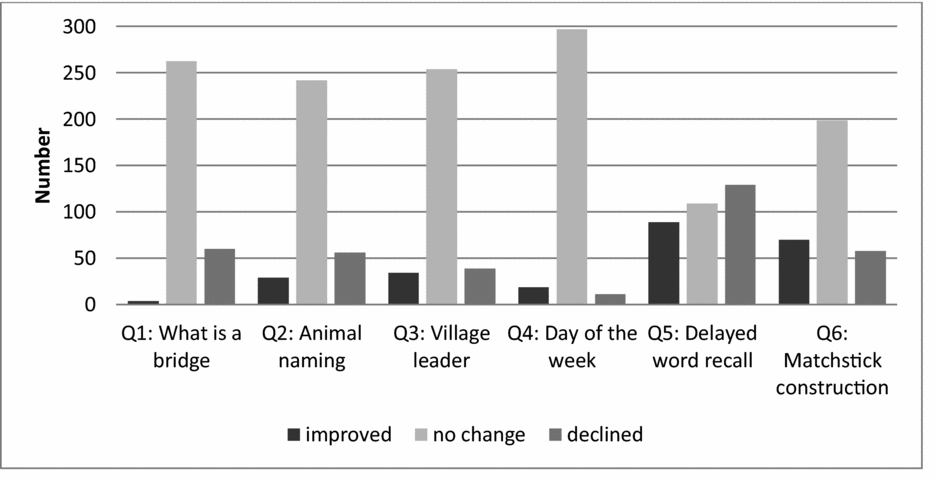
Changes in individual test items were investigated to identify if any items scores at two-year follow-up could be biased by a training effect. Summary data are presented in Figure 2. Although scores on the delayed recall and matchsticks items appeared to be the most amenable to change, these items were scored on a scale from 0 to 5 and 0 to 3, respectively, while three (what is a bridge, village leader, and day of the week) of the other four test items were scored as dichotomies and the other item (animal naming) on a scale from 0 to 2. If a change in item score of +1 or −1 for these items was considered to be “no change,” then the percentage of scores which changed was similar to the first four test items (delayed recall: improved 39 (11.9%), declined 76 (23.2%), matchstick construction: improved 30 (9.2%), declined 18 (5.5%). Although more people improved than declined on the day of the week and matchstick items, there was little evidence of a training effect.
Change in scores on individual test items.

Visual impairment and IDEA cognitive screen score
Forty (12.3%) people, of 326 with complete data available, were unable to read the top line of the visual acuity chart and of these 19 (47.5%) scored 0 or 1 on the match stick test (item 6) of the IDEA cognitive screen. This compared to 25 (8.7%) scoring 0 or 1 of 286 who could read the top row of the chart (χ 2 (1) = 45.152, p < 0.001). Although performing poorly on the test item was associated with poor visual acuity, this effect is likely to be attenuated by the effect of age. Indeed, test performance on the other five test items, which were non-visual, was also associated with poor visual acuity, although to a lesser extent (15 (37.5%) of 40 with poor visual acuity scored <6, compared to 55 (19.2%) of 286 with good visual acuity; χ 2 (1) = 6.946, p = 0.008). To adjust for this effect, visual acuity was considered for inclusion in the multivariable model investigating cognitive decline, but was rejected as non-significant.
Discussion
Rates of cognitive change
This is one of the first studies to investigate cognitive decline over time in SSA. The Ibadan–Indianapolis study followed-up a cohort of 2,459 Yoruba speakers aged 65 years and over in Ibadan, Nigeria over 5 years during the 1990s and recorded an annual dementia incidence rate of 1.35% (Hendrie et al., Reference Hendrie2001). The Ibadan–Indianapolis study also investigated cognitive decline over 2 years in 87 people with cognitive impairment, but no dementia (CIND) at baseline. Fourteen people (16.1%) had converted to dementia, 22 (25.3%) reverted to normal, and 51 (58.6%) remained CIND. The authors were unable to identify any baseline predictors of cognitive decline (Baiyewu et al., Reference Baiyewu2002). In a study by our team, also in Hai district, we identified 46 people with mild cognitive impairment (MCI) as part of a dementia prevalence study (Paddick et al., Reference Paddick2015b). Of 45 who consented to follow-up, 15 (33.3%) progressed to dementia, 8 (17.8%) had stable MCI, 19 (42.2%) had died, 2 returned to normal cognition, and 1 developed late-onset schizophrenia. In the current study, significant cognitive decline was seen in around a sixth of our cohort over two years. Although all these studies are difficult to compare, due to different settings and baseline clinical characteristics, the proportion of our sample with significant cognitive decline after two years does not seem unrealistic.
In around 7% of our cohort, cognitive performance improved from baseline, and nine people who scored ≤7 at baseline, scored >7 at follow-up. One possible reason for this is that it is a practise effect, frequently seen in longitudinal studies of cognition due to increased familiarity with testing procedures (Benedict and Zgaljardic, Reference Benedict and Zgaljardic1998). Although a practise effect may also have contributed to the improvements seen, our analysis of the individual screen items suggests this may be limited, especially given the two-year time gap. In those who had dementia at baseline, we offered cognitive stimulation therapy (CST) and the findings have been published (Paddick et al., Reference Paddick2017). Significant improvements in cognition were seen and these persisted at eight-week follow-up. This may have influenced levels of cognition at follow- up, although it is unlikely that the effects of CST would have persisted for this long. Improved cognition after recovery from depression or stroke, or other improvements in mood from baseline may be the most plausible explanation for improvements seen. Although dementia is considered irreversible, over 12% of individuals with MCI revert to normal cognition annually in longitudinal studies, and milder degrees of cognitive impairment frequently also reverse for reasons that are not clear (Koepsell and Monsell, Reference Koepsell and Monsell2012). A degree of reversibility and improvement in scores is therefore expected.
Our analysis of the individual items of the IDEA screen indicates relatively high rates of decline in the items measuring abstract thinking (What is a bridge?) and delayed recall. Further work on larger cohorts, over a longer time period would be needed to draw firm conclusions regarding the specific areas of brain function most affected during cognitive decline.
Risk factors for cognitive decline
Low levels of education and poor grip strength were potentially modifiable factors associated with cognitive decline. The role of education in cognitive performance has received much attention in recent years and is often considered within the framework of cognitive reserve (Prince et al., Reference Prince2012; Mortamais et al., Reference Mortamais2014). Given the low background literacy levels in our population, education may be particularly amenable to intervention. Beyond improving education provision for children, adult education initiatives and cognitive stimulation in later life may be of value in maintaining cognitive function in those at risk (Paddick et al., Reference Paddick2017). Grip strength is a well-established marker for generalized frailty of old age and its association with cognitive impairment has been noted previously (Auyeung et al., Reference Auyeung, Lee, Leung, Kwok and Woo2014; Koopman et al., Reference Koopman, van Bodegom, van Heemst and Westendorp2015). Since frailty is widely conceptualized as being potentially reversible, interventions to help reduce frailty are likely to help maintain cognitive function. In this context, poor grip strength is likely to be a marker for cognitive decline, rather than a specific risk factor, and any intervention should take a holistic approach to frailty management.
Although depression symptom burden was also significantly associated with decline, it is likely that people with depression would score poorly on the cognitive screen and it is unclear whether this was due to cognitive decline secondary to depression, or depression in isolation. A detailed medical examination would be required to investigate this further. Nevertheless, depression is a well-established risk factor for dementia in HIC studies (Diniz et al., Reference Diniz, Butters, Albert, Dew and Reynolds2013), although some authors suggest that depression may in fact be a prodrome for dementia (Schweitzer et al., Reference Schweitzer, Tuckwell, O'Brien and Ames2002). As such, depression is potentially modifiable, and prompt intervention may reduce dementia risk. The complex role of depression in determining cognitive performance on screening does emphasize the fact that no brief screen can be expected to differentiate between two medical conditions which may both result in poor test performance.
Although being a current or ex-smoker was associated with reduced odds of cognitive decline in bivariate analysis, this variable was highly confounded by sex (with very few women using tobacco) and did not appear in the multivariable model. Likewise, chewing tobacco was a risk factor in bivariate analysis only. Again, confounding with sex, but also age and education was apparent.
Visual impairment was associated with cognitive decline in bivariate analysis. Although visual impairment appears to have influenced scores on the matchstick test item, its overall impact on the total score is likely to be much more limited, as evidenced by its lack of independent association on multivariable analysis. Furthermore, poor vision, as with other sensory impairments, is likely to impact on cognitive function directly by decreasing levels of orientation, rather than just through reducing cognitive screening scores (Prince et al., Reference Prince2011). Adaptation of the matchstick construction item to use larger construction tools, such as pencils or spoons, should be considered in those with high levels of visual impairment.
Although hypertension was very common in our cohort, it was not associated with cognitive decline. The relationship between cognition and hypertension is likely to be complex, with higher blood pressure in older age groups potentially protective due to improved cerebral perfusion (Qiu et al., Reference Qiu, Winblad and Fratiglioni2005). The number of participants with hypotension was too small to allow meaningful analysis, although this area is worthy of further study. In contrast, mid-life hypertension increases cardiovascular risk, most notably with regard to stroke. Mid-life hypertension is associated with later life cognitive decline and dementia in meta-analytic studies with a quoted population-attributable risk of 5.1% (Norton et al., Reference Norton, Matthews, Barnes, Yaffe and Brayne2014), but data from SSA are lacking. The overall pattern of vascular risk factors in SSA appears to differ from that frequently noted in HICs and targeted for intervention. For example, nutritional transition is incomplete with many older individuals continuing to consume a traditional, relatively low calorie diet, with low levels of obesity and high levels of daily physical activity. Multi-modal dementia prevention interventions trialed in HIC settings may be effective in this setting but adaptation to the cultural and socioeconomic setting will be essential (Ngandu et al., Reference Ngandu2015).
Limitations
A number of limitations are acknowledged. We are unable to comment on how data from those who were eligible but who did not attend screening may have affected our findings. However, we are currently undertaking further work to identify, consent, and screen these people to understand this issue further. It was not possible to assess for genetic risk factors for cognitive decline, such as the APOE4 allele, or to analyze blood samples for other known vascular risk factors such as raised cholesterol. Although patients were examined for hypertension, it was not possible to examine for objective evidence of end organ damage such as left ventricular hypertrophy or urine microalbuminuria. In some cases, recordings of poor grip strength were thought to be due to a failure to understand instructions and therefore directly related to cognitive function. In these cases, the results may be a poor marker for sarcopenia. Nevertheless, poor grip strength is still likely to reflect wider frailty, emphasizing the multi-domain nature of the frailty syndrome. Rates of previous diagnosis of hypertension were relatively high. This reflects our own previous work on hypertension in this setting, which may have influenced awareness of hypertension in our cohort (Dewhurst et al., Reference Dewhurst, Dewhurst, Gray, Chaote, Orega and Walker2013). However, there is little evidence that this has impacted on treatment levels and so the role of hypertension in predicting cognitive decline. Finally, the role of stroke in predicting cognitive decline is not clear from our study, although it is likely to be important given recent data from Nigeria (Akinyemi et al., Reference Akinyemi2014). Rates of stroke identification in this community are known to be low, and as such we had to rely on either self-report or assessment of signs of stroke. More detailed research on the role of stroke in predicting cognitive decline is needed in this setting. This is especially so given the high rates of vascular risk factors and vascular dementia in Hai (Paddick et al., Reference Paddick2014b).
Conclusions
Our study suggests that factors reported to be associated with cognitive decline in HICs, including poor educational attainment, frailty, and depression are also predictive in this setting. These factors may be a potential area for future public health initiatives focused on dementia risk reduction. Further studies are suggested to investigate the interaction between these risk factors and other established risk markers for vascular disease and cognitive decline in HICs such as the APOE4 allele.
Conflict of interest
None.
Description of authors’ roles
This study was conceived, organized, and managed by RWW, S-MP, CLD, and WKG. Data collection was completed by JH, LS, S-MP, CC, SM, and JK. Statistical analysis and writing of the first draft of the paper was done by JH, LS, S-MP, and WKG. All listed authors were involved in the preparation, review, and critique of the final paper.
Acknowledgments
Baseline data collection was funded by a grant from Grand Challenges Canada (Grant number: 0086-04). CC conducted baseline data collection and JH and LS conducted follow-up data collection in part fulfillment of the requirement of a Masters in Research (MRes) degree at Newcastle University, UK. We thank all people and their families who participated in this study. We would like to thank Abigail Vernon, Norma Cardill, Victoria Ferguson, and Gillian Tough (Northumbria Healthcare NHS Foundation Trust) for administrative support.