The Great East Japan Earthquake
The Great East Japan Earthquake was a complex and historic disaster occurring on March 11, 2011. It consisted of a magnitude 9.0 earthquake that struck at 2:46 pm JST, a tsunami that followed the earthquake, and a leak at a nuclear power plant. The disaster resulted in 15 822 deaths, 3926 missing, and 5942 severely injured.1
The major features of this disaster included (1) many fatalities, 92.5% of which were caused by drowning in the tsunami; (2) a small number of severe injuries; (3) damage sustained by many medical institutions—in the 3 prefectures of Iwate, Miyagi, and Fukushima, 11 hospitals and 81 clinics were completely destroyed, while the remainder were damaged or unable to access utilities—precluding patient care; and (4) a nuclear power plant accident, which produced health concerns and generated negative economic impact through fear of radiation exposure. In addition, damage covered a large, 500-km area where many older individuals lived. A serious shortage of medical resources that existed before the disaster was exacerbated. A geographically-complex coastline created access difficulties. Emergency radio communication networks and satellite phones were impaired. Railways, roads, and airports needed for rescue operations were damaged, and a serious shortage of gasoline occurred. All of these features complicated response and relief efforts.
An additional complication arose from the Fukushima nuclear accident. Large amounts of radioactive material were released, and I131, Ce134, and Ce137 were detected in eastern Japan. However, to prevent social panic from fear of exposure, the government and the Tokyo Electric Power Company (TEPCO) delayed disclosing the information about leaked radiation. Potential radiation exposure prevented deployment of disaster medical teams and distribution of supplies in the first 2 weeks after the disaster, and caused many inhabitants to leave Fukushima.Reference Ishii2
Challenges in Japan's Disaster Medicine
In Japan, the goal of health care recovery from disaster is to return the public health insurance system to its predisaster level. The public health insurance system, in which all public and private medical institutions participate, provides all people in Japan with medical care at a fair charge. Also, private medical institutions help restore the health care system by providing health care services such as emergency medicine. These strengths of the Japan health care system are highly-evaluated worldwide.Reference Ishii, Hamamoto and Tsuruoka3–5 The reconstruction of private medical institutions is absolutely necessary in the restoration of health care, and disaster-affected areas cannot fully recover until health care is restored.
A shortage in human resources in health care was a major problem in Japan before the disaster. Although improvement is anticipated in the mid- and long-terms by increasing the capacity of medical schools, the number of physicians per 1000 people in Japan in 2008 was 2.15, which is less than 70% of the average for the Organization for Economic Co-operation and Development member countries.6
During disasters, special consideration is needed for vulnerable groups, such as older individuals, those with injuries or needing chronic care such as hemodialysis, persons with disabilities, pregnant women, infants, and foreigners. In Japan, the proportion of people aged 65 years old and older was 22.7% in 2009 and is anticipated to reach 30.5% in 2025.7 In 2010, there were 5 336 000 households consisted of older couples only and 4 665 000 households of older individuals living alone.7 Also in 2010, 5.8 million people received emergency medical transport by ambulance, and this number will reach about 6.2 million in 2023.8 Moreover, in December 2011, about 304 592 patients required hemodialysis.9 These numbers represent an important sector of the population whose needs should be considered in disaster planning.
The conditions of evacuees living in shelters also should be assessed. It has become common in Japan for evacuees of a large-scale disaster to be housed in groups for long periods in emergency shelters such as school gymnasiums. Although the supply of water and electricity may be sufficient in such shelters, people must sleep on the floor using simple beds made of cardboard, and privacy is not secured. In these living conditions, there is a risk of health deterioration from worsening sanitary conditions, fatigue, emotional stress, and sleep disruption. During the 3/11 disaster, nearly 400 000 people were evacuated to shelters at high elevation, and many were living there from snowy March until August, when temperatures rose above 30°C (86°F). More than 90 000 people remained in shelters 3 months after the earthquake. While temporary housing enabled evacuees to leave shelters, loss of community became a concern because evacuees were relocated from their original communities. People also feared solitary death (i.e., individuals, especially older people, who are unable to call relatives or acquaintances for help during an illness, die alone).Reference Fujita, Inoue and Seki10
Disaster Preparedness And CRISIS Management of The JMA
With about 165 000 members, the JMA is Japan's representative group of physicians and also the country's largest nongovernmental organization (NGO). About 56% of physicians in Japan belong to the JMA11; whereas, only 15% of physicians in the United States belong to the American Medical Association.Reference Collier12 The JMA helps maintain the health care system in Japan through its own code of conduct and professional autonomy, and, at the same time, ensures cooperation with the government.13 The JMA has recognized the importance of disaster preparedness since hosting the World Medical Association's Asian-Pacific Regional Conference in 2006.Reference Tsuji14–17 This event spurred the establishment of Japanese medical assistance teams (JMATs), which were the core of the JMA's disaster response. In addition, JMA's mission covered other operations associated with the 3/11 disaster.
JMAT Operations in the Great East Japan Earthquake
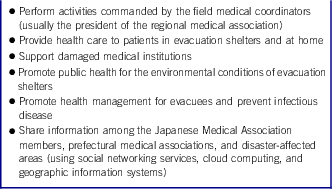
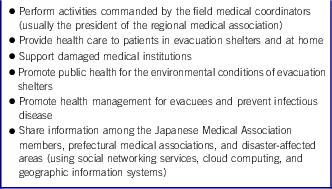
JMATs were created after the JMA's Committee on Emergency and Disaster Medicine issued its proposal in a 2010 report. The proposed goal was to establish a wide-spectrum disaster medical support system, including support for damaged medical institutions and for evacuees in shelters. The JMA reviewed medical responses in previous major disasters to determine the basis of a response plan. For example, in the 1985 crash of a Japan Airlines jet on Mount Osutaka in Gunma Prefecture, autopsies were systematically performed on more than 500 victims, mainly by the Gunma Medical Association.17 In the Great Hanshin Earthquake of 1995, it was found that medical and public health support and primary care for evacuees in shelters were a major need.Reference Ishii and Nakayama18–Reference Shinfuku22 Similarly, in the United States, after Hurricane Katrina, in 2005, the importance of emergency medical support for older people and hospitalized patients became obvious.Reference Bloodworth, Kevorkian, Rumbaut and Chiou-Tan23–Reference Dosa, Hyer and Thomas25 Based on these experiences, it was proposed that the primary mission of JMATs in large-scale disasters was medical and public health support in evacuation shelters during the acute phase, in addition to primary care and autopsies. Finally, several disaster training courses were proposed as a standard for the JMA concept, particularly the American Medical Association's National Disaster Life Support program.Reference Coule and Schwartz26
Although the idea of JMATs was still being developed, the JMA did not hesitate to launch the concept into practice in response to the 3/11 disaster. In total, 1384 teams were dispatched by July 15. The number of teams sent to each prefecture was 454 in Iwate (including 56 teams dispatched from within the prefecture by the Iwate Medical Association), 643 in Miyagi, 272 in Fukushima, and 12 in Ibaraki. Three other teams were dispatched to other disaster-affected prefectures. Team members included 2150 physicians (including doctors who are not JMA members), 1681 nursing personnel, 445 pharmacists, 1084 administrative personnel, and 481 other health care personnel (eg, physical therapists, laboratory technicians, welfare personnel/caregivers, clinical psychologists, nutritionists). The costs of JMAT activities and deployment were reimbursed from the government disaster fund.
JMATs shared their period of dispatch and roles with disaster medical assistance teams (DMATs), the government's disaster relief teams, which were created in 2005.Reference Kondo, Koido and Morino27 The missions of DMATs are trauma and critical care medicine and transportation of critical patients in the super-acute phase of a disaster (within the first 48-72 hours after a disaster occurs). JMATs took over the DMATs’ mission regarding medical and public health support for evacuation shelters and medical institutions in the disaster-affected area by sending teams with diverse medical specialists (Table 1). However, in this disaster, because of a relatively low number of severe injuries, DMATs had limited opportunities to provide trauma and critical care in their primary field mission, although they did demonstrate high mobility in assembling urgently.Reference Nagamatsu, Maekawa and Ujike28
The Roles of Japanese Disaster Assistance Teams
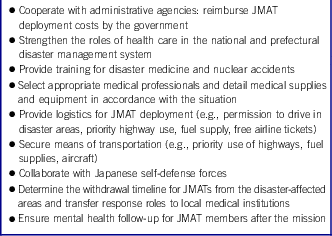
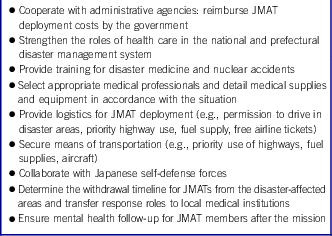
After 3/11, the JMA asked 43 prefectural medical associations to assemble and dispatch JMATs to disaster-affected areas (Table 2). JMATs from all prefectures except those in disaster-affected areas (Iwate, Miyagi, Fukushima, and Ibaraki) were assigned geographically to affected areas for deployment. For each JMAT, deployment in the disaster field lasted 3 to 7 days, and the continuity of medical service was secured by transferring care from one team to another. JMATs considered withdrawal when the local health care system became restored and medical assistance needs in the disaster area declined. Thus, on March 24, 2011, the JMA stopped sending JMATs to Ibaraki because local physicians took over the response. On April 14, the JMA decided to continue dispatching teams to selected regions in Iwate, Miyagi, and Fukushima prefectures. By June 28, the health care system was sufficiently recovered in all affected areas, and the JMA withdrew the JMATs on July 15.
The Roles of the Japan Medical Association and Prefectural Medical Associations for Japanese Medical Assistance Team (JMAT) Deployment
In addition, the JMA prepared JMATs II under universal health insurance coverage to provide long-term continuing medical support such as health care services in hospitals, mental health services, and health check-ups for evacuees in temporary housing in the disaster-affected areas. In spite of these efforts from the JMA and JMATs, recovery in some areas was delayed and outside medical support was still required.
Primary JMA Actions After the 3/11 Disaster
The JMA and JMATs were involved in different activities during the 3/11 disaster response. These activities included the following:
• Transporting a large amount of medical supplies on March 19 with support from the US military and embassy.Reference Ishii29, Reference Ishii30 For example, 8.5-ton truckloads of drugs were sent to Iwate and Miyagi prefectures at the same time that the Aichi Medical Association transported medical supplies to Fukushima by private jet.
• Sending experienced physicians for postmortem examination. Postmortem examination needs peaked in the first week after the disaster.
• Opening the closed highway for transportation. Joban- and Tohoku-Highways (which connects Tokyo to Miyagi through Fukushima) was closed to all but emergency transport after the disaster. However, fear of radiation exposure and serious shortages of gasoline, food, water, and medicine within the first week prompted the JMA to urge the Minister of Land, Infrastructure, and Transport to reopen the highway on March 15; the highway was partially reopened the following day.
• Requesting free flight services from major domestic airlines for JMAT deployment.
• Donating temporary clinics and trailer houses for Iwate prefectural hospital, which was completely destroyed by the tsunami.
Difficulties of the Response to Fukushima
The JMA sent advance members of JMATs to Fukushima on March 13, 2011, only 1 day after the first hydrogen explosion at Fukushima Daiichi Nuclear Power plant. The authorities (prime minister, TEPCO, and government agencies) provided no appropriate and timely information about the radiation measurements; instead, they reported that the area remained safe. The foreign media, however, quickly reported the dangerous situation at Fukushima Daiichi, and the Japanese public recognized the critical safety risks.Reference Fackler31, Reference Onishi and Fackler32 The lack of timely and accurate reporting by authorities fostered social distrust and fear in Japan, an environment that may have caused the delay of subsequent JMAT deployments to Fukushima. On March 15, the majority of DMATs that were deployed to Fukushima started withdrawing. The Nuclear Safety Division of the Ministry of Education, Culture, Sports, Science, and Technology in Japan did not initially supply updates through the system for prediction of environment emergency dose information. Therefore, the JMA decided to analyze the radiation distribution.Reference Nagata, Kimura and Ishii33
On March 18, radiation measurements in the Fukushima area (Figure) were created using ArcGIS Desktop 10 (Environmental Systems Research Institute) software.Reference Nagata, Kimura and Ishii33 Radiation measurements collected by the local government were used. Mapping enabled the risk of radiation to be visualized, which helped the JMA address the timing of optimal JMAT deployment. In fact, radiation mapping was available on the JMA website from March 19 to enable JMAT members to evaluate the risk of radiation exposure. Mapping showed that radiation in the Fukushima area was not distributed in a concentric fashion, but that the extent of contamination was affected by factors such as the type of radiation, wind, rain, and land geography.
Fukushima Prefecture Radioactivity Measurements (Provisional Values) on March 18, 2011, at 5:00 pm (unit 5 microsieverts/h).Reference Nagata, Kimura and Ishii33 Figure was originally published in: Nagata, T, Kimura, Y, and Ishii, M. Use of a Geographic Information System (GIS) in the Medical Response to the Fukushima Nuclear Disaster in Japan. Prehospital and Disaster Medicine. 2012;27(2):213–215.

After the JMAT deployment to Fukushima on July 15, 2011, was stopped, the majority of the local health care professionals continued working there. Others were reluctant to return to the area, in part because their offices or residences were located within the evacuation zone, and re-entry to that zone was prohibited. Therefore, the JMA undertook a successful negotiation with TEPCO to compensate the health care professionals who lost their properties in the evacuation zone.34
In May 2013, more than 2 years after the disaster, the medical association in Futaba-county, Fukushima, conducted a survey of the 20 members who were forced to leave from the evacuation area in Fukushima. The results showed that 5 members have a strong intention to return, another 5 members have given up thoughts of returning, and the last 10 have remained undecided (written communication, Futaba Medical Association).
Other Disaster Relief-Associated Missions of the JMA
The JMA performed numerous other missions to aid in disaster response and relief, including the following:
• Establishing a disaster response headquarters immediately after the earthquake to provide the latest information through website and fax to JMA members and the public, 24 hours a day, 7 days a week.
• Raising relief funds and distributing monetary donations (1.9 billion Japanese yen).
• Establishing the Survivors Health Support Liaison Council, comprising private hospital organizations, university hospitals, various professional organizations, the Japanese Red Cross Society, and administrative agencies. The council negotiated with the government to provide compensation to ill people in disaster-affected areas, and it also maintains the activities of and manages the JMATs II.
• Requesting funds for health care restoration in disaster areas (72 billion yen), public financial support for loans to private medical institutions, and unemployment insurance for medical staff who lost jobs, construction of hospital ships, and more.
• Developing countermeasures to the Fukushima nuclear accident. The JMA established a special committee on damages and recovery of medical institutions, received appointment to the national government's Dispute Reconciliation Committee for Nuclear Damage Compensation, and sent radioactive substance decontamination gel to the Fukushima Medical Association.
• Producing countermeasures to the electricity shortage. The JMA protested against the government's planned rolling blackouts (March 14-27), which might have endangered patients requiring continuous medical device support, such as intubation and ventilation, both in hospitals and at home.
• Requesting financial support to strengthen all medical institutions against future earthquakes.
• Requesting permission to provide long-term prescriptions at medical institutions outside disaster-affected area for evacuees; promoting public health at shelters; promoting health for vulnerable people such as children, pregnant women, older people, foreigners, and those needing special care; distributing automatic external defibrillators in evacuation shelters, and more.
Conclusions
The Great East Japan Earthquake caused extensive and widespread damage and triggered a nuclear accident that fostered social fear and distrust. The JMA exerted maximum effort to assist evacuees and patients in the disaster-affected areas; however, JMAT response plans can still be improved. Because Japan faces many disaster risks, such as earthquakes, tsunamis, and volcanic eruptions, and has numerous nuclear power plants and chemical complexes, better response plans are needed. Using lessons learned from this disaster, the JMA will conduct a retrospective analysis of JMAT operations, provide disaster medicine training as a part of continuing medical education programs, and strengthen the disaster preparedness of health care at national, prefectural, and local levels. In addition, because the numerous countries encircled by the Pacific Rim share a similar risk of natural disasters, the JMA experiences in disaster relief should prove valuable for responding to future incidents of this magnitude.
Acknowledgments
Sympathy is extended to all those affected by disasters worldwide in recent years, including the Great East Japan Earthquake of March 11, 2011, and to their victims. Support in response to this event was received from medical associations, physicians, and medical personnel worldwide.
Katsuhito Aoki, Kazuhiro Fujimaki, Yumiko Nishida, Tomomi Takeuchi, Naoto Tsuchiya, Manami Yazawa, and Naoko Fujitani, Community Healthcare Division, and Mieko Hamamoto, International Affairs Division of the Japan Medical Association assisted in completing this paper.