Implications
In ovo feeding (IOF) of appropriate nutrients has estabolised a new method of early nutritional regulation that provides opportunities for greater production efficiency and animal welfare. Our study showed that IOF of l-arginine (Arg) could improve breast muscle weight, hormones levels, amino acid (AA) concentrations and mammalian target of rapamycin (mTOR) signal pathway messenger RNA (mRNA) expressions of breast muscle until 21-day post-hatch broilers. Thus, the use of Arg could regulate protein deposition while contributing to the meat yield of commercial poultry.
Introduction
Muscle mass is an important indicator in determining BW, and the early development of post-hatch chick muscles has a crucial influence on later growth and meat yield of broilers (Kornasio et al., Reference Kornasio, Halevy, Kedar and Uni2011; Chen et al., Reference Chen, Lv, Zhang, Ruan, Wang and Lin2013). During the few days pre-hatch of embryos, the insufficient energy status forces the gluconeogenesis of AA from the depletion of muscle protein reserves, resulting in the reduction of breast muscle and early growth and development (Uni et al., Reference Uni, Ferket, Tako and Kedar2005; Foye et al., Reference Foye, Uni and Ferket2006a). In addition, under commercial practice, newly hatched chicks may be deprived of feed and water for up to 48 to 72 h (Kornasio et al., Reference Kornasio, Halevy, Kedar and Uni2011), which blocks muscle development and meat yield (Zhao et al., Reference Zhao, Gao, Zhang, Li, Lv, Yu, Gao and Zhou2017). Thus, it is suggested that the breast muscle may undergo an atypical development, and muscle atrophy appears in the later embryo and neonatal chicks (Chen et al., Reference Chen, Lv, Zhang, Ruan, Wang and Lin2013).
Many strategies have been conducted to improve skeletal muscle development during the few days pre- and post-hatch, such as, feeding at hatching and IOF (Uni et al., Reference Uni, Ferket, Tako and Kedar2005; Kornasio et al., Reference Kornasio, Halevy, Kedar and Uni2011; Zhao et al., Reference Zhao, Gao, Zhang, Li, Lv, Yu, Gao and Zhou2017). In ovo feeding is a method that injects exogenous nutrients into the amnion at the few days pre-hatch of embryos (Uni et al., Reference Uni, Ferket, Tako and Kedar2005). Broiler embryogenesis is an external process, and egg nutrients, which contain an excess of fat and moisture but not protein, are critical to growth and development of post-hatch broilers (Ohta et al., Reference Ohta, Kidd and Ishibashi2001; Shafey et al., Reference Shafey, Mahmoud, Alsobayel and Abouheif2014). Some researchers found that IOF of AA promoted the development and growth of embryos and neonatal chicks (Bakyaraj et al., Reference Bakyaraj, Bhanja, Majumdar and Dash2012; Tahmasebi and Toghyani, Reference Tahmasebi and Toghyani2016). It is suggested that the increase of body growth may be due to a higher content of AA in yolk or a better utilisation of AA by the embryos (Ohta et al., Reference Ohta, Kidd and Ishibashi2001).
l-arginine is one of essential AA of broilers, which has many biological functions and also serves as a precursor in protein synthesis (Wu et al., Reference Wu, Bazer, Davis, Kim, Peng, Rhoads, Satterfield, Smith, Spencer and Yin2009). Some experiments indicated that in ovo injection of Arg had positive effects on post-hatch growth performance of chicks (Foye et al., Reference Foye, Uni, Mcmurtry and Ferket2006b; Gao et al., Reference Gao, Zhao, Zhang, Li, Yu, Lv, Gao and Zhou2017), and demonstrated that the effects of Arg were both involved in glucose production (Foye et al., Reference Foye, Uni, Mcmurtry and Ferket2006b; Tangara et al., Reference Tangara, Chen, Xu, Huang and Peng2010) and hormones secretion (Foye et al., Reference Foye, Uni, Mcmurtry and Ferket2006b). In addition, Arg could enhance protein accumulation by activating the initiation effectors of the mTOR signalling pathway (Yao et al., Reference Yao, Yin, Chu, Liu, Deng, Li, Huang, Zhang, Tan and Wang2008; Wu, Reference Wu2009).The mTOR is a major signalling pathway that regulates protein synthesis in muscles (Deng et al., Reference Deng, Zheng, Liu, Chang, Zhang and Cai2013). l-arginine could regulate mTOR signal pathway in pigs (Yao et al., Reference Yao, Yin, Chu, Liu, Deng, Li, Huang, Zhang, Tan and Wang2008) and cells (Kong et al., Reference Kong, Tan, Yin, Gao, Li, Jaeger, Bazer and Wu2012). However, the research concerning IOF of Arg on protein deposition and the mTOR signal pathway of breast muscle is rarely reported in post-hatch broilers. Thus, we carried out this study to evaluate the effects of IOF of Arg on breast muscle growth, metabolite and hormone levels, AA concentrations and mRNA expressions of mTOR signal pathway from hatch to 21-day post-hatch broilers.
Material and methods
Incubation
This study was approved by the Institutional Animal Care and Use Committee of Nanjing Agricultural University, Nanjing, China. A total of 960 eggs, from the Arbor Acres broiler breeder flocks of 34 weeks, were collected from the Hewei Agriculture and Animal Husbandry Company (Guangde, China) with an average weight range of 60 to 65 g. Then the eggs were disinfected with 0.1% bromogeramine solution, and incubated in the micro-computer automatic incubator (Model: ZCA-A; Zhicheng Incubation Equipment Co. Ltd, Dezhou, China) at temperature of 37.8±0.1°C with relative humidity of 60%. Every egg in the incubator was turned through 90° per 3 min until 19 days of incubation. At 16 days of incubation, eggs were candled for selecting embryonated eggs and removing the ones of unfertilised or non-viable. After examination, 720 embryonated eggs were randomly distributed to three treatment groups of 240 eggs each (eight replicates in every treatment group) with similar weight.
In ovo feeding procedure
In ovo administration of Arg was carried out at 17.5 days of incubation of the embryo according to Uni et al. (Reference Uni, Ferket, Tako and Kedar2005). All injected solutions were freshly prepared on the day of injection and the three treatments comprised: (1) non-injected control group (NC), (2) diluent-injected group (DG; 0.75% NaCl solution), (3) 0.6 mg Arg/egg solution-injected group (10 g Arg dissolved in 1 l diluent, which was confirmed by the preliminary experiment in Gao et al. (Reference Gao, Zhao, Zhang, Li, Yu, Lv, Gao and Zhou2017)). The location of the amnion in the IOF group was identified by candling and 0.6 ml solution was injected into the amnion using 21-gauge needle (ShouDe, Nanjing, Jiangsu, China) to a depth of about 2 cm through the pinhole created at the surface of the large end of the egg. The control eggs received no injection, but it was subjected to the same handing procedures as the IOF treatment groups. Finally, after the injection, the pinholes immediately were sealed with paraffin wax and eggs were returned to the incubator, and then incubated with conventional procedure to complete the hatching process.
Animal husbandry
The chicks hatched from each of the three treatment groups were selected to obtain healthy and lively male ones. Then eighty male chicks, with weights close to the average BW of their pooled group, were randomly assigned to eight replicates of 10 birds each. They were distributed in three-tier cages and provided food and water freely in a temperature-controlled room at Nanjing Kangxin Poultry Industry (Nanjing, China), and the temperature were kept at 32°C to 34°C for the first 3 days and subsequently reduced by 2°C to 3°C per week to a final temperature of 20°C. Under incandescent white light with a light schedule of 23 h light and 1 h dark, the chicks were reared up to 21 days of age and offered a diet that met the nutrient requirements of Arbor Acres broiler. The details of the diet used for the broilers is given in Supplementary Table S1.
Sample collection
One chick from per replicate (total eight birds per treatment) was killed by cervical dislocation and dissected at hatch, 3-, 7- and 21-day post-hatch. Then the entire breast muscle was weighted and recorded. About 2.0 g subsample of breast muscle was placed in 2 ml RNAase-free tube as well as frozen in liquid nitrogen, and transferred to the refrigerator of −80°C for subsequent analysis. Meanwhile blood samples from each bird were immediately collected in heparinised tubes, shaken slightly and centrifuged for 10 min at 3000×g to obtain plasma. The plasma was shifted to a new RNAase-free tube and stored at −20°C for metabolite and hormone analysis.
Metabolite and hormone concentrations of plasma
In plasma, the concentrations of total protein (TP), albumen (ALB), aspartate aminotransferase (AST), alanine aminotransferase (ALT) were measured with specific assay kits (Nanjing Jiancheng Bioengineering Institute, Nanjing, China) according to the manufacturer’s instructions. Moreover, plasma triiodothyronine (T3) and thyroxine (T4) levels were determined by radioimmunoassay based on the commercially available kits (Beijing North Institute of Biological Technology, Beijing, China).
Amino acid analysis of breast muscle
The AA concentrations of breast muscle were determined following modified procedures described by Liu et al. (Reference Liu, Li, Kong, Tan, Li, Duan, Blachier, Hu and Yin2015). Briefly, ~75 mg samples was ground and hydrolysed in 10 ml of 6 mol/l hydrochloric acid solution at 110°C for 23 h under N2. The solution was diluted with water to 120 and 1 ml of the supernatant was used for analysis. The samples were filtered through a 0.22 μm membrane and then were analysed for AA concentrations using a Hitachi L-8900 amino acid analyzer (Hitachi, Tokyo, Japan). The AA concentration of breast muscle was expressed as milligram per gram of tissue.
Total RNA extraction and real-time PCR measurement
The breast muscle samples were subjected to total RNA extraction with Trizol reagent (Takara Biotechnology Co. Ltd, Dalian, China) for analysis of mTOR signal pathway gene expressions. The purity and quality of total RNA was assessed using a Nano-Drop 1000 spectrophotometer (Thermo Scientific, Wilmington, DE, USA) at 260 and 280 nm. It was ensured that the OD260/OD280 ratios of RNA samples were between 1.8 and 2.0. Then, the total RNA was treated with DNase I (TaKaRa Biotechnology Co. Ltd) to remove DNA and proceed reverse transcription reaction for complementary DNA (cDNA) synthesis using a PrimeScriptTMRT Master Mix kit (TaKaRa Biotechnology Co. Ltd) according to the manufacturer’s instructions. The cDNA resultant of 30 μl was stored at −80°C for further real-time PCR. The primers for this study were designed using Primer-BLAST in NCBI (Table 1) and synthesised by Invitrogen (Invitrogen Life Technologies, Shanghai, China). The amplification of gene was carried out using the ABI 7500 Real-Time PCR System (Applied Biosystems, Foster City, CA, USA) according to Yu et al. (Reference Yuan, Ding, He, Azzam, Lu and Zou2017), with a total volume of 20 μl using SYBR1 Premix Ex TaqTM Kits (Takara Biotechnology Co. Ltd), containing: 10 μl of SYBR Premix Ex Taq (2×), 0.4 μl of forward primer (10 μM), 0.4 μl of reverse primer (10 μM), 0.4 μl of ROX reference Dye (50×), 1 μl of cDNA and 7.8 μl of sterile, double-distilled water. Moreover, the PCR cycling conditions included initial denaturation at 95°C for 30 s, followed by 40 cycles of denaturation at 95°C for 5 s and anneal at 60°C for 30 s, and extension at 72°C for 45 s. All samples were measured in triplicate for reserving average value. The 18S ribosomal RNA was used as the housekeeping gene to calculate relative mRNA levels using the 2−ΔΔCt method described by Livak and Schmittgen (Reference Livak and Schmittgen2001).
Primer pairs used for the real-time PCR analysis

mTOR=mammalian target of rapamycin; S6K1=ribosomal protein S6 kinase-1; 4E-BP1=eIF4E-bindingmprotein-1; 18S rRNA=18S ribosomal RNA.
Statistical analysis
Treatments were analysed by one-way ANOVA using the GLM procedure of the SAS statistical software (version 8.02; SAS Institute Inc., Cary, NC, USA). The data on total and relative weight of breast muscle, the concentrations of metabolite, hormone and AA, and the mRNA expression of mTOR signal pathway were analysed using the individual broiler as the experimental unit (n=8). When differences among individual means were found in ANOVA tests (P<0.05), means were compared by Tukey’s test. The results are presented as means and standard error of the mean.
Results
Relative breast muscle weight
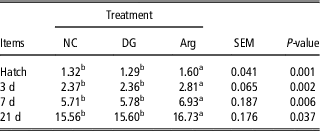
The effects of IOF of Arg on relative breast muscle weight of post-hatch broilers are shown in Table 2. In ovo feeding of Arg increased relative breast muscle weight at hatch, 3-, 7- and 21-day post-hatch compared with those of control groups (P<0.05).
Effects of in ovo feeding l-arginine on relative breast muscle weight of broilers at hatch, 3-, 7- and 21-day (d) post-hatch (% BW)

NC=non-injected control group; DG=diluent-injected group (0.75% NaCl solution, w/v); Arg=10 g/l (w/v) arginine solution-injected group (10 g Arg dissolved in 1 l diluent).
The pooled SEM, n=8.
a,bMeans in a row without a common superscript letter significantly differ (P<0.05).
Metabolite concentrations in plasma
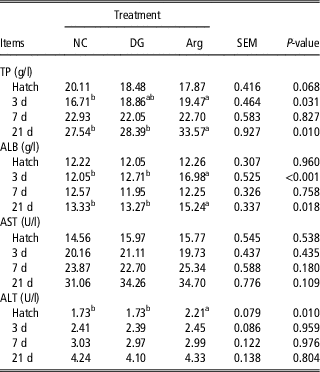
The effects of IOF of Arg on metabolite concentrations in plasma of post-hatch broilers are shown in Table 3. At 3- and 21-day post-hatch, the TP and ALB concentrations in Arg group were significantly higher than those of NC group (P<0.05). In ovo feeding of Arg improved the ALT activity at hatch compared with that of control groups (P<0.05), and there was no significant difference on AST and ALT activities in Arg group at other time points (P>0.05).
Effects of in ovo feeding of l-arginine on plasma total protein (TP), albumen (ALB), aspartate aminotransferase (AST), alanine aminotransferase (ALT) concentrations of broilers at hatch, 3-, 7- and 21-day (d) post-hatch

NC=non-injected control group; DG=diluent-injected group (0.75% NaCl solution, w/v); Arg=10 g/l (w/v) arginine solution-injected group (10 g Arg dissolved in 1 l diluent).
The pooled SEM, n=8.
a,bMeans in a row without a common superscript letter significantly differ (P<0.05).
Hormone levels in plasma
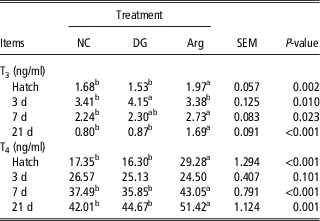
The effects of IOF of Arg on T3 and T4 levels in plasma of post-hatch broilers are shown in Table 4. The T3 level in Arg group was higher than that of NC group at four time points (P<0.05). Similarly, IOF of Arg increased T4 level compared with that of control groups at hatch, 7- and 21-day post-hatch (P<0.05); and there was a continuous rise in T4 level during the growth process of broilers.
Effects of in ovo feeding of l-arginine on plasma triiodothyronine (T3) and thyroxine (T4) levels of broilers at hatch, 3-, 7- and 21-day (d) post-hatch

NC=non-injected control group; DG=diluent-injected group (0.75% NaCl solution, w/v); Arg=10 g/l (w/v) arginine solution-injected group (10 g Arg dissolved in 1 l diluent).
The pooled SEM, n=8.
a,bMeans in a row without a common superscript letter significantly differ (P<0.05).
Amino acid concentrations in breast muscle
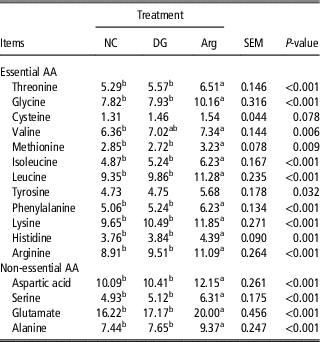
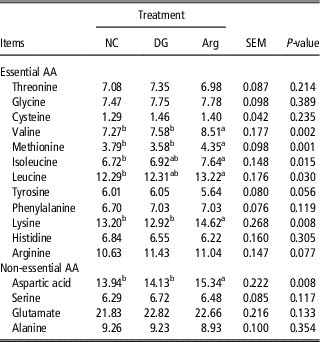
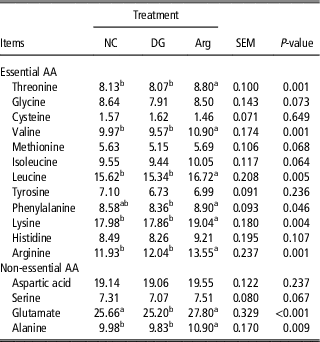
The effects of IOF of Arg on AA concentrations in breast muscle of post-hatch broilers are shown in Tables 5 to 7, respectively. At hatch, IOF of Arg increased most AA concentrations in breast muscle, except cysteine and tyrosine, compared with those of control groups (P<0.05). Moreover, the essential AA concentrations, such as valine, methionine, isoleucine, leucine and lysine, in Arg group were higher than those of NC group at 7-day post-hatch (P<0.05). In addition, IOF of Arg improved some essential AA (threonine, valine, leucine, phenylalanine, lysine and arginine) and non-essential AA (glutamate and alanine) concentrations compared with those of DG group at 21-day post-hatch (P<0.05).
Effects of in ovo feeding of l-arginine on breast muscle amino acid (AA) concentrations of broilers at hatch (mg/g)

NC=non-injected control group; DG=diluent-injected group (0.75% NaCl solution, w/v); Arg=10 g/l (w/v) arginine solution-injected group (10 g Arg dissolved in 1 l diluent).
The pooled SEM, n=8.
a,bMeans in a row without a common superscript letter significantly differ (P<0.05).
Effects of in ovo feeding of l-arginine on breast muscle free amino acid (AA) concentrations of broilers at 7-day post-hatch (mg/g)

NC=non-injected control group; DG=diluent-injected group (0.75% NaCl solution, w/v); Arg=10 g/l (w/v) arginine solution-injected group (10 g Arg dissolved in 1 l diluent).
The pooled SEM, n=8.
a,bMeans in a row without a common superscript letter significantly differ (P<0.05).
Effects of in ovo feeding of l-arginine on breast muscle free amino acid (AA) concentrations of broilers at 21-day post-hatch (mg/g)

NC=non-injected control group; DG=diluent-injected group (0.75% NaCl solution, w/v); Arg=10 g/l (w/v) arginine solution-injected group (10 g Arg dissolved in 1 l diluent).
The pooled SEM, n=8.
a,bMeans in a row without a common superscript letter significantly differ (P<0.05).
The mammalian target of rapamycin pathway messenger RNA expressions in breast muscle
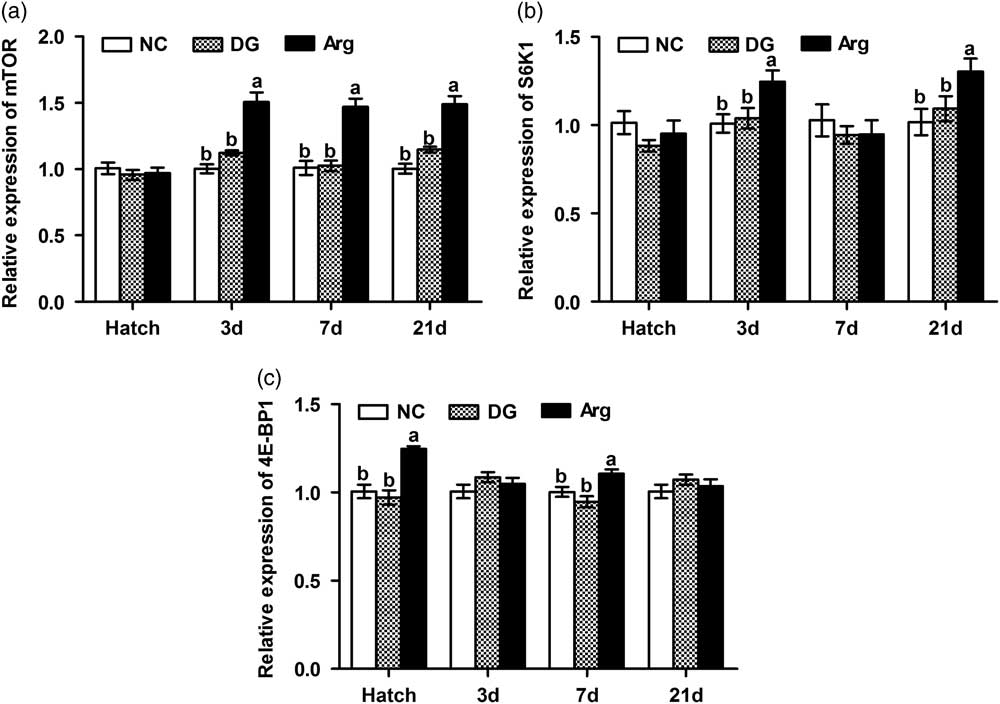
The effects of IOF of Arg on the mRNA expressions of mTOR, ribosomal protein S6 kinase-1 (S6K1) and eIF4E-bindingmprotein-1 (4E-BP1) in breast muscle of post-hatch broilers are shown in Figure 1. In ovo feeding of Arg increased mTOR mRNA expression at 3-, 7- and 21-day post-hatch, and improved S6K1 mRNA expression at 3 and 21 days as well as 4E-BP1 mRNA expression at hatch and 21-day post-hatch compared with those of control groups (P<0.05).
Effects of in ovo feeding of l-arginine on the messenger RNA expressions of mammalian target of rapamycin (mTOR, a); ribosomal protein S6 kinase-1 (S6K1, b); and eIF4E-bindingmprotein-1 (4E-BP1, c) in breast muscle of broilers at hatch, 3-, 7- and 21-day post-hatch. Values represent the mean value±SE (n=8). d=days; NC=non-injected control group; DG=diluent-injected group (7.5 g NaCl dissolved in 1 l sterile distilled water); Arg=l-arginine solution-injected group (10 g Arg dissolved in 1 l diluent). a,bMeans in a row without a common superscript letter significantly differ (P<0.05).

Discussion
It has been reported that IOF of nutrients could accelerate neonatal chick development and especially breast muscle growth. Uni et al. (Reference Uni, Ferket, Tako and Kedar2005) reported that IOF of carbohydrates and β-hydroxy-β-methylbutyrate (HMB) in amnion at 17.5 days of incubation increased relative breast muscle size by 6% to 8% over controls, and this weight advantage was sustained until 25-day post-hatch of broilers. Kornasio et al. (Reference Kornasio, Halevy, Kedar and Uni2011) demonstrated that injecting a solution of carbohydrates and HMB in the amniotic sac of the embryo several days before hatch increased breast muscle weight until 35-day post-hatch compared with control birds, which had a long-term supportive effect on breast muscle growth. l-arginine is an essential AA for poultry and serves as a precursor for synthesis of protein, nitric oxide, creatine, polyamines, agmatine and urea, which plays a critical role in metabolic pathway associated with growth (Wu et al., Reference Wu, Bazer, Davis, Kim, Peng, Rhoads, Satterfield, Smith, Spencer and Yin2009). Many studies indicated that diets supplementation with Arg could improve muscle development in animals (Tan et al., Reference Tan, Yin, Liu, Li, Xu, Kong, Huang, Tang, Shinzato, Smith and Wu2008; Fernandes et al., Reference Fernandes, Murakami, Martins, Sakamoto and Garcia2009). In ovo feeding of Arg could increase the BW of ducks at hatch and 7-day post-hatch (Tangara et al., Reference Tangara, Chen, Xu, Huang and Peng2010), which is similar to the results of Gao et al. (Reference Gao, Zhao, Zhang, Li, Yu, Lv, Gao and Zhou2017) that in ovo injection with 1% Arg could increase chick BW at 7- and 21-day post-hatch and there was no difference in hatchbility between 1% Arg and control groups. The Arg supplementation could improve muscle growth, which is not only related to enhancement of energy status for alleviating the degradation of skeletal muscle, but connected with hormone release for regulating nutrient metabolism in broilers (Foye et al., Reference Foye, Uni, Mcmurtry and Ferket2006b; Wu, Reference Wu2009; Yu et al., Reference Yuan, Ding, He, Azzam, Lu and Zou2017). In accordance with previous reports (Foye et al., Reference Foye, Uni, Mcmurtry and Ferket2006b; Tangara et al., Reference Tangara, Chen, Xu, Huang and Peng2010), our present results demonstrated that IOF of Arg at 17.5 days of incubation increased significantly relative breast muscle weight at hatch, 3-, 7- and 21-day of post-hatch. In addition, blood plasma metabolites provided some evidence on growth performance of broilers. The TP is a common parameter utilised to estimate the avian body condition; and albumin, one of the main blood proteins, serves as the favourable source of AA for synthesis of muscle protein in period of quick somatic growth of broilers. Broilers with larger BW have a higher concentration of serum TP (Corzo et al., Reference Corzo, Moran, Hoehler and Lemmell2005). The increasing TP and albumin concentrations are possibly related with high AA demands which supported subsequent growth performance of birds. Emadi et al. (Reference Emadi, Kaveh, Bejo, Ideris, Jahanshiri, Ivan and Alimon2010) found that dietary Arg improved growth performance and plasma parameters, especially albumin concentration. In ovo feeding of Arg in our present study also resulted in improvement in blood plasma TP and albumin concentrations at 3- and 21-day post-hatch broilers. There was little effect on plasma AST and ALT concentrations. It is suggested that IOF of Arg may serve as a positive method for promoting plasma metabolism which supported breast muscle growth in early post-hatch broilers.
l-arginine could stimulate the release of pituitary and pancreatic hormones, including glucagon, insulin and growth hormones, which in turn could increase protein synthesis and growth performance (Foye et al., Reference Foye, Uni, Mcmurtry and Ferket2006b; Tan et al., Reference Tan, Yin, Liu, Li, Xu, Kong, Huang, Tang, Shinzato, Smith and Wu2008; Wu, Reference Wu2009). Kim and Wu (Reference Kim and Wu2004) reported that dietary supplementation with 0.4% Arg increased plasma concentrations of insulin and growth hormone by 24% to 27% in piglets compared with controls. In addition, IOF of Arg and HMB also enhancs IGF-I and IGF-II levels at the day of hatch in comparison to the controls, which parallels the improved BW gains through 14-day post-hatch (Foye et al., Reference Foye, Uni, Mcmurtry and Ferket2006b). Moreover, hormones play a potential role in affecting skeletal muscle in broilers (Chen et al., Reference Chen, Lv, Zhang, Ruan, Wang and Lin2013) and the effect of IOF of Arg on thyroid hormones levels is little reported in post-hatch broilers. Studies performed in chicks have shown that there was a sharp rise in T3 and T4 levels during the final stage of avian embryos as well as an increasing in T3 and T4 levels with aging in post-hatch chicks (Reyns et al., Reference Reyns, Venken, de Escobar, Kühn and Darras2003; Lu et al., Reference Lu, McMurtry and Coon2007). Lu et al. (Reference Lu, McMurtry and Coon2007) suggested that thyroid hormones appear to be critical in stimulating developmental and metabolic processes necessary for normal growth and development during chick embryogenesis. In addition, T3 and T4 could regulate protein metabolism and the expression of many genes involved in cell proliferation and differentiation which promoted subsequent body growth of animals (Decuypere et al., Reference Decuypere, Van, Van and Darras2005; Chen et al., Reference Chen, Lv, Zhang, Ruan, Wang and Lin2013). Thus, IOF of Arg increased T3 and T4 concentrations in plasma of post-hatch broilers, which might be responsible for promoting breast muscle growth of birds in our study.
Skeletal muscle is the largest reservoir of both protein and AA in poultry. The concentration of AA in breast muscle has been suggested as an index for protein deposition (Liu et al., Reference Liu, Li, Kong, Tan, Li, Duan, Blachier, Hu and Yin2015). As presented in our experiment, IOF of Arg solution increased AA concentrations of breast muscle at hatch, 7- and 21-day post-hatch of broilers. During the final stage of incubation, the concentrations of some AA, such as glycine, proline, lysine and arginine, do not meet the requirements of embryo (Shafey et al., Reference Shafey, Mahmoud, Alsobayel and Abouheif2014). If there is a shortage of a particular AA, others are wasted. Thus, the injection of some adequate AA may improve AA utilisation to maximise the potential growth and meat yield of poultry (Ohta et al., Reference Ohta, Tsushima, Koide, Kidd and Ishibashi1999; Tahmasebi and Toghyani, Reference Tahmasebi and Toghyani2016). Ohta et al. (Reference Ohta, Kidd and Ishibashi2001) suggested that in ovo administration of AA increased AA concentrations in chicken embryos and other egg contents, which might be associated with a better utilisation of AA by the embryos (Ohta et al., Reference Ohta, Tsushima, Koide, Kidd and Ishibashi1999 and Reference Ohta, Kidd and Ishibashi2001). Some studies have pointed out that diet supplementation or IOF of Arg increased plasma arginine, proline and leucine concentrations in animal (Kim and Wu, Reference Kim and Wu2004; Gao et al., Reference Gao, Zhao, Zhang, Li, Yu, Lv, Gao and Zhou2017), which might associated with improving AA utilisation. Moreover, previous studies indicated that Arg supplementation improved intestine development and digestive and absorptive activity for increasing AA concentrations by upregulating the nutrient transport and brush border enzymes in birds (Foye et al., Reference Foye, Ferket and Uni2007; Tahmasebi and Toghyani, Reference Tahmasebi and Toghyani2016; Gao et al., Reference Gao, Zhao, Zhang, Li, Yu, Lv, Gao and Zhou2017). In addition, Foye et al. (Reference Foye, Ferket and Uni2007) demonstrated that IOF protein in combination with the free AA arginine and the leucine metabolite, HMB, enhanced jejunal alanine uptake, which enhanced activity of all intestinal AA and peptide transporters. In addition, embryos may utilise exogenous AA to increase energy status and save muscle protein from mobilisation for improving AA concentrations in muscle (Foye et al., Reference Foye, Uni, Mcmurtry and Ferket2006b; Tangara et al., Reference Tangara, Chen, Xu, Huang and Peng2010). It is suggested that IOF of Arg could improve the concentrations of AA by improving AA utilisation efficiency and the digestive and absorptive capacity to provide energy in post-hatch broilers.
Muscle growth depends on the balance between protein synthesis and degradation. The elevation of AA level in breast muscle not only serves as a source of protein, but also as a activator for regulating gene expression of mTOR pathway, such as leucine, glutamine and Arg (Wu, Reference Wu2009; Deng et al., Reference Deng, Zheng, Liu, Chang, Zhang and Cai2013). It is well known that the mTOR, a highly conserved serine/threonine protein kinase, is a major regulator of mRNA translation in muscles (Deng et al., Reference Deng, Zheng, Liu, Chang, Zhang and Cai2013). Activated mTOR phosphorylates two downstream target proteins: S6K1 and 4E-BP1, resulting in initiation of protein synthesis (Wu, Reference Wu2009). l-arginine, as an AA essential of broilers, is one of the key activators of mTOR via the TSC/Rheb signalling axis, it can suppress lysosomal localization of the TSC complex and interaction with its target small GTPase protein, Rheb (Carroll et al., Reference Carroll, Maetzel, Maddocks, Otten, Ratcliff, Smith, Dunlop, Passos, Davies and Jaenisch2016). Studies conducted in vitro and in vivo indicated that Arg played an important role in activating mTOR cell signalling pathway in skeletal muscle to enhance protein synthesis and whole body growth (Yao et al., Reference Yao, Yin, Chu, Liu, Deng, Li, Huang, Zhang, Tan and Wang2008; Wu et al., Reference Wu, Bazer, Davis, Kim, Peng, Rhoads, Satterfield, Smith, Spencer and Yin2009; Ham et al., Reference Ham, Caldow, Lynch and Koopman2014). Yao et al. (Reference Yao, Yin, Chu, Liu, Deng, Li, Huang, Zhang, Tan and Wang2008) demonstrated that dietary supplementation with Arg could activate mTOR signalling pathway in skeletal muscle of neonatal pigs. Kong et al. (Reference Kong, Tan, Yin, Gao, Li, Jaeger, Bazer and Wu2012) indicated that addition of 100 and 350 μM Arg to culture medium-dose dependently increased the abundance of total and phosphorylated mTOR, p70S6K and 4E-BP1 proteins of porcine placental cells. In the present study, IOF of Arg increased the mRNA expression of mTOR, S6K1 and 4E-BP1 in breast muscle of post-hatch broilers. This finding is in agreement with the results of Yuan et al. (Reference Yu, Gao, Zhao, Lv, Zhang, Li, Jiang, Gao and Zhou2015), who reported that supplementation of 100, 200 or 400 μM Arg to culture medium increased the mRNA abundances of mTOR, 4E-BP1 and S6K1, thus increased protein synthesis and reduced protein degradation of chicken intestinal epithelial cells. It is suggested that Arg might involve upregulating the gene expression of mTOR signal pathway for stimulating protein synthesis in breast muscle.
In conclusion, the results of the present investigation indicated that IOF of 0.6 mg Arg/egg solution at 17.5 days of incubation could increase metabolite and hormone concentrations in plasma as well as the mRNA expressions of mTOR pathway in breast muscle, which may contribute to improve protein deposition and subsequent breast muscle growth in broilers. These findings could provide a mechanism for explaining the previous observation that IOF of Arg enhanced poultry growth.
Acknowledgements
This study was funded by the National Natural Science Foundation of China (no. 31572425), the National Key Research and Development Program of China (no. 2016YFD0500501) and the Three Agricultural Projects of Jiangsu Province of China (no. SXGC (2017) 281).
Declaration of Interest
The authors have declared that no competing interests exist.
Ethics statement
This study was approved by the Institutional Animal Care and Use Committee of Nanjing Agricultural University, Nanjing, China.
Software and data repository resources
All relevant software and data are within the paper and its supporting information files.
Supplementary material
To view supplementary material for this article, please visit https://doi.org/10.1017/S1751731118000241