The earthquake, tsunami, and nuclear power plant (NPP) disaster in Japan in March 2011 was a unique situation. It resulted in massive regional infrastructure damage and required a level of real-time incident management not previously seen in other nuclear or radiological disasters. Based on our experiences and observations during the response,Reference Coleman, Simon, Noska, Telfer and Bowman1, Reference Simon, Coleman, Noska and Bowman2 we propose integrating a medical decision model for planning, exercising, and supporting the management of a NPP or other large-scale radiation emergency should one occur in the United States. This functional approach could be applicable to other types of disasters, and is compatible with the Incident Command System framework.3
The basis of response to a disaster is to take immediate action as necessary to save lives, protect property and the environment, and meet basic human needs.4 Recovery begins simultaneously but can continue for months or years, as is seen in Chernobyl where recovery efforts continue after more than 25 years. The National Disaster Recovery Framework identifies several core principles for recovery, including leadership and local primacy, public information, timeliness and flexibility, resilience and sustainability, and psychological and emotional recovery.5 All of these elements support the integration of a medical decision model, which involves providing data and recommendations to decision makers so that they can make, implement, and communicate timely decisions that have direct impact on the well-being of residents and their ability to recover from the disaster.
The approach we recommend is based on the following premises:
1. The overriding concern is for the well-being of the potentially affected population, which requires a valid ongoing assessment of all actual and potential health and medical consequences.
2. Radioactive releases and some expectation regarding the radionuclide content released can be predicted from ongoing assessment of the physical damage to and radiation emissions from the NPP.
3. Risk for long-term health consequences from radiation exposure and the environmental impact of any radioactive releases can be roughly projected from radiation measurement data, mindful of uncertainties related to the general health status of the population and the exposure conditions.
4. The paradigm of medical decision making used in emergency medicine can support incident management by providing timely decisions using on-site subject matter experts based on the best available information as it emerges and by modifying the course as new information is acquired. It is in contrast to a deliberative multistep and time-consuming decision-making process that depends on the greater degree of certainty when more of the outcome is known. While using experts and committees for consultation and advice, the medical decision model differs by having on-site decision makers empowered to make interim decisions and on-site experts making time-critical decisions and refining the course based on the data available.
5. Timely and understandable presentation of ongoing decisions, risk assessment, and the incident management strategy enhances public comprehension of the incident and accompanying risks as well as confidence in authorities.
6. Community resilience is a key goal: “A resilient community is not only prepared to help prevent or minimize the loss or damage to life, property and the environment, but also it has the ability to quickly return citizens to work, reopen businesses, and restore other essential services needed for a full and swift economic recovery.”6
These decisions are not hasty but informed, and they are made without excess debate and are revised as situational awareness evolves and new data are acquired. As in managing medical illnesses, not to make a decision and to continue an existing course is to make a decision.
Background
The Fukushima Disaster
The March 2011 disaster in Japan involved an earthquake and tsunami that massively disrupted local infrastructure including extensive damage to a NPP facility, a situation originally thought to be extremely unlikely.Reference Piore7 More than 15 000 lives were lost, thousands were missing,8, Reference Ohnishi9 and hundreds of thousands more were disrupted locally and throughout the country by the combined sequential phenomena. Deaths at and outside of the Fukushima Daiichi NPP were due to the earthquake and tsunami and not to radiation exposure.
Japan's emergency responders were overburdened with response to the 3 crises; a large number of the population had lost their homes and been dislocated; and fear and uncertainty were prevalent throughout Japan and elsewhere. Experts in various technical fields from Japan, the United States, and around the world worked to understand and mitigate the consequences of actual and potential releases of radioactive material. The United States activated emergency response assets to ensure the safety of American citizens both in Japan and elsewhere.
Numerous important and time-sensitive decisions to protect the health of the public had to be made based on the best available information, with the recognition that it was far from complete. The public health response to the NPP involved sheltering, evacuation, interdiction of food and water, radiation measurement, medical countermeasure use, risk assessment, and managing exclusion zones. The health and safety of the Japanese residents were guided by the Japanese; however, citizens of the United States were guided by US recommendations. The use of different recommendations10-13 caused confusion among the public.
Decisions about the health-related consequences resulting from the NPP encompassed more than just the potential risk from the radiation, which dominated the media and public discourse. Also considered were risks associated with evacuation and public relocation, the impact on physical and mental health from disruptions to normal life, economic losses, and the ongoing anxiety of living through a widespread physical and economic disaster.Reference Bromet, Havenaar and Guey14, Reference Chandra, Costa and Meredith15
Rationale for the Proposed Medical Decision Model
The authors’ experiences from the US response to the Fukushima NPP closely paralleled the decision-making steps conducted in medical management, particularly in making decisions promptly, as is often necessary in emergency medicine and oncology. In a catastrophic medical occurrence such as a sudden collapse of a person, interventions are required expeditiously. A “cardiac arrest working group” is not convened to discuss treatment options for the injured. Rather, treatment is administered immediately, based on the best information available at that time, experience, and knowledge-based algorithms,16 and follow-up care is based on the examination of more data when available. As the situation stabilizes, further consultation can occur.
Oncology management is also an excellent analogy for disaster management, particularly one that involves a release of radiation. The risks and benefits of radiation and other potentially carcinogenic treatments are a consideration, and management of the bone marrow component of the acute radiation syndrome is similar to that for oncology. The competing risks of efficacy and toxicity are evaluated on the patient's overall medical condition, the properties of the tumor (not all of which will be immediately known), and current scientific data; and a course of action is selected to avoid tumor growth and dissemination.Reference Coleman17 Working closely with patients and their families, physicians develop a treatment plan, initiate it in a timely manner; monitor its effectiveness, and modify its course as appropriate.
The concerns of the individuals and families, the reliance on expertise, the need to communicate complex scientific and medical concepts, and the need to make decisions immediately based on the data available at the time and to modify those decisions as the situation evolves are the same elements used in the response to a NPP accident. The model that is effective in the medical situation can be equally applicable to support management of the disaster.
Us Federal Response
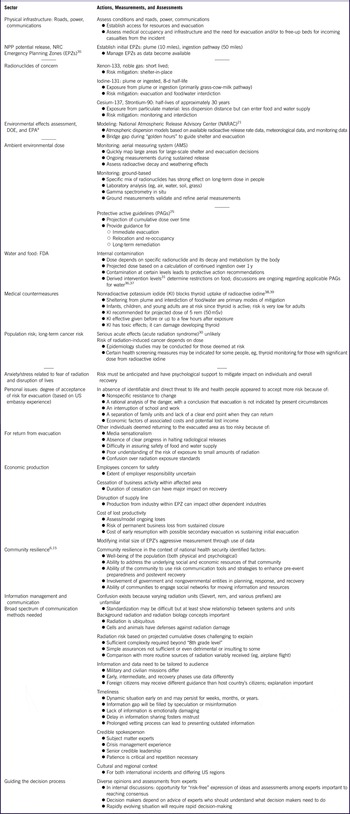
The US response to disaster uses a chronological framework of early, intermediate, and late phases to describe its evolution, with some intermediate and late phase activities identified as beginning in the early phase.18 A broad range of expertise is available for a US federal response, as described in the National Response Framework.18-34 The Table describes the federal response by sector and the actions, managements, and assessments required to manage the incident.
Sectors Requiring Management by Decision Makers for a Nuclear Power Plant (NPP) Incident

Abbreviations: DOE, Department of Energy; EPA, Environmental Protection Agency; NRC, Nuclear Regulatory Commission.
Data and Decisions
Initial assessment of physical damage will be available promptly and refined as detailed inspections occur. The Nuclear Regulatory Commission (NRC) requires that NPPs have 2 preplanned emergency planning zones (EPZs), a plume EPZ of 10 miles and an ingestion pathway EPZ of 50 miles. Their configuration and plans are specific to the location and circumstance of the incident.35 The NPP licensee is responsible for assessing the physical state of the reactor(s) and spent-fuel pools and mitigating the consequences of the incident in accordance with its NRC-mandated emergency plans.40
Analogous to the “golden hour” for medical care, radiation professionals can help minimize the dose to a population during a NPP crisis if they know where and when radioactive material is likely to spread from an environmental release. Because deploying field teams and making measurements take time, the Department of Energy bridges the gap during these golden hours by providing high-fidelity atmospheric dispersion modeling based on the best available radiological and meteorological data.21
The meteorological projections and the radionuclide dispersion models are followed by aerial measurements to gather environmental data quickly over large areas. These aerial measurements are supplemented, as conditions permit, by ground-based monitoring to confirm aerial measurements and identify the specific mix of radionuclides, which is critical to estimating the long-term dose to people. The Environmental Protection Agency's (EPA) protective action guidelines (PAGs) suggest precautions that state and local authorities can take during a radiation emergency based on the projected amount of radiation that might be received.25, 36, 37 The projected doses derived from measurements can be used to help determine the time people can spend in an area. Sufficiently high projected doses may require the relocation of a population.
Because a radiological release may contaminate food and water supplies, decision makers will also need to determine when to instruct the population to limit consumption. Although a single measurement of radioactivity in food or water could be used to provide a risk estimate, it would be highly uncertain and not necessarily representative; hence, serial measurements would more accurately validate the initial estimate and provide a more precise assessment of the likely dose and the potential risk.Footnote i The US Food and Drug Administration's derived intervention levels guide decisions about food;31 discussions regarding water protective action guidelines are ongoing.36, 37
In the early phase of an NPP release, a major radiation health issue is the potential inhalation of radioactive iodine from the plume or ingestion of radioactive iodine in contaminated food and water. Sheltering, evacuation, and interdiction of possibly contaminated food and water are the primary responses to prevent internal exposure. Individuals at sufficiently high risk from internal contamination with radioactive iodine may be advised to take stable (nonradioactive) potassium iodide (KI) to reduce thyroid gland uptake of radioactive iodine.38, 39
Radiation-Induced Cancer Concerns
The issue of greatest concern expressed both worldwide and in Japan was the risk of cancer induction caused by radiation exposure. The concept of radiation riskReference Land41-43 is often poorly understood because of confusion between short-term and long-term health effects and the magnitude of exposure required to produce each. While symptoms such as nausea and vomiting may occur at a dose of 0.75 Gy, the more serious acute health effects occur after relatively high exposures (>2 Gy),24 and the type and severity depend on the dose received. While NPP workers may be exposed to levels high enough to produce acute effects, the exposure from a NPP incident to members of the public at levels sufficient to produce such effects is unlikely and did not occur in Japan. Long-term effects are uncertain but may increase the chance for the development of cancer (or other health conditions) in later years.Reference Hall and Giaccia44, Reference Christodouleas, Forrest, Ainsley, Tochner, Hahn and Glatstein45 Although extensively debated, most current radiation risk models conservatively assume that any radiation exposure increases the lifetime risk of developing cancer.43, 46 For the vast majority of people potentially affected by an NPP, increase in their life-time risk will be extremely small and undetectable above their background life-time cancer risk. Simon etalReference Simon, Bouville and Land47, Reference Coleman, Adams and Adrianopoli48 and Gilbert and colleaguesReference Gilbert, Land and Simon49 discuss in detail the health risks from radioactive fallout.
Stress and Resilience
Based on experience from the Chernobyl incident, stress-related illness is another anticipated outcome for the affected population.Reference Bromet, Havenaar and Guey14 For US citizens who are in Japan or planning to travel there for business and education, travel warnings 50 can limit their ability to be there, creating stress for individuals and families. (Travel alerts provide a warning but more flexibility.) Based on observations in Japan, risk acceptance may vary markedly among individuals, with a very high level of concern shown particularly by women with young children.
Community resilience depends on preparation and the ability to minimize the effects of the disaster and respond to and move on afterward.Reference Chandra, Costa and Meredith15 Minimizing disruption to everyday life and returning individuals to their daily lives are key features of resilience.6, 51 Returning to work, reopening businesses, and restoring essential services are needed. However, economic recovery in the postdisaster period will be determined by the degree to which local radioactive contamination impedes public acceptance of the living and working conditions and products produced there. As radiation levels decline and industries within an EPZ consider resuming activity, complex issues emerge regarding personal risk to employees and responsibility of employers to protect their workers (M.A., oral communication, September 2011).
During the crisis, a good deal of information was available from various forms of media (eg, the media and Internet sources). Much of it was inaccurate; some provided opinion or overly simplistic explanations or exaggerated the situation, all of which can add to stress and reduce resilience. Given the complexity of the incident and the limited information available, this was not unexpected. To minimize misinformation and unnecessary concern or anxiety, messages need to be as factual and timely as possible. The means of communication and use of language can differ substantially by culture, and it is important to understand such differences. While the government may issue recommendations or mandates, families need to be able to evaluate that information and interpret it according to their beliefs and risk tolerance.
Communicating information about radiation and risk is challenging, as it requires complex, yet timely, nuanced discussions to convey concepts simply and adequately. Issues of radiation-related health effects and risk, public fear of radiation, polarization of opinion regarding nuclear power, sensationalism by the media, and a rapidly changing situation based on an array of data make a nuclear incident among the most complex for leadership and decision making. In Japan, the US embassy used multiple forms of communication that reinforced consistent messages. In-person sessions and discussions for US citizens were supplemented by extensive use of social media and embassy website resources. Having expert spokespersons who could present information, listen to concerns, and clarify issues—as physicians do in patient management—was reassuring during the rapidly evolving situation. The complexity of both the evolving situation and the decisions to be made makes clear and timely communication with the public critical to improve resilience for individuals and the community.
Application of The Medical Decision Model Within US Response
Guiding an emergency response requires the simultaneous consideration of a range of issues, some based on objective measurements (eg, contamination levels) and others on subjective evaluation of consequences (eg, need for voluntary evacuation). Crises that are extended in time tend to be dynamic; thus, we propose using a medical decision approach to support effective incident management. This approach empowers decision makers to manage health consequences promptly through informed choices based on on-site, readily available expert input, with additional experts accessible when needed, to assist in the analysis of the data available at the time and in longer term planning.Footnote ii
Progress toward a “new normal” can be achieved by basing the decision to implement 1 of 3 possible choices at each decision-making juncture on real-time data: (1) stop; (2) proceed with caution; or (3) return to normal operating procedures. An important element of this process reflects the dynamic nature of the crisis; a decision made at one point in time will be reviewed and can be modified as more data become available.
Decision Model
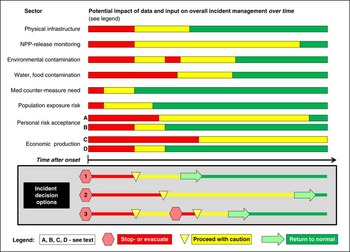
The Figure is a conceptual chart of how a NPP incident might unfold over time. Decision makers will need to simultaneously assess the range of issues and guide overall response supported by continual expert input.
Using a Medical Decision-Making Model to Support Incident Management of a Nuclear Power Plant Disaster. During the response, conditions in the different sectors over time can cause the overall progression to normal (or to new normal) to stop (red stop sign and bar), based on data that indicate a serious risk of harm. As the situation improves, indications for stopping will no longer be present for various sectors, so some may begin normal activity, which may require a period of caution (yellow caution triangle and bar) if manageable risk remains. The box illustrates 3 incident decision options.

For some sectors, guidance on the appropriate level of precaution will be derived by the inflow of data on infrastructure functionality, radioactivity release, and contamination of the environment. In general, data available in each sector will improve over the phases of response; however, the changing status of environmental contamination shows how an initial change in status (red to yellow) might temporarily stop (back to red) based on newly received data and then resume again with caution (yellow).
There will be situations in which recommendations from experts or guidelines from agencies may differ, as occurred between International Commission on Radiological Protection (ICRP) and EPA radiation exposure guidelines. The medical decision-making model proposed is particularly useful, as the decision maker would discuss the different opinions and options available and then select a series of next steps. Analogous to the primary care physician and patient coming to a decision after collecting and reviewing various expert opinions is the community and its leadership deciding on the risks, benefits, and timing for returning and rebuilding. The EPA protective action guidelines provide guidance to the local decision makers, as this is a local decision.25, 26
The two bars for personal risk acceptance illustrate how different individuals might interpret the same situation. Bar A is a very conservative, risk-averse approach, while bar B indicates that more risk would be acceptable. For economic production, bar C indicates an area that remains shut or limits activity due to a very conservative approach to resuming operations or to more widespread concern of a “funtional quarantine” of products from the impacted area. Bar D is a more aggressive approach to returning toward normal, with resumption of activities as soon as possible. Bar D assumes very small risk, with the idea that prolonged shut down could have serious and possibly permanent economic consequences for the people, region, and country. For all 4 bars, ongoing monitoring would be needed to provide continuing assessment.
In the Figure, the box of Incident Decision Options shows 3 ways in which the same overall incident decisions could be managed. Option 1 would be a more aggressive return toward normal; the overall activity would go from stop (red) to cautionary return (yellow) when all of the absolute indications for stopping had passed. While stop (bars A and C) may apply to some people or businesses, and some aspects of the economy would maintain a red condition (interdiction of food supply in a limited region), the overall restrictions would be reduced. This process would lead to a more rapid return to familiar life and the new normal.
Option 2 takes a very conservative approach and sustains the red condition much longer, until uncertainty is less. This approach would have a greater negative effect on business, family life, routine activities, and a sense of the new normal. Option 2 might possibly produce severe long-lasting impact to a region, such as permanent loss or relocation of businesses and other activities and long-term anxiety or stress from prolonged periods of caution.
Option 3 employs a more rapid return toward normal and, as in option 1, accepts the possibility of a return to a more restricted state if the situation deteriorates. The option of a return from evacuation with the possible need for a subsequent repeated evacuation might seem costly. However, this approach might aid the resumption of routine function and progress to the new normal. Option 3 might be much less expensive to public and regional well-being than a sustained state of emergency and might prevent a permanent loss of some industries.
Discussion
Experience during the Fukushima NPP crisis demonstrated the challenge of decision-making before knowing the final outcome of the incident. Waiting until the consequences are fully defined prolongs the emergency period and delays the development of a new normal set of living conditions. Postdisaster incident management has important similarities to emergency medical management or medical management of a potentially rapidly fatal disease such as cancer, in which decisions must be made on the best available information, the consequences are carefully evaluated, and the treatment course is continued or modified as appropriate. The process of reevaluation and adjustment may be repeated numerous times. While some extended consultation may be possible, waiting to make a decision until an outcome is certain, reviewed, and approved may result in a decision that is not effective, timely, or useful. The medical management approach is consistent with Department of Defense crisis action planning, a component of adaptive planning in which decisions must be made within hours.52 The US Incident Command System3 and the present model both emphasize the importance of decision-making at levels as close to the incident as possible.
Clinicians, particularly those operating in emergency conditions, have to make the best possible decisions for their patients using incomplete information. This process contrasts with scientific and political decision-making, which requires debate, review, revision, and generally committee discussion and consensus. Yet even in these spheres, the importance of using data to inform policy is recognized. Sunstein argues that decision makers need to recognize the cognitive limitations to which they are subject—particularly reliance on the availability heuristic (which leads to overestimating risk) and neglect of probability (which causes data to be ignored when strong emotions are triggered). To counter these limitations, he recommends relying on quantitative assessments to determine the magnitude of the problem, recognizing trade-offs, and exploring alternatives that may meet the same goal with lower costs and fewer risks.Reference Sunstein53
Effective leadership requires an understanding that criticism of early decisions may be inevitable, but that inaction may equally result in criticism and in inadequate protection of those in need. Moreover, inaction may also be perceived as a decision. The medical decision model requires that decision makers be fully empowered to make timely choices. In a rapidly evolving situation, science and communication advisors and decision makers must be able to think like clinicians and, through timely discussion and exchange of ideas, formulate decisions on the best data available at the time.Reference Coleman, Simon, Noska, Telfer and Bowman1, Reference Simon, Coleman, Noska and Bowman2 Having expertise available at the “command center” facilitates the exchange of information and the formulation of a plan of action.
This medical decision-making approach fits within the National Disaster Recovery Framework4, 5, 18 by bringing together decision makers, subject matter experts, and communication experts at the incident scene. Enhanced communication and confidence building occurs when people physically work together in challenging situations. This situation allows for dialogue and understanding the subtleties and nonverbal communication that are not conveyed in formal reports. As with medical care, camaraderie among physicians, patients, and families allows for deeper appreciation of the issues and confidence that the best is being done at the time, while reserving the willingness to change as the situation warrants. There is often no single right course, and the reach-back expertise from working groups and agencies can inform local decision makers about more global issues. Having this expertise on-site would more likely be viewed as an integral part of a team approach rather than as recommendations from people distant from the action.
Conclusions
The combined tragedy in Japan was a unique experience in terms of its severity and complexity, yet sophisticated technology was available to monitor the ongoing situation. Based on our observations in assisting with the US response, we propose a medical decision-making model for use in managing incidents involving radiation. This model would also be applicable to large-scale and large-consequence disasters, in which risk is assessed, managed, and mitigated in a timely manner based on the available information as it emerges, so that inaction does not cause harm. Months or years may pass before the full impact of an incident is known, yet real-time decisions need to be made based on the best available data. The incident management process is best done by on-site decision makers empowered to make interim decisions along with on-site experts, so that the decision-making team has a sense of local community needs, the uncertainties of the information, the rate of evolution of the incident, and the ability to communicate their recommendations and the rationale for them directly with each other. We do not recommend hasty decisions; rather we recommend that informed decisions be made without excess debate, allowing for revisions as situational awareness evolves and new data are acquired. As in clinical medicine, not to make a decision and continue a course is to make a decision. To assist and enable decision makers, science, communication, and policy advisors will have to think and act like clinicians. Such an approach may allow resumption of functions and a new-normal life sooner and enhance the sense of resilience6, 18 to a community whose functionality may be severely compromised in many ways by the crisis.
Disclaimer
The opinions and conclusions in this paper are those of the authors and subject matter experts. This is not the opinion, policy or conclusions of the US Government or any of its agencies.
Acknowledgments
Nicole Lurie, MD, MSPH, Assistant Secretary for Preparedness and Response (ASPR), provided leadership and support of the health and medical team in Japan and contributed key insights and suggestions for this new conceptual model. Many members of the US embassy staff in Tokyo who underwent a very challenging set of circumstances provided outstanding service, dedication, creative thinking, and effective leadership. Members of ASPR and the Secretary's Operations Center, Health and Human Services (HHS), especially Kevin Yeskey, MD, Thomas Sizemore, MD, Michael Vineyard for 24/7 mission support, and Lee Larson and Derek Estes, ASPR, created linkage with the Department of Defense Joint Operation Planning. Members of the Centers for Disease Control and Prevention (CDC) provided outstanding 24/7 support for the HHS team in Japan while managing complex issues within the United States. Rae T. Benedict, PhD, and Jeffrey Nemhauser, MD, CDC, provided editorial assistance. Alicia A. Livinski, National Institutes of Health library, provided editorial review and prepared the manuscript for publication.