1. introduction
The potential for transnational environmental crime (TEC) to result in the demise of an environmental resource or irreversible damage to the local and/or global environment makes prevention of this exploitation of the world’s finite natural assets a critical issue. The importance of TEC prevention intensifies when the implications of TEC for national and global security are taken into account.Footnote 1 However, law enforcement, by investigating crimes and arresting and prosecuting offenders, can only go so far in terms of TEC prevention. The rewards of the crime are in many cases so great, and the execution of the crime so uncomplicated,Footnote 2 that prospective offenders are not easily deterred, even if the penalties are severe. Moreover, the deterrence doctrine holds that the efficacy of law enforcement as a deterrent is largely dependent on the potential offender’s perception of punishment for the crime as certain, rather than the severity of the punishment.Footnote 3 This is because ‘enhancing the severity of punishment will have little impact on people who do not believe they will be apprehended for their actions’.Footnote 4 But punishment for environmental crime is anything but certain. One common criticism relating to the treatment of TEC is that it has been ‘woefully neglected’ by states,Footnote 5 with penalties set at far too low a level and enforcement against offenders often lax.Footnote 6
Furthermore, law enforcement is an expensive business. Even where good laws have been enacted to deal effectively with offenders, the difficulty of obtaining funding for salaries, training, equipment and deployment of law enforcement officers, not to speak of the associated infrastructure, can be a huge impediment to implementing those laws, particularly in developing countries.Footnote 7 Other impediments to effective law enforcement include cultural settings in which corruption is rife, institutions of criminal justice that do not regard TEC as a serious issue, poor cooperation among enforcement agencies, and practical problems such as the need to patrol vast areas.
If law enforcement alone is unable to deliver on TEC control, what else can be done?
There is a huge potential for third parties to be active participants, in parallel with governmental authorities, in crafting and implementing strategies to prevent TEC. The idea that whole-of-society responses are essential in this area is increasingly prevalent. In 2012, the United Nations Office on Drugs and Crime (UNODC) launched a new campaign, entitled ‘Transnational Organized Crime: Let’s Put Them Out of Business’, which specifically includes TEC.Footnote 8 UNODC points out that ‘[c]ombating a global phenomenon such as transnational organized crime requires partnerships at all levels. Governments, businesses, civil society, international organizations and people in all corners of the world have a part to play’.Footnote 9
This article explores the ways in which the capacities of third parties – non-state, non-offending actors – are now, and could be, harnessed by states for the prevention of TEC. Of course, it is not unusual for scholars to point out the need for environmental regulation that utilizes the capacities of both states and non-state actors.Footnote 10 However, this article’s contribution lies in drawing together concepts and theories from policing studies, criminology and regulatory studies in order to highlight the changing relationships between the state and non-state actors in relation to crime control, and applying them specifically to TEC. Moreover, it focuses on the role of the state as coordinator of public and private capabilities for achieving TEC prevention goals. The article builds on and goes further than some of the recent scholarship on TEC that has focused on the usefulness of a situational crime prevention approach as an alternative to traditional law enforcement methodologies. Situational crime prevention concentrates on the crime event rather than the offender, exploring how the situation or environment surrounding that event can be manipulated to close down opportunities for offenders as the crime progresses.Footnote 11 Studies of specific illegal markets in environmental commodities have described the essential steps in their trade and applied situational crime prevention techniques: for example, a study of the illicit trade in timber by Graycar and Felson,Footnote 12 and Wellsmith’s analysis relating to the illicit trade in wildlife.Footnote 13 Jacqueline Schneider’s recent book proposes a market reduction approach to the trade in endangered species, building on the foundation of situational crime prevention.Footnote 14 She details different crime scripts for various species (mammals, marine, plants and avian) and suggests various applications of situational techniques, including ways of increasing the effort and risks involved in engaging in these crimes. In this context, third parties are regarded primarily as useful sources of information that would enable law enforcement agencies or task forces to properly frame and understand the TEC problems they face and so to better target their responses. Others have explored a more proactive role for the local population in preserving natural assets such as wildlife.Footnote 15 However, ways in which governments could systematically catalyze the broad potential for third parties to contribute their own capacities in the pursuit of preventive outcomes have not been the focus of academic literature relating to TEC.Footnote 16
This article consists of a further five parts. The first (Section 2) addresses the changing role of the state and non-state actors in crime control over the last few decades. Governing ‘at a distance’ has led to a new emphasis on sharing responsibility for security. The article argues that, in order to get the best out of this sharing, coordination is needed, and that national governments are in the best position to undertake this role. Section 3 considers the identity and roles of third parties who can and do play a part in the prevention of TEC. Their possible roles, drawing on routine activities theory, could be as ‘handlers’ of potential offenders, ‘guardians’ of likely victims and ‘place managers’ or supervisors of crime settings. Going beyond the crime itself, third parties could also have roles that influence the social contexts or remote causes of crime: an example is given of the third parties that could have an impact on the illicit wildlife trade. Section 4 draws on regulatory theory to explore mechanisms that might be used to ensure that the positions, expertise and skills of third parties are employed for the purpose of prevention: examples are drawn from various areas of TEC, again with a particular focus on wildlife trafficking. In Section 5 some of the risks and difficulties associated with enlisting third parties as crime control partners and facilitating their crime control ventures are discussed. The article concludes in Section 6 with some thoughts about future directions for state action.
2. plural policing, third parties and the need for coordination
One significant feature of the ‘new regulatory state’ that has developed over the last few decades as neoliberalism has taken hold is an emphasis on ‘decentred, at-a-distance forms of state regulation’.Footnote 17 The implication for law enforcement is that police no longer have, nor do they claim, a monopoly on policing.Footnote 18 Policing has become multilateralized or pluralized.Footnote 19 This means that there is now an array of policing providers encompassing all sectors of society. The function of policing may be delivered not only by institutions of government, but also through government by private providers, above government by transnational policing providers, beyond government by commercial markets and below government by citizens themselves.Footnote 20 This burgeoning of policing providers has occurred hand-in-hand with the ‘responsibilization’ of non-state actors for their own security.Footnote 21
The state does not necessarily have a hand in the provision of these policing services, even as a patron. The numbers and the breadth of business of private security companies, for example, have grown enormously over the last few decades. In Western countries paid security providers easily outnumber the public police.Footnote 22 Often the first officer one sees upon entering a police force headquarters is a private security guard.Footnote 23 Other private entities – businesses, community groups and individual citizens – also contribute to law enforcement and the maintenance of public order both in partnership with the police and independently.Footnote 24
The potential for non-state actors, at whatever distance they reside from the state’s centre, to have a role in TEC prevention is therefore broad indeed. The advantages of using third parties for TEC control are beginning to be recognized. In recent widely reported remarks, the former United States (US) Secretary of State, Hillary Clinton, drawing attention to the rise in trafficking in endangered animal species, called for global partnerships ‘as robust and far-reaching as the criminal networks we seek to dismantle’.Footnote 25 She explained these partnerships in the following words:
Therefore, we need governments, civil society, businesses, scientists, and activists to come together to educate people about the harms of wildlife trafficking. We need law enforcement personnel to prevent poachers from preying on wildlife. We need trade experts to track the movement of goods and help enforce existing trade laws. We need finance experts to study and help undermine the black markets that deal in wildlife. And most importantly, perhaps, we need to reach individuals, to convince them to make the right choices about the goods they purchase.
The important message here is that the state cannot effectively act alone. The statement could also be taken to suggest, through reiteration of the words ‘we need’, that the state is in a central and crucial position in relation to these other actors. This view has merit. TEC prevention will have a better chance of ensuring that participants’ contributions are actively constructive towards the desired goal of prevention if there is some coordination of activities to that end, rather than just a bunch of random strategies employed by whoever has an idea (good or otherwise). National governments, acting alone and together, are a logical place for any coordinating function to be situated. Indeed, the call for a networked response to networked threatsFootnote 26 is already being taken seriously in relation to TEC. Networks of law enforcement agencies, both within states and between states, are becoming more common.Footnote 27 In fact, interagency approaches are fast becoming a regular feature of the broader response to transnational organized crime.Footnote 28 However, these networked responses are generally based on enforcement through top-down initiatives rather than prevention that makes use of the capacities of the myriad of social actors.
Of course, states may not always be willing or capable of coordinating crime prevention activities – indeed, weak or failing states may not be capable of tackling crime problems at all – in which case civil society and transnational institutions often do step into the breach and compensate for the state’s inadequacy in innovative ways.Footnote 29 For example, activist groups often partner with each other and with international organizations to collaborate on responses to TEC without any involvement by states. However, where governments do have the requisite willingness and capacity, their participation in a coordination role is likely to promote greater and more sustained national environmental and economic health. It is to this situation that this article is addressed.
3. the identity and roles of third parties
To harness the potential of third parties in relation to TEC prevention it is important to understand the essential steps – or crime scripts Footnote 30 – that comprise the commission of the various crimes that constitute TEC. Crime scripts vary from crime to crime and commodity to commodity. Understanding how a particular crime progresses ‘can help reveal those points where measures might plausibly be applied to optimize the preventive pay-off’.Footnote 31 It is at these ‘pinch-points for intervention’Footnote 32 that opportunities to disrupt or derail the crime will present themselves – a situational approach because it concentrates on manipulation of the crime event and not on the offenders. Generally situational crime prevention emphasizes what traditional law enforcement agencies can do to manage the situation by increasing the efforts and risks involved in the crime and reducing the rewards associated with it. But often it is third parties, not police or other law enforcement agencies, who will be on hand at these pinch-points to influence the course of the crime.
In the case of organized crime in the illegal wildlife trade, for example, a generalized five-step script has been identified from (1) poacher through (2) local courier, (3) national facilitator, (4) national exporter, to (5) receiver in the consumer country.Footnote 33 Of course, this script will vary depending on the product involved and the state of the market. A step may be missing or may merge with another. The advent of internet technology could be having the effect of ‘cutting out the middle man’ in illicit transnational transactions relating to wildlife. In the next section I identify possible third parties who could intervene at points along this generalized crime script, but first we need to consider what kind of roles such third parties could play.
The theory of situational crime prevention rests on opportunity theories: specifically rational choice theory, routine activity theory and crime pattern theory.Footnote 34 Routine activity theoryFootnote 35 is particularly useful for our purposes here because it reveals how third parties could play a role in crime prevention. The theory posits that ‘a crime is likely when an offender and a target come together at the same place, at the same time, and there is no one nearby to control the offender, protect the target, or regulate conduct at that place’.Footnote 36 With respect to particular transnational environmental crimes, third parties clearly have enormous potential to be controllers of crime – ‘handlers’ (supervisors or other influences over potential offenders), ‘guardians’ (protectors of victims) and ‘place managers’ (regulators of settings where TEC is committed). Their intervention at the pinch-points within crime scripts to prevent crimes and protect victims (who in the case of TEC are not necessarily human) may be proactive but may often be passive. Capable guardianship, for instance, might require nothing more than simply being there.
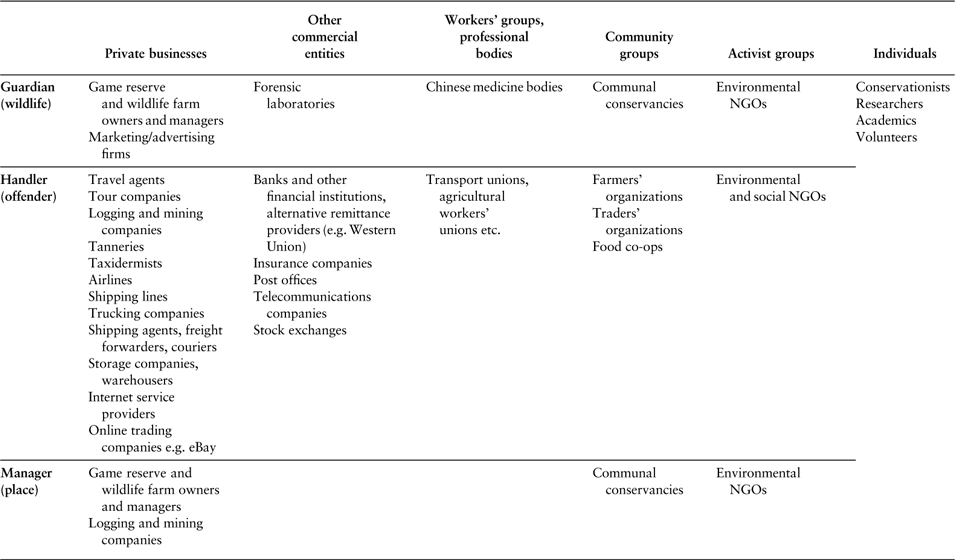
Table 1 below lists potential third parties in relation to the illicit trade in wildlife. No doubt this list is not comprehensive and more parties could be added. A similar list could be created for any form of TEC, and overlaps would be observable. For instance, transport, warehousing and financial parties are likely to crop up in the lists of third party actors for any TEC. In this table, third parties have been divided into ‘guardians’, ‘handlers’ and ‘managers’, although some third parties appear in more than one category. For example, private game reserve owners and managers are wildlife ‘guardians’ – many organize patrols to protect the animals on their reserves, and some have taken measures to make their animals less valuable to poachers by, for example, dehorning rhinoceros or injecting their horns with an indelible dye. But reserve managers are also ‘place managers’ in that they can act to reduce the opportunities for poaching, for example, by fencing their properties. Logging and mining companies may be ‘handlers’ in situations where their employees are tempted to engage in poaching (for sustenance, perhaps) by providing the workers with regular supplies of protein or the salary to purchase this themselves.Footnote 37 These extractive industries may also be ‘place managers’, for instance, by ensuring that the access roads they build are not accessible to, and are not used by, poachers.Footnote 38
Third parties in relation to the illicit wildlife trade

A situational crime prevention approach, however, has limits. Scholars have pointed out that the situational crime prevention framework has little to say about the root causes of crime, such as economic deprivation or social disengagement, or about long-term motivations, such as tradition or culture. Von Lampe notes that before the situational approach can be useful in responding to organized crime, it needs to shift its focus from volume crime and crime settings to incorporate societal contexts, such as the availability of resources to offenders and the transparency of state institutions.Footnote 39
This does not mean, however, that third parties have no role in relation to issues such as these that are more remote from the crime event. For example, educating consumers of wildlife and wildlife products about the impact of consumption on the animals and what it means for the future of the species and for biodiversity generally is an important demand-reduction (and thus preventative) intervention against the illicit wildlife trade. Non-state actors are often better equipped and more eager to deliver educational programmes than are states, and often have more legitimacy with their target audiences. This legitimacy may allow non-state actors to help communities to devise measures to deal with some of the underlying reasons for environmental crime, such as the prevalence of human–wildlife conflict that often sparks retaliatory or preventative poaching.Footnote 40 Similarly, poverty reduction may be achieved by the state through welfare payments, but it may equally be addressed by businesses through the provision of employment. By employing locals on a decent wage, for instance, private wildlife reserves and logging companies could reduce the economic incentives for them to engage in poaching or logging and, in some cases, give them a stake in the preservation of the surrounding natural resources. Non-state actors could also play a role in catalyzing the state to put in place anti-corruption measures, including monitoring and auditing institutions and reporting and transparency requirements, that indirectly would have an impact on the successful control of TEC.
4. mechanisms for harnessing third parties
How then could the state effectively harness the capacities of non-state actors to prevent crime? The coordinating role that the state can play in relation to third parties is not limited to regulation as traditionally understood, that is, rule-making or lawmaking. Regulation is a much broader concept, encompassing any purposeful intervention – be it legal, political, economic, social or psychological – to influence the flow of events.Footnote 41 The application of the criminal justice system is only one of many examples of regulation in this broader sense of the term. Ayres and Braithwaite propose that the way in which regulation occurs should be responsive to the particular situation of non-compliance and adaptable to any changes in that situation.Footnote 42 In other words, the degree of coerciveness applied by a regulator should depend on the extent of the regulatee’s compliance. Thus, responsive regulation is constituted by a repertoire of strategies applied in a way that is context-sensitive.Footnote 43
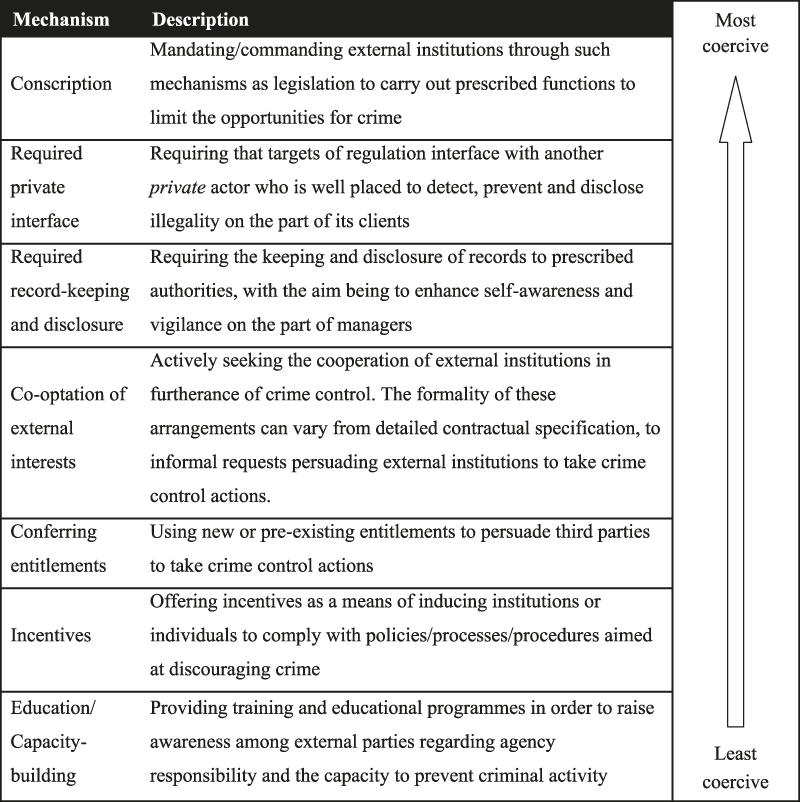
Grabosky and his colleaguesFootnote 44 have analyzed the mechanisms that states use to facilitate the coproduction of security generally. This is represented succinctly in diagrammatic form by BrewerFootnote 45 – see Figure 1 below. These mechanisms range along a continuum of coerciveness. In other words, they cover the gamut of responsive regulation, so that a mechanism can be chosen according not only to the particular situation but also to the degree of third party willingness to be involved in crime prevention.
Mechanisms used to facilitate community coproduction (after Brewer 2012, at p. 54).
By invoking such mechanisms, the state can ‘responsibilize’ third parties and encourage or command them to be vigilant in their roles as guardians, handlers and/or place managers. The following paragraphs explore these mechanisms further as they apply to TEC, with a particular focus on the illegal wildlife trade.
4.1. Conscription
States could conscript third parties to carry out certain actions or to obtain and report certain information. Obligations are generally imposed by legislation or other forms of rule-making, with penalties for non-compliance. The mandatory reporting of child abuse by doctors and teachers, the requirement that airlines check the validity of travellers’ documentation before they are allowed to board, and obligations on proprietors of licensed premises not to serve inebriated customers are all examples of conscription in the cause of preventing crime.
What kinds of action by third parties could the state mandate in the interests of preventing TEC? Mandatory reporting of suspicious patterns of transactions, targeted at companies that deal legally in wildlife or other environmental products and services, might be one effective third party conscription mechanism. Had banks been required to report suspicious patterns of financial transactions rather than just individual above-threshold transactions, the long-term trading relationship between a Laos-based company (Xaysavang Export-Import Company) and a South African company (Steyl Game CC) that became apparent during last year’s Chumlong Lemtongthai case in South Africa, may well have been exposed.Footnote 46 Lemtongthai was recently sentenced to 40 years’ imprisonment for a range of offences relating to the smuggling of rhinoceros horn from South Africa committed over a number of years.Footnote 47 Investigations into the trading relationship between these companies could have led to earlier revelations of illegality, with the result that fewer animals might have been unlawfully poached and traded.
In relation to rhinoceros and elephants, another possible conscriptive measure would be for governments to require privately held stockpiles of rhinoceros horn and ivory to be surrendered to central government, either for destruction or for registration and secure keeping.Footnote 48 Although this would be most unwelcome for private stockpile owners, it would make it more difficult to divert horn and ivory into the illegal market through theft and corruption.
4.2. Required Private Interface
This mechanism involves imposing obligations on the targets of regulation (potential offenders) to ‘use the machinery of private institutions’.Footnote 49 In this way third parties become ‘gatekeepers’, facilitating compliance by the targets with regulatory obligations. So, for instance, governments could require private businesses to be audited by, or take out insurance with, formally accredited professionals (the third parties in this case).
Requirements for rhinoceros horn taken in legal hunts to be treated by taxidermists before export (bringing into play the reporting obligations on taxidermists referred to in the next section), or for hunters to engage commercial shipping agents and/or customs brokers in the export of any trophies, would result in these professionals necessarily being engaged in processes that may allow them access to information indicating the misuse of legal hunting avenues for illicit purposes, and would be likely to have a deterrent effect on potential wrongdoers.
4.3. Required Record-Keeping and Disclosure
Cherney and his colleagues note that ‘record-keeping and disclosure have an important regulatory function by subjecting records to possible public scrutiny and enhancing vigilance on the part of third parties’.Footnote 50 Record-keeping is a common state strategy to ensure that it has access to information; it also means that third parties who maintain those records may be able more effectively to spot patterns that indicate that there is something suspicious going on and either report this to the authorities or intervene themselves to close down criminal opportunities. This may be the case particularly where those records relate to transactions or processes that might be used by organized criminals attempting to launder money or other items through legal channels.
The law relating to taxidermists in South Africa provides an example. Taxidermists are required to report to provincial conservation authorities when they receive a rhinoceros horn (for instance, to be made into a trophy). They are also required to keep a register of details such as date of receipt of the horns, their weight and micro-chip numbers, and the numbers of the hunting permit, transport permit and professional hunting register related to those horns. If requested, they must make this register available for inspection by the relevant authority.
Making internet service providers and online auction houses (such as eBay) responsible for keeping records that detail attempts to trade rhinoceros horn and other endangered species products through their sites would similarly impose a surveillance role on these non-state actors, which could help to close down a trafficking opportunity for criminal actors.
4.4. Cooptation of External Interests
Partnerships between authorities and private interests are common in many areas of crime prevention. Take, for example, the area of juvenile delinquency, where police often work with private organizations (church groups, community groups, welfare bodies, and the like) to divert young people away from a life of crime and give them alternatives for entertainment and gainful employment.
One example of the coopting of organized interests is the system of conservancies, which are found in many African countries. Conservancies are grassroots organizations, dedicated to protecting and preserving the environment of a designated area. In South Africa each conservancy must be registered with the provincial government agency responsible for maintaining wildlife conservation areas and biodiversity. There are hundreds of conservancies across South Africa. Conservancy members play an active role in making inventories of fauna and flora in the conservancy area and taking action to protect them, for example, by intervening in planning processes to provide objective information about the distribution and quantities of various species, thus ensuring that developments do not destroy important habitats. Conservancies often receive funding for specific projects (such as the removal of invasive species) from both public and private sources. Authorities also provide advice to conservancies on best environmental practices.
Conferring public recognition on the community’s ‘voice’ and publicly assisting in the conservancies’ good works could have a significant impact upon the degree to which communities ascribe value to the biodiversity of their area; this is particularly so where the community itself can make money from that biodiversity, such as through tourism activities. This gives the community a stake in the preservation of wildlife and flora and a reason to take action that can deter or disrupt their criminal exploitation, such as through poaching. Even a relatively passive role, such as monitoring and reporting on the area’s natural endowments, could have an impact on the extent of criminal activities that take place with respect to an area’s biodiversity.
Governments also leverage the capacities of third parties to realize outcomes they might not be able to achieve alone. For example:
• Project Scale, a recently launched initiative of INTERPOL to fight illegal fishing,Footnote 51 is partly funded by the Pew Charitable Trusts, an independent non-profit organization that was established by the family of the founder of the Sun Oil company, which has a broad research and public policy agenda that includes many environmental initiatives.Footnote 52
• In May 2013, a Memorandum of Understanding was signed by INTERPOL and the International Fund for Animal Welfare (IFAW) to formalize their ten-year relationship which has involved cooperation on anti-ivory poaching and trafficking initiatives such as Operation Worthy and Project Web. Among other things, IFAW supports INTERPOL in conducting training in operational matters and investigative techniques relating to wildlife crime for law enforcement and customs officers at East African hub airports.Footnote 53
• The efforts of non-governmental organizations (NGOs) have also been essential to the success of Operation Charm, a blitz on the sale of endangered species items in London led by the United Kingdom (UK) Metropolitan Police Wildlife Crime Unit (WCU). In 2006, the WCU took on partners for the operation – the David Shepherd Wildlife Foundation, WildAid, IFAW, WWF-UK and the World Society for the Protection of Animals. Those organizations raise public awareness and encourage the reporting of offending.Footnote 54
• The secretariats for the Convention on Biological Diversity (CBD)Footnote 55 and the Convention on International Trade in Endangered Species of Wild Fauna and Flora (CITES)Footnote 56 work closely with the wildlife trade monitoring network TRAFFIC,Footnote 57 which assists in their decision-making processes by providing expert analysis and advice. TRAFFIC is governed by a committee of members of its partner organizations, the WWF and the International Union for the Conservation of Nature (IUCN), the latter itself a network comprising more than 1,200 government and non-government organizations.Footnote 58
4.5. Conferring Entitlements
Governments can create rights and confer them upon third parties, along with the right to enforce them. Grabosky cites patent and trade mark laws as examples.Footnote 59 Governments can also encourage third parties to enforce entitlements they already hold. Cherney and his colleagues describe how police in the US encourage housing associations and residents to use civil laws such as municipal regulations and health and safety codes against property owners who allow, or at least fail to prevent, the production of methamphetamines on their properties.Footnote 60 Mazerolle and Ransley cite many similar instances of what they call ‘third party policing’.Footnote 61
Exploring the granting of entitlements in the field of TEC could be worthwhile. For example, loosening litigation standing requirements for class actions may be one measure that governments could take. Perhaps communities or individuals could be given rights to hold accountable, for a failure to meet a duty of care or specified standards, those in whose hands directly lie the guardianship of TEC victims or the management of potential crime settings (that is, other third parties). Many environmental statutes in the US already allow for private enforcement of their provisions. Citizen suits are allowed, for example, against violators of the Endangered Species Act,Footnote 62 including against the government if it fails to fulfil its non-discretionary statutory duties to list species as endangered or threatened.Footnote 63 Similarly, in Australia, section 475 of the Environment Protection and Biodiversity Conservation Act 1999 (Cth) grants standing to ‘interested persons’ to apply for injunctions to prevent contraventions of the Act. An interested person may be an individual (Australian citizen or ordinarily resident in Australia) or an incorporated organization whose interests are affected by the offending conduct or who has displayed a recent interest (within the two preceding years) in the environment through protection, conservation or research activities.Footnote 64
According to Burbank, Farhang and Kritzer,Footnote 65 private enforcement regimes have the following advantages. They can:
• multiply the resources devoted to prosecuting enforcement actions;
• shift the costs of regulation from the government to the private sector;
• take advantage of private information to detect violations;
• encourage legal and policy innovation;
• emit a clear and consistent signal that violations will be prosecuted;
• limit the need for direct intervention by the state in the economy and society; and
• facilitate participatory and democratic governance.
On the other hand, the authors note, private enforcement regimes also have several potential problems. These include:
• empowering non-expert judges to make policy;
• producing inconsistent and contradictory doctrine from courts;
• weakening the state’s capacity to articulate a coherent regulatory scheme;
• usurping governmental prosecutorial discretion;
• discouraging voluntary compliance;
• weakening oversight of policy implementation by the legislative and executive branches; and
• reducing democratic legitimacy and accountability.
Clearly any scheme for private enforcement of laws relating to the obligations of third parties to take measures to thwart TEC would need to be well designed and take potential risks into account.
4.6. Incentives
The use of incentives is potentially a more potent tool than any of the above for inducing efforts towards crime prevention. Grabosky suggests that one reason is that they may be perceived as more legitimate than coercive measures.Footnote 66 Incentives may be direct, such as the use of rewards for the provision of information to authorities and for the private capture of poachers. Alternatively, incentives may be indirect, in the form of, for example, tax deductions, administrative privileges and prizes.
Pires and Moreto describe a programme in Mongolia designed to incentivize local communities to protect the snow leopard. In return for training and equipment provided by authorities to local communities to help them increase their income through the production of hand-made woollen goods, the community agreed to adhere to rules of conduct regarding the protection of snow leopards and their prey. Profits from selling the goods produced were returned to the community with an additional 10% going into a conservation fund.Footnote 67
4.7. Education and Capacity-Building/Facilitation
Third parties will not always have the wherewithal to pursue or promote crime prevention aims and strategies. The final category in Figure 1 above concerns education and capacity-building for third parties to enable them to use their capacities more effectively in the furtherance of crime prevention. Perhaps ‘facilitation’ might be a better label for this type of intervention as, quite apart from formal training and capacity-building programmes provided by the state for non-state actors, there are a number of non-formal means by which the state can enhance and enable the actions of third parties who are inclined to contribute to crime prevention.
Some examples from the wildlife field of possible facilitation by the state include:
• facilitating informing (‘snitching’ or ‘dobbing’) by providing, or giving support to, a dedicated wildlife ‘hotline’ for anonymous reporting of criminal or suspicious behaviour;Footnote 68
• providing civil air space for drones owned or operated by private interests to patrol poaching hotspots (including national parks);Footnote 69
• providing media time and/or funding for NGO education campaigns relating to biodiversity conservation and wildlife crime;
• providing infrastructure and funding for conservancies and other similar community initiatives;
• ensuring, through tax policy, the financial viability of NGOs and community groups seeking to protect wildlife;
• providing such groups with relevant information, just as the South African Department of Environmental Affairs now does in relation to rhinoceros poaching and arrest statistics;
• training NGOs and community groups that wish to assist in law enforcement activities in environmental law, investigatory skills, criminal justice processes and rules of evidence;Footnote 70
• providing tools and training to enable third parties who operate record-keeping and registration systems to check the authenticity of documentation submitted to them;
• facilitating constructive engagement between private and public actors who can help each other to further crime prevention goals (by, for example, introducing third parties to one another, and providing virtual and physical forums in which they can meet and negotiate);
• more controversially, creating a regulated market space in which businesses can trade: for example, a market could be created in horn culled from living rhinoceros or taken from private stockpiles, with the aim of reducing poaching and illegal trafficking by meeting demand and removing the incentives for consumers to buy on the black market.
A debate about the last-mentioned, contentious mode of facilitation is under way in South Africa. Current proposals are for a highly regulated market run by the state with product provided both by the state and private individuals.Footnote 71 Another scenario is for the state to leave the market to be run by the private sector, yet still shape the market through mechanisms such as price regulation, tariffs and taxation, labelling laws, corporate reporting obligations, audit requirements, certification schemes or other requirements.
There are many instances where third parties have sufficient competence to initiate crime prevention and conservation strategies, alone or in partnership with other third parties. For instance, the WWF’s Global Forest and Trade Network (GFTN) is working with a chemical trading company (PT Adimitra Lestari) which owns oil palm concessions in East Kalimantan (Indonesia), to implement a forest management strategy with the partial aim of preventing the annihilation of elephants, which make themselves unpopular by eating from the palm trees as a result of the disappearance of their usual food sources. Certification schemes such as the Forest Stewardship Council (FSC) programmeFootnote 72 are largely managed and enforced without any state involvement.Footnote 73 At the other end of the supply chain, many large retail companies use their considerable power as buyers to impose conditions on their suppliers relating to environmental protection (for instance, purchasing only products made with FSC or PEFCFootnote 74 certified timber, or coffee and chocolate from FairtradeFootnote 75 sources).Footnote 76 Such private contracting regimes are often preferable to the alternative of little or no environmental regulation.
This article should not be regarded as suggesting that such initiatives are unimportant or undesirable. Measures such as these generally can be very helpful in terms of crime prevention and conservation efforts. Grabosky notes that abdication is a legitimate and often used state strategy.Footnote 77 Where private companies are involved, however, some if not most of these initiatives are likely to be undertaken with commercial interests uppermost in mind. Involvement in a certification scheme, for example, is seen as a way to manage one’s business reputation, create a level playing-field and remain competitive.Footnote 78 Measures that have as their primary goal to present the company as a good corporate citizen or as ‘green-friendly’, or to promote internal efficiencies, may not always ‘hit the mark’ when it comes to TEC prevention. In such cases governments may need to find ways to facilitate or even tweak the strategies undertaken by private parties in order to ensure that they produce the desired outcomes for crime prevention.
5. risks and difficulties
In exploring the capacities of third parties for TEC prevention, one may ask the question: what level of government intervention is optimal? Generally it is true to say that the role of law enforcement and regulatory authorities is increasingly about being ‘unobtrusively influential from a position offstage’.Footnote 79 However, this does not mean that traditional law enforcement has no role. Indeed, in the TEC area, it remains at the centre of much of the action. What it does suggest, however, is that the state needs to be fully cognizant of its pervasive ability to regulate from the sidelines – or ‘steer’ rather than ‘row’, as Osborne and Gaebler put it in their well-known metaphorFootnote 80 – and to make use of this ability while it continues to enforce the law directly. Less intrusive regulation can be extremely powerful. Where it is likely not to be, the state still has the capacity to command third parties to engage in certain crime preventive activities.
However, not all possible third party mobilizations will necessarily be wholly constructive. For instance, one possible form of mobilization is for governments to grant property rights over a specific resource (timber or wildlife, for example) to private parties. As a crime prevention tool, this is a blunt instrument and would need to be honed by making the grant contingent on fulfilling particular conditions for crime prevention and resource protection. Otherwise, third party actions may exploit the particular resource in question, or at least do nothing to conserve it or prevent its exploitation by others. Potential third party mobilizations therefore need to be thoroughly assessed for their likelihood of furthering the aim of preventing the targeted TEC and for possible unintended undesirable consequences. Such assessments then need to be followed up with careful implementation, monitoring and published evaluations.
There are many other reasons why harnessing the capacities of third parties for TEC prevention will not always be plain sailing. Some of these are discussed in turn below.
5.1. Complexities
The existence of multiple jurisdictions with their own laws and policies means that organizing and coordinating crime prevention efforts can be difficult. Borders can constitute a significant obstacle to effective collaboration on crime control measures, while at the same time facilitating organized crime groups who are adept at taking advantage of legal weaknesses and corruptible governments. Moreover, the existence of legal markets (such as in timber and much of the world’s wildlife) simplifies the laundering of illegal products through legal channels and may complicate the job of targeting crime prevention efforts only at the illegal side of the trade.
It is clear, too, that while there are diverse and multiple non-state actors who have capacity in relation to TEC prevention, often they are not all of the same orientation. Diverse ideologies can lead to different agendas and different ideas about appropriate responses to environmental harms.Footnote 81 The controversies over the legalization of markets in rhinoceros horn and ivory are illustrative of how different stakeholders can hold clashing views about means while still sharing a desire for identical ends (the termination of the illegal trades and the conservation of rhinoceros and elephants).
5.2. Corruption
A further difficulty relating to harnessing third party capacities for TEC prevention is the endemic corruption in many jurisdictions where TEC originates. Indeed, it could be argued that corruption is a necessary element in the crime script of many transnational environmental crimes. As a result, actors who appear to be in an optimal position to exercise third party roles may instead be or become ‘first parties’, that is, offenders. In the case of the illegal rhinoceros horn trade, a number of identified offenders have been individuals whom one would initially have identified as third parties – for example, managers of game reserves, owners and employees of safari hunt companies, and rangers in national parks.Footnote 82 Imposing obligations on, or outsourcing crime prevention functions by entrusting funds or duties to, such actors will be counterproductive if they are themselves involved in criminal activities. As Felbab-Brown notes:
[l]ocal institutional and cultural contexts matter a great deal and can facilitate or render ineffective regulatory frameworks. The overall level of corruption and the quality of law enforcement and rule of law matter as much as the regulatory design itself’.Footnote 83
Methods of verifying the trustworthiness of third parties given responsibility for crime prevention activities and of holding them accountable for their actions are therefore necessary. These mechanisms need to be situated outside the particular jurisdiction in question, such as in existing or bespoke intergovernmental bodies or international organizations. States might agree to ensure that, where TEC prevention activities are undertaken under state auspices, they meet specified standards relating to the integrity of the participants and the processes for their selection, and to monitoring their activities on an ongoing basis. A form of peer review of state commitment to enforcing those standards could then be adopted, not unlike that which now occurs with respect to other international standards, such as the Financial Action Task Force Recommendations on money laundering.Footnote 84
5.3. Accountability Issues
The issue of accountability is particularly important. At what stage in the transfer of state responsibility to a private actor does accountability for the actions of the latter cease to lie with the government? Who takes responsibility, for example, if a private company or an NGO has been contracted to carry out a particular crime prevention programme and does it so badly that crime is not prevented and other parties (or the victims) suffer losses? This is a live issue in terms of everyday domestic policing,Footnote 85 and there is no reason to believe it is any less significant in the context of transnational policing efforts or in the arena of TEC. Furthermore, ‘extensive reliance on non-governmental actors renders the task of monitoring and oversight more difficult’.Footnote 86 Attributing blame for a regulatory shortfall may be harder where there is a lack of transparency around the actions of a third party. Accountability mechanisms will sometimes need to be accompanied by mechanisms for monitoring, or at least auditing, the actions of third parties, as discussed in the previous paragraph.
5.4. A Lack of Will and Social Capital
The mechanisms presented above are situated along a continuum of coerciveness for a reason. The willingness of third parties to engage in crime prevention will inevitably vary. The costs of conscription, for example, may be onerous and induce deliberate non-compliance. Furthermore, partnerships between civil society and the state are notoriously fraught with difficulty.Footnote 87 Working together does not equal collaboration – there is more to it than that.Footnote 88 Brewer has convincingly argued that the existence and depth of social capital – that is, networks of relationships and norms of trust and reciprocity – are key to whether collaborative crime control efforts will be effective.Footnote 89 Growing these networks and norms is no easy task, involving the generation of mutual respect, fairness of treatment, a willingness to share costs and burdens, shared aspirations and a degree of leadership.Footnote 90 But where these favourable relationships are lacking, an element of coerciveness may still enable effective use of third party capacities to further crime prevention goals. And, on a positive note, many non-state actors are highly motivated to prevent TEC, so agreeing on co-productive preventive strategies might in many cases prove to be relatively straightforward. High trust relationships should be easier to create and maintain for those seeking to protect our natural resources than for those disparate illegal groups working to exploit them. Suspicion and self-interest, rather than trust and altruism, are likely to characterize criminal relationships.Footnote 91
6. conclusion
The need for a networked response to the networked threat of TEC is clear, but that response needs to go beyond law enforcement. A long history of neglect of TEC by national jurisdictions means that punishment for most crimes is still far from certain. TEC prevention through deterrence alone is therefore unlikely to be sufficient to protect the world’s natural assets, particularly in cases where crises are brewing. Reducing the impact of TEC needs a whole-of-society approach. This would require the state to take on, as it has in other areas of regulation, a much greater steering role.
There are many instances of third party action in relation to all forms of TEC, both as individual initiatives and in partnership with or at the behest of governments. At present such strategies are undertaken in an ad hoc way. Furthermore, different non-state actors have different agendas and interests in the field. This article therefore makes a case for a more systematic approach to harnessing the multitudinous capacities of third parties to play a part in policing TEC, with national governments as coordinators. Third party capacities are evident in their roles as guardians of potential victims, handlers of potential offenders and managers of crime settings, and third parties could also be influential in relation to the broader social contexts from which TEC derives. The article considers mechanisms to harness those capacities and apply them to TEC; it also points to some of the difficulties of doing so and to the possibilities of counterproductive outcomes in certain circumstances.
A more systematic approach could best be implemented with some dedicated strategic analysis and planning on the part of states, working individually and together. By focusing on particular criminal activities in specific jurisdictions, maps could be created of existing relevant third parties and the strategies currently being used, and which could potentially be used, to harness their capacities. Creating such maps would then readily lead to the identification of as yet unrecognized third parties capable of influencing TEC and of the appropriate regulatory strategies to foster their participation in prevention activities. In the mapping of existing and potential third parties, it would be important to critically analyze their levels of resistance to involvement in intervention and why this resistance exists. It is vital that such maps also take account of the drivers of the particular crimes to which they relate, using tools like the analytic toolkit for wildlife and forest crime developed in 2012 by the International Consortium on Combating Wildlife Crime.Footnote 92 The formation of specialist units within relevant government agencies may be warranted.
Until now, this kind of applied strategic thinking has been confined largely to the task of enhancing law enforcement in relation to TEC. With little evidence that this is having much impact on TEC, now is the time for states to extend this regulatory reach by harnessing third party capacities. Then we might see the emergence of a response strong enough to halt the current expansion in both the volume and distribution of transnational environmental crimes that threatens national and global environmental security.