Introduction
Many older adults live in long-term care (LTC) and this is a frail, vulnerable population. Psychiatric disorders are common among all older adults, and these may have an increased prevalence among individuals in LTC compared to older adults living in non-institutional settings. Dementia is a common psychiatric disorder in LTC as cognitive impairment and related behavioral symptoms are common precipitants of LTC admission (Balestreri et al., Reference Balestreri, Grossberg and Grossberg2000). Depression has also been identified as a risk factor for LTC admission (Harris, Reference Harris2007) and the transition to LTC may be an important stressor which may increase the risk of developing mood and anxiety disorders. Also, cognitive impairment associated with other psychiatric disorders such as schizophrenia and bipolar disorder may also make these conditions common in LTC populations (Green, Reference Green2006). Treating psychiatric disorders in LTC presents several challenges given the complex medical needs of LTC residents, frequent polypharmacy, and the limited availability of mental health services in many LTC settings. Although cognitive impairment and mental health problems are frequent among older people in LTC, the service provision to meet mental health needs is often inadequate, even in developed countries like the U.S.A. (Reichman et al., Reference Reichman1998) and the U.K. (Purandare et al., Reference Purandare, Burns, Challis and Morris2004). This may offer a partial explanation for the observations of inappropriate use of psychotropic medications among nursing home residents (Hosia-Randell and Pitkala, Reference Hosia-Randell and Pitkälä2005; Snowdon et al., Reference Snowdon, Day and Baker2006).
The world's population aged 65 years and older is growing by an unprecedented 800,000 people a month and in many countries, the very old (age 80+) is the fastest growing population group (U.S. Census Bureau and the National Institute on Aging, 2001). Worldwide, the population of people aged 60 years and over is expected to increase from 600 million in 2000 to 1.2 billion by 2025 and 2 billion by 2050. About two-thirds of all older people live in the developing world and this will increase to 75% by 2025 (World Health Organization, 2009). Most studies of the number of individuals currently residing in LTC are from developed countries. In the U.K., the number of people aged over 85 is estimated to rise from just over 1 million to nearly 4 million in the first half of this century while the estimated demand for LTC beds will rise from 450,000 to 1.1 million over this period (Wittenberg et al., Reference Wittenberg, Comas-Herrera, Pickard and Hancock2004). In Canada, with a total population of 33 million in 2006, over 200,0000 older adults were residents in LTC (Statistics Canada, 2006). In the U.S.A., over 1.3 million older adults were receiving care in LTC facilities corresponding to an estimated $200 billion in direct care costs (U.S. Department of Health and Human Services, 2009).
The future demand for LTC depends not only on the aging of the population, but also on the prevalence and severity of chronic conditions associated with admission to LTC. The numbers of people diagnosed to have dementia worldwide are expected to rise from 24.3 million in 2001 to 81.1 million in 2040 (Ferri et al., Reference Ferri2005). A large population study of Finnish older people found that dementia, Parkinson's disease, stroke and mental health problems were more strongly associated with the risk of institutionalization than with the risk of death without institutionalization (Nihtila et al., Reference Nihtila, Martikainen, Koskinen, Reunanen, Noro and Hakkinen2008). This may have a significant impact on the future demand for LTC. A review of 42 studies found that the rate of LTC admission for individuals with dementia increased from 20% in the first year after diagnosis of dementia to 50% after five years (Luppa et al., Reference Luppa, Luck, Brahler, Konig and Riedel-Heller1998). The increased amount of disability among younger populations approaching old age suggest that future LTC need could be 10–25% higher than previously estimated (Lakdawalla et al., Reference Lakdawalla, Goldman, Bhattacharya, Hurd, Joyce and Panis2003).
In the current study we review the prevalence of psychiatric disorders in LTC settings. Understanding the prevalence of psychiatric disorders in LTC will help inform current and future estimates of service need for residents in LTC in order to improve care for this vulnerable population.
Methods
Electronic literature search
We searched the electronic databases MEDLINE and PsychINFO from inception up to March 2009. We used the following medical subject headings and free-text words to identify articles on the prevalence of psychiatric disorders in LTC: “nursing homes”, “long term care” and “homes for the aged” combined with “affective disorders” “anxiety disorders” “bipolar disorder” “major depression”, “behavior disorder”, “delusions”, “psychosis”, “schizophrenia” or “mental disorders”. We also searched the reference lists of retrieved articles to identify other relevant articles. All studies of the prevalence of psychiatric disorders or behavior and psychological symptoms of dementia (BPSD) in LTC were eligible to be included in the review provided that the study population was identified as a LTC population and the method for determining diagnosis of psychiatric disorder was specified in the study. We classified psychiatric disorders into the following categories: dementia, BPSD, major depressive disorder, depressive symptoms (clinically relevant depressive symptoms not meeting criteria for major depression), bipolar disorders, anxiety disorders, schizophrenia, delirium, and alcohol use disorders. The term LTC is used for consistency throughout the paper and may be used interchangeably with nursing or care home.
We included non-English publications if the abstract of the study provided sufficient information for the purpose of data extraction, otherwise non-English publications were excluded from the review.
Data extraction
We excluded studies from retirement homes, assisted living homes, or from long stay or chronic care hospitals as we wanted to focus the current review on LTC. Data on the country of origin, LTC setting, number of LTC homes, diagnostic instruments and estimated prevalence of psychiatric disorders were abstracted from all studies where this information was available. Two authors extracted data from the abstracts and publications.
Data from the National Nursing Home Survey
We supplemented information from the published literature with data from the 2004 National Nursing Home Survey (NNHS). The NNHS is a two-stage survey of a representative sample of NHs in the U.S.A. conducted periodically by the Centers for Disease Control. The most recent wave of the NNHS was completed in 2004 and included 1,174 NHs and 13,507 participants. The NNHS contains information on survey weighting procedures that can be utilized to determine the prevalence of mental health conditions in the entire U.S. LTC population. Details of the NNHS survey and analytic methods are available on the NNHS website at: http://www.cdc.gov/nchs/nnhs.htm. We restricted our study sample to individuals aged 65 years or more at the time of the interview. We determined the prevalence of psychiatric disorders through identifying the following International Classification of Disease Codes recorded in the NNHS datafile: dementia (ICD-9 codes: 290.X, 294.1, 331.X, 797.X), major depressive disorder (296.2, 296.3, 296.9, 298.0), depressive syndromes including major depressive disorder (300.4, 309.0, 309.1, 311.X), bipolar disorder (296.0, 296.1), anxiety disorders (300.0, 300.2), schizophrenia (295.X), and alcohol use disorders (303.X). We also used the mood and behavioral indicators from the residents’ Minimum Dataset assessment to determine the prevalence of mood symptoms in all LTC residents and the prevalence of behavioral symptoms among those with dementia.
Results
Total number of studies
A total of 662 citations were reviewed for inclusion criteria. Among these citations, a total of 74 studies were identified examining the prevalence of psychiatric disorders in LTC populations which were included in the review. The majority of studies examined the prevalence of dementia (N = 30), BPSD (N = 9), and depression (N = 26). Most studies were from North America, Europe or Australia with relatively few studies from Asia, Africa or South America.
Prevalence of dementia in long-term care
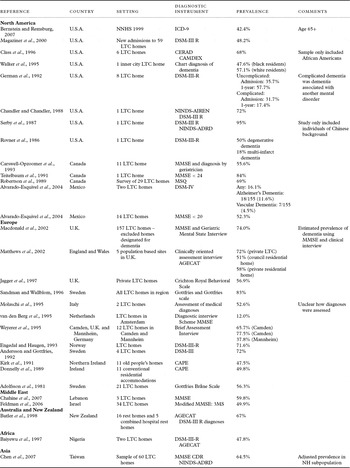
A total of 30 studies included information on the prevalence of dementia in nursing home populations (Table 1). The majority of studies were from North America (N = 13) (Serby et al., Reference Serby, Chou and Franssen1987; Chandler and Chandler, Reference Chandler and Chandler1988; Robertson et al., Reference Robertson, Rockwood and Stolee1989; Teitelbaum et al., Reference Teitelbaum, Ginsburg, Hopkins, Teitelbaum, Ginsburg and Hopkins1991; German et al., Reference German1992; Carswell-Opzoomer et al., Reference Carswell-Opzoomer, Puxty, Teaffe and Walop1993; Walker et al., Reference Walker1995; Class et al., Reference Class, Unverzagt, Gao, Hall, Baiyewa and Hendrie1996; Magaziner et al., Reference Magaziner2000; Arias-Merino et al., Reference Arias-Merino2003; Alvarado-Esquivel et al., Reference Alvarado-Esquivel2004; Bernstein and Remsburg, Reference Bernstein and Remsburg2007) and Europe (N = 12) (Adolfsson et al., Reference Adolfsson, Gottfries, Nystrom and Winbald1981; Donnelly et al., Reference Donnelly, Compton, Devaney, Kirk and McGuigan1989; Kirk et al., Reference Kirk, Donnelly and Compton1991; Andersson and Gottfries, Reference Andersson and Gottfries1992; Engedal and Haugen, Reference Engedal and Haugen1993; Molaschi et al., Reference Molaschi, Ponzetto, Ferrario, Scarafiotti and Fabris1995; van den Berg et al., Reference van den Berg, Spijker, Van Limbeek, Van Tilburg and van Alem1995; Weyerer et al., Reference Weyerer, Hafner, Mann, Ames and Graham1995; Sandman and Wallblom, Reference Sandman and Wallblom1996; Jagger et al., Reference Jagger, Lindesay, Jagger and Lindesay1997; Macdonald et al., Reference Macdonald2002; Matthews and Dening, Reference Matthews and Dening2002) with only two studies from the Middle East (Feldman et al., Reference Feldman, Clarfield, Brodsky, King and Dwolatzky2006; Chahine et al., Reference Chahine, Bijlsma, Hospers and Chemali2007) and one study each from Australia/New Zealand (Butler et al., Reference Butler, Fonseka, Barclay, Sembhi and Wells1998), Africa (Baiyewu et al., Reference Baiyewu, Adeyemi and Ogunniyi1997) and Asia (Chen et al., Reference Chen2007).
Prevalence of dementia in long-term care facilities

AGECAT = Automated Geriatric Examination for Computer Assisted Taxonomy; CAMDEX = Cambridge Mental Disorders of the Elderly Examination; CAPE = Clifton Assessment Procedure for the Elderly; CDR = Clinical Dementia Rating Scale; CERAD = Consortium to Establish a Registry for Alzheimer's Disease; DSM = Diagnostic And Statistical Manual; MMSE = Mini-mental State Examination; NH = nursing home; NINDS-ADRD = National Institute of Neurological Disorders and Stroke – Alzheimer's Disease and Related Disorders; NINDS-AIREN = National Institute of Neurological Disorders and Stroke – Association Internationale pour la Recherché et l'Enseignement en Neurosciences; NNHS = National Nursing Home Survey; MSQ = Mental Status Questionnaire.
A variety of methods were used in dementia studies with a total of 16 different diagnostic measures for dementia. The most common diagnostic instrument was the DSM-III or DSM-IV which were used in a total of 10 studies. The estimated prevalence of dementia in nursing homes varied between 12.0% (van den Berg et al., Reference van den Berg, Spijker, Van Limbeek, Van Tilburg and van Alem1995) and 95% (Serby et al., Reference Serby, Chou and Franssen1987) with a median prevalence of dementia of 58% from all the studies.
Prevalence of BPSD in long-term care
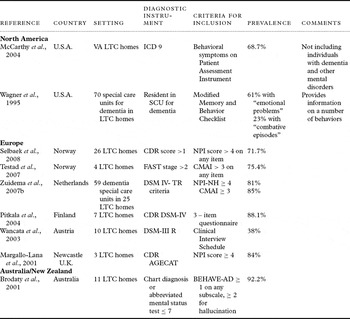
A total of nine studies reporting the prevalence of behavioral symptoms in LTC resident with dementia or cognitive impairment were identified (Table 2). Many of the studies published prior to 2005 were also reviewed in a previous publication on this topic (Zuidema et al., Reference Zuidema, Koopmans and Verhey2007a). Among these studies, two were from North America (Wagner et al., Reference Wagner, Teri, Orr-Rainey, Wagner, Teri and Orr-Rainey1995; McCarthy et al., Reference McCarthy, Blow and Kales2004), six from Europe (Margallo-Lana et al., Reference Margallo-Lana2001; Wancata et al., Reference Wancata, Benda, Meise and Windhaber2003; Pitkälä et al., Reference Pitkälä, Laurila, Strandberg and Tilvis2004; Testad et al., Reference Testad, Aasland and Aarsland2007; Zuidema et al., Reference Zuidema, Derksen, Verhey and Koopmans2007b; Selbaek et al., Reference Selbaek, Kirkevold and Engedal2008) and one from Australia/New Zealand (Brodaty et al., Reference Brodaty2001). A variety of instruments were used to assess severity of behavior symptoms in dementia with the Neuropsychiatric Inventory (N = 3) and the Cohen-Mansfield Agitation Inventory (N = 2) being the most frequently utilized measure of behavioral symptoms in dementia. The prevalence of any behavioral symptom in LTC residents with dementia varied between 38% (Wancata et al., Reference Wancata, Benda, Meise and Windhaber2003) and 92% (Brodaty et al., Reference Brodaty2001). The median prevalence of any behavior symptom in dementia in LTC residents from the nine studies was 78%.
Prevalence of behavioral and psychological symptoms of dementia in long-term care

AGECAT = Automated Geriatric Examination for Computer Assisted Taxonomy; BEHAVE-AD = Behavioral Pathology in Alzheimer Disease Rating Scale; CDR = Clinical Dementia Rating Scale; CMAI = Cohen Mansfield Agitation Inventory; DSM = Diagnostic and Statistical Manual of Mental Disorders; FAST = Functional Assessment Staging Scale; NPI = Neuropsychiatric Inventory; SCU = Special Care Unit; VA = Veterans’ Affairs.
Prevalence of depression and depressive symptoms in long-term care
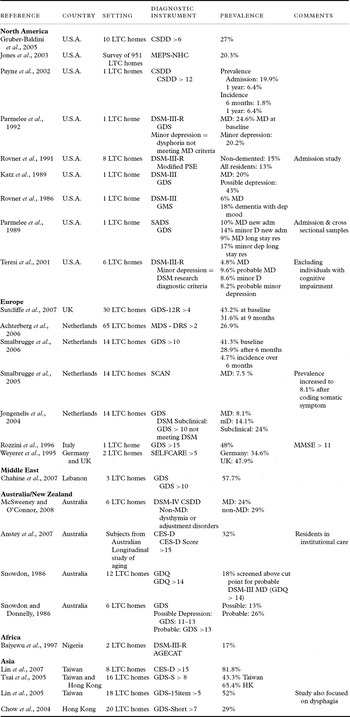
A total of 26 studies reported on the prevalence of major depression or depressive symptoms in LTC residents (Table 3). These studies included nine studies from North America (Rovner et al., Reference Rovner1986; Katz et al., Reference Katz, Lesher, Kleban, Jethanandani and Parmelee1989; Parmelee et al., Reference Parmelee, Katz and Lawton1989; Rovner et al., Reference Rovner, German, Brant, Clark, Burton and Folstein1991; Parmelee et al., Reference Parmelee, Katz and Lawton1992; Teresi et al., Reference Teresi, Abrams, Holmes, Ramirez and Eimicke2001; Payne et al., Reference Payne2002; Jones et al., Reference Jones, Marcantonio and Rabinowitz2003; Gruber-Baldini et al., Reference Gruber-Baldini, Zimmerman, Boustani, Watson, Williams and Reed2005), seven studies from Europe (Snowdon, Reference Snowdon1986; Snowdon and Donnelly, Reference Snowdon and Donnelly1986; Weyerer et al., Reference Weyerer, Hafner, Mann, Ames and Graham1995; Rozzini et al., Reference Rozzini, Boffelli, Franzoni, Frisoni and Trarucchi1996; Jongenelis et al., Reference Jongenelis, Pot, Eisses, Beekman, Kluiter and Ribbe2004; Smalbrugge et al., Reference Smalbrugge, Jongenelis, Pot, Beekman and Eefsting2005a; Reference Smalbrugge, Jongenelis, Pot, Eefsting, Ribbe and Beekman2006; Achterberg et al., Reference Achterberg, Pot, Kerkstra and Ribbe2006; Anstey et al., Reference Anstey, Sanden, Sargent-Cox and Luszcz2007; Sutcliffe et al., Reference Sutcliffe2007; McSweeney and O'Connor, Reference McSweeney and O'Connor2008), one study from the Middle East (Chahine et al., Reference Chahine, Bijlsma, Hospers and Chemali2007), four studies from Australia/New Zealand (Snowdon and Donnelly, Reference Snowdon and Donnelly1986; Snowdon, Reference Snowdon1986; Anstey et al., Reference Anstey, Sanden, Sargent-Cox and Luszcz2007; McSweeney and O'Connor, Reference McSweeney and O'Connor2008), one study from Africa (Baiyewu et al., Reference Baiyewu, Adeyemi and Ogunniyi1997), and four studies from Asia (Chow et al., Reference Chow2004; Tsai et al., Reference Tsai, Chung, Wong and Huang2005; Lin et al., Reference Lin, Wang, Chen, Wu and Portwood2005; Reference Lin, Wang and Huang2007). A variety of diagnostic criteria and depression rating scales were used to define depression in the studies. The prevalence of major depression in LTC ranged from 5% (Teresi et al., Reference Teresi, Abrams, Holmes, Ramirez and Eimicke2001) to 25% (McSweeney and O'Connor, Reference McSweeney and O'Connor2008) with a median prevalence of 10%. The prevalence of depressive symptoms varied between 14% (Parmelee et al., Reference Parmelee, Katz and Lawton1989) to 82% (Lin et al., Reference Lin, Wang and Huang2007) with a median prevalence of 29%.
Prevalence of major depression and depressive symptoms in long-term care

AGECAT = Automated Geriatric Examination for Computer Assisted Taxonomy; CES-D = Centre for Epidemiological studies Depression Scale; CSDD = Cornell Scale for Depression in Dementia; GDS =; Geriatric Depression Scale GMS = Geriatric Mental Status Schedule; MDS DRS = Minimum Dataset Depression Rating Scale; MD = major depressive disorder; MEPS-NHS = Medical Expenditure Panel – Nursing Home Component; PSE = Present State Examination; SADS = Schedule for Affective Disorders and Schizophrenia.
Prevalence of anxiety disorders in long-term care
In contrast to the number of studies of depression in LTC, very little attention has been paid to anxiety disorders with a total of three studies. In an Australian study of five nursing homes (Cheok et al., Reference Cheok, Snowdon, Miller and Vaughan1996), subjects who scored 18 or more on the Mini-mental State Examination (MMSE) were interviewed using an anxiety questionnaire devised by Lindesay et al. (Reference Lindesay, Briggs and Murphy1989). Eleven percent were considered to have generalized anxiety; phobic disorders occurred in 14% of subjects and 2% had panic disorder. A strong association was demonstrated between anxiety and depression, as demonstrated in many previous studies. Fifty-eight percent of the subjects with generalized anxiety were rated on the Geriatric Depression Scale (GDS) as definitely depressed. Parmelee et al. (Reference Parmelee, Katz and Lawton1993) assessed anxiety and depression among residents of a large nursing home using the Schizophrenia and Affective Disorders Scale. There was a prevalence rate of 3.5% for anxiety or panic disorders and another 13.2% reported milder anxiety symptoms not meeting diagnostic criteria. On follow-up, there was an overall incidence rate of 2.3% for “possible anxiety disorders”. Finally, a study from the Netherlands (Smalbrugge et al., Reference Smalbrugge, Pot, Jongenelis, Beekman and Eefsting2005b) used the Schedules for Clinical Assessment in Neuropsychiatry in a sample of 333 nursing home residents in 14 nursing homes. Participants all had an MMSE score greater than 14. The prevalence of anxiety disorders was 5.7%, with 4.2% having sub-threshold anxiety disorders and 29.7% having symptoms of anxiety. The presence of anxiety disorders was associated with depression, stroke and MMSE score greater than 23.
Prevalence of substance use disorders in long-term care
The prevalence of substance abuse in LTC has also received little attention with only three studies being identified. Data from the 1985 National Nursing Home Survey, based on the presence of alcohol problems identified by staff report, found a prevalence of only 2.8% for current alcohol abuse or dependence among nursing home residents (National Center for Health Statistics, 1989). Higher rates have been reported in studies conducted in Veterans’ Administration (VA) nursing homes in the U.S.A. One study of alcohol abuse or dependence found a rate of 18% of residents reporting active symptoms at the time of admission (Joseph et al., Reference Joseph, Ganzini and Atkinson1995). In another study of a VA nursing home, 29% of residents had a lifetime diagnosis of alcohol abuse, with 10% of the residents meeting criteria for abuse or dependence within one year of admission (Oslin et al., Reference Oslin, Streim, Parmelee, Boyce and Katz1997). The 1985 National Nursing Home Survey reported a prevalence of illicit drug abuse or dependence in 0.9% of nursing home residents with a higher rate of 2.7% prevalence found among men aged less than 64 years (National Center for Health Statistics, 1989).
Prevalence of other psychiatric disorders in long-term care
The prevalence of schizophrenia in LTC has been observed to decline over time. In the 1985 National Nursing Home Survey, 9.8% had schizophrenia and in the 1987 Medical Expenditure Survey, 9.2% had schizophrenia. However, these percentages decreased to 7.1% in 1995 and 5.9% in 1996 respectively (Mechanic and McAlpine, Reference Mechanic and McAlpine2000). There are few studies of the prevalence of bipolar disorder in LTC, but Tariot et al. (Reference Tariot, Podgorski, Blazina and Leibovici1993) found a 3% prevalence rate of bipolar disorder in a sample of 80 residents in one public nursing home. Residents of long-term care homes are particularly vulnerable to the development of delirium, but few studies have been done in these settings. Most studies of the prevalence of delirium among residents in long-term care facilities show rates that range from 6% to 14% (Cacchione et al., Reference Cacchione, Culp, Laing and Tripp-Reimer2003).
Results from the 2004 National Nursing Home Survey (NNHS)
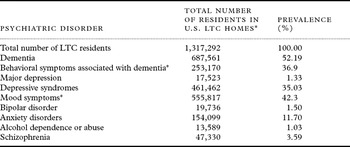
The results from the 2004 NNHS survey are reported in Table 4. As in previous studies of psychiatric disorders in LTC, dementia was the most common psychiatric diagnosis in long-term care. A total of 687,581 LTC residents aged 65 years or more were identified as having dementia accounting for 52% of all LTC residents in this age group. Among these residents with dementia, 36.9% had some current behavioral symptom associated with dementia. A chart diagnosis of major depression was diagnosed in 1.3% of all NH residents although other depressive symptoms were much more common. Depressive symptoms were identified in over 35% of all LTC residents while mood symptoms were identified on the MDS assessments were present in over 45% of residents. Anxiety disorders were also common in the NNHS with over 11% of all LTC residents having an anxiety disorder. The prevalence of schizophrenia, bipolar disorder and alcohol use disorders were much less common being diagnosed in 3.6%, 1.5% and 1.0% of all NH residents respectively.
Prevalence of psychiatric disorders in long-term care (LTC) in the 2004 National Nursing Home Survey

*As determined from mood and behavior indicators from Minimum Dataset assessments.
All results are estimates of the entire U.S. Nursing Home Population using Survey Weighting Procedures for individuals aged 65 years or older.
Discussion
Our review found a relatively high prevalence of many psychiatric disorders in a variety of LTC populations. Dementia and behavioral symptoms associated with dementia were the most common psychiatric disorders in LTC homes. Major depressive disorder and depressive symptoms were also common in LTC residents. There are few studies of other common mental disorders in LTC although the existing literature suggests that anxiety disorders, schizophrenia and bipolar disorder are common in this population as well. Of note, the estimates of psychiatric disorders varied between studies, likely due to differences in diagnostic tools and underlying populations. There were also potential gaps in the existing literature in psychiatric disorders in LTC. Most studies had small sample sizes, were conducted in LTC facilities in developed countries, and included relatively few LTC facilities in study samples. In addition, many studies were conducted several years ago which may not reflect current trends in the prevalence of psychiatric disorders in LTC.
Although we did not make direct comparisons of the prevalence of mental disorders in LTC compared to other populations, the prevalence of psychiatric disorders in LTC appears to be different when compared to the prevalence of mental disorders in other settings. It is not surprising that the prevalence of dementia in LTC is much higher than the prevalence of dementia in community settings as dementia (Coughlin et al., Reference Coughlin, McBride and Liu1990; Buhr et al., Reference Buhr, Kuchibhatla, Clipp, Buhr, Kuchibhatla and Clipp2006) and behavioral symptoms of dementia (Buhr et al., Reference Buhr, Kuchibhatla, Clipp, Buhr, Kuchibhatla and Clipp2006) are leading reasons for LTC admission. The Canadian Study of Health and Aging examined the prevalence of dementia in a sample of older Canadian adults. The prevalence of dementia for individuals aged 65 years or older was 8%, varying between 2.4% in those aged 65 to 74 years up to 34.5% of those aged 85 years (Canadian Study of Health and Aging Study Group, 1994). The estimated number of cases in the community and institutional samples were equal, although the total institutional population is much smaller and dementia was three times more common among individuals aged 85 or older who resided in institutions when compared to individuals in the community. A second community based study of dementia in the U.S.A., the Cache County Study, found that 8.2% of individuals aged 65 or older had dementia, including individuals in both community and institutional settings, with a higher proportion of residents with dementia living in LTC (Tschanz et al., Reference Tschanz2004).
There have been few studies examining the prevalence of other mental health disorders among the elderly in non-institutional settings. The Epidemiological Catchment Area study in the U.S.A. found a lifetime prevalence of depression in individuals aged 65 and older to be 2.0% (Robbins and Regier, Reference Robbins and Regier1991) while the Cache County Study reported lifetime depression rates of 15.8% (Steffens et al., Reference Steffens2000). Likewise the prevalence of anxiety disorders in a community-based sample in the Netherlands was 10.2% (Beekman et al., Reference Beekman1998). The prevalence of schizophrenia reported in the ECA for all individuals aged 65+ was 0.3% (Regier et al., Reference Regier1993), although more accurate estimates place this figure at closer to 1% (Cohen et al., Reference Cohen2000). It appears that mood and anxiety psychiatric disorders are at least as prevalent, or have a higher prevalence, when compared to community-based samples.
Most of the studies included in our review were from settings in North America, Europe and Australia, which may be due in part to our search criteria limiting studies to English language publications. A recent study of global prevalence of dementia however would support that there have been relatively few population-based studies of dementia prevalence outside North America, Europe, Australia and Japan (Ferri et al., Reference Ferri2005). This is concerning given that the global prevalence of dementia is increasing most rapidly in developing countries where resources for caring for this expanding population is limited (Ferri et al., Reference Ferri2005). Research into the prevalence of dementia and other mental health disorders in LTC residents from a diversity of countries will be important for government planning and policy-makers to ensure adequate resources for this growing population.
Given the high prevalence of psychiatric disorders in LTC homes it is not surprising that these populations are high users of psychotropic medications. Estimates of the use of psychotropic medications in Canadian LTC facilities indicate that antipsychotics, antidepressants and benzodiazepines are prescribed to 30%, 12% and 23% of residents in LTC facilities respectively, in Ontario, Canada (Conn et al., Reference Conn, Ferguson, Mandelman and Ward1999). A study of psychotropic drug use in Norwegian LTC facilities found that 75% of LTC residents with dementia and 68% of individuals without dementia were prescribed at least one psychotropic medication with antipsychotics, antidepressants, and benzodiazepines being the most frequently prescribed medication classes (Selbaek et al., Reference Selbaek, Kirkevold and Engedal2007). Similar results were observed in a study of LTC residents with dementia in Finland where the prevalence of atypical antipsychotics, antidepressants and anxiolytics were prescribed to 41%, 47%, and 38% of residents respectively, while only 3% were prescribed cholinesterase inhibitors (Pitkälä et al., Reference Pitkälä, Laurila, Strandberg and Tilvis2004). Approximately 30% of U.S. LTC residents with dementia receive treatment with cholinesterase inhibitors, a class of medication which is indicated in the treatment of many common forms of dementia (Seitz et al., Reference Seitz, Gruneir, Conn and Rochon2009). In contrast, the corresponding percentages of individuals with dementia treated with any antipsychotic, antidepressants, or benzodiazepine in this same population was 73% in individuals prescribed cholinesterase inhibitors and 61% of individuals with dementia who were not receiving cholinesterase inhibitors (Seitz et al., Reference Seitz, Gruneir, Conn and Rochon2009). The indications for these medications is not often clear as antipsychotics and antidepressants are both frequently used to treated agitation or aggressive behavior in dementia as off-label treatments, although safety concerns with the use of antipsychotics (Gill et al., Reference Gill2004; Reference Gill2005) have been a major recent cause for concern in older adults with dementia.
Although psychotropic medications are frequently used in NH residents, there have been only a few randomized controlled trials of medication interventions for NH residents with psychiatric disorders. These have included a small number of trials of antidepressants for depression (Katz et al., Reference Katz, Simpson, Curlik, Parmelee and Muhly1990; Streim et al., Reference Streim2000; Magai et al., Reference Magai, Kennedy, Cohen and Gomberg2000; Oslin et al., Reference Oslin2000; Burrows et al., Reference Burrows, Salzman, Satlin, Noble, Pollock and Gersh2002; Weintraub et al., Reference Weintraub, Streim, Datto, Katz, DiFilippo and Oslin2003; Roose et al., Reference Roose2003), antipsychotics for BPSD (Street et al., Reference Street2000; Clark et al., Reference Clark, Street, Feldmen and Breier2001; Frank et al., Reference Frank, Kleinman, Ciesla, Rupnow and Brodaty2004; Streim et al., Reference Streim2008), and cholinesterase inhibitors for Alzheimer's dementia (Tariot et al., Reference Tariot2001). Given the known risks associated with psychotropic medications in this frail population, greater research into non-pharmacological approaches to managing psychiatric disorders in LTC populations are needed. Studies of depression treatment in primary care have found that the majority of older adults with depression would prefer psychological treatments although few receive them (Unützer et al., Reference Unützer2003). Likewise, psychosocial and behavioral interventions for BPSD are also infrequently implemented in LTC despite the increasing evidence for many forms of psychosocial therapies for BPSD.
Where does the field go from here to further our understanding of psychiatric disorders in LTC? There is a dearth of information from countries outside Europe and North America. Additional epidemiological studies from developing countries would add to the existing literature and assist these countries in optimizing care in the future. There are also few multinational studies using consistent methodology from which direct comparisons of psychiatric disorders in LTC across different countries can be made. Collaboration across centers and adoption of standard survey methods would help to better define the extent of psychiatric disorders in LTC and to identify particular environments that may be protective against the development of psychiatric disorders or their sequelae. Given the high prevalence of most psychiatric disorders in LTC further research into effective and safe pharmacological and non-pharmacological interventions will also be important to provide appropriate treatments for this vulnerable population.
Conflict of interest declaration
Dr. Purandare has attended advisory boards or received honoraria from Pfizer, Shire, Novartis, Lundbeck, Eli-Lilly, and Wyeth. Dr. Conn has attended advisory boards or received honoraria from Janssen-Ortho, Eli Lilly, Pfizer, Wyeth, Organon, Lundbeck, and Astra-Zeneca.
Description of authors' roles
Dr. Seitz, Dr. Conn and Dr. Purandare contributed to the research questions, study design, analysis of the data, and writing the paper. Dr. Seitz and Dr. Conn reviewed the studies for inclusion in the review and completed the data extraction.
Acknowledgments
Dr. Seitz is supported by a Postdoctoral Fellowship Award from the Alzheimer Society of Canada. We are grateful to Mary McDiarmid for her assistance in designing the search strategies and retrieving articles, and to Shelly Clancy for her assistance with manuscript preparation.