Congenital cardiac disease is one of the commonest defects found at birth, being observed in more than 1 of each 100 live births.Reference Hoffman and Kaplan1 Among these lesions, atrial septal defect and tetralogy of Fallot account for approximately one-tenth and one-twentieth of the overall defects, respectively. Genetic factors have been associated with both lesions. Mutations of GATA4 were found mostly in familial examples of atrial septal defect,Reference Garg, Kathiriya and Barnes2–Reference Nemer, Fadlalah and Usta9 but never in these lesions when occurring sporadically. Mutations of NKX2-5 were also observed in a spectrum of both familial and sporadic occurrences of congenitally malformed hearts, including those with atrial septal defect and tetralogy of Fallot, frequently in association with abnormalities of atrioventricular conduction.Reference Akazawa and Komuro10–Reference Ikeda, Hiroi and Hosoda17
In this study, we sequenced GATA4 and NKX2-5 to determine their genetic contribution to the occurrence of sporadic congenital cardiac defects in Indonesia, producing what is, to the best of our knowledge, the first evidence of a new mutation of GATA4 causing an atrial septal defect.
Materials and methods
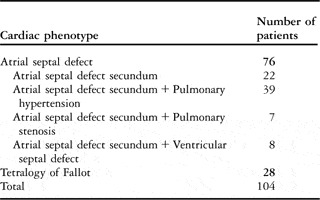
We recruited 76 patients with atrial septal defects located within the oval fossa, and 28 patients with tetralogy of Fallot. In Table 1, we list the cardiac phenotypes. All patients were non-syndromic, and had been diagnosed on the basis of echocardiography and other standard methods by one of coauthors (S.E.R.) working at Hasan Sadikin General Hospital in Bandung, Indonesia. As established by taking a careful history, we confirmed that none of the parents possessed an abnormal cardiac phenotype. Informed consent was obtained from all the participating families. As normal controls were unavailable for the Indonesian population, we used normal Japanese controls to observe polymorphisms, recognizing that Indonesian and Japanese populations are ethnically unrelated. Experimental protocols were approved by the institutional review board in Yokohama city university school of medicine.
Cardiac phenotypes of the patients.

Genomic deoxyribonucleic acid, or DNA, was extracted from peripheral leukocytes using FlexiGene Blood DNA kit (Qiagen, Tokyo, Japan). Whole genome amplification was performed wtih Illustra GenomiPhi V2 DNA Amplification Kit (GE Healthcare Bio-Science, Tokyo, Japan).
We analysed 6 coding exons of GATA4, and 2 exons of NKX2-5, along with their flanking intronic regions. All primers were designed using the web-based Primer3 software (http://frodo.wi.mit.edu/cgi-bin/primer3/primer3_www.cgi). Detailed information of primers is available on request. Polymerase chain reaction was cycled 35 times at 94°C for 30 sec, at 58–64°C for 30 sec and at 72°C for 30 sec in a total volume of 20 μl containing 30 ng of whole genome amplification deoxyribonucleic acid, and/or genomic deoxyribonucleic acid, as a template, 0.5 μM of forward and reverse primers, 200 μM of each deoxynucleotide triphosphates, and 0.5 Unit of ExTaq (Takara, Ohtsu, Japan) or LATaq (Takara, Japan), purified with ExoSAP-IT (United States Biochemical, Cleveland, OH), and sequenced using BigDye Terminator ver.3.1 (Applied Biosystems, Foster City, CA) on the 3100 Genetic Analyzer (Applied Biosystems). Deoxyribonucleic acid sequences were compared with the reference genome sequences based on the University of California, Santa Cruz Genome Browser (May 2006 assembly) using the SeqScape software Ver.2.1 (Applied Biosystems). All the nucleotide changes found in whole genome amplification deoxyribonucleic acids were also confirmed by sequencing using original genomic deoxyribonucleic acids. Regarding polymorphisms, normal control deoxyribonucleic acids were sequenced until the change was seen, needing up to 96 normal chromosomes.
Results and discussion
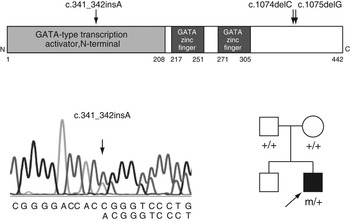
A heterozygous mutation of GATA4, specifically c.341_342insA (p.T114TfsX95), was identified in 1 of the patients (Fig. 1). Analysis of his parental deoxyribonucleic acid confirmed the novel nature of the mutation. Parentage was confirmed by microsatellite analyses. The patient was a 4-year-old boy, presenting because of failure to thrive and recurrent respiratory infections. Echocardiography revealed a hole of 1.4 centimeters diameter in the floor of the oval fossa, as well as pulmonary hypertension. At the age of 4 1/2 years, the defect was closed by insertion of an Amplatzer septal occluder. He is now in a good condition. His healthy 30-year-old father, and 20-year-old mother, were not consanguineous. The pregnancy had been uneventful, and his elder brother, aged 6 years, is also healthy, without any cardiac or other abnormalities (Fig. 1).
The protein truncation mutation of GATA4. c.341_342insA identified in this study is the earliest type of truncation. c.1074delC and c.1075delG were previously reported (upper).Reference Garg, Kathiriya and Barnes2, Reference Okubo, Miyoshi and Baba3 Electropherogram of the identified mutation is shown (lower left). The family pedigree of the patient with c.341_342ins shows clearly its new occurrence. +: wild type, m: mutated.

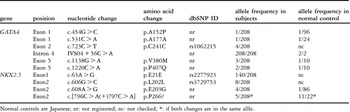
The mutation, c.341_342insA, is the third protein truncation mutation of GATA4, resulting in much earlier termination than the other two, c.1074delC and c.1075delG, thus far reported.Reference Garg, Kathiriya and Barnes2, Reference Okubo, Miyoshi and Baba3, Reference Hirayama-Yamada, Kamisago and Akimoto5 All the reported truncations have been found in patients with atrial septal defects. Missense mutations are associated with varied phenotypes, including atrial septal defect, tetralogy of Fallot, atrioventricular septal defect, and ventricular septal defect.Reference Garg, Kathiriya and Barnes2, Reference Sarkozy, Conti and Neri4–Reference Rajagopal, Ma and Obler7, Reference Nemer, Fadlalah and Usta9, Reference Zhang, Li and Shen18. Three inframe changes, specifically p.S46del, p.A118_A119insA, and p.A125_A126insAA, have also been found in patients with ventricular septal defect and tetralogy of Fallot.Reference Zhang, Li and Shen18 Mutations of GATA4 mutations have been reported to be very rare in patients with sporadic congenital cardiac lesions, with an estimated prevalence of less than 1%,Reference Posch, Perrot and Schmitt8, Reference Nemer, Fadlalah and Usta9, Reference Zhang, Li and Shen18–Reference Posch, Berger, Perrot and Ozcelik20 this fitting well with our own finding. We also found 5 other SNPs, including rs1062245 in GATA4, as judged by normal control studies or according to the database of single nucleotide polymorphisms (http://www.ncbi.nlm.nih.gov/sites/entrez) (Table 2). GATA4, a central zinc finger transcription factor for cardiac development, binds specifically to the A/T GATA A/G motif on the deoxyribonucleic acid, and modulates transcription of downstream target genes.Reference Nemer, Fadlalah and Usta9 GATA4 can also physically interact with NKX2-5Reference Zhu, Shiojima and Hiroi21 and TBX5,Reference Garg, Kathiriya and Barnes2 producing familial congenital heart defectsReference Schott, Benson and Basson12 as well as the well recognized Holt-Oram syndrome, which consists of cardiac septal defects, abnormalities of conduction, and skeletal anomalies of the limbs.Reference Basson, Bachinsky and Lin22, Reference Li, Newbury-Ecob and Terrett23 The previously reported mutation, c.1075delG, failed to activate transcription of downstream genes.Reference Garg, Kathiriya and Barnes2 Thus mutational consequences of the c.341_342insA found in this study could be similar to c.1075delG as c.341_342insA, and may potentially produce a much shorter protein than c.1075delG, even if its transcript escapes the nonsense mediated decay (Fig. 1).
Polymorphisms found in this study.

Normal controls are Japanese; nr: not registered; nc: not checked; *: if both changes are in the same allle.
None of our patients presented with any pathological changes in NKX2.5, albeit that 5 polymorphisms have been identified in this gene (Table 2). Approximately one-twentieth of examples of both atrial septal defect and tetralogy of Fallot may be caused by such mutations.Reference McElhinney, Geiger, Blinder, Benson and Goldmuntz11 The fact that none of our patients exhibited such abnormalities is further evidence supporting the notion that sporadic examples of congenital cardiac disease are genetically heterogeneous. Our analysis of 104 patients with sporadic forms of atrial septal defect and tetralogy of Fallot, therefore, for mutations of the GATA4 and NKX2-5 genes has revealed a new mutation of GATA4 in 1 patient with an atrial septal defect. As far as we are aware, this is the first direct link of such a new mutation demonstrated using genomic deoxyribonucleic acids.
Acknowledgments
We express our gratitude to all patients and their families who participated in this project. This study was supported by a Research Grant from the Ministry of Health, Labour and Welfare (N. M.).
Contract grant sponsor: Research Grant from the Ministry of Health, Labour and Welfare (N. M.).