‘I had,’ said he, ‘come to an entirely erroneous conclusion which shows, my dear Watson, how dangerous it always is to reason from insufficient data.’
Sherlock Holmes: The Adventure of the Speckled Band
The transition from elementary school to middle school can be a challenge for the majority of young people involved (Vinson, Reference Vinson2006). Not only are they adapting to hοrmonally induced physical, emotional, and cognitive changes (Wigfield, Lutz, & Wagner, Reference Wigfield, Lutz and Wagner2005), but they also have to enter a new educational environment (Barber & Olsen, Reference Barber and Olsen2004; Weldy, Reference Weldy1995). Thus, it is not surprising that leaving elementary school for middle school is associated with a rise in fears and worries (Grills-Taquechel, Norton, & Ollendick, Reference Grills-Taquechel, Norton and Ollendick2010). Given that poor transition has been associated with decreased wellbeing and attainment several years later (West, Sweeting, & Young, Reference West, Sweeting and Young2010), better interventions are required that integrate recent developments and novel techniques from the field of counselling and clinical psychology.
In Greece, the elementary–middle school transition takes place at age 12 (6th grade). Greek students undergoing middle school transition are expected not only to change schools or school buildings, but also to enter an educational environment that is typically more impersonal, larger, more demanding academically, and characterised by the frequent changing of instructors. Also, middle school students are generally expected to be more independent and responsible for their own assignments and other commitments, to assimilate the expectations of multiple teachers, and to gain acceptance into a new peer group. Thus, children may be exposed to considerable anxiety and stress while moving to middle school.
Although moderate to mild levels of anxiety are considered to be adaptive, because they provide the motivation required for optimal performance and functioning in response to daily events, excessive levels of anxiety can become problematic (Weis, Reference Weis2014). In the latter case, the individual is unable to prevent the escalation of anxiety to a level that undermines their ability to meet basic needs (Townsend, Reference Townsend2013). A range of studies indicate that excessive anxiety and worry are associated with the experience of behavioural, emotional and adjustment problems in children, affecting them socially and academically (e.g., Blankstein, Flett, & Watson, Reference Blankstein, Flett and Watson1992; Jacob, Suveg, & Whitehead, Reference Jacob, Suveg and Whitehead2014; McDonald, Reference McDonald2001; Tomb & Hunter, Reference Tomb and Hunter2004). These findings attest to the importance of reducing children's fears and concerns before a critical event or turning point in their academic career, such as an impending school transition, to promote their academic and psychosocial adjustment.
Cognitions and Fears About School Transition and Intervention
Contemporary conceptualisations of social adjustment suggest that information processing plays an important role in the maintenance of children's problematic behaviour by influencing the way children perceive and respond to interpersonal situations (Crick & Dodge, Reference Crick and Dodge1994). In addition, evidence from the anxiety literature consistently demonstrates that when presented with ambiguous social information, anxious children and adults will often interpret it in an anxiety-provoking fashion (Creswell & O'Connor, Reference Creswell and O'Connor2011). For example, an anxious person who sees a companion yawn is likely to interpret this yawn in a negative light (e.g., ‘I am boring’) compared to a less anxious person who might interpret it as showing that his/her companion simply had a hard day (Cartwright-Hatton, Reynolds, & Wilson, Reference Cartwright-Hatton, Reynolds, Wilson, Silverman and Field2011). Moreover, during the last decade, innovative interpretation training programs have been developed that have proven successful in modifying negative interpretations for ambiguous cues or hostile attributions for social events. In one study reported by Vassilopoulos, Banerjee, and Prantzalou (Reference Vassilopoulos, Banerjee and Prantzalou2009), children aged 10–11 years who were high in self-reported social anxiety received three brief sessions in which they were presented with a series of ambiguous scenarios (e.g., ‘During arts education, you ask your classmate for one of his/her crayons but s/he refuses’) followed by a benign (e.g.,‘S/he needs the crayon to finish his/her painting’) or negative interpretation (e.g., ‘S/he dislikes you’). After the children had indicated which interpretation described how they would think in that situation, they were given feedback on what was the ‘correct’ interpretation (which was always benign). It was found that the training not only reduced the negative interpretations of the children but also reduced their trait anxiety. The trained group also showed lower anxiety about an anticipated social encounter (meeting a group of peers who are complete strangers). These findings suggest that negative cognitions in children are malleable, and that interpretation training has a beneficial effect on important aspects of social adjustment. In a subsequent study, Vassilopoulos, Brouzos, Damer, Mellou, and Mitropoulou (Reference Vassilopoulos, Brouzos, Damer, Mellou and Mitropoulou2013) incorporated interpretation training procedures into group prevention programs for children who were high in social anxiety and found that they can decrease children's anxiety levels and increase their self-reported likeability.
There is preliminary evidence that altering anxiety-related cognitions can also reduce children's fears and concerns about secondary school transition. Cox, Bamford, and Lau (Reference Cox, Bamford and Lau2015), using a modified version of the cognitive bias modification procedure developed by Vassilopoulos et al. (Reference Vassilopoulos, Banerjee and Prantzalou2009), trained 11-year-olds over three brief sessions to interpret ambiguous social vignettes in a less threatening manner. This group subsequently evidenced a significant reduction in school concerns two months before moving to secondary school. Cox et al. (Reference Cox, Bamford and Lau2015) also reported that children with more worries about the impending transition appeared to have benefitted more from this specific intervention than their less anxious counterparts. In the present study, we sought to replicate and extend these initial findings by incorporating interpretation training procedures into a prevention group for children undergoing secondary school transition. More specifically, our aim was to investigate whether this type of intervention could increase children's positive thinking and reduce their transition-related worries and fears.
One strategy for teaching positive thinking is the use of a problem-focused group counselling model. According to this model (Vassilopoulos et al., Reference Vassilopoulos, Brouzos, Damer, Mellou and Mitropoulou2013), children are encouraged to work together in small groups to identify and challenge anxious cognitions and attribution styles, focusing on reducing pessimistic and catastrophic thinking. More specifically, during cognitive restructuring, children are presented with a problem scenario that reflects an ambiguous social interaction. The students first identify the facts in the scenario, then suggest possible interpretations for the described situation and determine which interpretation is the most rational or helpful one. Finally, students are encouraged to role play the scenarios and apply the problem-solving skills that they have acquired in real-life social situations (i.e., when dealing with ambiguity, they learn to wait before acting on or reacting to what they feel, in order to accumulate more evidence or resolve the situation in a more constructive way). In this way, children are provided with the skills they need to develop positive and realistic future expectations or cope with future problems, which could prevent the development of anxiety or excessive worry. Problem-focused group interventions have been successfully applied to help students overcome negative peer pressure (Hall, Rushing, & Khurshid, Reference Hall, Rushing and Khurshid2011) and deal effectively with bullying and anxiety (Hall, Reference Hall2006; Vassilopoulos et al., Reference Vassilopoulos, Brouzos, Damer, Mellou and Mitropoulou2013). In general, problem-solving either as a stand-alone intervention, or combined with other interventions, is considered to be one of the most effective counselling techniques for children and adolescents (Manassis, Reference Manassis2012).
It is important to note that accumulating evidence supports the connection between problem-solving ability and lower levels of anxiety or higher academic performance in children and adolescents. First, almost all of the empirically supported, school-based anxiety interventions for children and adolescents include a problem-solving component (for a review, see Herzig-Anderson, Colognori, Fox, Stewart, & Masia Warner, Reference Herzig-Anderson, Colognori, Fox, Stewart and Masia Warner2012). Further, in a two-year longitudinal study of 3rd- through 5th-grade students (N = 1,361), social problem-solving skills (combined with social support) were significantly related to improvement in academic and behavioural adjustment (Dubow, Tisak, Causey, Hryshko, & Reid, Reference Dubow, Tisak, Causey, Hryshko and Reid1991). Finally, Murdock, Greene, Adams, Hartmann, Bittinger, and Will (Reference Murdock, Greene, Adams, Hartmann, Bittinger and Will2010) explored the associations between life stressors, problem-solving coping efficacy, and anxiety in a sample of 45 children between the ages of 7 and 12 years. The analyses revealed that the association between life stress and children's anxiety symptoms was moderated by problem-solving efficacy. Thus, the relationship between problem-solving skills and children's emotional wellbeing and academic performance appears to be empirically supported.
The Current Study
A problem-oriented transition group was created that capitalised on the recent experimental evidence suggesting that altering negative cognitions can increase positive thinking and decrease worries and fears about an impending secondary school transition (Cox et al., Reference Cox, Bamford and Lau2015). This school-based intervention was designed to be comprehensive, relatively short in length and number of sessions, and to be delivered in a group format to provide a minimally resource-intensive program (Gerrity & DeLucia-Waack, Reference Gerrity and DeLucia-Waack2007). The content topics of the program included problem solving, cognitive restructuring, and social competence. In order to include a cognitive restructuring component, interpretation training was adopted as an important part of the group. The main purpose of this article was to describe a problem-focused group intervention for secondary school transition and to conduct a preliminary investigation of its efficacy using a pre- and post-test design. There was also a no-intervention group to control for maturation and testing effects.
Following a holistic approach to the evaluation of group outcome, several indicators of school adjustment were used, and these were classified into two broad categories (see Birch & Ladd, Reference Birch, Ladd, Juvonen and Wentzel1996; Ladd, Buhs, & Seid, Reference Ladd, Buhs and Seid2000; Ladd, Kochenderfer, & Coleman, Reference Ladd, Kochenderfer and Coleman1997; Pettit, Bates, & Dodge, Reference Pettit, Bates and Dodge1997): (a) children's attitudes toward school (school liking and avoidance) and (b) children's feelings about their classroom peer relationships (loneliness and social dissatisfaction). The rationale behind their inclusion in the current study was that reducing children's worries and concerns about the near future and/or helping them develop a more positive outlook on the impending school transition may have broader beneficial effects on children's current school adjustment.
Thus, it was hypothesised that children in the intervention group: (a) would be less likely — compared to the no-intervention control group — to report feelings of loneliness and/or school avoidance, as well as more likely to endorse school liking after the intervention, (b) would be less likely to endorse negative interpretations and/or more likely to endorse benign interpretations compared with their baseline scores, (c) would report fewer negative emotional reactions in response to hypothetical vignettes after the intervention compared to baseline, and (d) would report fewer concerns and worries about moving to secondary school compared with the control group. Finally, possible predictors of secondary school concerns were also examined. As girls are more likely to report feeling anxious or worried than boys (Lindemann, Reference Lindemann1996; Pomerantz, Altermatt, & Saxon, Reference Pomerantz, Altermatt and Saxon2002), it was hypothesised that girls in the current sample would report more worries and concerns about starting secondary school compared to boys. In addition, on the basis of previous evidence showing that fears and worries about secondary school can be experimentally reduced by altering cognition (Cox et al., Reference Cox, Bamford and Lau2015), it was also investigated whether post-assessment interpretation style predicts worries related to secondary school three months before children's school transition.
Method
Participants
Participants were Year 6 Greek children (N = 55) enrolled in primary schools in north-western Greece. All children were fluent in Greek. No exact information was obtained on the socio-economic background of each individual child, but it should be noted that the schools in which the study was carried out were attended by children from a working- and middle-class background.
Participating schools were three easily accessible, medium-size (up to 200 students) inner-city public schools. Their selection was based on their geographic proximity to research staff, and no invited school, class or student declined to participate. Nevertheless, allocation of the four 6th-grade classes to conditions was randomised, with control groups being at different schools to the intervention groups. It should be noted that participating classes were rather small and homogeneous, with roughly 15–20 students coming from similar ethnic, social, cultural, and linguistic backgrounds.
One participant was removed from the data because he had a very low score (>3 standard deviations below the mean) on one of the measures (SLAQ). The remaining 54 children were allocated either to the intervention (35 participants: 18 males, 17 females), or the no-intervention control group (19 participants: 9 males, 10 females). Experimental groups did not differ significantly in age, t(52) = .44, p >. 05 or gender distribution, χ2 = .08, p > .05.
Measures
Students’ attitudes toward school
Students’ attitudes toward school were assessed using the School Liking and Avoidance Questionnaire (SLAQ; Ladd et al., Reference Ladd, Buhs and Seid2000). The SLAQ is a child self-report measure composed of 14 questions designed to measure the constructs of school liking (nine items) and avoidance (five items). School liking questions included items such as ‘Are you happy when you're at school?’ and questions designed to index school avoidance included items such as ‘Do you wish you could stay home from school?’ Items were answered on a 3-point scale (yes, sometimes, and no). Items were reverse-scored as necessary so that higher scores indicated greater school liking or avoidance. The adequate internal validity and factorial structure of the scale has been confirmed in previous studies (Ladd, Kochenderfer, & Coleman, Reference Ladd, Kochenderfer and Coleman1996). For the present study, Cronbach's alphas were .78 and .83 (for school avoidance and liking respectively) at pre-assessment, as well as .56 and .62 (for school avoidance and liking respectively) at post-assessment.
Children's loneliness and social dissatisfaction
Children's feelings of loneliness and social dissatisfaction were measured with the Illinois Loneliness Questionnaire (ILQ; Asher, Hymel, & Renshaw, Reference Asher, Hymel and Renshaw1984). This unifactorial, 24-item, self-report measure contains 16 primary items that focus on: (a) children's feelings of loneliness (e.g., ‘I feel alone’), (b) subjective estimations of peer status (e.g., ‘I have lots of friends’), or (c) feelings of social adequacy versus inadequacy (e.g., ‘I can easily work as a team with the other children’). The remaining eight filler items focused on children's hobbies or preferred activities (e.g., ‘I like painting’). Children responded to each statement using a 3-point Likert-type scale (yes, sometimes, and no). Items were reverse-scored as necessary so that higher scores indicated greater loneliness and social dissatisfaction. Previous research has shown that the present scale has satisfactory psychometric properties (Hymel et al., 1983, as cited in Hymel & Franke, Reference Hymel, Franke, Schneider, Rubin and Ledingham1985). For the present study, Cronbach's alphas were .69 at pre-assessment and .79 at post-assessment.
Ambiguous Situations Inventory (ASI)
This test was based on a measure of interpretation biases developed by Vassilopoulos and colleagues (Reference Vassilopoulos, Banerjee and Prantzalou2009). A series of 18 ambiguous social scenarios were presented, which reflected events that commonly occur and are relevant for the age group in question.These include inviting classmates to your birthday party, some of whom do not reply, approaching a group of peers who stop talking upon seeing you, and going to your classmate's home to play together where nobody opens the door for you. Each description was followed by two thoughts that sometimes occur to people in these situations. One interpretation always involved a negative judgment about oneself and the other interpretation involved a benign judgment of oneself or the situation. For example, the interpretations in response to the above-mentioned situation ‘You go to your classmate's house to play together. You ring the bell, but nobody opens the door’ were: (a) ‘S/He doesn't want to open the door because I'm boring’ (negative interpretation); and (b) ‘The classmate is not at home’ (benign interpretation). Participants rated the explanations in terms of the extent to which they would be most likely to come to their mind if this event had happened to them, using a 5-point Likert scale ranging from 1 (I would not think of it at all) to 5 (I would think of it immediately). Negative and benign interpretations for each situation were shown in a fixed random order. Half of the event descriptions were presented at pre-assessment and the other half of the descriptions were presented at post-assessment. For the current sample, Cronbach's alphas were .72 and .78 (for negative and benign interpretations respectively) at pre-assessment, as well as .86 and .80 (for negative and benign interpretations respectively) at post-assessment.
Secondary school concerns
Participants’ secondary school concerns were measured with the Greek version of the School Concerns Questionnaire (SCQ; Rice, Frederickson, & Seymour, Reference Rice, Frederickson and Seymour2011). The SCQ assesses children's worries about 20 different topics related to secondary school transition (e.g., ‘making new friends’, ‘being bullied’, ‘lots of different teachers’, ‘discipline and detentions’) on a 10-point Likert scale from (1) not at all concerned to (10) very concerned. Past research has shown that the measure has sound psychometric properties and is associated with anxiety and depressive symptoms (Rice et al., Reference Rice, Frederickson and Seymour2011). The SCQ was administered only once, about one and half months after the termination of the intervention (follow-up). In the present study, Cronbach's alpha was .89.
Procedures
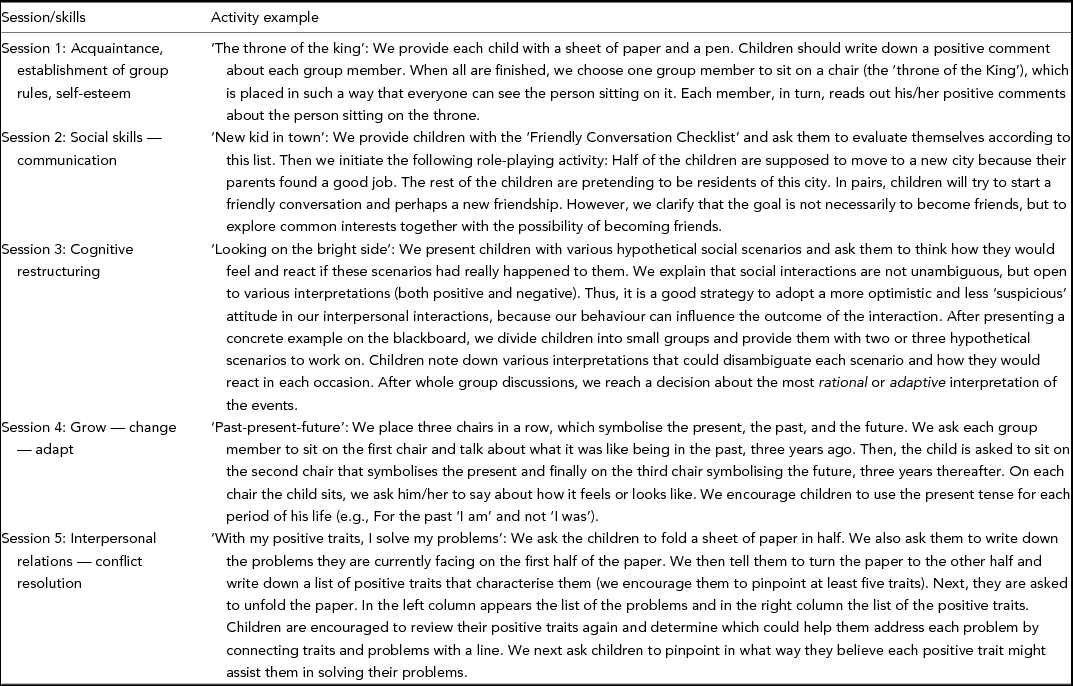
Participation in the study took place during the second school trimester (January–March 2015) and was completely voluntary. Prospective group members gave assent verbally, whereas their parents gave their consent through an opt-out procedure. Children completed the ASI, the SLAQ, and ILQ one week before the commencement of the program. In the intervention groups, the group facilitator administered the questionnaires to class groups by reading all questionnaire items out to the class. However, in the control groups the same set of questionnaires (except for the ASI, which was given only in the intervention group) was administered by the classroom teacher following the same procedure. Post-assessment questionnaires were administered at the end of the last session. The two intervention groups were led by the same group facilitator on the same day (but at different times) for 90 minutes per week for 5 weeks. All sessions were held at the school within the normal hours of the school day, and they followed roughly the same format from week to week. They began with a brief introduction to the topic of the session and an invitation for group members to check in. After the check-in, the topic of the day and group exercise were introduced. After completion of the group exercise and discussion, the remaining time was spent in further sharing and discussion followed by a brief check-out (for a brief overview of the sessions, see Table 1). Control group participants received no intervention during the course of this study. Pre-assessment and post-assessment data from the control groups were collected over the same 5-week interval as the intervention groups. In addition, three months before secondary school transition, but one and a half months after the termination of the group, children in both the experimental and control groups were asked to complete the SCQ as a follow-up assessment. However, three participants from the intervention group failed to complete the SCQ due to being absent on the day of follow-up assessment.
Structure, Skills, and Examples of the Group Program for Secondary School Transition

The group facilitator was a female graduate student at the Department of Education, University of Patras, who had attended a group counselling course. Her leadership style combined person-centred counselling (e.g., active listening, reflection, empathy) and active teaching techniques (e.g., psychoeducation, feedback, modelling, role play, and problem solving). She submitted weekly group plans and group summaries to the course instructor (first author) and received supervision on a regular basis. No ethics approval was obtained for this study because there is no system of ethical review of psychology research in the Greek university system. However, all research practices for this study were consistent with the Declaration of Helsinki (DoH).
Results
Preliminary Analyses
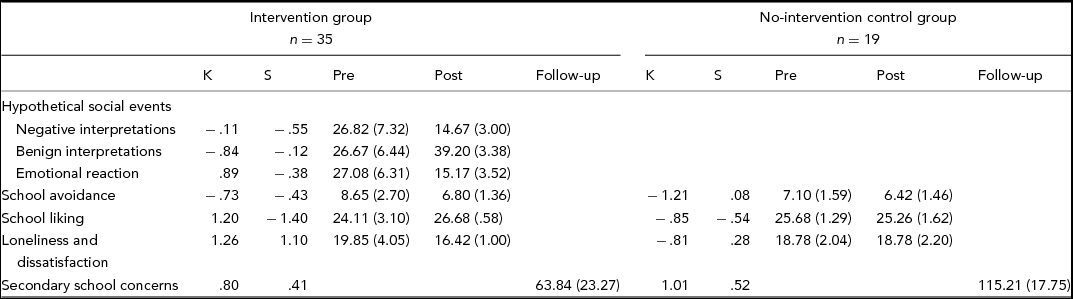
Data were first screened for skewness and kurtosis. The ILQ scores were found to be positively skewed and a log-transformation was applied.Footnote 1 Descriptive statistics for study outcome variables at pre-assessment are shown in Table 2.
Kurtosis and Skewness, Means (and Standard Deviations) of the Main Variables for Each Group on Each Occasion of Testing

Note: K = kurtosis; S = skewness.
Students’ Attitudes Toward School
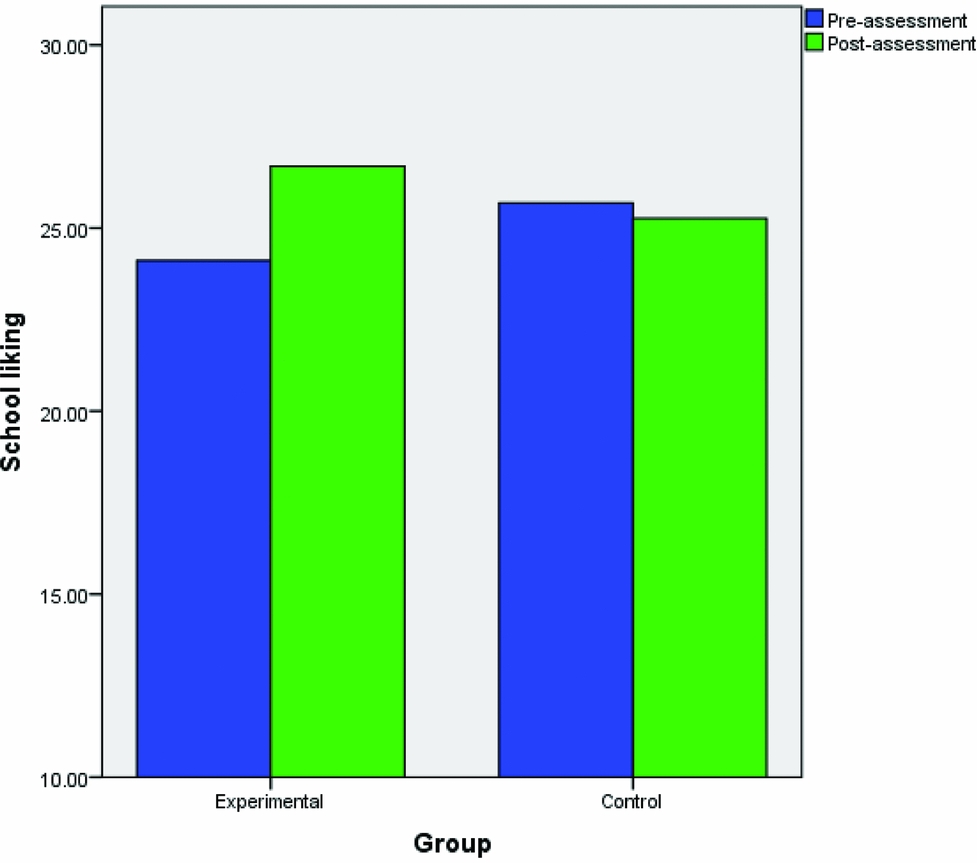
Means and standard deviations for attitudes toward school at each stage of assessment are presented in Table 2. Study hypotheses were tested using mixed ANOVAs with Group (intervention vs. control) as the between-subjects factor and Time (pre- vs. post-intervention) as the within-subjects factor. The analysis of school liking scores showed a significant main effect of time, F(1, 52) = 10.83, p = .002, partial η2 = .17, qualified by an interaction between time and group, F(1, 52) = 20.99, p < .001, partial η2 = .29. Post hoc comparisons showed a significant increase in school liking ratings after intervention, t(34) = 5.56, p < .001, whereas participants in the control group did not significantly change their scores, t(18) = 1.84, p > .05. Simple effect tests also revealed that although the control group reported greater school liking at pre-assessment, F(1, 52) = 4.41, p = .04, partial η2 = .08, children in the intervention group were more likely to report liking for school compared to children in the control group at post-assessment, F(1, 52) = 21.88, p < .001, partial η2 = .30 (see Table 2 and Figure 1).
Mean children's ratings of their school liking pre- and post-assessment.

In the ANOVA on school avoidance scores, a main effect of time, F(1, 52) = 17.64, p <. 001, partial η2 = .25, was qualified by a significant interaction between time and group, F(1, 52) = 3.75, p = .05, partial η2 = .07. Post hoc comparisons showed a significant pre-post reduction in school avoidance in both the intervention group, t(34) = 4.41, p < .001, and the control group, t(18) = 2.57, p = .02. Simple effect tests revealed that although children in the intervention group reported greater school avoidance at pre-assessment, F(1, 52) = 5.25, p = .03, there was no significant difference between groups at post-assessment, F(1, 52) = .90, p > .05. In addition, analysis of change scores showed significantly greater reductions in school avoidance in the intervention group (M = 1.85, SD = 2.48) than in the control group (M = 0.68, SD = 1.15), t(51.158) = 2.35, p < .05 (see Table 2).
Children's Loneliness and Social Dissatisfaction
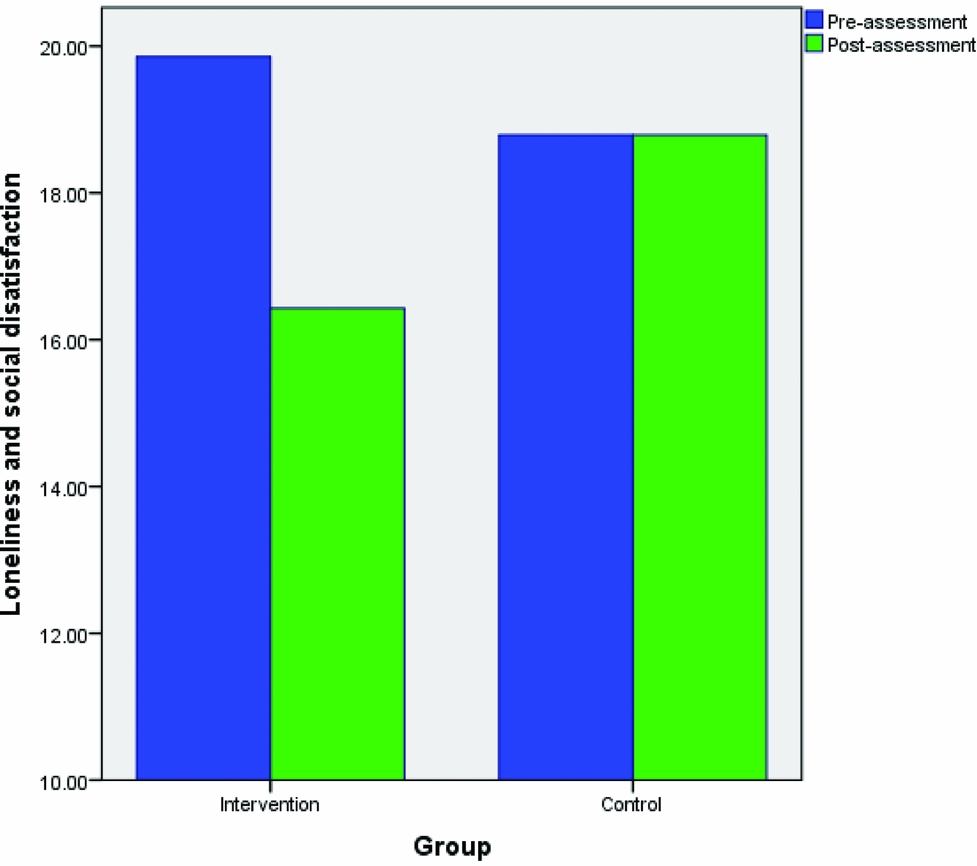
Changes in perceived loneliness were examined using a mixed ANOVA with Group (intervention vs. control) as the between-subjects factor and Time (pre- vs. post-intervention) as the within-subjects factor. As with the attitudes toward school, there was a significant main effect of time, F(1, 52) = 17.38, p < .001, partial η2 = .25, qualified by the interaction between time and group, F(1, 52) = 17.02, p < .001, partial η2 = .25. Post hoc comparisons revealed a significant decrease in ratings of perceived loneliness after intervention, t(34) = 6.04, p < .001, but no significant reduction in ratings for the control group, t(18) = .04, p > .05. In addition, although there was no significant difference between groups at pre-assessment, F(1, 52) = .86, p = .35, participants in the intervention condition were less likely to report feeling lonely compared to participants in the control condition at post-assessment, F(1, 52) = 30.68, p < .001, partial η2 = .37 (see Table 2 and Figure 2).
Mean children's ratings of their loneliness and social dissatisfaction pre- and post-assessment.

Ambiguous Situations Inventory
Changes in negative or benign interpretations and emotional reaction estimates were examined using paired-samples t tests. It was found that children in the intervention group reported a significant decrease in negative interpretations, t(33) = 9.60, p < .001, as well as an increase in benign interpretations, t(33) = 9.81, p < .001. They also evidenced a significant decrease in estimates of negative emotional reactions, t(33) = 10.73, p < .001, compared with their baseline scores (see Table 2).
Secondary School Concerns
A univariate ANOVA was performed on school concerns, with Group as the between-participants factor. The analysis revealed a highly significant main effect of group, F(1, 49) = 68.59, p < .001, partial η2 = .58. Inspection of group means (Table 2) indicated that although children in the control group evidenced a high level of fears and concerns three months before their transition to secondary school, children in the intervention group reported far fewer school concerns than those in the control group.
Regression Analysis
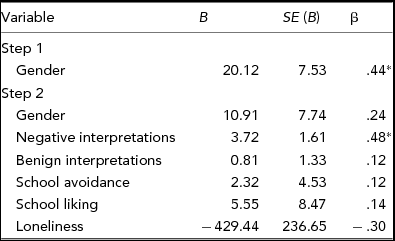
The data were then examined to determine whether post-assessment outcome variables (negative and benign interpretations, school liking, school avoidance, loneliness and social dissatisfaction) could predict secondary school concerns at follow-up in the intervention group. A hierarchical linear regression analysis was used to examine predictors of secondary school concerns (SCQ), entering gender (dummy-coded: boys = 0, girls = 1) in step 1 and mean-centred post-assessment outcome variables in step 2. At step 1, gender was found to be a significant predictor of SCQ scores (β = .44, t = 2.67, p = .01, ΔR 2 = .19), with girls reporting more school concerns compared to boys. Crucially, at step 2, only post-assessment negative interpretations were found to be significant predictors of participants’ school concerns at follow-up (β = .48, t = 2.31, p = .03, ΔR 2 = .23), after controlling for the effect of gender (Table 3). Gender did not significantly predict school concerns (β = .24, t = 1.41, p = .17) when post-assessment outcomes were included in the model.
Summary of Hierarchical Regression Analysis for Variables Predicting Secondary School Concerns

Note: Gender coded as boys = 0, girls = 1.
In sum, the regression analysis suggests that students who showed a less negative interpretation style at post-assessment tended to be those who reported fewer secondary school concerns three months before school transition.
Discussion
In line with our initial hypotheses, the results of this study indicate that participation in a problem-oriented group for elementary school students may contribute to reducing school avoidance and negative interpretation of ambiguous, anxiety-related information. The intervention was also effective in increasing benign interpretations of the same ambiguous stimuli and self-reported school liking. Furthermore, children's perceived loneliness, as well as their concerns about an impending school transition, were significantly reduced as a result of their participation in the group. These results not only replicate and extend the findings reported by Cox et al. (Reference Cox, Bamford and Lau2015), but also add to a growing body of evidence suggesting that participation in a universal prevention group can promote school adjustment and emotional wellbeing in children and adolescents (Harpine, Reference Harpine2013; Kulic, Daglei, & Horne, Reference Kulic, Dagley and Horne2001; Schechtman, Reference Shechtman2014). Finally, a gender effect was found in that girls were more likely to report feeling worried about starting secondary school compared to boys.
The present study also represents an interesting attempt to incorporate adapted techniques and material designed to decrease interpretation bias (Vassilopoulos et al., Reference Vassilopoulos, Banerjee and Prantzalou2009) into a universal transition group for 6th-grade students. Crucially, there was some evidence to suggest that the presence of a lower negative interpretation style at the end of the intervention was uniquely associated with fewer worries and school concerns that were assessed three months before secondary school transition. Although no definite conclusions can be drawn about the direction of causality, these results are in line with social information theories that suggest that information processing biases may be causally linked to children's social adjustment by influencing how real-life ambiguous events are processed (Crick & Dodge, Reference Crick and Dodge1994).
While large effect sizes are rarely found in universal prevention studies (because no participant selection process usually takes place), the effect sizes found in the current study regarding group outcomes suggest that the skills and strategies emphasised by the program were relevant to the participants and easy to master. Although the lack of an active control means that it is unclear which components of the group contributed to its efficacy and how these components influenced the results, we speculate that the use of small-group, problem-solving techniques was a critical factor that affected the success of the program. Thus, giving participants the opportunity to work actively in small groups and evaluate alternative interpretations for hypothetical events by examining the evidence for and against each of them and/or generating their own explanations might have enhanced the effects of interpretation training. This possibility is further supported by research in the context of anxiety-related interpretation bias that demonstrates that an active method of interpretation training, in which participants had to generate and/or select threatening meanings of ambiguous event descriptions, strengthened training-congruent effects (e.g., Hoppitt, Mathews, Yiend, & Mackintosh, Reference Hoppitt, Mathews, Yiend and Mackintosh2010).
Learning how to initiate and maintain social relationships or resolve interpersonal conflict is another group component that we consider to be essential for promoting secondary school adjustment. We have found that this component works best when the group facilitator is less directive when necessary. Sometimes group facilitators, especially less experienced ones, intervene to resolve any dispute among group members for fear of spoiling the group climate established so far. However, this swift intervention deprives group members of the opportunity to learn how to apply conflict resolution strategies in a safe context. At other times, group facilitators, especially those adopting the person-centred approach, stand passively in front of the children, waiting for the group to find its own direction. As Van Velsor (Reference Van Velsor2017, p. 308) points out, ‘a facilitator must decide whether to be a ‘sage on the stage’ (i.e., when children really need direction) and when to be a ‘guide on the side’ (i.e., when the children can negotiate successfully on their own). This decision making (which is always informed by the group's developmental stage and group members’ needs or personal characteristics) on the part of the group facilitator does not stand in contrast to the Rogerian concept of non-directiveness adopted in the current program, because the role of the counsellors (person-centred ones included) is to help clients ‘to reach a decision wisely, rather than reach a wise decision’ (Shiloh, Reference Shiloh, Marteu and Richards1996, p. 87).
Although promising, these results are preliminary and must be interpreted with caution. First and foremost, the sample was rather small in size, which limits the generalisation of the results. Larger samples are needed to confirm the effectiveness of the intervention. Also, because we did not use individual random assignment to place participants in intervention and control groups, there might have been group differences in characteristics not measured in this study. A further shortcoming of the present study was that it relied exclusively on children's self-reports. Future studies should employ multi-informant methods such as teacher and parent reports and/or classroom observation. In addition, given the brief duration of the intervention, future researchers could use short measures (e.g., the Critical Incidents Questionnaire; Kivlighan & Goldfine, Reference Kivlighan and Goldfine1991) and collect additional data to identify what part/s of the program brought about what effects. Another limitation is that we investigated the benefits of preparing children before moving on to secondary school. Future studies should examine whether the proposed intervention facilitates students’ school adjustment after they have started to negotiate the contextual change. Finally, future research could also compare the current universal program to an alternative prevention program to control for any non-specific therapeutic factors.
In sum, the results suggest that a universal, problem-oriented prevention group can reduce worries about an impending school transition and facilitate school adjustment. The brevity of the intervention and the size of the effect could make the group model attractive to mental health professionals and teachers wishing to implement psychoeducational programs within their regular curricula.