Several times, clients in my office who are looking for the financial analyst, they'll ask me, “Excuse me, I have a rendezvous with a financial analyst, can you tell me where I can [find] this person?” When I say “Yes, that's me,” they're shocked. When I first started working there, some clients just completely refused to work with me. Some even sent letters to the bank—wealthy customers—and said I should go back to the banlieue Footnote 2and to give my job to someone “French” …But now, mainly, they're just shocked when I say that I'm the analyst, like “Oh? Well …” They don't imagine that a Black person, a young Black woman, would have a position like this … I don't let it get to me. I just work hard and make sure that whenever one of them gives me that look, I do a little extra, make sure everything is perfect.”
—Josette, Financial Advisor, 28At the beginning of the year, when I started teaching, there was a teacher meeting and the head of the department introduced me and another woman because we were new. I was the only Black teacher. The next week I got to the room where my class was held and someone was in it. I waited a few minutes thinking the class before just hadn't ended, but then it was really time for me to start class, so I knocked on the door. A woman opened the door, said, “Tell your teacher this is my class,” and shut the door in my face, didn't even give me a chance to speak. The same one I sat next to at the introductions; she didn't recognize me … So, I knocked again and she opened and nearly yelling was like “Don't interrupt my class. I just told you …” And I stopped her, told her, “I amthe teacher; this is myclassroom” … She looked at me like she couldn't understand me or like I was speaking another language … I just wanted to make sure she knew I was a teacher too, that I had the same authority [as she].
—Khadijah, Lecturer and Doctoral Student, 29INTRODUCTION
At first glance, these two scenarios seem very similar: two educated, first-generation French Black womenFootnote 3 experiencing discrimination in the workplace. More specifically, both of them encounter mistaken presumptions, where their status and authority is underestimated. And yet the options available to them in how they respond to these situations are far from the same. If Josephine openly challenges the prejudiced attitudes of customers she is obliged to serve, her job could be put at risk. Khadijah, by contrast, having encountered negative treatment from a peer, not a patron, has greater latitude in choosing her response. What these two incidents make clear is that when it comes to confronting racism—all antiracist responses are not created equal.
The experiences and responses of these two women highlight two issues that need to be attended to in furthering the study of antiracism. It is well known that living in societies where they are marginalized can leave members of stigmatized groups subject to multiple forms of racism, discrimination, and exclusion in their daily interactions (Essed Reference Essed1991), leading them to develop multiple antiracist responses to manage these encounters. Yet all antiracist responses are not appropriate or feasible for every encounter of racism. Accordingly if we are fully to understand the choices that minorities make in responding to racism, we also need to know how the conditions of an incident of racism constrain the range of antiracist responses individuals can practically (or feasibly) employ. Secondly, and perhaps less intuitively obvious, when it comes to ethnoracial minorities of immigrant origins, we must attend to how they experience racial prejudice and discrimination as expressions of both xenophobic attitudes and assumptions about racial inferiority. This dual racism may raise challenges when it comes to interpreting incidents of discrimination or prejudice.
This exploratory study offers insight into both of these issues by examining how everyday antiracism is practiced among first-generation French Blacks.Footnote 4 Drawing on in-depth interviews with members of this group from various class backgrounds, this paper analyzes the repertoire of antiracist strategies these individuals say they used to respond to racism. Studying this group expands the demographic terrain of antiracism research by offering insight into the particular antiracist strategies employed by ethnoracial minorities of immigrant origins whose experiences have been largely unexplored. Minorities of immigrant descent warrant further inquiry because their position in social hierarchies of race may leave them subject to both the racial stigma and structural discrimination faced by other native ethnoracial minorities and to stigmas of foreignness and cultural incompatibility indicative of their parents' experience as immigrants (Kasinitz et al., Reference Kasinitz, Mollenkopf and Waters2002, Reference Kasinitz, Mollenkopf and Waters2006; Waters Reference Waters1999; Wu Reference Wu2002). Examining this population of ethnoracial minorities of immigrant origins may shed light on how issues of race, immigration, and national identity generate distinctive conditions for the experience of racism and antiracism (Kasinitz et al., Reference Kasinitz, Mollenkopf, Waters and Holdaway2008; Modood Reference Modood2004; Tuan Reference Tuan1998).
This paper also contributes to the conceptual refinement of the growing literature on everyday antiracism, enhancing our knowledge of how context impacts the use of everyday antiracist strategies. Integrating Kasinitz et al.'s (Reference Kasinitz, Mollenkopf, Waters and Holdaway2008) framework for categorizing incidents of racial discrimination and prejudice with Fleming et al.'s (Reference Fleming, Lamont and Welburn2010) analysis of responses to stigmatization among African Americans, I analyze antiracist responses by taking into account both the nature of the relationship between the victim and the perpetrator of racism (i.e., impersonal vs. personal) and the social context of the encounter (e.g., school, work, public space, etc). In doing so, I highlight how the conditions of a given incident of racism or discrimination set constraints on the range of antiracist modalities an individual can practically (or feasibly) employ.
The paper begins with a review of previous research on everyday racism and antiracist strategies, underscoring the advantages of examining antiracist strategies in relation to the context of the social interaction and the kind of racial slight a strategy attempts to address. It then moves on to a brief discussion of issues of race, discrimination, and identity for first-generation ethnoracial minorities in France, to set the context for understanding both the experience of racism for first-generation French Blacks and the varied ways they respond to it. Finally, after a brief description of methodology, the paper explores some of the responses to racism used among first-generation French Blacks.
EVERYDAY RACISM AND ANTIRACIST STRATEGIES
Over the last few decades, social scientists have noted shifts in the nature of racism, which is often manifested in ways more subtle and nebulous than the biological racism and blatant discrimination so prevalent in the past. Alternately labeled symbolic racism (Sears Reference Sears, Katz and Taylor1988), everyday racism (Essed Reference Essed1991), and aversive racism (Dovidio et al., Reference Dovidio, Gaertner, Kawakami and Hodson2002), these routine encounters of racism are suffused with differential or negative treatment towards individuals due to conscious or subconscious prejudice towards their perceived racial group membership (Essed Reference Essed1991). Whether exhibited in the negative actions and treatment of racial discrimination or the derogatory attitudes and stereotypes of racial prejudice (Kasinitz et al., Reference Kasinitz, Mollenkopf, Waters and Holdaway2008), the frequently covert nature of everyday racism can make it difficult to identify and acknowledge by victims and perpetrators alike (Sue et al., Reference Sue, Capodilupo, Torino, Bucceri, Holde, Nadal and Esquilin2007).
An interdisciplinary body of research is analyzing the frequency, forms and contexts of routine racism that minorities' experience. For instance, social psychologists D'Augelli and Hershberger (Reference D'Augelli and Hershberger1993) catalogue the frequency with which African Americans experience different types of everyday racist incidents (e.g., disparaging comments, personal verbal insults, threats, violence, etc.), while Landrine and Klonoff (Reference Landrine and Klonoff1996) examine the frequency of racist encounters from different perpetrators (e.g., teachers, employers, colleagues, strangers, etc.). Similarly, Swim et al. (Reference Swim, Hyers, Cohen, Fitzgerald and Bylsma2003) chart differences in the nature, context, target, and location of racist incidents, as well as between the perpetrator and his or her relationship to the target.
In addition, a sociological body of research examines antiracism, particularly how stigmatized minorities come to conceptualize and subvert routine racism (Feagin Reference Feagin1991). Essed's (Reference Essed1991) influential study of Black women in the United States and Surinamese in the Netherlands compares how Black women from these two cultures come to recognize, understand, and challenge routine racism. Lacy (Reference Lacy2007) studies how African Americans living in racially integrated and segregated environments go about managing their racial identities. Additionally, Lamont (Reference Lamont2000a, Reference Lamont, Lamont and Thévenot2000b) and her collaborators have focused on everyday antiracist strategies, which Lamont and Fleming (Reference Lamont and Fleming2005) describe as the “micro-level responses that individuals use to counter racist ideology in their daily life” (p. 6).Footnote 5 To illustrate, Lamont and Molnár's (Reference Lamont and Molnár2002) study of African American marketing specialists reveals how cosmopolitan Blacks use consumption to counter negative external definitions of Blacks as being unpatriotic or lazy and to signal to the White majority their aspirations for achieving full social membership (e.g., as American citizens or middle-class people).
One shortcoming in the existing literature, however, is that the diverse antiracist strategies exhibited within and across populations are often compared indiscriminately, without giving sufficient consideration to the nature of racism or the context of the encounter.Footnote 6 A few scholars, however, are addressing this weakness, developing schemas to classify and distinguish between antiracist responses (Lamont et al., Reference Lamont, Morning and Mooney2002). Fleming et al. (Reference Fleming, Lamont and Welburn2010) offer a classification framework that differentiates antiracist responses according to their functional aim or “modalities”—highlighting whether a response attempts to challenge or deflate conflict in a social interaction.
Beyond functional aim, we know that antiracist responses are not employed at random, but rather tailored to address distinct encounters of stigmatization, underestimation, exclusion, or silencing. Not all responses are suitable in every context. For instance, individuals may have little to no ability to confront some incidents of discrimination (e.g., taxi drivers refusing to stop), whereas in other situations they may be able to confront the perpetrator or make a formal complaint (i.e., being ignored in a store) (Fleming et al., Reference Fleming, Lamont and WelburnForthcoming). Moreover, the risks associated with using a given modality may vary greatly depending upon the social context or the power relationship one has with the perpetrator. Thus, even when confrontation is logistically feasible, personal or professional risks may inhibit confrontation.
RACE, IMMIGRATION, AND THE FRENCH CONTEXT
Traditionally, France was held as an exemplar of assimilation, able to transform its European immigrants into Frenchmen in one generation. Yet, as France has had to integrate a more ethnically, racially, and religiously diverse population of “new” French, its image as a bastion of successful assimilation has come under question. “Immigration” in France has come to be used as a substitute or euphemism for race, ushering in a “new racism.” In the words of Balibar (Reference Balibar, Balibar and Wallerstein1991):
Ideologically, current racism … centers upon the immigration complex, fits into a framework of “racism without races” … whose dominant theme is not biological heredity but the insurmountability of cultural differences … which, at first sight, does not postulate the superiority of certain groups or people in relation to others but “only” the harmfulness of abolishing frontiers, the incompatibility of lifestyles and traditions
(p. 21).Amidst mounting tensions between native White Frenchmen and non-Western “immigrants”, phenotypic traits indicating non-European origins have become stigmatized. Increasingly, the intolerance and xenophobia once reserved for immigrants is extended to their descendants, who are frequently portrayed as being as culturally incompatible with mainstream French society as their parents (Body-Gendrot and Schain, Reference Body-Gendrot, Schain, Horowitz and Noiriel1992).Footnote 7 As a result, the dilemma of integration for descendants of African immigrants often gets framed as a problem of assimilating individuals who are culturally different—where culture is used euphemistically to mean race—which is conveyed in seemingly race-neutral labels such like “personnes issues de l'immigration ou supposées d'être telles” or “enfants d'immigrés” (Simon Reference Simon2000).Footnote 8 This goes hand in hand with the perpetuation of popular and governmental discourses that reinforce common sense understandings of “Black” as mutually exclusive from “European” (Alexander Reference Alexander1996; Andersson Reference Andersson2010; Goldberg Reference Goldberg2006).
The association of being Black with noncitizenship, and accordingly foreignness, reveals a deep contradiction in the public conception of France as a color-blind nation or a “société sans race” (Sabbagh and Peer, Reference Sabbagh and Peer2008). Insisting on the irrelevance of race in French society, French public discourse frequently equates a denial of biological races and lack of official racial categories with the absence of racism in French society (Weil Reference Weil2002; Wievorka Reference Wievorka1992). A parallel discourse claims that race—as a concept and reality—is incompatible with the founding notions of French republicanism and universalism, obscuring how French republicanism always had universalizing and particularizing facets (Goldberg Reference Goldberg2006). As Silverman (Reference Silverman2007) notes, “‘Race’ was not banished with the call for equality and liberty … but, from the onset, was built into the very fabric of the Republican nation” (p. 631). Indeed, the racial hierarchies upon which France's colonial legacy was founded testify to how racial distinctions have long functioned as features rather than failures of French republicanism (Wilder Reference Wilder2005). In their aptly titled article, “The Modern Colonial Politics of Citizenship and Whiteness in France,” Jugé and Perez (Reference Jugé and Perez2006) highlight the scant attention paid to how definitions of French citizenship serve as a construction of Whiteness: “French politics of race and Whiteness are especially damaging yet nebulous in France, because it is [easy] to get blind-sided by this universal concept of membership: inclusive citizenship … people of colour who do not fit the ‘special’ characteristics required to become French find themselves in the foreigner category” (p. 191).
Denials of the existence of race and mythologies of color-blindness make it easy to trivialize, ignore, or outright deny contemporary claims of racial discrimination (Shepard Reference Shepard2006). This may be why in reflecting on the United Nation's Committee on the Elimination of Racial Discrimination's 2010 report on racism in France, the Special Rapporteur for France expressed concern that the resurgence in racism and xenophobia in the country since 2005 might be due to “a lack of political will at the highest levels of the State to provide equal opportunities for all and to address the concerns of each and every citizen” (CERD 2011, p. 5). In this context, racial discrimination is particularly difficult for Blacks to confront even when differences in the life chances of Whites and minorities testify to the de facto significance of race (Fassin and Fassin, Reference Fassin and Fassin2006).
The uprisings that raged throughout metropolitan France in 2005, however, brought broader public awareness to the sentiments of frustration, dissociation, and rage among French ethnoracial minorities on two fronts (Tissot Reference Tissot2007). On one hand, they highlighted how discrimination has expanded beyond more overt forms of discrimination to include indirect racism, particularly around issues of perceived ethnic origins and national identity (Durpaire Reference Durpaire2006; Fall Reference Fall2005; Fassin and Fassin, Reference Fassin and Fassin2006; Gueye Reference Gueye2006).Footnote 9 On the other, they contributed to the establishment of le Conseil Représentatif des Associations Noires (CRAN)—a social association of Blacks living in France. The organization defines itself as representing all Black people living in France rather than representing specific national groups—Africains or Antillais—in recognition of and response to how they are externally categorized in French society (Gueye Reference Gueye2010; Keaton Reference Keaton2010). The convergence of the uprisings, the creation of CRAN, and the institutionalization of national commemoration of slavery (Fleming Reference Fleming, Freeman, Johnson and SealeyForthcoming), has brought particular attention to the unique challenges faced by French Blacks (Clark Hine et al., Reference Clark Hine, Keaton and Small2009; Ndiaye Reference Ndiaye2008).
THE CASE OF FIRST-GENERATION FRENCH BLACKS
With roots in Mali, Senegal, Cameroon, Ivory Coast, Togo, and Guinea, among others, first-generation French of sub-Saharan African origins are exceedingly heterogeneous, representing a cornucopia of ethnic groups, familial national origins, cultural and religious traditions. Unfortunately, it is difficult to know the precise size of this population. French laws prohibiting the collection of data on race or parental origins of French citizens makes first-generation French Blacks (and other minority first-generation groups) statistically indistinguishable from their White French counterparts.Footnote 10 Furthermore because most census data and population surveys do not record the original nationality of naturalized French citizens, it is difficult to get even a retrospective picture of people whose parents (or grandparents) had foreign nationality (Simon Reference Simon2005; Simon and Stavo-Debauge, Reference Simon and Stavo-Debauge2004).Footnote 11 This “politics of indifferentiation” further perpetuates the evasion of the realities of racial diversity in France (Simon Reference Simon2008).Footnote 12 However, as Simon (Reference Simon2003) reveals, estimates suggest that the sub-Saharan African immigrant population increased by 43% between 1990 and 1999, while the overall immigrant population increased by only 3.4% (p. 1094).
There has been a dearth of research on first-generation French Blacks (Fall Reference Fall2005). Scholarship on racism and immigration in France frequently focuses on North African immigrants and their descendants, often considered the most frequent victims of French discrimination (Lamont Reference Lamont2000a; Silverman Reference Silverman1992; Simon Reference Simon2000), while extant research on Blacks in France has focused on sub-Saharan African immigrants or refugees with much less attention on their descendants (Barou Reference Barou2002; Fall Reference Fall1986; Poiret Reference Poiret1996); Fleming (Reference Fleming, Freeman, Johnson and SealeyForthcoming) offers a different viewpoint. Situated at the crossroads of hierarchies of race and immigration, first-generation French Blacks occupy a unique social position, which can leave them subject to intersecting forms of racial stigma, prejudice, and discrimination. Some of this racism mirrors what other native ethnoracial minorities face, while other forms parallel issues faced by immigrants who are ethnoracial minorities. Recent research, however, suggests this group also faces distinct forms of racism because their skin color and phenotypic features are read as markers of foreignness, leaving them subject to perpetual queries on their origins that call their “Frenchness” into question (Durpaire Reference Durpaire2006; Malonga Reference Malonga2004).Footnote 13 This denial of their claims reflects the ways that Whiteness gets conflated with national identity and belonging in the French case (Lozès Reference Lozès2007; Sagot-Duvauroux Reference Sagot-Duvauroux2004).
Being ethnoracial minority citizens also influences this group's understandings of race, national belonging, and citizenship rights, shaping their views on how racism should be responded to (Andersson Reference Andersson2010; Franchi and Andronikof-Sanglade, Reference Franchi, Andronikof-Sanglade, Bekker, Dodds and Khosa2001; Keaton Reference Keaton2006). Raised in immigrant households, many with Muslim upbringings, their antiracist practices could be expected to mirror those of North Africans—being structured around the religious mores of Islam and with ambivalence about French principles of universalism (Lamont Reference Lamont1999; Lamont et al., Reference Lamont, Morning and Mooney2002). At the same time, being schooled in the French public education system, they might also deploy antiracist responses informed by French republicanism, and by White French elite, popular, and activist antiracist rhetoric (Lamont Reference Lamont2000a; Lentin Reference Lentin2004). Ultimately, the range of antiracist practices they employ may be as diverse as the manifold forms of racism that they encounter.
METHODS
This paper draws on semistructured interviews with twenty first-generation French Black adults, ages eighteen to thirty-five, from various class backgrounds, living in Paris or its suburbs. These interviews probed their perceptions of challenges and opportunities for descendants of immigrants in France, their experiences with discrimination, and their racial, ethnic, and national self-understandings.Footnote 14 Given the small sample size, the study's purpose is not to reach firm conclusions but to explore new paths of inquiry.
A snowball approach was used to recruit the sample. I located participants by making contacts with community and cultural associations, university organizations, and previous respondents. To increase internal diversity in the sample, only one respondent was solicited from each previous respondent. Criteria for entry into the sample included: being a French citizen, being raised and educated in France, and having at least one parent who migrated to France from sub-Saharan Africa. Additionally, the study focused on the eighteen to thirty-five-year-old cohort because most people of this age group have come into full adulthood, are primarily responsible for their own livelihood, and are experiencing the socioeconomic advantages and disadvantages of the labor market. All respondents had finished high school and were either regularly employed or were self-supporting full-time students (i.e., full-time night shifts or part-time employment and student loans).
While the relatively high level of education and employment among the interviewees makes them unrepresentative of the larger population, these characteristics also increased the likelihood that respondents would live and work in integrated environments, interacting with White French in public and at work—where everyday racism frequently occurs (Feagin and Sikes, Reference Feagin and Sikes1994; Hochschild Reference Hochschild1995; Pattillo-McCoy Reference Pattillo-McCoy1999; Tatum Reference Tatum1999). To diversify the sample, I sought respondents raised in families of varied class backgrounds, resulting in a sample with seven respondents from (self-described) poor or working-poor families, eight from working-class families, and five from middle-class families. Ultimately, examining educated, employed young Black French extends the terrain of inquiry on the French “second-generation” by moving us beyond the more often studied populations of adolescents and jeunes defavorisés (disadvantaged youth) (Oberti et al., Reference Oberti, Voisin and Sanselme2009; Silverman Reference Silverman1992; Silberman et al., Reference Silberman, Alba and Fournier2007; Thomson and Crul, Reference Thomson and Crul2007).
To elucidate the cultural repertoire (Swidler Reference Swidler1986) participants drew upon in constructing their antiracist strategies, they were asked to describe specific incidents when they perceived racism in multiple locales (e.g., school, work, public spaces, etc.) and in varied relationships (e.g., co-workers, neighbors, or strangers). They were also asked to describe their responses to these encounters and/or responses they advocated to manage such situations. In most interviews, narratives about coping with routine racism emerged spontaneously in discussions of challenges and opportunities in French society. When these themes did not emerge spontaneously, respondents were probed at the end of the interview in questions about discrimination, racism, and social integration.
The interviews were conducted by the author, at a time and location of the participant's choosing. They were digitally audio-recorded, and lasted between fifty minutes and three hours. Field notes were written after each interview describing the respondent, setting, and salient themes in the interview. Close, iterative readings of the field notes and interviews were conducted soon after the interview to facilitate the process of grounded theory development (Charmaz Reference Charmaz2006; Glasser and Strauss, Reference Glasser and Strauss1967). I first considered respondents' accounts of encounters with perceived prejudice discrimination and exclusion. Then I paid attention to patterns of responses and their normative beliefs about responding to these encounters. It is worth noting, that while many descriptions of racism focused on the lack of representation of Blacks in the media, politics, or executive positions, this paper focuses on racism in social interactions.
As a Black American female researcher, I was both an insider (on the basis of race, and sometimes class and religion) and an outsider (as an American and nonimmigrant in my society). Consequently, I often oscillated between these positions over the course of an interview. Likewise, interviewees perceived me as both similar and different—anticipating my experience with racism as a Black person, yet expecting me to be unfamiliar with manifestations of racism in France. My body also became a tool of experimentation, as my physical appearance left me subject to similar treatment, prejudice, and challenges confronted by Black French—from being passport-controlled to being questioned about my “real” origins after identifying myself as American. Whatever personal challenges these experiences supplied, being exposed to what Keaton (Reference Keaton2005) identifies as “the hostilities and incivilities experienced by those with whom I am assigned skinship relations,” (p. 409) was an asset to my research.
EXPERIENCING AND RESPONDING TO RACISM
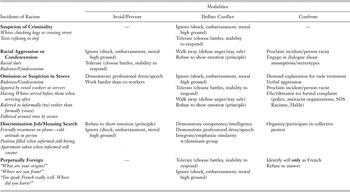
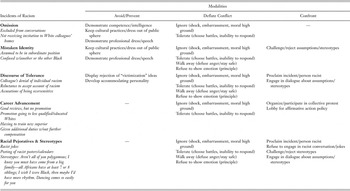
In their discussion of how first-generation American ethnoracial minorities in New York experience and respond to racism, Kasinitz et al. (Reference Kasinitz, Mollenkopf, Waters and Holdaway2008, p. 326) provide a useful framework of racism that distinguishes between incidents of racial discrimination (i.e., negative actions and treatment) and racial prejudice (i.e., negative attitudes and stereotypes), and categorizes both according to the nature of relationship between minorities and perpetrators of racism (anonymous vs. personal) and the social context in which the encounter occurs (e.g., school, work, public space, public institutions). Integrating Kasinitz et al.'s (Reference Kasinitz, Mollenkopf, Waters and Holdaway2008) with Fleming et al.'s (Reference Fleming, Lamont and Welburn2010) categorization of antiracist responses to stigmatization modalities (avoid/prevent, deflate conflict and confront), I organize the antiracist modalities used by respondents to counter everyday racism (whether manifested as racial prejudice or discrimination) according to the nature of relationship (impersonal vs. personal) and the specific contexts of each encounter. Beyond identifying and classifying respondents' responses, I also underscore how the conditions of a given racist encounter constrain the possible responses. In the following section, I review the four possible configurations of responses, classifying them by the character of the relationship between victim and perpetrator, and the context of the incident. The pattern of responses in both impersonal and personal encounters, respectively, are presented in Figures 1 and 2.
Use of Antiracist Modalities—Impersonal Encounters

Use of Antiracist Modalities—Personal: Work

Impersonal: PublicFootnote 15
The most commonly reported form of racism was experiencing discriminatory mistreatment from strangers in public spaces, particularly when shopping. Several respondents told stories about retail workers being rude or condescending (e.g., using the informal tu rather than formal vous), ignoring their presence, serving White customers before them, or refusing to provide services. One respondent recounted this incident:
I went with my sister to buy a gift … and we took it to where they do gift-wrapping. The woman said, “We don't do gift-wrapping.” … I'd been there just the week before and asked about [gift-wrapping], which is what I told her. She kept saying, “No, no. It's not possible.” My sister, she's a lawyer, asked for the manager. Then her story changed… “Well, yes we do gift wrapping, but I was tired.” And she told this whole long story about having a bad day. My sister cut her off. “Stop your games. If you ever do that again, we'll report you and file charges.”
Other respondents were not so direct in their confrontation as to threaten to file charges. Nevertheless, nearly half of them did question or challenge workers when they felt they were treated unjustly. Still, conflict-deflating approaches (e.g., to tolerate and/or ignore workers, walk away, or leave the store) were mentioned nearly as much as confrontational responses. A few explained that they used these conflict-deflating responses because they were sometimes uncertain about whether an incident was racially motivated. More often, however, respondents offered a simpler rationale—confrontation just was not worth the effort.
Other incidents in public places include being ignored by taxi drivers or having Whites react to respondents with fear. This type of racism did not provide respondents with much opportunity for response. One woman, for instance, recalled walking to her new apartment in a banlieue (suburb) populated with few other Black people, when she noticed that a White woman had hugged her purse when the respondent walked by. The respondent said all she could do was to ignore the incident, partially because she was unsure if the woman's reaction was racism or simply “fear of the unknown,” which for her was a matter of fearing immigrants more broadly, and not Black people specifically. The pervasive stigma towards immigrants and their descendants makes it difficult for them to determine if the discrimination they experience is primarily about them being Black or about presumptions that they are foreign, immigrant, or Muslim (Balibar Reference Balibar, Balibar and Wallerstein1991). Furthermore, like this young woman, some respondents were very hesitant to attribute hostile reactions to race fearing they would be viewed as overly sensitive or racist (Beyala Reference Beyala2000; Sagot-Duvauroux Reference Sagot-Duvauroux2004). Overwhelmingly, such encounters left respondents feeling incapable of direct response, so ignoring them was the only strategy available.
Respondents were most likely to use a confrontational response when strangers were aggressive or blatantly demeaning. Mariama, recounted this story:
I was waiting in line with my friend at the SNCFFootnote 16 counter, buying a ticket at Gare du Nord. A woman in line in front of my friend asked if we could hold her place in line. When she came back an old [White] French man, way at the back of the line, came pushing through the queue and when he got behind the woman, he tapped her on the shoulder—with his cane!—and said, “Hey, the line is back there.” I just stared at him for a minute … Then I lost it. I started shouting, “We don't talk to people like that. She was already here, but still we don't speak to other people like that … and we certainly don't poke them with a cane!” And he was surprised like, “Okay, okay.” He got indignant with me and kept saying, “That's enough, that will suffice.”
Explaining her reaction, Mariama was convinced that the gentleman would have never acted that way with a White woman. Such explosive forms of confrontation were rare, yet many respondents said they'd grown less tolerant of aggression and rudeness from White French as they got older. One respondent remarked:
I was far out in the banlieue … and transferred from the RER to a bus … [but] I wasn't sure if I needed a ticket for a new zone. I asked the driver … he said yes, but he was very short and I hadn't explained the transfer. So I started to explain and he says, “See … If we explain it to them, they still don't understand.” I asked, “Excuse me sir, but why are you taking that tone with me?” And he was like, “Well I explained it to you and you keep asking questions.” [I replied] “Yes, but … What have I done for you to speak to me that way? And who are they?”
Impersonal: Job Search
Experiences with racism when applying for jobs were particularly difficult encounters, that often began as early as searching for a first internship. One respondent told me:
One of my mother's friends, a [White] French woman, had a friend who was looking to hire someone for an internship. She told me, “It shouldn't be a problem, just contact them. I've told them you're smart and ambitious and hardworking.” So I applied and went for an interview, but I never got a response. My mother's friend said she didn't know what happened at first, but eventually she told us that the woman said no … [but] said if she knew any [White] French girls who wanted to apply that would be fine.
The confirmation of racial discrimination this young woman received is rare. The reason respondents failed to get interviews or jobs was seldom so clear. Others told of how they'd received encouraging feedback speaking to employers by phone, only to be told that position was already filled once they arrived for a face-to-face interview. Describing how her brother was unemployed for two years after getting certified in software design, one young woman observed that hiring discrimination was particularly frustrating for individuals who had been academically successful:
There's always this problem of job discrimination. Sometimes there are people, like my brother, who cassent leurs têtes (rack their brains) after school, saying “Okay, now what am I supposed to do? I have a good degree, but still can't get a job.” It's a rather vicious cycle.
Given these realities, it is worth remarking that only a quarter of the respondents noted that people could appeal to antiracist organizations like SOS Racisme if discriminated against. None, however, had personally made any appeals. Just as many respondents, however, described antiracist organizations as being ineffective, largely due to their lack of political clout. More importantly, even when respondents were convinced their rejection was racially motivated, they felt helpless because they lacked evidence to prove their suspicions. The illegality of collecting ethnoracial data renders first-generation French minorities statistically invisible from their White counterparts, so proving institutional patterns of racial exclusion is all but impossible (Silberman et al., Reference Silberman, Alba and Fournier2007; Simon Reference Simon2003). Moreover, many deemed filing formal complaints futile because the fines for discrimination were too trivial to stop or deter racism. Some of these respondents insisted on the need for collective mobilization and lobbying for affirmative action policies in France:
You know they're [White French] like, “Oh it's going to start inequality here. People are going to be hired because they're Black or Arabs.” That's not true. What we're asking for is to be hired because we're skilled; we just happen to be Black or Arab. They don't want to give us the jobs. That's why we've got to organize. I don't think it's going to happen without some sort of social movement.
Impersonal: Questions on Origins
One topic that emerged spontaneously as many respondents discussed their perceptions of social integration was facing questions from White French like, “Where are you from?” or “What are your origins?” For a few, origin questions indicated little more than cultural curiosity, so they simply answered. Other respondents were a bit more ambivalent about such questions and the assumptions of foreignness they implied. While they would reveal their familial origins, they made a point of emphasizing that they were first of all French: “I always say that I'm French, of Cameroon origins, because it's … a way of putting together these two parts of me.” Emphasizing their Frenchness was a way for these respondents to demonstrate their commonality with French peers without immigrant origins, as one observed, “We were all born here … when you only have lived in [one] country, you're likely to have experienced the same things.” It is worth noting, however, that even for some respondents who said that the question posed no personal problem, several still held considerable ambivalence about being questioned about origins. To illustrate, after telling me the question didn't bother her, when I asked Aicha why she thought that White French posed that question, she took a long time to reply. Finally she said, “You know, I speak French very well. I don't have an accent, so there's no need to ask about my origins.” Still, after another long pause, she concluded, “But here, I'm obligated to answer that question.” That sense of obligation echoes another respondent's sentiments, “Yes, on papers, sure, we're all French. But when I say I'm French, I'm obligated to specify my origins.”
Other respondents, however, were convinced that questions about their origins were inappropriate. Being frequently questioned about their origins left them feeling that White French were incapable of seeing being Black as compatible with being French, revealing contradictions in the imagined ideal of a color-blind France. Over time some respondents came to take firm positions about revealing, or as was often the case, not revealing their origins. Philipe explains, “When I get into a discussion, I tell them I'm not going to justify myself. I've only had a single nationality in my life. I say always—I am French … when I'm joking, I say I'm more French than Sarkozy … It's something I won't explain.” For others, their declarations of being French became strategic, not necessarily indicative of its salience in their personal self-conception, but rather used to reveal the implicit racial assumption in questions about origins. Fatima, a marketing manager who described herself as “profoundly Parisian,” notes:
I say “I'm French” totally on principle. I was born in France; I'm French. That forces them to confront what they said. And then they have to change their question [imitating hmms, haws, and stuttering] and they say, “I mean what are your origins?” And I say, “Oh, well my parents are from Senegal. But I'm from here, Paris, the nineteenth” [arrondissement].
The way that these respondents choose to confront and challenge identifications that exclude them from the valued social category French lends credence to Keaton's (Reference Keaton2005) assertion that a shift has occurred in the self-understandings of some French descendants of immigrants. Defining themselves as being French or French of “X” origin(s) marks a significant departure from previous generations whose self-understandings tended to emphasize parental nationality. Table 1 provides examples of the specific antiracist practices used across modalities in impersonal encounters.
Antiracist Practices by Modality: Impersonal Encounters

Personal: Work
The second most frequent accounts of discrimination and racism across the interviews occurred in the workplace. More than half of the respondents told stories about White co-workers confusing them with another Black employee—often despite very different appearances. More problematically, several respondents recalled multiple occasions when they were automatically assumed to be in subordinate positions (e.g., intern, janitorial staff, or security worker). Many respondents were conflicted about how to interpret those assumptions—did they signal Whites' inability to imagine Blacks in positions of authority or was there some other characteristic of theirs that was being misjudged (e.g., age). Most respondents ignored such encounters when perpetrated by a stranger. Such situations were harder to ignore, however, when committed by co-workers they'd already met—leading a few to directly challenge their mistaken identity.
A few respondents said they used offense as their best defense to thwart racism at work. They tried to disprove, or at least distance themselves from, negative stereotypes about Blacks and/or people of immigrant origins in several ways: presenting a happy and positive disposition, conveying shared values and interests to co-workers, working twice as hard to show their competence and intelligence, and demonstrating professionalism through their speech, dress, and even how they styled their hair. One respondent noted, “On a personal level you have to make an effort. I mean, whatever I do, I try to do it well … it sounds a little bit simple, but wherever I go, even if I have to work twice as much as my peers, I do it.” A few respondents explained that they used preventative antiracist practices to help transform misconceptions White French have about first-generation French Blacks. While acknowledging that some Whites still held derogatory stereotypes about Blacks, these respondents often emphasized progress towards greater racial tolerance and acceptance. As one respondent noted, “The best way to rid people of stereotypes is just to show … that I'm capable of doing things well so that folks have to question their assumptions.” Other respondents, however, were less convinced about trying to prevent racism, explaining that Whites evaluated them in arbitrary and unpredictable ways. One observed, “I can't help thinking that there's a little portion of luck… I mean, it's like you carry yourself well, you do everything correctly, and then you have to wish for some luck for someone [White] to notice or to have your skills acknowledged.”
Respondents also discussed institutional racism at their jobs, for example, minorities having their requests for vacation or shift changes repeatedly denied. Others noted being repeatedly passed over for promotion despite positive job reviews—or having trained and taught White employees who would then get promoted to manage them. Many respondents had a hard time determining how to respond in these cases. With the exception of one woman who filed a complaint about job promotion, no respondent formally challenged workplace discrimination. Some felt they lacked adequate evidence to prove their accusations. Most, however, feared that confronting their superiors might put their jobs at risk, as one respondent explained:
What do you do, for instance, when you've been working for five years in the same company? You're qualified; you have degrees. They tell you, you're wonderful, great, and hardworking … but they never even suggest you should be promoted. So you stay at the same level and watch as everyone passes you by? But you have to work, especially when it took so long to find a job anyway.
Finally, by far the most frequently mentioned type of racism at work was racially derogatory comments from co-workers. These ranged from racially prejudiced jokes to clichéd comments that pathologized their race or culture. One respondent recalls:
I was surprised when this guy I worked with told us about a trip he took to Mali. He told us about the people, how he stayed with a family he'd met there and how nice they were. [I thought] wow, maybe I was wrong. I always thought he was really racist, the kind who would never be around Black people … But then, I went into his office a couple of days later and I saw [the family's] picture—or I figured it was their picture; what other Blacks would he have a picture of?—so I asked their name. And he said, “I don't know—Bam-bam-boula or something,” and laughed. I thought, Ahh—okay. Guess I wasn't wrong.
Respondents detailed a wide range of conflict-deflating responses to racially charged comments: ignoring or pretending not to hear the comment, refusing to laugh, or leaving the conversation. Some directly challenged racist assumptions, at times confrontationally in anger, but often trying to deflate conflict by opening dialogue to correct false assumptions and stereotypes (e.g., all Africans are polygamous or all Black people can dance). Several respondents simply tried to avoid colleagues who repeatedly made racist comments. Given the frequency of such events, most respondents detailed a range of these strategies depending on the situation. Table 2 provides examples of the specific antiracist practices used across modalities in personal encounters.
Antiracist Practices by Modality: Personal Encounters: Work

Personal: School
A few respondents mentioned experiencing racial prejudice from their White classmates in childhood. One respondent recalled other children refusing to hold his hand fearing “they would become Black,” and another noted how she and her sisters had been mocked and pointed at when starting a new school in the provinces. One woman told of being excluded in elementary school:
Everyone had been talking about the [birthday] party for weeks, but a few days before, neither me nor the other Black students had gotten an invitation. Then the weekend for the party passed and the girl never said anything about it. I asked my mother why I hadn't been invited and she never really answered. I was very marked, very marked, by that.
Although typically brushed off as simple childhood ignorance, for some these early moments foreshadowed how belonging would be constrained for them as Black French.
Other respondents recalled how teachers had underestimated their ambition, potential, or intelligence (e.g., being placed into lower-level classes with no regard to their previous academic success). These stories were particularly salient to their aims of pursuing higher education. Khadijah, the graduate student quoted in the introduction recalled professors asking, “Why do you want to get a PhD? Just take the agrégation Footnote 17 to be an English as a second language teacher and teach in junior high or high school. Besides, you don't have the money to do a PhD.” Khadijah ignored the advice, noting with some indignation, “I kept thinking, I never had the money to do even an associate's degree … Since when do you care about my financial situation anyway? At every step it was, “That's good enough,” you know?” Respondents with similar experiences either ignored teachers or transferred to new advisors or programs. No respondents ever openly challenged their teachers or questioned if their comments were racially motivated. However, most respondents who pursued advanced degrees said they became more outspoken as they continued their educations. A few even did ask professors why instead of being encouraged they were repeatedly counseled to quit; seldom did they feel they received an adequate response.
DISCUSSION
Respondents' accounts revealed clear variations in the fit and feasibility of the various antiracist responses that could be used for different types of racial encounter. Conflict-deflating responses were the only ones used in all the impersonal and personal encounters across contexts. While some instances of racism are amenable to antiracist practices in all three modalities, others were not. This was particularly true of impersonal encounters in public spaces, such as hailing cabs or having one's identity checked by the police. The brevity of these encounters often made direct confrontation impossible. Moreover, because they occurred with no forewarning and could never be fully anticipated, avoidance/prevention strategies were unfeasible. The one exception to using preventative strategies was in retail environments or restaurants, where repeated instances of receiving inadequate service or being followed made some try to signal middle-class status and respectability with their dress. Overall, feeling they had little control, many respondents left these situations with a sense of frustration, discouragement, and anger. Perhaps the most difficult of these encounters were applying for jobs or housing, because the outcomes could have direct and significant consequences on their lives.
The one impersonal encounter respondents did express some sense of control over was addressing questions about their origins. Although they could not predict who would pose the question, it had become so habitual that they were never really surprised by it. Despite being unsettling to some, most had already reconciled themselves to the idea that such questions would remain constant features in their lives. This regularity, however, left respondents equipped with a battery of both conflict-deflating and confrontational responses to address such questions—and the presumption of foreignness they implied.
In the sphere of personal encounters with perceived racial discrimination, respondents used antiracist practices from all modalities in most contexts. Most expressed a greater sense of control in managing personal encounters, particularly in the workplace. For some, encountering negative stereotypes and discrimination issued a challenge for them to prove their intelligence, fortitude, and skill—disproving stereotypes, or at least showing that stereotypes do not apply to all Blacks. When respondents did use confrontational strategies, they were often to engage in dialogue with perpetrators of racism or to challenge stereotypes by pointing out flawed or mistaken assumptions.
One interesting observation revealed by respondents' descriptions of their personal experiences with racism was that they often held very different conceptualizations of racism and discrimination. While some respondents emphasized prejudice, others focused more on recounting experiences with discrimination. These differences highlight Kasinitz et al.'s (Reference Kasinitz, Mollenkopf, Waters and Holdaway2008) observation:
We live in a time of immense racial talk and racial labeling. But this widespread “race talk” means that people use the same terms to describe different phenomena. People who believe they have been treated unfairly and who are not White frequently use the language of race, discrimination, and racism… But some of them are describing being viewed as stereotypes, some are describing ethnic rivalries, and some are describing workplace disputes among co-workers that take on an ethnic or racial tone
(p. 325).While “race talk” writ large may be less prevalent in France given oppressive taboos relating to race, it is clear that the terms “racism” and “discrimination” still evoke a broad range of perceived injustice and inequalities. To illustrate, one young woman described what she termed a “subtle racism” among White French focused on racial prejudice: “They will smile and tell you that everything is okay, but [they] still hold an image of me and Africans [as coming] from a village, or having five or six kids, or not being civilized.” Yet when I asked if she had been affected by racism in her own life, she responded, “I don't think that racism will touch my own life.” When asked the same question, another respondent with similar views about the racial prejudices of White French remarked, “While some say that they experience problems because they are Black, either in school or finding a job, I've never felt that.” In both cases, respondents interpreted my questions about racism as being about discrimination, yet in explaining their views on French society, they used racism to refer to racial prejudice.
Interestingly, these respondents' accounts also contained the narrowest range of antiracist strategies. On one hand, we might attribute this lack to the fact that they are less likely to see discrimination in their lives. The dearth of antiracist strategies in their narratives, however, may be equally linked to their perception that White French racial prejudices are fixed and rigid. From that perspective, confronting perceived racial prejudice is futile, because such beliefs are too deep-rooted to be changed.
Conversely, respondents who drew upon the greatest repertoire of antiracist strategies—from all three modalities—had the most nuanced and expansive view of racism. While they were more likely to interpret a situation as racial discrimination and prejudice, they also noted the evolution in attitudes and increased acceptance of cultural difference. Furthermore, they were also the most sensitive to the fact that different situations required different intensities of responses. Indeed, several explained that the stereotypes and discrimination they faced felt so constant and unrelenting that they had learned to choose their battles:
They [White French] say [children of Black or Arab origins] are dummies because they don't do well in school, they never reflect on the curricula at schools. Or … they want to get “exotic” or try to step on ghetto people, they say, “Let's have a … djembe [drum] class. You know, it's African. You can do dances.” My class in Africa doesn't do djembe. You have to have a minimum knowledge of Africa before doing stupid shit like that. It's clichés and it's never thought out … I mean, it's deep … this battle against clichés and stereotypes. It's everyday.
Silva (Reference SilvaForthcoming) argues that the “taken-for-granted definitions of racism … are fundamental to a better understanding of differences in the salience of antiracism narratives and strategies,” because individuals' folk conceptualizations of how racism works shape how they believe racism should be handled (p. 4). Elucidating the common-sense understandings people hold about the structure and operation of racism may clarify which incidents they think are amenable to change (and thus, worth responding to), providing a vital key to unlocking the mechanisms that determine the kind and range of antiracist strategies individuals employ.
CONCLUSION
The primary objective of this paper is to contribute to the understanding of the range of everyday antiracist responses used by first-generation French Blacks in varied situations. Lamont et al. (Reference Lamont, Morning and Mooney2002) contend that a comprehensive understanding of antiracism in the French context requires examining the range of antiracist devices used among different ethnoracial groups—amongst activist and ordinary people alike. Several important studies on the participation of Black youth and activists in antiracist efforts through both organized social movements (Fall Reference Fall2005; Gueye Reference Gueye2006) and ostentatious resistance (Durpaire Reference Durpaire2006; Fassin and Fassin, Reference Fassin and Fassin2006) have emerged in recent years (Lentin Reference Lentin2004; Lloyd Reference Lloyd1998). Our knowledge about how ordinary, non-activist, adult Black French experience and cope with racism, however, is still rather limited. By offering insight into the experiences of racism and antiracist strategies of first-generation French Blacks, this paper begins the work of addressing that gap in our knowledge.
I highlight some particularities in the kinds of racism faced and managed by members of this group. In addition to facing racial stigma and structural discrimination, habitual questions about their origins or where they're “really” from reveal how this group can also be excluded from the valued social category of “French.” Ironically, even though assumptions about their having foreign origins are clearly based on others' interpretation of their color and racial markers, the denial that race is a subnational characteristic of social significance for French citizens persists. Unfortunately, as Simon (Reference Simon2008) writes, the “politics of indifferentiation” which perpetuates this tradition of upholding policies that deny distinctions based on ancestry among French citizens has increasingly made “a political credo … tantamount to a sociological truth” (p. 8).
The paper also contributes to the development of a heuristic device for comparing and analyzing different strategies, presenting a matrix charting the continuum of antiracist responses that can feasibly be used to address different manifestations of racism. Undoubtedly, the specific action an individual takes to respond to a particular incident of racial discrimination or prejudice depends on a complex calculation of considerations. Yet, on a more abstract level, the nature of the racist encounter and its social context can constrain the range of antiracist modalities that are fitting or feasible for an individual to use. Brief interactions with strangers or at work where their jobs may be put at risk place tighter constraints on the practicality or wisdom of using confrontation. Similarly, the inability to anticipate many forms of racism and discrimination limits the use of avoidance/preventative modalities—especially in isolated occurrences of racial aggression, demeaning treatment, or suspicion of criminality. Ultimately, I have tried to show that contextualizing antiracist strategies helps us better understand the appropriateness and feasibility of different modalities of response—refining how we make comparisons between strategies.
One crucial issue to examine in future research is how the type and variety of antiracist responses individuals use are related to their broader understanding of how race and racism operate in French society. The literature on “second-generation” assimilation may prove helpful here, as several studies have examined the relationship between the second-generations' ethnoracial identifications and their perceptions of race relations, discrimination, and opportunities for minorities in America (Alba and Nee, Reference Alba and Nee1997; Kasinitz et al., Reference Kasinitz, Mollenkopf, Waters and Holdaway2008; Portes and Rumbaut, Reference Portes and Rumbaut2001; Suárez-Orozco and Suárez-Orozco, Reference Suárez-Orozco, Suárez-Orozco, Romanucci-Ross and DeVos1995). For example, in Mary Waters' (Reference Waters1999) study of second-generation West Indians and Haitian Americans in New York, she found three identification types among the young people in her study—immigrant, ethnic, and Black—which corresponded to very different ways of understanding the significance of racism, and consequently, prompted distinctive responses to prejudice and discrimination. Examining the correspondence between cultural identification and outlooks on race among first-generation French Blacks, and other non-White first-generation European minorities may provide a productive point of departure for deepening our understanding of these groups' antiracist practices.
One last issue that merits investigation is the vital role that religious difference plays in the construction of distinction between “native French” and first-generation French of sub-Saharan African and Maghrebi origins. Indeed, despite France's conceptions of itself as inherently secular (Body-Gendrot Reference Body-Gendrot2007), perceived religious incompatibilities often serve as the primary barrier to acceptance of these populations into the French mainstream. Zolberg and Long (Reference Zolberg and Woon1999) have argued that religion may serve as a strong axis of exclusion for first-generation French of African origins. Future research should examine the influence of religion on outlook on race relations as well.