1. Introduction
In the century after the Napoleonic Wars ended it is estimated that between 44 and 52 million people from Europe emigrated overseas.Footnote 1 Of that number, about ten million came from Britain and six million from Ireland. Their destinations were primarily the United States, followed by the settler colonies of Canada, Australia and New Zealand.Footnote 2 They came from all walks of life, and followed a wide variety of occupations. Concerns surrounding their employment, including recruitment strategies, wages, and working conditions, clearly preoccupied emigrants who went to the so-called British World, as well as to Europe, and it is on a selection of such globe-trotting settlers and sojourners that this article is focused.
The first part of the study analyses the historiography of labour migration from Victorian Britain. As well as highlighting different interpretations, it considers whether the existing literature adequately depicts the attitudes of trade unions, employers and governments towards overseas relocation as a strategy for relieving unemployment and poverty. Was it a vehicle for defusing, exporting or igniting radicalism? Did perceptions, policies and practices remain static or evolve during the nineteenth century, and what determined continuities and changes? The spotlight then shifts to a handful of empirical studies, in which primary sources are deployed to illustrate and humanise the theoretical issues raised in the evaluation of the secondary literature. While the examples cannot reflect the full character of labour migration, they have been selected from different locations, occupations and periods, and constitute the main part of the article. A short epilogue identifies recurring threads in a multi-hued tapestry of movement, and highlights how concerns and traditions of labour emigration that had emerged in the nineteenth century created legacies that persisted into the era after the First World War.
2. Appraising the literature
The relationship between labour organisations and emigration was mentioned in passing by Sidney and Beatrice Webb in their History of trade unionism, first published in 1894.Footnote 3 After identifying the genesis of union-assisted emigration in trade union reports in the early 1840s, they associated the practice most clearly with the 1850s, while also noting that emigration funds continued to feature in the financial ledgers of larger unions until the mid-1870s. The Webbs claimed that the unions’ support for emigration was a reflection of their view that wages and conditions could only be improved by regulating the supply of labour, and that the practice was abandoned when it became evident that subsidising the export of workers had no effect in reducing the surplus, and had also aroused the ire of labour organisations overseas.Footnote 4
More than half a century later, the Webbs’ interpretation was challenged by Charlotte Erickson and R. V. Clements.Footnote 5 Erickson's study of trade union-assisted emigration in the second half of the nineteenth century emphasised that it was implemented over a much longer time span, citing evidence from newspapers, as well as trade union journals and minute books to demonstrate not only its retention by old-established unions such as the textile workers, but its later adoption by new national unions in the coal and iron industries. The objectives, driven by the unions’ members, were to alleviate the hardships caused by regular industrial depressions and to secure better wages and conditions within the existing forms of industrial organisation. Trade unions, Erickson argued, sought to implement their members’ wishes by offering advice and information as well as funds, although the parlous state of their treasuries meant that their ability to provide grants often depended on funding from overseas employers, which in turn hinged on employment conditions in the overseas industry. The ebb and flow of movement was therefore dictated more by the hosts than the donors. When there was a simultaneous economic downturn in Britain and overseas, union-assisted emigration inevitably dried up, although Erickson claims that its efficacy was not seriously questioned until the international depression of the 1880s and the emergence of new unionism in the following decade. Increasing economic integration made it more difficult for emigrants to secure employment, while the speed of transatlantic travel facilitated return, reinforcing the idea that emigration was not a final solution. The extension of union membership to unskilled workers also meant that emigration became unaffordable, since the high contributions that were required to support the practice were beyond the reach of the new members.
Writing in the same journal as Erickson, six years later, R. V. Clements disputed the Webbs’ assumption that the unions’ use of emigration benefits reflected their endorsement of the theories of the classical economists. The doctrine that emigration was the best strategy for improving labour conditions in response to the law of supply and demand was, he claimed, confined mainly to bourgeois middle-class debate, and was ignored by most trade unions, which adopted emigration for practical rather than philosophical reasons, and only as an intermittent auxiliary strategy. Its use was dictated by a variety of criteria, which reflected different stages in union tactics, differences in organisation and bargaining power, and fluctuations in the employment market. In the late 1840s, when trade unionism was weak, emigration was perceived as an escape route from low wages and oversupply of labour. In the 1850s, while it continued to be used as a weapon in times of conflict, it was adopted by unions of skilled tradesmen as one of a varied package of benefits that would allegedly both strengthen the unions and enhance the status of their members. Persistent unemployment in 1869–1870 caused the ‘Junta’ of trade union leaders who normally opposed emigration to reverse their attitude in order to strengthen their own position by exporting unskilled labourers. But Clements, unlike Erickson, claimed that only a minority of unions had an active emigration policy, few men were assisted to go overseas, and support was generally directed at individuals who had already decided to emigrate on their own initiative. Any emigration policy on the part of trade unions, Clements argued, would have undermined their central objective of improving workers’ conditions.
Two years earlier, in 1953, Wilbur Shepperson had classified industrial emigration from mid-nineteenth-century Britain under four headings: the privately financed movement of individuals and families, which probably accounted for the greatest (though unquantifiable) numbers and sometimes involved subsidies from emigration clubs or societies; emigration sponsored by trade unions, particularly in the 1840s, with the same objectives of escape and equalisation of wages that were identified by Clements; the philosophically based, economically unrealistic emigration schemes of utopian communists who sought cheap, remote American land on which to establish their new Eden; and the counter movement of radicals, notably Chartists, who opposed the ‘transportation of the innocent’.Footnote 6 Like Clements, Shepperson believed that numbers were small, and that emigration was a fundamentally negative, defeatist philosophy, which could not alleviate distress. Yet he claimed that the barrage of emigration propaganda and the departure of even a few people had a significant psychological impact on local communities.
Following a lull of almost two decades, scholarly interest in trade union emigration was briefly revisited in James Cameron's doctoral thesis, one chapter of which discussed the role of emigration societies and trade unions in stimulating Scottish emigration to Upper Canada from 1815 to 1855.Footnote 7 As we shall see, philanthropic associations played a much bigger part than trade unions, and Cameron concluded that the extent of union-sponsored emigration had been exaggerated, at least in Scotland, where the development of unions was slow and erratic in the first half of the nineteenth century. He concurred with the views of Clements and Shepperson that emigration was only a supplementary response of trade unions to distress, with minimal expenditure in comparison with what was spent on other benefits.
More detailed analysis of trade union emigration by scholars writing in the 1970s shifted the spotlight to the late Victorian period. In 1972, articles by Pamela Horn and Rollo Arnold considered the neglected agricultural sector, demonstrating a close relationship between emigration agents and Joseph Arch's National Agricultural Labourers’ Union, as well as between Primitive Methodism and emigration.Footnote 8 Arch had been a Primitive Methodist preacher for 25 years when he formed the Union in 1872. At first, he set his face against emigration, and the agents whom he described as ‘prowling around’, luring away the cream of the population.Footnote 9 But after a tour of North America in 1873 he accepted emigration as a ‘disagreeable necessity’, and even said that, but for his responsibilities as President of the Union, he would have taken his wife and family to Canada, which was ‘a better land than England’.Footnote 10 His Union spent over £6,000 assisting nearly 4,000 emigrants to go to Canada, and 2,500 to Queensland and New Zealand.Footnote 11 Some of the New Zealand recruitment agents who canvassed in the Union's heartlands in Warwickshire and Lincolnshire had initially practised their oratory as Primitive Methodist preachers and class leaders.Footnote 12 J. D. Rowe in the 1960s and Philip Payton four decades later demonstrated that support for Methodism and trade unionism was also a notable characteristic of Cornish copper miners in South Australia, where strike leaders and agitators included local Methodist preachers such as John Visack, William Rowe and Josiah Thomas.Footnote 13
Two years after Horn and Arnold's studies of agricultural trade unionism and emigration, Howard Malchow addressed the equally understudied issue of government funding, charting the steps by which organised labour after the mid-nineteenth century transferred its emphasis from emigration benefits provided by individual unions towards lobbying for a state programme of assistance. He echoed Clements’ assertion that liberal economic theory was largely irrelevant in shaping trade union attitudes to emigration, favouring both the pragmatic view and the argument that unions continued to assist emigrants well after the 1860s. The initial outcome of the emergence of a lobby for state assistance was the short-lived National Emigration League (1870–1872). That was followed by the more robust National Association for the Promotion of State-Directed Colonisation, which during the 1880s brought together trade unionists and middle-class philanthropists in an eight-year campaign for a national scheme of emigration as a response to economic distress. It ultimately foundered on several rocks: opposition from organised labour overseas, competition with other lobby groups, its non-partisan status, an economic upturn, and the questionable need for state intervention as unassisted emigration continued apace.Footnote 14
The last two decades have seen a handful of studies on the export of radicalism to Britain's overseas empire. Following Michael Vance's work on Scottish weavers who went to the Ottawa Valley during the decade after the end of the Napoleonic Wars, Malcolm Chase looked at the role of Chartists in the Canadian rebellions of 1837, and Philp Payton, as noted already, analysed trade union activism among Cornish miners in South Australia.Footnote 15 At a later date, in another location, British leaders of the South African labour movement, notably the Scot J. T. Bain, featured in Jonathan Hyslop's scrutiny of trade unionism on the Rand in the decade before the First World War, while Billy Kenefick concluded that the decline of Scottish radicalism in the 1920s was partly due to the emigration of political activists.Footnote 16
Scholarship has therefore offered a fairly wide-ranging – if sporadic – analysis of trade union involvement with emigration. There is general agreement that it was a pragmatic response in pursuit of betterment, and its intensity fluctuated according to economic conditions. It was viewed by some employers as a vehicle for defusing social unrest and thinning the labour market during periods of crisis, and by some unionists as a means of exporting radicalism, particularly later in the nineteenth century, by which time many of the emigrants had considerable experience of activism in Britain. Yet there was friction within domestic union circles about the extent to which emigration benefits depleted strike funds, diluted labour solidarity, and diverted attention from the campaign for social reform. This was paralleled by resentment among overseas unions about the use of misleading propaganda and the flooding of the labour market.Footnote 17
There is also no clear consensus about the overall significance of such emigration, partly because the paucity of records means that it cannot be quantified: we simply do not know how many individuals were assisted by their unions or how much was spent on them. We know a little more about charitable societies such as the Scottish weavers’ associations, and also about the Highland and Island Emigration Society, a quasi-government body that assisted 5,000 famine-stricken Highlanders to Australia in the 1850s, through a combination of Treasury aid, landowners’ contributions and participants’ savings.Footnote 18 For insights into the participants’ attitudes and experiences, we turn now to a selection of case histories.
3. The Scottish handloom weavers: radicalism exported
It is striking that experiments in labour emigration – albeit transitory ventures – have often been triggered by the dislocation that resulted from the conflicts in which Britain was involved. The first such example in the nineteenth century was the short-lived scheme of assisted emigration to Canada that emerged out of the clarion calls for state-aided overseas colonisation during the economic depression that followed the end of the Napoleonic Wars in 1815.Footnote 19 As demobilised soldiers returned to an already overstocked labour market, and a rapid growth in population combined with poor harvests and high prices to create unemployment and destitution, support for mercantilist philosophies gave way to the ideas of Thomas Malthus. Emigration, which in the previous generation had been opposed in political and public discourse as a threat to national security and prosperity, was now advocated as a safety valve that would mitigate the risk of social conflict, as well as easing pressure on poor relief.Footnote 20
Lobbying was widespread, but was particularly vociferous in Ireland and Scotland, where the destitute were not entitled to assistance, and where penury was particularly acute among cottiers and handloom weavers. Since the late eighteenth century Irish handloom weavers had been moving to Glasgow and its hinterland, and until the 1840s they continued to seek employment in a trade whose death knell had already been sounded as a consequence of oversupply and increasing assault from the power loom. In 1816 the Scots Magazine lamented that ‘the situation of the country becomes more and more deplorable’,Footnote 21 and by 1819 unemployed weavers had divided into two opposing camps, espousing either radical reform or assisted emigration. Those who favoured radical reform argued that places vacated by Scottish emigrants would be filled by Irish immigrants, and at a meeting on Glasgow Green in June 1819 they shouted down those who advocated emigration.Footnote 22 Their opponents, meanwhile, formed themselves into 35 emigration societies in the counties of Lanark and Renfrew, representing over 13,000 individuals. Their activities were supervised and co-ordinated by the Glasgow Committee on Emigration, led by Lord Archibald Hamilton, the Whig MP for Lanarkshire, and Kirkman Finlay, a former Lord Provost of Glasgow, a cotton manufacturer and Tory MP. These two opposing politicians had been brought together by a shared fear of radical insurrection after the failure of public works programmes to relieve distress, and in 1820 they successfully brought the case for assisted emigration before the House of Commons, partly by raising the spectre of sedition.
The government was also swayed by a barrage of petitions from the weavers themselves, pleas that they made to both local and central government, and to private bodies. Adapting the support structure of the trade guilds, in 1819 they began to deluge the Lanarkshire County Meeting and the Colonial Department with their demands for emigration, accompanied by claims that many people were unable to save themselves from ‘starvation or becoming a burden on the parish’.Footnote 23 Some played on the authorities’ terror of violent resistance in the way they framed their petitions. For instance, in 1821 Robert Beath, secretary of the Kirkfieldbank Emigration Society, responded to the very limited government subsidy given to the first batch of weavers the previous year by implicitly threatening to resort to unlawful means. ‘We have used every lawful means in order to obtain our desired object but without effect’ was how he expressed his frustration in his petition, an implicit threat that was heightened by the fact that Beath had been arrested for radical activity during a weavers’ strike in 1812.Footnote 24
In the face of persistent lobbying, the government in May 1820 authorised a loan of £11,000 to assist 1,100 members of the emigration societies who could make their way to Upper Canada. If they could fund their transatlantic passage, the government would provide free transport from Quebec to their destination, a 100-acre grant to each family, seed corn and implements, and staggered loans of £10 a head, to be repaid within ten years. In order to raise the passage money, the societies sought supplementary funds from private charity. Robert Lamond, the secretary of the Glasgow Emigration Committee, assured donors that those whom they assisted were people of integrity, who were politically conservative, and who would, moreover, build a ‘little Glasgow’ in Upper Canada. To further emphasise the respectability and self-help image of his venture, he appealed for donations of Bibles and other books.Footnote 25
By summer 1820 enough money had been raised in Glasgow, Edinburgh and London to embark 1,200 emigrants on the Clyde in three ships, but the flood of petitions continued, and in 1821 a further 1,883 emigrants left in four vessels. Since there were many more applicants than places, lots were drawn in both years, and the numbers who crossed the Atlantic represented only a fraction of the societies’ members. Those who emigrated formed settlements in the Rideau and Ottawa valleys, a location that had been chosen by the government for its small-scale experiments in state-aided emigration in the previous four years. Those ventures had been generated by a concern for imperial defence in the wake of the 1812–1814 war with the United States, although by the time the weavers were granted assistance the rationale was not defence and security in the colony but the relief of poverty and the defusing of social tension in Scotland.
By 1821, when the second contingent left the Clyde, conditions were beginning to improve, but in 1826 renewed unemployment triggered a further wave of petitions from all over the British Isles, and also led to the appointment of a parliamentary select committee to investigate the pros and cons of systematic, regular state-aided emigration. Scottish handloom weavers and other tradesmen were prominent among those who petitioned the committee. Some invoked their previous military service. On 24 May 1827, for instance, two families of weavers from Maxwell's Town, Paisley, members of the 2nd Paisley Emigration Society, claimed that ‘in consequence of the stagnation of the manufactures of the country, they have suffered privations which would harrow up the feelings of the most callous … [Since] they have large families, and have served in the British army, they pray for assistance to emigrate to Upper Canada, as they are to be ejected from their dwellings on the 28th of May.’Footnote 26 Others requested assistance to join friends and relatives who had been helped to emigrate earlier in the decade and who were allegedly doing well in Canada. Four days after the Maxwell's Town petition was submitted, another emigration society in Paisley, representing 60 heads of families who were in ‘extreme distress’ because of the ‘badness of trade and the advance in the price of provisions’ petitioned for aid to join their ‘many’ friends in Canada.Footnote 27 The most common theme, however, was the urgency of the situation, since – according to the petitioners from Kirkfieldbank, ‘their miseries are increasing, and their only hope is emigration’.Footnote 28 Thirty-one heads of families from the Renfrewshire parish of Johnstone painted a picture of escalating hopelessness and destitution.
Petitioners state, that they are labourers and natives of Scotland; that in consequence of the want of employment during the last six months, they are reduced to the most abject state of misery that is possible; that they had formed themselves into a Society, originally consisting of fifteen, for the purpose of petitioning in January 1827, for the means of emigration to Upper Canada, and subsistence until they obtain crops of their own; that they have been forced by daily experience to apply again, in the most humble manner, their Society having increased to 30, 25 of whom are destitute of either houses or bedding, their little all having been taken by their landlords, they are now depending for shelter from the storm, to [sic] the charity of their neighbours; that their misery is increasing from the great quantity of labour performed by the unemployed operative weavers, so that, by even travelling for 20 miles around, they are not able to obtain a single day's employment. That Petitioners’ case is rendered still more deplorably desperate, from the circumstance of the country gentlemen doing nothing in their behalf, and that they are now left to the deplorable condition of seeing their helpless offspring perish for want to food; pray that endeavours may be made to relieve them from their awful situation.Footnote 29
The government, however, was concerned about the cost of its earlier experiments, and – anticipating an imminent economic upturn – refused to dip into the public purse again. It was therefore left to the emigration societies to renew their appeals to private charity, and by 1828 the Paisley Emigration Society had raised enough funds locally to send a shipload of 117 weavers and their families across the Atlantic, with further contingents over the next two years, after the government offered 50-acre land grants to members of some emigration societies, provided those organisations covered the cost of transportation and provisions.
How did the emigrants fare in Canada, and to what extent did they import the radicalism they had forged in Scotland? We have to take with a pinch of salt the claims of prosperity and independence in the settlers’ letters that accompanied the petitions to the Select Committee in the 1820s, since the objective of those missives was to persuade the government to adopt a more extensive and systematic scheme of state aid. But Michael Vance's study of the Ottawa Valley settlements has shown how the longstanding traditions of political acuity, collective action and self-help among the handloom weavers, which they honed through the lobbying of their specially created emigration societies, were then exported to Lanark County, where in due course the Scottish settlers became involved in campaigning for political reform in Upper Canada. At the same time, however, they also exported their domestic political and religious divisions, and the Church of Scotland minister in one of the townships, Ramsay, was concerned about the threat posed by Methodist preachers, who, he said, were ‘too controversial, and too fond of politics for their high office’.Footnote 30
Back in Scotland, although only a small minority of the societies’ membership was able to emigrate, the outflow of the early 1820s was identified to a large extent with Scottish weavers. Oversupply of labour and government opposition meant that Scottish trade union development was slow and erratic until the 1850s, so the weavers continued to rely on specific emigration societies.Footnote 31 These remained part of the fabric of the exodus from the western Lowlands to a much greater extent than anywhere else in Britain or Ireland, retaining their influence long after government interest had waned. They re-emerged during subsequent recessions, notably in the 1840s, and most particularly in Paisley, where a witness to the Poor Law Commission in 1843 described how ‘society has been almost turned upside down for want of means to maintain the able-bodied poor of the population’.Footnote 32 After the collapse of Paisley's specialised shawl-weaving industry had plunged the town into nationally recognised ‘misery and destitution’, with 17,000 dependent on charitable relief, a total of about 2,500 weavers went to Canada with the aid of private charitable assistance, and over 500 were sent to Auckland in New Zealand, Britain's newest Crown colony, by the Colonial Land and Emigration Commission as bounty emigrants. For three decades the Cotton Spinners’ Association also sponsored its members to emigrate to the United States, often providing assistance of up to £20 per family.Footnote 33
In Canada, the Ottawa Valley settlers left a legacy of radicalism that continued well beyond the time and place of the pioneers. Best known is William Lyon Mackenzie, the son of a Dundee weaver. After emigrating from Scotland in 1820, Mackenzie established himself as a businessman, journalist and politician, becoming the first mayor of Toronto and one of the leaders of the 1837 Upper Canadian Rebellion, a political reform movement which, following on from a similar uprising in Lower Canada, opposed the autocratic ‘family compact’ that ran the province.Footnote 34 Several other Scots, including tradesmen from the Lowlands, who also supported the insurrection and its objective of achieving responsible government, are not remembered, perhaps because, as Michael Vance has suggested, the emphasis on American republicanism in Canadian historiography has eclipsed the impact of transatlantic political ideas on Canada in the nineteenth century.Footnote 35 Specifically, Vance argues, Chartist principles expounded by Scottish settlers shaped the radical ‘Clear Grit’ splinter movement within the Reform Party in Canada West in the late 1840s. Its founders included several first- and second-generation Scots who exercised their influence particularly through the newspapers they published and edited. Malcolm Cameron, who had been brought up among the Scottish weavers and tradesmen of Lanark County in the Ottawa Valley, co-founded the radical Bathurst Courier with his brother in 1834 before moving on to a political career, while the Toronto Examiner was owned by James Lesslie, who had emigrated from Dundee in 1822, two years after the abortive ‘Radical War’ had brought the possibility of armed insurrection in central Scotland.Footnote 36 Thomas Carlyle recommended state-aided emigration in the belief that it would divert potential Chartists into more productive economic pursuits, claiming that the emigrant who received state aid would ‘be a real blessing, raising new corn for us, purchasing new webs and hatchets from us; Leaving us at least in peace – instead of staying here to be a Physical-Force Chartist, unblessed and no blessing!’.Footnote 37 The Scots of Canada West, however, seem to have taken their Chartist radicalism with them. As well as advocating universal suffrage and equal representation, the emigrants transferred their dislike of established, endowed churches to the controversy over the Clergy Reserves, which they felt perpetuated in Canada the inequitable patronage networks and cronyism that had frustrated them in Scotland. Footnote 38
4. Scottish and Welsh coal miners
The collier constituency was another significant source of labour emigration from Britain, including central Scotland, especially in the 1860s, when there was a significant movement to mines west of the Allegheny Mountains in the north-eastern United States. The exodus reflected more a quest for betterment than the expulsive triggers of unemployment or destitution, for the men were attracted by high wages, fast steamship transport, and (in Scotland) by the rhetoric of Alexander McDonald, the Scottish miners’ union leader. Monkland-born McDonald had been instrumental in setting up a national union of Scottish miners in 1855 and, following an unsuccessful 14-week strike in 1856, he recommended that about 10 per cent of miners should be assisted to emigrate, in order ‘to get in a foreign land, that which is denied them here – a fair day's wage for a fair day's work’.Footnote 39 He visited the US on three occasions to investigate employment openings for union members. McDonald's two brothers were doing well at mines in Ohio and Illinois, several acquaintances in the United States had also earned good money, and he kept tabs on transatlantic developments by allegedly subscribing to 30 American newspapers a week.Footnote 40
In the 1860s Alexander McDonald acted as an agent for at least one American mining company, the Hampshire and Baltimore Coal Company of Virginia. He publicised opportunities in a Glasgow newspaper, and encouraged colliers in the west of Scotland to form local district emigration committees, paying 6d a week to fund the emigration of members whose names would be entered in a lottery. In 1865, when mine owners threatened to impose wage reductions, McDonald's counter-threat to remove all labour from affected mines was strengthened by the offer of free transatlantic passages from American coal operators,Footnote 41 and at the height of the scheme, parties of miners and their families left the Clyde on Anchor Line vessels in groups of about 100. On one occasion McDonald went on board to wish them well, to warn them not to harbour expectations that were too high, but to assure them of success if they worked hard.Footnote 42 When he visited pithead towns in America after the Civil War he found significant numbers of his fellow Scots – 7,000 in Maryland, 3,000 in Pennsylvania, 2,000 in Illinois, and ‘large colonies’ in Ohio.Footnote 43 But experiences did not fully match expectations, for while wages and housing were better, working hours were longer than at home, and safety legislation and unionisation were both less advanced. By 1870, with new pits opening up in Lanarkshire, demand – and wages – increased in Scotland, and when an international trade recession in 1873 caused significant unemployment in American heavy industry, the popularity of emigration waned, though McDonald's personal enthusiasm for the US did not waver.
It was not only Scottish miners who emigrated. Indeed, collier emigration is probably most immediately associated in the public mind with South Wales. As that area became more and more industrialised, the technical skills of the Welsh miners and furnace-men became highly prized in the developing industrial centres of the United States, particularly in towns like Scranton and Pittsburgh in Pennsylvania. Some of those industrial emigrants were lured by high wages, but as time went on the triggers became increasingly negative, as they emigrated in response to industrial depression in the valleys, poor housing, bad working conditions, and the lockouts with which managers countered workers’ strikes. There was a modicum of financial assistance in the shape of Workmen's Emigration Societies, which came into being in 1868 and 1869 in several South Wales valley towns to assist members to emigrate, an idea that was followed by the North Wales Quarrymen's Union in the 1870s.Footnote 44
But as with the Scots, experience did not always match expectations. There is an interesting difference between the letters sent home by Welsh farming emigrants and those written by industrial emigrants, for while the farmers were generally optimistic and encouraging to their fellow-countrymen, the miners were much more negative and discouraging, pouring cold water on the aspirations of those who might be thinking of following their example.Footnote 45 As early as 1834, David Davies wrote gloomily from Carbondale, Pennsylvania, to his mother:
I cannot blame anyone but myself because nothing would do but that I should come to America. It is coal work here and that very stagnant at present and the outlook is poor that any [sic] improvement will take place for a long time. Also the news that we get from newspapers and letters makes things worse and, consequently, the more dissatisfied with our situation. I heard today that they could not get enough coal nor make enough iron to meet demands in Glamorganshire and Monmouthshire. This makes everyone here want to return home. I wish that I could persuade Welsh people to believe the truth about this country.Footnote 46
Warnings increased during the recession in the American mining industry after the Civil War, and again in the late nineteenth century, when American employers – who increasingly regarded the Welsh as militant unionists – brought in cheap labour from southern and eastern Europe to break the unions and the strikes in which Welshmen were involved in an attempt to resist wage reductions.Footnote 47 While David Watkins enjoyed living ‘in a free country where the rights of men are upheld’, he warned that the miners would not tolerate the arrogance of some new arrivals whose attitudes had soured working conditions.
Some of them are set up as bosses over us because they have just come from the Old Country and are more used to oppressing the workmen by carrying the work on at less cost. It is like this with us at the moment, as the owner of the works has sent some creature from Scotland here; but I think that he regrets it because we have had two or three strikes against him already and we will have some more to put him in his place until he leaves. If one of the bosses utters a harsh word to one of the workmen it is quite likely that there would be a strike against him the next day.Footnote 48
Thirty years later, John Williams did not mince his words when he blamed the European competition that was driving British miners out of work on the ‘foolhardy and unreasonable impositions’ of his Welsh compatriots. They had, he alleged, become ‘perfectly unmanageable and the operators had no alternative but to send and get whole cargoes of the foreigners I have named, who now practically monopolise the business, and no longer will America hold out a friendly hand to the British miner who must stay at home and do the best he can there or come here and starve.’Footnote 49 Although Williams claimed that ‘thousands’ of expatriate miners could not afford to go home as they wished, in fact in the 1890s many did return to Wales because of the combination of competition and deskilling.
5. Entrepreneurial sojourners: Aberdeen granite tradesmen
Returning to their homeland was an integral part of the experience of colliers, whose employment was often contract-based, heavily dependent on the economic cycle, and governed by the increasing economic integration of the Western world.Footnote 50 It was facilitated by faster transatlantic travel, which was also a major factor in the temporary emigration of many of the granite masons and quarrymen from the city of Aberdeen and its hinterland, whose experiences in the United States provide us with our final example of labour emigration.
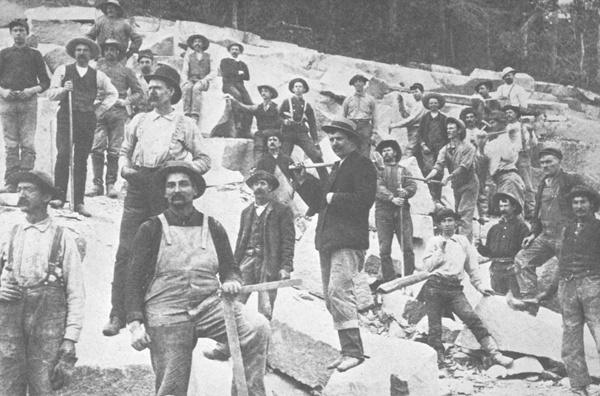
By the second half of the nineteenth century Aberdeen had developed an international reputation in the manufacture of polished granite, thanks largely to a flourishing export trade with the US, particularly in the production of civil war memorials. Business was mainly in the hands of American agents who were based in Aberdeen to negotiate orders for manufacturers in the US, and links were strongest with the New England States of Vermont, Maine and Massachusetts where, as in Aberdeen, there were extensive granite deposits. Some of those businessmen were Aberdonians who had settled in New England, most notably in Barre, Vermont, where in the 1880s there were over 50 granite quarries, and where the city's 2,000 Scots made up 20 per cent of Barre's populationFootnote 51 (Figure 1).
Granite workers, Rock of Ages quarry, Barre, Vermont. Courtesy of the Aldrich Public Library, Barre, Vermont.

It was therefore not simply finished granite products that were exported from Aberdeen: there was a simultaneous emigration of quarrymen and stonemasons, particularly the latter, from whom the American manufacturers were keen to learn. It was common for these tradesmen to cross the Atlantic either with no guarantee of work, or under a private arrangement, using friends already in the US to help them find jobs when they arrived. Some stayed permanently, and in due course set up their own granite yards, which then became a focus for the employment of successive waves of emigrants, in a very clear demonstration of workplace-based chain migration. Many others, however, commuted annually across the Atlantic, leaving their families behind in Aberdeen – about 200 a year, according to one contemporary estimate in 1888.Footnote 52 Every spring, contingents of granite tradesmen left the city's station on special trains, on their way to embark at Glasgow or Liverpool, and their departure warranted regular coverage in the local press. There was a significant return movement in the late autumn, when the American yards closed, and the returners spent the winter working on orders that they had brought back with them. Many returned to New England the following spring, often to the same employer, creating a pattern of seasonal migration that persisted for years. Still others would stay in New England until they had saved enough money from their wages to open a yard back in Aberdeen, where they would rely heavily for orders on networks and business contacts that they had cultivated during their time in the US.
In the early phase, the movement was influenced very much by American incentives rather than domestic push factors: higher wages and better opportunities, not unemployment or poor conditions at home. That pattern changed at the end of the nineteenth century, with the onset of trade depression, and from about 1902 the annual spring exodus began to be seen more as a way to relieve an overcrowded home labour market than a means of capitalising on American opportunities. Many men no longer left willingly, as Union branch secretaries all over Aberdeenshire reported emigration among those who could no longer make ends meet, and in some years they seem to have been barely able to scrape together their passage money. Worse problems arose when the US industry was unable to absorb the influx, as in 1907 and 1908, when an American depression caused a premature return movement, and further dislocation in the home labour market. Then in 1913 a two-month spring strike in Aberdeen led to a bigger than normal transatlantic movement. At the same time, an increasing problem for Aberdeen men was that the Americans, having by then amassed a skilled labour force of their own, had little need to recruit men in Scotland, and were hostile to those who did not settle or assimilate to life in the United States, but continued to send home the bulk of their earnings.
On the whole, relations between the Scottish tradesmen and their American counterparts seem to have been harmonious, but industrial action was not unknown. On the other side of the border, there was a particularly acrimonious dispute at Beebe Plain quarries in Quebec, where a disagreement over the use of non-union labour at the Stanstead Granite Company set Aberdonian against Aberdonian in an industrial civil war fought on Canadian soil. Alexander Robertson was a former President of the Aberdeen Trades Council who in the late nineteenth century worked at various granite centres in the United States and Canada, including British Columbia, where he had organised branches of the Journeymen Stonecutters’ Union of North America and the Bricklayers’ and Stonemasons’ Union. In 1905, when the jurisdiction of the American Granite Cutters’ Union was extended to Canada, he attempted to unionise the Stanstead Company's firm in Toronto, where he was then working. His actions were opposed by the company, which instead tried to persuade employees to sign long-term agreements and take out shares. When those who refused to do so were dismissed, the rest of the workforce in Toronto and their quarrymen colleagues at Beebe Plain downed tools. Among the strike-breakers sourced by the Stanstead Company were at least 50 men who were recruited from Aberdeen by agents who visited the city between 1906 and 1909, a situation which created particular bitterness because they were set against their fellow Scots who had settled at Beebe Plain. The strike-breakers were blacklisted by the Union on both sides of the Atlantic, but they were in equally dire straits if they refused to fulfil their contracts, since they were under obligation to their employer until the pre-paid passages had been recouped out of their wages.Footnote 53
Twenty years earlier, a similar dilemma, also resulting from an agent's visit to Aberdeen, had faced a contingent of granite tradesmen who were recruited to cut stone for the construction of a new State Capitol building in Austin, Texas. After the old Capitol had burned down in 1881, the building syndicate hired to construct its replacement ran into financial difficulties. In an attempt to cut costs they employed 500 convicts from State penitentiaries to work as stonecutters on the project, which in turn led to a massive backlash of public opinion in Texas and, more seriously, to a bitter dispute with the American Granite Cutters’ Union about the use of cheap, non-unionised labour.
When the Union boycotted the project in a well-supported strike, the building syndicate sent an agent, George Berry, to Aberdeen to recruit 150 cutters and 15 blacksmiths to break the strike. But Berry's recruitment pitch was disingenuous, both in the advertisement he inserted in an Aberdeen newspaper on 3 April 1886, and in the subsequent recruitment meeting he held in the city's Music Hall, which attracted an audience of 300. Readers and audience were told they were going to a legitimate job in a temperate climate. They were also promised at least 18 months’ steady work at wages of $4–6 per day, along with cheap board and lodging, and prepayment of a proportion or the whole of the £10 fare. While Berry did admit that some convict labour was being used, he claimed this was only because insufficient free labour was available.
Eighty-six recruits accompanied Berry on 15 April on the first stage of an 18-day journey to Austin, taking their transatlantic passage on one of the Anchor line steamers at Greenock. They were totally unprepared for the reception given them at New York, where they were intercepted by three officials from the American Granite Cutters’ Union, who alerted them to their role as strike-breakers. They managed to persuade 24 recruits not to proceed to Texas, but to make their way to Vermont instead in search of clean jobs. The others, meanwhile, were allegedly ‘coaxed and coerced’ aboard the ferry for New Jersey, from where they went on by train to Austin, arriving on 2 May.Footnote 54 There are conflicting accounts of their reception. One of the recruits, Alexander Greig, wrote home to his parents the next day, describing the hearty welcome they had received and refuting claims that the men had been deceived.Footnote 55 He painted a different picture of the New York incident from that described in the American Granite Cutters’ Journal, which had alleged the men had been manhandled aboard the ferry. But not all the recruits were of the same mind as Greig, particularly once the work actually began, and they found they were working in blazing sun, with no shade, in temperatures of over 100 degrees Fahrenheit. The cutting yards were not at Austin, as they had been led to believe, but at Burnet, 70 miles away, and the quarry was at Marble Falls, a few miles from Burnet, in the middle of the Texan desert. The lodgings – a fenced enclosure at Burnet – were cramped and uncomfortable, with four to six men sharing a room ten feet square, and the food was described as, at best, ‘indifferent’.Footnote 56
There was also financial disillusionment. The men had incurred unexpected extra expenses during their seven-day journey from New York, and their hopes of high wages did not materialise, for when it was found that many of them had no previous experience of granite cutting, they were unable to earn even a dollar a day. The payroll vouchers for the period May 1886 to May 1887 indicate that the stonecutters were receiving only about 27 cents an hour on average. The blacksmiths, according to a Texas newspaper, were particularly inept, so that trained granite cutters on piece work became impatient at time and money unnecessarily lost waiting for their tools to be sharpened. By the end of October 1886 at least three of the Scots had died, and by May 1887 the payroll vouchers show only 15 of the original recruits were still employed at Burnet. It was difficult for the Scots to seek alternative employment, since, like the strike-breakers at Beebe Plain, their prepaid passages were to be recouped from their wages before they received a penny. Even if they absconded (as many seem to have done) it was uncertain whether they would find other work, at least in the granite industry, since they had been blacklisted by the American Granite Cutters’ Union, and their names circulated to every branch of that organisation. The Union was also pursuing the building syndicate through the American courts, and eventually succeeded in having the main contractor convicted of violating the Contract Labour Law, for which offence he was fined the statutory penalty of $1,000 for each illegally imported worker, along with $1,000 costs.Footnote 57 The project was also plagued by design and construction problems. In 1887, after it became clear that the original structure was likely to be dangerously heavy, drastic alterations had to be made to the design of the half-built Capitol, and after its completion the following year, major structural defects were discovered in both its roof and drains.
6. Legacies
What are the recurring threads and lasting legacies of a century of labour emigration to the British World? Most emigrants who took their skills overseas did so in the hope of betterment rather than as a consequence of banishment, but a common refrain from this overview has been the disparity between expectations and experiences, particularly for individuals who experienced disappointment in wages, working conditions, or the attitudes of host societies and fellow workers. Some, as we have seen, were the victims of disingenuous recruitment agents.
A common response to deception, disillusionment or discrimination was to form or join trades unions to press for better conditions, a response whose legacy continued well into the twentieth century. In a number of locations Scottish emigrants were accused of persistent and pernicious workplace militancy and targeted by the authorities. Following two syndicalist-style strikes on the Rand in 1913–1914, ten Scots were named on a list of ‘27 Dangerous Strike Leaders’ compiled by the Johannesburg Police Deputy Commissioner. Of the nine trades union and labour activists deported from South Africa, five were Scots, including James Thompson Bain, the so-called father of the South African Labour Movement.Footnote 58 Meanwhile in Canada, ex-members of the Lanarkshire Miners’ Union were involved in a long, acrimonious strike on Vancouver Island in 1913, during which 300 men were imprisoned, including a Scot who died in jail.Footnote 59 Six years later Scots featured prominently in the Winnipeg General Strike, and in 1922, the negative stereotype of the Scots was encapsulated in a comment by the Canadian politician, former Minister of the Interior, Clifford Sifton, who warned against admitting ‘mechanics from the Clyde’ since they were ‘riotous, turbulent, and with an insatiable appetite for whiskey’.Footnote 60 James Bryson McLachlan, who had emigrated from Lanarkshire to Cape Breton in 1902, became leader of the Nova Scotia colliers and a founding member of the Communist Party of Canada.Footnote 61 At the same time, back in Scotland, Wal Hannington, one of the founding members of the Communist Party in Britain, was a fervent opponent of emigration. Echoing the views of nineteenth-century Chartists who had decried emigration as a ‘transportation of the innocent’,Footnote 62 Hannington claimed the exodus was simultaneously aggravating labour problems overseas and taking away skilled political activists whose talents should be deployed in orchestrating radicalism at home. Unlike Alexander McDonald, the Scottish miners’ leaders, who six decades earlier had boarded transatlantic ships at Greenock to encourage embarking emigrants, Hannington – along with other members of the National Unemployed Workers’ Movement – went on board to try to dissuade them from leaving, particularly in the winter of 1923.Footnote 63
In Australia, the combination of radicalism and Methodism imported by Cornish copper miners had a significant role in shaping the country's trade union and labour movement, although the Amalgamated Miners’ Association later developed a militancy that was very different from the moderate approach of the Methodist chapel preachers.Footnote 64 Another recurring feature in several of the scenarios examined in this article has been the part played by the Methodist Church in shaping emigrants’ attitudes to the value of their labour, as well as giving them a distinctive identity in their new lands. By the early twentieth century that function was becoming formalised. As emigration surged in the decade before the First World War, the Methodist Conference bowed to the inevitable and began to advise emigrants rather than (as in the past) simply criticise them. In particular, the creation of the Methodist Brotherhood in 1908 provided specific assistance to those who had already decided to emigrate, in terms of booking passages, facilitating employment, and putting individuals and families in touch with Methodist congregations overseas. After falling into abeyance during the war, the Brotherhood was recognised as a voluntary migration society under the terms of the Empire Settlement Act in 1922 and therefore became eligible for state funding. That legislation allocated up to £3 million a year from government coffers to assist overseas colonisation through loans and grants to subsidise passages, land settlement and training in partnership with the four dominion governments or with public and private bodies in the UK or the dominions. Drawing on the unprecedented injection of resources, the Methodist Church made arrangements with Methodist Conferences in Australia, New Zealand and Canada to recruit emigrants under Group Nomination, and although movement subsequently came to a virtual standstill during the Depression, in 1929 the Brotherhood collaborated with the Coalfield Distress Fund – another Methodist social work enterprise – to finance the emigration of miners and their families to Canada and Australia.Footnote 65
The expansion of the Methodists’ role in assisting emigrants was one thread in a much bigger, long-term tapestry of philanthropic involvement in working-class emigration schemes that had begun with the Scottish handloom weavers after the Napoleonic Wars but had been largely shunned by the state until 1922. Several para-church organisations were able to take advantage of the Empire Settlement Act, perhaps most notably the Salvation Army. It had come into being in 1878 to help what its founder, William Booth, called the ‘submerged tenth’ of England's population, and by the end of the nineteenth century it claimed to be the world's largest emigration and employment agency for unemployed or destitute working-class men and women. In 1903 its ad hoc arrangements were formalised through the creation of a Migration and Settlement Department, which for the next thirty years hosted lecture programmes, operated employment exchanges, supplied letters of introduction, supervised passages, and assisted emigrants through a special loan fund.Footnote 66
Finally, we have seen that not all the emigrants who have featured in this overview put down permanent roots abroad. Like many of those who went to Europe, return to their country of origin was always an option, which was taken up by an estimated 20–40 per cent of emigrants.Footnote 67 Those who sojourned overseas frequently brought back with them a wide variety of new skills, practices and ideas, which they introduced to the workplaces of Britain in the same way that the techniques and tools they had earlier exported overseas had helped to shape and fertilise the labour environments of many parts of the United States and the British Empire.
Acknowledgements
Thanks go to Fabrice Bensimon for his encouragement, and to three anonymous reviewers for feedback on an earlier draft of this article.