I. Introduction
A. Scenario
Consider the following scenario. Betsy is a generally healthy 75-year old who loves gardening and watching the HGTV channel on television. She may have mild to moderate dementia, although she’s never been formally diagnosed. She lives alone, but Minnie, her neighbor and good friend, is happy to drive her for grocery shopping and church. Minnie also unplugged the stove (just in case…), taught Betsy how to use the microwave, and arranged for a senior meals service to bring a warm dinner every day. Betsy is not close to her son, Frank, who lives 200 miles away and sometimes sends a Mother’s Day card. Nevertheless, Betsy and Frank have a joint checking account. All her bills are sent to Frank, who ensures they are paid. Betsy’s only medical visits over the past decade have been to an ophthalmologist who did her cataract surgery 2 years ago, and an orthopedist who did her hip replacement surgery 7 years ago. Otherwise she is perking along as a fairly independent senior.
One day Betsy sees an ad on TV for a study testing a new drug for joint pain. She asks Minnie to take her there because she’s got “gardener’s elbow,” as she calls it. Every time she weeds or digs in her garden, that doggone elbow bothers her quite a bit.
At the research site Betsy speaks to the research coordinator, a nurse who discerns that Betsy appears to be a good candidate for the study — a welcome development, since the research site has strong incentives to recruit a substantial number of subjects within the next few weeks. However, the coordinator also suspects that Betsy may be having problems with her memory and cognitive processing.
Per the “Common Rule” that lays out requirements for the ethical conduct of human subjects research, 1 informed consent must be sought either from prospective research subjects or, if they lack capacity, from the person’s legally authorized representative (LAR). 2 An LAR, in turn, “means an individual or judicial or other body authorized under applicable law to consent on behalf of a prospective subject to the subject’s participation in the procedure(s) involved in the research.” 3 At this point several questions arise: (a) how should it be determined whether Betsy actually has the capacity to consent to this research; (b) if Betsy lacks capacity, who is her LAR?; and (c) if the research center’s approach to determining Betsy’s capacity and/or identifying her LAR does not comport with applicable law, what problem(s) does that pose?
It is tempting, and probably fairly common in the research setting, for research investigators and coordinators simply to discern, for themselves, whether a prospective participant seems able to understand the information and provide consent and, if not, to reach out to next of kin — in this case, to contact Betsy’s son Frank.
Oops. Not so fast.
B. Overview
From historical developments reviewed in Part II, Institutional Review Boards (IRBs) are required to ensure that prospective research participants be appropriately evaluated for their decision-making capacity and, for those lacking capacity, that decisions be made by that person’s LAR. If the state in which the study is to be conducted has not provided research-specific guidance, IRBs generally are asked to rely on states’ statutes addressing ordinary healthcare. 4
A few states have enacted research-specific statutes, as briefly described in Part III . Of note, these statutes focus almost exclusively on surrogacy, 5 mostly bypassing the equally important issue of determining capacity for research purposes. And yet proper capacity evaluation is a crucial precondition.Reference Appel 6 After all, a determination that someone lacks capacity to make his/her own medical decisions is a weighty one that immediately deprives that person of important rights to self-determination. Reciprocally, a decision that someone is capable of deciding to enter research can, if that person actually lacks capacity, potentially cause harm.
Where a state provides no research-specific guidance, we must turn to statutes covering ordinary healthcare. Part IV focuses on capacity determination. We find abundant, and widely varying, provisions. Although many states require an attending physician to make the call, some also permit advanced practice registered nurses and physician assistants. Other states require at least two licensed professionals, sometimes including a psychiatrist or licensed psychologist. Note, this article does not delve into special subgroups such as those with mental illness or developmental delay. Part IV then suggests options for addressing some of the challenges that capacity determinations sometimes pose for research.
Part V turns to proxy decision-makers for ordinary healthcare of incapacitated persons — the source for LAR identification in states lacking research-specific guidance. Every state permits competent adults to identify someone who will serve as Durable Power of Attorney (DPoA), also dubbed Agent for Healthcare Decision-making. And every state has a process by which a court can adjudicate someone to be incompetent to manage some or all of his/her affairs, then appoint a conservator/guardian to make various decisions on that person’s behalf. Beyond these two avenues, however, statutes for selecting surrogate decisionmakers (and thereby LARs, in the absence of research-specific statutes) exhibit considerable variation.
Many states rely on a familiar next-of-kin (NoK) hierarchy, although provisions for resolving disputes at a given priority level (e.g., quarrels among the person’s adult children) differ significantly. Several states forego NoK — after all, families do not always know and love each other dearly — instead asking the supervising healthcare provider to select someone who has shown caring and concern, knows the patient and his/her values, and is willing to serve. While this can work well in the setting of ordinary treatment, it can pose challenges in selecting LARs for research. Alternatively, several states ask the attending physician to reach out to the patient’s family and friends to request that they collectively choose a surrogate. If the “caring/concern” approach poses logistical challenges for investigators, this one poses even greater complexities.
Finally, a number of states have no or severely limited surrogacy provisions to govern ordinary healthcare beyond DPoAs and court-selected conservators. Absent a DPoA or conservator, in these states no one has express legal authority to make either treatment or research decisions for someone who cannot speak for himself. Indeed, in some of those states, legislatures have repeatedly rejected bills to fill in that blank. While this can be vexatious for ordinary healthcare, it poses extraordinary difficulties for investigators, whose pool of potential participants already is often small. Part V then explores some potentially workable approaches to these daunting challenges.
Finally, Part VI offers reflections on the importance of getting this right, and the potential consequences of failing to adhere to state laws governing capacity and surrogacy.
II. A Bit of History
A. Guidance and a Need for Clarification
In the 1970s, following a series of scandals surrounding human subjects research,Reference Beecher 7 the United States Congress authorized the National Commission for the Protection of Human Subjects of Biomedical and Behavioral Research to undertake a thorough study of the ethical principles that should guide human subjects research. The result was the Belmont Report, 8 which subsequently was enriched and codified as 45 CFR 46 (for federally funded human subjects research) and 21 CFR 50 (for FDA-governed human subjects research). Of note, although these federal regulations include special provisions for the protection of vulnerable persons such as women and fetuses, prisoners, and children, no specific protections are identified for adults lacking decision-making capacity. 9
The late 1990s and early 2000s witnessed several major developments casting doubt on the United States’ protections for human subjects in research. In 1998 the Department of Health and Human Services’ Office of Inspector General (OIG) severely criticized the ways in which Institutional Review Boards (IRBs) — the boards mandated to conduct ethics review of all federally funded human subjects research 10 — conducted their work.Reference Brown 11 Among other problems, the OIG found that IRBs generally reviewed too many protocols too quickly and with too little expertise, conducted little or no continuing review, faced conflicts of interest that threatened the independence of their reviews, failed to provide adequate training for board members or for investigators, and failed to evaluate their own effectiveness. 12
A second major development concerned litigation.Reference Mello, Studdert and Brennan 13 Although human subjects research had occasionally prompted lawsuits prior to 1999,Reference Hoffman and Berg 14 a flurry of civil actions followed the 1999 death of Jesse Gelsinger, a young man who volunteered for a gene transfer study at the University of Pennsylvania.Reference Onixt and Sterling 15 Although the resulting complaint did not name the IRB as a defendant, several lawsuits thereafter named the IRB as an entity, sometimes the IRB chair, and sometimes IRB members individually as defendants.Reference Anderlik and Elster 16 Moreover, although the IRB was not named as a defendant in Grimes v Kennedy Krieger Institute, the Maryland Supreme Court took Johns Hopkins’s IRB severely to task as it found fault with numerous aspects of a lead abatement study conducted in the homes of disadvantaged Baltimore residents. 17
In a third contemporaneous development, the federal government suspended all human subjects research at a number of institutions, for varying lengths of time, out of concerns regarding their treatment of human research subjects. In 1999, for instance, the Office of Protection from Research Risks 18 shut down all federally funded human subjects research at Duke University Medical Center — the fourth such move in a decade and the largest at that time — out of safety concerns.Reference Weiss 19 Similarly, the June 2, 2001 death of Ellen Roche in a Johns Hopkins drug study prompted the Office of Human Research Protection (OHRP) to suspend virtually all clinical research at that institution.Reference Marshall 20 Other major medical research institutions have likewise faced suspensions.Reference Anderlik and Elster 21
Finally, some institutions undertook internal assessments of their own processes. In 2001, for instance, legal counsel for the University of California, Los Angeles determined that California law only permitted court-appointed guardians to serve as LARs. Thereafter the institution placed a moratorium on all research involving surrogate consent, until California’s Health and Safety Code was amended to permit proxy consent for research.Reference Scott 22 In a similar vein, in the early 2000s OHRP wrote a number of determination letters informing various institutions that their surrogate consent processes did not measure up to applicable legal standards. Responding to such a letter, in 2002 Vanderbilt University suspended all research featuring proxy consent until a 2003 change in Tennessee Department of Health policy began to permit some surrogate consent for research.Reference Klitzman 23
As IRBs urgently reexamined their processes in the wake of these developments, two of their most pivotal questions concerned proper procedures for (a) determining prospective research participants’ decision-making capacity, and (b) identifying legally authorized representatives who could consent on behalf of incapacitated subjects.
B. OHRP Clarifies: Identifying LARs in the Absence of Applicable Law
As noted, initially the Common Rule simply asked investigators to identify “an individual or judicial or other body authorized under applicable law to consent … “ 24 with no further guidance. The problem then was — and still is — that very few states have statutes specifically governing human subjects research. Hence, in that sense, there was no “applicable law.”
Responding to IRBs’ by-then urgent concerns, OHRP provided guidance.
The issue as to who can be an LAR is determined by the laws of the jurisdiction in which the research is conducted (e.g., local or state law). Some states have statutes, regulations, or common law that specifically address consent by someone other than the subject for participation in research. Most states have no law specifically addressing the issue of consent in the research context. In these states, law that addresses who is authorized to give consent on behalf of another person to specific medical procedures or generally to medical treatment may be relevant if the research involves those medical procedures or medical treatment.
When the laws of the jurisdiction in which the research is being conducted provide a reasonable basis for authorizing an individual to consent on behalf of a prospective subject to their participation in the research procedure(s), OHRP would consider such an individual to be an LAR as defined by HHS regulations at 45 CFR 46.102(c). IRBs may wish to consult with legal counsel when deciding who can serve as an LAR for subjects of proposed research. 25
Accordingly, the definition of “LAR” was expanded. Per 45 CFR 46.102(i),
Legally authorized representative means an individual or judicial or other body authorized under applicable law to consent on behalf of a prospective subject to the subject’s participation in the procedure(s) involved in the research. If there is no applicable law addressing this issue, legally authorized representative means an individual recognized by institutional policy as acceptable for providing consent in the nonresearch context on behalf of the prospective subject to the subject’s participation in the procedure(s) involved in the research. 26
Thus, in the absence of research-specific statutes, the institution/IRB must look to state/local law governing ordinary healthcare capacity determinations 27 and surrogate designations.Reference Jessica 28 And this must be the law governing the locale in which the research is conducted, not the law of some other jurisdiction.
At this point it may be tempting for the reader to assume that states offer a fairly standard approach to capacity and surrogacy. Not so. Below we will explore the broad variation among state statutes, to illustrate the wide uncertainties shadowing research on prospective participants who may have diminished capacity.
A few states actually do have research-specific statutes, reviewed briefly in Part III . Parts IV and V then survey the diversity of provisions governing ordinary healthcare — Part IV, for statutes governing capacity determinations and Part V, for statutes governing who can serve as surrogate to make ordinary healthcare decisions for persons lacking capacity. Finally, Part VI considers some broader implications. Nota bene: this article does not purport to provide an exhaustive 50-state survey. Nevertheless, a broad sampling will exhibit the remarkable diversity of challenges these statutes present.
III. State Statutes Specifically Governing Human Subjects Research
The few states that have enacted research-specific statutes vary in interesting ways. Notably, although all of them address LAR identification only one of those reviewed here, namely New Jersey, addresses capacity determinations.
New Jersey’s “Access to Medical Research Act” 29 requires that
[a] determination that a subject is unable to consent, as well as the extent of his incapacity and the likelihood that he will regain decision-making capacity, shall be made by an attending physician with no connection to the proposed research and shall be made to a reasonable degree of medical certainty. 30
This restriction makes good sense. The researcher, after all, has a prior allegiance to science and to the success of the investigation, hence is in a conflict of interest if s/he is also in the position to determine whether a prospective participant has the capacity to say yes or no to the project.Reference Morreim and Jennings 31 Hence a qualified person completely outside the research – in particular the patient’s own attending, who may know that person well – is the appropriate one to make the capacity determination. For incapacitated persons New Jersey then requires that “surrogate informed consent may be obtained from an authorized representative with reasonable knowledge of the subject, who shall include any of the following persons, in the following descending order of priority:” guardian, patient-chosen healthcare representative, spouse, domestic partner, adult son or daughter, custodial parent, adult sibling, etc. 32 These requirements are suspended for life-threatening emergencies where certain other conditions are met. 33
Kansas’s research statute does not guide capacity assessment, hence local IRB policy should require investigators to follow Kansas’s provisions governing capacity determinations for ordinary healthcare. Kansas does permit research on incapacitated human subjects, so long as the project is either undertaken by a licensed practitioner with medical staff membership or is approved by the appropriate IRB. 34 If the person is an adult or emancipated minor, is being treated by a licensed physician, and is “incapable of giving informed consent for the research protocol,” 35 a legal guardian or patient-chosen agent for healthcare decision-making may enter that person into a research project. If there is no guardian or agent, the person’s next of kin, in a designated order of priority, can provide consent. 36
Virginia’s human research statute likewise lacks provisions for determining capacity. Regarding surrogacy, the law identifies an LAR as the custodial parent(s) of a minor, a patient-chosen agent appointed in his/her advance directive (provided that the AD specifically authorizes research), the legal guardian, or spouse, adult child, parent, sibling, or person authorized by law to consent on that person’s behalf. 37 Virginia adds several helpful caveats: if the patient (even if incapacitated) protests, s/he will not be enrolled; if LARs at the same priority level (e.g. adult children) disagree, then the patient will not be enrolled in the research; and an LAR may not consent to nontherapeutic research that carries even a minor increase over minimal risk, or is contrary to the patient’s religious beliefs or basic values. 38
California distinguishes between medical experimentation that is, versus is not, conducted under the purview of an institution that has a Federal-Wide Assurance (FWA) 39 and which oversees research under the requisites of 45 CFR 46. 40 For the former, California stipulates that nonemergency research 41 can be undertaken for persons unable to consent, if consented to by an LAR who is identified per a familiar next-of-kin hierarchy. 42
For research not under the purview of an institutional FWA and 45 CFR 46, much of California’s Protection of Human Subjects in Medical Experimentation Act 43 applies to adults with capacity to make their own decisions. Nevertheless, the statute does offer provisions for persons who are under a court-ordered conservatorship, with differing instructions depending on whether or not that conservatorship encompasses medical treatment decisions. 44 These provisions do not generally contemplate incapacitated persons who are not under a conservatorship, other than situations in which the research is “related to maintaining or improving the health of the human subject or related to obtaining information about a pathological condition of the human subject.” 45
Some states, rather than enacting a separate statute governing research, insert relevant provisions into a broader healthcare statute. In Oregon, a health care advocate (i.e., “a person who is authorized to make health care decisions on behalf of an individual if the individual does not have a guardian or a health care representative” 46) may not make decisions on an individual’s behalf with respect to “[a]n experimental procedure, unless the procedure has been approved by an institutional review board and is determined by the treating physician to be in the best interest of the individual.” 47 Neither can s/he consent to “[a]n experimental drug that has not been approved for use by the United States Food and Drug Administration, unless the drug is part of an approved clinical trial and the individual’s treating physician has determined that it is in the best interest of the individual.” 48
Similarly, within its provisions for advance directives Oklahoma offers a section on “experimental treatments.” 49 If a patient is being treated by a licensed physician at an accredited medical school that conducts IRB-approved human subjects research, then a legal guardian, attorney-in-fact, or family member (per a specified order of priority) can provide informed consent if the patient lacks capacity. 50 Separate permissions are granted for IRB-approved research on life-threatening emergencies, where waiver of informed consent has been granted for incapacitated persons. 51 In these latter states, capacity determinations for research presuppose, hence clearly must follow, state law governing ordinary healthcare.
The foregoing states provide explicitly research-specific guidance, hence satisfying the initial federal expectation to follow “applicable law” regarding consent to research on incapacitated persons. 52 Few states have adopted such statutes, however. Therefore researchers must, per updated OHRP guidance, look instead to states’ laws governing ordinary healthcare.
As we will now see, those provisions vary tremendously. Part IV will consider various approaches to determining capacity, while Part V explores the even wider variation among states’ statutes for selecting surrogate decisionmakers in ordinary healthcare.
IV. State Statutes Governing Who Determines Patient Capacity for Ordinary Healthcare
A. Statutory Guidance
We begin by recalling that, even as it details how LARs should be identified for persons lacking capacity, the Common Rule does not actually discuss how capacity should be assessed in the first place. Similarly, although OHRP guidance directs IRBs to base LAR policies on state statutes for ordinary healthcare (absent research-specific statutes), it is in fact silent regarding capacity determination. Indeed, as recently as 2023, FDA guidance regarding surrogate consent for research on incapacitated persons expressly notes, e.g., that capacity can be partial or complete, and that it can result from various etiologies. But remarkably, it says nothing regarding how those capacity determinations should be made, or by whom. 53
Surely this deficiency needs to be remedied. State law for ordinary healthcare should govern capacity determination in research, just as it does for LAR selection.
First, if it is important to identify the right person to speak on someone’s behalf, surely it is at least as important to ensure, from the outset, that this person actually is unable to make his decisions and thereby truly needs a proxy. A determination that someone is incapacitated implies a substantial detriment to personal liberty and autonomy. Reciprocally, regarding as capacitated someone who lacks the relevant abilities risks avoidable harm to that person.
Second, investigators are in an inherent, ineradicable conflict of interest, whether for determining capacity or for selecting surrogates. Investigators are not fiduciaries of research subjects.Reference Morreim 54 Their loyalty is already pegged — to the science and the investigation, not to the persons who participate as research subjects. Although they must treat those participants with respect and must honor various side constraints, they still work under incentives that favor completing the project, potentially on occasion to participants’ detriment. 55
Third, just as we cannot legitimately assume that investigators are ethically the appropriate persons to determine capacity, neither can we presume they are actually qualified. Clinical healthcare research is undertaken by persons from a wide variety of fields — not just physicians, but also dentists, speech therapists, physical therapists, biomedical engineers, nurses, pharmacists, and a host of others. Many of these individuals receive no training whatever, regarding how properly to assess the decisional capacity of a prospective research subject. Surely, if it is important to follow state law regarding who should speak for the person, it is at least as important to follow state law regarding whether anyone at all should speak for that person.
Thus, it is reasonable to suppose that, just as IRBs are expected to base their LAR policies on state laws governing the non-research context, they should likewise tap that same source to construct their policies on capacity determination. Hence, here too, we should look to state laws governing the non-research context. 56
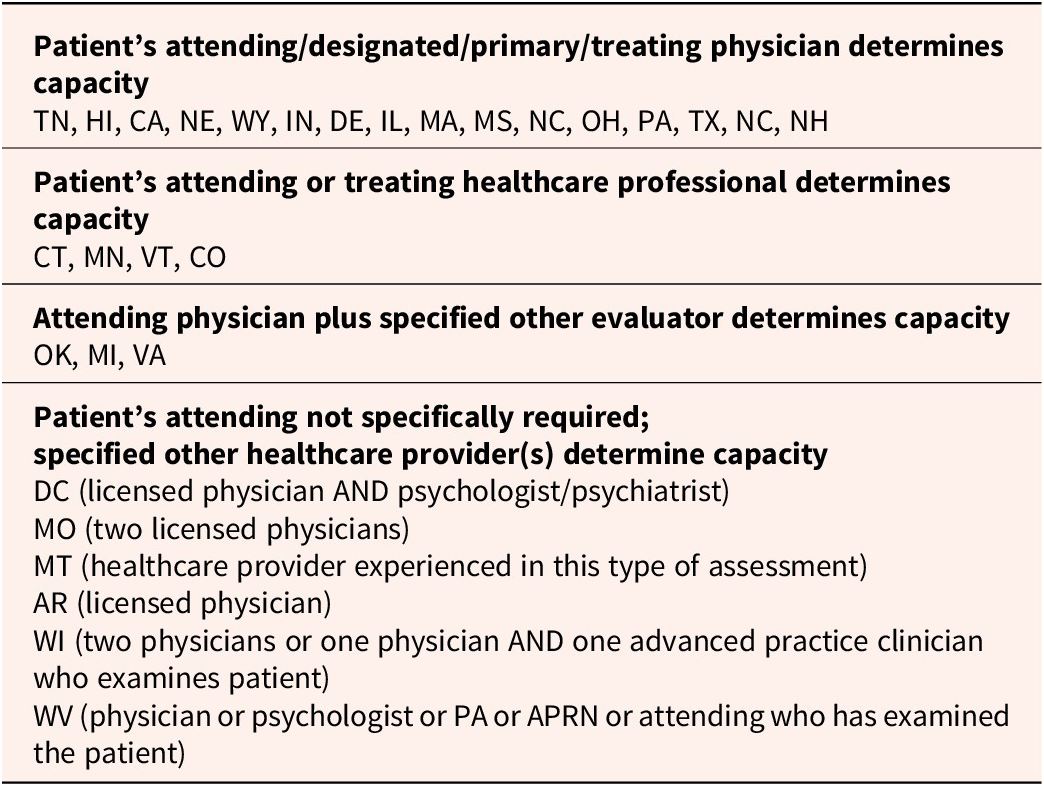
That said, statutory guidance is somewhat limited. Of US jurisdictions as of 2023, 41 define decisional (in)capacity (or “(in)competence”) by statute, leaving the remainder with no statutory definition. 57 Of the 41, a number of jurisdictions define capacity only in the setting of advance directives, leaving unclear whether the definition applies more broadly across the healthcare spectrum. 58 And just 39 jurisdictions specify who has the authority to determine whether a patient has capacity. 59
Of those jurisdictions, many require the call to be made by the patient’s “attending” (a.k.a. “designated” 60 or “primary” 61 or “treating” 62) physician, which is generally defined as “the physician selected by or assigned to the patient who has primary responsibility for treatment and care of the patient and who is a licensed physician in [state]” 63 or, more broadly, the patient’s attending healthcare professional, which can include advanced practice nurses or physician assistants. 64
Some states require supplementing the attending physician’s determination. Thus, Oklahoma requires the attending plus another physician who has examined the patient, 65 while Michigan requires the attending plus either another licensed physician or a licensed psychologist. 66 Virginia requires certification by a second “capacity reviewer,” except where the person is unconscious or has profound impairment due to trauma. 67
A few jurisdictions do not designate the patient’s attending provider, instead aiming more broadly. The District of Columbia, for instance, requires
2 professionals who are licensed to practice in the District and qualified to make a determination of mental incapacity. One of the 2 certifying professionals shall be a physician and one shall be a qualified psychologist or psychiatrist. At least 1 of the 2 certifying professionals shall examine the individual within 1 day preceding certification. 68
Missouri asks for “certification by two licensed physicians based upon an examination of the patient that the patient is incapacitated and will continue to be incapacitated for the period of time during which treatment decisions will be required.” 69 Montana requires determination “by a health care provider experienced in this type of assessment.” 70
Once the relevant law is identified for governing capacity determination in ordinary healthcare, the ostensibly simple requirement to follow that law can be surprisingly complex.
B. Challenges, Potential Remedies for Investigators
The history of research ethics is replete with stories of investigators who, however well-meaning, misused and sometimes abused the human beings they studied, particularly those who lack capacity or are otherwise vulnerable.Reference Beecher 71 Thus, at this point we must consider how to permit research to proceed with reasonable efficiency while fully respecting human participants. Varying scenarios prompt different responses.
Sometimes incapacity has already been established, e.g. by a judicial proceeding or during ordinary medical care. Here, investigators can generally rely on that determination. Note, if the investigator needs access to the person’s medical records to verify a capacity determination, the Health Insurance Portability and Accountability Act (HIPAA) requires that, when otherwise protected health information is sought for research purposes, the investigator must ordinarily ask the IRB to approve a waiver before s/he can properly delve into the patient’s medical records. 72
Often, however, an investigator or research coordinator may be the first clinician to suspect incapacity, as with our friend Betsy. Fair enough, but a researcher’s initial suspicion is just a first step and does not constitute a lawful capacity determination. Alternatively, suppose the investigator is also the patient’s attending physician. Here too, independent capacity determination is essential. It should not be made by an investigator-attending, who as noted carries inevitable conflicts of interest. Physicians are their patients’ fiduciaries, obligated to place patients’ interests above others’, whereas an investigator’s first priority is to the science. 73 Even if the investigator has no financial interest in the research, 74 s/he is professionally and intellectually invested in the success of the work. This is largely a good thing. Medical research would be considerably poorer if its investigators were indifferent. However, the obverse of this is that conflicted investigators’ judgment calls can be inappropriately shaded in ways they may not even recognize.
If state law requires that the attending physician/provider determine capacity, and either the patient has none, or the investigator is the attending, two responses seem appropriate.
First, New Jersey has it right: “A determination that a subject is unable to consent, as well as the extent of his incapacity and the likelihood that he will regain decision-making capacity, shall be made by an attending physician with no connection to the proposed research and shall be made to a reasonable degree of medical certainty.” 75
Second, where state statute requires only a licensed physician or other licensed professional(s), IRB policies can require investigators to identify an appropriate person for capacity determinations. Where an attending physician is required, IRBs can note that statutory definitions of “attending” physician typically permit identifying someone other than a treating provider. Per one such state:
“Designated physician” means a physician designated by an individual or the individual’s agent, guardian, or surrogate, to have primary responsibility for the individual’s health care or, in the absence of a designation or if the designated physician is not reasonably available, a physician who undertakes such responsibility. 76
Here, an IRB could recognize that an investigator-cum-attending is “not reasonably available,” albeit for ethical rather than practical reasons. To cover these instances the IRB could assemble a cadre of professionals who are willing and statutorily qualified to assess capacity. As noted, many states require only one evaluator while some require two. Admittedly, this will likely carry costs for the evaluators’ time and expertise. Thus, for protocols envisioning enrollment of incapacitated participants, investigators should be prepared to write the costs of capacity assessments into their grant applications.
Overall, although a requirement for independent capacity evaluation could indeed add a layer of complexity to clinical research, a willing and qualified cadre of state-qualified professionals to undertake these evaluations could make the process reasonably streamlined as well as ethically and legally acceptable.
Capacity Determination for Ordinary Healthcare: A Sampling

V. State Statutes Governing Who May Serve as Healthcare Surrogate for Ordinary Healthcare
Every state provides an option for the appropriate court, after finding a person lacks capacity, to appoint a conservator/guardian to make various decisions for that individual, often including healthcare. 77 Likewise, states permit adults to complete an advance directive naming who will be authorized to make healthcare decisions on that person’s behalf if s/he loses capacity — i.e., an Agent for Healthcare Decision-making or DPoA. 78
It is tempting to assume that, in the absence of a court-appointed conservator or DPoA, most if not all states authorize a prioritized NoK hierarchy — typically spouse, adult children, parents, adult siblings, etc. — to speak on behalf of incapacitated persons.
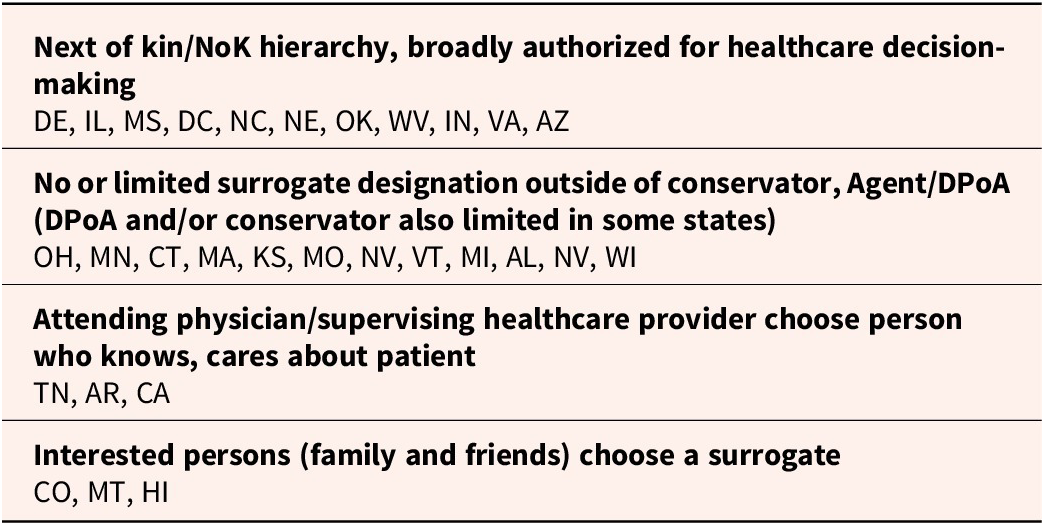
Not so fast. Although many states draw healthcare surrogates (“proxies”) from an NoK hierarchy, many do not. Some states instead ask the attending physician to choose someone who knows the patient and has shown caring and concern, while others ask the attending to reach out to family and friends who, in turn, collectively choose a surrogate. And, as detailed below, while many NoK states permit these surrogates to make essentially all healthcare decisions, some limit those decisions strictly to end-of-life scenarios. Finally, some states have no provision for surrogacy whatever, beyond conservators and Agents/DPoAs. Each scenario carries very different implications for choosing an LAR for research, once a patient is determined to lack capacity.
As noted, this article does not purport to provide a 50-state analysis. Rather, the goal is to depict the variation among states’ provisions and to track the implications of those variations for the ethical and lawful conduct of human subjects research.
A. States Requiring NoK Hierarchy for Selecting Healthcare Surrogates
Many states permit a specified NoK to make virtually any healthcare decision the patient could make. 79 Here, identifying an LAR for research is usually fairly clear, with no in-the-moment call required. If someone has a loving spouse who is willing and available, e.g., then once the person is determined to lack capacity, that spouse is legitimated to make healthcare decisions generally, including to decide whether s/he will be entered into a research study.
However, if the investigator has no prior relationship with the prospective research participant, then s/he must somehow identify that person’s family members. Suppose Betsy’s neighbor, Minnie, is the only person accompanying Betsy. If Minnie does not know about son Frank or lacks his contact information, and if Betsy cannot produce it, then the investigator may need to access Betsy’s medical records. As noted above, however, HIPAA 80 generally requires asking the IRB or similar research ethics board to approve a waiver 81 before the investigator can use medical records to find NoK. 82
In another tricky scenario, suppose that Betsy is actually married but deeply estranged. Is the investigator stuck with Betsy’s husband? In NoK states probably yes, though maybe not. Some states permit the attending to disqualify a surrogate if that person appears not to be acting in the patient’s best interests, 83 although this cannot ordinarily be discerned until after that person has become involved. Moreover, the fact that an attending can disqualify a family member does not necessarily mean that an investigator would have the right to pick and choose among family simply by disqualifying someone whose decision s/he does not favor. Alternatively, a court may have sole authority to disqualify someone as surrogate. 84 That said, many states are silent on this question.
Suppose there is no spouse and we instead look to the person’s adult children. If they agree with one another, no problem. But if they disagree, state statutes may or may not help.Reference DeMartino 85 A state may require disputes to be resolved by the local probate court. 86 Or it may stipulate that a majority view within the class will prevail,Reference DeMartino, Dudzinski and Doyle 87 unless a member of a lower priority files a guardianship petition in court. 88 Elsewhere the attending must simply urge disputing family to reach consensus. 89 If they fail to reach one, some states permit the attending to disqualify the disputants and/or confer with other members of that class or a lower priority class. 90 In another approach, the attending physician or advanced practice registered nurse can choose whichever surrogate in the class s/he deems best qualified. 91
These options are not particularly helpful for a clinical investigator. The time and effort required to reach out to multiple adult children or siblings and urge them to reach consensus, or to petition a court, will likely be prohibitive if the research is to proceed with a modicum of efficiency. Here, it may be tempting for an IRB to create a work-around — for instance, to ask the ethics committee or in-house counsel to make the call, where NoK do not produce consensus or majority agreement. 92 Although attractive, any such work-around will not produce a legally authorized representative if it does not match applicable state law. 93
B. States Providing Limited or No Surrogacy Guidance for Ordinary Healthcare
As noted, essentially every state permits competent adults to identify a DPoA/Agent to make healthcare decisions on that adult’s behalf when s/he loses capacity. However, that authority can vary considerably. In some states an Agent/DPoA does not govern ordinary healthcare, but rather can only make decisions where the incapacitated patient has a terminal illness or is permanently unconscious. In Ohio, for instance, a patient-appointed representative’s authority encompasses only end-of-life scenarios, 94 while Minnesota’s statute likewise appears to suggest that the patient-appointed proxy can (only) make decisions the patient could, within the realm of the living will — a document that focuses on end of life decisions. 95 Michigan specifies that the patient’s advocate, or a surrogate defined in terms of NoK, “acting on behalf of the patient, has the right to make an informed decision regarding receiving, continuing, discontinuing, and refusing medical treatment for the patient’s reduced life expectancy due to advanced illness,” defined as a terminal illness. The law offers no provisions outside of end-of-life scenarios. 96 Oregon adds a twist. Although NoK authority is limited to end-of-life scenarios, 97 in non-terminal situations for patients who have no guardian or patient-appointed representative, Oregon provides that other healthcare decisions can be made by a “health care advocate” who is chosen by the patient’s individualized service plan team. 98
Thus, some statutes encompass only end-stage scenarios, leaving a blank spot for other healthcare decisions. Some other states do permit a patient-chosen agent/DPoA to make decisions broadly across the healthcare spectrum (if the patient’s advance directive permits), but offer no or only limited surrogacy provisions for people who have not executed an advance directive.Reference DeMartino 99 Assuredly, if these situations are difficult for ordinary care, they are even more so for research.
Moreover, permitting people to complete an advance directive is of value only if someone has taken the time and thought to do so. But “research has shown that only 25-33% of adult patients have a formal ACP [advance care planning] document, with significant racial disparities among patient populations. One study found that 44% of white patients over 50 had an advance directive (AD), but only 24% of black patients did.”Reference Fiester 100 Thus, if a state authorizes surrogate decision-making only where the patient has completed an advance directive, or only for end-of-life situations, clinical research will mostly be stymied for those lacking capacity.
In sum, although IRBs can base LAR policies on statutes governing ordinary healthcare (absent research-specific guidance in their jurisdiction), 101 they may be left empty-handed in states that offer no guidance at all, or nothing but a DPoA, or nothing beyond end-of-life scenarios. An IRB might be tempted to create a policy that would be acceptable in some other state, e.g., a state applying an NoK hierarchy across the healthcare spectrum. But it is doubtful that such borrowing would be acceptable, given that “who can be an LAR is determined by the laws of the jurisdiction in which the research is conducted (e.g., local or state law).” 102 This is particularly seen where the state legislature has considered, but expressly rejected, filling that “blank space” with surrogacy provisions covering healthcare generally. 103 In these states, research involving incapacitated participants appears to be restricted to people who have chosen a DPoA/Agent or who have a court-appointed conservator, so long as the state permits DPoAs and/or conservators to make research-related decisions. 104
C. States Providing a Non-NoK Approach to Surrogates for Ordinary Healthcare
In NoK states, spouses always top the list. But spouses do not always have a loving relationship. Suppose our Betsy is still married to a bitterly estranged husband. They despise each other and have lived hundreds of miles apart for many years. Divorce is expensive — why bother when the wretched lout is gone. Although, as noted, some states have provisions for disqualifying a surrogate who seems not to be acting in the patient’s best interest, 105 even there, the first obligation is to locate that spouse and seek his/her input. Accordingly some states have rejected NoK hierarchies in favor of two major alternatives.
1. Attending Physician/Supervising Provider Chooses Surrogate
In some states the attending directly selects a surrogate for an incapacitated person. In California, e.g.,
a health care provider or a designee of the health care facility caring for the patient may choose a surrogate to make health care decisions on the patient’s behalf … The patient’s surrogate shall be an adult who has demonstrated special care and concern for the patient, is familiar with the patient’s personal values and beliefs to the extent known, and is reasonably available and willing to serve. 106
That person may, but need not necessarily, be chosen from a list of options, including various NoK and a “close personal friend.” 107 Tennessee’s provision is similar, 108 as is Arkansas’s. 109 As the goal is to identify the person who is best qualified to make decisions in accordance with the patient’s wishes, the provider should attend to such factors as frequency of contact and demonstrated concern for the patient. For ordinary healthcare, surely this approach has merit over mandating NoK who may be estranged or uninterested.
However desirable this approach may be for ordinary healthcare, it presents formidable complexities for the research setting, requiring investigators to learn about prospective participants’ social lives, including which people genuinely care about that person, and somehow to sort through whatever back-biting, competition, and false tales emerge from those seeking to control the incapacitated person. Frank is barely present in Betsy’s life, but we don’t know why. Neighbor Minnie appears very attentive, but is she truly a devoted friend, or just a nosy neighbor who will gossip to the entire neighborhood? And even if an IRB grants access to medical records, many patients have no long-standing attending physician who could make such a thoughtful choice, instead using only random urgent-care clinics for whatever medical issues crop up.
Additionally, states embracing this approach do not require that a determination of capacity or a selection of surrogate at one site should be binding at any other site. For ordinary medical care this makes sense. After all, patients’ capacity and social situation can change over time. Even if, seven years ago, Betsy’s orthopedist might have asked her son Frank to help with decisions, this does not bind her ophthalmologist five years later. Subsequent physicians may not have access to earlier physicians’ records and, more importantly, Betsy’s relationship with Frank may have changed considerably in the interceding years, rendering neighbor Minnie a more appropriate surrogate at the later date. And even if Betsy had shown signs of dementia 7 years earlier, any LAR her orthopedist appointed would not necessarily be appropriate at a later time. It is also possible that neither the orthopedist nor the ophthalmologist actually paid attention to Betsy’s capacity, let alone formally appointed any surrogate or recorded notes on the matter.
Part IV , above, offers one possible remedy. If the IRB has enlisted a cadre of physicians/providers to serve as attendings for purposes of capacity determination, perhaps that same cadre might undertake a suitable search for family and friends, and identify an acceptable surrogate. Here, too, such services may appropriately require a fee, which should be written into investigators’ grant applications. As always, any such option would need to comport with the laws of the jurisdiction in which the research is to be conducted. 110 Multisite trials would require a separate process for each jurisdiction.
Alternatively, some of the states employing this caring/concern approach offer NoK as a reasonable alternative for IRB policy. Although Tennessee, for instance, asks the supervising healthcare provider to identify someone showing care and concern, the statute goes on to state that “[c]onsideration may be given” to a familiar NoK hierarchy consisting of spouse, adult child, parent, adult sibling, close friend, etc. 111 Where this is the case, an IRB might reasonably draw on that part of the statute to adopt an NoK-based LAR. 112
2. “Interested Persons” Choose a Surrogate
Several states embrace yet another approach. In Colorado, once the patient has been determined by a court or attending physician to lack capacity, 113
the attending physician, or such physician’s designee, shall make reasonable efforts to locate as many interested persons as practicable, and the attending physician or advanced practice nurse may rely on such individuals to notify other family members or interested persons. 114
“Interested person,” in turn, “means a patient’s spouse, either parent of the patient, any adult child, sibling, or grandchild of the patient, or any close friend of the patient.” 115
Interested persons who are informed of the patient’s lack of decisional capacity shall make reasonable efforts to reach a consensus as to who among them shall make medical treatment decisions on behalf of the patient. The person selected to act as the patient’s proxy decision-maker should be the person who has a close relationship with the patient and who is most likely to be currently informed of the patient’s wishes regarding medical treatment decisions. 116
In other words, the attending asks the patient’s family and friends to find additional family and friends, then collectively figure out who among them should serve as the patient’s surrogate. However,
[i]f any of the interested persons disagrees with the selection or the decision of the proxy decision-maker or, if, after reasonable efforts, the interested persons are unable to reach a consensus as to who should act as the proxy decision-maker, then any of the interested persons may seek guardianship of the patient by initiating guardianship proceedings. 117
Hawai’i’s approach is similar, 118 as is Montana’s. 119
Just above we saw formidable challenges for investigators in states requiring a supervising provider to select a surrogate who knows and cares about the patient. Here the logistical difficulties are even more daunting. Once again, an investigator must secure IRB approval for identifying these people through an EMR. 120 Even then, the sheer time and effort to locate friends and family will often be prohibitive.
Surrogate Selection for Ordinary Healthcare: A Sampling

VI. Overall Observations
It is tempting, perhaps justified, to throw up one’s hands in frustration. Most states have not enacted statutes specifically governing clinical research. And although, in the absence of such a statute, IRBs can base policies on states’ provisions for ordinary healthcare, 121 the reality is that many states’ governance for capacity and surrogacy are either absent or do not work well for clinical research. We have seen a bewildering array:
-
• all states permit courts to declare a person to be incapacitated and name a guardian/conservator of the person;
-
• all states permit a capacitated adult to identify a DPoA/Agent for healthcare decisionmaking;
-
• a few of these states limit DPoA/conservator authority exclusively to end-of-life scenarios;
-
• outside of DPoA or conservatorship, some states have no provisions whatever for decisionmaking in ordinary healthcare;
-
• outside of DPoA or conservatorship, many states require NoK in a specified priority order to make decisions across the spectrum of healthcare, with diverse provisions for disagreements among NoK;
-
• outside of DPoA or conservatorship, some NoK states limit surrogates’ authority strictly to scenarios in which the person is either dying or permanently unconscious;
-
• some states forego an NoK hierarchy, instead asking the supervising healthcare provider to choose someone who has shown caring and concern, who knows the patient and is willing to serve;
-
• some other states, likewise abjuring an NoK hierarchy, instead ask providers to reach out to friends and family, and ask them to select a surrogate.
Amidst this bewildering array, prospective research participants who may be incapacitated deserve to have a state-authorized determination of capacity and a legally authorized representative making decisions on their behalf. IRBs in states lacking useable surrogacy statutes might try to create ostensibly reasonable policies, perhaps writing an NoK policy that would be acceptable in some other state. But that isn’t the law, because guidance for the non-research setting must come from the jurisdiction in which the research is to be conducted. 122 IRBs and investigators stray from bona fide law at their peril.
A. Consequences of Non-Legal Capacity Determinations or LAR Selections
That peril could involve civil or even criminal risks. Although states vary, a civil complaint for battery is an obvious option, as the plaintiff alleges an intentional act that causes harmful or offensive contact to which that person has not consented. The intent need not be to cause harm or offense as such; the actor merely needs to intend the act itself, which then causes the unconsented, offensive touching. 123
In the research setting, obviously the investigator intentionally undertakes the interventions in the protocol. Consent is lacking where [a] the person lacks the capacity to consent (or where capacity is doubtful and not properly assessed) and/or where [b] no legally authorized person has consented on his/her behalf. Finally, as attested by a long history of abuses in human subjects research, 124 it is arguably offensive to enroll an incapacitated person into someone’s research project without bona fide consent by the appropriate person. 125
At least one state has codified civil recourse for the research setting. In California, an investigator’s failure to obtain informed consent — here, to properly determine capacity and/or properly identify an LAR — can generate liability for compensation between $500 and $25,000, partly depending on whether the failure is negligent or willful. 126
Criminal law also can be in play. An action for criminal battery requires mens rea, a criminal intent actually to do wrong, as beyond simply intent to undertake an action that, in turn, causes the harmful or offensive contact. Conviction requires proof beyond a reasonable doubt, a standard well beyond civil law’s preponderance of the evidence. 127 Here, too, California provides an example.
Any person who is primarily responsible for the conduct of a medical experiment and who willfully fails to obtain the subject’s informed consent, as provided in this chapter, and thereby exposes a subject to a known substantial risk of serious injury, either bodily harm or psychological harm, shall be guilty of a misdemeanor punishable by imprisonment in the county jail for a period not to exceed one year or a fine of fifty thousand dollars ($50,000), or both. 128
B. Alternative Approaches When Statutes Do Not Suffice
Surely high-quality scientific research, including for people with diminished capacity, is desirable. While this article aims to describe the problem as richly as possible, and does not purport to offer robust resolutions, a few suggestions may be in order.
States with research-specific statutes must of course be honored. Regarding court-appointed surrogates, some states permit conservators/guardians to consent to experimental medical or behavioral research only “if it is intended to preserve the life or prevent serious impairment of the physical health of the ward or it is intended to assist the ward to regain his abilities and has been approved for that person by the court.” 129 Illinois forbids a parent or guardian to consent to a ward’s participation in any “unusual, hazardous, or experimental services” without approval by court and a determination that such services are in the “best interests” of the ward. 130 In New Hampshire, although a guardian of the person can consent to medical care, s/he cannot consent to experimental treatment, inter alia, unless previously authorized by the probate court or previously consented to by the ward in an advance directive such as a living will or durable power of attorney. 131
Outside of that, the first option is simply to refrain entirely from undertaking clinical research on persons who lack capacity, in states providing no lawful means to identify an LAR. Beyond that, some creativity may be required.
One option comes from the research setting itself. For longitudinal research in which capacity may later fade, investigators can encourage participants to complete a state-authorized advance directive or DPoA while they are able. OHRP tells us that
IRBs and investigators should consider the need to discuss with the prospective subjects whether they should designate someone to serve as a legally authorized representative at the outset of the study, consistent with all applicable laws. Even if a subject has consented on his or her own accord, a designated representative would be ready to step in as the legally authorized representative if the subject’s ability to assess his or her own needs and interests becomes compromised during the study. 132
Even if a person has somewhat questionable capacity for a complex decision regarding research participation, s/he may still retain the capacity to identify someone s/he knows and trusts. 133
Additionally, as discussed above, IRBs can facilitate research by promptly providing appropriate permissions for investigators to access medical records as they search for capacity determinations, already-identified LARs and the like. They can, as also suggested, assemble cadres of independent providers to assess capacity and/or, where appropriate, serve as LARs.
If there is an absence of statutory guidance, or where faithful adherence to law stymies clinical research, an obvious, albeit likely difficult, step may be to remedy statutory deficiencies. Several points are worth emphasizing. First, many of the states with research-specific guidance do not include provisions for capacity assessment. Other than New Jersey, 134 other research-specific statutes generally presume that a capacity determination has been made, thereafter offering protections for those lacking capacity. 135 Accordingly, an appropriate statutory reform would follow New Jersey’s requirement that independent practitioners, not investigators, should determine capacity. 136
Second, new statutes governing LAR selection should be logistically easier than requiring investigators to learn extensive details of the prospective participant’s social networks. Rather, a fairly straightforward surrogate selection such as an NoK hierarchy may be preferable, although such provisions should additionally include a means by which toxic or unavailable kin can be replaced by a more suitable alternative. Of interest, this is California’s approach. For ordinary healthcare of incapacitated patients, the state asks physicians to choose a surrogate who knows and cares about the patient, is willing to serve, etc. 137 On the other hand, California’s research-specific statute looks for NoK to serve as LARs. 138
Additional legislative protections should be considered. Virginia, e.g., provides several elements worth replicating: if an incapacitated person protests being enrolled in research, s/he will not be enrolled; if LARs at the same priority level (e.g. adult children) disagree, then the patient will not be enrolled in the research; an LAR may not consent to nontherapeutic research that is a minor increase over minimal risk, or is contrary to the patient’s religious beliefs or basic values. 139
That said, in states lacking useable research provisions and where legislation is not forthcoming, it may be necessary simply to exclude from research any person for whom a non-conflicted, independent capacity evaluation cannot be undertaken, or for whom a properly authorized LAR cannot be identified, or perhaps restrict such enrollment to uncommon situations in which the research offers a major, otherwise-unavailable prospect of benefit to a person who has no alternative options.
Statutory reforms such as the foregoing can be difficult to achieve, of course. But on a note of optimism, large and powerful research institutions, perhaps especially in states lacking basic healthcare surrogacy provisions, perhaps also joining forces with large pharmaceutical and device firms, might be able to articulate the foregoing issues and press for solutions that better respect the rights, goals and interests of persons who may lack the capacity to decide whether they wish to enter clinical research. Ideally, a “uniform determination of capacity and surrogacy for research act” could cover both, across the states. 140
Acknowledgements
The author expresses immense gratitude to Terrence Ackerman, PhD, Nancy M. P. King, JD, and an anonymous reviewer for JLME for very helpful comments provided on earlier drafts of this article.