

The only way out of a debt crisis is to deal with your debts … That's why households are paying down their credit card and store card bills. It means banks getting their books in order. And it means Governments – all over the world – cutting spending and living within their means.Footnote 1
Introduction: Popular narratives of crisis
Policy and media responses to the global financial crisis have been couched in terms of a number of domestic analogies.Footnote 2 Governments, we are told, should get their ‘houses in order’, they should ‘live within their means’, ‘tighten their belts’, and ‘make tough decisions’ on spending.Footnote 3 Often this domestic analogy is performed through a direct equation between the exchequer and the household, where the national debt is portrayed rather like an optional item on a shopping list. Just as governments need to practice fiscal rectitude, so should the people. At different stages during the financial crisis, everyday economic subjects have been encouraged to pay down their mortgages, think about the future, or focus on small choices like which bread to buy, whether to stay in or go out, or whether to have a ‘staycation’.Footnote 4
On the one hand, this move to domesticate public reasoning about responses to the financial crisis has provided some superficial legitimacy for the austerity narrative. Subjects are responsibilised as bill-paying financial citizens; included within a collective moral economy of restraint that draws lines of equivalence between the day-to-day realities of household finance and sovereign debt. On the other hand, we would argue, the deployment of this household analogy brings to light deeper issues related to the gendering of finance and the legitimation of financial practices that follows. While it would be easy to dismiss this as ‘mere’ rhetoric, a fanciful claim that ‘we are all in it together’, that would overlook a longer tradition of imagining global finance in gendered terms.
The discursive move to domesticate reasoning about finance works in line with a series of gendered depictions of finance that have come to prominence in recent years. In particular, we would note that the household in question is always a heterosexual household, a move which carries its own hetero-normative common sense: a set of moral imperatives born of the supposedly ‘natural’ traits of – and relations between – ‘men’ and ‘women’.Footnote 5 Here we think of popular media debates about the role of men in the financial crisis, which ask questions like: ‘If Lehman Brothers had been Lehman Sisters, run by women instead of men, would the credit crunch have happened?’Footnote 6 Or as BBC business editor Robert Peston put it: is the financial crisis just a story about ‘men behaving badly’?Footnote 7 Such popular stereotypes about good girls and naughty boys seem to carry a political resonance that requires interrogation.
The argument is outlined over four sections that seek to elaborate upon and engage the hetero-normative politics of global finance; the possibilities entailed and foreclosed. Section I addresses popular and critical debates over the need to ‘embed’ or ‘tame’ finance and argues that such discussions represent global finance in distinctly gendered terms. It harks back to a supposedly golden age of embedded liberalism that carried its own hetero-normative limits, for example, the nuclear family, racial hierarchies, highly segmented access to credit, etc. Section II looks to draw on the work of feminist International Political Eonomy (IPE) scholars to question how we might think about the hetero-normative politics of finance. In particular, we engage the work of Marieke De Goede who examines the discursive portrayal of finance-as-feminine versus financial knowledge-as-male-mastery. While this move provides a useful entry point for understanding certain aspects of gendered finance, we seek to supplement this view with a discussion of changing patterns of gender and the emergence of speculative finance in the latter half of the twentieth century.
In particular, we focus on popular representations of finance at key moments in its (dis)embedded history: the consolidation of statist finance in the first half of the twentieth century; the heyday of deregulation in the 1980s and the 1990s; and the fallout from the financial crisis that erupted in 2008 with the demise of Lehman Brothers. Our argument examines visual and discursive representations of finance through a variety of cultural media, including bond advertising posters, films about speculative finance, and media portrayals of female policymakers in newspapers such as Bild (Germany) and The Guardian (UK). These images are not just representative but constitutive of financial reality and how it is experienced: they make the financial economy ‘visible’ and do so in distinctively gendered ways.Footnote 8
Central to the hetero-normative representation of global finance, we argue, is the way certain ideas about men and women work to legitimate (or delegitimate) finance, its role within the state, and its relationship to the wider (re)productive economy. Section III examines a range of adverts for government bonds that rely upon particular assumptions about the sexual relations (and responsibilities) of men and women. Section IV then addresses the portrayal of male bankers in films such as Wall Street, American Psycho, and Inside Job. Interestingly, in these films the persona and body of the male becomes a central subject for critical thinking about finance in a manner that resonates with current ire at the role of men in the crisis. Section 4 then looks at the moral valorisation of women after the crisis, focusing on the dominant images of Christine Lagarde and Angela Merkel as saviours of global finance. In particular, ideas about Angela Merkel as the good housewife have been mobilised to support policies of austerity and fiscal rectitude in the EU. Finally, we conclude by revisiting perhaps the seminal film of ‘embedded liberalism’ It's a Wonderful Life, in order to identify the hetero-normative pathologies of global finance.
Our central argument is that debates about the financial crisis/response have drawn upon hetero-normative gender stereotypes that underpin a wider narrative about the need to re-embed finance in a homely ethos. In so doing, they connect up with a longer tradition of thought in political economy whereby the household – understood in hetero-normative terms – is rendered as a foundation for thinking about how finance is made sense of and acted upon. In theoretical terms, it romanticises an understanding of oikonomia as the self-sufficient household economy, versus the wealth oriented (speculative) realm of chrematistics.Footnote 9 Taking popular representations of finance seriously highlights that financial markets are always-already embedded in gendered social relations. Moreover, even the critical vocabulary, which seeks to ‘embed’ or ‘tame’ global finance, explicitly draws upon and serves to reproduce hetero-normative political frameworks. This is a limit for the imagination of global finance that we seek to problematise and engage.
I. (Em)bedding finance
Critical responses to the global financial crisis have been couched in terms of a generalised requirement to re-embed finance. The crisis is widely regarded as a watershed moment for footloose, unfettered financial capitalism.Footnote 10 Media and policy circles encouraged us to think about a financial sector that had run away with itself; excessively enthralled to mathematical investment models that were somewhat detached from the real world.Footnote 11 Even where finance worked well, it had only encouraged banks to leverage at levels that created further systemic risks.Footnote 12 Such were the perils of these ‘new’ forms of disembedded (global) finance that the incentive structures were particularly prone to the emergence of ‘deviant’ forms of finance: ‘predatory finance’, ‘ponzi schemes’, ‘rogue traders’, and straight ‘con artists’.Footnote 13 And such delinquency was all prime fodder for the lively discussion of ‘spivs’ on increasingly important financial news channels like Sky.Footnote 14
The argument for reversing this trend has turned on a simple proposition: we now need to re-embed finance in the real economy. Policies for such embedding have been put forward: in fiscal terms, the related agendas of taxing bankers' bonuses, taxing financial transactions, or closing offshore tax havens have enjoyed popular appeal.Footnote 15 On the financial reform side, there has been a moderate if muted discussion of breaking up the banks and/or creating small banks to help local enterprise and address the dominance of big banks (and the ‘too big to fail’ narrative).Footnote 16
However, despite the attractiveness of the disembedded/embedded dichotomy, not least for encouraging some reflection on the issue of reforming financial governance, there are clearly problems with the distinction. As a range of critical IPE scholars have long noted, finance is always embedded.Footnote 17 Indeed, from a constitutive perspective, the very possibility of something called ‘finance’ depends upon on-going layers of cultural signification which are embedded in social discourses that overlap and diverge, and which depend upon chance, instability and rupture to (re)create meaning.Footnote 18
On this view, the period of apparently disembedded finance (and there have been many throughout history) was in fact very much embedded: in the professional legitimacy of mathematical economics;Footnote 19 the social legitimacy of a separation between politics and markets;Footnote 20 the idolisation of Gordon Gekko amongst traders; the everyday legitimacy of homeowner financial subjects;Footnote 21 and to this list we would also like to add the hetero-normative political economy of finance. By this we mean to suggest that a number of hetero-normative assumptions about gender have worked, historically, to give meaning to different facets of financial activity. Bankers have been sexed. Bonds were made sexy. And, when it all came ‘crashing down’, the refashioned idea(l) of heterosexual gender roles came to the fore as an influential register of critical interpretation. As Robert Peston remarked:
I think there may be a sense (and here I'm on very dangerous territory) in which masculine vices played a dominant role in fomenting the crunch. … if we're looking to prevent a repetition of the kind of financial calamity we've just endured, it mightn't be a bad start to appoint a woman as chief executive of Citigroup (or HSBC), or as chancellor of the exchequer or even (heaven forfend) as governor of the Bank of England …Footnote 22
In the fallout of the crisis, pundits blamed the testosterone-driven culture of investment banking and asked whether finance needed to be more feminine, understood as: more risk averse, nurturing, and sharing.Footnote 23 Such representations worked to essentialise gender roles, drawing on assumptions about how women are (allegedly) more patient and caring – mindful of the long-term wellbeing of their families, etc. – and thus, more akin to the type of finance to which we want to return. Importantly though, this was a hetero-normative critique of finance: the sexual mores of male bankers were questioned,Footnote 24 and the mothering potential of figures such as Angela Merkel and Christine Lagarde was promoted.Footnote 25
In short, the use of gender as a register for critical engagement with finance worked to naturalise the subject and render its politics in simple terms: less whoring and more homemaking. The (em)bedding of liberal finance was made legitimate through hetero-normative critique.
This line of thought clearly situates alongside the prevailing feminist interpretation of the crisis, that domination of and through (neo-liberal) finance is predicated upon – and perpetuates – a patriarchal structure.Footnote 26 However, we are also interested to trace the various lines of hetero-normative argument that have emerged and changed over time. Taking a historical trajectory reveals, we would suggest, an important moral narrative of embedded liberalism that is (re)produced through the deployment of hetero-normative logics. On this view, gender imaginaries are actively enlisted to the legitimation of (state-centric) financial arrangements that are themselves underpinned by assumptions about stable family units, the concentration of wealth and welfare in particular states, and the female burden of adjustment and social (re)production, etc., etc. In this way, the ontology of finance – as well as gender – becomes a central question of analysis.
The desire to return to liberalism's golden age of embeddedness – supposing a mutually beneficial relationship between the (re)productive economy and ‘tamed’ finance capital is not unproblematic: (i) it fetishises an understanding of the economy as embedded in progressive social relations that is at odds with the lived experiences at the time, particularly of women, ethnic minorities, and indigenous peoples; (ii) it further valorises an understanding of oikonomia as the self-sufficient, nurturing, household economy – as opposed to the wealth-oriented, more speculative, realm of chrematistics – that cannot be separated from its initial articulation in a patriarchic (slaveholding) society; and in its most recent iteration, (iii) it legitimises the rather muted – if not regressive - nature of responses to the global financial crisis that go under the banner of austerity.
More specifically, on a purely materialist reading, idealising the period of ‘embedded liberalism’ of the 1950s and 1960s as one of progressive social relations ignores the gendered (and racialised) politics of finance of the time. During that period, access to credit was highly unequal, with practices such as red lining, where whole neighbourhoods were refused access to credit, being widespread.Footnote 27 In this regard, the global financial crisis has provided an important stimulus to work that not only makes visible exactly these gendered inequities of finance and its excesses, but indeed the various ways in which pre-crisis credit practices were deeply embedded within gendered social relations.Footnote 28 For example, Adrienne Roberts traces the demand for subprime loans back to the ‘the restructuring of relations of social reproduction’ and the role played in particular by the American state in this regard.Footnote 29
Our second point follows from this, namely: a deeply problematic romanticisation of the wholesomeness of the household economy and – by extension – of embedded liberalism's legitimation of statist finance. This distinction of ‘good’ economy versus ‘bad’ economy is not without precedence. An important precursor can be found in Aristotle's distinction between oikonomia and chrematistics, the former the reciprocal world of self-sufficient households, the latter the world of commerce and the market. This distinction, later taken up by Karl Polanyi, a key figurehead in the development of the concept of the (dis)embedded economy, obscures the extent to which oikonomia was underpinned by patriarchic gender relations.Footnote 30 Indeed, the romanticisation of oikonomia and the (related) advocacy of statist finance as ‘good’ finance closely resonate with feminist debates that critique how the nostalgia for the state expressed in some (well meaning) globalisation scholarship fails to acknowledge the state's role in the institutionalisation of (patriarchic) gender relations.Footnote 31
Finally, the trope of ‘embedded’ or ‘tamed’ finance also has important implications for attempts to reimagine finance in the aftermath of the crisis. As Nicky Marsh points out, ‘in both Britain and the United States … the financial crisis of 2008 was repeatedly compared to that of 1929 and this facilitated certain conversations (regarding an apocalyptic-like crisis and the benevolent necessity of State intervention)’.Footnote 32 The solution is – as it was in the 1930s and 1940s – to re-embed finance. And this imaginary cuts across a wide political spectrum. Indeed, as we will show, even ostensibly more disruptive responses to the crisis such as the Occupy campaigns remain deeply imbued with hetero-normative assumptions. In so doing, we argue, they effectively foreclose more radical possibilities. Thus, by exploring popular gendered representations of finance, we seek to draw out the reiterative hetero-normativity of finance and its political significance.
II. Hetero-normative finance?
How should we address the hetero-normative politics in finance? It is important to stress the range and heterogeneity of gender analyses of finance and the financial crisis. Numerous feminist interpretations of the crisis have already been articulatedFootnote 33 and it is likely that with the burgeoning question of men and masculinities in IR and IPE this expansion will continue.Footnote 34
Existing feminist work on the financial crisis has done much to underline the constitutive depth and implications of the role of masculinity in the crisis. Beyond Peston's quip about ‘men behaving badly’, Penny Griffin has argued that in order to understand the crisis ‘we need to examine seriously and in detail the culture of privilege, competitive success, and masculine prowess that contemporary financial discourse has created and sustained, a culture that has so effectively excluded (embodied) possibilities (male, female, and otherwise).’Footnote 35 This is a call to move beyond the abstract theory of neoliberal finance, to interrogate how ‘gendered configurations of power, knowledge, representation, and identity’ inform the imagination and practice of global finance.Footnote 36
This line of argument suggests that while there may be a masculinised discourse of finance, where particular traits such as machismo and risk-taking are seen as necessary features underpinning abstract financial models, this discourse forms a part of the wider (and on-going) socialisation of such models. On this view, the popular call to gender pluralism – women in banks, women in power, etc. – can be seen as merely an adaptation of the ‘bourgeois worldview of social and economic harmony’ which leaves unchecked the various structures of domination at issue.Footnote 37 As Griffin attests ‘… recourse to biological explanations for crisis, … entirely abstracts the contemporary financial industry from the contextual and historical changes in financial regulation and practice that have enabled “sloppy” behavior’. There is thus a curious individualisation of responsibility, which both affirms the discourse of ‘gentlemanly capitalism’Footnote 38 and seeks to relegitimate risk-based models through the inclusion of women.Footnote 39
While we echo much in the critical feminist perspective on the financial crisis, we are also interested to unpick how gender imaginaries have evolved and changed to sustain a moral narrative of finance over time. For sure, issues of social reproduction and male domination – both within and beyond finance – are clearly important questions, and ones that our argument bears upon. However, there is also more that can be said about the way IPE imagines finance-as-international, and how this then speaks to the moral limits of the current debate.Footnote 40 An important limit to the current critique of finance is the suggestion that neoliberal finance is the primary problem. For us, given the particular experience of embedded liberalism and its many exclusions (along racial, gender, and social lines), it is curious how IPE often returns to the view that some form of state amelioration of finance (implicitly combined with free trade) is, without question, normatively desirable. In this article we suggest that gender plays an important role in this regard.
An important precursor for feminist analyses of finance is Marieke De Goede's ‘Mastering Lady Credit’.Footnote 41 In that article, De Goede makes the argument that global finance has historically been depicted in feminine terms, whereas masculine identity has been attributed to traders. For her, the logic of ‘normal gender relations’, that is, male mastery over woman, has been constructed as the appropriate metaphor of finance, where the cold and calculating reason of man is imagined to tame the ‘natural’ ‘femininity’ of finance. De Goede traces the depiction of finance as ‘Lady Credit’, and ‘Fortuna’, by authors such as Daniel Defoe, Jonathan Swift, and Niccoló Machiavelli, to identify a system of morality surrounding finance. Finance, she argues
is neither essentially a virgin nor a whore, but she is what financial man will make of her. If her essence is malleability, it becomes the responsibility of the financial trader to make an honest woman out of her.Footnote 42
Finance is represented as simultaneously vulnerable and promiscuous, and certainly in the need of manly protection.
In this way, De Goede establishes the importance of thinking about finance in terms of a discursive identity, where the relationship between masculinity and femininity informs our understanding of the politics of finance. This is an important distinction to stress as it fundamentally breaks with the idea that a gendered approach to finance should be primarily concerned with adding more women, or re-educating men.Footnote 43
Identifying the hetero-normative elements of financial discourse allows De Goede to make a number of insightful points about the nurturing of ‘normal’ and ‘abnormal’ finance. Financial crises can be depicted as periods of madness, where masculine reason and truth has been misguided by the temptations of Lady Credit. Further, she draws an important theme of discipline, whereby the excess of man's relationship with credit can be contained through practices like accountancy: ‘in order for financial man to resist the temptations of Lady Credit, he must first and foremost master and submit himself and his own lust’.Footnote 44 This presents an image of ‘normal finance’ as ‘sexual restraint’. In short, Lady Credit needs to be tamed, and such taming will ensure a return to stable growth.
This argument clearly chimes with much recent talk about ‘taming finance’ and the need to re-embed finance draws on similarly gendered assumptions.Footnote 45 Further, however, we also detect an important element of nostalgia in contemporary debates about re-embedding finance.Footnote 46 As well as emphasising the need for financial/sexual restraint, economists, and commentators have suggested that the crisis prone nature of global finance can be overcome if we go back to the ‘good old times’ of embedded liberalism,Footnote 47 where finance was controlled by the state.Footnote 48 Embedded liberalism, as noted, was also a period that emphasised ‘strong family values’ with family units organised around the male bread winner and stay-at-home wife, where access to credit was highly exclusionary, given the widespread use of bank practices such as redlining, and which rested upon a particularly hierarchical international division between rich and powerful northern and southern states (with attendant differentials between the economic circumstances of families).Footnote 49 Moreover, it was also the time period where financial speculation became a mass phenomenon, at least in the United States, the system's core.Footnote 50
We therefore seek to contribute to existing analyses of gender and finance by questioning the wider politics of finance – and how it is related to the state – by engaging the shifting patterns of gender that are used to legitimate – or more recently critique – finance. While we are clearly influenced by De Goede's argument, there is also a sense in which we might develop the hetero-normative politics of global finance. Certain nuances in the gendered depiction of finance can be identified. For instance, it is particular areas of finance that receive special attention as ‘highly sexualised’, for example, investment rather than high street banking. Equally, it seems that male characteristics are themselves becoming a source of concern in the public spotlight where the very possibility of financial mastery, per se, has been placed in question.Footnote 51
Particular instantiations of hetero-normativity do different things. For example, a crucial element in the austerity narrative is the hetero-normative legitimation of a particular relationship between finance and the state through the images of the mother or housewife. While this is not a million miles away from the image of the tamed harlot, in critical terms, it is nevertheless a signal that the hetero-normativity of finance is a moving feast that may require sensitivity to nuances in the discourse, and their implications. In this way, we connect up with a set of revisionist arguments in gender studies that seek to blur the hard binary of heterosexual vs homosexual, by looking to uncover how gender and sex function as a form of socionormative governance: ‘that institutionalized, normative heterosexuality regulates those kept within its boundaries as well as marginalising and sanctioning those outside them’.Footnote 52 On this view, we need to stay attuned to the shifting patterns of heterosexual valorisation, the hierarchies between and within gender positions that are performed through hetero-normative logics.
III. Sexing up finance: Marrying debt
In the wake of the subprime crisis, there was a vast amount of media focus on the sexuality of risk-taking. In particular, men were associated with a testosterone-fuelled culture of finance that was/is anathema to stability. What is perhaps lost in this current focus is the way gender and sexuality has been used in different ways at different times to do different things. Gender is not straightforwardly associated with financial expansion or retrenchment, for instance. In her work on the World Bank, Griffin has looked at how the role of women – as homemakers – along with their feminine qualities, has been used to legitimise the expansion of credit via the rolling out of microfinance initiatives.Footnote 53 Thus, it is important to retain a sensitivity to the nuanced sexualisation of finance in particular cases. In this section, we address what is perhaps commonly regarded as the least sexy element of contemporary global finance: long-term government debt. By addressing a number of advertising campaigns we argue, instead, that bonds have historically been tied to ideas about sex, gender and marriage.
In 2010, the Japanese Ministry of Finance ran an advertising campaign specifically aimed at men of marrying age. One of these ads, published in the free commuter magazine R25, depicts five young women who confess to the sex appeal of bonds, saying they are attracted to men ‘who are serious about money’ and invest for ‘stability’.Footnote 54 Ironically at a time when Japanese marriage rates are at an all-time low and government debt levels at an all-time high, buying low-yielding Japanese government bonds is presented as a solution to these predicaments of the Japanese economy.
On this view, the idea of financial stability is ‘sold’ as both sexually attractive and capable of attracting a suitable mate. While such marketing may appear as the common place of a sales focus, we would suggest that there is more to the story. This is not the only time in history where governments have tried to sell the purchase of bonds as a way to secure a blissful marriage; nor is it the only time that specific representations of gender have been employed in this endeavour.
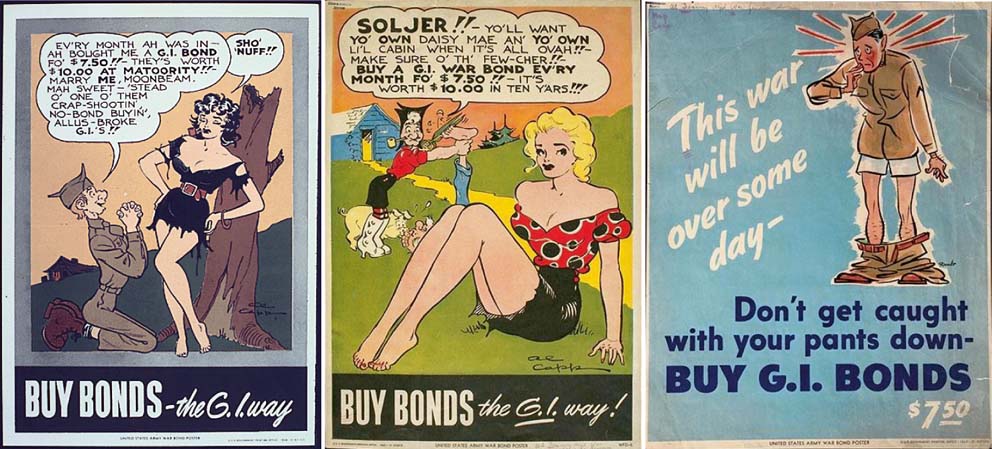
Take for example the three posters in Figure 1, which are part of the US government campaign to sell war bonds during World War Two. On the left poster, the woman is portrayed as scantily clad. The man's commitment to bonds – rather than gambling – seems to imply that he will be able to guarantee excitement through marriage. Or rather by marrying he will achieve excitement. Marriage seems to be possible for him because he bought bonds.
War Bonds (USA, 1940s)Footnote 55
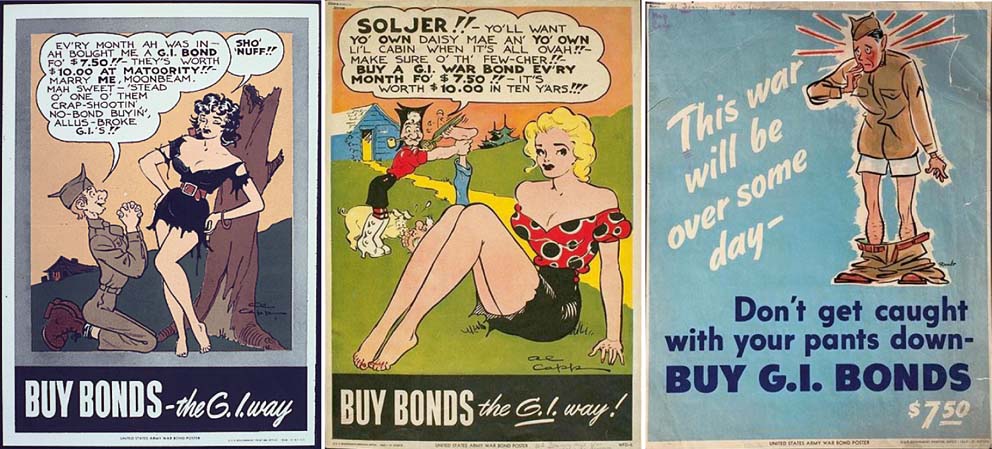
The middle poster not only implies sexual excitement as a direct consequence of buying a war bond, but also a return to rural tranquillity, complete with farm and cattle, at a time where roughly 13 per cent of the American labour force was still employed in the farming sector. Indeed, this poster suggests that finance is not just about big city slickers, but for the small man from the countryside. On the third image, again, the issue of the man and his manhood is a central focus. It suggests that by buying bonds men can retain a sense of dignity, finance as a way of avoiding shame, of being caught with your pants down.
The sale of war bonds was backed by a number of psychological research studies conducted for the War Finance Division of the US Treasury Department and several mass media advertising campaigns aimed at convincing the public to buy War Bonds. By 1945, the War Bond campaign had achieved name recognition of 94 per cent across the adult population and bonds had been bought by 40 per cent of the income-earning population.Footnote 56 The ‘messages’ these advertisements send about gendered financial relations are even more striking, given the self-professed emphasis that the architects of the War Bond drive put on aligning the messages to be communicated in these campaigns with prevailing ‘cognitive structures’.Footnote 57
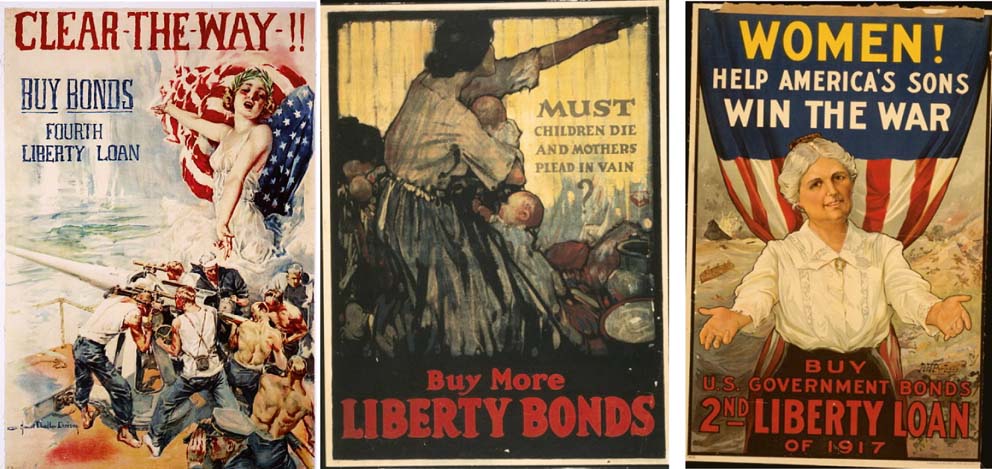
However, bond advertising has not only drawn upon the interplay of heterosexual virtues and vices. Traditionally, aesthetic representations of bond finance have also had a strong domestic tilt (with regard to both nation and household). Indeed, the US governments' ‘liberty bonds’ campaign during the First World War played on the evocation of strong associations between liberty, motherhood, virtue, the state, and finance (see Figure 2).
Liberty Bonds I (USA, 1910s)Footnote 59
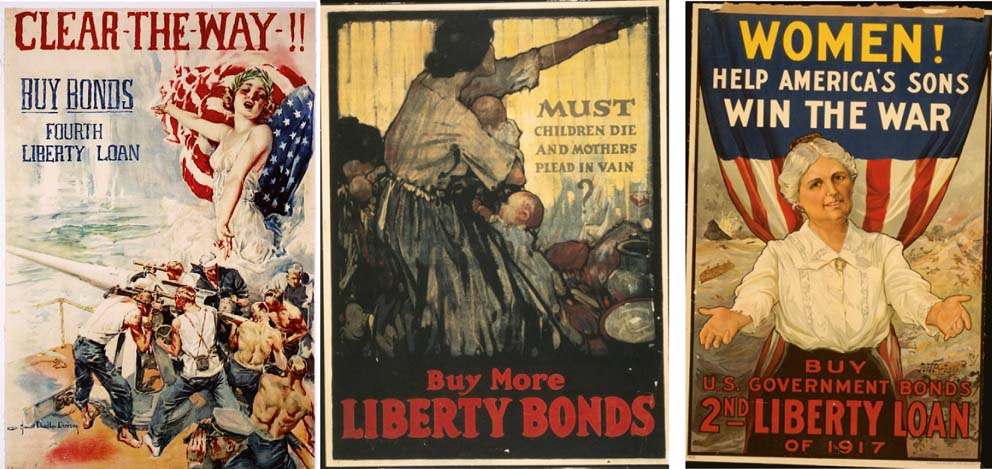
The ideal types of the woman – as ‘virgin’, ‘mother’, and ‘crone’ – are called upon to invest, as a subtle affirmation of their gender roles, while being robbed of their individual agency as those that are merely there to be protected. These conceptions of womanhood – bound up with investing in bonds, and thus helping the war effort – are promoted in the Liberty Bond advertising campaign. Here again, the campaign was aimed at creating ‘strong social pressures to buy bonds’.Footnote 58 Moreover, with the intensification of the American war effort, the appeals of the campaign turned increasingly ‘emotional’, with the portrayals of ‘obviously defenceless’ women playing a central role. In so doing, these advertisements not only ‘capitalise patriotism’, as Sung Won Kang and Hugh Rockoff suggest, they also capitalise patriarchy.Footnote 60
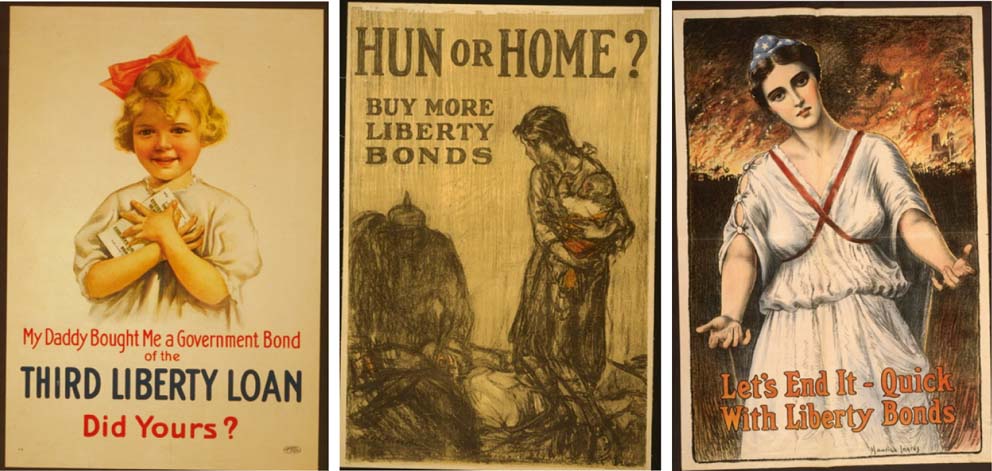
Finally, there is a note of hetero-normative discipline as expressed in the left image of Figure 3. The father/protector is being ‘guilted’ into buying bonds by comparison with other mythical fathers. Being a responsible father no longer solely entails the typical parental duties, but also being a responsible investor. As ever the notion of the father protector is implored to act on heterosexual instincts diametrically opposed to the sex drive enlisted in Figure 1. Equally, the rosy domestic image of the first picture in Figure 3, contrasts starkly with the apocalyptical scenes of the last two images. Here, buying bonds is the only protection against a shadowy enemy, the only barrier between us and a burning inferno. The message is very clear: if you don't buy bonds, you and your beloved and all you hold dear will be swallowed up by war. Somewhat ironically from the current crisis vantage point, bond finance is here portrayed as stable, a safe haven from chaos.
Liberty Bonds II (USA, 1910s)Footnote 62
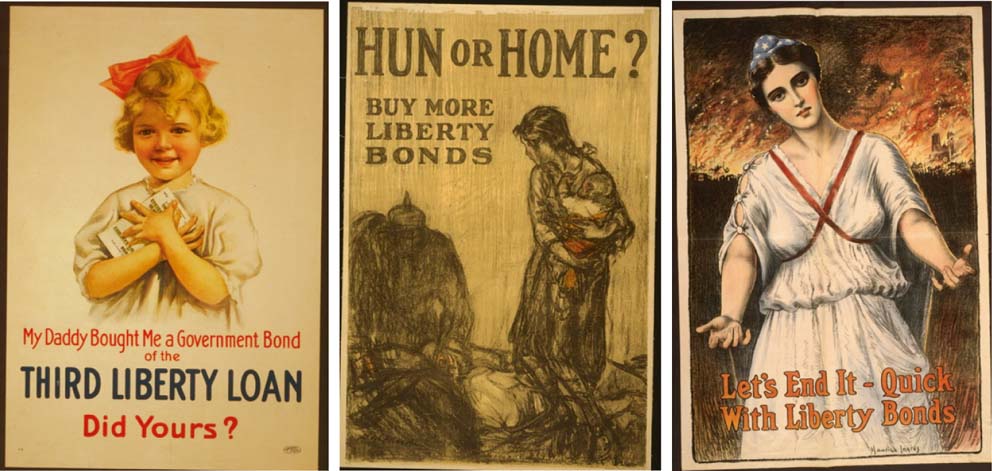
These aesthetic representations both draw upon and contribute to gendered notions of finance. Yet in so doing, they are also used to legitimate a notion of ‘state-finance’ as protective, essential for survival.Footnote 61 Different elements of the hetero-normative logic are deployed. It is not simply a game of playing upon the sexual impulses of the single man, but the arousing potential of financial stability for women. While this is covert in the example of US War Bonds, where the woman simply chooses a bond investor over a gambler, the Japanese women are quite open about how attractive they find men who invest in bonds. Indeed, the ‘social fact’ of female empowerment in the period between embedded liberalism and the twenty-first century has played an important role in the emergence and change of gendered finance.
Finally, a number of tropes are deployed: protective motherhood, virtuous widowhood, and good-willed spinster, as symbols and/or embodiments of national protection. Once married, the mood turns to guilt, where the man is implored to think like other responsible fathers to invest for their children. The entire family becomes an embodiment of concern, only buying government bonds can save the liberty and democracy of the heterosexual family. The financial state is legitimated upon the hetero-normative cartoon of home, family, and shame.
IV. Dirty bankers: Films about finance
In the previous section, different iterations of hetero-normativity were deployed to underpin the legitimacy of buying bonds. The gendering of global finance was predicated upon a specific narrative about the various ‘natural’ tensions in family life: sexual desire, shame, protective/nurturing impulses, etc. It is important to note that this is a specifically state-centric ontology of finance, part of a larger moral discourse of (Western) liberalism-as-salvageable that accompanied the twentieth century spirit of growth and technological advance.
In this section, we move on to develop ideas about the figure of the man and, specifically ideas about his duties towards the family. While the shame of earlier bond adverts revolved around male duties to protect children, the shame of men in financial cinema is primarily located in their sexuality.
According to De Goede, Lady Credit was originally developed by Defoe as a satirical device, aimed at warning people of the dangers of finance. On this account finance became feminine, dirty, dangerous, a potentially uncontrollable coquette who could drive men to wreck and ruin.Footnote 63 Interestingly, however, when we turn to popular film narratives about finance in the 1980s and early 1990s, this critical dimension of gendered finance begins to orientate almost exclusively around the sexuality of men: the thrusting masculinity of characters like Gordon Gekko and Patrick Bateman. In this way, we might begin to tease out some subtle shifts in the patterns of hetero-normative valorisation that speak of an evolution in the gendered politics of finance. No longer is it the moral flaws of woman that drive financial excess, but the hypersexual masculinity of bankers, that become doubly antisocial: against family and against the real economy.
During this period, a series of popular film narratives portrayed the idea of ‘global finance’ via a focus on the (male) investment banker: his morality, his largesse. For example, Sleeping with the Enemy (1991) emplaced the figure of the investment banker as morally questionable, violent, and abusive. Rather than being a focus of love or an image of mother protection, the female character is portrayed in a constant state of fear and insecurity, under threat not – as in the bond adverts – from abroad, but importantly, at home. This portrayal of a financial man as potentially violent and morally doubtful can be read as part of a more general disquiet over the rapid changes in financial markets throughout the 1980s, the advances of financial liberalisation and the fallout from the US Savings and Loans Crisis. The seemingly inexorable advance of finance capital unsettled traditional understandings of productive capitalism (its potential for stability/welfare).
Developing this theme, a more critical set of insights on the structural logics and antisocial potentials of finance is introduced by Wall Street (1987). Again the identity and character of the male becomes a central conceit for reflecting the changing fortunes and limits of finance. Wall Street establishes a moral play where heterosexual men at different stages in life – the yuppie, the established player, the wise Father – embody various elements in the shift from productive to finance capitalism. The narrative works through the eyes of the young man who encounters the temptations of money and ‘liquid’ capitalism espoused by Gordon Gekko, who thinks that ‘lunch is for wimps’ and ‘greed is good’. Through fulfilling a number of tests, the younger man is set up to use his family connections with industry-unions to facilitate insider trading.
A critical vocabulary is established that arguably underpins many of the subsequent cinematic portrayals of, and, we would argue, contemporary critiques of global finance. The individualising, risk-taking, wealth-oriented idea of finance is exemplified by an aspirational masculinity that wants more, now. The critique of this new form of ‘liquid’ finance turns on duties to the family, and the tragic arc which leads the main character to sell out his Father is an epitome of wider opinion that finance has no social purpose: it is destabilising, immoral.Footnote 64
In a film like American Psycho, a ‘representative text for Reaganomics’ according to Richard Godden, this focus on the body and persona of the male becomes extreme.Footnote 65 The hypermasculinity of Patrick Bateman is evidenced in his physical perfectionism, his competitive behaviour, and his consumerism. While Wall Street presents a straight man's moral play about self-interest gone wrong, American Psycho (2000) goes a step further. No longer just an immoral banker, Bateman is a sexual sadist who picks up prostitutes, not to tame them, but to butcher them. While there are similarities with Gekko – an image of refinement, power, and sexuality – the interior monologue goes beyond a love of ‘greed’ to reveal a psychopath who feels nothing, whose nights are filled with murder and sexual violence. Bateman's self-mastery, with elaborate fitness routines, and a love of Phil Collins, is a façade, and the reality of Bateman, indeed of finance, is a violent dystopia.Footnote 66
Such film narratives advance a critical discourse about finance. The body of the male is placed in question, strong, ambitious, sexual. Tempting as it may be to laud them, the danger of risk-taking – the danger of finance – is understood through crime, violence, lust, and murder. These ‘excessive masculinities’ are the prism through which cinema has entertained the discourse of finance. Importantly, we think, these tropes remain in the postcrisis documentary Inside Job (2010).
The narrative/argument of Inside Job focuses on the incentives structure of finance to argue that bankers are almost bound to behave in ways that destabilise the ‘real’ economy. Bankers, policymakers, and (even) academics are portrayed as living a high life: exciting experiences, vast amounts of money. Indeed, the film plays to the infantile masculinity identified by Griffin;Footnote 67 investment bankers get special treatment as particularly dirty, they receive six figure bonuses, sports cars, indeed, one Icelandic banker even buys a pin-striped private jet (!).
In this way, the personal mores of bankers are put in question as a central locus of critique. They are all (apparently) men, who regularly take cocaine and visit strip clubs and prostitutes. The filmmakers even include an interview with a high-class prostitute about her business relations with Wall Street bankers. Indeed, in a highly telling reversal of De Goede's arguments about how men should seek to discipline their ‘sexual desire for Lady Credit’ through the practice of accountancy, the prostitute is portrayed as a disciplined businesswoman who is able to provide a thorough record of her accounts. In this way, Inside Job juxtaposes an image of the excessive masculinity vs the whore as financially stable and financially prudent. Again a narrative of shame becomes a critical device:
In an industry in which drug use, prostitution, and fraudulent billing of prostitutes as a business expense occur on an industrial scale, it wouldn't be hard to make people talk, if you really wanted to.Footnote 68
Through such film narratives the (hetero)sexual mores of men have become a central locus of critical engagement with global finance. Duties to family, to society, and to productive capitalism have been rendered as a moral foundation for intervention.
V. Mother Merkel: Household finance writ large
As the previous sections have suggested, gender and finance are historically intertwined through the performance of legitimation and critique. At different times, women have been whores, wives, and mothers. Equally, men have been responsible, or ashamed, risky, or irresponsible. The relationship between men and women has been deployed as a central locus for understanding the relationship between finance and the state, and between finance and the productive economy. Interestingly, whereas De Goede identifies the temptation of female sexuality as the lure for men, the films in the previous section started to place the man as the driving force. The crux of the moral argument was not that men were ‘tempted’, but that they were inherently sexual, lascivious, and whoring.
In a telling inversion, the figure of the whore in Inside Job is presented as a stabilising nurturing device, able to recognise the values of productivity and prudence. This nuance in the values attributed to men/women in hetero-normative frameworks might be seen as part of wider shifts in sexual practices in the latter half of the twentieth century. As Stevi Jackson and Sue Scott argue, the so-called sexual revolution carries a number of antinomies that can mean that greater liberation in some areas translates into moral repression in others. For example:
Greater tolerance of pre-marital, even casual, sex and of marital breakdown and serial relationships co-exists with the continuing reification of monogamy. … It is difficult, these days, to find any area of adult sexual conduct that most people will unequivocally say is wrong – the one exception seems to be sexual infidelity, especially adultery.Footnote 69
Thus, the figure of the ‘dirty banker’ can stand as an unquestionable moral category: a sinner against the hetero-normative institution of marriage, the family, and the home. Understood in terms of masculine sexuality, finance becomes a figure that requires control. On this basis, we suggest, the figure of the female solution for finance can be articulated, both as a virtuous matriarchal figure and as a prudent, calculating, household manager.
In the wake of the global financial crisis, women such as the German chancellor Angela Merkel and the IMF managing director Christine Lagarde, have become figureheads of the return to a more stable financial world.Footnote 70 Together, they have become a core focus of the renewed ‘financial embeddedness’ narrative. However, embeddedness here does not solely stand for reattaching the financial to the real economy, but for a concrete hetero-normative notion of this economy that sees it as an analogy of the (heterosexual) household.
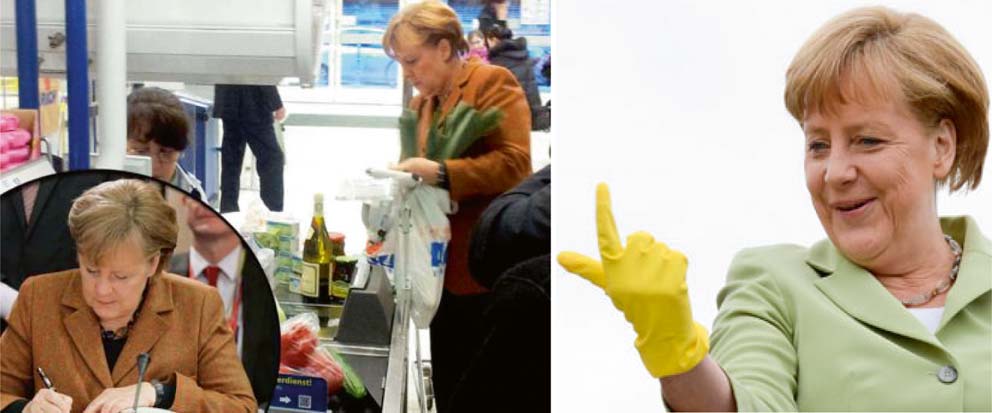
Angela Merkel introduced the concept of the Swabian housewife to the debate at the Christian Democratic Party Conference in 2008. The Swabian housewife works hard and lives within her means. She frowns on debt and has an instinctive preference for frugality. This imagery has been drawn upon throughout the Eurozone crisis. In March 2012, the German tabloid Bild ran a photo story on Merkel doing her grocery shopping, having just signed the new European fiscal pact in the morning (see Figure 4). In May 2012, Bild brought another story, comparing Merkel's down to earth habit of grocery shopping with Nicolas Sarkozy's holidaying with his rich friends: ‘this is why we like her’.Footnote 72 In more satirical terms, The Guardian daily blog on the Eurozone crisis ran a spoof readers competition. With the rather fantastic image of Merkel feeding penguins while wearing marigolds, it asked readers to suggest to the European Central Bank (ECB) what Merkel should really be doing with her rubber gloves, arguing that maybe she should live up to her credentials as the good housewife and clean up the Eurozone.Footnote 73
Angela Merkel, the good housewifeFootnote 71
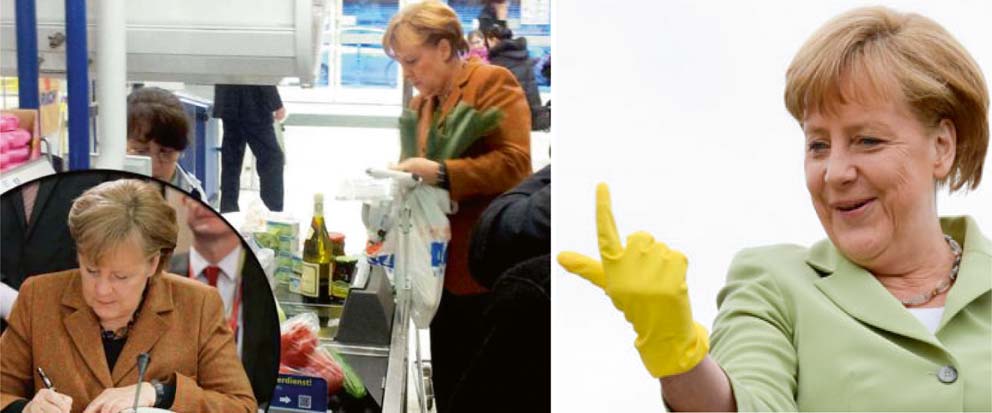
The household economy is here presented as the perfect antidote to the disembedded and ruthless world of global finance. However, what becomes clear from the hetero-normative focus of our argument is that drawing on notions of the household economy against the harsh world of global finance is a false dichotomy. Both instantiations of the economy are deeply embedded in specific gender relations.
The hetero-normative assumptions of the household economy, in combination with the austerity narrative, foreclose political space. Finance has to be tamed, that is, bankers have to go back to their wives, and the nation is turned into a household. These gendered constructions of money and finance, and the hetero-normative politics that they entail, bring their own silences with regard to phenomena such as the credit card debt of the young, the financial difficulties faced by single parent households, etc., which are placed outside the concern of hetero-normative finance.Footnote 75 Once again, the tropes of gender and hetero-normativity are deployed to underpin policies and practices that carry significant implications for gender relations.
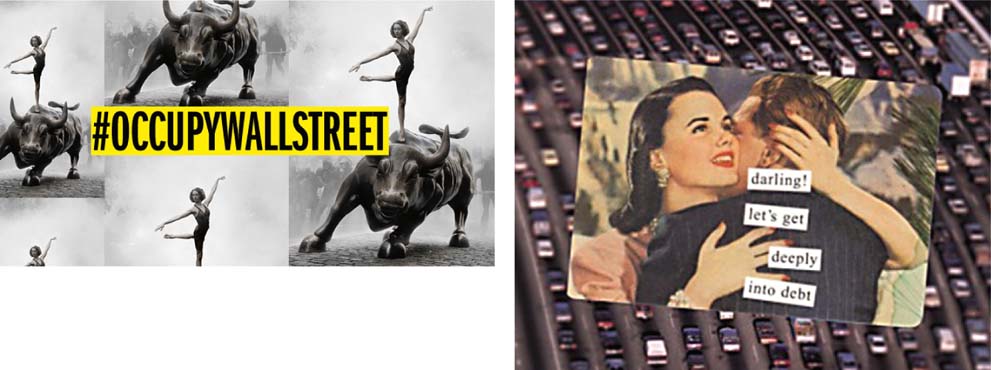
What we see at play here is a subtle shift of how the state-finance relationship is understood and enacted. There has been a reversal in the gendered assumptions that underpin this relationship. Now it is the good housewife (both literally, but also standing at the helm of nations or organisations such as the IMF) who has to ‘take the bull by the horns’ as one prominent Occupy Wall Street slogan suggests. This change in the gendered stereotypes of finance is clearly portrayed in artistic representations of attempts to reassert control over finance. As Figure 5 shows, the bull has to be put on the leash, it has to be domesticated. Women have to stand ‘on top’ of finance (see Figure 5, left image). Yet, even within these highly sophisticated critiques of finance, there seems to be a strongly hetero-normative tendency, pitching the two sexes against each other in a fight of who controls finance and future wellbeing and the economic practices (such as consumerism) that this entails. This is the case even in satirical interventions, such as a recent Adbusters campaign (see Figure 5, right image).
Taking the bull by its hornsFootnote 74
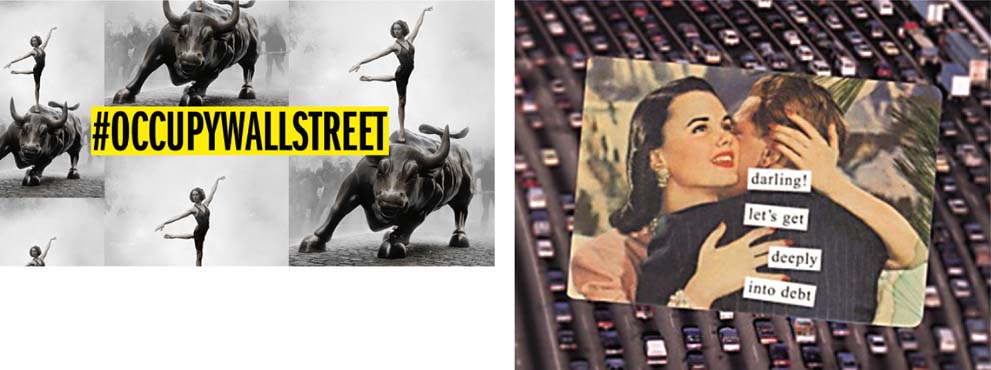
The heterosexual family emerges as the core unit that needs to be protected. Rather tellingly, Christine Lagarde, in a much-publicised interview with The Guardian in 2012, compared the conditions in Greece with
the little kids from a school in a little village in Niger who get teaching two hours a day, sharing one chair for three of them, and who are very keen to get an education. I have them in my mind all the time. Because I think they need even more help than the people in Athens.
Here (and The Guardian was quoting rather selectively from the interview), the caring Lagarde enlists the trope of the woman protecting her family from male greed and corruption, reversing the images propagated by the liberty bonds of a century ago. Her ambition is to protect the children and there is only one way to do this: through financial responsibility. Asked what this implied for Greek children, Lagarde replied: ‘Well, hey, parents are responsible, right? So parents have to pay their tax.’Footnote 76 Pay your taxes and live within your means as the standard solution to the crisis.
Re-embedding finance through narratives of the household, austerity, and the good (read: parental) taxpayer ostensibly serves the purpose of doing away with the ‘old’ system of promiscuous capitalism, promiscuous bankers, and promiscuous IMF heads. The end of masculine promiscuity (read: reckless finance) is nigh, it is time for the prudent housewife (not without a little irony: the state) to take control. The family must be defended. The family must also act as the moral locus of austerity, justifying and suffering from the welfare cuts that are entailed. Albeit, we might argue, with a renewed romance for embedded liberalism: the good old-fashioned liberal family can learn some humility from the suffering of poor African children. The violence(s) and exclusions that this brings with it are ignored.Footnote 77
Conclusion: It's a wonderful life?
In this article, we have drawn attention to some of the gendered constructions of finance that have come to play a prominent role in post-crisis discursive responses. While gendered constructions of finance are fluid – and indeed an appreciation of such fluidity is an important element in accessing the constitutive significance of gender in current debates – they have worked to demarcate ‘normal’ and ‘good’ behaviour in finance, legitimating, and critiquing particular relationships between finance, state, and the productive economy. As such, gender is an important element in the politics of global finance.
With regard to the question of resisting finance, Bill Maurer has made the call for ‘dressing it up in mufti’ to help us ‘think about the modifier “alternative” differently – as an alternation in phase over time, rather than as an “other” outside of or opposed to a dominant formation’.Footnote 78 On the one hand, following Butler's interventions on drag, satirical interventions on finance might be seen as ‘alternation in phase’. Take for instance Adbusters' recent campaign as portrayed in Figure 5 above. There is a rich vein of critical engagement to be mined in satire for sure. On the other hand, and looking to cinema, there is already some purchase in the queer – indeed insane – position of Patrick Bateman who embodies the violence of finance:
All I have in common with the uncontrollable and the insane, the vicious and the evil, all the mayhem I have caused and my utter indifference toward it I have now surpassed. My pain is constant and sharp, and I do not hope for a better world for anyone. In fact, I want my pain to be inflicted on others. I want no one to escape. But even after admitting this, there is no catharsis; my punishment continues to elude me, and I gain no deeper knowledge of myself. No new knowledge can be extracted from my telling. This confession has meant nothing.Footnote 79
Indeed, a credible but seldom heard response to financial crisis might be to recognise that attempts to ‘embed’ finance have themselves reproduced the conditions of further instability. Perhaps ‘embedding’ is a form of violence?
Beyond this, it might also be possible to think in terms of invention, as opposed to the binary of regulation or resistance. Are there other ways of being financial that can be imagined, for example, peer to peer lending, money art, the kinds of economies that exist at Burning Man, or around alternative currencies, etc.? Such relational systems blur the need to think about ‘big finance’ and ‘big gender’ and encourage an alternative set of financial visions.
Without wishing to end on a point of advocacy, however, we would just conclude by returning to the seminal film of embedded liberalism: It's a Wonderful Life (1946). In many ways, this film represents the true origin of many of the dilemmas faced in this article. It's a Wonderful Life presents an archetype of the way oikonomia can inform banking finance through the image of the good, embodied, and embedded ‘savings and loan’. It is an image that is especially powerful in a US context, for its ability to draw upon the spirit of America as it emerged from the Great Depression: that hard-working families could expect to live a decent life if only they knuckled down, saved, and invested in a home. It follows hard on the heels of the institutionalisation of ‘embedded liberalism’ through the creation of the Bretton Woods system in 1944. And the romance of this image is crystallised in the ultimate salvation of the savings and loan bank by the very community that benefitted from its model of capitalism: there is something good in liberalism and it is people.
From the perspective of hetero-normativity It's a Wonderful Life serves as a panacea to the brutal, risk-taking, uncaring capitalism of investment banking. The story is echoed in bond adverts, Wall Street, Inside Job, and the performances of Angela Merkel and Christine Lagarde. However, this image neither convinces, nor does it contain the excess of finance. The structure of morality in the film is predicated on male seniority in the household. The wife bears the burden of adjustment when things go wrong and she has to listen to his rages, when he cannot make things work. The black maid is afforded a central role in the family, but is chastised for listening to a dinner conversation too closely. Then, in the humbling conclusion, the black maid is the last person to bring him the money needed to bail out the savings and loan. On this view, the myth of embedded liberalism is (re)produced through claiming the voice and the value of the very social categories it marginalises.