There are patterns inherent in any language that serve to provide predictability and constraints for the learner. Many of these patterns involve similarities between lexical items, such as how similar words sound to one another. This variable, dubbed neighborhood density (ND), attempts to index how many similar-sounding words exist in a language for any given word. It has been operationalized in the literature by counting the number of words (i.e., neighbors) that are present in a language by adding, substituting, or deleting a sound in any word position (Landauer & Streeter; Reference Landauer and Streeter1973; Luce & Pisoni, Reference Luce and Pisoni1998). For example, neighbors for the English word /fl / include /sl/ (a substitution), /flt/ (an addition), and /l/ (a deletion). Words with few neighbors, such as /fl/, are believed to reside in sparse neighborhoods, while words with many neighbors, such as /sit/, are believed to reside in dense neighborhoods.
ND has frequently been co-investigated with several related variables, including phonotactic probability (PP; the relative frequency of sounds or sound sequences in a language; Vitevitch & Luce, Reference Vitevitch and Luce1999), word frequency (WF; the frequency with which a word occurs in a language; Kucera & Francis, Reference Kucera and Francis1967), and neighborhood frequency (NF; the mean word frequency of a word's neighbors; Vitevitch & Sommers, Reference Vitevitch and Sommers2003). It is beyond the scope of this study to consider reported interactions between these three variables (and others, such as word length and age of acquisition). However, note that such experiments are typically designed to differentiate influences of these variables on a given task (e.g., word learning), rather than to assess the validity of them. For example, Cluff and Luce (Reference Cluff and Luce1990) jointly classified stimuli in terms of their ND and WF on a task of word recognition. An “easy” word had low ND and high WF; a “hard” word had high ND and low WF. Similarly, Metsala (Reference Metsala1997) found that sparse words high in WF were most accurately identified. As such, when attempting to validate how a particular lexical variable has been operationalized in the literature, it becomes necessary to control for other variables in order to minimize confounding influences. For example, a positive correlation exists between PP and ND (Storkel & Rogers, 2000): dense words tend to be composed of frequently occurring sound sequences, while sparse words are often low in sound probability. At the same time, sparse words can still be high in PP (e.g., /kwin/) and vice versa. This again highlights the need for careful stimuli control, given that prior work reported a “particularly problematic processing environment” created by the orthogonal variation of PP and ND (Luce & Large, Reference Luce and Large2001, p. 574).
Considering the vast and varied cross-linguistic research that has been published on the effects of ND on speech perception and production using the single-segmental metric (e.g., Marian, Blumenfeld, & Boukrina, Reference Marian, Blumenfeld and Boukrina2008; Munson & Solomon, Reference Munson and Solomon2004; Storkel, Armbruster, & Hogan, Reference Storkel, Armbruster and Hogan2006; Storkel & Rogers, 2000; Vitevitch & Rodríguez, Reference Vitevitch and Rodríguez2005), it is important to demonstrate that such a measure adequately captures perceptions of phonological similarity. This becomes especially important when considering previous domain- and language-dependent results. Specifically, adults perceived sparse words more accurately than dense words in English (Luce & Pisoni, Reference Luce and Pisoni1998; Vitevitch & Luce, Reference Vitevitch and Luce1999), yet the opposite effect was found in Spanish (Vitevitch & Rodríguez, 2005; cf. Baus, Costa, & Carreiras, Reference Baus, Costa and Carreiras2008). Meanwhile, a productive advantage for dense relative to sparse words has been reported in German, Spanish, and English (Marian et al., Reference Marian, Blumenfeld and Boukrina2008; Stamer & Vitevitch, Reference Stamer and Vitevitch2012; Vitevitch & Sommers, Reference Vitevitch and Sommers2003; respectively).
In addition to the facilitative effects of ND on production, similar effects of NF were observed in Spanish and English (Baus et al., Reference Baus, Costa and Carreiras2008; Vitevitch & Sommers, Reference Vitevitch and Sommers2003). Dense words were produced more accurately, and words with many neighbors containing high word frequencies (i.e., words with high NF) shared the same advantage. This suggests that the frequencies of a word's neighbors may also affect its activation. However, no effects of NF on perceptual accuracy were found (Luce & Pisoni, Reference Luce and Pisoni1998). Given the contrasting findings between perceptual and productive studies, as well as between languages, the precise nature of ND may depend on the type of task involved as well as related variables such as NF.
Despite numerous investigations of ND, few studies have tested the validity of the single-segmental metric used to index phonological similarity. As part of an experiment investigating differences between statistical and behavioral measures of lexical activation, Luce and Large (Reference Luce and Large2001) presented consonant–vowel–consonant (CVC) nonwords to typical adults, who were asked to produce a similar-sounding word for each stimulus. Approximately 70% of the responses involved a single substitution, with single additions and deletions accounting for fewer than 6% of the responses. These results illustrate that while a majority of the observed changes support the single-segment metric, almost a quarter of the responses did not confine phonological similarity to a single-sound criterion. In addition, while additions and deletions are valid changes under the current definition of ND, participants rarely relied on making them during the task. Given the authors’ original aims of the study, a detailed item analysis was not conducted to further explore other influences on the changes (e.g., phonological composition). Hence, it was not clear which stimuli received the greatest number of changes, specific types of changes (e.g., substitutions vs. deletions), and/or particular contextual changes (e.g., changes to word-initial or word-final position). Finally, Luce and Large (Reference Luce and Large2001) calculated a measure of entropy in the study, which indexed the number of different words generated for a particular stimulus. Using a median split, words were designated as low or high in entropy. This served to provide a behavioral versus statistical measure of lexical activation. No significant effects of ND were found between low- and high-entropy words, suggesting the two variables might provide different information (phonological similarity vs. lexical diversity as a function of phonology).
In another study, Vitevitch (Reference Vitevitch2008) analyzed approximately 20,000 words from the 1964 Merriam–Webster Pocket Dictionary according to their ND. This sample of words, which included only the most frequent and familiar words in English (Kucera & Francis, Reference Kucera and Francis1967; Nusbaum, Pisoni, & Davis, Reference Nusbaum, Pisoni and Davis1984, respectively), has been used extensively in previous studies of ND. In the analysis, Vitevitch (Reference Vitevitch2008) analyzed neighborhood connections according to the single-segmental metric of ND. There were three major findings. First, results indicated that 53% of lexical entries were hermits, or words that had no neighbors at all (e.g., obtuse). Second, 13% of lexical entries only had a few neighbors. Third, 34% of lexical entries had multiple neighbors. Summarizing the results, two-thirds of the words had few or no neighbors. This again highlights the importance of operationalizing phonological similarity in a manner that is representative of how words phonologically resemble one another. Otherwise, ND is merely a limited estimation of phonological similarity and may fail to incorporate other influential components of a word, such as phonological composition, frequencies of neighbors, or WF.
It is possible that defining phonological similarity on the basis of a single-segmental alteration has significant limitations. Consider the English word /pis/. Using the current definition of ND, a neighbor for /pis/ is /lis/ (a substitution), but not /tiz/ (two substitutions). Consequently, neither /tiz/ nor /ɛlɪfənt/ are neighbors of /pis/; clearly though, one of these words is more phonologically similar to the target. Next, the single-sound metric of ND assumes that phonemes are equally different from one another. That is, neighbors of a target word are equally phonologically similar to the target. In the case of a target word such as /dil/, where its neighbors include /til/ and /vil/ (word-initial substitutions), /t/ and /d/ are much more phonologically similar to one another than are /t/ and /v/. Finally, the phonological composition of a target word may influence the types and places of change that occur. Perhaps words with particular phonetic features (e.g., fricatives vs. plosives or voiceless vs. voiced) are more prone to certain changes than are others (e.g., substitutions vs. deletions). Word position may also interact with such changes. The single-segmental metric of ND does not take such details into account because there is no consideration of featural information or word position; the only requirement is that a single phonemic change occurred somewhere in the word.
THE PRESENT STUDY
In order to better understand how adults perceive phonological similarity, as well as consider how phonological composition may influence the number and types of changes made to a target word, a task must be created for participants to make perceptual judgments. Specifically, prompting participants to name a similar-sounding word in response to a target would help answer the primary question of the current study, consistent with procedures in Luce and Large (Reference Luce and Large2001). In addition, beyond conducting an analysis that examines the types of changes made (e.g., additions or substitutions), as well as where in the word such changes occurred (e.g., initial or final position), a detailed item analysis must be conducted for each stimulus. Finally, it is possible that when participants are assessing potential neighbors in response to a nonword, a neighbor's WF or the WF of a particular neighbor (i.e., NF) may increase the lexical activation of a word and its subsequent selection. A secondary goal in the current study therefore is to differentiate effects of ND, WF, and NF.
Given previous findings that roughly 75% of all changes involved altering a single segment (e.g., Luce & Large, Reference Luce and Large2001), it is predicted that a similar result will be found in the current study. If this result is replicated, it would lend further support that a single-segmental metric can capture phonological similarity the majority of the time. However, the metric's inability to account for other changes nearly a quarter of the time (i.e., more than one segment is altered) would nonetheless be highlighted. Alternatively, if the average number of changes made per word varies, the operationalization of ND may need to be revisited. Regarding the influence of word position, it is predicted that participants will make the greatest number of changes to the word-final segment of a target, consistent with Luce and Large (Reference Luce and Large2001). Finally, it is predicted that real-word substitutions will be relatively high in WF and NF due to increased lexical activation levels.
METHOD
Participants
Fifty adult participants were recruited from undergraduate courses at Ithaca College. All participants were native English speakers and had no history of speech, language, or hearing impairment. Prior to participation, each participant signed an informed consent form approved by the college's human subjects research committee.
Materials
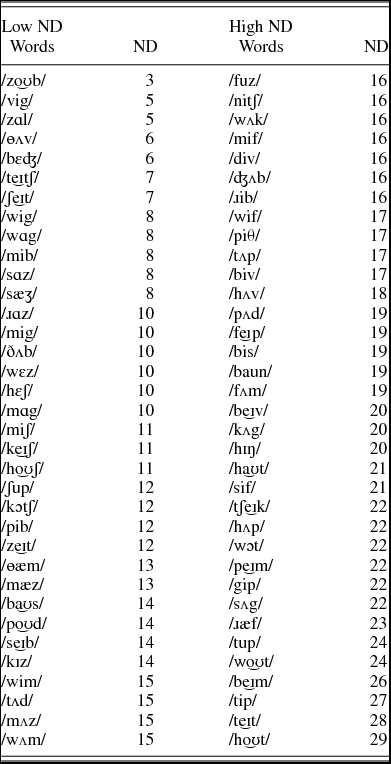
Seventy CVC nonwords were selected as stimuli (see Appendix A stimuli). Nonwords were necessary to include in the study because they do not contain semantic information or WF values. Otherwise, responses might be impacted by the semantic nature or WF of a stimulus, and not solely its phonological form. For example, /kæt/ might elicit [dɑg] instead of a phonological neighbor such as [bæt]. In order to allow for a broad sampling of ND, half of the nonwords had few neighbors and were sparse (M = 10.34 neighbors, SD = 3.28, range = 3–15), and the other half had many neighbors and were dense (M = 20.23 neighbors, SD = 3.65, range = 16–29). Consistent with prior work (e.g., Storkel et al., Reference Storkel, Armbruster and Hogan2006), ND was determined by the number of words that could be formed by adding, deleting, or substituting a single sound to a target nonword, and was calculated using the Hoosier Mental Lexicon (Nusbaum et al., Reference Nusbaum, Pisoni and Davis1984). An independent-samples t test confirmed that the sparse condition had significantly fewer neighbors than the dense condition, t (68) = 11.92, p < .01, d = 2.85. Featural aspects of the stimuli were similar in each condition (e.g., word-initial /s/ appeared in both dense and sparse words). Finally, careful attention was paid to ensure that a variety of changes were possible for each type of change and word position. For example, roughly half of the stimuli allowed for either a substitution or a deletion in both word-initial and word-final positions.
Recall from the introductory section that other lexical and sublexical variables (e.g., PP and NF) have often been co-investigated with ND to differentiate their influences on a given task. In the current study, only one particular variable (ND) is being explored in order to validate its current operationalization as a single phonemic change. It was of additional interest to determine how the ND of a stimulus, sparse or dense, might impact the number and types of changes to it. Given the primary purpose of the study, coupled with reported interactions among ND, PP, and NF (Vitevitch & Luce, Reference Vitevitch and Luce1999), sparse and dense conditions were carefully matched for PP and NF in order to minimize confounding influences. An independent-samples t test confirmed that the sparse and dense conditions were not significantly different in PP: biphone probability, t (68) = 1.66, p = .10, d = 0.40; segmental probability, t (68) = 0.47, p = .64, d = 0.11; or NF, t (68) = 0.07, p = .94, d = 0.02.
Stimuli were randomized using a random number generator, then recorded in a soundproof Tracoustics RE-243-Bv audio booth using a Roland Edirol R-09 digital recorder. Stimuli were recorded by a female, native English speaker who speaks with a General American English dialect. In order to decrease prosodic alterations related to list reading, “filler” words were placed at the beginning and end of the list. Stimuli were normalized using Adobe Audition and spliced into individual 16-bit WAV files at a sampling rate of 44.1 kHz. A different native speaker of English identified the stimuli with 100% accuracy, indicating the recordings were intelligible and of high quality. Consistent with similar work of this nature (Vitevitch & Luce, Reference Vitevitch and Luce1999), 3 s of silence were inserted between stimuli to allow for responses.
Procedure
Participants attended one experimental session and were tested individually. Consistent with Luce and Large (Reference Luce and Large2001), participants were told that they would be hearing a list of nonwords, and were instructed to name the most similar-sounding real word that came to mind. Stimuli were presented over Audio-Technica ATH-M40fs precision studiophones. A bidirectional microphone was positioned in close proximity to the participant's lips, and all responses were recorded to a Roland Edirol R-09 digital recorder.
Each participant completed three practice trials. These trials allowed for the possibility of sound substitutions, additions, and deletions, and served to familiarize participants with the task. Responses to practice items were not included in the analysis. After participants demonstrated task comprehension, the experiment was administered. Consistent with prior studies of this nature (Luce & Large, Reference Luce and Large2001; Vitevitch & Luce, Reference Vitevitch and Luce1999), each stimulus was played once during the task. If participants failed to respond during the aforementioned 3-s window, a “no response” was scored and the next item was presented.
Analysis
Responses were phonetically transcribed by the second and third authors, research assistants trained in English phonetics and phonology. Approximately 99% of the responses provided were real words, with one to two sounds retained from each stimulus (M = 2.03, SD = 0.29, range = 1.28–2.90); “no responses” accounted for less than 5% of the data. Interrater reliability was calculated for approximately 20% of speech samples by a research assistant trained in English phonetic transcription. Mean point-to-point transcription agreement reached 97.68% between listeners (SD = 3.78%, range = 87%–100%). In the small number of cases where the transcribers disagreed, the original judge's transcriptions were used in the analysis.
The first analysis determined the average number of changes made per word by a participant. The total number of changes made across all stimuli was divided by the number of stimuli to which a participant responded. For example, if a participant made 70 overall changes and responded to each stimulus, 70/70 = 1 (i.e., an average of one sound change was made per word).
The second analysis considered the types of changes a participant made, and where such changes occurred in a word. Responses for each participant were categorized by type of change (additions, deletions, or substitutions) as well as place of change (initial, medial, or final). Next, percentages for each type and place of change were calculated by dividing the number of changes that occurred for a certain type/place of change by the total number of changes made. For example, if a participant made 12 word-initial substitutions and 74 total changes to the stimuli, 12/74 = 0.16 × 100 = 16%. Therefore, 16% of all changes for this participant involved a word-initial substitution.
A third analysis considered the phonological composition of stimuli that received the greatest and least number of changes in relation to the number, type, and place of changes. The top 10% and bottom 10% of stimuli were analyzed regarding their phonetic features and density category (sparse or dense). In addition, the most frequently produced words in response to a particular nonword were examined to gauge response consistency among participants and potential effects of WF.
RESULTS
Participant analysis
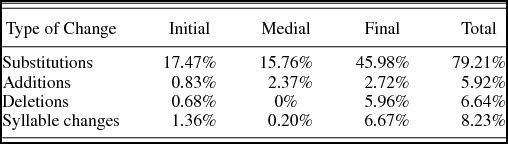
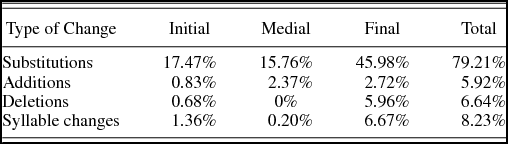
Consistent with predictions and prior work (Luce & Large, Reference Luce and Large2001), the majority of changes (81.62%) involved a single segmental change to a word. Overall, participants made an average of one change per word (M = 1.19, SD = 0.08, range = 1.03–1.39), though sizable variation was observed between participants. This was true for the total number of changes made across stimuli (range = 45–114), as well as for what percentage of changes involved more than a single segment in a word (5%–35%). Table 1 displays the percentages of substitutions, deletions, additions, and syllabic changes by word position. Given that only 2% of changes involved multiple segments at a time (e.g., adding two sounds or substituting three sounds), these types of changes are not differentiated in the table for ease of viewing. As predicted, and consistent with the findings in Luce and Large (Reference Luce and Large2001), the most common type of change involved a word-final substitution, which accounted for nearly half of all changes (45.98%). The second most frequent change involved a word-initial substitution (17.47% of all changes), followed by a substitution of the vowel (15.76% of all changes).
Percentages of responses by type of change and word position
Item analysis
The number of changes made by the group in response to a specific stimulus ranged widely, from 45 total changes to /vig/ to 114 total changes to /θæm/. In order to explore variability between stimuli regarding the number of changes made, types of changes made, and where changes were made within a nonword, the following properties of a stimulus were considered in the first analysis: ND, PP, and NF. Note that while sparse and dense stimuli did not significantly differ in PP or NF, each stimulus nevertheless had values for these factors to be analyzed. First, using a median split, a similar amount of changes was found between words with low ND and those with high ND, t (68) = 0.39, p = .70, d = 0.09, as well as words with low PP and high PP: biphone probability, t (68) = 0.56, p = .58, d = 0.13; segmental probability, t (68) = 1.64, p = .11, d = 0.34. However, significantly more changes were made to words with low NF than those with high NF, t (68) = 2.08, p < .05, d = 0.50. In order to explore potential interactions between ND and NF, four conditions were created using a median split: low ND-low NF, low ND-high NF, high ND-low NF, and high ND-high NF. All pairwise comparisons were nonsignificant (all ps > .05). A similar analysis was conducted for ND and PP using a median split: low ND-low PP, low ND-high PP, high ND-low PP, and high ND-high PP. Again, all pairwise comparisons were nonsignificant (all ps > .05). As such, the only influential factor on the number of changes made was NF.
A second analysis explored the types of changes made to stimuli, in addition to the influence of word position on such changes. Approximately the top 10% of stimuli with the greatest number of changes made to them (N = 8) was compared to the bottom 10% of stimuli with the least number of changes made to them (N = 8). Although featural differences were not found (e.g., both groups of words contained similar amounts of word-initial voiced sounds, tense vowels, etc.), a small trend was observed related to the words’ densities. Specifically, 75% of the words with the least number of changes were from dense neighborhoods; only half this amount was found among words with the greatest number of changes. As such, words containing the greatest amount of changes tended to be sparse in ND (i.e., less phonologically similar to real words). No significant differences emerged between the types of change possible (e.g., additions or deletions) per word position between the groups. For example, a word-initial substitution was possible in 8/8 stimuli in the bottom 10% group and 7/8 stimuli in the top 10% group. Upon analyzing the PP of both conditions, there was an equal number of stimuli with low PP and high PP. A related analysis considered the ND and NF of the top 10% of stimuli that were most likely to elicit more than one segmental change (N = 8). No trend was observed among the group, which consisted of equal numbers of sparse and dense stimuli, low PP and high PP stimuli, and low NF and high NF stimuli.
Upon considering phonological composition, two stimuli in the group with the greatest number of changes contained /h/ in word-initial position and /ʃ/ in word-final position: /h ʃ/ and /hɛʃ/. It is interesting though that, despite identical initial and final segments, the type of change varied significantly. Participants made twice the number of word-initial substitutions, and nearly triple the number of word-medial substitutions, to /hɛʃ/ versus /hʃ/, while word-final substitutions were more than twice as common to /hʃ/. This suggests that phonological similarity is likely determined by each individual member of a CVC stimulus, highlighting the segmental nature of perceptual judgments.
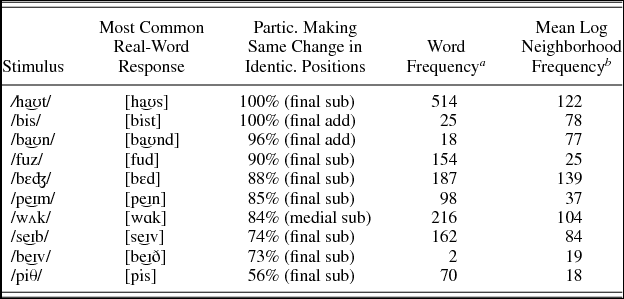
A third type of analysis considered the most frequent real-word responses to a particular nonword. This served to analyze consistency among participants in generating specific words for the same stimulus, as well as to examine potential effects of WF and NF. The 10 nonwords displayed in Table 2 had the greatest number of changes made to them in a specific word position. For example, 86% of all changes to the stimulus /h t/ involved a word-final substitution, and 100% of participants making this specific type of change produced the real word house. An entropy value was calculated for each stimulus, which refers to the number of different words generated by the group (range = 4–27). Using a median split, stimuli were designated as low-entropy items or high-entropy items. Consistent with Luce and Large (Reference Luce and Large2001), there was no significant effect of ND, t (68) = 0.56, p = .58, d = 0.13; there were nearly identical numbers of sparse and dense stimuli in each condition. There was also no effect of NF, t (68) = 1.44, p = .16, d = 0.34. However, an independent-samples t test revealed that significantly more changes were made to words with high entropy than with low entropy, t (68) = 2.32, p < .05, d = 0.55.
Most frequently produced real-word responses

aKucera and Francis (Reference Kucera and Francis1967).
bStorkel and Hoover (2010).
DISCUSSION
The goal of the present study was to explore how adults perceive phonological similarity relative to the traditional single-segmental metric. Variables of interest included the average number of changes made per nonword, types of changes made (substitutions, deletions, or additions), and where changes were made within the nonword (initial position, medial position, or final position). An additional goal of the study was to consider how the phonological composition of a word and other factors (e.g., WF or NF) might influence perceptual judgments of similarity. Results for the participant analysis will be discussed, followed by the item analysis.
Participant analysis
Consistent with Luce and Large (Reference Luce and Large2001), participants in the present study tended to create a neighbor for a target nonword by altering one segment. At the same time, approximately 20% of responses involved more than one segmental change. For example, in response to the stimulus /b v/, some participants produced [fvɹɪt]. This response resulted in making a total of four changes to the target (one substitution and three additions), including the epenthesis of a syllable. Other examples included [stup] for /ʃup/ (one substitution and one addition), [sɪft] for /sif/ (one substitution and one addition), and [θʌm] for /ðʌb/ (two substitutions). Note that the “neighbors” in the above examples are unaccounted for using the traditional operationalization of ND.
Participants in the present study ranged in their permissibility of phonological changes. Some participants applied a strict criterion of allowing only one segmental change to form a neighbor, which was observed in as many as 90% of their productions. Other participants, in contrast, made more than one sound change in a third of their responses. This reveals high variability between individuals regarding what is phonologically similar. Such discrepancies do not fit under the single-segmental metric of ND, which assumes similar perception among a group.
Regarding the types of changes made, as well as the word position in which the most changes occurred, word-final substitutions were the most common alteration. Given that substitutions accounted for nearly 80% of all changes, individuals in the current study relied mostly on substituting a single sound while retaining two existing sounds. Additions and deletions, which accounted for roughly 10% of total changes in the current study (and even fewer in Luce & Large, Reference Luce and Large2001), may not be ideal candidates because these productions could alter a target's syllable structure. In line with typical production, adults aim to match a target's phonological representation as closely as possible. Given the very low frequency of additions and deletions observed both in the present study and in prior work (Luce & Large, Reference Luce and Large2001), this calls into question whether or not these changes should even be factored into a measure of phonological similarity.
Perhaps the nature of the particular stimuli in the current study influenced which changes were allowed to form a neighbor. In order to consider this possibility, the types of changes possible for each stimulus revealed that while substitutions were the most frequent possibility to form a neighbor (75% of the time), there were ample opportunities to either delete a sound to form a neighbor (40% of the time) or add a sound to form a neighbor (30% of the time). This should have afforded participants ample opportunities to make these types of changes that would have resulted in higher percentages than currently found. The discrepancy of the types of possible changes across a set of stimuli may speak more to the structure of language itself, given that identical findings were found using a different set of stimuli (e.g., Luce & Large, Reference Luce and Large2001).
With respect to the finding that word-final substitutions were the most frequent change, this is consistent with Luce and Large (Reference Luce and Large2001). It is interesting that this contrasts with the notion of traditional rhyming. Rhyming consists of substituting the onset of a syllable while retaining the rime (e.g., /kæt/ /mæt/, /bæt/). Instead of retaining the rime and altering the onset, as children are taught to do during phonological development, participants in the present study altered the coda. One reason for this strategy may relate to serial position effects involving phonological processing. The last sound that a participant hears may be the most perceptually salient during a time-pressure task, and therefore the most ideal candidate to alter. This is consistent with recency effects observed in serial recall (e.g., Murdock, Reference Murdock1962). It remains possible that children and adults might use different strategies during a task similar to the one in the current study, with children relying more on word-initial substitutions. Further studies of this nature can help to explore this possibility.
Item analysis
Another purpose of the present study was to consider how phonological composition and other factors of a stimulus might influence perceptual judgments of phonological similarity. No significant differences emerged between sparse and dense words regarding the amount or types of changes made. At the same time, in a smaller analysis that examined only the words that underwent the greatest and least number of changes, participants made the least number of changes to dense nonwords. One explanation for this trend is that there are multiple available candidates that sound similar to these forms, such that more than one sound change becomes unnecessary. In contrast, sparse words, which are relatively dissimilar to real words, might require more than one sound change due to fewer items being available for immediate retrieval. For example, the sparse nonword /θæm/ (ND = 13) had more than 100 total changes made to it, while the dense nonword /tip/ (ND = 27) had half this amount, yet twice the number of neighbors. Perhaps such differences are only found during interactions between a word's ND and particular phonological compositions, which might also explain why overall findings did not emerge in the group analysis. Considering the above example, the initial and final sounds in /θæm/ only occur in two monosyllabic English words, /θʌm/ and /θim/, while the initial and final sounds in /tip/ occur in several monosyllabic English words (e.g., /tɑp/, /tp/, /tp/, /tp/, etc.).
In addition to ND, WF and NF also appeared to influence an individual's perceptual judgments. Upon analyzing the WFs of the most consistent real-word responses, the average WF was 145, with 70% of words containing WFs of greater than 50 (Kucera & Francis, Reference Kucera and Francis1967). Previous work has already explored the interaction between the area of WF and ND (Cluff & Luce, Reference Cluff and Luce1990). The WF of a word may even be more influential than ND, resulting in the selection of a less phonologically similar form simply due to its frequent occurrence in a language. For example, a third of participants responded to /nitʃ/ with [mit], altering two target segments but producing a word with high WF. Similarly, a quarter of participants responded to /hʃ/ with [hs]. There was also an effect of NF on the number of changes made to a nonword. Fewer changes were made to words with high NF than to those with low NF. Perhaps greater lexical activation levels for neighbors of nonwords with high NF that also happen to be phonologically similar to a target are the first to be selected. In contrast, neighbors of nonwords with low NF may have less lexical activation, and participants may therefore retrieve a less phonologically similar word. As a result, more changes might be observed in the responses.
Finally, significantly more changes were made to high-entropy items relative to low-entropy items. This suggests that if a nonword is capable of generating a wide variety of responses, such responses may not always conform to the traditional single-segmental metric of ND. This does not seem to be related to WF given that no effect of NF was found between low-entropy and high-entropy items. Instead, there appears to be greater flexibility in what is considered phonologically similar to a target item if it is prone to wide interindividual variation.
Alternative measure of ND
Beyond the current metric of ND that solely considers the phoneme as the basis of phonological similarity, another possibility might be considered. Instead of operationalizing ND at the phonemic level, perhaps features of target sounds and substituted sounds could be scored and matched on a number of dimensions. Note that such an analysis challenges the assumption mentioned in the introductory section that phonemes are equally different from one another. One analysis comparing the featural properties of two sounds (i.e., a target and a substitute) was proposed by Edwards, Beckman, and Munson (Reference Edwards, Beckman and Munson2004). This analysis is most appropriate for analyzing substitutions, which is suitable given the current results that 4/5 changes are substitutions. According to Edwards et al. (Reference Edwards, Beckman and Munson2004), each consonant in a participant's production is analyzed relative to a target phoneme on a 3-point scale: place of articulation, manner of articulation, and voicing. Each vowel is also coded for accuracy on a 3-point scale: dimension (front, middle, or back), height (high, mid, or low), and length (lax or tense). One point is awarded for each correct feature, thereby allowing each phoneme to receive a maximum of 3 points. If CVC stimuli are used in a study, as is typically the case with experiments of ND, participants can be awarded up to 9 points per production (3 phonemes × 3 points/phoneme). Such an analysis permits more than a single-segmental change, while still estimating a measure of phonological similarity. That is, instead of using a binary judgment to determine whether a production is similar or dissimilar to a target (i.e., a neighbor or not a neighbor), this analysis determines the degree of similarity. In the example provided in the introductory section of responding to /pis/ with [tiz], a participant would receive 2 points for target /p/, produced as [t] (1 point for correct voicing: voiceless; 0 points for correct place: bilabial; 1 point for correct manner: stop), 3 points for target /i/ (1 point for correct dimension: front; 1 point for correct height: high; 1 point for correct length: tense), and 2 points for target /s/, produced as [z] (0 points for correct voicing: voiceless; 1 point for correct manner: fricative; 1 point for correct place: alveolar) for a total of 7/9 points. Therefore, the response was 78% phonologically similar to the target, while the foil example, /ɛlɪfənt/, would be 0% phonologically similar. Note that using the traditional operationalization of ND, /pis/ and /tiz/ are considered to be phonologically dissimilar (i.e., not neighbors). Further work can explore if such a featural measure can adequately and appropriately capture phonological similarity. While this analysis is clearly appropriate for substitutions, sound changes such as deletions may be more challenging given a full 3-point penalty would be assigned. Given their very low occurrence, however, this again begs the question of whether additions and deletions should be factored into ND at all.
Limitations
While the current study explored the nature of phonological similarity using CVC stimuli, consistent with the majority of studies of this nature, there are tens of thousands of words in English that do not conform to this syllable structure. Kessler and Treiman (Reference Kessler and Treiman1997) estimated that 2,000 words in English are composed of CVC structures. Given that any metric of phonological similarity must adequately account for a word's neighbors, regardless of syllable structure, results of this study cannot be generalized to other syllable structures (e.g., consonant–consonant–vowel). As Vitevitch (Reference Vitevitch2008) reported, half of the most frequent and familiar words in English have no neighbors at all using the single-segmental metric. Hence, CVC stimuli, which are predominantly used in studies of ND, may not reliably and/or validly capture how phonological similarity is perceived in a language. Other stimuli to be considered include vowel–consonant, consonant–vowel, and consonant–vowel–consonant–consonant, which account for almost half of all conversational words in English (French, Carter, & Koenig, Reference French, Carter and Koenig1930).
An additional limitation of this study is that perception of phonological similarity was only tested in English. The operationalization of ND may differ between languages due to the particular phonotactics of a language. For example, while consonant–consonant–vowel–consonant is a permissible structure in English, this would be a violation in other languages. Future studies can explore if the traditional single-segmental metric of ND is sensitive to such cross-linguistic differences.
Future directions
It would be informative to conduct the task administered in the current study with both school-aged children and older adults. Such an experiment could investigate potential interactions between age and ND, given that prior work has shown ND differently influences children and adults. For example, one study found that adults learned novel dense words best (Storkel et al., Reference Storkel, Armbruster and Hogan2006), while another study reported sparse words best triggered the word learning process in children (Hoover, Storkel, & Hogan, Reference Hoover, Storkel and Hogan2010).
In addition, because the primary aim of the current study was to explore how individuals perceive phonological similarity, and not the speed of such processing, reaction times were not collected. It is possible that there might be an interaction between the speed of a response and the number of phonological changes made, as well as the word position in which changes are made. Such possibilities can be examined in further studies of this nature.
Finally, although the current study replicated the design of Luce and Large (Reference Luce and Large2001) and required only one response to a stimulus, future studies could elicit multiple responses. If participants are asked to provide two words, for example, positional changes may be observed such that word-initial changes become more prevalent due to recency effects.
Summary
The current study explored how typical adults perceive phonological similarity. Participants made roughly one change per word, generally supporting the single-segmental metric of ND. However, variability observed between participants suggests that individuals use different criteria when evaluating a word's neighbors. The majority of changes involved a substitution, particularly in word-final position. In addition, a trend was found that sparse nonwords and high-entropy words resulted in the greatest number of changes. Therefore, the number of neighbors for a given word and the response variety may also influence perceptions of phonological similarity. Finally, words with high WF were the most typical real-word responses to a nonword. Taken together, the results indicate that phonological similarity often involves more than a single-sound change, especially when considering other influences such as WF, NF, phonological composition, and a word's phonological resemblance to other items in the lexicon.
APPENDIX A
Stimuli
ACKNOWLEDGMENTS
Thanks to the participants in the study, Stefanie Spach for lending her voice to the project, and Anne Escobedo, Alexandra Fish, and Spencer Horchler for assistance with data analysis.