The coronavirus disease 2019 (COVID-19) pandemic has catalyzed great interest in the type and adequacy of room ventilation within hospitals. Some hospitals, for example, converted standard rooms to airborne infection isolation rooms (AIIRs) to accommodate COVID-19 surges.Reference Rhee, Baker and Vaidya1 Many also avoided placing patients with possible COVID-19 in positive-pressure rooms for fear of potentiating airborne transmission; indeed, some hospitals converted operating rooms to negative pressure.Reference Al-Benna2 Little is known, however, about the risk of long-range severe acute respiratory coronavirus virus 2 (SARS-CoV-2) transmission associated with positive-pressure rooms. We report transmission rates following inadvertent placement of a highly symptomatic patient with undiagnosed COVID-19 and a high viral load in a positive-pressure room.
Methods
Case summary
A patient with lymphoma on B-cell depleting therapy and a history of COVID-19 3 months prior was admitted to an outside hospital in April 2021 with progressive dyspnea. Computed tomography showed worsening ground-glass opacities compared to a restaging scan 10 days prior. Two nasopharyngeal swabs were negative for SARS-CoV-2 using polymerase chain reaction (PCR) on admission. Lung biopsy demonstrated organizing pneumonia. The patient was treated with high-dose steroids and initially improved but worsened 2 weeks later and required high-flow nasal cannula. He was transferred to the medical intensive care unit (MICU) at Brigham and Women’s Hospital (BWH) in Boston with a working diagnosis of organizing pneumonia and was placed in a positive-pressure room on standard precautions.
On arrival, the patient was tachypneic with a dry cough on high-flow nasal cannula (50 L per minute with 70% fraction of inspired oxygen). He did not wear a mask. A surveillance SARS-CoV-2 PCR nasal swab sent by the transferring hospital the day before transfer returned positive 16 hours after arrival at BWH. A repeat nasopharyngeal test (Cepheid Xpert, Sunnyvale, CA) confirmed active infection with a cycle threshold of 15. The patient was moved to an AIIR after 22 hours in positive pressure. The patient was diagnosed with recrudescent COVID-19 due to immunosuppression.
Setting and exposure definition
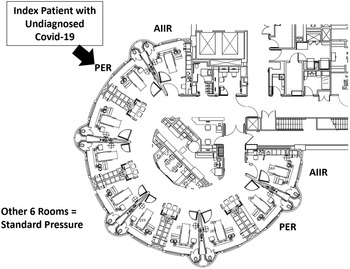
The BWH MICU unit is a circular pod with 10 single rooms, including 2 AIIRs with 12 air exchanges per hour, 2 protected environment rooms with positive pressure (12 air exchanges per hour), and 6 standard rooms (6 air exchanges per hour) (Fig. 1). Only the AIIRs have anterooms. Doors for non–COVID-19 patients typically remain open. Beds are arranged such that patients face the doors. The 2 AIIRs were occupied by patients with active COVID-19; 6 patients were in standard rooms and 1 patient was in the other positive-pressure room. A universal masking policy (with surgical masks) was in effect for staff. Standard precautions included eye protection for all patient encounters.
Configuration of the intensive care unit that housed the patient with undiagnosed COVID-19. Note. AIIR, airborne infection isolation room; PER, protected environment room (positive pressure).

All staff on the unit for ≥2 hours without wearing a respirator, staff who directly cared for the patient, and all non–COVID-19 patients on the unit were considered potentially exposed. Staff were contacted by occupational health staff and were advised to undergo serial PCR testing every 2–3 days. This study was performed under the auspices of hospital infection control operations but was approved by the Mass General Brigham Institutional Review Board.
Results
The 7 non–COVID-19 patients (2 of whom were fully vaccinated) were considered exposed; 4 were tested serially for at least ≥10 days after exposure, 1 was tested through day 8 then expired, and 2 were tested through day 5 then expired. All tested negative. In total, 52 healthcare workers were considered exposed, including 12 who directly cared for the patient. Among them, 32 (62%) were tested at least once ≥3 days after exposure, including 9 direct-care providers. All tested negative. The vaccination rate among hospital staff was 84%.
Discussion
The discovery of this patient with undiagnosed COVID-19 in a positive-pressure room triggered high concern for several reasons. First, the patient had a low PCR cycle threshold, indicating a high viral load, a factor strongly associated with transmission.Reference Marks, Millat-Martinez and Ouchi3,Reference Karan, Klompas, Tucker, Baker, Vaidya and Rhee4 Second, the patient was unmasked and required high-flow nasal cannula, which some guidelines and hospitals consider to be an aerosol-generating procedure. Although recent data have demonstrated that high-flow oxygen has very little effect on aerosol generation, it was an indicator of the severity of the patient’s respiratory symptoms including tachypnea and cough, two factors associated with increased aerosol generation.Reference Luo, Liu and Liao5,Reference Klompas, Baker and Rhee6 Third, the unit was circular with adjacent standard-pressure rooms with mostly open doors. Despite these factors, we did not identify any secondary transmission to patients or staff.
Most reports of long-range airborne SARS-CoV-2 transmission have occurred in nonhospital indoor settings with poor ventilation.Reference Hamner, Dubbel and Capron7–Reference Shen, Li and Dong9 One possible exception is a large cluster our hospital sustained in September 2020, during which our investigation uncovered that the room of the index patient had a positive pressure gradient relative to the nurse station.Reference Klompas, Baker and Rhee10 However, it was difficult to quantify the contribution of positive airflow in that cluster given the large number of staff and patients who had direct close contact with the index patient and other infected individuals.
We speculate that the lack of transmission in this case was due to the high rate of air changes in the patient’s room, which would have rapidly diluted aerosols; the protection afforded by distance from the source patient leading to further aerosol dilution; universal staff masking; and high vaccination rates.
Our analysis was limited by the focus on a single patient in a single unit, albeit one with many concerning circumstances, and incomplete testing of all staff on the unit. Nonetheless, this case study suggests that the risk of long-range SARS-CoV-2 transmission in hospitals may be low, even with highly infectious patients in positive-pressure rooms, in the setting of good ventilation, masking, and high staff vaccination rates.
Acknowledgments
Financial support
No financial support was provided relevant to this article.
Conflicts of interest
Drs. Rhee and Klompas report royalties from UpToDate, unrelated to this work. All other authors report no conflicts of interest relevant to this article.